

The DOI matches its Crossref record; 1 of the 1 references it cites were found in a registry or an index.
A cascade of sulfur transferases delivers sulfur to the sulfur-oxidizing heterodisulfide reductase-like complex
Open accessPreprint — published as 10.1002/pro.5014 · Paper page
Abstract
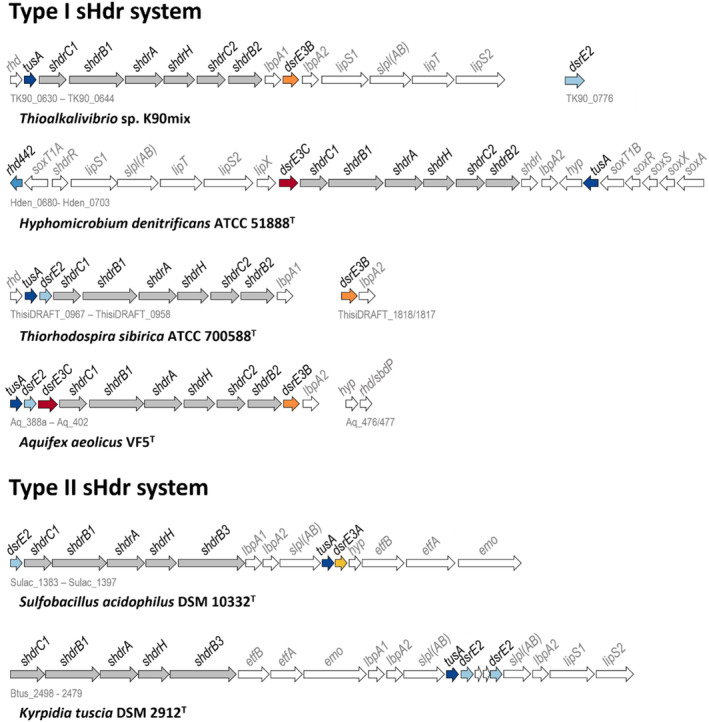
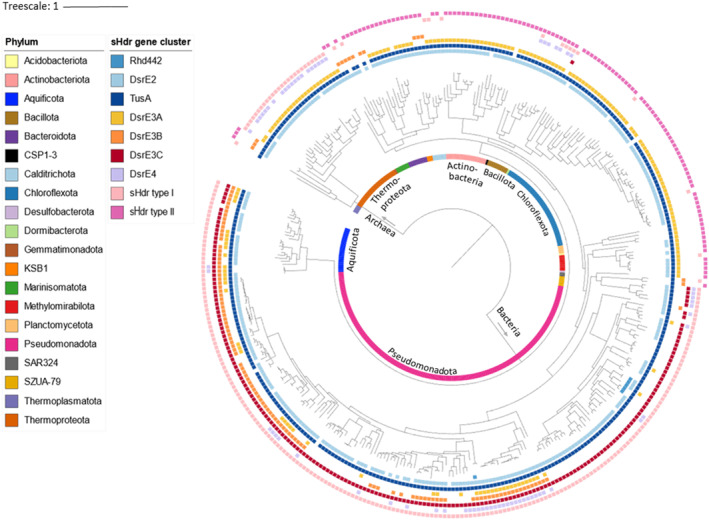
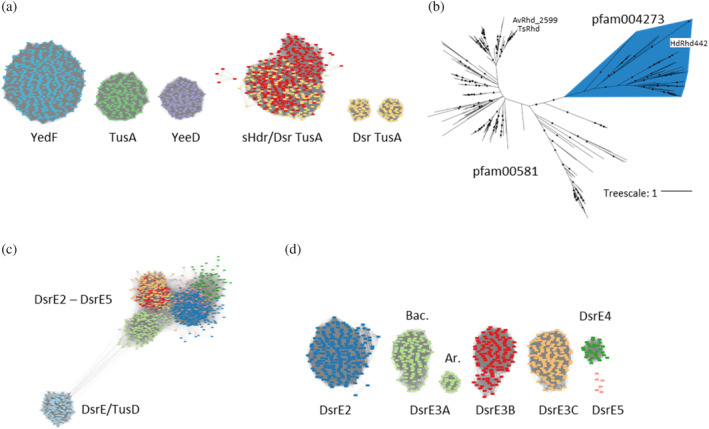
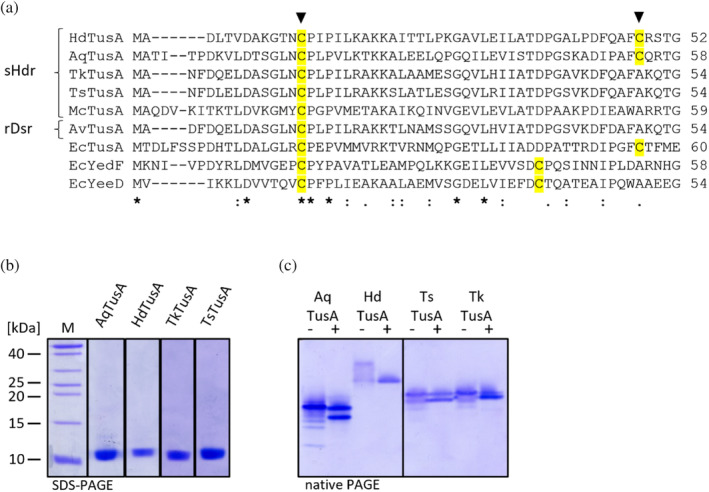
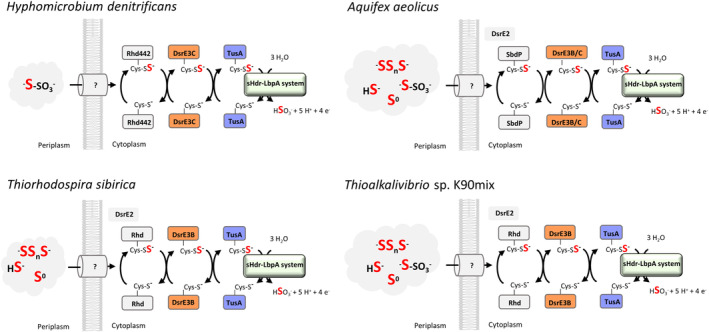
A heterodisulfide reductase-like complex (sHdr) and novel lipoate-binding proteins (LbpAs) are central players of a wide-spread pathway of dissimilatory sulfur oxidation. Bioinformatic analysis demonstrate that the cytoplasmic sHdr-LbpA systems are always accompanied by sets of sulfur transferases (DsrE proteins, TusA, rhodaneses). The exact composition of these sets may vary depending on the organism and sHdr system type. To enable generalizations, we studied model sulfur oxidizers from distant bacterial phyla, i.e. Aquificota and Pseudomonadota. DsrE3C of the chemoorganotrophic Alphaproteobacterium Hyphomicrobium denitrificans and DsrE3B from the Gammaproteobacteria Thioalkalivibrio sp. K90mix, an obligate chemolithotroph, and Thiorhodospira sibirica , an obligate photolithotroph, are homotrimers that donate sulfur to TusA. Additionally, the hyphomicrobial rhodanese-like protein Rhd442 exchanges sulfur with both TusA and DsrE3C. The latter is essential for sulfur oxidation in Hm. denitrificans . TusA from Aquifex aeolicus (AqTusA) interacts physiologically with AqDsrE, AqLbpA and AqsHdr proteins. This is particularly significant as it establishes a direct link between sulfur transferases and the sHdr-LbpA complex that oxidizes sulfane sulfur to sulfite. In vivo, it is unlikely that there is a strict unidirectional transfer between the sulfur-binding enzymes studied. Rather, the sulfur transferases form a network, each with a pool of bound sulfur. Sulfur flux can then be shifted in one direction or the other depending on metabolic requirements. A single pair of sulfur-binding proteins with a preferred transfer direction, such as a DsrE3-type protein towards TusA, may be sufficient to push sulfur into the sink where it is further metabolized or needed. SIGNIFICANCE STATEMENT: A network of bacterial sulfur transferases is uncovered and characterized that ultimately delivers sulfur to a complex cytoplasmic sulfur-oxidizing metalloenzyme, sHdr, that resembles heterodisulfide reductase from methanogenic archaea and interacts with lipoate-binding proteins. Similar sets of sulfur transferases occur in phylogenetically distant bacteria, underscoring the fundamental importance of the work.
Overview
The claims and statistics of this paper haven’t been checked yet.
Run the check — free, no account needed. It reads the open-access text and checks the sources it cites.
Integrity signals
Registry
Cites
Statistics
Figures
Verification
Claims the paper makes
The claims and statistics of this paper haven’t been checked yet.
Run the check — free, no account needed. It reads the open-access text and checks the sources it cites.
Self-check
Percentages, sums and reported differences re-computed from the paper’s own numbers.
The self-check needs the paper’s full text.
Citations
Cites
Highly accurate protein structure prediction with AlphaFold
Jumper, J., Evans, R., Pritzel, A., Green, T., Figurnov, M., Ronneberger, O., Tunyasuvunakool, K., Bates, R., Žídek, A., Potapenko, A., et al. (2021) · Nature · doi:10.1038/s41586-021-03819-2 · Cited by 43,764
Research works printed but not linked: 68
- 10.1016/bs.ampbs.2019.07.004 · DOI
- 10.1002/iub.1371 · DOI
- 10.1038/nchembio779 · DOI · Paper page
- 10.1111/j.1574-6976.2006.00036.x · DOI
- 2020, On H2S prodrugs, Antioxid Redox Signal, 33, 999, 10.1089/ars.2020.8078 · DOI
- Dahl C. A biochemical view on the biological sulfur cycle. In: Lens P , Ed. (2020) Environmental technologies to treat sulfur pollution: principles and engineering. IWA Publishing, London, pp. 55–96. · DOI
- -. Sulfur metabolism in phototrophic bacteria. In: Hallenbeck PC , Ed. (2017) Modern topics in the phototrophic prokaryotes: Metabolism, bioenergetics and omics. Springer International Publishing, Cham, pp. 27–66. · DOI
- 10.1074/jbc.M113.536425 · DOI
- 10.1371/journal.pone.0040785 · DOI
- 10.1016/j.jmb.2008.10.016 · DOI
- 2018, Lipoate-binding proteins and specific lipoate-protein ligases in microbial sulfur oxidation reveal an atypical role for an old cofactor, eLife, 7, e37439, 10.7554/eLife.37439 · DOI
- 10.1038/s41396-018-0209-7 · DOI
- 2023, Identification of a novel lipoic acid biosynthesis pathway reveals the complex evolution of lipoate assembly in prokaryotes, PLos Biol, 21, e3002177, 10.1371/journal.pbio.3002177 · DOI
- 10.1186/1471-2164-15-1107 · DOI
- 10.1074/jbc.M114.591669 · DOI
- 10.1093/femsle/fnw156 · DOI
- Kümpel C , Grosser M , Tanabe TS , Dahl C (2023) Fe/S proteins in microbial sulfur oxidation. Biochimica et Biophysica Acta (BBA) - Molecular Cell Research submitted. · DOI
- 2021, Structural and spectroscopic characterization of a HdrA-like subunit from Hyphomicrobium denitrificans, FEBS J, 288, 1664, 10.1111/febs.15505 · DOI
- 2020, The rise of diversity in metabolic platforms across the Candidate Phyla Radiation, BMC Biology, 18, 69, 10.1186/s12915-020-00804-5 · DOI
- 10.1186/2049-2618-1-22 · DOI
- 2023, HMSS2: an advanced tool for the analysis of sulfur metabolism, including organosulfur compound transformation, in genome and metagenome assemblies, Mol Ecol Resour, 23, 1930, 10.1111/1755-0998.13848 · DOI
- 10.1099/00221287-142-4-775 · DOI
- 10.1128/aem.03098-16 · DOI
- 2019, Genomes of neutrophilic sulfur-oxidizing chemolithoautotrophs representing 9 proteobacterial species from 8 genera, Front Microbiol, 10, 316, 10.3389/fmicb.2019.00316 · DOI
- 10.1371/journal.pone.0004345 · DOI · Paper page
- 10.1074/jbc.M112.431569 · DOI
- 10.1016/j.molcel.2005.11.001 · DOI · Paper page
- 10.1271/bbb.64.799 · DOI
- Yildiz T , Leimkühler S (2021) TusA is a versatile protein that links translation efficiency to cell division in Escherichia coli . J Bacteriol 203. · DOI
- 10.1126/sciadv.aba7637 · DOI
- 2017, First insights into the pleiotropic role of vrf (yedF), a newly characterized gene of Salmonella Typhimurium, Sci Rep, 7, 15291, 10.1038/s41598-017-15369-7 · DOI
- 1973, Rhodanese, Advances in Enzymology and Related Areas of Molecular Biology, 39, 327
- 10.1093/embo-reports/kvf150 · DOI · Paper page
- 10.1074/jbc.M111.324863 · DOI
- 2022, HMS-S-S: a tool for the identification of sulphur metabolism-related genes and analysis of operon structures in genome and metagenome assemblies, Mol Ecol Resour, 22, 2758, 10.1111/1755-0998.13642 · DOI
- 10.1371/journal.pbio.1000354 · DOI · Paper page
- 10.1038/32831 · DOI
- 10.1111/1462-2920.13511 · DOI
- 2022, Rhodaneses minimize the accumulation of cellular sulfane sulfur to avoid disulfide stress during sulfide oxidation in bacteria, Redox Biology, 53, 102345, 10.1016/j.redox.2022.102345 · DOI
- 10.1002/prot.21314 · DOI
- 10.1128/JB.182.8.2277-2284.2000 · DOI
- 10.1006/abio.1998.2990 · DOI
- 2023, A metabolic puzzle: consumption of C1 compounds and thiosulfate in Hyphomicrobium denitrificans XT, Biochim Biophys Acta Bioenerget, 1864, 148932, 10.1016/j.bbabio.2022.148932 · DOI
- 2023, Carbon fixation in the chemolithoautotrophic bacterium Aquifex aeolicus involves two low-potential ferredoxins as partners of the PFOR and OGOR enzymes, Life, 13, 627, 10.3390/life13030627 · DOI
- 10.4056/sigs.2315092 · DOI
- 10.1099/00207713-49-2-697 · DOI
- Hallgren J , Tsirigos KD , Pedersen MD , Almagro Armenteros JJ , Marcatili P , Nielsen H , Krogh A , Winther O (2022) DeepTMHMM predicts alpha and beta transmembrane proteins using deep neural networks. bioRxiv. · DOI · Paper page
- 2023, Stepwise pathway for early evolutionary assembly of dissimilatory sulfite and sulfate reduction, ISME J, 17, 1680, 10.1038/s41396-023-01477-y · DOI · Paper page
- 2020, Sulfite oxidation by the quinone-reducing molybdenum sulfite dehydrogenase SoeABC from the bacterium Aquifex aeolicus, Biochim Biophys Acta Bioenerg, 1861, 148279, 10.1016/j.bbabio.2020.148279 · DOI
- 2023, In the Alphaproteobacterium Hyphomicrobium denitrificans SoxR serves as a sulfane sulfur-responsive repressor of sulfur oxidation, Antioxidants, 12, 1620, 10.3390/antiox12081620 · DOI
- 10.1128/JB.186.3.595-600.2004 · DOI · Paper page
- Ausubel FA , Brent R , Kingston RE , Moore DD , Seidman JG , Smith JA , Struhl K . 1997. Current protocols in molecular biology, John Wiley & Sons, New York.
- 10.1099/13500872-142-12-3363 · DOI
- 10.1021/pr8007946 · DOI
- 10.1016/0039-9140(72)80240-6 · DOI
- 10.1186/1471-2105-11-119 · DOI · Paper page
- 10.1093/nar/gkaa1105 · DOI · Paper page
- 10.1093/NAR/GKAA913 · DOI · Paper page
- 10.1093/molbev/mst010 · DOI · Paper page
- 10.1186/1471-2148-10-210 · DOI · Paper page
- 10.1093/molbev/msu300 · DOI · Paper page
- 10.1038/nmeth.4285 · DOI · Paper page
- 10.1093/sysbio/syq010 · DOI · Paper page
- 10.1093/sysbio/syr041 · DOI · Paper page
- 10.1093/molbev/msx281 · DOI · Paper page
- 10.1093/NAR/GKAB301 · DOI · Paper page
- 10.1038/nbt.3988 · DOI · Paper page
- 10.1093/bioinformatics/bty1057 · DOI · Paper page
Metadata
- Authors
- Tanabe, T. S., Bach, E., D’Ermo, G., Mohr, M. G., Hager, N., Pfeiffer, N., Guiral, M., & Dahl, C.
- Affiliations
- University of Vienna (AT)
- University of Bonn (DE)
- Centre National de la Recherche Scientifique (FR)
- Corresponding author
- Dahl, Christiane
- ORCID
- Venue
- Protein Science
- Publisher
- openRxiv
- Published
- 2023-12-18
- Volume
- 33
- Issue
- 6
- Pages
- e5014-e5014
- ISSN
- 0961-8368 (ISSN-L)
- PMC
- PMC11094781
- OpenAlex
- W4396937845
- Cited by
- 9
- References
- 1
- Citations by year
- 2026: 4 · 2025: 3 · 2024: 2
- FWCI
- 0.60
- Type
- journal article
- Language
- en
- Open access
- hybrid
- doi.org
- Licence
- cc-by-nc
- Locations
- Protein Science (publishedVersion, cc-by-nc)
- bioRxiv (Cold Spring Harbor Laboratory) (acceptedVersion, cc-by-nc-nd)
- PubMed Central (publishedVersion, cc-by-nc)
- PubMed (publishedVersion)
- HAL (submittedVersion, cc-by-nc)
- bonndoc (University of Bonn) (submittedVersion)
- bonndoc (University of Bonn)
- Funders
- Deutscher Akademischer Austauschdienst (57388731, 40444VM)
- Deutsche Forschungsgemeinschaft (351/13‐1)
- Studienstiftung des Deutschen Volkes
- Topics
- Life Sciences › Biochemistry, Genetics and Molecular Biology › Biochemistry › Metalloenzymes and iron-sulfur proteins
- Physical Sciences › Materials Science › Metals and Alloys › Metal Extraction and Bioleaching
- Life Sciences › Biochemistry, Genetics and Molecular Biology › Molecular Biology › Microbial metabolism and enzyme function
- Keywords
- Tusa, rhodanese, sulfur fluxes, sulfane sulfur, sulfite, Thioalkalivibrio, Aquifex aeolicus
- MeSH terms
- Bacterial Proteins, Oxidation-Reduction, Oxidoreductases, Sulfur, Sulfurtransferases
About these checks
Registry, retraction, Cites and statistics results are computed, not judged, with one exception: a printed reference that no index lists is read once by a model before it counts as a citation error. Claims are extracted by a model and kept only when their quote appears verbatim in the text; each cited source is then checked, with a model’s help, for whether it says what the claim relies on. Those verdicts can be wrong — read the claim’s quote and the cited source before relying on one.
Statistics and arithmetic are recomputed, not judged.
Confidence bands are shown only for fields calibrated on our annotated test set. None is calibrated yet, so no band is shown.
What counts as a claim ›How we measure confidence ›How we check this ›
Are you an author, or do you see a problem with this page? Request a review
Data sources
Bibliographic data: Semantic Scholar, OpenAlex, Crossref.
Contains information from the Semantic Scholar Academic Graph Datasets, made available under the ODC Attribution License (ODC-BY 1.0).
Semantic Scholar’s data is described in: Kinney, R., et al. (2023). The Semantic Scholar Open Data Platform. arXiv:2301.10140.
