

The DOI matches its Crossref record; 2 of the 2 references it cites were found in a registry or an index.
Hydrodynamic Radii of Intrinsically Disordered Proteins: Fast Prediction by Minimum Dissipation Approximation and Experimental Validation
Open accessPreprint — published as 10.1021/acs.jpclett.4c00312 · Paper page
Abstract
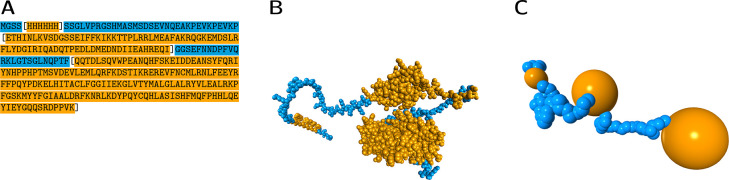
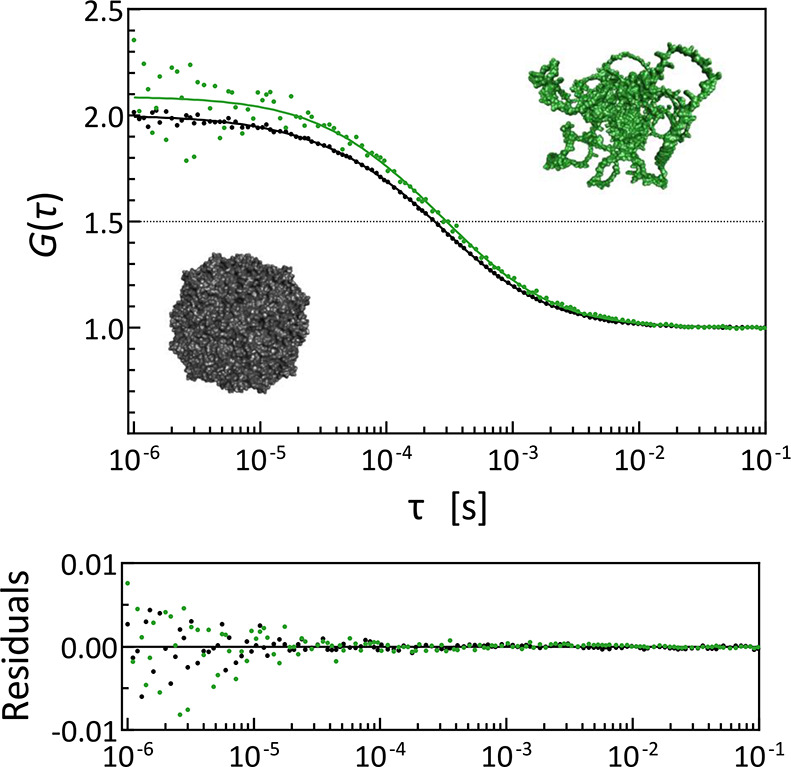
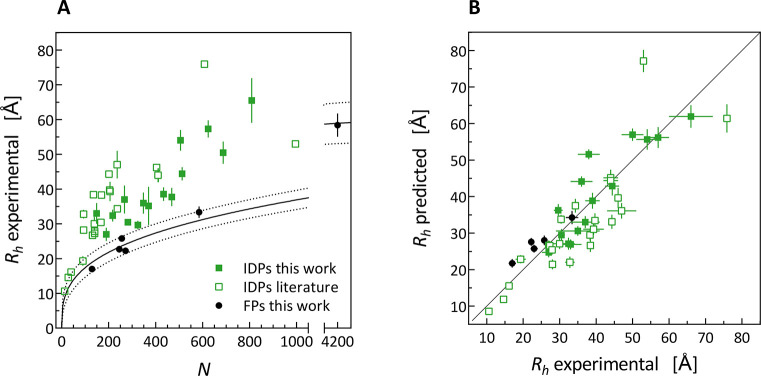
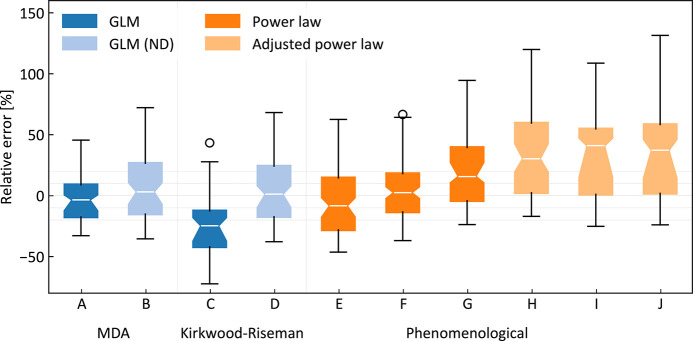
The diffusion coefficients of globular and fully unfolded proteins can be predicted with high accuracy solely from their mass or chain length. However, this approach fails for intrinsically disordered proteins (IDPs) containing structural domains. We propose a rapid predictive methodology for estimating the diffusion coefficients of IDPs. The methodology uses accelerated conformational sampling based on self-avoiding random walks and includes hydrodynamic interactions between coarse-grained protein subunits, modeled using the generalized Rotne-Prager-Yamakawa approximation. To estimate the hydrodynamic radius, we rely on the minimum dissipation approximation recently introduced by Cichocki et al . Using a large set of experimentally measured hydrodynamic radii of IDPs over a wide range of chain lengths and domain contributions, we demonstrate that our predictions are more accurate than the Kirkwood approximation and phenomenological approaches. Our technique may prove valuable in predicting the hydrodynamic properties of both fully unstructured and multidomain disordered proteins. TOC Graphic:
Overview
The claims and statistics of this paper haven’t been checked yet.
Run the check — free, no account needed. It reads the open-access text and checks the sources it cites.
Integrity signals
Registry
Cites
Statistics
Figures
Verification
Claims the paper makes
The claims and statistics of this paper haven’t been checked yet.
Run the check — free, no account needed. It reads the open-access text and checks the sources it cites.
Self-check
Percentages, sums and reported differences re-computed from the paper’s own numbers.
The self-check needs the paper’s full text.
Citations
Cites
Highly accurate protein structure prediction with AlphaFold
Jumper, J., Evans, R., Pritzel, A., Green, T., Figurnov, M., Ronneberger, O., Tunyasuvunakool, K., Bates, R., Žídek, A., Potapenko, A., et al. (2021) · Nature · doi:10.1038/s41586-021-03819-2 · Cited by 43,764
AlphaFold and Implications for Intrinsically Disordered Proteins
Ruff, K. M., & Pappu, R. V. (2021) · Journal of Molecular Biology · doi:10.1016/j.jmb.2021.167208 · Cited by 635
Research works printed but not linked: 104
- 10.1146/annurev-biochem-072711-164947 · DOI · Paper page
- 10.1038/nrm3920 · DOI
- 10.1016/j.jmb.2004.02.002 · DOI
- 10.1016/j.sbi.2020.12.012 · DOI
- 10.1007/s10930-009-9201-4 · DOI
- 2014, Temperature effects on the hydrodynamic radius of the intrinsically disordered N-terminal region of the p53 protein, Proteins: Structure, Function, and Bioinformatics, 82, 668, 10.1002/prot.24449 · DOI
- 10.1073/pnas.1001743107 · DOI
- 2021, Salt-dependent conformational changes of intrinsically disordered proteins, The Journal of Physical Chemistry Letters, 12, 6684, 10.1021/acs.jpclett.1c01607 · DOI
- 2020, Revealing the hidden sensitivity of intrinsically disordered proteins to their chemical environment, The Journal of Physical Chemistry Letters, 11, 10131, 10.1021/acs.jpclett.0c02822 · DOI
- 2012, Disordered protein diffusion under crowded conditions, The Journal of Physical Chemistry Letters, 3, 2703, 10.1021/jz3010915 · DOI
- 10.1038/nature13999 · DOI
- 10.1073/pnas.1904997116 · DOI
- 10.1038/nature25762 · DOI · Paper page
- 2020, Orchestration of signaling by structural disorder in class 1 cytokine receptors, Cell Communication and Signaling, 18, 1
- Evans, J. S . The biomineralization proteome: protein complexity for a complex bioceramic assembly process. Proteomics 2019, 19, 1900036. · DOI
- 10.1073/pnas.1814051115 · DOI
- 10.1021/bi972494r · DOI
- 10.1002/pro.5560070720 · DOI
- 10.1101/gad.912401 · DOI · Paper page
- 10.1016/j.cell.2018.02.051 · DOI
- 2018, Structural dynamics of the GW182 silencing domain including its RNA recognition motif (RRM) revealed by hydrogen-deuterium exchange mass spectrometry, Journal of The American Society for Mass Spectrometry, 29, 158, 10.1007/s13361-017-1830-9 · DOI
- Raisch, T. ; Valkov, E . Regulation of the multisubunit CCR4-NOT deadenylase in the initiation of mRNA degradation. Current Opinion in Structural Biology 2022, 77, 102460. · DOI
- Louros, N. ; Schymkowitz, J. ; Rousseau, F . Mechanisms and pathology of protein misfolding and aggregation. Nature Reviews Molecular Cell Biology 2023, 1–22. · DOI
- Chakraborty, P. ; Zweckstetter, M . Role of aberrant phase separation in pathological protein aggregation. Current Opinion in Structural Biology 2023, 82, 102678. · DOI
- 10.1016/j.cell.2016.06.010 · DOI
- 10.1261/rna.079026.121 · DOI
- 2023, Diversity of hydrodynamic radii of intrinsically disordered proteins, European Biophysics Journal, 52, 607, 10.1007/s00249-023-01683-8 · DOI · Paper page
- 10.1016/j.bpj.2017.06.042 · DOI
- 10.1016/j.bpj.2022.12.013 · DOI
- 2016, Hydrodynamic radii of intrinsically disordered proteins determined from experimental polyproline II propensities, PLoS Computational Biology, 12, e1004686, 10.1371/journal.pcbi.1004686 · DOI
- 2017, Intrinsic α helix propensities compact hydrodynamic radii in intrinsically disordered proteins, Proteins: Structure, Function, and Bioinformatics, 85, 296, 10.1002/prot.25222 · DOI
- 10.1073/pnas.0911107107 · DOI
- 10.1016/j.str.2010.10.006 · DOI
- 10.1093/bioinformatics/bts172 · DOI
- 2013, Structural ensemble of an intrinsically disordered polypeptide, The Journal of Physical Chemistry B, 117, 118, 10.1021/jp308984e · DOI
- 10.1016/j.jmb.2018.05.012 · DOI · Paper page
- 2018, Looking at the disordered proteins through the computational microscope, ACS Central Science, 4, 534, 10.1021/acscentsci.7b00626 · DOI
- 10.1016/j.str.2018.10.016 · DOI
- 2019, Sequence effects on size, shape, and structural heterogeneity in intrinsically disordered proteins, The Journal of Physical Chemistry B, 123, 3462, 10.1021/acs.jpcb.9b02575 · DOI
- 2020, Hydrodynamic properties of biomacromolecules and macromolecular complexes: concepts and methods. A tutorial mini-review, Journal of Molecular Biology, 432, 2930, 10.1016/j.jmb.2019.12.027 · DOI
- 10.1021/jacs.0c02088 · DOI
- 10.1021/ma60075a022 · DOI
- 1982, Sedimentation of asymmetric elastic dumbbells and the rigid-body approximation in the hydrodynamics of chains, Macromolecules, 15, 520, 10.1021/ma00230a059 · DOI
- 2012, Translational diffusion coefficients of macromolecules, Eururopean Physical Journal E, 35, 130, 10.1140/epje/i2012-12130-x · DOI
- de la Torre, J. G. Analytical Ultracentrifugation. Instrumentation, Software, and Applications; Springer, 2016; pp 195–217. · DOI
- 1981, Inclusion of hydrodynamic interaction in polymer dynamical simulations, Macromolecules, 14, 1710, 10.1021/ma50007a019 · DOI
- 1983, Variational bounds for polymer transport coefficients, Journal of Chemical Physics, 78, 1588, 10.1063/1.444849 · DOI
- Cichocki, B. ; Ekiel-Jeżewska, M. L. ; Wajnryb, E . Communication: Translational Brownian motion for particles of arbitrary shape. Journal of Chemical Physics 2012, 136. · DOI
- 1982, Bead models of segmentally flexible macromolecules, Journal of Chemical Physics, 76, 6425, 10.1063/1.442999 · DOI
- 1983, Hydrodynamic resistance and diffusion coefficients of segmentally flexible macromolecules with two subunits, Journal of Chemical Physics, 78, 2081, 10.1063/1.444917 · DOI
- 1985, Center of diffusion of flexible macromolecules, Macromolecules, 18, 2522, 10.1021/ma00154a029 · DOI
- Cichocki, B. ; Rubin, M. ; Niedzwiecka, A. ; Szymczak, P . Diffusion coefficients of elastic macromolecules. Journal of Fluid Mechanics 2019, 878, R3. · DOI
- 10.1038/347631a0 · DOI
- Doi, M. ; Edwards, S. F. The Theory of Polymer Dynamics; Oxford University Press, 1988; Vol. 73.
- 1999, The kinetic theory of dilute solutions of flexible polymers: Hydrodynamic interaction, Rheology Series, 8, 467, 10.1016/S0169-3107(99)80039-2 · DOI
- Szymczak, P. ; Cieplak, M . Hydrodynamic effects in proteins. Journal of Physics: Condensed Matter 2011, 23, 033102. · DOI
- Skolnick, J . Perspective: On the importance of hydrodynamic interactions in the subcellular dynamics of macromolecules. The Journal of Chemical Physics 2016, 145. · DOI
- Frenkel, D. ; Smit, B. Understanding molecular simulation: from algorithms to applications; Elsevier, 2001; Vol. 1.
- 10.1063/1.1699180 · DOI · Paper page
- 10.1063/1.1742462 · DOI
- 10.1063/1.1746947 · DOI
- 10.1016/S1359-0278(98)00016-9 · DOI
- 10.1093/bioinformatics/btu744 · DOI
- 2013, How long is a piece of loop?, PeerJ, 1, e1, 10.7717/peerj.1 · DOI
- 10.1021/ja01118a065 · DOI
- Zuk, P. ; Wajnryb, E. ; Mizerski, K. ; Szymczak, P . Rotne–Prager–Yamakawa approximation for different-sized particles in application to macromolecular bead models. Journal of Fluid Mechanics 2014, 741, R5. · DOI
- 1970, The motion of long slender bodies in a viscous fluid Part 1. General theory, Journal of Fluid Mechanics, 44, 791, 10.1017/S002211207000215X · DOI
- 1979, Hydromechanics of low-Reynolds-number flow. Part 5. Motion of a slender torus, Journal of Fluid Mechanics, 95, 263, 10.1017/S0022112079001464 · DOI
- 1977, On axisymmetric stokes flow past a torus, Zeitschrift für Angewandte Mathematik und Physik ZAMP, 28, 541, 10.1007/BF01601334 · DOI
- Waszkiewicz, R. ; Szymczak, P. ; Lisicki, M . Stability of sedimenting flexible loops. Journal of Fluid Mechanics 2021, 919, A14. · DOI
- 10.1002/pol.1954.120120102 · DOI
- 2003, Translational diffusion of polymer chains with excluded volume and hydrodynamic interactions by Brownian dynamics simulation, Journal of Chemical Physics, 118, 8061, 10.1063/1.1564047 · DOI
- 2023, Effects of Sequence Composition, Patterning and Hydrodynamics on the Conformation and Dynamics of Intrinsically Disordered Proteins, International Journal of Molecular Sciences, 24, 1444, 10.3390/ijms24021444 · DOI
- Kim, S. ; Karrila, S. J. Microhydrodynamics: Principles and Selected Applications; Butterworth-Heinemann: London, 1991. · DOI
- 1982, Many-sphere hydrodynamic interactions and mobilities in a suspension, Physica A, 115, 21, 10.1016/0378-4371(82)90127-3 · DOI
- 1994, Friction and mobility of many spheres in Stokes flow, Journal of Chemical Physics, 100, 3780, 10.1063/1.466366 · DOI
- 10.1063/1.1670977 · DOI
- 1970, Transport properties of polymer chains in dilute solution: Hydrodynamic interaction, Jorunal of Chemical Physics, 53, 436
- 2018, GRPY: An Accurate Bead Method for Calculation of Hydrodynamic Properties of Rigid Biomacromolecules, Biophysical Journal, 115, 782, 10.1016/j.bpj.2018.07.015 · DOI
- Waszkiewicz, R. ; Bartczak, M. ; Kolasa, K. ; Lisicki, M. Pychastic: Precise Brownian dynamics using Taylor-Itō integrators in Python. SciPost Physics Codebases 2023, 11. · DOI
- 10.1016/j.jinorgbio.2012.02.031 · DOI
- 10.1139/o85-102 · DOI
- 2000, The anticodon-binding domain of tyrosyl-tRNA synthetase: state of folding and origin of the crystallographic disorder, Biochemistry, 39, 1739, 10.1021/bi992382v · DOI
- 10.1021/bi0019545 · DOI
- 10.1002/mrc.1132 · DOI
- 10.1006/viro.2001.1296 · DOI
- 10.1074/jbc.M300518200 · DOI
- 10.1110/ps.051368005 · DOI
- 10.1016/j.molcel.2004.11.019 · DOI
- 10.1021/pr070237v · DOI
- 10.1016/j.jmb.2008.03.039 · DOI
- 10.1073/pnas.0809222105 · DOI
- 10.1529/biophysj.107.126995 · DOI
- 10.1371/journal.pone.0011684 · DOI
- 10.1016/j.str.2011.01.011 · DOI
- 2014, Alanine and proline content modulate global sensitivity to discrete perturbations in disordered proteins, Proteins: Structure, Function, and Bioinformatics, 82, 3373, 10.1002/prot.24692 · DOI
- 10.1016/j.jmb.2016.11.017 · DOI
- 2017, Structural properties of the intrinsically disordered, multiple calcium ion-binding otolith matrix macromolecule-64 (OMM-64), Biochimica et Biophysica Acta (BBA)-Proteins and Proteomics, 1865, 1358, 10.1016/j.bbapap.2017.08.019 · DOI
- 2019, The intrinsically disordered C-terminal F domain of the ecdysteroid receptor from Aedes aegypti exhibits metal ion-binding ability, The Journal of Steroid Biochemistry and Molecular Biology, 186, 42, 10.1016/j.jsbmb.2018.09.008 · DOI
- 10.1016/j.bpj.2010.02.006 · DOI
- Le Guillou, J. ; Zinn-Justin, J . Critical exponents for the n-vector model in three dimensions from field theory. Physical Review Letters 1977, 39, 95. · DOI
- 10.1016/j.str.2005.04.009 · DOI
- Philo, J. S . SEDNTERP: a calculation and database utility to aid interpretation of analytical ultracentrifugation and light scattering data. European Biophysics Journal 2023, 1–34.
- 10.1021/bi991765q · DOI
Metadata
- Authors
- Waszkiewicz, R., Michaś, A., Białobrzewski, M. K., Klepka, B. P., Cieplak-Rotowska, M. K., Staszałek, Z., Cichocki, B., Lisicki, M., Szymczak, P., & Niedzwiecka, A.
- Affiliations
- University of Warsaw (PL)
- Institute of Physics (PL)
- Corresponding author
- Szymczak, Piotr
- ORCID
- Venue
- The Journal of Physical Chemistry Letters
- Publisher
- openRxiv
- Published
- 2024-02-08
- Volume
- 15
- Issue
- 19
- Pages
- 5024-5033
- ISSN
- 1948-7185 (ISSN-L)
- PMC
- PMC11103702
- OpenAlex
- W4396593132
- Cited by
- 16
- References
- 2
- Citations by year
- 2026: 4 · 2025: 10 · 2024: 2
- FWCI
- 2.18
- Type
- journal article
- Language
- en
- Open access
- hybrid
- doi.org
- Licence
- cc-by
- Locations
- The Journal of Physical Chemistry Letters (publishedVersion, cc-by)
- bioRxiv (Cold Spring Harbor Laboratory) (acceptedVersion, cc-by-nc)
- PubMed Central (publishedVersion, cc-by)
- PubMed (publishedVersion)
- Funders
- European Commission (POIG.02.02.00-00-025/09)
- Narodowe Centrum Nauki (2018/31/D/ST3/02408, 2016/22/E/NZ1/00656)
- Uniwersytet Warszawski
- European Regional Development Fund (POIG.02.02.00-00- 025/09)
- Topics
- Life Sciences › Biochemistry, Genetics and Molecular Biology › Molecular Biology › Protein Structure and Dynamics
- Physical Sciences › Chemistry › Physical and Theoretical Chemistry › Advanced Physical and Chemical Molecular Interactions
- Physical Sciences › Mathematics › Modeling and Simulation › Fractional Differential Equations Solutions
- Keywords
- intrinsically disordered proteins, hydrodynamic radius, diffusion coefficient prediction, hydrodynamic interactions, self-avoiding walks, conformational sampling
- MeSH terms
- Diffusion, Protein Conformation, Hydrodynamics, Intrinsically Disordered Proteins
About these checks
Registry, retraction, Cites and statistics results are computed, not judged, with one exception: a printed reference that no index lists is read once by a model before it counts as a citation error. Claims are extracted by a model and kept only when their quote appears verbatim in the text; each cited source is then checked, with a model’s help, for whether it says what the claim relies on. Those verdicts can be wrong — read the claim’s quote and the cited source before relying on one.
Statistics and arithmetic are recomputed, not judged.
Confidence bands are shown only for fields calibrated on our annotated test set. None is calibrated yet, so no band is shown.
What counts as a claim ›How we measure confidence ›How we check this ›
Are you an author, or do you see a problem with this page? Request a review
