

The DOI matches its Crossref record; 2 of the 2 references it cites were found in a registry or an index.
Pooled PPIseq: screening the SARS-CoV-2 and human interface with a scalable multiplexed protein-protein interaction assay platform
Open accessPreprint — published as 10.1371/journal.pone.0299440
Abstract
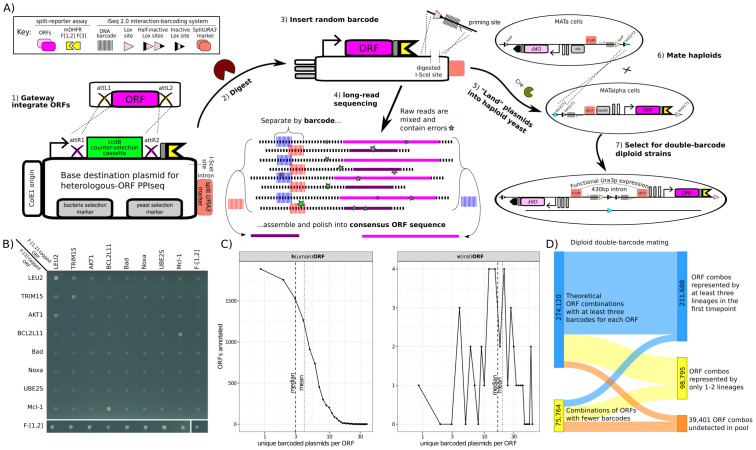
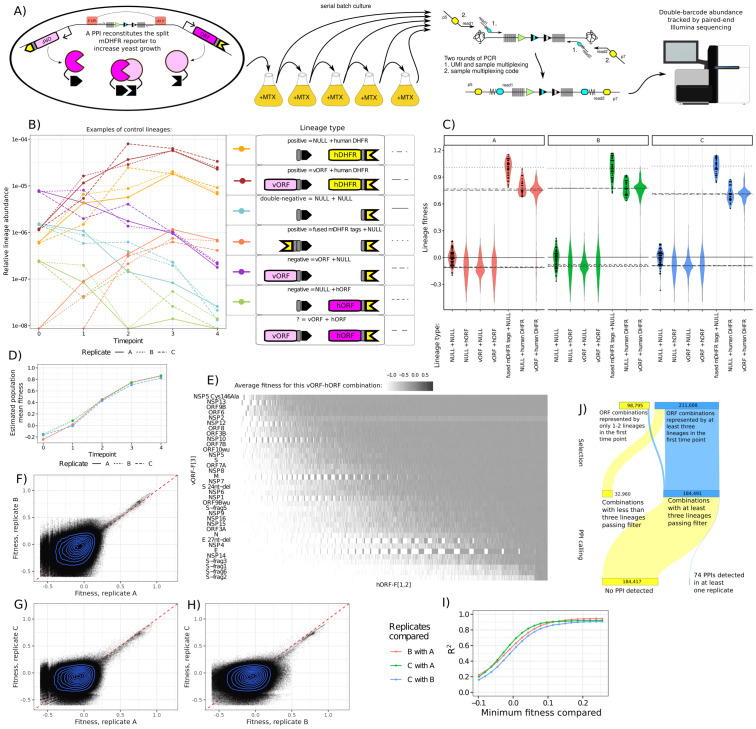
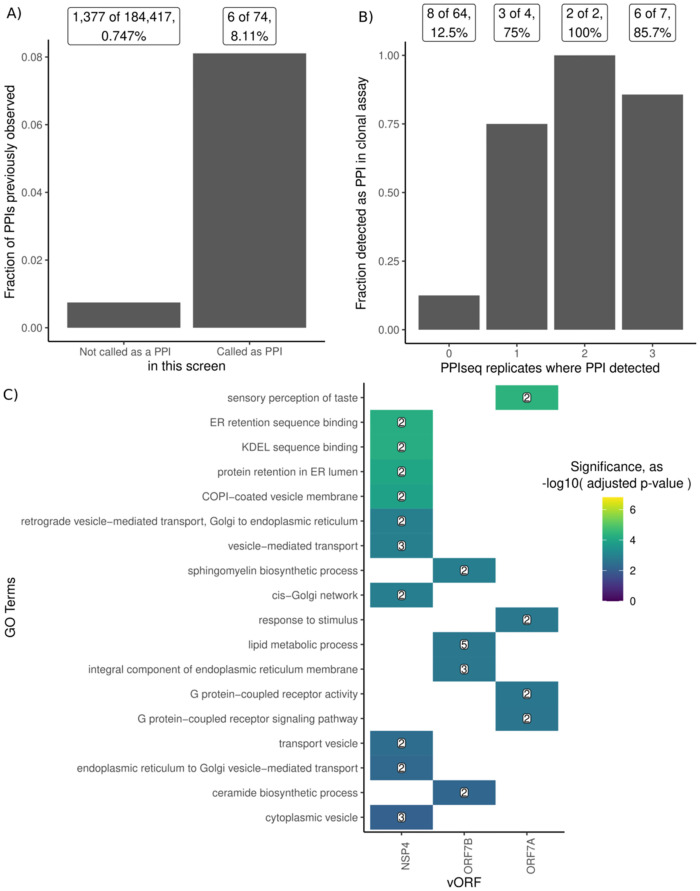
P rotein- P rotein I nteractions ( PPI s) are a key interface between virus and host, and these interactions are important to both viral reprogramming of the host and to host restriction of viral infection. In particular, viral-host PPI networks can be used to further our understanding of the molecular mechanisms of tissue specificity, host range, and virulence. At higher scales, viral-host PPI screening could also be used to screen for small-molecule antivirals that interfere with essential viral-host interactions, or to explore how the PPI networks between interacting viral and host genomes co-evolve. Current high-throughput PPI assays have screened entire viral-host PPI networks. However, these studies are time consuming, often require specialized equipment, and are difficult to further scale. Here, we develop methods that make larger-scale viral-host PPI screening more accessible. This approach combines the mDHFR split-tag reporter with the iSeq2 interaction-barcoding system to permit massively-multiplexed PPI quantification by simple pooled engineering of barcoded constructs, integration of these constructs into budding yeast, and fitness measurements by pooled cell competitions and barcode-sequencing. We applied this method to screen for PPIs between SARS-CoV-2 proteins and human proteins, screening in triplicate >180,000 ORF-ORF combinations represented by >1,000,000 barcoded lineages. Our results complement previous screens by identifying 74 putative PPIs, including interactions between ORF7A with the taste receptors TAS2R41 and TAS2R7, and between NSP4 with the transmembrane KDELR2 and KDELR3. We show that this PPI screening method is highly scalable, enabling larger studies aimed at generating a broad understanding of how viral effector proteins converge on cellular targets to effect replication.
Overview
The claims and statistics of this paper haven’t been checked yet.
Run the check — free, no account needed. It reads the open-access text and checks the sources it cites.
Integrity signals
Registry
Cites
Statistics
Figures
Verification
Claims the paper makes
The claims and statistics of this paper haven’t been checked yet.
Run the check — free, no account needed. It reads the open-access text and checks the sources it cites.
Self-check
Percentages, sums and reported differences re-computed from the paper’s own numbers.
The self-check needs the paper’s full text.
Citations
Cites
Highly accurate protein structure prediction with AlphaFold
Jumper, J., Evans, R., Pritzel, A., Green, T., Figurnov, M., Ronneberger, O., Tunyasuvunakool, K., Bates, R., Žídek, A., Potapenko, A., et al. (2021) · Nature · doi:10.1038/s41586-021-03819-2 · Cited by 43,764
AlphaFold and Implications for Intrinsically Disordered Proteins
Ruff, K. M., & Pappu, R. V. (2021) · Journal of Molecular Biology · doi:10.1016/j.jmb.2021.167208 · Cited by 635
Research works printed but not linked: 109
- 10.1111/cmi.12465 · DOI
- 10.1128/MMBR.00026-09 · DOI
- 10.1371/journal.ppat.1003279 · DOI
- 10.1074/jbc.RA119.011410 · DOI
- 10.1016/j.str.2015.08.007 · DOI
- 10.1128/JVI.02406-14 · DOI
- 10.1016/j.it.2013.05.002 · DOI
- 10.3389/fmicb.2017.01557 · DOI
- 10.1016/j.semcdb.2018.07.018 · DOI
- 10.1371/journal.pone.0000459 · DOI
- 10.1038/415141a · DOI
- 10.1038/nature04670 · DOI
- 10.1038/s41586-020-2286-9 · DOI · Paper page
- 10.3390/v14030611 · DOI
- 10.1016/S0022-2836(02)01281-0 · DOI
- 10.1093/emboj/cdg359 · DOI
- 10.1126/science.1164801 · DOI
- 10.1074/mcp.M111.012500 · DOI
- 10.15252/msb.20188792 · DOI
- 10.1016/j.tcb.2016.09.011 · DOI
- 10.1038/340245a0 · DOI
- 10.1038/35001009 · DOI · Paper page
- 10.1126/science.1116804 · DOI
- 10.1073/pnas.96.10.5394 · DOI
- 10.1073/pnas.95.21.12141 · DOI
- 10.1021/pr900491n · DOI
- 10.1073/pnas.080078197 · DOI
- 10.1126/science.1153878 · DOI
- 10.1038/ncomms15586 · DOI
- 10.1073/pnas.1204952109 · DOI
- 10.15252/msb.20177532 · DOI
- 10.15252/msb.20156660 · DOI
- 10.1093/nar/gkac045 · DOI
- 10.1126/scisignal.260pe11 · DOI
- 10.1126/science.abj8754 · DOI · Paper page
- 10.1126/science.abm4805 · DOI · Paper page
- 10.1016/j.jmb.2013.10.030 · DOI
- 10.3389/fphy.2019.00010 · DOI
- 10.1021/acs.jproteome.1c00011 · DOI
- 10.1016/j.tibs.2008.10.009 · DOI
- 10.1093/bioinformatics/btu763 · DOI
- 10.1016/S0076-6879(00)28419-X · DOI
- 10.1038/nmeth.3776 · DOI
- 10.1016/j.cell.2021.04.011 · DOI · Paper page
- 10.1038/s41586-020-2188-x · DOI · Paper page
- 10.7150/thno.8255 · DOI · Paper page
- 10.1093/nar/gkp1000 · DOI
- 10.1101/gr.2583304 · DOI
- 10.7554/eLife.62365 · DOI
- 10.1016/j.cels.2019.03.005 · DOI
- 10.1074/mcp.TIR117.000385 · DOI
- 10.1039/C2MB25265A · DOI
- 10.1101/pdb.prot090035 · DOI
- 10.7554/eLife.32472 · DOI · Paper page
- 10.1101/gr.212092.116 · DOI · Paper page
- 10.1016/j.cels.2020.05.011 · DOI
- 10.1021/sb5003357 · DOI
- 10.1016/j.cels.2019.09.009 · DOI
- 10.1038/s41467-021-22664-5 · DOI
- 10.1261/rna.072413.119 · DOI
- 10.1093/nar/gkr771 · DOI · Paper page
- 10.1016/j.celrep.2014.04.009 · DOI
- 1980, Leucine biosynthesis in Saccharomyces cerevisiae. Purification and characterization of beta-isopropylmalate dehydrogenase, J Biol Chem, 255, 7255, 10.1016/S0021-9258(20)79695-X · DOI
- 10.1016/j.bbamcr.2014.11.007 · DOI
- 10.1016/j.molcel.2004.12.030 · DOI · Paper page
- 10.20944/preprints202004.0009.v1 · DOI
- 10.1038/nprot.2007.15 · DOI
- 10.1007/BF00340712 · DOI
- 10.1002/yea.320110408 · DOI
- 10.1007/s10482-013-9905-5 · DOI
- 10.1111/j.1365-2958.1995.mmi_18010077.x · DOI
- 10.1101/2023.10.23.563542 · DOI
- 10.1016/j.cels.2018.09.004 · DOI
- 10.1101/2023.05.06.539663 · DOI
- 10.1038/s41467-021-21903-z · DOI
- 10.1093/database/baaa096 · DOI
- 10.15252/msb.20167233 · DOI
- 10.1089/omi.2011.0118 · DOI · Paper page
- 10.1101/2021.02.05.428650 · DOI
- 10.1038/s41467-023-40228-7 · DOI
- 10.1016/j.cell.2020.12.004 · DOI
- 10.1098/rsob.180017 · DOI
- 10.1128/mbio.02289-22 · DOI
- 10.1038/s42003-022-03865-0 · DOI
- 10.1038/s41587-022-01475-z · DOI
- 10.1128/mbio.00524-13 · DOI
- 10.1007/s00018-022-04469-x · DOI
- 10.1007/s00415-020-10197-8 · DOI
- 10.1101/2023.10.13.562064 · DOI
- 10.15252/msb.20156484 · DOI
- 10.1177/1087057110363822 · DOI
- 10.1186/gb-2014-15-2-r29 · DOI · Paper page
- 10.1186/s13059-020-02091-3 · DOI
- 10.1101/530790 · DOI
- 10.1016/j.copbio.2013.02.023 · DOI
- 10.1038/s41467-019-11809-2 · DOI
- 10.1126/science.abf9302 · DOI · Paper page
- 10.1101/pdb.top083543 · DOI
- 10.1073/pnas.1705867114 · DOI
- 10.1016/j.cell.2020.08.012 · DOI · Paper page
- 10.1016/0022-5193(83)90398-3 · DOI
- Maitreya J. Dunham, Marc R. Gartenberg, Grant W . Brown. Methods in Yeast Genetics and Genomics. Cold Spring Harbor Laboratory Press; 2015.
- 10.1002/yea.2992 · DOI
- 10.1016/0378-1119(92)90454-W · DOI
- 10.1126/science.2544026 · DOI
- 10.1101/gr.121095.111 · DOI · Paper page
- 10.1093/bioinformatics/btv053 · DOI
- O. Tange . GNU Parallel - The Command-Line Power Tool. USENIX Mag. 2011;1: 42–47.
- 10.1111/j.2517-6161.1995.tb02031.x · DOI · Paper page
Metadata
- Authors
- Miller, D., Dziulko, A., & Levy, S.
- Affiliations
- SLAC National Accelerator Laboratory (US)
- University of Colorado Boulder (US)
- Corresponding author
- Miller, Darach
- Dziulko, Adam
- Levy, Sasha
- Venue
- PLoS ONE
- Publisher
- openRxiv
- Published
- 2024-02-14
- Volume
- 20
- Issue
- 1
- Pages
- e0299440-e0299440
- ISSN
- 1932-6203 (ISSN-L)
- PMC
- PMC11741623
- OpenAlex
- W4406501025
- Cited by
- 1
- References
- 2
- Citations by year
- 2026: 1
- FWCI
- 0.77
- Type
- journal article
- Language
- en
- Open access
- gold
- doi.org
- Licence
- cc-by
- Locations
- PLoS ONE (publishedVersion, cc-by)
- bioRxiv (Cold Spring Harbor Laboratory) (acceptedVersion, cc-by)
- PubMed Central (publishedVersion, cc-by)
- PubMed (publishedVersion)
- DOAJ (DOAJ: Directory of Open Access Journals) (submittedVersion, cc-by-sa)
- Funders
- Division of Intramural Research, National Institute of Allergy and Infectious Diseases (R01AI164530)
- National Institutes of Health
- National Institute of Allergy and Infectious Diseases (R01AI164530)
- SLAC National Accelerator Laboratory
- Topics
- Health Sciences › Medicine › Infectious Diseases › SARS-CoV-2 and COVID-19 Research
- Life Sciences › Biochemistry, Genetics and Molecular Biology › Molecular Biology › Bioinformatics and Genomic Networks
- Life Sciences › Biochemistry, Genetics and Molecular Biology › Cell Biology › Biotin and Related Studies
- Keywords
- SARS-CoV-2, protein-protein interaction, host-virus interaction, ORF7a, NSP4, antiviral drug targets
- MeSH terms
- COVID-19, SARS-CoV-2, Humans, Viral Proteins, Protein Interaction Mapping, Host-Pathogen Interactions, High-Throughput Screening Assays, HEK293 Cells, Protein Interaction Maps
About these checks
Registry, retraction, Cites and statistics results are computed, not judged, with one exception: a printed reference that no index lists is read once by a model before it counts as a citation error. Claims are extracted by a model and kept only when their quote appears verbatim in the text; each cited source is then checked, with a model’s help, for whether it says what the claim relies on. Those verdicts can be wrong — read the claim’s quote and the cited source before relying on one.
Statistics and arithmetic are recomputed, not judged.
Confidence bands are shown only for fields calibrated on our annotated test set. None is calibrated yet, so no band is shown.
What counts as a claim ›How we measure confidence ›How we check this ›
Are you an author, or do you see a problem with this page? Request a review
How to cite
Cite CoChat for the checks on this page, and the paper for its own findings.
- This page
- CoChat. (2026). Citation check: Pooled PPIseq: screening the SARS-CoV-2 and human interface with a scalable multiplexed protein-protein interaction assay platform. https://app.cochat.ai/papers/10.1101/2024.02.13.580123
- The paper
- Miller, D., Dziulko, A., & Levy, S. (2024). Pooled PPIseq: screening the SARS-CoV-2 and human interface with a scalable multiplexed protein-protein interaction assay platform. PLoS ONE. https://doi.org/10.1101/2024.02.13.580123
