

TFIIS is required for reproductive development and thermal adaptation in barley
Open accessPreprint — published as 10.1007/s00299-024-03345-1
The DOI matches its Crossref record; 34 of the 34 references it cites were found in a registry or an index.
Abstract
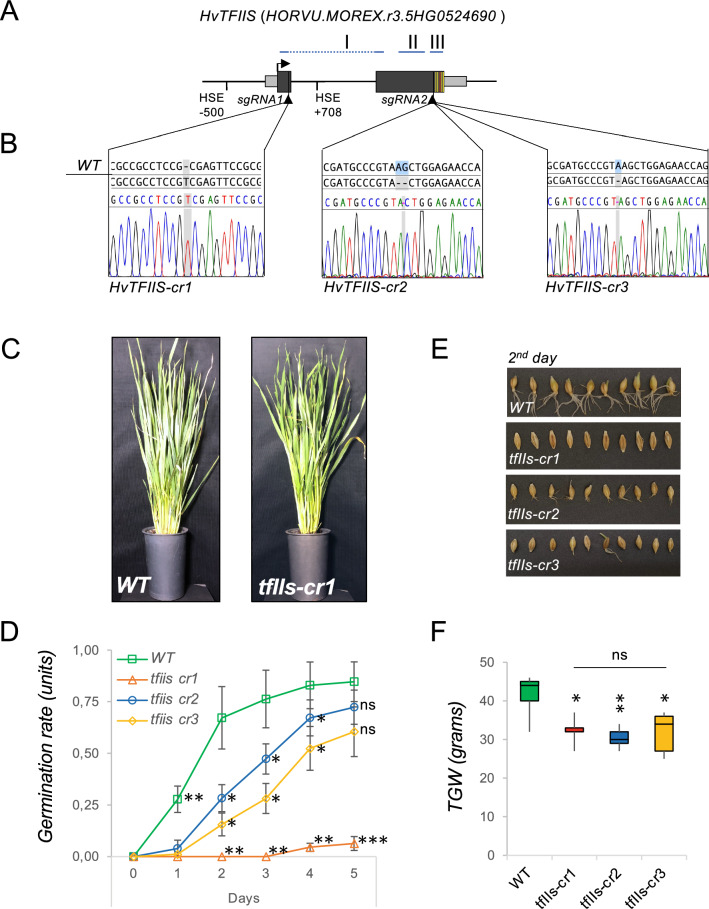
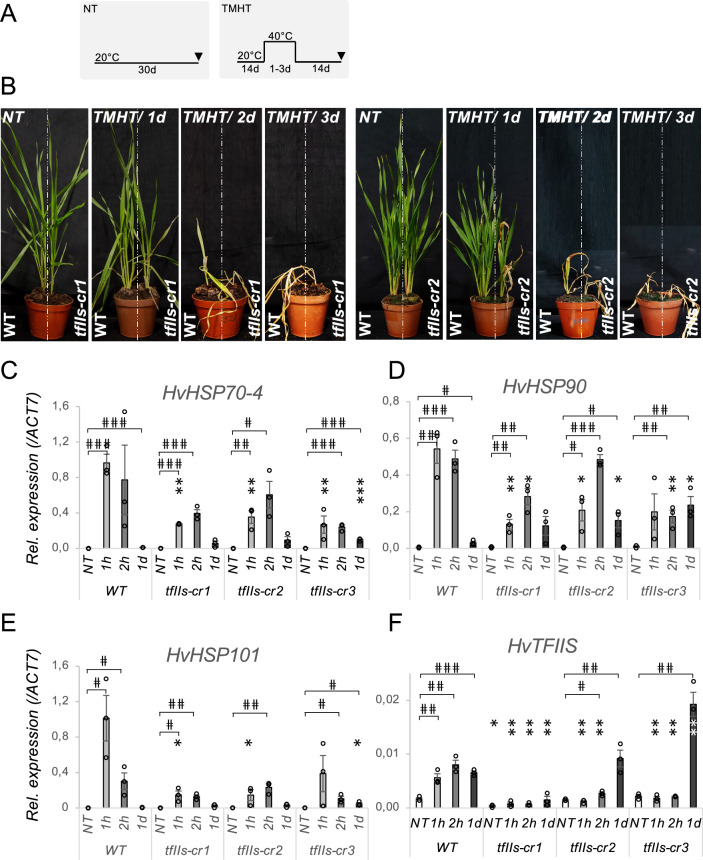
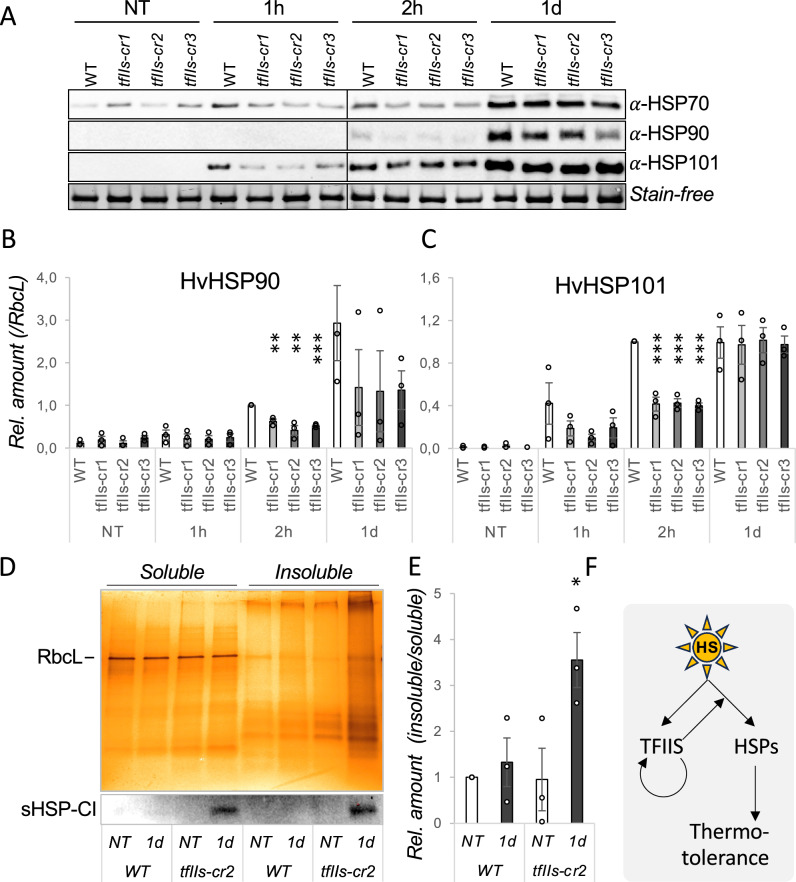
Regulation of transcriptional machinery and its adaptive role under different stress conditions are studied extensively in the dicot model plant Arabidopsis , but our knowledge on monocot species remains elusive. TFIIS is an RNA polymerase II associated transcription elongation co-factor. Previously it was shown that TFIIS ensures efficient transcription elongation that is necessary for heat stress survival in A. thaliana . However, the function of TFIIS has not been analysed in monocots. In the present work, we have generated and studied independent tfIIscrispr mutant barley lines. We show that, TFIIS is needed for reproductive development and heat stress survival in barley. The molecular basis of HS-sensitivity of tfIIs mutants is the retarded expression of heat stress protein transcripts, that leads to late accumulation of HSP chaperones, enhanced proteotoxicity and ultimately to lethality. We also show that TFIIS is induced and autoregulated in response to heat, supporting a conserved adaptive function of these control elements for plant thermal adaptation. In sum, our results are a step forward for the better understanding of transcriptional machinery regulation in monocot crops.
Overview
The claims and statistics of this paper haven’t been checked yet.
Free: it reads the open-access text and checks the first 5 claims that cite a source we can check. Create a free account to check every claim.
Integrity signals
Registry
Cites
Statistics
Figures
Verification
Claims the paper makes
The claims and statistics of this paper haven’t been checked yet.
Free: it reads the open-access text and checks the first 5 claims that cite a source we can check. Create a free account to check every claim.
Self-check
Percentages, sums and reported differences re-computed from the paper’s own numbers.
The self-check needs the paper’s full text.
Citations
Cites
Highly accurate protein structure prediction with AlphaFold
Jumper, J., Evans, R., Pritzel, A., Green, T., Figurnov, M., Ronneberger, O., Tunyasuvunakool, K., Bates, R., Žídek, A., Potapenko, A., et al. (2021) · Nature · doi:10.1038/s41586-021-03819-2 · Cited by 43,764
Jalview Version 2—a multiple sequence alignment editor and analysis workbench
Waterhouse, A. M., Procter, J. B., Martin, D. M. A., Clamp, M., & Barton, G. J. (2009) · Bioinformatics · doi:10.1093/bioinformatics/btp033 · Cited by 11,399
UniProt: the Universal Protein Knowledgebase in 2023
The UniProt Consortium, Bateman, A., Martin, M.-J., Orchard, S., Magrane, M., Ahmad, S., Alpi, E., Bowler-Barnett, E. H., Britto, R., Bye-A-Jee, H., et al. (2023) · Nucleic Acids Research · doi:10.1093/nar/gkac1052 · Cited by 7,210
CRISPOR: intuitive guide selection for CRISPR/Cas9 genome editing experiments and screens
Concordet, J.-P., & Haeussler, M. (2018) · Nucleic Acids Research · doi:10.1093/nar/gky354 · Cited by 2,655
Heat shock factors: integrators of cell stress, development and lifespan
Åkerfelt, M., Morimoto, R. I., & Sistonen, L. (2010) · Nature Reviews Molecular Cell Biology · doi:10.1038/nrm2938 · Cited by 1,455
Martin, F. J., Amode, M. R., Aneja, A., Austine-Orimoloye, O., Azov, A. G., Barnes, I., Becker, A., Bennett, R., Berry, A., Bhai, J., et al. (2023) · Nucleic Acids Research · doi:10.1093/nar/gkac958 · Cited by 1,023
Quality and quantity control of gene expression by nonsense-mediated mRNA decay
Kurosaki, T., Popp, M. W., & Maquat, L. E. (2019) · Nature Reviews Molecular Cell Biology · doi:10.1038/s41580-019-0126-2 · Cited by 826
Sadana, P., Geyer, R., Pezoldt, J., Helmsing, S., Huehn, J., Hust, M., Dersch, P., & Scrima, A. (2018) · Journal of Biological Chemistry · doi:10.1074/jbc.ra117.001068 · Cited by 720
Using plastid genome-scale data to resolve enigmatic relationships among basal angiosperms
Moore, M. J., Bell, C. D., Soltis, P. S., & Soltis, D. E. (2007) · Proceedings of the National Academy of Sciences · doi:10.1073/pnas.0708072104 · Cited by 711
The barley pan-genome reveals the hidden legacy of mutation breeding
Jayakodi, M., Padmarasu, S., Haberer, G., Bonthala, V. S., Gundlach, H., Monat, C., Lux, T., Kamal, N., Lang, D., Himmelbach, A., et al. (2020) · Nature · doi:10.1038/s41586-020-2947-8 · Cited by 565
Research works printed but not linked: 3
- 2020, Critical Role of Transcript Cleavage in Arabidopsis RNA Polymerase II Transcriptional Elongation, 32, 1449
- 2017, The Composition of the Arabidopsis RNA Polymerase II Transcript Elongation Complex Reveals the Interplay between Elongation and mRNA Processing Factors, 29, 854
- 2019, The hunt for RNA polymerase II elongation factors: a historical perspective, 26, 771
Metadata
- Authors
- Ahmad, I., András, K., Verma, R., Szádeczky-Kardoss, I., Szaker, H. M., Pettkó-Szandtner, A., Silhavy, D., Havelda, Z., & Csorba, T.
- Affiliations
- Magyar Agrár- és Élettudományi Egyetem (HU)
- HUN-REN Szegedi Biológiai Kutatóközpont (HU)
- Corresponding author
- Csorba, Tibor
- ORCID
- Venue
- Plant Cell Reports
- Publisher
- openRxiv
- Published
- 2024-03-27
- Volume
- 43
- Issue
- 11
- Pages
- 260-260
- ISSN
- 0721-7714 (ISSN-L)
- PMC
- PMC11467006
- OpenAlex
- W4403291116
- Cited by
- 1
- References
- 34
- Citations by year
- 2025: 1
- FWCI
- 0.24
- Type
- journal article
- Language
- en
- Open access
- hybrid
- doi.org
- Licence
- cc-by
- Locations
- Plant Cell Reports (publishedVersion, cc-by)
- bioRxiv (Cold Spring Harbor Laboratory) (acceptedVersion, other-oa)
- PubMed Central (publishedVersion, cc-by)
- PubMed (publishedVersion)
- Funders
- Magyar Agrár- és Élettudományi Egyetem
- European Commission (739593)
- Hungarian Scientific Research Fund (K-139349, K-137722, K-146300, K-134914)
- Magyar Tudományos Akadémia (BO/00015/21)
- Nemzeti Kutatási Fejlesztési és Innovációs Hivatal (KIM NKFIA 2022-2.1.1-NL-2022-00005)
- Tempus Közalapítvány
- HORIZON EUROPE Framework Programme (EU Horizon 2020 grant No. 739593)
- Nemzeti Kutatási, Fejlesztési és Innovaciós Alap (2022–2.1.1-NL, 2022-2.1.1-NL-2022-00005, KIM NKFIA 2022-2.1.1-NL-2022-00005)
- Topics
- Life Sciences › Agricultural and Biological Sciences › Plant Science › Plant Molecular Biology Research
- Life Sciences › Biochemistry, Genetics and Molecular Biology › Molecular Biology › Heat shock proteins research
- Life Sciences › Agricultural and Biological Sciences › Plant Science › Plant Stress Responses and Tolerance
- Keywords
- TFIIS, RNA polymerase II, transcription elongation, heat stress adaptation, barley, reproductive development, proteotoxicity, monocotyledons, thermal adaptation
- MeSH terms
- Thermotolerance, Adaptation, Physiological, Hordeum, Heat-Shock Proteins, Mutation, Plant Proteins, Reproduction, Gene Expression Regulation, Plant, Heat-Shock Response, Transcriptional Elongation Factors
About these checks
Registry, retraction, Cites and statistics results are computed, not judged, with one exception: a printed reference that no index lists is read once by a model before it counts as a citation error. Claims are extracted by a model and kept only when their quote appears verbatim in the text; each cited source is then checked, with a model’s help, for whether it says what the claim relies on. Those verdicts can be wrong — read the claim’s quote and the cited source before relying on one.
Statistics and arithmetic are recomputed, not judged.
Confidence bands are shown only for fields calibrated on our annotated test set. None is calibrated yet, so no band is shown.
What counts as a claim ›How we measure confidence ›How we check this ›
Are you an author, or do you see a problem with this page? Request a review
How to cite
Cite CoChat for the checks on this page, and the paper for its own findings.
- This page
- CoChat. (2026). Citation check: TFIIS is required for reproductive development and thermal adaptation in barley. https://app.cochat.ai/papers/10.1101/2024.03.26.586761
- The paper
- Ahmad, I., András, K., Verma, R., Szádeczky-Kardoss, I., Szaker, H. M., Pettkó-Szandtner, A., Silhavy, D., Havelda, Z., & Csorba, T. (2024). TFIIS is required for reproductive development and thermal adaptation in barley. Plant Cell Reports. https://doi.org/10.1101/2024.03.26.586761
Data sources
Bibliographic data: Semantic Scholar, OpenAlex, Crossref.
Contains information from the Semantic Scholar Academic Graph Datasets, made available under the ODC Attribution License (ODC-BY 1.0).
Semantic Scholar’s data is described in: Kinney, R., et al. (2023). The Semantic Scholar Open Data Platform. arXiv:2301.10140.
