

Proteolytic processing of both RXLR and EER motifs in oomycete effectors
Open accessPreprint — published as 10.1111/nph.20130
The DOI matches its Crossref record; 52 of the 52 references it cites were found in a registry or an index.
Abstract
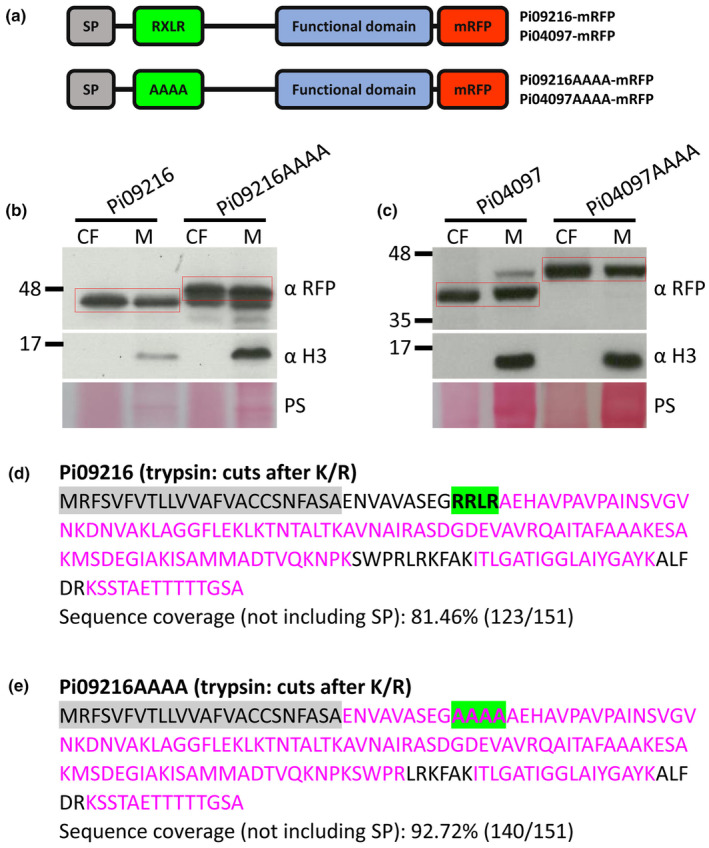
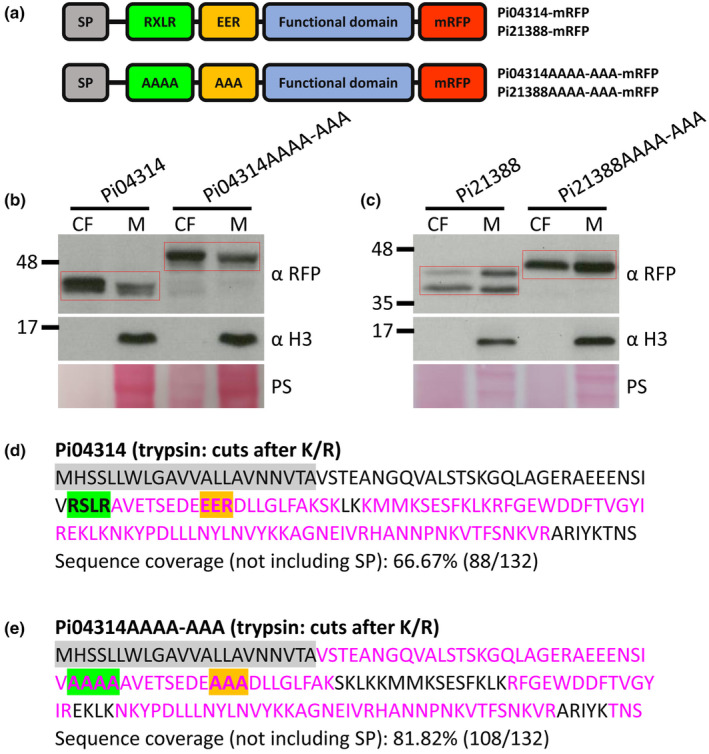
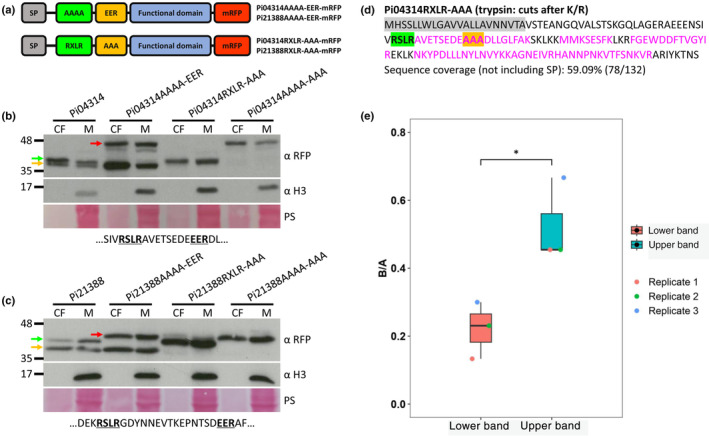
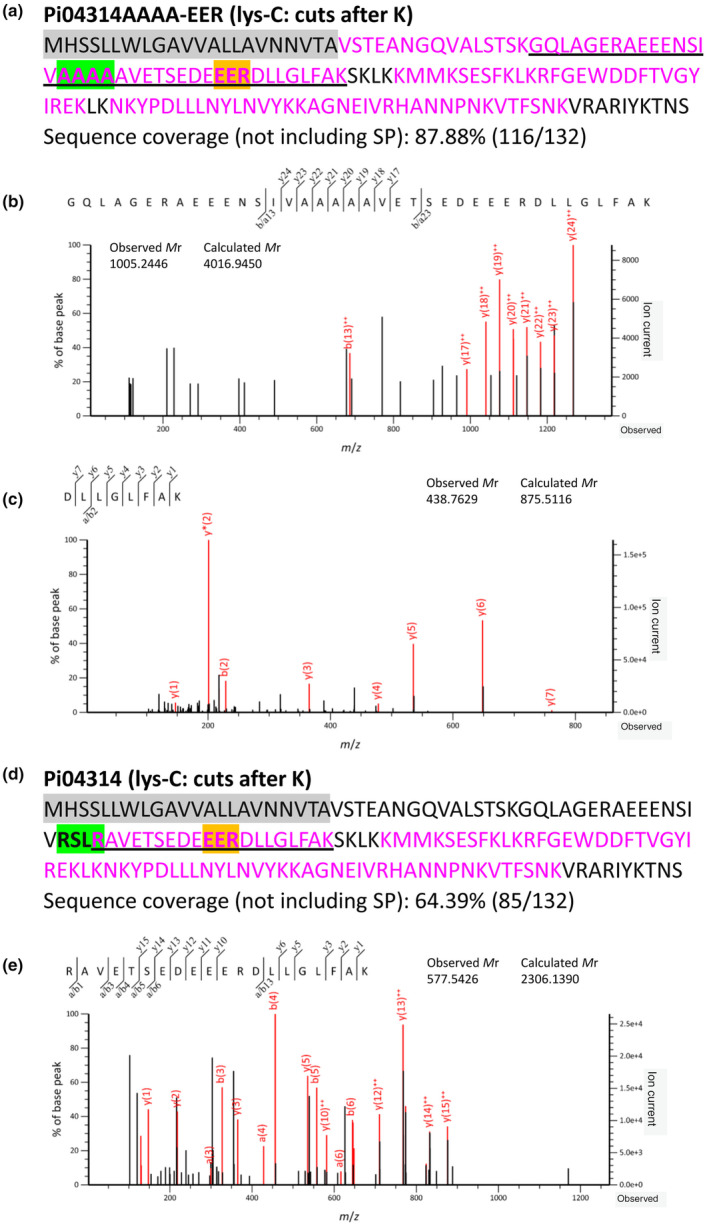
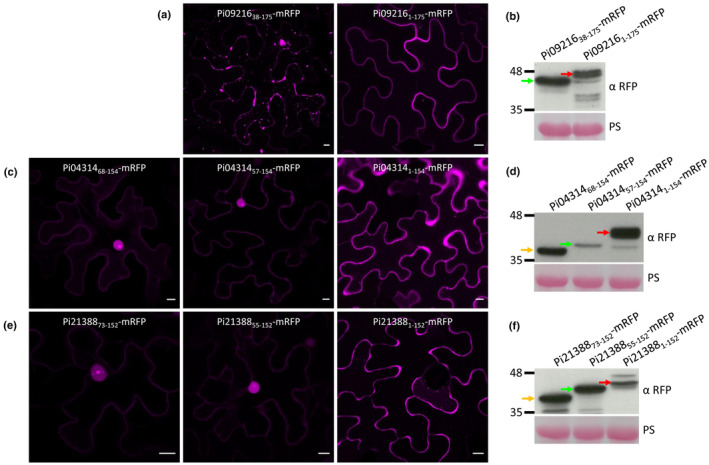
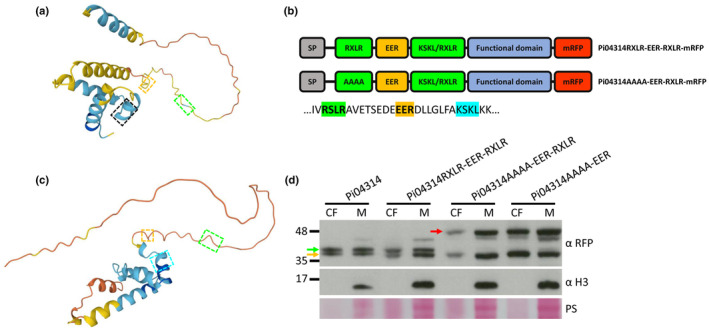
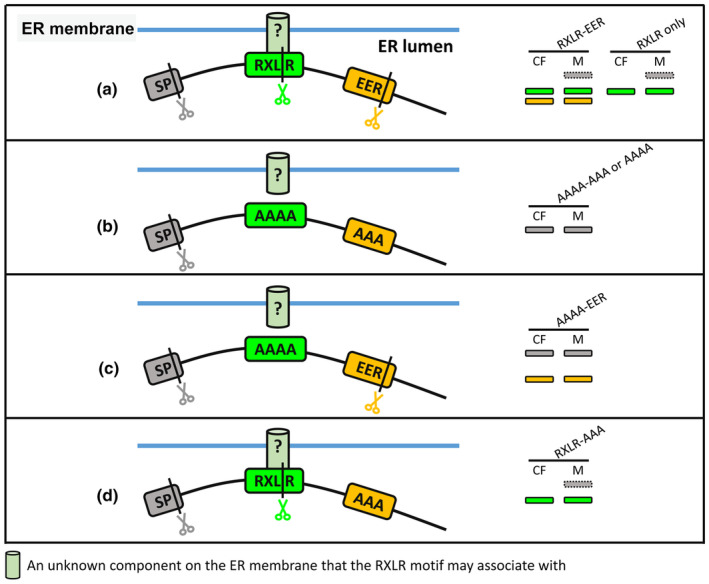
Arg-any amino acid-Leu-Arg (RXLR) effectors are central oomycete virulence factors that target diverse host proteins and processes to suppress plant immunity. Relatively little is known about how they are processed post-translationally before delivery into host cells. Proteolytic cleavage at the RXLR motif was observed to occur prior to secretion in all Phytophthora infestans effectors tested, suggesting it is a general rule, and was observed to occur between the leucine and the second arginine. There was no cleavage of a naturally occurring second RXLR motif in a structured region of Pi21388/AvrBlb1, or one introduced at a similar position in effector Pi04314, in keeping with the motif being positionally constrained, potentially to disordered regions closely following the signal peptide. Remarkably, independent proteolytic cleavage of the Glu-Glu-Arg (EER) motif, often found immediately downstream of the RXLR, was also observed in diverse effectors, occurring immediately after the arginine. Expression of full-length effectors in host plant Nicotiana benthamiana revealed that, although secreted, they were poorly processed, suggesting that RXLR and EER cleavage does not occur in all eukaryotic cells. Our observations indicate that, whether possessing both RXLR and EER, or either motif alone, these effectors are likely proteolytically processed prior to secretion in all cases.
Overview
The claims and statistics of this paper haven’t been checked yet.
Free: it reads the open-access text and checks the first 5 claims that cite a source we can check. Create a free account to check every claim.
Integrity signals
Registry
Cites
Statistics
Figures
Verification
Claims the paper makes
The claims and statistics of this paper haven’t been checked yet.
Free: it reads the open-access text and checks the first 5 claims that cite a source we can check. Create a free account to check every claim.
Self-check
Percentages, sums and reported differences re-computed from the paper’s own numbers.
The self-check needs the paper’s full text.
Citations
Cites
Highly accurate protein structure prediction with AlphaFold
Jumper, J., Evans, R., Pritzel, A., Green, T., Figurnov, M., Ronneberger, O., Tunyasuvunakool, K., Bates, R., Žídek, A., Potapenko, A., et al. (2021) · Nature · doi:10.1038/s41586-021-03819-2 · Cited by 43,764
The global burden of pathogens and pests on major food crops
Savary, S., Willocquet, L., Pethybridge, S. J., Esker, P., McRoberts, N., & Nelson, A. (2019) · Nature Ecology & Evolution · doi:10.1038/s41559-018-0793-y · Cited by 4,309
Genome sequence and analysis of the Irish potato famine pathogen Phytophthora infestans
Haas, B. J., Kamoun, S., Zody, M. C., Jiang, R. H. Y., Handsaker, R. E., Cano, L. M., Grabherr, M., Kodira, C. D., Raffaele, S., Torto-Alalibo, T., et al. (2009) · Nature · doi:10.1038/nature08358 · Cited by 1,471
Self-citationThe Top 10 oomycete pathogens in molecular plant pathology
Kamoun, S., Furzer, O., Jones, J. D. G., Judelson, H. S., Ali, G. S., Dalio, R. J. D., Roy, S. G., Schena, L., Zambounis, A., Panabières, F., et al. (2015) · Molecular Plant Pathology · doi:10.1111/mpp.12190 · Cited by 991
Self-citationA translocation signal for delivery of oomycete effector proteins into host plant cells
Whisson, S. C., Boevink, P. C., Moleleki, L., Avrova, A. O., Morales, J. G., Gilroy, E. M., Armstrong, M. R., Grouffaud, S., van West, P., Chapman, S. N., et al. (2007) · Nature · doi:10.1038/nature06203 · Cited by 978
Self-citationExternal Lipid PI3P Mediates Entry of Eukaryotic Pathogen Effectors into Plant and Animal Host Cells
Kale, S. D., Gu, B., Capelluto, D. G. S., Dou, D., Feldman, E., Rumore, A., Arredondo, F. D., Hanlon, R., Fudal, I., Rouxel, T., et al. (2010) · Cell · doi:10.1016/j.cell.2010.06.008 · Cited by 464
Rehmany, A. P., Gordon, A., Rose, L. E., Allen, R. L., Armstrong, M. R., Whisson, S. C., Kamoun, S., Tyler, B. M., Birch, P. R. J., & Beynon, J. L. (2005) · The Plant Cell · doi:10.1105/tpc.105.031807 · Cited by 441
Self-citationVleeshouwers, V. G. A. A., Rietman, H., Krenek, P., Champouret, N., Young, C., Oh, S.-K., Wang, M., Bouwmeester, K., Vosman, B., Visser, R. G. F., et al. (2008) · PLoS ONE · doi:10.1371/journal.pone.0002875 · Cited by 415
Oh, S.-K., Young, C., Lee, M., Oliva, R., Bozkurt, T. O., Cano, L. M., Win, J., Bos, J. I. B., Liu, H.-Y., van Damme, M., et al. (2009) · The Plant Cell · doi:10.1105/tpc.109.068247 · Cited by 383
Five Reasons to Consider Phytophthora infestans a Reemerging Pathogen
Fry, W. E., Birch, P. R. J., Judelson, H. S., Grünwald, N. J., Danies, G., Everts, K. L., Gevens, A. J., Gugino, B. K., Johnson, D. A., Johnson, S. B., et al. (2015) · Phytopathology® · doi:10.1094/phyto-01-15-0005-fi · Cited by 348
Self-citation
Research works printed but not linked: 7
- 2016, Export of malaria proteins requires co-translational processing of the PEXEL motif independent of phosphatidylinositol-3-phosphate binding, Nature communications, 7, 1
- 2016, A Phytophthora infestans RXLR effector targets plant PP1c isoforms that promote late blight disease, Nature communications, 7, 1
- 2021, Oomycete intracellular effectors: specialised weapons targeting strategic plant processes, New Phytologist, 233, 1074
- 2013, Two distinct secretion systems facilitate tissue invasion by the rice blast fungus Magnaporthe oryzae, Nature communications, 4, 1
- 2016, Identification of Phakopsora pachyrhizi candidate effectors with virulence activity in a distantly related pathosystem, Frontiers in Plant Science, 7, 269
- 2012, Nature methods, 9, 676
- 2021, Alphafold Protein Structure Database: massively expanding the structural coverage of protein-sequence space with high-accuracy models, Nucleic Acids Research, 50, D439
Metadata
- Authors
- Xu, L., Wang, S., Wang, W., Wang, H., Welsh, L., Boevink, P. C., Whisson, S. C., & Birch, P. R.
- Affiliations
- James Hutton Institute (GB)
- Corresponding author
- Birch, Paul RJ
- ORCID
- Venue
- New Phytologist
- Publisher
- openRxiv
- Published
- 2024-04-19
- Volume
- 245
- Issue
- 4
- Pages
- 1640-1654
- ISSN
- 0028-646X (ISSN-L)
- PMC
- PMC11754927
- OpenAlex
- W4402930663
- Cited by
- 13
- References
- 52
- Citations by year
- 2026: 3 · 2025: 8 · 2024: 2
- FWCI
- 3.15
- Type
- journal article
- Language
- en
- Open access
- hybrid
- doi.org
- Licence
- cc-by
- Locations
- New Phytologist (publishedVersion, cc-by)
- bioRxiv (Cold Spring Harbor Laboratory) (acceptedVersion, cc-by-nc-nd)
- PubMed Central (publishedVersion, cc-by)
- PubMed (publishedVersion)
- Discovery Research Portal (University of Dundee) (submittedVersion, cc-by)
- Funders
- University of Dundee
- Rural and Environment Science and Analytical Services Division (JHI‐B1‐1)
- James Hutton Institute
- China Scholarship Council
- Directorate for Biological Sciences
- Biotechnology and Biological Sciences Research Council (BB/S003096/1)
- University Postgraduate Programme
- H2020 European Research Council (PathEVome (787764), 787764)
- Topics
- Life Sciences › Agricultural and Biological Sciences › Plant Science › Plant Pathogens and Resistance
- Life Sciences › Agricultural and Biological Sciences › Plant Science › Plant-Microbe Interactions and Immunity
- Life Sciences › Agricultural and Biological Sciences › Plant Science › Plant Pathogenic Bacteria Studies
- Keywords
- RXLR effectors, oomycete effectors, Phytophthora infestans, proteolytic processing, post-translational cleavage, effector secretion, plant immunity suppression, signal peptide
- MeSH terms
- Amino Acid Sequence, Oomycetes, Nicotiana, Amino Acid Motifs, Virulence Factors, Phytophthora infestans, Proteolysis
About these checks
Registry, retraction, Cites and statistics results are computed, not judged, with one exception: a printed reference that no index lists is read once by a model before it counts as a citation error. Claims are extracted by a model and kept only when their quote appears verbatim in the text; each cited source is then checked, with a model’s help, for whether it says what the claim relies on. Those verdicts can be wrong — read the claim’s quote and the cited source before relying on one.
Statistics and arithmetic are recomputed, not judged.
Confidence bands are shown only for fields calibrated on our annotated test set. None is calibrated yet, so no band is shown.
What counts as a claim ›How we measure confidence ›How we check this ›
Are you an author, or do you see a problem with this page? Request a review
How to cite
Cite CoChat for the checks on this page, and the paper for its own findings.
- This page
- CoChat. (2026). Citation check: Proteolytic processing of both RXLR and EER motifs in oomycete effectors. https://app.cochat.ai/papers/10.1101/2024.04.16.589758
- The paper
- Xu, L., Wang, S., Wang, W., Wang, H., Welsh, L., Boevink, P. C., Whisson, S. C., & Birch, P. R. (2024). Proteolytic processing of both RXLR and EER motifs in oomycete effectors. New Phytologist. https://doi.org/10.1101/2024.04.16.589758
Data sources
Bibliographic data: Semantic Scholar, OpenAlex, Crossref.
Contains information from the Semantic Scholar Academic Graph Datasets, made available under the ODC Attribution License (ODC-BY 1.0).
Semantic Scholar’s data is described in: Kinney, R., et al. (2023). The Semantic Scholar Open Data Platform. arXiv:2301.10140.
