

The DOI matches its Crossref record; 1 of the 1 references it cites were found in a registry or an index.
A high lipid diet leads to greater pathology and lower tolerance during infection
Open accessPreprint — published as 10.1242/jeb.249541 · Paper page
Abstract
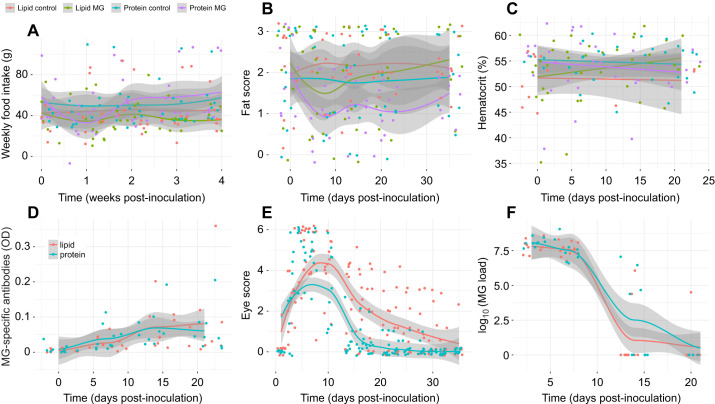
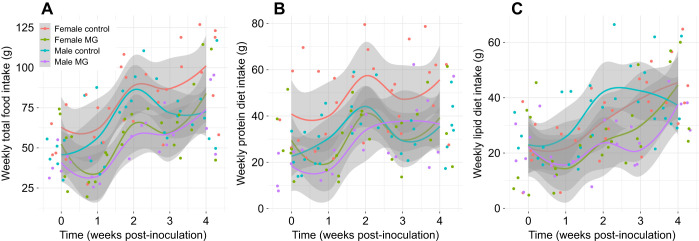
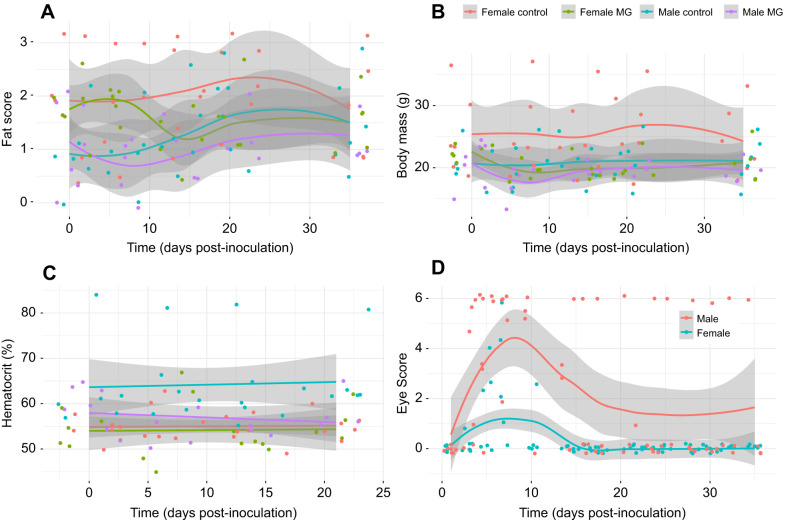
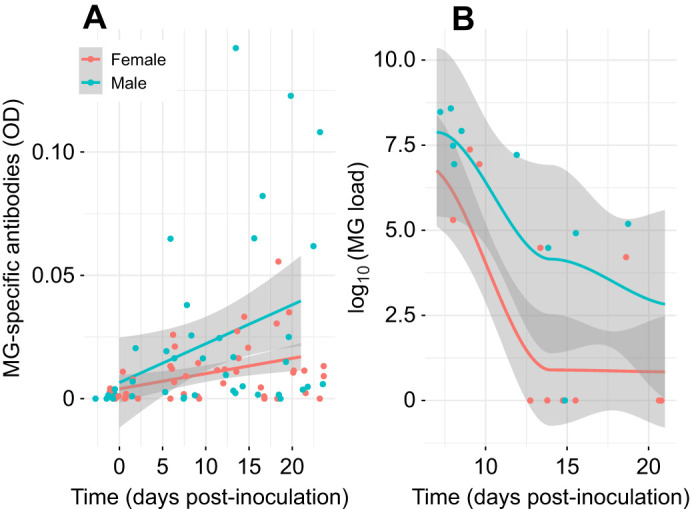
Despite the clear effect of food resources on wildlife disease dynamics, few studies have investigated how shifts in diet, specifically macronutrient content, shape vertebrate host responses to infection. While each individual macronutrient plays a vital role in physiological processes necessary for pathogen defense, it is often difficult to disentangle the role of an individual macronutrient on disease pathology. We explored the effects of dietary macronutrient composition on disease pathology and feeding behavior of canaries ( Serinus canaria domestica) infected with Mycoplasma gallisepticum (MG). First, we provided canaries with isocaloric diets comprised of identical ingredients that varied in macronutrient content (high-protein or high-lipid) then MG- or sham-inoculated birds. We then offered both diets to canaries before and after MG- and sham-inoculation. In experiment one, high protein diet birds consumed more food than high lipid diet birds and experienced a more pronounced decrease in food intake after infection. High protein diet birds were more tolerant to MG infection, exhibiting reduced pathology when compared to high lipid diet birds, despite the two treatments having similar levels of MG-specific antibodies and MG loads. When birds had access to both diets, they consumed more of the high protein diet and experienced pathology for less time than lipid or protein restricted birds. These results highlight that macronutrient makeup of the diet can shape host tolerance and pathology and thus affect host-pathogen transmission dynamics. Summary Statement: Macronutrient composition of the diet shapes tolerance in an avian host pathogen system. Birds that had greater access to protein exhibited reduced pathology despite similar pathogen loads when compared with birds with greater access to lipids.
Overview
The claims and statistics of this paper haven’t been checked yet.
Run the check — free, no account needed. It reads the open-access text and checks the sources it cites.
Integrity signals
Registry
Cites
Statistics
Figures
Verification
Claims the paper makes
The claims and statistics of this paper haven’t been checked yet.
Run the check — free, no account needed. It reads the open-access text and checks the sources it cites.
Self-check
Percentages, sums and reported differences re-computed from the paper’s own numbers.
The self-check needs the paper’s full text.
Citations
Cites
Iron in infection and immunity
Cassat, J. E., & Skaar, E. P. (2013) · Cell Host & Microbe · doi:10.1016/j.chom.2013.04.010 · Cited by 1,214
Research works printed but not linked: 54
- 10.1177/1534582306289580 · DOI
- 10.1242/jeb.013136 · DOI
- 10.1098/rsbl.2013.0594 · DOI
- 10.1093/icb/icp028 · DOI
- 10.1073/pnas.0710335105 · DOI
- 10.1098/rstb.2017.0086 · DOI
- 10.1016/S0169-4758(99)01620-8 · DOI
- 10.1111/1365-2656.12113 · DOI
- 10.1111/j.1365-2435.2010.01766.x · DOI
- 10.1111/ele.12229 · DOI
- 10.1016/j.jaci.2005.04.036 · DOI
- 10.1080/03079450701286277 · DOI
- 10.1080/03079450802499100 · DOI
- 1997, Role of pro-and anti-inflammatory cytokines during inflammation: experimental and clinical findings, Journal of Biological Regulators and Homeostatic Agents, 11, 91
- 10.3382/ps.0741463 · DOI
- 10.1016/j.jnutbio.2023.109315 · DOI
- 2005, Evolutionary causes andconsequences of immunopathology. Annual Review of Ecology, Evolution and Systematics, 36, 373, 10.1146/annurev.ecolsys.36.102003.152622 · DOI
- 10.1113/jphysiol.1978.sp012339 · DOI
- 10.1080/03079450802216629 · DOI
- 2019, Modeling the effects of resource-driven immune defense on parasite transmission in heterogenoeous host populations, Integrative and Comparative Biology, 59, 1253, 10.1093/icb/icz074 · DOI
- 10.1086/600086 · DOI
- 10.1080/03079457.2011.571660 · DOI
- 10.1098/rstb.2017.0087 · DOI
- 10.1007/BF02381210 · DOI
- 10.1079/PNS2003243 · DOI
- 10.3382/ps.2008-00386 · DOI
- Klasing, K. C. 1998. Comparative Avian Nutrition. CAB International, 1998. · DOI
- 10.1080/00071660701671336 · DOI
- 10.1126/science.760197 · DOI
- 10.1038/s41467-018-02974-x · DOI · Paper page
- 10.1084/jem.186.10.1757 · DOI
- 10.1182/blood-2008-02-078071 · DOI
- 10.1111/j.1365-2435.2008.01459.x · DOI
- 10.1017/S000711450769936X · DOI
- 10.3390/cells9041022 · DOI
- 2011, Consequences of immunopathology for pathogen virulence evolution and public health: malaria as a case study, Evolutionary Applications, 4, 278, 10.1111/j.1752-4571.2010.00178.x · DOI
- 10.1093/beheco/arac120 · DOI
- 10.1098/rsbl.2021.0125 · DOI
- 10.1111/mec.17428 · DOI
- 10.1016/S1286-4579(01)01460-5 · DOI
- 10.1093/ajcn/32.3.593 · DOI
- 10.1016/j.biocon.2016.10.034 · DOI
- 10.1073/pnas.1814273116 · DOI
- 10.1111/1365-2656.13152 · DOI
- 10.1002/ece3.9865) · DOI
- 10.4331/wjbc.v8.i2.120 · DOI
- 10.1098/rspb.2011.0522 · DOI
- 10.1111/j.1365-2656.2008.01499.x · DOI
- 10.1111/1365-2656.12127 · DOI
- 10.1111/1365-2656.14026 · DOI
- 10.1186/s12862-022-02007-8 · DOI
- 10.1098/rstb.2008.0151 · DOI
- 10.1111/j.1365-2435.2007.01235.x · DOI
- 10.1371/journal.pgen.1005030 · DOI
Metadata
- Authors
- Perrine, W. G., Sauer, E. L., Love, A. C., Morris, A., Novotny, J., & DuRant, S. E.
- Affiliations
- University of Arkansas at Fayetteville (US)
- Corresponding author
- DuRant, Sarah E.
- Venue
- Journal of Experimental Biology
- Publisher
- openRxiv
- Published
- 2024-08-06
- Volume
- 228
- Issue
- 5
- ISSN
- 0022-0949 (ISSN-L)
- PMC
- PMC11925396
- OpenAlex
- W4407039604
- Cited by
- 6
- References
- 1
- Citations by year
- 2026: 2 · 2025: 4
- FWCI
- 3.29
- Type
- journal article
- Language
- en
- Open access
- hybrid
- doi.org
- Licence
- Locations
- Journal of Experimental Biology (publishedVersion, cc-by)
- bioRxiv (Cold Spring Harbor Laboratory) (acceptedVersion)
- PubMed Central (publishedVersion, cc-by)
- PubMed (publishedVersion)
- Journal of the Arkansas Academy of Science (submittedVersion, cc-by)
- Funders
- National Science Foundation (1941861)
- University of Arkansas
- Arkansas Biosciences Institute
- Topics
- Life Sciences › Immunology and Microbiology › Microbiology › Microbial infections and disease research
- Life Sciences › Immunology and Microbiology › Parasitology › Bird parasitology and diseases
- Life Sciences › Agricultural and Biological Sciences › Ecology, Evolution, Behavior and Systematics › Animal Behavior and Reproduction
- Keywords
- Mycoplasma gallisepticum, canaries, high-fat diet, macronutrient composition, host tolerance, disease pathology, feeding behavior, dietary intake, wildlife disease, diet and immunity
- MeSH terms
- Animals, Animal Feed, Bird Diseases, Canaries, Diet, Dietary Fats, Feeding Behavior, Female, Male, Mycoplasma Infections, Mycoplasma gallisepticum, Diet, High-Fat
About these checks
Registry, retraction, Cites and statistics results are computed, not judged, with one exception: a printed reference that no index lists is read once by a model before it counts as a citation error. Claims are extracted by a model and kept only when their quote appears verbatim in the text; each cited source is then checked, with a model’s help, for whether it says what the claim relies on. Those verdicts can be wrong — read the claim’s quote and the cited source before relying on one.
Statistics and arithmetic are recomputed, not judged.
Confidence bands are shown only for fields calibrated on our annotated test set. None is calibrated yet, so no band is shown.
What counts as a claim ›How we measure confidence ›How we check this ›
Are you an author, or do you see a problem with this page? Request a review
How to cite
Cite CoChat for the checks on this page, and the paper for its own findings.
- This page
- CoChat. (2026). Citation check: A high lipid diet leads to greater pathology and lower tolerance during infection. https://app.cochat.ai/papers/10.1101/2024.08.02.606372
- The paper
- Perrine, W. G., Sauer, E. L., Love, A. C., Morris, A., Novotny, J., & DuRant, S. E. (2024). A high lipid diet leads to greater pathology and lower tolerance during infection. Journal of Experimental Biology. https://doi.org/10.1101/2024.08.02.606372
