

PHIStruct: Improving phage-host interaction prediction at low sequence similarity settings using structure-aware protein embeddings
Open accessPreprint — published as 10.1093/bioinformatics/btaf016 · Paper page
The DOI matches its Crossref record; 54 of the 54 references it cites were found in a registry or an index.
Abstract
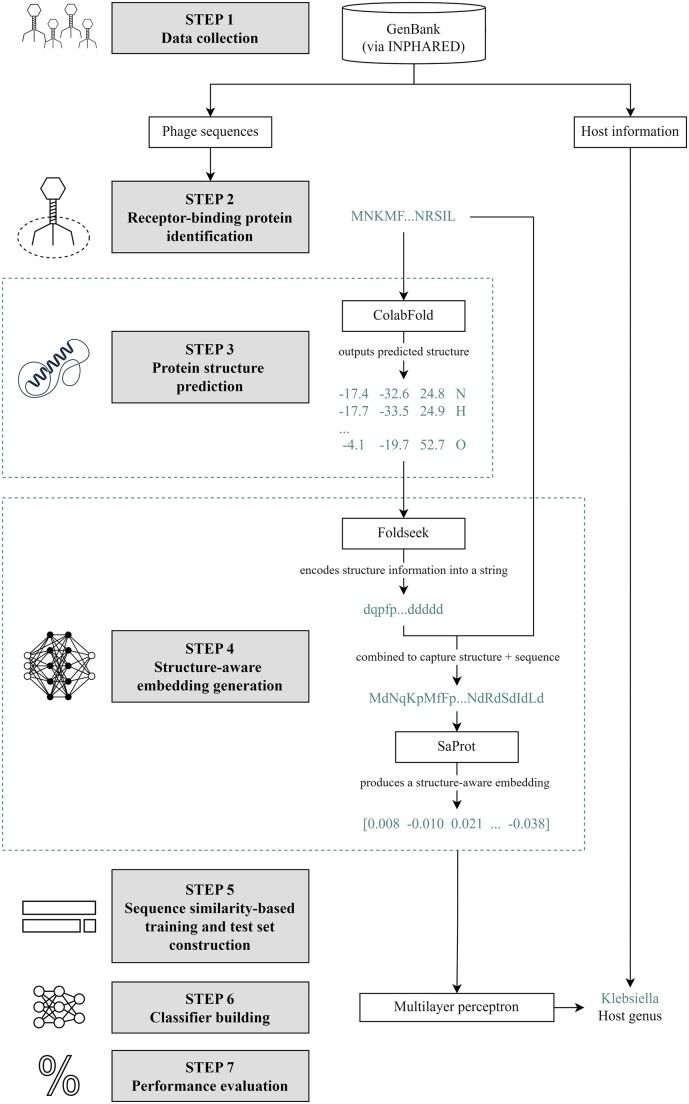
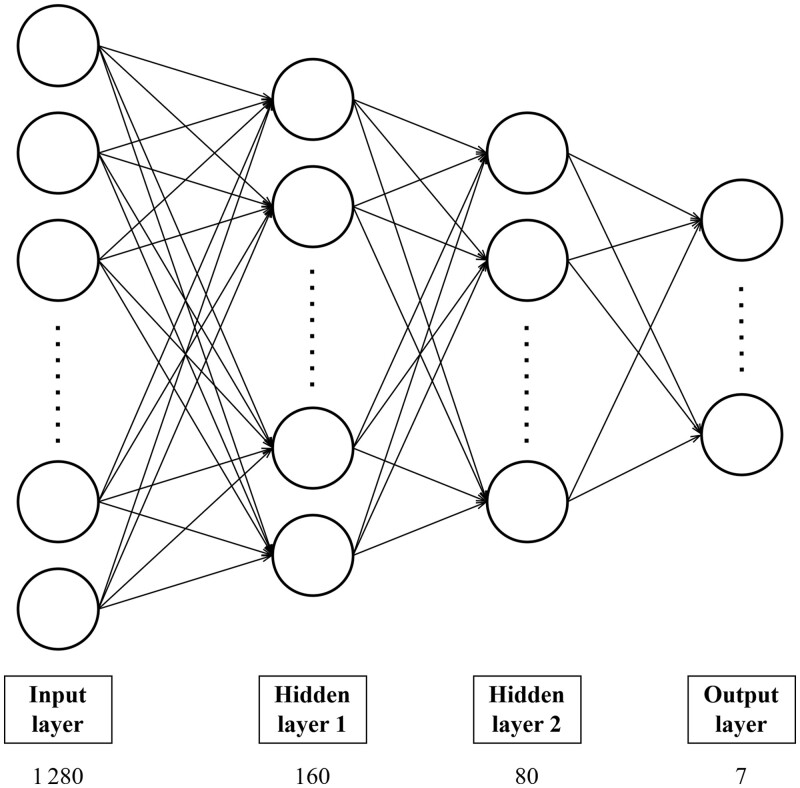
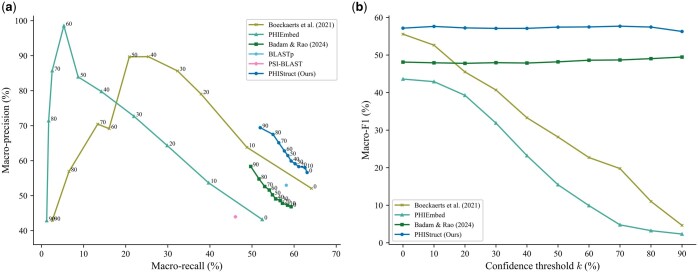
Motivation: Recent computational approaches for predicting phage-host interaction have explored the use of sequence-only protein language models to produce embeddings of phage proteins without manual feature engineering. However, these embeddings do not directly capture protein structure information and structure-informed signals related to host specificity. Result: We present PHIStruct, a multilayer perceptron that takes in structure-aware embeddings of receptor-binding proteins, generated via the structure-aware protein language model SaProt, and then predicts the host from among the ESKAPEE genera. Compared against recent tools, PHIStruct exhibits the best balance of precision and recall, with the highest and most stable F1 score across a wide range of confidence thresholds and sequence similarity settings. The margin in performance is most pronounced when the sequence similarity between the training and test sets drops below 40%, wherein, at a relatively high-confidence threshold of above 50%, PHIStruct presents a 7% to 9% increase in class-averaged F1 over machine learning tools that do not directly incorporate structure information, as well as a 5% to 6% increase over BLASTp. Availability and Implementation: The data and source code for our experiments and analyses are available at https://github.com/bioinfodlsu/PHIStruct .
Overview
The claims and statistics of this paper haven’t been checked yet.
Free: it reads the open-access text and checks the first 5 claims that cite a source we can check. Create a free account to check every claim.
Integrity signals
Registry
Cites
Statistics
Figures
Verification
Claims the paper makes
The claims and statistics of this paper haven’t been checked yet.
Free: it reads the open-access text and checks the first 5 claims that cite a source we can check. Create a free account to check every claim.
Self-check
Percentages, sums and reported differences re-computed from the paper’s own numbers.
The self-check needs the paper’s full text.
Citations
Cites
Highly accurate protein structure prediction with AlphaFold
Jumper, J., Evans, R., Pritzel, A., Green, T., Figurnov, M., Ronneberger, O., Tunyasuvunakool, K., Bates, R., Žídek, A., Potapenko, A., et al. (2021) · Nature · doi:10.1038/s41586-021-03819-2 · Cited by 43,764
Prokka: rapid prokaryotic genome annotation
Seemann, T. (2014) · Bioinformatics · doi:10.1093/bioinformatics/btu153 · Cited by 18,818
Prodigal: prokaryotic gene recognition and translation initiation site identification
Hyatt, D., Chen, G.-L., LoCascio, P. F., Land, M. L., Larimer, F. W., & Hauser, L. J. (2010) · BMC Bioinformatics · doi:10.1186/1471-2105-11-119 · Cited by 12,587
Cd-hit: Accelerated for clustering the next-generation sequencing data
Fu, L., Niu, B., Zhu, Z., Wu, S., & Li, W. (2012) · Bioinformatics · doi:10.1093/bioinformatics/bts565 · Cited by 11,175
ColabFold - Making protein folding accessible to all
Mirdita, M., Schütze, K., Moriwaki, Y., Heo, L., Ovchinnikov, S., & Steinegger, M. (2021) · doi:10.1101/2021.08.15.456425 · Cited by 9,391
Varadi, M., Anyango, S., Deshpande, M., Nair, S., Natassia, C., Yordanova, G., Yuan, D., Stroe, O., Wood, G., Laydon, A., et al. (2022) · Nucleic Acids Research · doi:10.1093/nar/gkab1061 · Cited by 7,850
UniProt: the Universal Protein knowledgebase
Apweiler, R. (2004) · Nucleic Acids Research · doi:10.1093/nar/gkh131 · Cited by 7,498
Evolutionary-scale prediction of atomic level protein structure with a language model
Lin, Z., Akin, H., Rao, R., Hie, B., Zhu, Z., Lu, W., Smetanin, N., Verkuil, R., Kabeli, O., Shmueli, Y., et al. (2022) · doi:10.1101/2022.07.20.500902 · Cited by 5,990
MMseqs2 enables sensitive protein sequence searching for the analysis of massive data sets
Steinegger, M., & Söding, J. (2017) · Nature Biotechnology · doi:10.1038/nbt.3988 · Cited by 4,840
Rives, A., Meier, J., Sercu, T., Goyal, S., Lin, Z., Liu, J., Guo, D., Ott, M., Zitnick, C. L., Ma, J., et al. (2021) · Proceedings of the National Academy of Sciences · doi:10.1073/pnas.2016239118 · Cited by 3,286
Research works printed but not linked: 8
- Gustavo E. A. P. A. Batista , Ana L. C. Bazzan , and Maria Carolina Monard . Balancing training data for automated annotation of keywords: a case study. In Sérgio Lifschitz, Nalvo F. Almeida Jr., Georgios Joannis Pappas Jr., and Ricardo Linden, editors, WOB, pages 10–18, 2003.
- 2024, Celia Ferriol-González, Jesús Oteo-Iglesias, Rafael Sanjuán, Pilar Domingo-Calap, Bernard De Baets, and Yves Briers. Prediction of Klebsiella phage-host specificity at the strain level, Nature Communications, 15, 4355
- Diederick P Kingma and Jimmy Ba . Adam: a method for stochastic optimization. In International Conference on Learning Representations (ICLR), 2015.
- 2021, PHIAF: prediction of phage-host interactions with GAN-based data augmentation and sequence-based feature fusion, Briefings in Bioinformatics, 23, bbab348
- Aaron van den Oord , Oriol Vinyals , and Koray Kavukcuoglu . Neural discrete representation learning. In I. Guyon, U. Von Luxburg, S. Bengio, H. Wallach, R. Fergus, S. Vishwanathan, and R. Garnett, editors, Advances in Neural Information Processing Systems, volume 30. Curran Associates, Inc., 2017.
- 2021, AlphaFold Protein Structure Database: massively expanding the structural coverage of protein-sequence space with high-accuracy models, Nucleic Acids Research, 50, D439
- 2023, Antimicrobial resistance: Addressing a global threat to humanity, PLOS Medicine, 20, 1
- Keyulu Xu , Weihua Hu , Jure Leskovec , and Stefanie Jegelka . How powerful are graph neural networks? In International Conference on Learning Representations, 2019.
Metadata
- Authors
- Gonzales, M. E. M., Ureta, J. C., & Shrestha, A. M. S.
- Affiliations
- De La Salle University (PH)
- Walter and Eliza Hall Institute of Medical Research (AU)
- Corresponding author
- Shrestha, Anish M.S.
- Venue
- Bioinformatics
- Publisher
- openRxiv
- Published
- 2024-08-24
- Volume
- 41
- Issue
- 1
- ISSN
- 1367-4803 (ISSN-L)
- PMC
- PMC11783280
- OpenAlex
- W4406308609
- Cited by
- 23
- References
- 54
- Citations by year
- 2026: 17 · 2025: 6
- FWCI
- 6.30
- Type
- journal article
- Language
- en
- Open access
- gold
- doi.org
- Licence
- Locations
- Bioinformatics (publishedVersion, cc-by)
- bioRxiv (Cold Spring Harbor Laboratory) (acceptedVersion, cc-by-nc-nd)
- PubMed Central (publishedVersion, cc-by)
- PubMed (publishedVersion)
- Funders
- Monash University
- Philippine Council for Health Research and Development
- Topics
- Life Sciences › Immunology and Microbiology › Virology › Bacteriophages and microbial interactions
- Life Sciences › Biochemistry, Genetics and Molecular Biology › Molecular Biology › Machine Learning in Bioinformatics
- Life Sciences › Biochemistry, Genetics and Molecular Biology › Molecular Biology › Genomics and Phylogenetic Studies
- Keywords
- receptor binding protein, host specificity, low sequence similarity, phage resistance genes, protein structure, multilayer perceptron
- MeSH terms
- Machine Learning, Algorithms, Bacteriophages, Software, Viral Proteins, Computational Biology
About these checks
Registry, retraction, Cites and statistics results are computed, not judged, with one exception: a printed reference that no index lists is read once by a model before it counts as a citation error. Claims are extracted by a model and kept only when their quote appears verbatim in the text; each cited source is then checked, with a model’s help, for whether it says what the claim relies on. Those verdicts can be wrong — read the claim’s quote and the cited source before relying on one.
Statistics and arithmetic are recomputed, not judged.
Confidence bands are shown only for fields calibrated on our annotated test set. None is calibrated yet, so no band is shown.
What counts as a claim ›How we measure confidence ›How we check this ›
Are you an author, or do you see a problem with this page? Request a review
How to cite
Cite CoChat for the checks on this page, and the paper for its own findings.
- This page
- CoChat. (2026). Citation check: PHIStruct: Improving phage-host interaction prediction at low sequence similarity settings using structure-aware protein embeddings. https://app.cochat.ai/papers/10.1101/2024.08.24.609479
- The paper
- Gonzales, M. E. M., Ureta, J. C., & Shrestha, A. M. S. (2024). PHIStruct: Improving phage-host interaction prediction at low sequence similarity settings using structure-aware protein embeddings. Bioinformatics. https://doi.org/10.1101/2024.08.24.609479
Data sources
Bibliographic data: Semantic Scholar, OpenAlex, Crossref.
Contains information from the Semantic Scholar Academic Graph Datasets, made available under the ODC Attribution License (ODC-BY 1.0).
Semantic Scholar’s data is described in: Kinney, R., et al. (2023). The Semantic Scholar Open Data Platform. arXiv:2301.10140.
