

The DOI matches its Crossref record; 120 of the 120 references it cites were found in a registry or an index.
Biological structure and function emerge from scaling unsupervised learning to 250 million protein sequences
Open accessPublished version of a preprint
Abstract
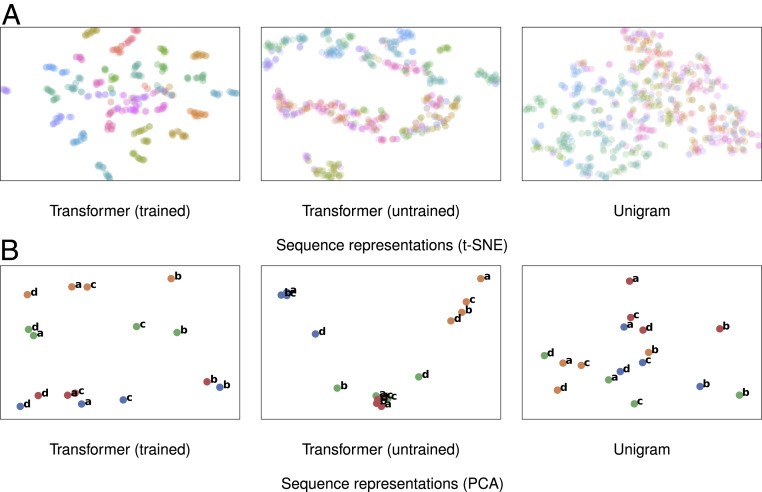
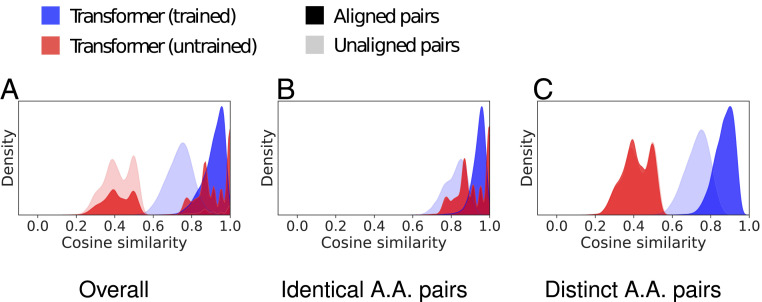
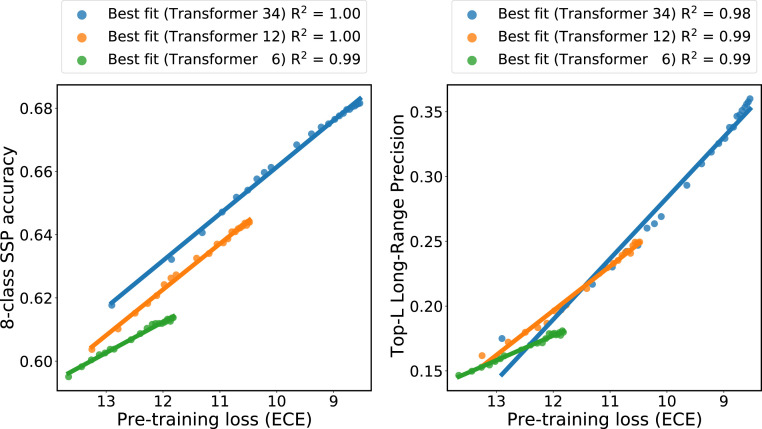
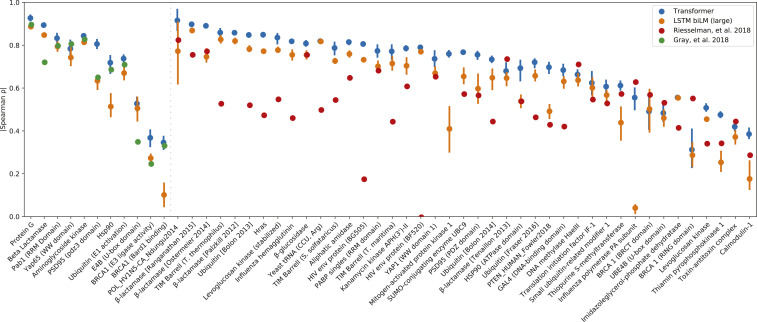
Significance: Learning biological properties from sequence data is a logical step toward generative and predictive artificial intelligence for biology. Here, we propose scaling a deep contextual language model with unsupervised learning to sequences spanning evolutionary diversity. We find that without prior knowledge, information emerges in the learned representations on fundamental properties of proteins such as secondary structure, contacts, and biological activity. We show the learned representations are useful across benchmarks for remote homology detection, prediction of secondary structure, long-range residue–residue contacts, and mutational effect. Unsupervised representation learning enables state-of-the-art supervised prediction of mutational effect and secondary structure and improves state-of-the-art features for long-range contact prediction.
Overview
The claims and statistics of this paper haven’t been checked yet.
Free: it reads the open-access text and checks the first 5 claims that cite a source we can check. Create a free account to check every claim.
Integrity signals
Registry
Cites
Statistics
Figures



Verification
Claims the paper makes
The claims and statistics of this paper haven’t been checked yet.
Free: it reads the open-access text and checks the first 5 claims that cite a source we can check. Create a free account to check every claim.
Claims other papers make about this one
Each is checked against this paper’s own text: does it say what the citing paper says it does?
The source backs part of the claim, not all of it — or backs it for a different population, condition or comparison.
In the citing paper
“The current state-of-the-art in sequence-based modeling is the use of AI/ML embeddings pretrained on multimillion-scale protein collections.118”
From Advancing Targeted Protein Degradation via Multiomics Profiling and Artificial Intelligence (2023) · cites this paper as [118]
Experimental — accuracy not yet measuredThe source backs part of the claim, not all of it — or backs it for a different population, condition or comparison.
In the citing paper
“Since then, various language model-based protein embedding methods have been applied to these and other protein prediction problems through transfer learning, including protein phenotype prediction 28,32-34, residue-residue contact prediction 32,70, fold recognition 33, protein-protein 71,72 and protein-drug interaction prediction 35,73.”
From Learning the protein language: Evolution, structure, and function (2021) · cites this paper as [32]
Experimental — accuracy not yet measuredThe source backs part of the claim, not all of it — or backs it for a different population, condition or comparison.
In the citing paper
“It has been shown that the resulting representations contain rich information about the structure and the function of the proteins 17 , 32 , 33 .”
From Turnover number predictions for kinetically uncharacterized enzymes using machine and deep learning (2023) · cites this paper as [17]
Experimental — accuracy not yet measuredThe source backs part of the claim, not all of it — or backs it for a different population, condition or comparison.
In the citing paper
“the evolutionary scale modeling (ESM) family (Rives et al. 2021), comprising transformer protein language models such as ESM-2 and ESMFold, surpasses earlier single-sequence protein language models, demonstrating enhanced capability in generating accurate structure predictions based on protein sequences.”
From Large language models (LLMs): survey, technical frameworks, and future challenges (2024) · cites this paper as Rives et al. 2021
Experimental — accuracy not yet measuredThe cited source says what the claim attributes to it.
In the citing paper
“New work has since shown that the representations learned by language models are also powerful features for learning of variant fitness as a subsequent supervised learning task 32,34, building on earlier observations that language models can improve protein property prediction through transfer learning 27.”
From Learning the protein language: Evolution, structure, and function (2021) · cites this paper as [32]
7 more claims about this paper
Create a free account to see every claim other papers make about this one.
Self-check
Percentages, sums and reported differences re-computed from the paper’s own numbers.
The self-check needs the paper’s full text.
Citations
Cites
Vaswani, A., Shazeer, N., Parmar, N., Uszkoreit, J., Jones, L., Gomez, A. N., Kaiser, L., & Polosukhin, I. (2017) · arXiv · doi:10.48550/arxiv.1706.03762 · Cited by 120,404
Hochreiter, S., & Schmidhuber, J. (1997) · Neural Computation · doi:10.1162/neco.1997.9.8.1735 · Cited by 102,318
Basic local alignment search tool
Altschul, S. F., Gish, W., Miller, W., Myers, E. W., & Lipman, D. J. (1990) · Journal of Molecular Biology · doi:10.1006/jmbi.1990.9999 · Cited by 98,669
BERT: Pre-training of Deep Bidirectional Transformers for Language Understanding
Devlin, J., Chang, M.-W., Lee, K., & Toutanova, K. (2018) · arXiv · doi:10.48550/arxiv.1810.04805 · Cited by 73,173
BERT: Pre-training of Deep Bidirectional Transformers for Language Understanding
Devlin, J., Chang, M.-W., Lee, K., & Toutanova, K. (2019) · Proceedings of the 2019 Conference of the North American Chapter of the Association for Computational Linguistics: Human Language Technologies, Volume 1 (Long and Short Papers) · doi:10.18653/v1/n19-1423 · Cited by 54,325
(2008) · Journal of Machine Learning Research · Cited by 33,051
Efficient Estimation of Word Representations in Vector Space
Mikolov, T., Chen, K., Corrado, G., & Dean, J. (2013) · arXiv · doi:10.48550/arxiv.1301.3781 · Cited by 26,568
Distributed Representations of Words and Phrases and their Compositionality
Mikolov, T., Sutskever, I., Chen, K., Corrado, G., & Dean, J. (2013) · arXiv · doi:10.48550/arxiv.1310.4546 · Cited by 24,533
Reducing the dimensionality of data with neural networks
Hinton, G. E., & Salakhutdinov, R. R. (2006) · Science · doi:10.1126/science.1127647 · Cited by 20,928
Kabsch, W., & Sander, C. (1983) · Biopolymers · doi:10.1002/bip.360221211 · Cited by 15,320
Research works printed but not linked: 4
- A. Radford . Language models are unsupervised multitask learners. OpenAI Blog [Preprint] (2019). https://openai.com/blog/better-language-models (Accessed 6 August 2020).
- 10.1016/S0022-2836(05)80360-2 · doi:10.1016/s0022-2836(05)80360-2 · Paper page
- A. Radford K. Narasimhan T. Salimans I. Sutskever Improving language understanding by generative pre-training. OpenAI Blog [Preprint] (2018). https://openai.com/blog/language-unsupervised (Accessed 6 August 2020).
- T. Mikolov . Subword language modeling with neural networks. The website of T. Mikolov [Preprint] (2012). http://www.fit.vutbr.cz/∼imikolov/rnnlm/char.pdf (Accessed 14 March 2021).
Cited by
Highly accurate protein structure prediction with AlphaFold
Jumper, J., Evans, R., Pritzel, A., Green, T., Figurnov, M., Ronneberger, O., Tunyasuvunakool, K., Bates, R., Žídek, A., Potapenko, A., et al. (2021) · Nature · doi:10.1038/s41586-021-03819-2 · Cited by 43,764
Evolutionary-scale prediction of atomic level protein structure with a language model
Lin, Z., Akin, H., Rao, R., Hie, B., Zhu, Z., Lu, W., Smetanin, N., Verkuil, R., Kabeli, O., Shmueli, Y., et al. (2022) · doi:10.1101/2022.07.20.500902 · Cited by 5,990
Self-citationSignalP 6.0 predicts all five types of signal peptides using protein language models
Teufel, F., Almagro Armenteros, J. J., Johansen, A. R., Gíslason, M. H., Pihl, S. I., Tsirigos, K. D., Winther, O., Brunak, S., von Heijne, G., & Nielsen, H. (2022) · Nature Biotechnology · doi:10.1038/s41587-021-01156-3 · Cited by 2,867
On the Opportunities and Risks of Foundation Models
Bommasani, R., Hudson, D. A., Adeli, E., Altman, R., Arora, S., von Arx, S., Bernstein, M. S., Bohg, J., Bosselut, A., Brunskill, E., et al. (2021) · arXiv · doi:10.48550/arxiv.2108.07258 · Cited by 2,676
ProtTrans: Toward Understanding the Language of Life Through Self-Supervised Learning
Elnaggar, A., Heinzinger, M., Dallago, C., Rehawi, G., Wang, Y., Jones, L., Gibbs, T., Feher, T., Angerer, C., Steinegger, M., et al. (2022) · IEEE Transactions on Pattern Analysis and Machine Intelligence · doi:10.1109/tpami.2021.3095381 · Cited by 2,329
Metadata
- Authors
- Rives, A., Meier, J., Sercu, T., Goyal, S., Lin, Z., Liu, J., Guo, D., Ott, M., Zitnick, C. L., Ma, J., & Fergus, R.
- Affiliations
- Meta (United States) (US)
- New York University (US)
- Harvard University (US)
- Yale University (US)
- Corresponding author
- Rives, Alexander
- ORCID
- Venue
- Proceedings of the National Academy of Sciences
- Publisher
- National Academy of Sciences
- Published
- 2021-04-05
- Volume
- 118
- Issue
- 15
- ISSN
- 0027-8424 (ISSN-L)
- 1091-6490
- PMC
- PMC8053943
- OpenAlex
- W3146944767
- Cited by
- 3,286
- References
- 100
- Citations by year
- 2026: 787 · 2025: 813 · 2024: 697 · 2023: 448 · 2022: 305 · 2021: 162
- FWCI
- 126.15
- Type
- journal article
- Language
- en
- Open access
- hybrid
- doi.org
- Licence
- Locations
- Proceedings of the National Academy of Sciences (publishedVersion, cc-by-nc-nd)
- bioRxiv (Cold Spring Harbor Laboratory) (acceptedVersion, cc-by-nc-nd)
- PubMed Central (publishedVersion, cc-by-nc-nd)
- PubMed (publishedVersion)
- Knowledge@UChicago (University of Chicago) (submittedVersion, cc-by-nc-nd)
- University of Chicago
- Funders
- National Science Foundation (1339362)
- Topics
- Life Sciences › Biochemistry, Genetics and Molecular Biology › Molecular Biology › Machine Learning in Bioinformatics
- Life Sciences › Biochemistry, Genetics and Molecular Biology › Molecular Biology › Protein Structure and Dynamics
- Life Sciences › Biochemistry, Genetics and Molecular Biology › Molecular Biology › RNA and protein synthesis mechanisms
- Keywords
- protein language models, unsupervised learning, protein evolution, protein structure prediction, secondary structure prediction, protein tertiary structure, remote homology
- MeSH terms
- Unsupervised Machine Learning, Amino Acids, Protein Conformation, Sequence Homology, Amino Acid, Sequence Analysis, Protein
About these checks
Registry, retraction, Cites and statistics results are computed, not judged, with one exception: a printed reference that no index lists is read once by a model before it counts as a citation error. Claims are extracted by a model and kept only when their quote appears verbatim in the text; each cited source is then checked, with a model’s help, for whether it says what the claim relies on. Those verdicts can be wrong — read the claim’s quote and the cited source before relying on one.
Statistics and arithmetic are recomputed, not judged.
Confidence bands are shown only for fields calibrated on our annotated test set. None is calibrated yet, so no band is shown.
What counts as a claim ›How we measure confidence ›How we check this ›
Are you an author, or do you see a problem with this page? Request a review
How to cite
Cite CoChat for the checks on this page, and the paper for its own findings.
- This page
- CoChat. (2026). Citation check: Biological structure and function emerge from scaling unsupervised learning to 250 million protein sequences. https://app.cochat.ai/papers/10.1073/pnas.2016239118
- The paper
- Rives, A., Meier, J., Sercu, T., Goyal, S., Lin, Z., Liu, J., Guo, D., Ott, M., Zitnick, C. L., Ma, J., & Fergus, R. (2021). Biological structure and function emerge from scaling unsupervised learning to 250 million protein sequences. Proceedings of the National Academy of Sciences. https://doi.org/10.1073/pnas.2016239118
Data sources
Bibliographic data: Semantic Scholar, OpenAlex, Crossref.
Contains information from the Semantic Scholar Academic Graph Datasets, made available under the ODC Attribution License (ODC-BY 1.0).
Semantic Scholar’s data is described in: Kinney, R., et al. (2023). The Semantic Scholar Open Data Platform. arXiv:2301.10140.
