

The DOI matches its Crossref record; 1 of the 1 references it cites were found in a registry or an index.
Physical-aware model accuracy estimation for protein complex using deep learning method
Open accessPreprint — published as 10.1016/j.csbj.2025.01.017 · Paper page
Abstract
With the breakthrough of AlphaFold2 on monomers, the research focus of structure prediction has shifted to protein complexes, driving the continued development of new methods for multimer structure prediction. Therefore, it is crucial to accurately estimate quality scores for the multimer model independent of the used prediction methods. In this work, we propose a physical-aware deep learning method, DeepUMQA-PA, to evaluate the residue-wise quality of protein complex models. For the input complex model, the residue-based contact area and orientation features were first constructed using Voronoi tessellation, representing the potential physical interactions and hydrophobic properties. Then, the relationship between local residues and the overall complex topology as well as the inter-residue evolutionary information are characterized by geometry-based features, protein language model embedding representation, and knowledge-based statistical potential features. Finally, these features are fed into a fused network architecture employing equivalent graph neural network and ResNet network to estimate residue-wise model accuracy. Experimental results on the CASP15 test set demonstrate that our method outperforms the state-of-the-art method DeepUMQA3 by 3.69% and 3.49% on Pearson and Spearman, respectively. Notably, our method achieved 16.8% and 15.5% improvement in Pearson and Spearman, respectively, for the evaluation of nanobody-antigens. In addition, DeepUMQA-PA achieved better MAE scores than AlphaFold-Multimer and AlphaFold3 self-assessment methods on 43% and 50% of the targets, respectively. All these results suggest that physical-aware information based on the area and orientation of atom-atom and atom-solvent contacts has the potential to capture sequence-structure-quality relationships of proteins, especially in the case of flexible proteins. The DeepUMQA-PA server is freely available at http://zhanglab-bioinf.com/DeepUMQA-PA/ .
Overview
The claims and statistics of this paper haven’t been checked yet.
Run the check — free, no account needed. It reads the open-access text and checks the sources it cites.
Integrity signals
Registry
Cites
Statistics
Figures
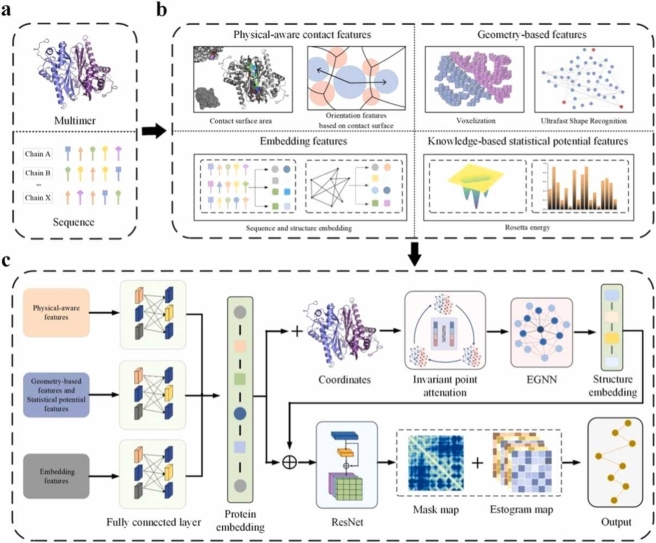
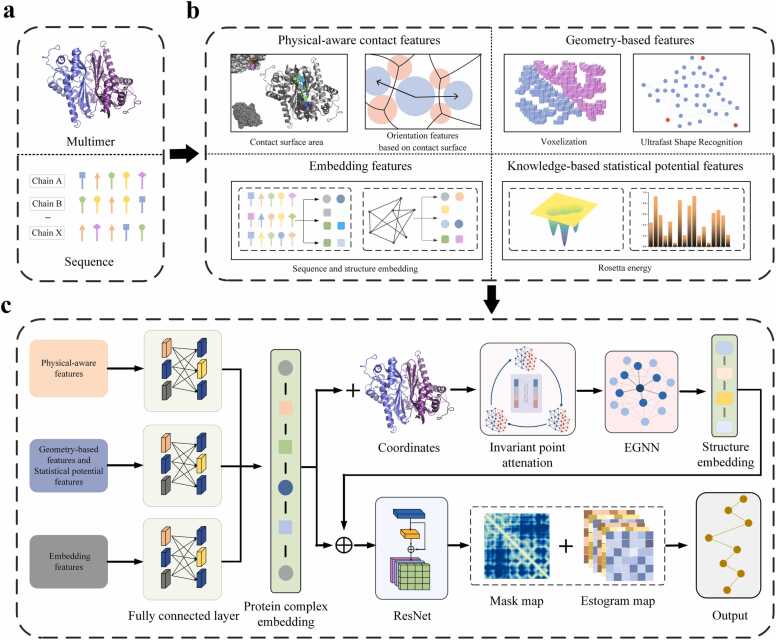
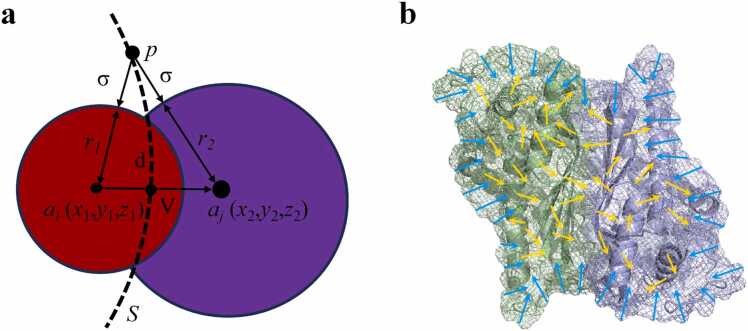
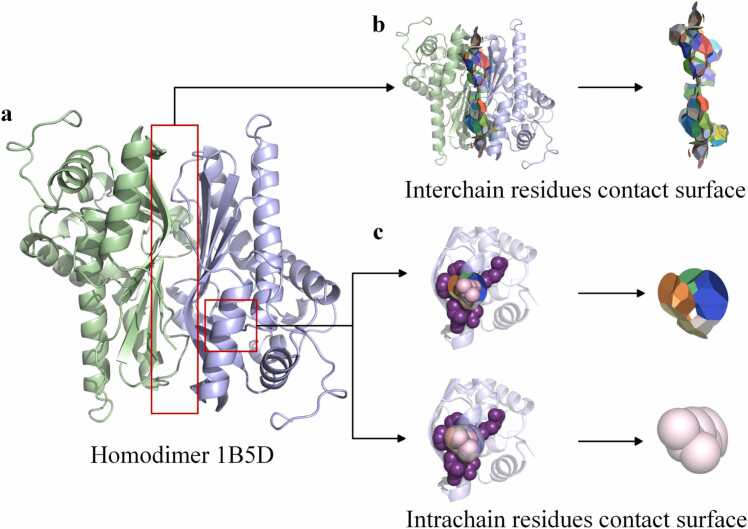
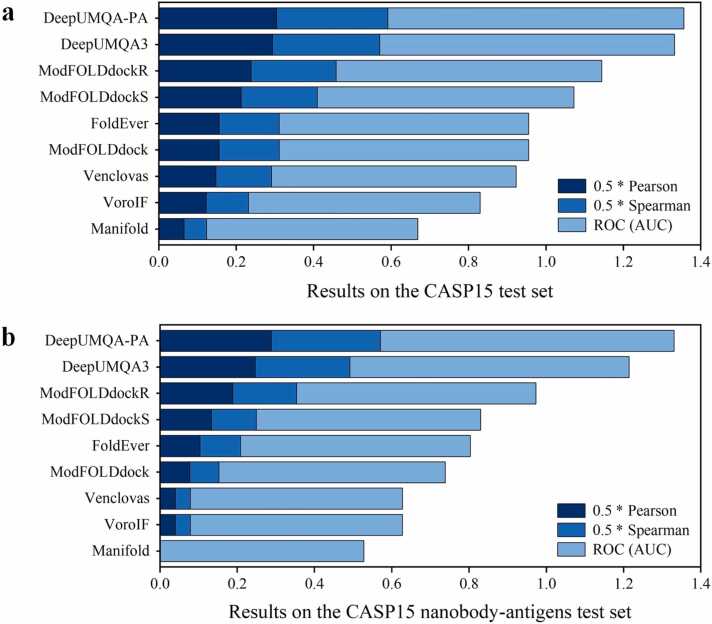
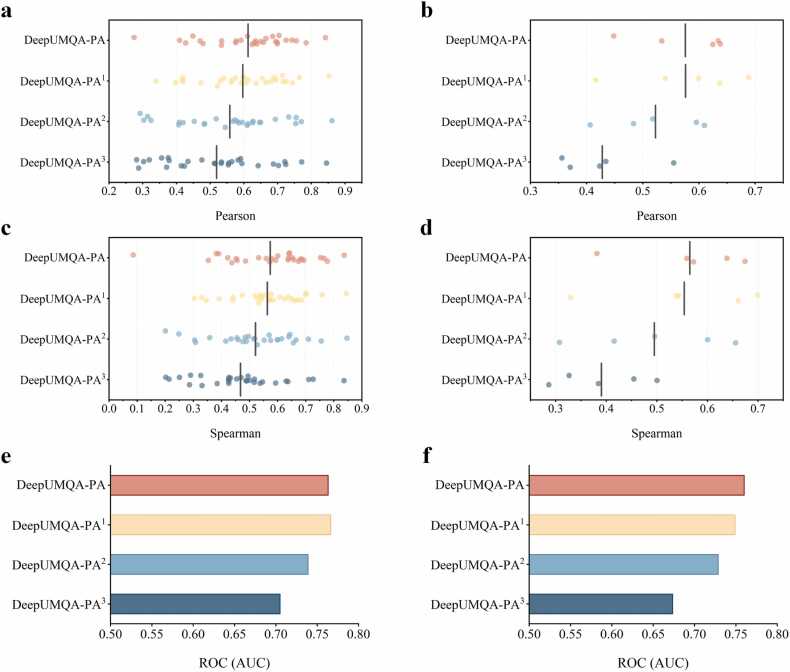
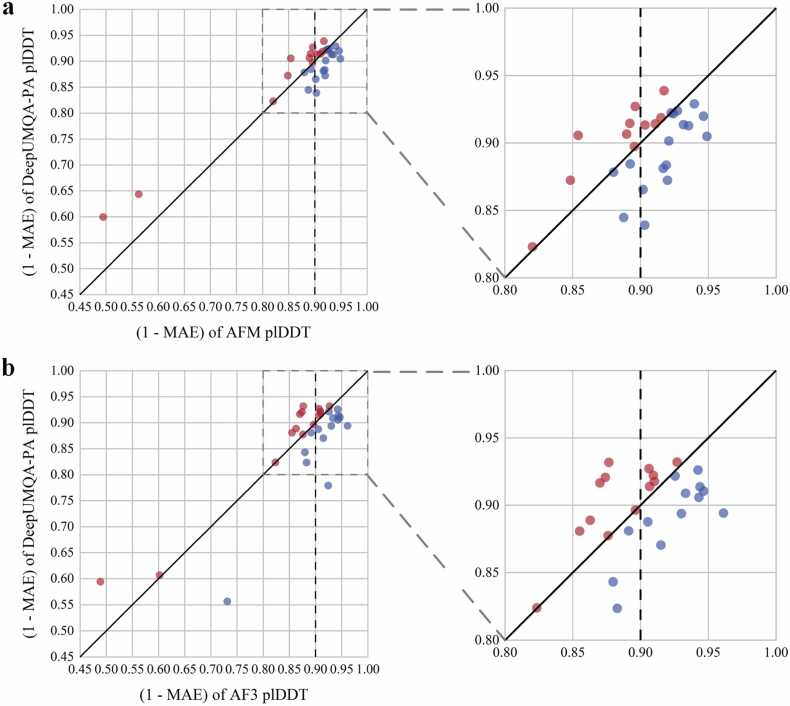
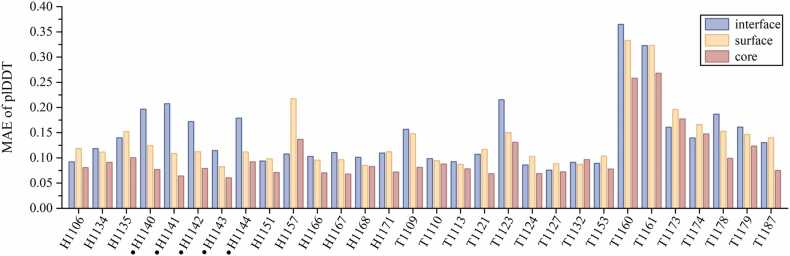
Verification
Claims the paper makes
The claims and statistics of this paper haven’t been checked yet.
Run the check — free, no account needed. It reads the open-access text and checks the sources it cites.
Self-check
Percentages, sums and reported differences re-computed from the paper’s own numbers.
The self-check needs the paper’s full text.
Citations
Cites
Highly accurate protein structure prediction with AlphaFold
Jumper, J., Evans, R., Pritzel, A., Green, T., Figurnov, M., Ronneberger, O., Tunyasuvunakool, K., Bates, R., Žídek, A., Potapenko, A., et al. (2021) · Nature · doi:10.1038/s41586-021-03819-2 · Cited by 43,764
Research works printed but not linked: 53
- 10.1101/2021.10.04.463034 · DOI · Paper page
- 10.1002/prot.26585 · DOI
- 10.1093/bioinformatics/btad573 · DOI · Paper page
- 10.1002/prot.26570 · DOI
- 10.1038/S41586-024-07487-W · DOI · Paper page
- 10.1002/prot.26617 · DOI · Paper page
- 10.1002/prot.26545 · DOI
- 10.1002/prot.26542 · DOI
- 10.1002/prot.26532 · DOI
- 10.1002/prot.26569 · DOI · Paper page
- 10.1002/prot.26554 · DOI · Paper page
- 10.1093/bioinformatics/btad591 · DOI
- 10.1073/pnas.0535768100 · DOI
- 10.1002/(SICI)1096-987X(19970715)18:9<1113::AID-JCC1>3.0.CO;2-U · DOI
- 10.1002/prot.25278 · DOI
- 10.1038/319199a0 · DOI
- 2021, E(n) Equivariant Graph Neural Networks.” presented at the Proceedings of the 38th International Conference on Machine Learning, Proceedings of Machine Learning Research, 2021, 9323
- 10.1093/bioinformatics/btt473 · DOI · Paper page
- 10.1002/prot.26612 · DOI
- 10.1371/journal.pone.0161879 · DOI · Paper page
- 10.1093/bioinformatics/btae586 · DOI
- 10.1002/prot.24172 · DOI
- 10.1093/bioinformatics/btz122 · DOI
- 10.1038/s41467-021-21511-x · DOI · Paper page
- 10.1002/jcc.20681 · DOI
- 10.1093/bioinformatics/btac056 · DOI · Paper page
- 10.1002/prot.26564 · DOI
- 10.1093/bib/bbad420 · DOI
- 10.1126/science.adk8946 · DOI
- 10.1101/2022.07.20.500902 · DOI · Paper page
- 2022, Learning inverse folding from millions of predicted structures.” presented at the Proceedings of the 39th International Conference on Machine Learning, Proceedings of Machine Learning Research, 162, 8946
- 10.1126/science.ade2574 · DOI · Paper page
- 10.1016/B978-0-12-381270-4.00019-6 · DOI
- 10.1016/S0076-6879(04)83004-0 · DOI
- 10.1038/srep33509 · DOI
- 10.1007/978-3-319-46493-0_38 · DOI · Paper page
- 10.1016/j.neucom.2019.10.008 · DOI
- 10.1016/j.neucom.2021.03.091 · DOI · Paper page
- 10.48550/arXiv.1606.08415 · DOI · Paper page
- 10.1109/IWQoS.2018.8624183 · DOI
- 10.1002/pro.2007 · DOI
- 10.1111/opo.12636 · DOI
- 2022, Spearman’s correlation coefficient in statistical analysis, International Journal of Nonlinear Analysis and Applications, 13, 3249
- 10.1007/3-540-44886-1_25 · DOI
- 10.1103/RevModPhys.11.1 · DOI
- 10.1080/00018736100101281 · DOI
- 10.1038/s41467-023-37701-8 · DOI
- 10.1002/prot.26554 · DOI · Paper page
- 10.1093/bioinformatics/btad591 · DOI
- 10.1038/s41467-021-21511-x · DOI · Paper page
- 2022, Learning inverse folding from millions of predicted structures.” presented at the Proceedings of the 39th International Conference on Machine Learning, Proceedings of Machine Learning Research, 162, 8946
- 10.1126/science.ade2574 · DOI · Paper page
- 10.1093/bioinformatics/btac056 · DOI · Paper page
Metadata
- Authors
- Wang, H., Sun, M., Xie, L., Liu, D., & Zhang, G.
- Affiliations
- Zhejiang University of Technology (CN)
- Corresponding author
- Zhang, Guijun
- Venue
- Computational and Structural Biotechnology Journal
- Publisher
- openRxiv
- Published
- 2024-11-03
- Volume
- 27
- Pages
- 478-487
- ISSN
- 2001-0370 (ISSN-L)
- PMC
- PMC11799971
- OpenAlex
- W4406704559
- Cited by
- 5
- References
- 1
- Citations by year
- 2026: 3 · 2025: 2
- FWCI
- 1.49
- Type
- journal article
- Language
- en
- Open access
- gold
- doi.org
- Licence
- cc-by-nc-nd
- www.biorxiv.org/about/FAQ#license (vor)
- Locations
- Computational and Structural Biotechnology Journal (publishedVersion, cc-by-nc-nd)
- bioRxiv (Cold Spring Harbor Laboratory) (acceptedVersion)
- PubMed Central (publishedVersion, cc-by-nc-nd)
- PubMed (publishedVersion)
- DOAJ (DOAJ: Directory of Open Access Journals) (submittedVersion, cc-by-sa)
- Funders
- National Natural Science Foundation of China (62173304, 2023R5248)
- National Key Research and Development Program of China (2022ZD0115103)
- Topics
- Life Sciences › Biochemistry, Genetics and Molecular Biology › Molecular Biology › Protein Structure and Dynamics
- Life Sciences › Biochemistry, Genetics and Molecular Biology › Molecular Biology › Machine Learning in Bioinformatics
- Life Sciences › Biochemistry, Genetics and Molecular Biology › Structural Biology › Enzyme Structure and Function
- Keywords
- protein complex structure prediction, model accuracy assessment, Voronoi tessellation, hydrophobic interactions, graph neural networks, protein language model embeddings, flexible proteins, CASP15
About these checks
Registry, retraction, Cites and statistics results are computed, not judged, with one exception: a printed reference that no index lists is read once by a model before it counts as a citation error. Claims are extracted by a model and kept only when their quote appears verbatim in the text; each cited source is then checked, with a model’s help, for whether it says what the claim relies on. Those verdicts can be wrong — read the claim’s quote and the cited source before relying on one.
Statistics and arithmetic are recomputed, not judged.
Confidence bands are shown only for fields calibrated on our annotated test set. None is calibrated yet, so no band is shown.
What counts as a claim ›How we measure confidence ›How we check this ›
Are you an author, or do you see a problem with this page? Request a review
