

The DOI matches its Crossref record; 2 of the 2 references it cites were found in a registry or an index.
Two different and robustly modeled DNA binding modes of Competence Protein ComP - systematic modeling with AlphaFold 3, RoseTTAFold2NA, Chai-1 and re-docking in HADDOCK
Open accessPreprint — published as 10.1371/journal.pone.0315160 · Paper page
Abstract
The competence protein ComP is a Type IV minor pilin and the extracellular DNA binding protein involved in natural transformation in the human pathogens Neisseria gonorrhoeae , Neisseria meningitidis, Eikenella corrodens and related Neisseriaceae bacteria. Details of the DNA binding mode of ComP is enigmatic, and the 3D structure of the DNA :: protein complex remains unresolved. Here we characterize the ComP orthologs in a set of Neisseriaceae family members, model their common structural domains and their interaction with different preferred 12 base pair long DNA binding motifs, DNA Uptake Sequences (DUS) and scrambled versions of these. Through systematic in silico modeling using AlphaFold 3, RoseTTAFold2NA, and Chai-1 and model comparisons, we bring a new understanding of the interactions between DNA and ComP. We report six distinct binding modes of which two, here named Epsilon and Gamma, were robustly modeled across platforms and different ComPs. The characteristics and robustness of the predicted models and DNA binding modes from each tool are assessed and discussed. This work expands the knowledge on the ComP :: DUS interaction and guides further wet- and dry-lab systematic and experimental characterization of these complexes through which molecular and clinical interventions may be developed.
Overview
The claims and statistics of this paper haven’t been checked yet.
Run the check — free, no account needed. It reads the open-access text and checks the sources it cites.
Integrity signals
Registry
Cites
Statistics
Figures
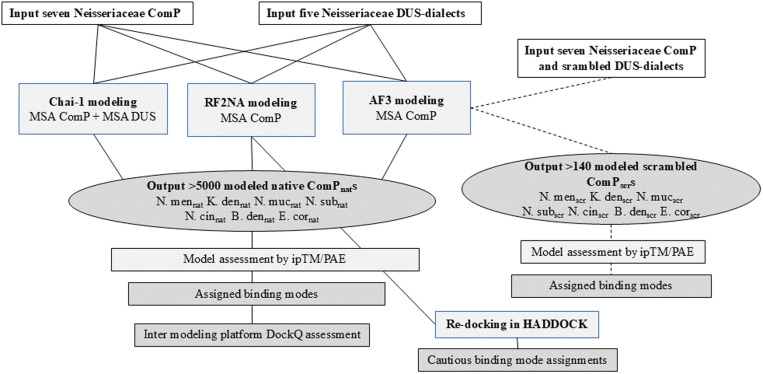
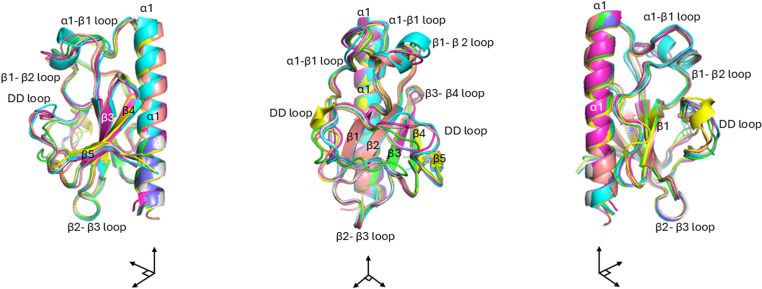
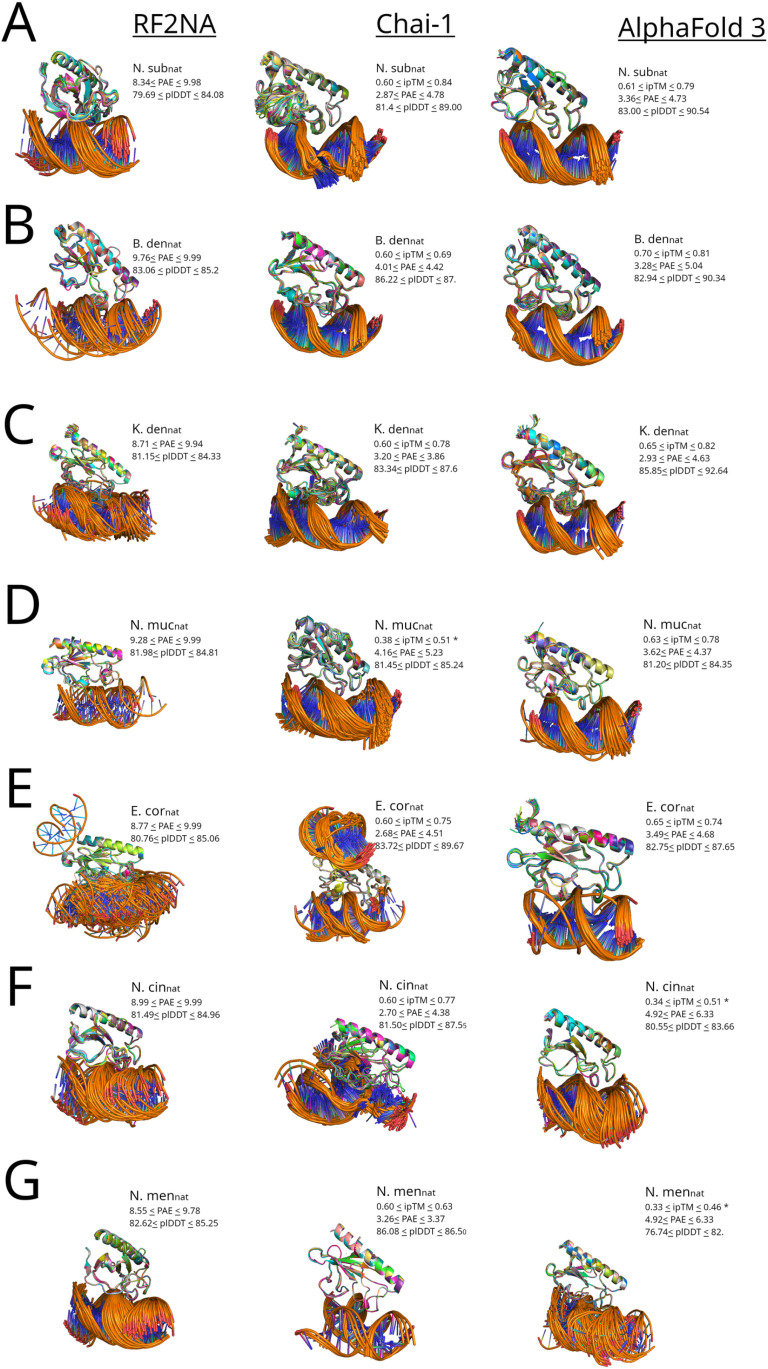
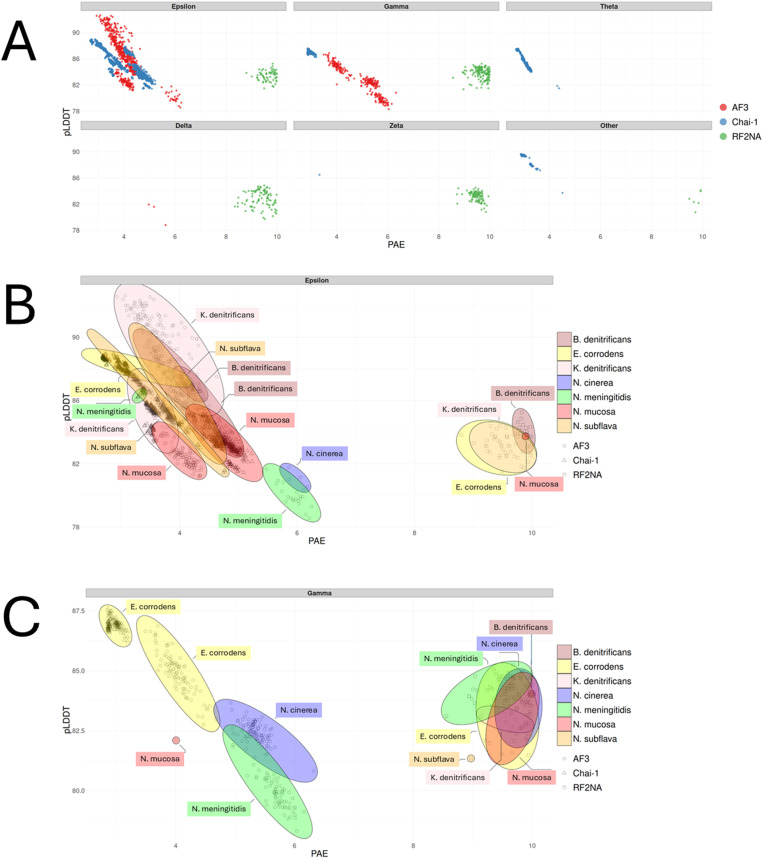
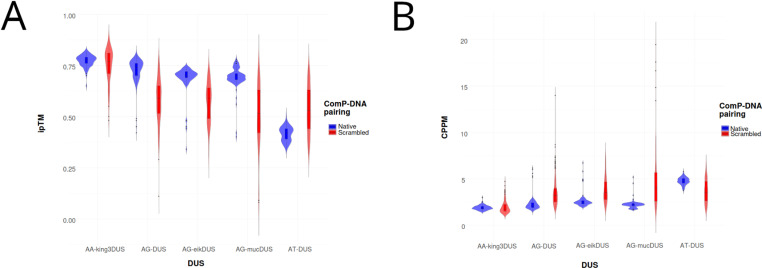
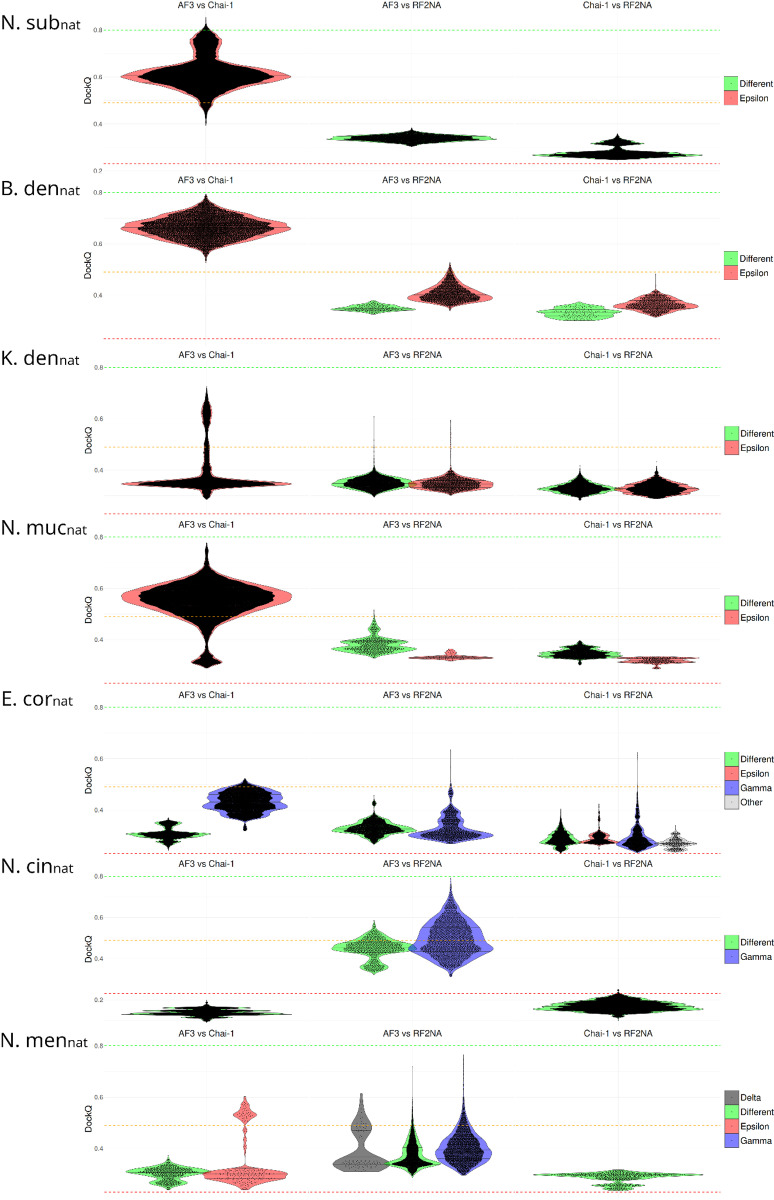
Verification
Claims the paper makes
The claims and statistics of this paper haven’t been checked yet.
Run the check — free, no account needed. It reads the open-access text and checks the sources it cites.
Self-check
Percentages, sums and reported differences re-computed from the paper’s own numbers.
The self-check needs the paper’s full text.
Citations
Cites
Highly accurate protein structure prediction with AlphaFold
Jumper, J., Evans, R., Pritzel, A., Green, T., Figurnov, M., Ronneberger, O., Tunyasuvunakool, K., Bates, R., Žídek, A., Potapenko, A., et al. (2021) · Nature · doi:10.1038/s41586-021-03819-2 · Cited by 43,764
AlphaFold and Implications for Intrinsically Disordered Proteins
Ruff, K. M., & Pappu, R. V. (2021) · Journal of Molecular Biology · doi:10.1016/j.jmb.2021.167208 · Cited by 635
Research works printed but not linked: 41
- 10.1046/j.1365-2958.2002.03193.x · DOI
- 10.1038/s41586-024-07487-w · DOI · Paper page
- 10.1128/JB.01408-06 · DOI
- 10.1098/rstb.2015.0528 · DOI
- 10.1038/s41579-021-00650-4 · DOI · Paper page
- 10.1038/s41592-023-02086-5 · DOI · Paper page
- 10.1128/JCM.01609-14 · DOI
- 10.1371/journal.pone.0161879 · DOI · Paper page
- 2022, Mobility of extracellular DNA within gonococcal colonies, Biofilm, 4, 100078, 10.1016/j.bioflm.2022.100078 · DOI
- 10.1371/journal.pgen.1004014 · DOI
- 10.1016/j.str.2016.04.001 · DOI
- 10.1186/1471-2105-10-421 · DOI · Paper page
- 2022, Rapid detection of Neisseria gonorrhoeae genomic DNA using gold nanoprobes which target the gonococcal DNA uptake sequence, Frontiers in Cellular and Infection Microbiology, 12, 920447, 10.3389/fcimb.2022.920447 · DOI
- 10.1073/pnas.1218832110 · DOI
- 10.1101/2024.10.10.615955 · DOI · Paper page
- 2024, AlphaFold predictions of fold-switched conformations are driven by structure memorization, Nature communications, 15, 7296, 10.1038/s41467-024-51801-z · DOI · Paper page
- 10.48550/arxiv.2210.01776 · DOI
- 2024, Genetic Manipulation of Neisseria gonorrhoeae and Commensal Neisseria Species, Current Protocols, 4, e70000, 10.1002/cpz1.70000 · DOI
- 10.1146/annurev-genet-112618-043641 · DOI
- 10.1111/j.1574-6968.2012.02612.x · DOI
- 10.1093/nar/gkad013 · DOI
- 10.1371/journal.pgen.1003458 · DOI
- 10.1073/pnas.85.18.6982 · DOI
- 10.1093/bioinformatics/btl461 · DOI
- 10.1002/pro.3923 · DOI
- 10.1128/JB.00464-16 · DOI
- 10.1007/s00430-019-00642-5 · DOI
- 10.1126/science.adl2528 · DOI · Paper page
- 10.1101/2024.05.28.596225 · DOI
- 10.1038/s41592-022-01488-1 · DOI · Paper page
- 10.1038/s42256-024-00792-z · DOI
- 10.1099/mic.0.2007/010496-0 · DOI
- 10.1093/bioinformatics/btw482 · DOI
- 10.1186/s12859-014-0399-6 · DOI
- 10.1186/s12859-019-3019-7 · DOI · Paper page
- 10.1038/s41592-019-0437-4 · DOI · Paper page
- 10.48550/arXiv.2408.16975 · DOI
- 10.1186/gb-2008-9-3-r60 · DOI
- 2025, Challenges in bridging the gap between protein structure prediction and functional interpretation. Proteins: Structure, Function, and Bioinformatics, 93, 400, 10.1002/prot.26614 · DOI · Paper page
- 10.1101/2024.11.19.624167 · DOI
- 10.1002/prot.20264 · DOI · Paper page
Metadata
- Authors
- Helsem, S. A., Alfsnes, K., Frye, S. A., Hesselberg Løvestad, A., & Ambur, O. H.
- Affiliations
- OsloMet – Oslo Metropolitan University (NO)
- Norwegian Institute of Public Health (NO)
- Oslo University Hospital (NO)
- Corresponding author
- Ambur, Ole Herman
- ORCID
- Venue
- PLoS ONE
- Publisher
- openRxiv
- Published
- 2024-11-24
- Volume
- 20
- Issue
- 5
- Pages
- e0315160-e0315160
- ISSN
- 1932-6203 (ISSN-L)
- PMC
- PMC12061091
- OpenAlex
- W4410204749
- Cited by
- 3
- References
- 2
- Citations by year
- 2026: 1 · 2025: 2
- FWCI
- 0.90
- Type
- journal article
- Language
- en
- Open access
- gold
- doi.org
- Licence
- Locations
- PLoS ONE (publishedVersion, cc-by)
- bioRxiv (Cold Spring Harbor Laboratory) (acceptedVersion, cc-by)
- PubMed Central (publishedVersion, cc-by)
- PubMed (publishedVersion)
- DOAJ (DOAJ: Directory of Open Access Journals) (submittedVersion)
- Topics
- Life Sciences › Biochemistry, Genetics and Molecular Biology › Molecular Biology › Protein Structure and Dynamics
- Life Sciences › Biochemistry, Genetics and Molecular Biology › Molecular Biology › Biochemical and Structural Characterization
- Life Sciences › Biochemistry, Genetics and Molecular Biology › Structural Biology › Enzyme Structure and Function
- Keywords
- DNA binding modes, natural transformation, Neisseriaceae, protein-DNA complex, protein structure prediction, AlphaFold3, Chai-1, model robustness, Neisseria gonorrhoeae, Neisseria meningitidis, Eikenella corrodens
- MeSH terms
- Bacterial Proteins, Binding Sites, DNA, DNA-Binding Proteins, Humans, Models, Molecular, Protein Binding, Fimbriae Proteins, Molecular Docking Simulation
About these checks
Registry, retraction, Cites and statistics results are computed, not judged, with one exception: a printed reference that no index lists is read once by a model before it counts as a citation error. Claims are extracted by a model and kept only when their quote appears verbatim in the text; each cited source is then checked, with a model’s help, for whether it says what the claim relies on. Those verdicts can be wrong — read the claim’s quote and the cited source before relying on one.
Statistics and arithmetic are recomputed, not judged.
Confidence bands are shown only for fields calibrated on our annotated test set. None is calibrated yet, so no band is shown.
What counts as a claim ›How we measure confidence ›How we check this ›
Are you an author, or do you see a problem with this page? Request a review
