

ParaSurf: A Surface-Based Deep Learning Approach for Paratope-Antigen Interaction Prediction
Open accessPreprint — published as 10.1093/bioinformatics/btaf062 · Paper page
The DOI matches its Crossref record; 30 of the 30 references it cites were found in a registry or an index.
Abstract
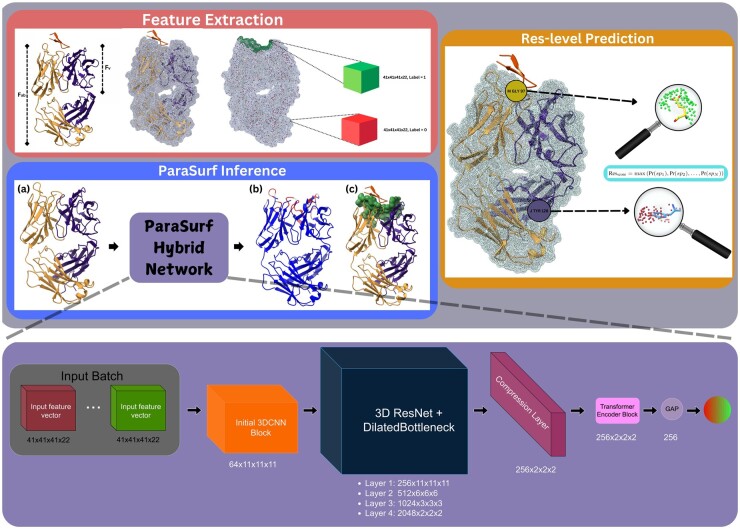
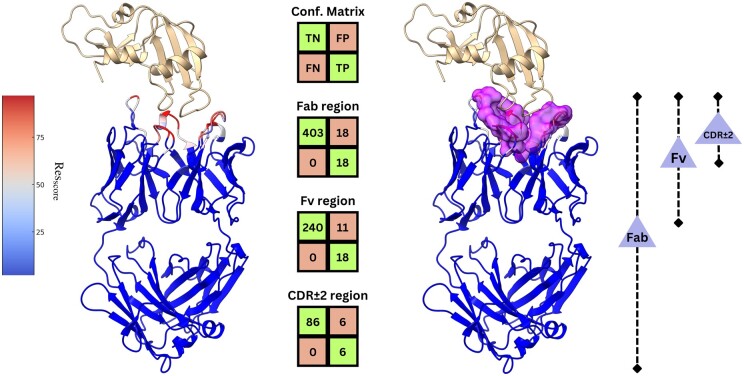
Motivation: Identifying antibody binding sites, is crucial for developing vaccines and therapeutic antibodies, processes that are time-consuming and costly. Accurate prediction of the paratope’s binding site can speed up the development by improving our understanding of antibody-antigen interactions. Results: We present ParaSurf, a deep learning model that significantly enhances paratope prediction by incorporating both surface geometric and non-geometric factors. Trained and tested on three prominent antibody-antigen benchmarks, ParaSurf achieves state-of-the-art results across nearly all metrics. Unlike models restricted to the variable region, ParaSurf demonstrates the ability to accurately predict binding scores across the entire Fab region of the antibody. Additionally, we conducted an extensive analysis using the largest of the three datasets employed, focusing on three key components: (1) a detailed evaluation of paratope prediction for each Complementarity-Determining Region loop, (2) the performance of models trained exclusively on the heavy chain, and (3) the results of training models solely on the light chain without incorporating data from the heavy chain. Availability and Implementation: Source code for ParaSurf, along with the datasets used, preprocessing pipeline, and trained model weights, are freely available at https://github.com/aggelos-michael-papadopoulos/ParaSurf . Contact: angepapa@iti.gr , axenop@iti.gr Supplementary information: Supplementary data are available at Bioinformatics online.
Overview
The claims and statistics of this paper haven’t been checked yet.
Free: it reads the open-access text and checks the first 5 claims that cite a source we can check. Create a free account to check every claim.
Integrity signals
Registry
Cites
Statistics
Figures
Verification
Claims the paper makes
The claims and statistics of this paper haven’t been checked yet.
Free: it reads the open-access text and checks the first 5 claims that cite a source we can check. Create a free account to check every claim.
Self-check
Percentages, sums and reported differences re-computed from the paper’s own numbers.
The self-check needs the paper’s full text.
Citations
Cites
Highly accurate protein structure prediction with AlphaFold
Jumper, J., Evans, R., Pritzel, A., Green, T., Figurnov, M., Ronneberger, O., Tunyasuvunakool, K., Bates, R., Žídek, A., Potapenko, A., et al. (2021) · Nature · doi:10.1038/s41586-021-03819-2 · Cited by 43,764
Cd-hit: a fast program for clustering and comparing large sets of protein or nucleotide sequences
Li, W., & Godzik, A. (2006) · Bioinformatics · doi:10.1093/bioinformatics/btl158 · Cited by 11,410
PDB2PQR: an automated pipeline for the setup of Poisson-Boltzmann electrostatics calculations
Dolinsky, T. J., Nielsen, J. E., McCammon, J. A., & Baker, N. A. (2004) · Nucleic Acids Research · doi:10.1093/nar/gkh381 · Cited by 3,472
Weiner, P. K., & Kollman, P. A. (1981) · Journal of Computational Chemistry · doi:10.1002/jcc.540020311 · Cited by 1,189
IMGT(R), the international ImMunoGeneTics information system(R)
Lefranc, M.-P., Giudicelli, V., Ginestoux, C., Jabado-Michaloud, J., Folch, G., Bellahcene, F., Wu, Y., Gemrot, E., Brochet, X., Lane, J., et al. (2009) · Nucleic Acids Research · doi:10.1093/nar/gkn838 · Cited by 1,119
Deciphering interaction fingerprints from protein molecular surfaces using geometric deep learning
Gainza, P., Sverrisson, F., Monti, F., Rodolà, E., Boscaini, D., Bronstein, M. M., & Correia, B. E. (2020) · Nature Methods · doi:10.1038/s41592-019-0666-6 · Cited by 834
Development and evaluation of a deep learning model for protein–ligand binding affinity prediction
Stepniewska-Dziubinska, M. M., Zielenkiewicz, P., & Siedlecki, P. (2018) · Bioinformatics · doi:10.1093/bioinformatics/bty374 · Cited by 663
Vreven, T., Moal, I. H., Vangone, A., Pierce, B. G., Kastritis, P. L., Torchala, M., Chaleil, R., Jiménez-García, B., Bates, P. A., Fernandez-Recio, J., et al. (2015) · Journal of Molecular Biology · doi:10.1016/j.jmb.2015.07.016 · Cited by 424
Smyth, M., & Martin, J. H. J. (2000) · Molecular Pathology · doi:10.1136/mp.53.1.8 · Cited by 371
Parapred: antibody paratope prediction using convolutional and recurrent neural networks
Liberis, E., Veličković, P., Sormanni, P., Vendruscolo, M., & Liò, P. (2018) · Bioinformatics · doi:10.1093/bioinformatics/bty305 · Cited by 165
Research works printed but not linked: 6
- Josh Abramson , Jonas Adler , Jack Dunger , Richard Evans , Tim Green , Alexander Pritzel , Olaf Ronneberger , Lindsay Willmore , Andrew J Ballard , Joshua Bambrick , et al. Accurate structure prediction of biomolecular interactions with alphafold 3. Nature, pages 1–3, 2024.
- Kaiming He , Xiangyu Zhang , Shaoqing Ren , and Jian Sun . Deep residual learning for image recognition. In Proceedings of the IEEE conference on computer vision and pattern recognition, pages 770–778, 2016.
- Magnus Høie , Alissa Hummer , Tobias Olsen , Morten Nielsen , and Charlotte Deane . Antifold: Improved antibody structure design using inverse folding. In NeurIPS 2023 Generative AI and Biology (GenBio) Workshop, 2023.
- Charles A Janeway Jr , Paul Travers , Mark Walport , and Mark J Shlomchik . The structure of a typical antibody molecule. In Immunobiology: The Immune System in Health and Disease. 5th edition. Garland Science, 2001.
- Raphael Townshend , Rishi Bedi , Patricia Suriana , and Ron Dror . End-to-end learning on 3d protein structure for interface prediction. Advances in Neural Information Processing Systems, 32, 2019.
- A Vaswani . Attention is all you need. Advances in Neural Information Processing Systems, 2017.
Metadata
- Authors
- Papadopoulos, A.-M., Axenopoulos, A., Iatrou, A., Stamatopoulos, K., Alvarez, F., & Daras, P.
- Affiliations
- Information Technologies Institute (GR)
- Centre for Research and Technology Hellas (GR)
- Corresponding author
- Papadopoulos, Angelos-Michael
- Daras, Petros
- ORCID
- Venue
- Bioinformatics
- Publisher
- openRxiv
- Published
- 2024-12-19
- Volume
- 41
- Issue
- 2
- ISSN
- 1367-4803 (ISSN-L)
- PMC
- PMC11855283
- OpenAlex
- W4407284294
- Cited by
- 9
- References
- 30
- Citations by year
- 2026: 5 · 2025: 4
- FWCI
- 2.69
- Type
- journal article
- Language
- en
- Open access
- gold
- doi.org
- Licence
- Locations
- Bioinformatics (publishedVersion, cc-by)
- bioRxiv (Cold Spring Harbor Laboratory) (acceptedVersion, cc-by)
- PubMed Central (publishedVersion, cc-by)
- PubMed (publishedVersion)
- Topics
- Life Sciences › Biochemistry, Genetics and Molecular Biology › Molecular Biology › vaccines and immunoinformatics approaches
- Life Sciences › Biochemistry, Genetics and Molecular Biology › Molecular Biology › Machine Learning in Bioinformatics
- Life Sciences › Immunology and Microbiology › Immunology › Monoclonal and Polyclonal Antibodies Research
- Keywords
- antigen-antibody reaction, antibody binding sites, deep learning, surface geometry, Fab region, hypervariable region, heavy chain, light chain
- MeSH terms
- Deep Learning, Antigens, Binding Sites, Antibody, Models, Molecular, Protein Binding, Software, Computational Biology
About these checks
Registry, retraction, Cites and statistics results are computed, not judged, with one exception: a printed reference that no index lists is read once by a model before it counts as a citation error. Claims are extracted by a model and kept only when their quote appears verbatim in the text; each cited source is then checked, with a model’s help, for whether it says what the claim relies on. Those verdicts can be wrong — read the claim’s quote and the cited source before relying on one.
Statistics and arithmetic are recomputed, not judged.
Confidence bands are shown only for fields calibrated on our annotated test set. None is calibrated yet, so no band is shown.
What counts as a claim ›How we measure confidence ›How we check this ›
Are you an author, or do you see a problem with this page? Request a review
How to cite
Cite CoChat for the checks on this page, and the paper for its own findings.
- This page
- CoChat. (2026). Citation check: ParaSurf: A Surface-Based Deep Learning Approach for Paratope-Antigen Interaction Prediction. https://app.cochat.ai/papers/10.1101/2024.12.16.628621
- The paper
- Papadopoulos, A.-M., Axenopoulos, A., Iatrou, A., Stamatopoulos, K., Alvarez, F., & Daras, P. (2024). ParaSurf: A Surface-Based Deep Learning Approach for Paratope-Antigen Interaction Prediction. Bioinformatics. https://doi.org/10.1101/2024.12.16.628621
Data sources
Bibliographic data: Semantic Scholar, OpenAlex, Crossref.
Contains information from the Semantic Scholar Academic Graph Datasets, made available under the ODC Attribution License (ODC-BY 1.0).
Semantic Scholar’s data is described in: Kinney, R., et al. (2023). The Semantic Scholar Open Data Platform. arXiv:2301.10140.
