

High throughput identification of genetic regulators of microglial inflammatory processes in Alzheimer’s disease
Open accessPreprint — published as 10.1186/s12974-025-03562-9 · Paper page
The DOI matches its Crossref record; 86 of the 86 references it cites were found in a registry or an index; none of the 71 sources its claims cite is checked for support yet.
Abstract
Genome-wide association studies (GWAS) have identified over a hundred genetic risk factors for Alzheimer’s disease (AD), many of which are predominantly expressed in microglia. However, the pathogenic role for most of them remains unclear. To systematically investigate how AD GWAS variants influence human microglial inflammatory responses, we conducted CRISPR inhibition (CRISPRi) screens targeting 119 AD GWAS hits in hiPSC-derived microglia (iMGLs) and used the production of reactive oxygen species (ROS) in response to the viral mimic poly(I:C) as a functional readout. Top hits whose knockdown either increased or decreased ROS levels in response to poly(I:C) were further analyzed using CROP-seq to integrate CRISPRi with single-cell RNA sequencing (scRNA-seq). This analysis identified 9 unique microglial clusters, including a poly(I:C)-driven inflammatory cluster 2. Emerging evidence supports a pathogenic role of viral infections in AD and cross comparison of our scRNA-seq data with iMGLs xenotransplanted into an AD mouse model shows significant overlap between our clusters and AD-relevant microglial clusters. Knockdown of MS4A6A and EED , which resulted in elevated ROS production in the presence of poly(I:C), increased the proportion of cluster 2 cells and induced functionally related changes in gene expression. In addition, KD of MS4A6 led to a reduction in the proportion of iMGLs in the DAM (disease associated microglia) cluster under all conditions, suggesting that this gene may modulate the DAM response. In contrast, KD of INPP5D or RAPEP1 which lead to low levels of ROS in the presence of poly(I:C), did not significantly affect the proportion of cells in cluster 2 but rather shaped the inflammatory response. This included the upregulation of an HLA-associated inflammatory cluster (cluster 6) by INPP5D knockdown under all conditions, independent of poly(I:C) stimulation. Importantly, KD of INPP5D or RAPEP1 had many shared differentially expressed genes (DEGs) under both vehicle and poly(I:C) treated conditions. Overall, our findings demonstrate that despite the diverse biological functions of AD GWAS variants, they converge functionally to regulate human microglial states and shape inflammatory responses relevant to AD pathology.
Overview
CoChat Summary
TL;DR
The paper reports a high-throughput CRISPRi screen of 119 Alzheimer’s disease GWAS hits in hiPSC-derived microglia, using poly(I:C)-induced ROS as a readout, followed by CROP-seq on top hits. It identifies MS4A6A and EED as high-ROS hits that promote an inflammatory cluster and INPP5D/RABEP1 as low-ROS hits that shape inflammatory responses, with shared metabolic gene-expression changes.
Key findings
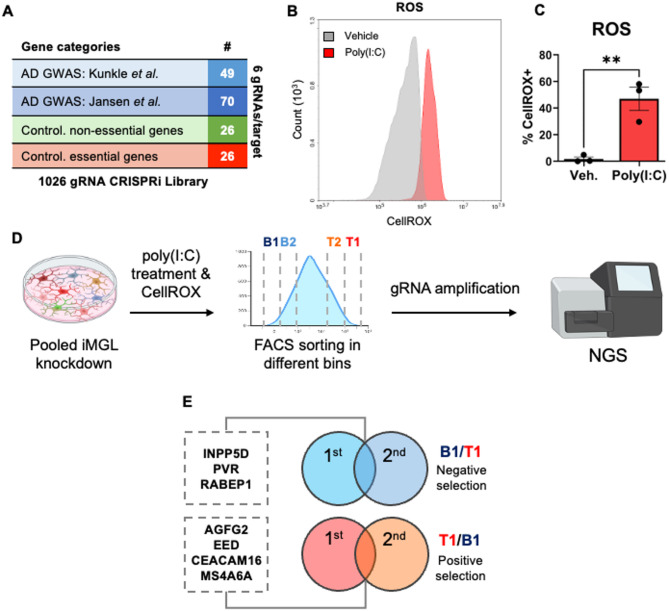
- In pooled CRISPRi screens of 119 AD GWAS hits (1026 gRNAs targeting 171 genes), top high-ROS hits included MS4A6A and EED, and top low-ROS hits included INPP5D and RABEP1; 4 of 6 CROP-seq-tested genes (INPP5D, RABEP1, MS4A6A, EED) had significant effects on gene expression.
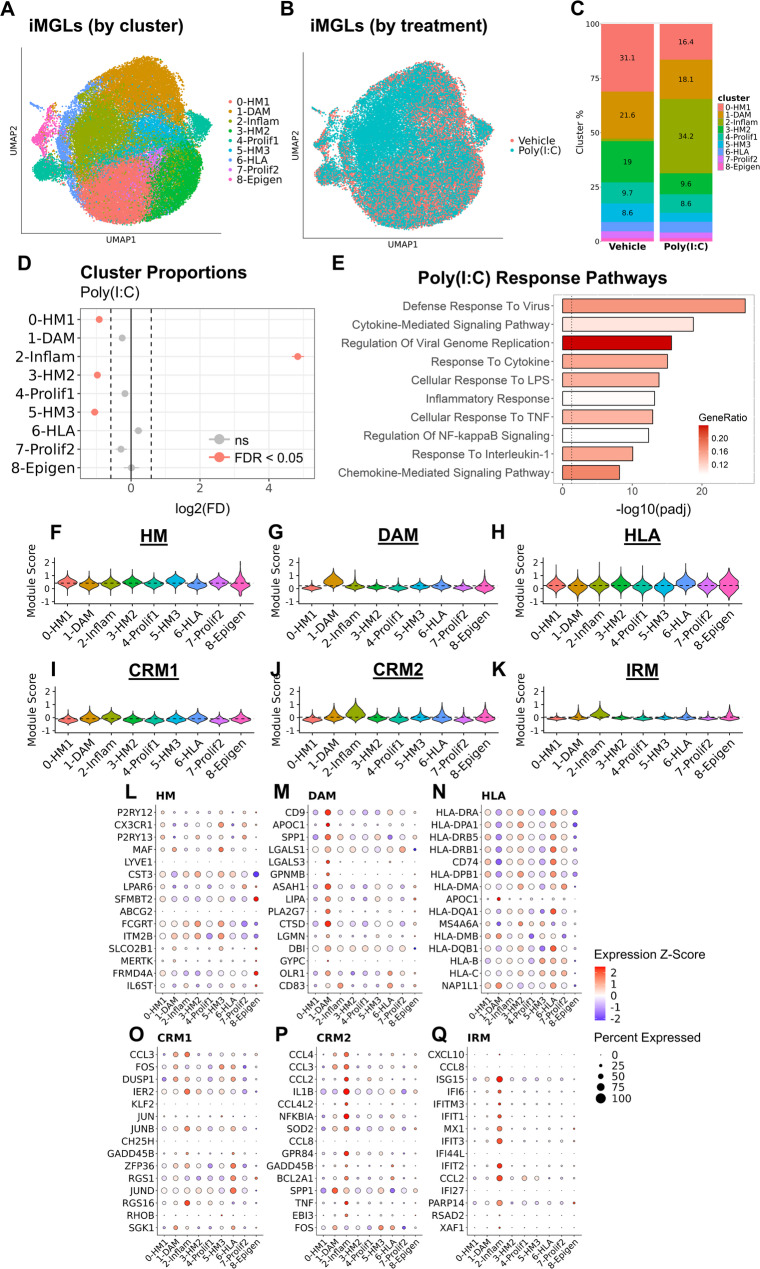
- scRNA-seq of 44,913 cells identified 9 microglial clusters; poly(I:C) increased cluster 2-Inflam from 1.2% of vehicle cells to 34.2% of poly(I:C)-treated cells (log2 fold difference >4).
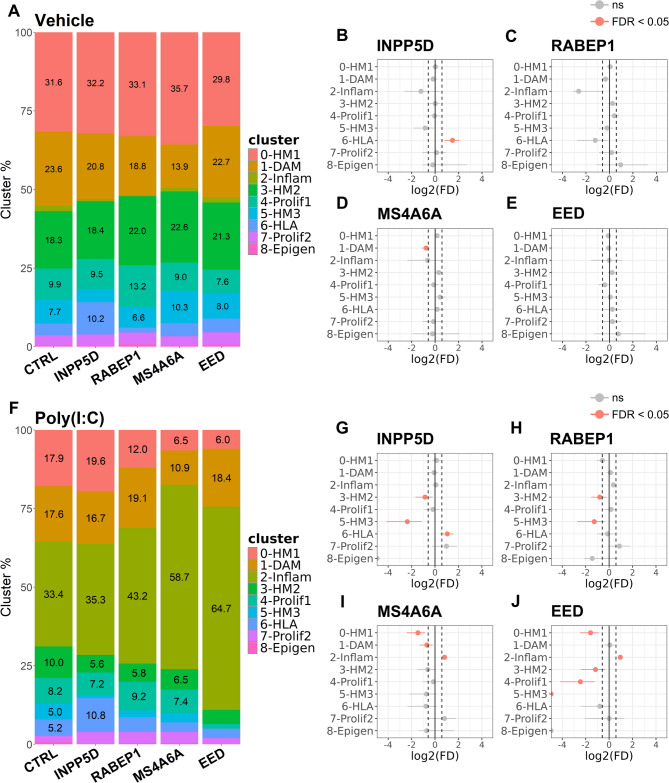
- KD of high-ROS hits MS4A6A and EED increased the proportion of inflammatory cluster 2 cells; MS4A6A KD also reduced the DAM cluster under all conditions. KD of low-ROS hits INPP5D or RABEP1 did not significantly change cluster 2 proportion but shaped the inflammatory response, with INPP5D KD upregulating poly(I:C)-independent HLA cluster 6 under all conditions.
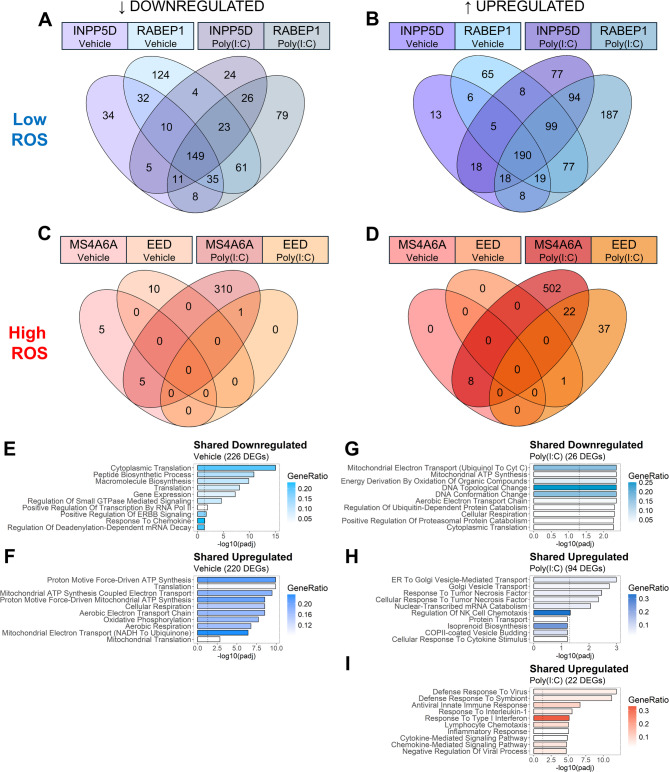
- MS4A6A KD under poly(I:C) had 311 downregulated and 524 upregulated DEGs; EED KD had 59 upregulated DEGs (22 overlapping with MS4A6A) and 1 downregulated DEG. Low-ROS targets shared 226 downregulated and 220 upregulated DEGs under vehicle conditions, including oxidative phosphorylation-related pathways.
Methods
- Pooled CRISPRi screens: FA10 hiPSC-derived iMGLs expressing dCas9-KRAB-MeCP2 were transduced at day 21 post-HPC with a lentiviral gRNA library (1026 gRNAs; 6 per gene; 119 AD GWAS hits plus 26 essential and 26 non-essential controls) at MOI ~0.3, treated with 10 µg/mL poly(I:C) for 2 h at day 35, stained with 1 µM CellROX Deep Red, FACS-sorted into top/bottom 12.5% and 12.5–25% bins, and analyzed by NGS with MAGeCK RRA; two independent screens were performed.
- CROP-seq: two independent experiments transduced iMGLs with 3 gRNAs per target for high-ROS (AGF2, EED, MS4A6A), low-ROS (INPP5D, PVR, RABEP1), and control (CABP5, SAGE1) genes; vehicle- or poly(I:C)-treated cells were processed by 10x scRNA-seq and analyzed with Seurat, Mixscape, scProportionTest, and EnrichR.
- Comparisons: iMGL clusters were compared to published human microglial snRNA-seq and xenotransplanted iMGL datasets using PCA and module scores.
Limitations
- Stated: the CRISPRi screen used only ROS production as the inflammatory readout, not the full repertoire (e.g., cytokine/chemokine secretion); non-inflammatory processes such as phagocytosis were not assessed; all experiments were in vitro, and xenotransplantation was proposed for future maturation/interaction studies.
- Stated: EED knockdown was modest, likely blunting results, and other loss-of-function methods (e.g., CRISPR KO) could be used.
- Evident: the screen used FDR < 0.5 for hit calling, and only 4 of 6 CROP-seq-tested genes had significant effects; iMGLs lack neuronal co-culture and may differ from aged postmortem brain microglia (e.g., MG1:Neuronal Surveillance had least overlap).
Model-written summary. Check it against the paper before relying on it.
Integrity signals
Registry
Cites
Statistics
Figures
Verification
Claims the paper makes
0 Valid · 0 Not valid · 38 Not checked · 122 Own results and interpretations
A result the paper reports from its own data — it cites no other source for it, so there is none to check. The quote shows it is in the paper.
In the paper
“4 of 6 genes tested had significant effects on gene expression (INPP5D, RABEP1, MS4A6A, EED) and were analyzed further.”
§ High throughput identification of genetic regulators of microglial inflammatory processes in Alzheimer's disease > Results > CROP-seq investigation of top AD GWAS ROS modulators
plainstates a cause- Asserted: passes — The authors put it forward as true.
- Checkable: passes — It can be checked against evidence.
- Load-bearing: passes — The paper’s conclusions depend on it.
- Based: passes — The paper gives a reason why it holds.
A result the paper reports from its own data — it cites no other source for it, so there is none to check. The quote shows it is in the paper.
In the paper
“Most notably, we saw a dramatic increase in cluster 2 in poly(I:C)-treated cells, having 34.2% of cells in this cluster compared to 1.2% of cells from vehicle-treated cells.”
§ High throughput identification of genetic regulators of microglial inflammatory processes in Alzheimer's disease > Results > Analysis of the effect of poly(I:C) on microglial cell state
plainstates a cause- Asserted: passes — The authors put it forward as true.
- Checkable: passes — It can be checked against evidence.
- Load-bearing: passes — The paper’s conclusions depend on it.
- Based: passes — The paper gives a reason why it holds.
A result the paper reports from its own data — it cites no other source for it, so there is none to check. The quote shows it is in the paper.
In the paper
“We observed a highly significant enrichment of cells in cluster 2 for poly(I:C)-treated cells, with a log2 fold difference greater than 4.”
§ High throughput identification of genetic regulators of microglial inflammatory processes in Alzheimer's disease > Results > Analysis of the effect of poly(I:C) on microglial cell state
plainstates an association- Asserted: passes — The authors put it forward as true.
- Checkable: passes — It can be checked against evidence.
- Load-bearing: unclear — It is unclear whether the paper’s conclusions depend on it.
- Based: passes — The paper gives a reason why it holds.
A result the paper reports from its own data — it cites no other source for it, so there is none to check. The quote shows it is in the paper.
In the paper
“Treatment with poly(I:C) for 2 h led to an increase of ROS as measured by flow cytometry (FC) of CellROX + cells.”
§ High throughput identification of genetic regulators of microglial inflammatory processes in Alzheimer's disease > Results > Generation of pooled CRISPRi gRNA libraries for AD GWAS hits and control genes
plainstates a causen = 3- Asserted: passes — The authors put it forward as true.
- Checkable: passes — It can be checked against evidence.
- Load-bearing: passes — The paper’s conclusions depend on it.
- Based: passes — The paper gives a reason why it holds.
A result the paper reports from its own data — it cites no other source for it, so there is none to check. The quote shows it is in the paper.
In the paper
“The top pathways were related to antiviral responses, response to cytokines and chemokines, inflammatory responses, NFκB signaling, and TNF signaling (Fig. 2E).”
§ High throughput identification of genetic regulators of microglial inflammatory processes in Alzheimer's disease > Results > Analysis of the effect of poly(I:C) on microglial cell state
plainstates an association- Asserted: passes — The authors put it forward as true.
- Checkable: passes — It can be checked against evidence.
- Load-bearing: unclear — It is unclear whether the paper’s conclusions depend on it.
- Based: passes — The paper gives a reason why it holds.
80 more claims
Create a free account to see all 160 claims and to verify the 71 references still open.
- It may state two separate claims as one. 47
- Probably not a substantial claim. 37
- The quote only partly states this claim. 1
Self-check
Percentages, sums and reported differences re-computed from the paper’s own numbers.
Each contradiction between two passages listed here was confirmed by an independent check.
Rated minor: it would not touch a result — a value no result rests on, a p-value that stays on the same side of the significance level, or a conflict that is clerical, resolved elsewhere in the paper, or outside its own findings.
In the paper
§ High throughput identification of genetic regulators of microglial inflammatory processes in Alzheimer's disease > Methods > CROP-seq analysis
“Then, only cells that were at least 3 standard deviations above the median were kept, as described previously [22].”
§ High throughput identification of genetic regulators of microglial inflammatory processes in Alzheimer's disease > Methods > CROP-seq analysis
“Cells were eliminated that: (i) had less than 750 or greater than 6,680 number of genes detected per cell; (ii) had less than 500 or greater than 28,500 number of unique molecular identifiers per cell; and (iii) had greater than 12% mitochondrial gene expression (genes present in mitochondrial DNA).”
Rated minor: it would not touch a result — a value no result rests on, a p-value that stays on the same side of the significance level, or a conflict that is clerical, resolved elsewhere in the paper, or outside its own findings.
In the paper
§ High throughput identification of genetic regulators of microglial inflammatory processes in Alzheimer's disease > Results > iMGLs are transcriptionally similar to human AD brain microglia
“To further compare our iMGL clusters to endogenous control and AD microglial clusters from the same data set as used in the PCA [29], we performed module score analysis (Figures S4B-M; Table S4).”
§ High throughput identification of genetic regulators of microglial inflammatory processes in Alzheimer's disease > Results > KD of ROS modulators change global gene expression
“Analysis of INPP5D unique UR DEGs revealed several pathways associated with MHCII protein complex assembly, antigen presentation, and immunoglobulin production (Figure S4B).”
Citations
Cites
Comprehensive Integration of Single-Cell Data
Stuart, T., Butler, A., Hoffman, P., Hafemeister, C., Papalexi, E., Mauck, W. M., Hao, Y., Stoeckius, M., Smibert, P., & Satija, R. (2019) · Cell · doi:10.1016/j.cell.2019.05.031 · Cited by 15,453
Induced Pluripotent Stem Cell Lines Derived from Human Somatic Cells
Yu, J., Vodyanik, M. A., Smuga-Otto, K., Antosiewicz-Bourget, J., Frane, J. L., Tian, S., Nie, J., Jonsdottir, G. A., Ruotti, V., Stewart, R., et al. (2007) · Science · doi:10.1126/science.1151526 · Cited by 10,310
Enrichr: interactive and collaborative HTML5 gene list enrichment analysis tool
Chen, E. Y., Tan, C. M., Kou, Y., Duan, Q., Wang, Z., Meirelles, G. V., Clark, N. R., & Ma’ayan, A. (2013) · BMC Bioinformatics · doi:10.1186/1471-2105-14-128 · Cited by 7,814
Dictionary learning for integrative, multimodal and scalable single-cell analysis
Hao, Y., Stuart, T., Kowalski, M. H., Choudhary, S., Hoffman, P., Hartman, A., Srivastava, A., Molla, G., Madad, S., Fernandez-Granda, C., et al. (2024) · Nature Biotechnology · doi:10.1038/s41587-023-01767-y · Cited by 5,631
Defining a Cancer Dependency Map
Tsherniak, A., Vazquez, F., Montgomery, P. G., Weir, B. A., Kryukov, G., Cowley, G. S., Gill, S., Harrington, W. F., Pantel, S., Krill-Burger, J. M., et al. (2017) · Cell · doi:10.1016/j.cell.2017.06.010 · Cited by 3,276
Alzheimer Disease Genetics Consortium (ADGC), Kunkle, B. W., The European Alzheimer’s Disease Initiative (EADI), Cohorts for Heart and Aging Research in Genomic Epidemiology Consortium (CHARGE), Genetic and Environmental Risk in AD/Defining Genetic, P. A. E. R. F. A. D. C. (., Grenier-Boley, B., Sims, R., Bis, J. C., Damotte, V., Naj, A. C., et al. (2019) · Nature Genetics · doi:10.1038/s41588-019-0358-2 · Cited by 2,946
Li, W., Xu, H., Xiao, T., Cong, L., Love, M. I., Zhang, F., Irizarry, R. A., Liu, J. S., Brown, M., & Liu, X. S. (2014) · Genome Biology · doi:10.1186/s13059-014-0554-4 · Cited by 2,684
New insights into the genetic etiology of Alzheimer’s disease and related dementias
Bellenguez, C., Küçükali, F., Jansen, I. E., Kleineidam, L., Moreno-Grau, S., Amin, N., Naj, A. C., Campos-Martin, R., Grenier-Boley, B., Andrade, V., et al. (2022) · Nature Genetics · doi:10.1038/s41588-022-01024-z · Cited by 2,498
Jansen, I. E., Savage, J. E., Watanabe, K., Bryois, J., Williams, D. M., Steinberg, S., Sealock, J., Karlsson, I. K., Hägg, S., Athanasiu, L., et al. (2019) · Nature Genetics · doi:10.1038/s41588-018-0311-9 · Cited by 2,277
Initiative, T. A. D. N., Hollingworth, P., CHARGE consortium, EADI1 consortium, Harold, D., Sims, R., Gerrish, A., Lambert, J.-C., Carrasquillo, M. M., Abraham, R., et al. (2011) · Nature Genetics · doi:10.1038/ng.803 · Cited by 1,997
Cited by
Zhou, S., Xu, L., Dong, J., Zhang, X., Gao, W., Luo, H., & Fang, X. (2026) · Phytotherapy Research · doi:10.1002/ptr.70249 · Cited by 2
Cell-type-resolved transcriptomic landscape of human focal cortical dysplasia
Fang, C., Liu, Y., Zhang, X., Wang, Z., Guo, R., Guo, J., Liu, X., Tan, Y., Lu, H., Zhao, R., et al. (2026) · Proceedings of the National Academy of Sciences · doi:10.1073/pnas.2513674123 · Cited by 2
Li, Y., Ma, S., & Fei, T. (2026) · International Journal of Molecular Sciences · doi:10.3390/ijms27083371 · Cited by 1
Liu, Y., Fu, R., Ge, C., Long, Z., Wang, H., & He, G. (2026) · Brain Research Bulletin · doi:10.1016/j.brainresbull.2026.111994 · Cited by 1
High‐Content CRISPR Screening: Methods and Applications
Zhang, Y., Zhang, Y., Tang, X., Deng, X., Zhou, Y., Wu, Y., & Luo, J. (2026) · MedComm · doi:10.1002/mco2.70964
Li, X., Rong-liang, G., Teng, Z., Liu, P.-P., & Liu, C. (2026) · Ageing Research Reviews · doi:10.1016/j.arr.2026.103377
Arif, S., Luo, Q., Hao, X., Zheng, R., Sun, N., Quan, Z., Ni, J., Qiu, Y., & Qing, H. (2026) · Research Square · doi:10.21203/rs.3.rs-10721231/v1
Microglia in Alzheimer’s disease: Insights into disease progression and therapy
Saini, V., Mukherjee, S., Vora, C., Jindal, H., & Jha, H. C. (2026) · Advances in immunology · doi:10.1016/bs.ai.2026.06.004
Esmaeili, H., Das, S., Rytel, K., Sidransky, E., & Chen, Y. (2026) · Molecular Genetics and Metabolism · doi:10.1016/j.ymgme.2026.110265
Chen, B., Yang, H., 安贵鹏, & Mao, X. (2026) · Frontiers in Immunology · doi:10.3389/fimmu.2026.1979260
Cardona, C. L., Patel, R., Finan, G. M., Kim, T., Sproul, A. A., & Teich, A. F. (2026) · bioRxiv (Cold Spring Harbor Laboratory) · doi:10.64898/2026.11.16.767071
Self-citationLai, G., Hu, B., Duan, S., Yang, X., Xie, G., & Wu, X. (2026) · Journal of Immunology Research · doi:10.1155/jimr/4142717
Metadata
- Authors
- Cardona, C. L., Wei, L., Kim, J., Angeles, E., Singh, G., Chen, S., Patel, R., Ifediora, N., Canoll, P., Teich, A. F., Hargus, G., Chavez, A., & Sproul, A. A.
- Affiliations
- Columbia University Irving Medical Center (US)
- University of California San Diego (US)
- Seoul National University (KR)
- Corresponding author
- Sproul, Andrew A.
- ORCID
- Venue
- Journal of Neuroinflammation
- Publisher
- openRxiv
- Published
- 2025-03-11
- Volume
- 22
- Issue
- 1
- Pages
- 294-294
- ISSN
- 1742-2094 (ISSN-L)
- PMC
- PMC12729107
- OpenAlex
- W4416933689
- Semantic Scholar
- b0761d45d89397956fea6dbb37854260dfbc9725
- Cited by
- 12
- References
- 81
- Citations by year
- 2026: 12
- FWCI
- 3.39
- Type
- journal article
- Language
- en
- Open access
- gold
- doi.org
- Licence
- cc-by-nc-nd
- www.biorxiv.org/about/FAQ#license (vor)
- Locations
- Journal of Neuroinflammation (publishedVersion, cc-by-nc-nd)
- bioRxiv (Cold Spring Harbor Laboratory) (submittedVersion)
- PubMed Central (publishedVersion, cc-by-nc-nd)
- PubMed (publishedVersion)
- PubMed Central (submittedVersion)
- PubMed (submittedVersion)
- DOAJ (DOAJ: Directory of Open Access Journals) (submittedVersion)
- Seoul National University Open Repository (Seoul National University) (submittedVersion)
- Funders
- Burroughs Wellcome Fund
- Henry and Marilyn Taub Foundation
- Thompson Family Foundation
- National Institutes of Health
- National Institute on Aging (RF1AG078352, P30AG066462, R01AG073360, R01AG078352)
- National Institute of Neurological Disorders and Stroke (DP2NS131566, K08NS116166)
- Topics
- Life Sciences › Neuroscience › Neurology › Neuroinflammation and Neurodegeneration Mechanisms
- Life Sciences › Neuroscience › Cellular and Molecular Neuroscience › Alzheimer's disease research and treatments
- Life Sciences › Biochemistry, Genetics and Molecular Biology › Molecular Biology › Inflammasome and immune disorders
- Keywords
- Alzheimer's disease, microglia, microglial inflammation, genetic risk factors, iPSC-derived microglia, reactive oxygen species, poly(I:C), viral mimicry, disease-associated microglia, MS4A6A, EED, INPP5D, HLA, oxidative phosphorylation
- MeSH terms
- Neuroinflammatory Diseases, Alzheimer Disease, Humans, Inflammation, Reactive Oxygen Species, Microglia, Genome-Wide Association Study
About these checks
Registry, retraction, Cites and statistics results are computed, not judged, with one exception: a printed reference that no index lists is read once by a model before it counts as a citation error. Claims are extracted by a model and kept only when their quote appears verbatim in the text; each cited source is then checked, with a model’s help, for whether it says what the claim relies on. Those verdicts can be wrong — read the claim’s quote and the cited source before relying on one.
A language model drew the claims from the paper on 2026-11-27, under version 3 of the claim definition (model deepseek-v4.1-flash, prompt extract-v3).
A second model labelled each claim on 2026-11-27 (model jev-1.13-20260917, definition revision gold-guideline-v0.2).
Statistics and arithmetic are recomputed, not judged.
Confidence bands are shown only for fields calibrated on our annotated test set. None is calibrated yet, so no band is shown.
What counts as a claim ›How we measure confidence ›How we check this ›
Are you an author, or do you see a problem with this page? Request a review
Data sources
Bibliographic data: Semantic Scholar, OpenAlex, Crossref.
Contains information from the Semantic Scholar Academic Graph Datasets, made available under the ODC Attribution License (ODC-BY 1.0).
Semantic Scholar’s data is described in: Kinney, R., et al. (2023). The Semantic Scholar Open Data Platform. arXiv:2301.10140.
