

The DOI matches its Crossref record; its reference list is not available.
Data-efficient protein mutational effect prediction with weak supervision by molecular simulation and protein language models
Open accessPreprint — published as 10.1093/bib/bbaf536 · Paper page
Abstract
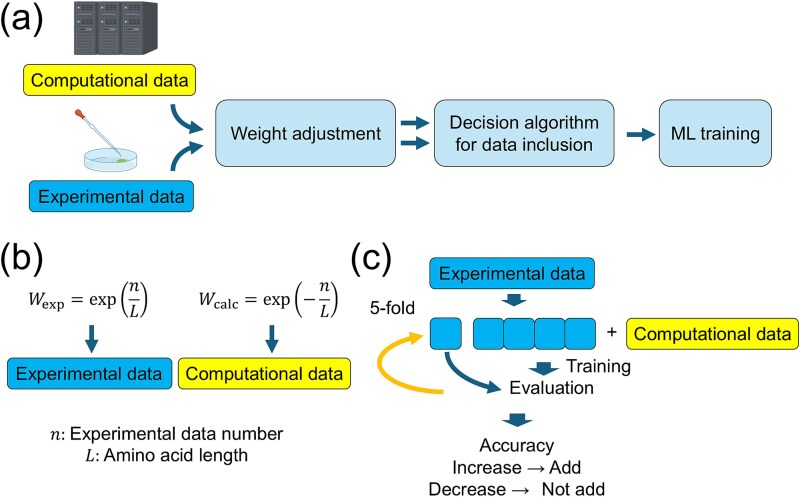
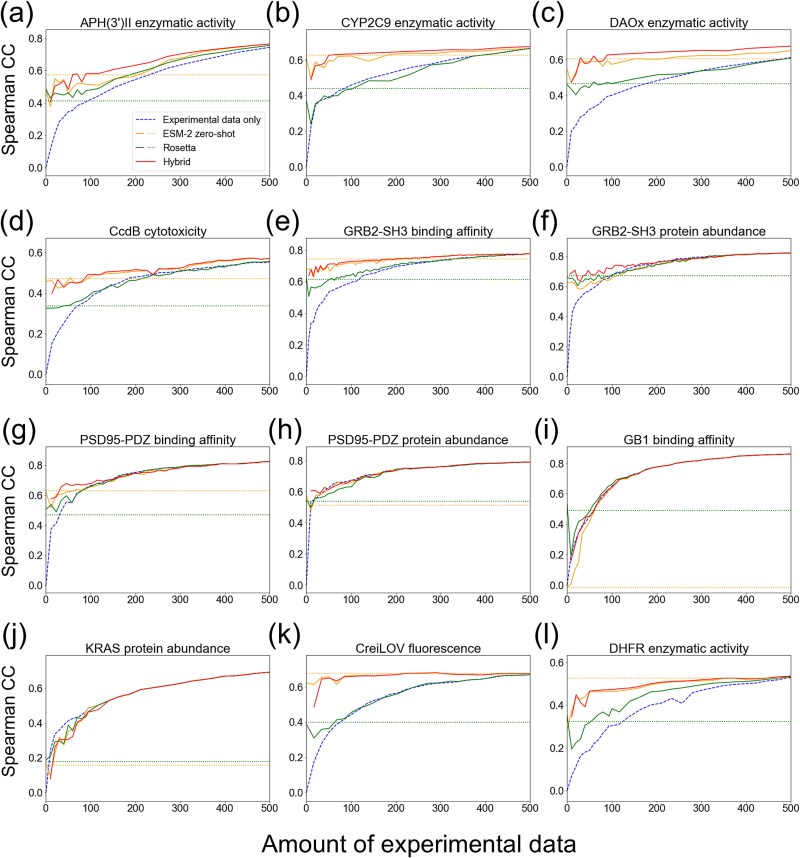
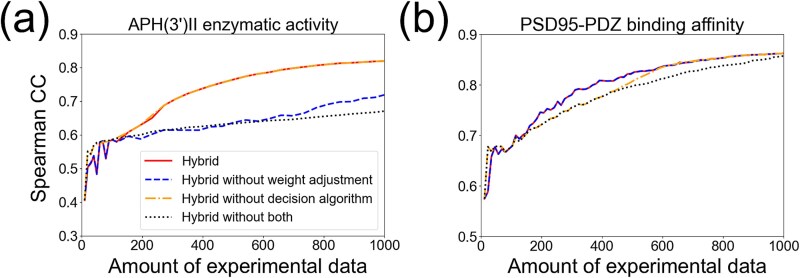
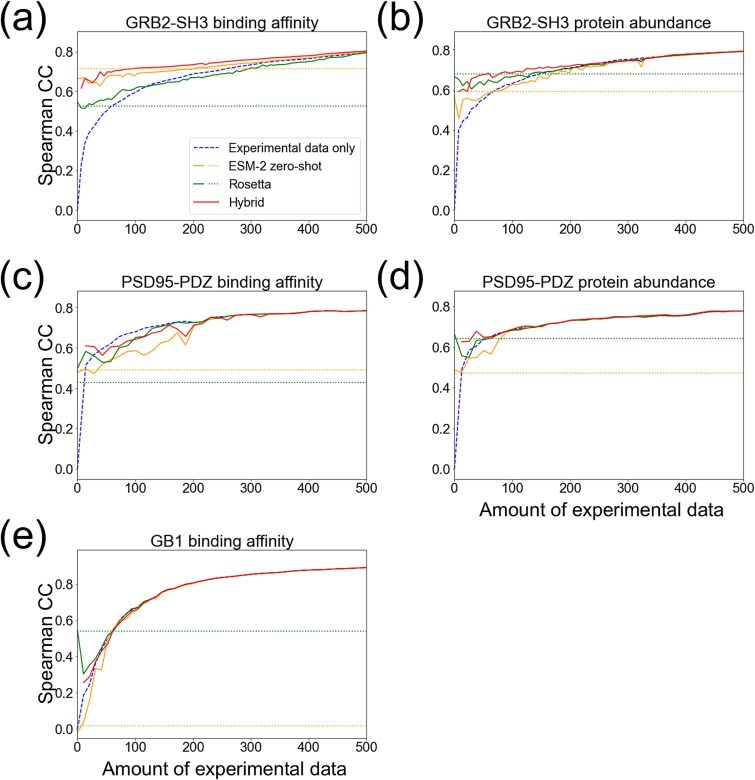
Machine learning-based protein mutational effect prediction is widely used in protein engineering and pathogenicity prediction, but training data scarcity remains a major challenge due to high costs of experimental measurements. A previous study proposed data augmentation using computational estimates by molecular simulation. However, this approach has been limited to predicting mutational effects on thermostability. Here, we present a new data augmentation method that combines molecular simulation with zero-shot prediction computed by protein language models. These computational estimates serve as “weak” training data to supplement experimental training data. Our method dynamically adjusts the weight and inclusion of weak training data based on available experimental training data. This reduces potential negative impacts of weak training data while extending applicability to diverse protein properties such as binding affinity and enzymatic activity. Benchmark tests demonstrate that our method improves prediction accuracy particularly when experimental training data are scarce. These results indicate the capability of our approach to advance protein engineering and pathogenicity prediction in small data regimes.
Overview
The claims and statistics of this paper haven’t been checked yet.
Run the check — free, no account needed. It reads the open-access text and checks the sources it cites.
Integrity signals
Registry
Cites
Statistics
Figures
Verification
Claims the paper makes
The claims and statistics of this paper haven’t been checked yet.
Run the check — free, no account needed. It reads the open-access text and checks the sources it cites.
Self-check
Percentages, sums and reported differences re-computed from the paper’s own numbers.
The self-check needs the paper’s full text.
Citations
No citation lists for this paper
No citation lists for this paper yet — checked again daily.
References 59 · Cited by 2
Research works printed but not linked: 55
- 10.1038/s41592-021-01100-y · DOI · Paper page
- 10.1021/acssynbio.8b00155 · DOI
- 10.1016/j.copbio.2022.102713 · DOI
- 10.1186/1471-2105-7-405 · DOI
- 10.1007/s00726-012-1407-7 · DOI
- 10.1016/j.sbi.2023.102600 · DOI
- 2019, Machine-learning-guided directed evolution for protein engineering, Nature methods, 16, 687, 10.1038/s41592-019-0496-6 · DOI · Paper page
- 10.1021/acscatal.3c02743 · DOI
- 10.1021/acscatal.9b04321 · DOI
- 10.1093/bioinformatics/bty238 · DOI
- 10.1016/B978-0-12-381270-4.00019-6 · DOI
- 10.1126/science.ade2574 · DOI · Paper page
- 2021, Language models enable zero-shot prediction of the effects of mutations on protein function, Advances in neural information processing systems, 34, 29287
- 10.1038/s41586-022-04586-4 · DOI
- 10.1093/nar/gku511 · DOI
- 10.1016/j.ajhg.2021.07.001 · DOI
- 10.1038/s41467-024-45630-3 · DOI
- 10.1093/molbev/msw182 · DOI
- 10.1038/s41586-023-06954-0 · DOI
- 10.1021/acssynbio.2c00662 · DOI
- 10.1038/s41467-024-47671-0 · DOI
- 2023, Predicting a protein’s stability under a million mutations, Advances in Neural Information Processing Systems, 36, 76229
- 10.1038/s41467-024-51776-x · DOI · Paper page
- 2024, Improving the prediction of protein stability changes upon mutations by geometric learning and a pre-training strategy, Nat Comput Sci, 4, 840, 10.1038/s43588-024-00716-2 · DOI · Paper page
- Savojardo C , Manfredi M , Martelli PL , Casadio R. DDGemb: predicting protein stability change upon single- and multi-point variations with embeddings and deep learning. Bioinformatics. 2024;41(1). · DOI
- 10.1126/science.adg7492 · DOI · Paper page
- 2025, Structure-based self-supervised learning enables ultrafast protein stability prediction upon mutation, Innovation (Camb), 6, 100750
- 10.1093/nar/gki387 · DOI · Paper page
- 10.1517/17460441.2015.1032936 · DOI
- 2023, Proteingym: Large-scale benchmarks for protein fitness prediction and design, Advances in Neural Information Processing Systems, 36, 64331
- 10.1002/prot.22921 · DOI
- 2018, Flex ddG: Rosetta ensemble-based estimation of changes in protein–protein binding affinity upon mutation, The Journal of Physical Chemistry B, 122, 5389, 10.1021/acs.jpcb.7b11367 · DOI · Paper page
- 10.1093/nar/28.1.235 · DOI · Paper page
- 10.1016/j.str.2009.03.017 · DOI
- 10.1016/S0092-8674(00)81307-0 · DOI · Paper page
- 10.1016/S0969-2126(01)00157-5 · DOI · Paper page
- 10.1016/S0022-2836(03)00121-9 · DOI
- 10.1074/jbc.M405427200 · DOI · Paper page
- 10.1038/s41467-021-21422-x · DOI
- 10.1006/jmbi.1998.2395 · DOI
- 10.1073/pnas.97.23.12463 · DOI
- 10.1021/bi962337c · DOI
- 2016, Comparative protein structure modeling using MODELLER, Current protocols in bioinformatics, 54, 5
- 10.1089/cmb.2008.0173 · DOI
- 10.1111/J.1747-0285.2008.00641.X · DOI
- 10.1021/ci980211b · DOI
- 10.1016/j.molstruc.2006.07.004 · DOI
- 10.1007/s00726-009-0287-y · DOI
- 1998, New chemical descriptors relevant for the design of biologically active peptides, A multivariate characterization of 87 amino acids. Journal of medicinal chemistry, 41, 2481
- 2005, A new set of amino acid descriptors and its application in peptide QSARs, Peptide Science: Original Research on Biomolecules, 80, 775, 10.1002/bip.20296 · DOI
- 2013, Benchmarking of protein descriptor sets in proteochemometric modeling (part 2): modeling performance of 13 amino acid descriptor sets, Journal of cheminformatics, 5, 1
- 2001, Random forests, Machine learning, 45, 5, 10.1023/A:1010933404324 · DOI · Paper page
- 10.1023/B:STCO.0000035301.49549.88 · DOI · Paper page
- 10.1016/j.jmp.2018.03.001 · DOI · Paper page
- 2011, Scikit-learn: Machine learning in Python, the Journal of machine Learning research, 12, 2825
Metadata
- Authors
- Deguchi, T., Ab Ghani, N. S., Kurumida, Y., Iida, S., Kobayashi, K., & Saito, Y.
- Affiliations
- Artificial Intelligence Research Center (JP)
- School of Frontier Engineering, Kitasato University, 1-15-1 Kitazato, Minami-ku, Sagamihara, Kanagawa 252-0373, Japan
- Kitasato University (JP)
- Graduate School of Frontier Sciences, The University of Tokyo, 5-1-5, Kashiwanoha, Kashiwa, Chiba 277-0882, Japan
- Venue
- Briefings in Bioinformatics
- Publisher
- openRxiv
- Published
- 2025-04-14
- Volume
- 26
- Issue
- 5
- ISSN
- 1467-5463 (ISSN-L)
- PMC
- PMC12513171
- OpenAlex
- W4415046037
- Cited by
- 2
- References
- 59
- Citations by year
- 2026: 2
- FWCI
- 0.60
- Type
- journal article
- Language
- en
- Open access
- gold
- doi.org
- Licence
- Locations
- Briefings in Bioinformatics (publishedVersion, cc-by)
- bioRxiv (Cold Spring Harbor Laboratory) (acceptedVersion, cc-by)
- Europe PMC (PubMed Central) (publishedVersion, cc-by)
- PubMed (publishedVersion)
- Funders
- Japan Agency for Medical Research and Development (JP19ak0101122)
- National Institute of Advanced Industrial Science and Technology
- Japan Association for Chemical Innovation
- Japan Society for the Promotion of Science London (22H03691)
- New Energy and Industrial Technology Development Organization (JPNP14004)
- Japan Society for the Promotion of Science (22H03691, JPMJSP2108, JPNP14004)
- Cybermedia Center, Osaka University
- Institute of Genetics
- Topics
- Life Sciences › Biochemistry, Genetics and Molecular Biology › Molecular Biology › Protein Structure and Dynamics
- Life Sciences › Biochemistry, Genetics and Molecular Biology › Molecular Biology › Machine Learning in Bioinformatics
- Life Sciences › Biochemistry, Genetics and Molecular Biology › Genetics › Genomics and Rare Diseases
- Keywords
- weakly supervised learning, data augmentation, molecular simulation, protein language models, zero-shot prediction, data scarcity, protein thermal stability, binding affinity prediction, pathogenicity prediction, protein engineering
- MeSH terms
- Machine Learning, Mutation, Proteins, Computational Biology, Molecular Dynamics Simulation
About these checks
Registry, retraction, Cites and statistics results are computed, not judged, with one exception: a printed reference that no index lists is read once by a model before it counts as a citation error. Claims are extracted by a model and kept only when their quote appears verbatim in the text; each cited source is then checked, with a model’s help, for whether it says what the claim relies on. Those verdicts can be wrong — read the claim’s quote and the cited source before relying on one.
Statistics and arithmetic are recomputed, not judged.
Confidence bands are shown only for fields calibrated on our annotated test set. None is calibrated yet, so no band is shown.
What counts as a claim ›How we measure confidence ›How we check this ›
Are you an author, or do you see a problem with this page? Request a review
How to cite
Cite CoChat for the checks on this page, and the paper for its own findings.
- This page
- CoChat. (2026). Citation check: Data-efficient protein mutational effect prediction with weak supervision by molecular simulation and protein language models. https://app.cochat.ai/papers/10.1101/2025.04.08.647800
- The paper
- Deguchi, T., Ab Ghani, N. S., Kurumida, Y., Iida, S., Kobayashi, K., & Saito, Y. (2025). Data-efficient protein mutational effect prediction with weak supervision by molecular simulation and protein language models. Briefings in Bioinformatics. https://doi.org/10.1101/2025.04.08.647800
Data sources
Bibliographic data: Semantic Scholar, OpenAlex, Crossref.
Contains information from the Semantic Scholar Academic Graph Datasets, made available under the ODC Attribution License (ODC-BY 1.0).
Semantic Scholar’s data is described in: Kinney, R., et al. (2023). The Semantic Scholar Open Data Platform. arXiv:2301.10140.
