

The DOI matches its Crossref record; 2 of the 2 references it cites were found in a registry or an index.
Harnessing photosynthetic ATP for whole-cell biocatalysis in the cyanobacterium Synechocystis
Open accessPreprint — published as 10.1021/acssuschemeng.5c07236 · Paper page
Abstract
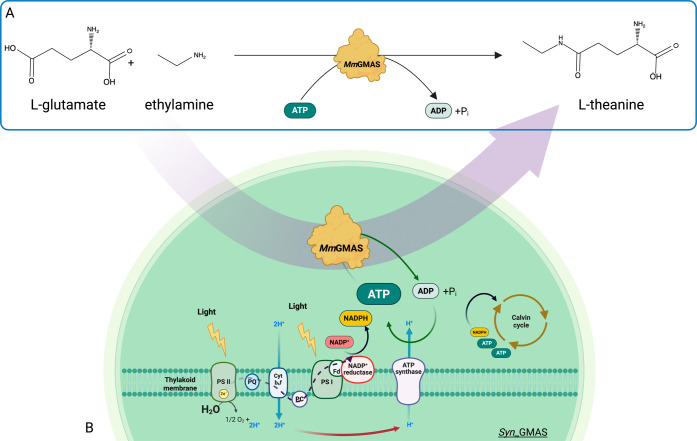
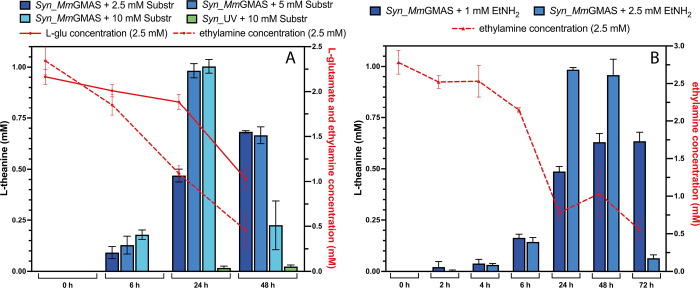
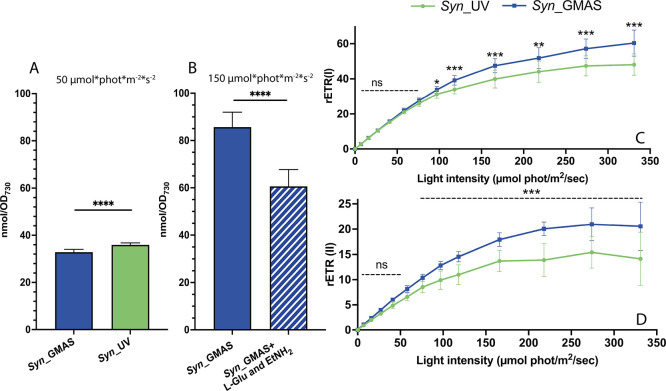
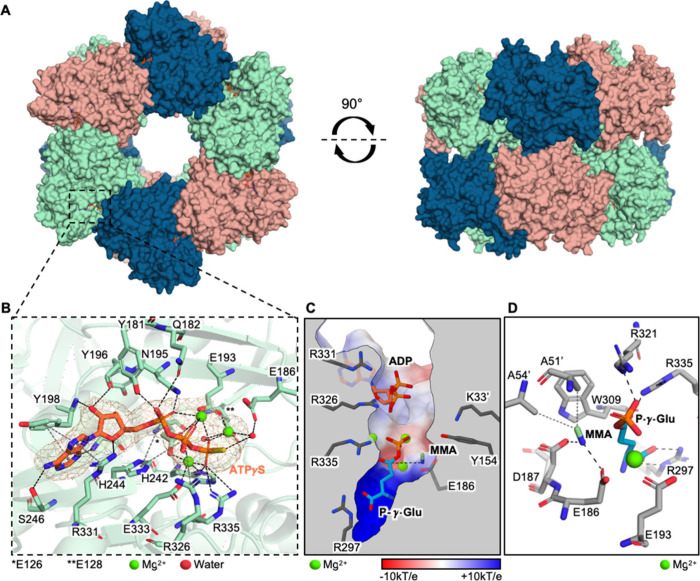
Photosynthetic organisms use sunlight to produce ATP and NADPH powering their metabolism. Harnessing these products for driving biocatalytic reactions would enable to develop clean and sustainable alternatives for chemical reactions. In this study, we present the first demonstration that ATP produced from the photosynthetic process, can fuel a biocatalytic transformation in the whole-cell configuration. This result was achieved by expressing in the cyanobacterium Synechocystis sp. PCC 6803 an ATP-dependent enzyme, the γ-Glutamyl-MethylAmide Synthetase from Methylovorus mays No. 9 ( Mm GMAS). The expressed enzyme was able to drive in the transgenic strain the light-driven biosynthesis of L-theanine. Consumption of ATP by the recombinant Mm GMAS was even beneficial under strong illumination, protecting the photosynthetic electron transport from photodamage. These findings demonstrate the possibility of using photosynthetic microorganisms like Synechocystis as potential platform for sunlight driven biotransformations with wide potential biocatalytic applications. In this perspective, we further present the tridimensional structure of Mm GMAS, which explains its promiscuous in vivo activity and provides the basis for its rational evolution.
Overview
The claims and statistics of this paper haven’t been checked yet.
Run the check — free, no account needed. It reads the open-access text and checks the sources it cites.
Integrity signals
Registry
Cites
Statistics
Figures
Verification
Claims the paper makes
The claims and statistics of this paper haven’t been checked yet.
Run the check — free, no account needed. It reads the open-access text and checks the sources it cites.
Self-check
Percentages, sums and reported differences re-computed from the paper’s own numbers.
The self-check needs the paper’s full text.
Citations
Cites
Highly accurate protein structure prediction with AlphaFold
Jumper, J., Evans, R., Pritzel, A., Green, T., Figurnov, M., Ronneberger, O., Tunyasuvunakool, K., Bates, R., Žídek, A., Potapenko, A., et al. (2021) · Nature · doi:10.1038/s41586-021-03819-2 · Cited by 43,764
Yoto, A., Motoki, M., Murao, S., & Yokogoshi, H. (2012) · Journal of Physiological Anthropology · doi:10.1186/1880-6805-31-28 · Cited by 110
Research works printed but not linked: 56
- Abraham, M. J. et al. Gromacs: High performance molecular simulations through multi-level parallelism from laptops to supercomputers. SoftwareX 1–2, 19–25 (2015). · DOI · Paper page
- 10.1093/NAR/GKAB294 · DOI
- 10.1107/S2059798323003595 · DOI
- 10.1002/cbic.201402550 · DOI
- 10.1021/acs.jafc.1c03240 · DOI
- 10.1016/0010-4655(95)00042-E · DOI
- 10.1021/ct300400x · DOI
- 10.1093/nar/gkae300 · DOI
- 10.3390/metabo11010052 · DOI
- 10.3390/pharmaceutics16010001 · DOI
- 10.1021/bi061865d · DOI
- 10.1021/acs.jcim.1c00203 · DOI
- 10.1107/S0907444910007493 · DOI · Paper page
- 10.1107/S090744491003982X · DOI
- 2020, Pathway engineering of Escherichia coli for one-step fermentative production of L-theanine from sugars and ethylamine, Metabolic Engineering Communications, 11, e00151, 10.1016/j.mec.2020.e00151 · DOI
- Fan, C. , Qi, J. , Cong, Y. & Zhang, C . Enhanced L-theanine production through semi-rational design of γ-glutamylmethylamide synthetase from Methylovorus mays. Enzyme Microb. Technol. 180, 110481 (2024). · DOI
- 10.1007/s00253-015-6695-x · DOI
- 10.1021/acs.jafc.0c01796 · DOI
- 10.3390/nu11040923 · DOI
- 10.1107/S2052252514009324 · DOI
- 10.1002/pro.3280 · DOI
- 10.1016/j.biopsycho.2006.06.006 · DOI · Paper page
- 10.1016/j.jmb.2007.05.022 · DOI
- 2019, From Proteins to Perturbed Hamiltonians: A Suite of Tutorials for the GROMACS-2018 Molecular Simulation Package, Living J. Comput. Mol. Sci, 1, 1
- 10.1021/bp070371k · DOI · Paper page
- 2020, Theanine transporters are involved in nitrogen deficiency response in tea plant (Camellia sinensis L.), Plant Signaling and Behavior, 15, 20
- 10.1007/s00203-002-0446-y · DOI
- 10.1111/1751-7915.70146 · DOI
- 10.1007/s00253-019-10255-w · DOI
- 10.1002/cite.202200077 · DOI
- 10.1246/bcsj.78.1077 · DOI · Paper page
- 10.1107/S0907444911001314 · DOI
- 10.1016/j.jcou.2018.10.008 · DOI
- 10.1007/s10295-020-02305-4 · DOI
- 10.1007/s11705-016-1591-1 · DOI · Paper page
- 10.1371/journal.pone.0232391 · DOI · Paper page
- 10.1007/s00726-015-1925-1 · DOI
- Pope, M. A. , Hodge, J. A. & Nixon, P. J . An Improved Natural Transformation Protocol for the Cyanobacterium Synechocystis sp. PCC 6803. Front. Plant Sci. 11, (2020). · DOI · Paper page
- 10.1021/bi020083r · DOI
- 10.1016/j.jbiotec.2012.05.006 · DOI
- 10.1038/s41467-023-43650-z · DOI
- 10.1016/j.foodchem.2017.09.046 · DOI
- 10.1002/cctc.202100688 · DOI
- 10.1080/00021369.1985.10867191 · DOI
- 10.1107/S0907444909042589 · DOI
- 10.1002/jcc.21367 · DOI
- 2021, L-theanine as a promising agent on brain health-promoting foods – A review, Journal of Food Bioactives, 13, 32
- Wang, N. et al. Crystal structures of-glutamylmethylamide synthetase provide insight into bacterial metabolism of oceanic monomethylamine. Journal of Biological Chemistry 296, 100081 (2021b). · DOI
- 10.1038/277293a0 · DOI
- 10.1002/pro.4224 · DOI
- 10.1101/2024.11.19.624167 · DOI
- 10.1271/bbb.70668 · DOI
- 10.1271/bbb.70462 · DOI
- Yang, T. et al. Combining protein and metabolic engineering strategies for high-level production of L-theanine in Corynebacterium glutamicum . Bioresource Technology 394, 130200 (2024). · DOI
- 10.1016/j.ymben.2016.08.002 · DOI
- 10.1007/s11427-008-0137-2 · DOI
Metadata
- Authors
- Loprete, G., Traverso, E., Vascon, F., Botteri, M., Robescu, M. S., Ubiali, D., Cendron, L., Morosinotto, T., & Bergantino, E.
- Affiliations
- University of Padua (IT)
- University of Pavia (IT)
- Corresponding author
- Bergantino, Elisabetta
- ORCID
- Venue
- ACS Sustainable Chemistry & Engineering
- Publisher
- openRxiv
- Published
- 2025-05-30
- Volume
- 13
- Issue
- 43
- Pages
- 18667-18677
- ISSN
- 2168-0485 (ISSN-L)
- PMC
- PMC12588301
- OpenAlex
- W4415468576
- Cited by
- 2
- References
- 2
- Citations by year
- 2026: 2
- FWCI
- 0.60
- Type
- journal article
- Language
- en
- Open access
- hybrid
- doi.org
- Licence
- Locations
- ACS Sustainable Chemistry & Engineering (publishedVersion, cc-by)
- bioRxiv (Cold Spring Harbor Laboratory) (acceptedVersion)
- Europe PMC (PubMed Central) (publishedVersion, cc-by)
- PubMed (publishedVersion)
- Padua Research Archive (University of Padova) (submittedVersion, cc-by)
- Funders
- European Commission (ECS_00000036)
- European Synchrotron Radiation Facility (ID30A-3)
- Università degli Studi di Padova
- Dipartimento di Biologia, Università degli Studi di Padova (BIRD221528/22, U-GOV CEND_BIRD24_01)
- NextGenerationEU (ECS00000036)
- Topics
- Life Sciences › Biochemistry, Genetics and Molecular Biology › Molecular Biology › Microbial Metabolic Engineering and Bioproduction
- Life Sciences › Biochemistry, Genetics and Molecular Biology › Molecular Biology › Photosynthetic Processes and Mechanisms
- Life Sciences › Biochemistry, Genetics and Molecular Biology › Molecular Biology › Enzyme Catalysis and Immobilization
- Keywords
- whole-cell biocatalysis, Synechocystis sp. PCC 6803, ATP-dependent enzyme, enzyme structure, cyanobacteria
About these checks
Registry, retraction, Cites and statistics results are computed, not judged, with one exception: a printed reference that no index lists is read once by a model before it counts as a citation error. Claims are extracted by a model and kept only when their quote appears verbatim in the text; each cited source is then checked, with a model’s help, for whether it says what the claim relies on. Those verdicts can be wrong — read the claim’s quote and the cited source before relying on one.
Statistics and arithmetic are recomputed, not judged.
Confidence bands are shown only for fields calibrated on our annotated test set. None is calibrated yet, so no band is shown.
What counts as a claim ›How we measure confidence ›How we check this ›
Are you an author, or do you see a problem with this page? Request a review
