

The DOI matches its Crossref record; 2 of the 2 references it cites were found in a registry or an index.
Addressing the Embeddability Problem in Transition Rate Estimation
Open accessPreprint — published as 10.1021/acs.jpca.3c01367
Abstract
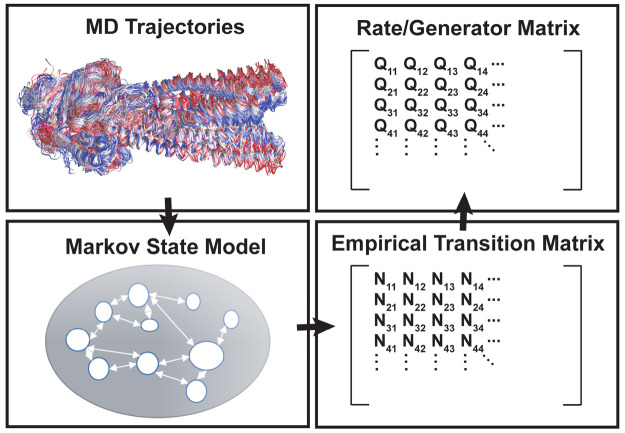
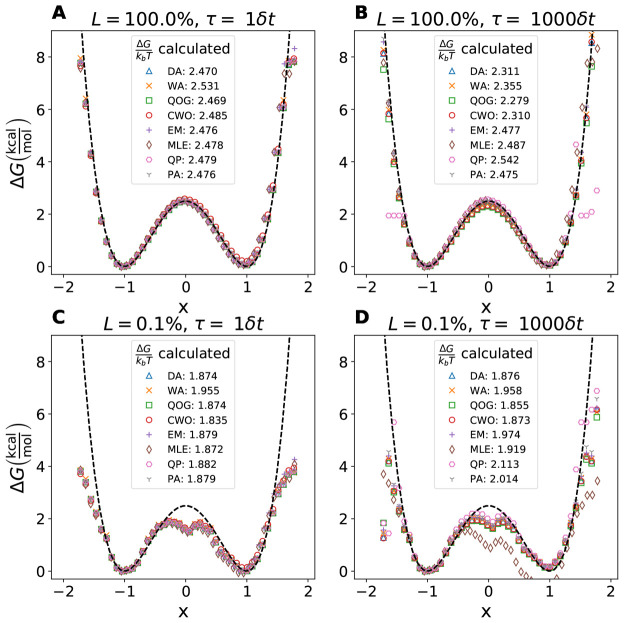
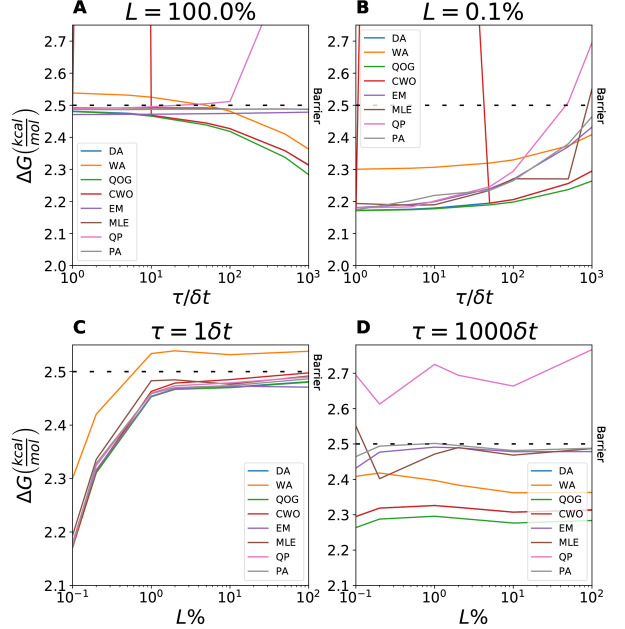
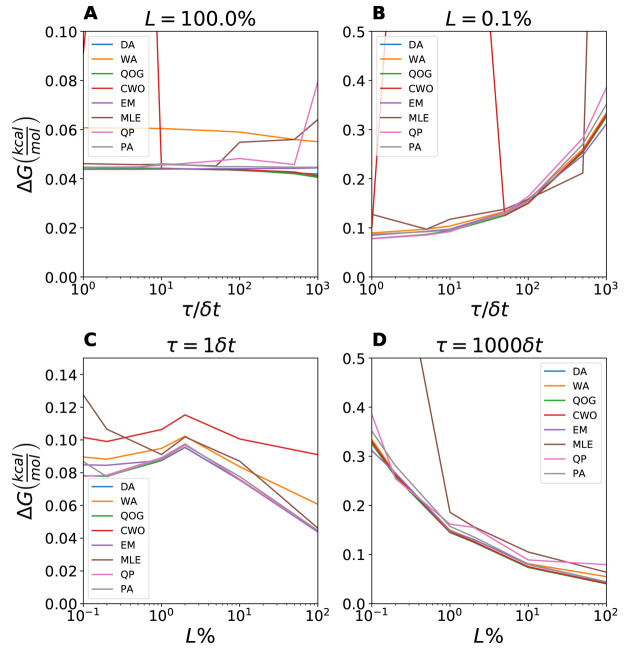
Markov State Models (MSM) and related techniques have gained significant traction as a tool for analyzing and guiding molecular dynamics (MD) simulations due to their ability to extract structural, thermodynamic, and kinetic information on proteins using computationally feasible MD simulations. The MSM analysis often relies on spectral decomposition of empirically generated transition matrices. Here, we discuss an alternative approach for extracting the thermodynamic and kinetic information from the so-called rate/generator matrix rather than the transition matrix. Although the rate matrix itself is built from the empirical transition matrix, it provides an alternative approach for estimating both thermodynamic and kinetic quantities, particularly in diffusive processes. We particularly discuss a fundamental issue with this approach, known as the embeddability problem and offer ways to address this issue. We describe eight different methods to overcome the embeddability problem, including a novel approach developed for this work. The algorithms were tested on data from a one-dimensional toy model to show the workings of these methods and discuss the robustness of each method in terms of its dependence in lag time and trajectory length.
Overview
The claims and statistics of this paper haven’t been checked yet.
Run the check — free, no account needed. It reads the open-access text and checks the sources it cites.
Integrity signals
Registry
Cites
Statistics
Figures
Verification
Claims the paper makes
The claims and statistics of this paper haven’t been checked yet.
Run the check — free, no account needed. It reads the open-access text and checks the sources it cites.
Self-check
Percentages, sums and reported differences re-computed from the paper’s own numbers.
The self-check needs the paper’s full text.
Citations
Cites
Markov state models of biomolecular conformational dynamics
Chodera, J. D., & Noé, F. (2014) · Current Opinion in Structural Biology · doi:10.1016/j.sbi.2014.04.002 · Cited by 776
Markov Chains: From Theory to Implementation and Experimentation
Gagniuc, P. A. (2017) · doi:10.1002/9781119387596 · Cited by 415
Research works printed but not linked: 47
- 10.1016/S0959-440X(00)00061-0 · DOI
- 2017, Openmm 7: Rapid development of high performance algorithms for molecular dynamics, PLoS computational biology, 13, e1005659, 10.1371/journal.pcbi.1005659 · DOI · Paper page
- 2012, Routine microsecond molecular dynamics simulations with amber on gpus. 1. generalized born, Journal of Chemical Theory and Computation, 8, 1542, 10.1021/ct200909j · DOI
- 2014, Unifying on-chip and inter-node switching within the Anton 2 network, ACM SIGARCH Computer Architecture News, 42, 1, 10.1145/2678373.2665677 · DOI
- 10.1111/j.1467-9868.2009.00736.x · DOI
- 2002, Hidden Markov processes, IEEE Transactions on Information Theory, 48, 1518, 10.1109/TIT.2002.1003838 · DOI
- 10.1016/j.ymeth.2010.06.002 · DOI · Paper page
- 10.1016/j.sbi.2010.10.006 · DOI
- 10.1198/016214505000000664 · DOI
- 10.1021/ar5002999 · DOI
- G. R. Bowman , K. A. Beauchamp , G. Boxer , and V. S. Pande , “Progress and challenges in the automated construction of Markov state models for full protein systems,” Journal of Chemical Physics, vol. 131, no. 12, 2009. · DOI · Paper page
- 2012, Estimating the eigenvalue error of Markov state models, Multiscale Modeling & Simulation, 10, 61, 10.1137/100798910 · DOI · Paper page
- 2014, Spectral rate theory for two-state kinetics, Physical Review X, 4, 011020, 10.1103/PhysRevX.4.011020 · DOI · Paper page
- 2005, Position-dependent diffusion coefficients and free energies from Bayesian analysis of equilibrium and replica molecular dynamics simulations, New Journal of Physics, 7, 34
- 10.1063/1.2714539 · DOI
- 2002, Analyzing rating transitions and rating drift with continuous observations, Journal of Banking & Finance, 26, 423
- 10.1016/J.Bbagen.2014.10.019 · DOI · Paper page
- 10.1002/jcc.540130812 · DOI · Paper page
- 10.1016/0021-9991(77)90121-8 · DOI · Paper page
- 10.1016/0010-4655(95)00053-I · DOI
- 10.1002/jcc.540161104 · DOI
- A. Barducci , G. Bussi , and M. Parrinello , “Well-tempered metadynamics: A smoothly converging and tunable free-energy method,” Physical Review Letters, vol. 100, no. 2, 2008. · DOI · Paper page
- A. Laio and F. L. Gervasio , “Metadynamics: A Method To Simulate Rare Events And Reconstruct The Free Energy In Biophysics, Chemistry And Material Science,” Reports On Progress In Physics, vol. 71, no. 12, 2008. · DOI · Paper page
- 10.1002/Wcms.31 · DOI
- 10.1021/Jp045424K · DOI · Paper page
- 1999, Replica-exchange molecular dynamics method for protein folding, Chemical Physics Letters, 314, no. 1-2, 141
- 10.1143/Jpsj.65.1604 · DOI
- 10.1039/b509983h · DOI
- 10.1063/1.1308516 · DOI
- 10.1063/1.1472510 · DOI
- 10.1080/03610926.2012.742543 · DOI
- 2013, On the embedding problem for discrete-time Markov chains, Journal of Applied Probability, 50, 918, 10.1239/jap/1389370090 · DOI
- Y. Inamura , “Estimating continuous time transition matrices from discretely observed data,” Bank Of Japan, pp. 06–07, 2006.
- T. Marada , “Quantitative credit risk modeling: Ratings under stochastic time,” VU University Amsterdam, Master thesis, 2008.
- 10.1007/Bf01027790 · DOI
- I. Gimondi , G. A. Tribello , and M. Salvalaglio , “Building maps in collective variable space,” Journal of Chemical Physics, vol. 149, no. 10, 2018. · DOI
- J. D. Chodera , N. Singhal , V. S. Pande , K. A. Dill , and W. C. Swope , “Automatic discovery of metastable states for the construction of Markov models of macromolecular conformational dynamics,” Journal of Chemical Physics, vol. 126, no. 15, 2007. · DOI
- J.-H. Prinz , H. Wu , M. Sarich , B. Keller , M. Senne , M. Held , J. D. Chodera , C. Schuette , and F. Noe , “Markov models of molecular kinetics: Generation and validation,” Journal of Chemical Physics, vol. 134, no. 17, 2011. · DOI · Paper page
- 2011, Msmbuilder2: Modeling Conformational Dynamics On The Picosecond To Millisecond Scale, Journal of Chemical Theory and Computation, 7, 3412, 10.1021/ct200463m · DOI · Paper page
- 10.1063/1.1732899 · DOI
- 10.1063/1.480818 · DOI
- 10.1111/1467-9965.00114 · DOI
- 2001, Regularization algorithms for transition matrices, Algo Research Quarterly, 4, no. 1/2, 23
- 2006, Fitting timeseries by continuous-time Markov chains: A quadratic programming approach, Journal of Computational Physics, 217, 782, 10.1016/j.jcp.2006.01.045 · DOI
- 10.1002/nav.3800030109 · DOI · Paper page
- 10.1007/bf02846028 · DOI
- 10.1214/aoms/1177729694 · DOI · Paper page
Metadata
- Authors
- Goolsby, C., Losey, J., Xu, Y., Düker, M.-C., Sherman, M. G., Matteson, D. S., & Moradi, M.
- Affiliations
- University of Arkansas at Fayetteville (US)
- Cornell University (US)
- University of Massachusetts Amherst (US)
- Corresponding author
- Moradi, Mahmoud
- ORCID
- Venue
- The Journal of Physical Chemistry A
- Publisher
- openRxiv
- Published
- 2019-08-02
- Volume
- 127
- Issue
- 27
- Pages
- 5745-5759
- ISSN
- 1089-5639 (ISSN-L)
- PMC
- PMC10350963
- OpenAlex
- W4382502848
- Cited by
- 6
- References
- 2
- Citations by year
- 2026: 3 · 2025: 1 · 2021: 1 · 2019: 1
- FWCI
- 0.35
- Type
- journal article
- Language
- en
- Open access
- hybrid
- doi.org
- Licence
- cc-by-nc-nd
- Locations
- The Journal of Physical Chemistry A (publishedVersion, cc-by-nc-nd)
- bioRxiv (Cold Spring Harbor Laboratory) (acceptedVersion)
- PubMed Central (publishedVersion, cc-by-nc-nd)
- PubMed (publishedVersion)
- Journal of the Arkansas Academy of Science (submittedVersion, cc-by-nc-nd)
- Funders
- National Science Foundation (1940276, 1934985, 1945465, 1940188, 1940223, 1940124)
- Arkansas Economic Development Commission
- Arkansas High Performance Computing Center, University of Arkansas
- Division of Chemistry (CHE 1945465, 1945465)
- Topics
- Life Sciences › Biochemistry, Genetics and Molecular Biology › Molecular Biology › Protein Structure and Dynamics
- Physical Sciences › Chemistry › Physical and Theoretical Chemistry › Advanced Physical and Chemical Molecular Interactions
- Physical Sciences › Physics and Astronomy › Statistical and Nonlinear Physics › Model Reduction and Neural Networks
- Keywords
- transition rate estimation, Markov state models, rate matrix, generator matrix, transition matrix, spectral decomposition, protein kinetics, thermodynamic properties, diffusive dynamics, time delay, trajectory length
About these checks
Registry, retraction, Cites and statistics results are computed, not judged, with one exception: a printed reference that no index lists is read once by a model before it counts as a citation error. Claims are extracted by a model and kept only when their quote appears verbatim in the text; each cited source is then checked, with a model’s help, for whether it says what the claim relies on. Those verdicts can be wrong — read the claim’s quote and the cited source before relying on one.
Statistics and arithmetic are recomputed, not judged.
Confidence bands are shown only for fields calibrated on our annotated test set. None is calibrated yet, so no band is shown.
What counts as a claim ›How we measure confidence ›How we check this ›
Are you an author, or do you see a problem with this page? Request a review
How to cite
Cite CoChat for the checks on this page, and the paper for its own findings.
- This page
- CoChat. (2026). Citation check: Addressing the Embeddability Problem in Transition Rate Estimation. https://app.cochat.ai/papers/10.1101/707919
- The paper
- Goolsby, C., Losey, J., Xu, Y., Düker, M.-C., Sherman, M. G., Matteson, D. S., & Moradi, M. (2019). Addressing the Embeddability Problem in Transition Rate Estimation. The Journal of Physical Chemistry A. https://doi.org/10.1101/707919
