

The DOI matches its Crossref record; 3 of the 3 references it cites were found in a registry or an index.
Tn5 transposase and tagmentation procedures for massively scaled sequencing projects
Abstract
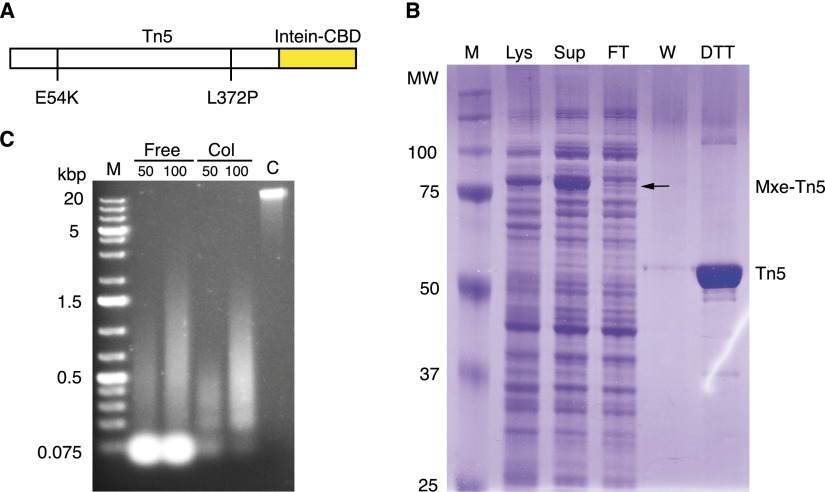
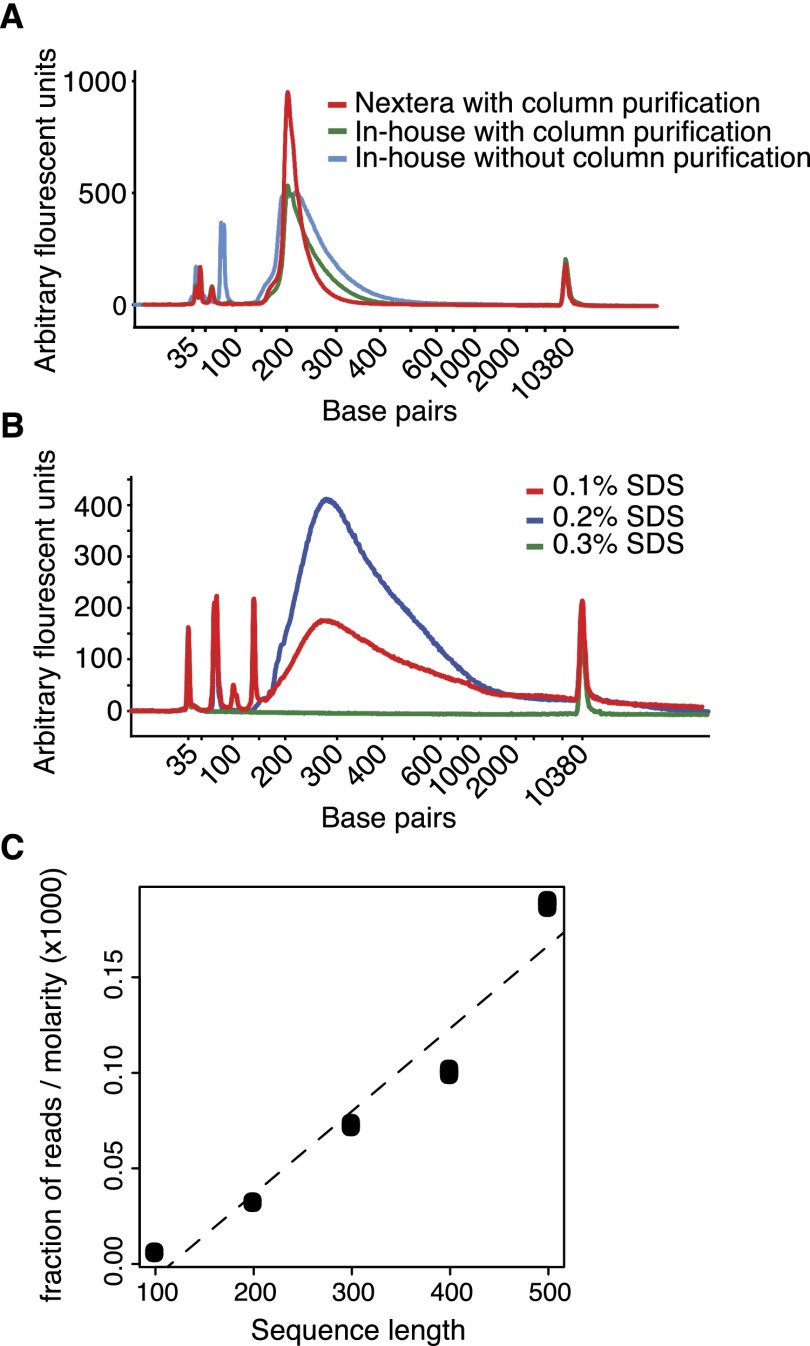
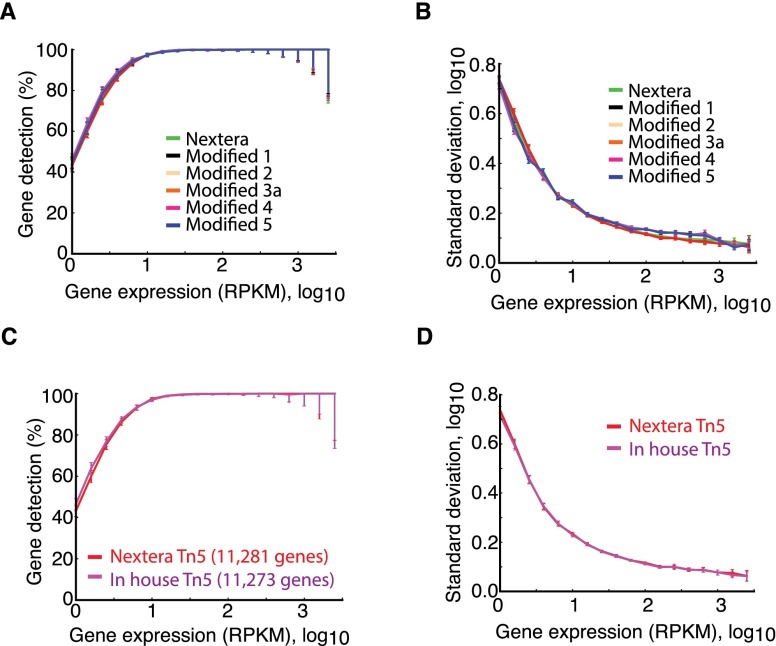
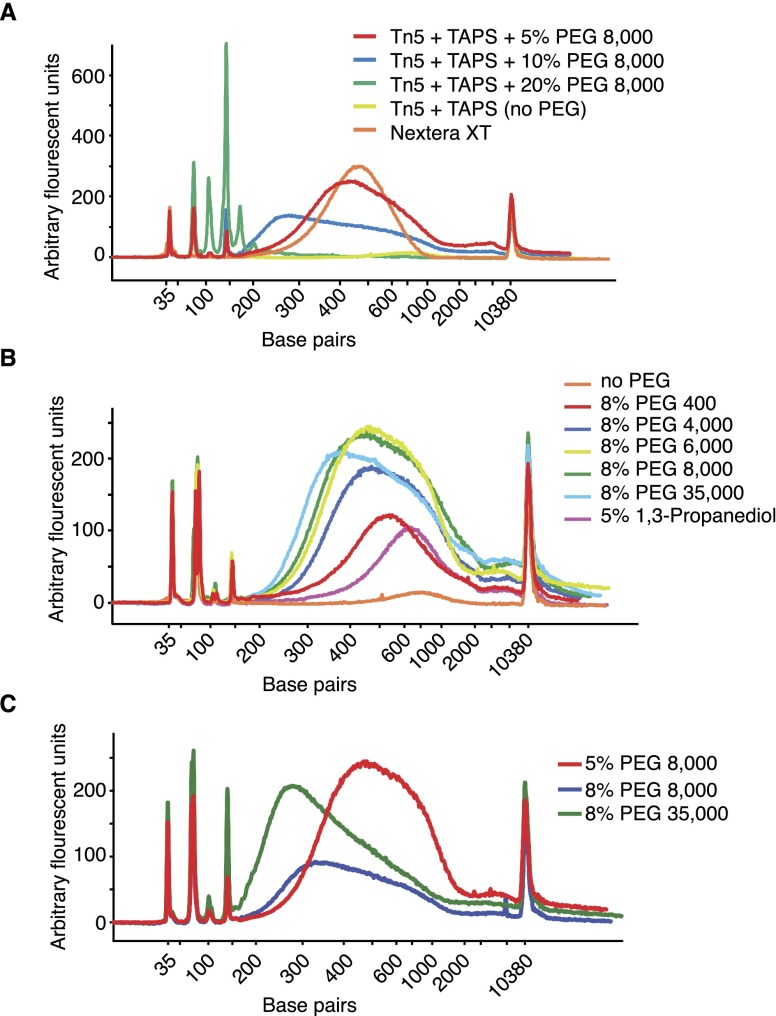
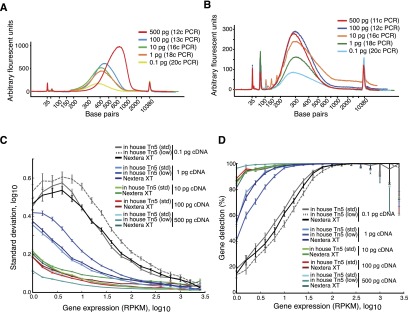
Massively parallel DNA sequencing of thousands of samples in a single machine-run is now possible, but the preparation of the individual sequencing libraries is expensive and time-consuming. Tagmentation-based library construction, using the Tn5 transposase, is efficient for generating sequencing libraries but currently relies on undisclosed reagents, which severely limits development of novel applications and the execution of large-scale projects. Here, we present simple and robust procedures for Tn5 transposase production and optimized reaction conditions for tagmentation-based sequencing library construction. We further show how molecular crowding agents both modulate library lengths and enable efficient tagmentation from subpicogram amounts of cDNA. The comparison of single-cell RNA-sequencing libraries generated using produced and commercial Tn5 demonstrated equal performances in terms of gene detection and library characteristics. Finally, because naked Tn5 can be annealed to any oligonucleotide of choice, for example, molecular barcodes in single-cell assays or methylated oligonucleotides for bisulfite sequencing, custom Tn5 production and tagmentation enable innovation in sequencing-based applications.
Overview
The claims and statistics of this paper haven’t been checked yet.
Run the check — free, no account needed. It reads the open-access text and checks the sources it cites.
Integrity signals
Registry
Cites
Statistics
Figures
Verification
Claims the paper makes
The claims and statistics of this paper haven’t been checked yet.
Run the check — free, no account needed. It reads the open-access text and checks the sources it cites.
Claims other papers make about this one
Each is checked against this paper’s own text: does it say what the citing paper says it does?
In the citing paper
“In vitro TE systems have been leveraged to generate protocols to assay chromatin accessibility (ATAC-seq) [36] as well as efficient deep sequencing library production (tagmentation) [37].”
From The case for not masking away repetitive DNA (2018) · cites this paper as [37]
Self-check
Percentages, sums and reported differences re-computed from the paper’s own numbers.
The self-check needs the paper’s full text.
Citations
Cites
Sequencing technologies – the next generation
Metzker, M. L. (2010) · Nature Reviews Genetics · doi:10.1038/nrg2626 · Cited by 7,066
Smart-seq2 for sensitive full-length transcriptome profiling in single cells
Picelli, S., Björklund, Å. K., Faridani, O. R., Sagasser, S., Winberg, G., & Sandberg, R. (2013) · Nature Methods · doi:10.1038/nmeth.2639 · Cited by 2,358
Self-citationQuantitative single-cell RNA-seq with unique molecular identifiers
Islam, S., Zeisel, A., Joost, S., La Manno, G., Zajac, P., Kasper, M., Lönnerberg, P., & Linnarsson, S. (2014) · Nature Methods · doi:10.1038/nmeth.2772 · Cited by 1,183
Research works printed but not linked: 16
- 10.1101/gr.136242.111 · DOI
- 10.1186/gb-2010-11-12-r119 · DOI
- 10.1074/jbc.274.52.37021 · DOI
- Eberwine, 2014, The promise of single-cell sequencing, Nat Methods, 11, 25, 10.1038/nmeth.2769 · DOI
- 10.1074/jbc.273.13.7367 · DOI
- 10.1016/j.celrep.2012.08.003 · DOI · Paper page
- 10.1126/science.1247651 · DOI · Paper page
- 10.1038/nsb778 · DOI
- 10.1186/1471-2180-11-38 · DOI
- 10.1038/nprot.2014.006 · DOI · Paper page
- 10.1046/j.1365-2958.2003.03382.x · DOI
- 10.1146/annurev.genet.42.110807.091656 · DOI
- Sandberg, 2014, Entering the era of single-cell transcriptomics in biology and medicine, Nat Methods, 11, 22, 10.1038/nmeth.2764 · DOI
- 10.1101/SQB.1979.043.01.046 · DOI
- 10.1038/nprot.2013.118 · DOI
- 10.1073/pnas.80.19.5852 · DOI
Cited by
Sorted by citations
CUT&Tag for efficient epigenomic profiling of small samples and single cells
Kaya-Okur, H. S., Wu, S. J., Codomo, C. A., Pledger, E. S., Bryson, T. D., Henikoff, J. G., Ahmad, K., & Henikoff, S. (2019) · Nature Communications · doi:10.1038/s41467-019-09982-5 · Cited by 2,187
Comparative Analysis of Single-Cell RNA Sequencing Methods
Ziegenhain, C., Vieth, B., Parekh, S., Reinius, B., Guillaumet-Adkins, A., Smets, M., Leonhardt, H., Heyn, H., Hellmann, I., & Enard, W. (2017) · Molecular Cell · doi:10.1016/j.molcel.2017.01.023 · Cited by 1,494
Self-citationA single-cell transcriptomic atlas characterizes ageing tissues in the mouse
The Tabula Muris Consortium, Almanzar, N., Antony, J., Baghel, A. S., Bakerman, I., Bansal, I., Barres, B. A., Beachy, P. A., Berdnik, D., Bilen, B., et al. (2020) · Nature · doi:10.1038/s41586-020-2496-1 · Cited by 1,247
A rapid and robust method for single cell chromatin accessibility profiling
Chen, X., Miragaia, R. J., Natarajan, K. N., & Teichmann, S. A. (2018) · Nature Communications · doi:10.1038/s41467-018-07771-0 · Cited by 1,147
Chromatin Potential Identified by Shared Single-Cell Profiling of RNA and Chromatin
Ma, S., Zhang, B., LaFave, L. M., Earl, A. S., Chiang, Z., Hu, Y., Ding, J., Brack, A., Kartha, V. K., Tay, T., et al. (2020) · Cell · doi:10.1016/j.cell.2020.09.056 · Cited by 1,146
Metadata
- Authors
- Picelli, S., Björklund, Å. K., Reinius, B., Sagasser, S., Winberg, G., & Sandberg, R.
- Venue
- Genome Research
- Publisher
- Cold Spring Harbor Laboratory
- Published
- 2014-07-30
- Volume
- 24
- Issue
- 12
- Pages
- 2033-2040
- ISSN
- 1088-9051
- 1549-5469
- PMC
- PMC4248319
- Cited by
- 973
- References
- 3
- Language
- en
- Funders
- European Research Council (243066)
About these checks
Registry, retraction, Cites and statistics results are computed, not judged, with one exception: a printed reference that no index lists is read once by a model before it counts as a citation error. Claims are extracted by a model and kept only when their quote appears verbatim in the text; each cited source is then checked, with a model’s help, for whether it says what the claim relies on. Those verdicts can be wrong — read the claim’s quote and the cited source before relying on one.
Statistics and arithmetic are recomputed, not judged.
Confidence bands are shown only for fields calibrated on our annotated test set. None is calibrated yet, so no band is shown.
What counts as a claim ›How we measure confidence ›How we check this ›
Are you an author, or do you see a problem with this page? Request a review
How to cite
Cite CoChat for the checks on this page, and the paper for its own findings.
- This page
- CoChat. (2026). Citation check: Tn5 transposase and tagmentation procedures for massively scaled sequencing projects. https://app.cochat.ai/papers/10.1101/gr.177881.114
- The paper
- Picelli, S., Björklund, Å. K., Reinius, B., Sagasser, S., Winberg, G., & Sandberg, R. (2014). Tn5 transposase and tagmentation procedures for massively scaled sequencing projects. Genome Research. https://doi.org/10.1101/gr.177881.114
