

The DOI matches its Crossref record; 74 of the 74 references it cites were found in a registry or an index.
Solving differential equations with neural networks: Applications to the calculation of cosmological phase transitions
Abstract
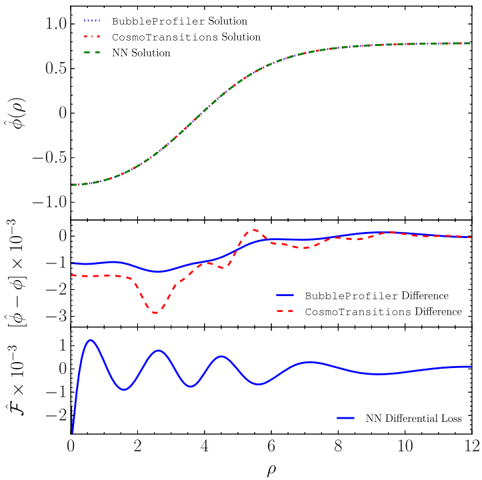
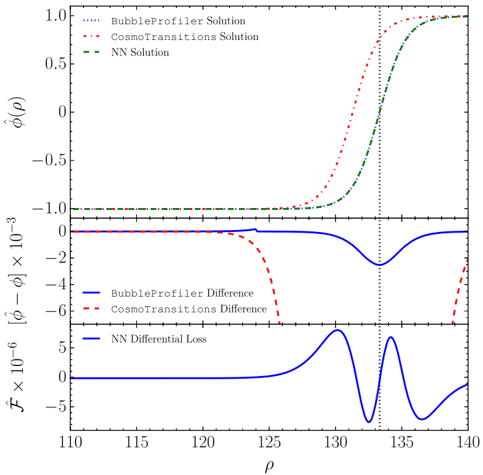
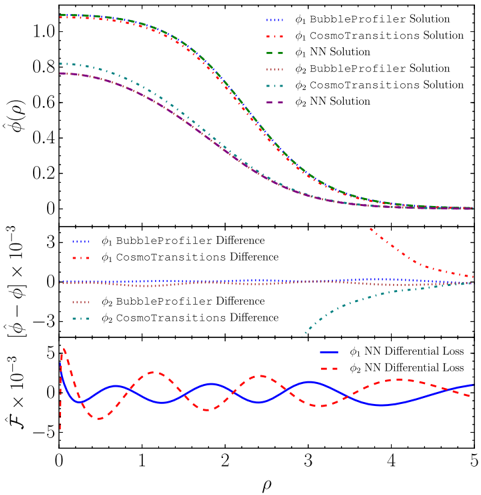
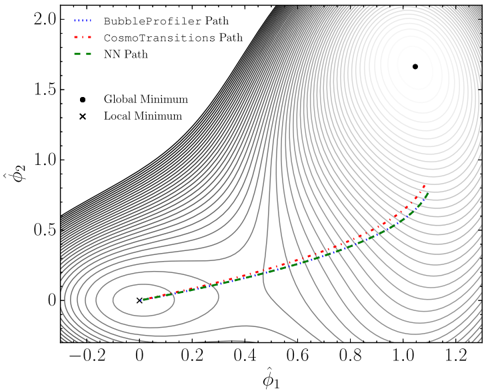
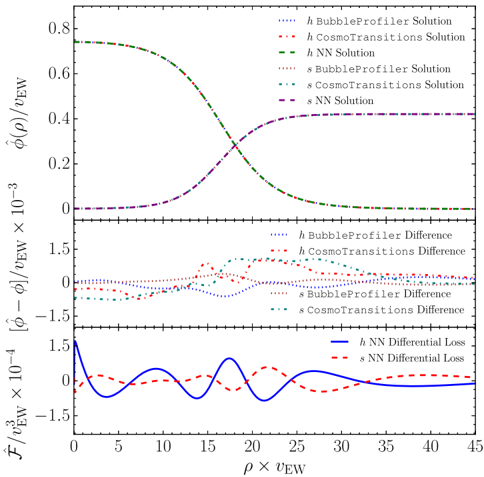
Starting from the observation that artificial neural networks are uniquely suited to solving optimization problems, and most physics problems can be cast as an optimization task, we introduce a novel way of finding a numerical solution to wide classes of differential equations. We find our approach to be very flexible and stable without relying on trial solutions, and applicable to ordinary, partial and coupled differential equations. We apply our method to the calculation of tunneling profiles for cosmological phase transitions, which is a problem of relevance for baryogenesis and stochastic gravitational wave spectra. Comparing our solutions with publicly available codes which use numerical methods optimized for the calculation of tunneling profiles, we find our approach to provide at least as accurate results as these dedicated differential equation solvers, and for some parameter choices, even more accurate and reliable solutions. In particular, we compare the neural network approach with two publicly available profile solvers, CosmoTransitions and BubbleProfiler, and give explicit examples where the neural network approach finds the correct solution while dedicated solvers do not. We point out that this approach of using artificial neural networks to solve equations is viable for any problem that can be cast into the form $\mathcal{F}(\stackrel{\ensuremath{\rightarrow}}{x})=0$, and is thus applicable to various other problems in perturbative and nonperturbative quantum field theory.
Overview
The claims and statistics of this paper haven’t been checked yet.
Run the check — free, no account needed. It reads the open-access text and checks the sources it cites.
Integrity signals
Registry
Cites
Statistics
Figures
Verification
Claims the paper makes
The claims and statistics of this paper haven’t been checked yet.
Run the check — free, no account needed. It reads the open-access text and checks the sources it cites.
Claims other papers make about this one
Each is checked against this paper’s own text: does it say what the citing paper says it does?
In the citing paper
“Incorporating the current 2σ bound on the tensor/scalar ratio r [75, 76] requires roughly H/M P < 10 -7 .”
From Hyperbolic compactification of M-theory and de Sitter quantum gravity (2022) · cites this paper as [75]
Self-check
Percentages, sums and reported differences re-computed from the paper’s own numbers.
The self-check needs the paper’s full text.
Citations
Cites
Multilayer feedforward networks are universal approximators
Hornik, K., Stinchcombe, M., & White, H. (1989) · Neural Networks · doi:10.1016/0893-6080(89)90020-8 · Cited by 21,728
Approximation capabilities of multilayer feedforward networks
Hornik, K. (1991) · Neural Networks · doi:10.1016/0893-6080(91)90009-t · Cited by 6,091
On anomalous electroweak baryon-number non-conservation in the early universe
Kuzmin, V. A., Rubakov, V. A., & Shaposhnikov, M. E. (1985) · Physics Letters B · doi:10.1016/0370-2693(85)91028-7 · Cited by 3,008
Fate of the false vacuum: Semiclassical theory
Coleman, S. (1977) · Physical Review D · doi:10.1103/physrevd.15.2929 · Cited by 2,552
Violation of CP in variance, C asymmetry, and baryon asymmetry of the universe
Sakharov, A. D. (1991) · Soviet Physics Uspekhi · doi:10.1070/pu1991v034n05abeh002497 · Cited by 1,561
The Minimal Model of nonbaryonic dark matter: a singlet scalar
Burgess, C. P., Pospelov, M., & ter Veldhuis, T. (2001) · Nuclear Physics B · doi:10.1016/s0550-3213(01)00513-2 · Cited by 955
Caprini, C., Hindmarsh, M., Huber, S., Konstandin, T., Kozaczuk, J., Nardini, G., No, J. M., Petiteau, A., Schwaller, P., Servant, G., et al. (2016) · Journal of Cosmology and Astroparticle Physics · doi:10.1088/1475-7516/2016/04/001 · Cited by 927
Morrissey, D. E., & Ramsey-Musolf, M. J. (2012) · New Journal of Physics · doi:10.1088/1367-2630/14/12/125003 · Cited by 852
Decay of the false vacuum at finite temperature
Linde, A. D. (1983) · Nuclear Physics B · doi:10.1016/0550-3213(83)90293-6 · Cited by 829
The Minimal Model of Nonbaryonic Dark Matter: A Singlet ScalarPreprint
Burgess, C. P., Pospelov, M., & ter Veldhuis, T. (2000) · Cited by 601
Erratum: Fate of the false vacuum: semiclassical theory
Coleman, S. (1977) · Physical Review D · doi:10.1103/physrevd.16.1248 · Cited by 600
Electroweak baryon number non-conservation in the early Universe and in high-energy collisions
Rubakov, V. A., & Shaposhnikov, M. E. (1996) · Uspekhi Fizicheskih Nauk · doi:10.3367/ufnr.0166.199605d.0493 · Cited by 563
Gravitational waves from first-order cosmological phase transitions
Kosowsky, A., Turner, M. S., & Watkins, R. (1992) · Physical Review Letters · doi:10.1103/physrevlett.69.2026 · Cited by 507
Electroweak baryon number non-conservation in the early Universe and in high-energy collisions
Rubakov, V. A., & Shaposhnikov, M. E. (1996) · Physics-Uspekhi · doi:10.1070/pu1996v039n05abeh000145 · Cited by 501
Action minima among solutions to a class of Euclidean scalar field equations
Coleman, S., Glaser, V., & Martin, A. (1978) · Communications in Mathematical Physics · doi:10.1007/bf01609421 · Cited by 500
Wainwright, C. L. (2012) · Computer Physics Communications · doi:10.1016/j.cpc.2012.04.004 · Cited by 499
Thermally Generated Gauge Singlet Scalars as Self-Interacting Dark Matter
McDonald, J. (2002) · Physical Review Letters · doi:10.1103/physrevlett.88.091304 · Cited by 463
Electroweak phase transition and baryogenesis
Anderson, G. W., & Hall, L. J. (1992) · Physical Review D · doi:10.1103/physrevd.45.2685 · Cited by 461
Singlet Higgs phenomenology and the electroweak phase transition
Profumo, S., Ramsey-Musolf, M. J., & Shaughnessy, G. (2007) · Journal of High Energy Physics · doi:10.1088/1126-6708/2007/08/010 · Cited by 452
Neural algorithm for solving differential equations
Lee, H., & Kang, I. S. (1990) · Journal of Computational Physics · doi:10.1016/0021-9991(90)90007-n · Cited by 436
Gravitational waves from phase transitions at the electroweak scale and beyond
Grojean, C., & Servant, G. (2007) · Physical review. D. Particles, fields, gravitation, and cosmology/Physical review. D. Particles and fields · doi:10.1103/physrevd.75.043507 · Cited by 430
Electroweak baryogenesis and standard model CP violation
Huet, P., & Sather, E. (1995) · Physical Review D · doi:10.1103/physrevd.51.379 · Cited by 422
Strong electroweak phase transitions in the Standard Model with a singlet
Espinosa, J. R., Konstandin, T., & Francesco Riva, B. (2011) · Nuclear Physics B · doi:10.1016/j.nuclphysb.2011.09.010 · Cited by 417
Sterile Neutrinos, Dark Matter, and Pulsar Velocities in Models with a Higgs Singlet
Kusenko, A. (2006) · Physical Review Letters · doi:10.1103/physrevlett.97.241301 · Cited by 356
Deep learning in color: towards automated quark/gluon jet discrimination
Komiske, P. T., Metodiev, E. M., & Schwartz, M. D. (2017) · Journal of High Energy Physics · doi:10.1007/jhep01(2017)110 · Cited by 291
Jet-images — deep learning edition
de Oliveira, L. (2022) · OSTI OAI (U.S. Department of Energy Office of Scientific and Technical Information) · doi:10.1007/jhep07%282016%29069 · Cited by 291
Classification without labels: learning from mixed samples in high energy physics
Metodiev, E. M., Nachman, B., & Thaler, J. (2017) · Journal of High Energy Physics · doi:10.1007/jhep10(2017)174 · Cited by 287
Jet-images — deep learning edition
de Oliveira, L., Kagan, M., Mackey, L., Nachman, B., & Schwartzman, A. (2016) · Journal of High Energy Physics · doi:10.1007/jhep07(2016)069 · Cited by 282
Gravitational waves from electroweak phase transitions
Apreda, R., Maggiore, M., Nicolis, A., & Riotto, A. (2002) · Nuclear Physics B · doi:10.1016/s0550-3213(02)00264-x · Cited by 277
Deep-learning top taggers or the end of QCD?
Kasieczka, G., Plehn, T., Russell, M., & Schell, T. (2017) · Journal of High Energy Physics · doi:10.1007/jhep05(2017)006 · Cited by 276
Decay of the false vacuum at finite temperature
(1983) · Nuclear Physics B · doi:10.1016/0550-3213(83)90072-x · Cited by 270
A determination of parton distributions with faithful uncertainty estimation
Ball, R. D., Del Debbio, L., Forte, S., Guffanti, A., Latorre, J. I., Piccione, A., Rojo, J., & Ubiali, M. (2009) · Nuclear Physics B · doi:10.1016/j.nuclphysb.2008.09.037 · Cited by 264
The numerical solution of linear ordinary differential equations by feedforward neural networks
Meade, A. J., & Fernandez, A. A. (1994) · Mathematical and Computer Modelling · doi:10.1016/0895-7177(94)90095-7 · Cited by 256
Deep-learned Top Tagging with a Lorentz Layer
Butter, A., Kasieczka, G., Plehn, T., & Russell, M. (2018) · SciPost Physics · doi:10.21468/scipostphys.5.3.028 · Cited by 251
Anomaly Detection for Resonant New Physics with Machine Learning
Collins, J. H., Howe, K., & Nachman, B. P. (2018) · Physical Review Letters · doi:10.1103/physrevlett.121.241803 · Cited by 250
Electroweak baryogenesis and dark matter from a singlet Higgs
Cline, J. M., & Kainulainen, K. (2013) · Journal of Cosmology and Astroparticle Physics · doi:10.1088/1475-7516/2013/01/012 · Cited by 247
Morandi, G. (1995) · WORLD SCIENTIFIC eBooks · doi:10.1142/2785 · Cited by 227
Learning new physics from a machine
D’Agnolo, R. T., & Wulzer, A. (2019) · Physical review. D/Physical review. D. · doi:10.1103/physrevd.99.015014 · Cited by 226
Singlet Higgs Phenomenology and the Electroweak Phase TransitionPreprint
Profumo, S., Musolf, M. J., & Shaughnessy, G. (2012) · Cited by 215
Playing tag with ANN: boosted top identification with pattern recognition
Almeida, L. G., Backović, M., Cliche, M., et al. (2015) · Journal of High Energy Physics · doi:10.1007/jhep07(2015)086 · Cited by 208
Deep learning in color: towards automated quark/gluon jet discrimination
Schwartz, M. D. (2022) · OSTI OAI (U.S. Department of Energy Office of Scientific and Technical Information) · doi:10.1007/jhep01%282017%29110 · Cited by 185
Solution of nonlinear ordinary differential equations by feedforward neural networks
Meade, A. J., & Fernandez, A. A. (1994) · Mathematical and Computer Modelling · doi:10.1016/0895-7177(94)00160-x · Cited by 172
Possible appearance of the baryon asymmetry of the universe in an electroweak theory
Shaposhnikov, M. (1986) · Infoscience (Ecole Polytechnique Fédérale de Lausanne) · Cited by 169
Constraining Effective Field Theories with Machine Learning
Brehmer, J., Cranmer, K. S., Louppe, G., & Pavez, J. (2018) · Physical Review Letters · doi:10.1103/physrevlett.121.111801 · Cited by 160
Electroweak baryogenesis: concrete in a SUSY model with a gauge singlet
Huber, S. J., & Schmidt, M. G. (2001) · Nuclear Physics B · doi:10.1016/s0550-3213(01)00250-4 · Cited by 156
Chang, S., Timothy Cohen, A., & Ostdiek, B. (2018) · Physical review. D/Physical review. D. · doi:10.1103/physrevd.97.056009 · Cited by 156
Comments on the electroweak phase transition
Michael Dine, B., Leigh, R. G., Huet, P., Linde, A. D., & Linde, D. (1992) · Physics Letters B · doi:10.1016/0370-2693(92)90026-z · Cited by 145
Chala, M., Germano Nardini, B., & Sobolev, I. (2016) · Physical review. D/Physical review. D. · doi:10.1103/physrevd.94.055006 · Cited by 144
Deep-learning top taggers or the end of QCD
Kasieczka, G., Plehn, T., Russell, M., & Schell, T. (2017) · Repository for Publications and Research Data (ETH Zurich) · doi:10.3929/ethz-b-000191242 · Cited by 136
Electroweak phase transition and baryogenesis in the nMSSM
Huber, S. J., Konstandin, T., Prokopec, T., & Schmidt, M. G. (2006) · Nuclear Physics B · doi:10.1016/j.nuclphysb.2006.09.003 · Cited by 135
Parton shower uncertainties in jet substructure analyses with deep neural networks
Barnard, J., Dawe, E., Dolan, M. J., & Rajcic, N. (2017) · Physical review. D/Physical review. D. · doi:10.1103/physrevd.95.014018 · Cited by 135
Bubbles in the supersymmetric standard model
Moreno, J. M., Quirós, M., & Seco, M. (1998) · Nuclear Physics B · doi:10.1016/s0550-3213(98)00283-1 · Cited by 126
Aaboud, M., Aad, G., Abbott, B., Abdinov, O., Abeloos, B., Abidi, S. H., AbouZeid, O. S., Abraham, N. L., Abramowicz, H., Abreu, H., et al. (2018) · Physical review. D/Physical review. D. · doi:10.1103/physrevd.97.072016 · Cited by 103
Deep-learned Top Tagging with a Lorentz Layer
Butter, A., Kasieczka, G., Plehn, T., & Russell, M. (2018) · Repository for Publications and Research Data (ETH Zurich) · doi:10.3929/ethz-b-000415419 · Cited by 90
Efficient numerical solution to vacuum decay with many fields
Masoumi, A., Olum, K. D., & Shlaer, B. (2017) · Journal of Cosmology and Astroparticle Physics · doi:10.1088/1475-7516/2017/01/051 · Cited by 89
Was the electroweak phase transition preceded by a color-broken phase?
Cline, J. M., Moore, G. D., & Servant, G. (1999) · Physical review. D. Particles, fields, gravitation, and cosmology/Physical review. D. Particles and fields · doi:10.1103/physrevd.60.105035 · Cited by 74
Machine learning uncertainties with adversarial neural networks
Englert, C., Galler, P., Harris, P., & Spannowsky, M. (2019) · The European Physical Journal C · doi:10.1140/epjc/s10052-018-6511-8 · Cited by 72
Self-citationA fresh look at the calculation of tunneling actions
Espinosa, J. R. (2018) · Journal of Cosmology and Astroparticle Physics · doi:10.1088/1475-7516/2018/07/036 · Cited by 69
Bubbles in the supersymmetric standard model
Moreno, J. M., Quirós, M., & Seco, M. (1998) · CERN Document Server (European Organization for Nuclear Research) · Cited by 68
Numerical approach to multi-dimensional phase transitions
Konstandin, T., & Huber, S. J. (2006) · Journal of Cosmology and Astroparticle Physics · doi:10.1088/1475-7516/2006/06/021 · Cited by 59
Search for the Higgs Boson Decaying to Two Muons in Proton-Proton Collisions at s=13 TeV
Sirunyan, A. M., Tumasyan, A., Adam, W., Ambrogi, F., Asilar, E., Bergauer, T., Brandstetter, J., Brondolin, E., Dragicevic, M., Erö, J., et al. (2019) · Physical Review Letters · doi:10.1103/physrevlett.122.021801 · Cited by 59
Bubble wall profiles with more than one scalar field: a numerical approach
John, P. (1999) · Physics Letters B · doi:10.1016/s0370-2693(99)00272-5 · Cited by 54
Comparison of Artificial Neural Network Architecture in Solving Ordinary Differential Equations
Mall, S., & Chakraverty, S. (2013) · Advances in Artificial Neural Systems · doi:10.1155/2013/181895 · Cited by 52
Ball, R. D., Debbio, L. D., Forte, S., Guffanti, A., Latorre, J. I., Piccione, A., Rojo, J., & Ubiali, M. (2009) · Nuclear Physics B · doi:10.1016/j.nuclphysb.2009.02.027 · Cited by 50
A fresh look at the calculation of tunneling actions in multi-field potentials
Espinosa, J. R., & Konstandin, T. (2019) · Journal of Cosmology and Astroparticle Physics · doi:10.1088/1475-7516/2019/01/051 · Cited by 44
Semi-analytic techniques for calculating bubble wall profiles
Akula, S., Balázs, C., & White, G. (2016) · The European Physical Journal C · doi:10.1140/epjc/s10052-016-4519-5 · Cited by 36
Guada, V., Maiezza, A., & Nemevšek, M. (2019) · Physical review. D/Physical review. D. · doi:10.1103/physrevd.99.056020 · Cited by 33
Numerical Solution of Blasius Equation through Neural Networks Algorithm
Ahmad, I., & Bilal, M. (2014) · American Journal of Computational Mathematics · doi:10.4236/ajcm.2014.43019 · Cited by 28
Constrained potential method for false vacuum decays
Park, J.-H. (2011) · Journal of Cosmology and Astroparticle Physics · doi:10.1088/1475-7516/2011/02/023 · Cited by 22
A Fresh Look at the Calculation of Tunneling Actions in Multi-Field Potentials
Espinosa, J. R., & Konstandin, T. (2018) · DESY (CERN, DESY, Fermilab, IHEP, and SLAC) · Cited by 22
Chatrchyan, S., Khachatryan, V., Sirunyan, A. M., Tumasyan, A., Adam, W., Aguiló, E., Bergauer, T., Dragicevic, M., Erö, J., Fabjan, C. W., et al. (2013) · Physical review. D. Particles, fields, gravitation, and cosmology/Physical review. D. Particles and fields · doi:10.1103/physrevd.87.072001 · Cited by 17
Signs of heavy Higgs bosons at CLIC: an $$e^+ e^-$$ road to the electroweak phase transition
No, J. M., & Spannowsky, M. (2019) · The European Physical Journal C · doi:10.1140/epjc/s10052-019-6955-5 · Cited by 10
Self-citationDouble-charming Higgs boson identification using machine-learning assisted jet shapes
Lenz, A. J., Spannowsky, M., & Tetlalmatzi-Xolocotzi, G. (2018) · Physical review. D/Physical review. D. · doi:10.1103/physrevd.97.016001 · Cited by 7
Self-citationNeural network analysis in Higgs search using ttH, H→bb and TAG database development for ATLAS
McGlone, H. (2009) · Enlighten: Theses (The University of Glasgow) · doi:10.5525/gla.thesis.71226 · Cited by 3
Research works printed but not linked: 3
- M. E. Shaposhnikov, 1986, JETP Lett., 44, 465
- A. D. Linde, 1990, Contemp. Concepts Phys., 5, 1
- L. V. Kantorovich, 1948, Usp. Math. Nauk, 3, 89
Cited by
Hyperbolic compactification of M-theory and de Sitter quantum gravity
De Luca, G. B., Silverstein, E., & Torroba, G. (2022) · SciPost Physics · doi:10.21468/scipostphys.12.3.083 · Cited by 39
Metadata
- Authors
- Piscopo, M. L., Spannowsky, M., & Waite, P.
- ORCID
- Waite, Philip
- Venue
- Physical Review D
- Publisher
- American Physical Society (APS)
- Published
- 2019-07-09
- Volume
- 100
- Issue
- 1
- ISSN
- 2470-0010
- 2470-0029
- Cited by
- 117
- References
- 74
- Language
- en
- Funders
- University of Tuebingen
- Humboldt Society
About these checks
Registry, retraction, Cites and statistics results are computed, not judged, with one exception: a printed reference that no index lists is read once by a model before it counts as a citation error. Claims are extracted by a model and kept only when their quote appears verbatim in the text; each cited source is then checked, with a model’s help, for whether it says what the claim relies on. Those verdicts can be wrong — read the claim’s quote and the cited source before relying on one.
Statistics and arithmetic are recomputed, not judged.
Confidence bands are shown only for fields calibrated on our annotated test set. None is calibrated yet, so no band is shown.
What counts as a claim ›How we measure confidence ›How we check this ›
Are you an author, or do you see a problem with this page? Request a review
Data sources
Bibliographic data: Semantic Scholar, OpenAlex, Crossref.
Contains information from the Semantic Scholar Academic Graph Datasets, made available under the ODC Attribution License (ODC-BY 1.0).
Semantic Scholar’s data is described in: Kinney, R., et al. (2023). The Semantic Scholar Open Data Platform. arXiv:2301.10140.
