

The DOI matches its Crossref record; 2 of the 2 references it cites were found in a registry or an index.
Quantum information science and technology professional learning for secondary science, technology, engineering, and mathematics teachers
Open accessAbstract
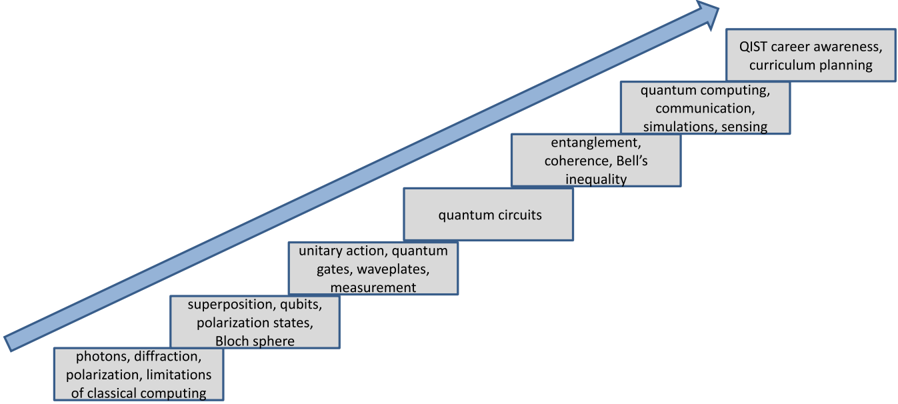
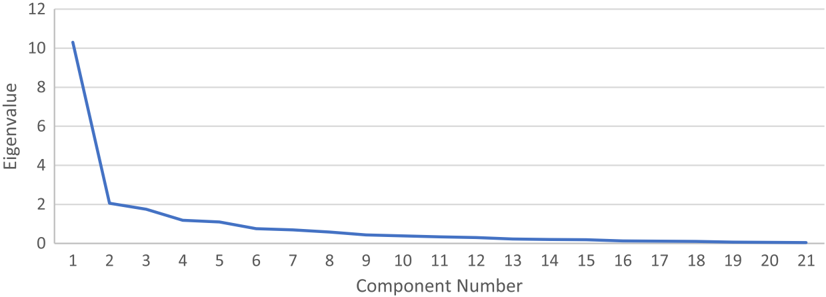
[This paper is part of the Focused Collection in Investigating and Improving Quantum Education through Research.] There is a growing need in the United States for a workforce trained in quantum information science and technology (QIST), a disciplinary topic that is rarely addressed in precollege science, mathematics, and computer science curricula. University quantum physics and physics education researchers designed and initiated a 4-week, 12-h QIST professional development workshop for N = 5 1 preservice and in-service secondary school science, mathematics, and computer science educators. A STEM integration framework guided the workshop structure, which incorporated a situated cognition model for learning quantum concepts and computing, identifying recent advances in quantum technologies, planning curricula, and differentiating among QIST subfields including quantum communication, quantum computation, quantum simulation, and quantum metrology and sensing. The pre-/post-research design employed a newly developed teacher attitude survey, Exploratory factor analysis identified three latent constructs in teachers’ self-efficacy, including (i) knowledge about QIST academic pathways and careers; (ii) QIST pedagogical fluency and STEM integration; and (iii) facilitating QIST learning. Parametric comparisons of means indicated that teacher participants showed significant gains overall and in all latent constructs with medium to large effect sizes ( p < 0.0 0 1 ). This professional learning model shows promise in strengthening teachers’ self-confidence in pedagogical content knowledge of quantum ideas so they may facilitate student engagement in quantum information science, a field that involves conceptual change and is often considered abstract, counterintuitive, inaccessible, and suitable only for the academically elite. Implications for policy and practice are discussed. Published by the American Physical Society 2024
Overview
The claims and statistics of this paper haven’t been checked yet.
Run the check — free, no account needed. It reads the open-access text and checks the sources it cites.
Integrity signals
Registry
Cites
Statistics
Figures
Verification
Claims the paper makes
The claims and statistics of this paper haven’t been checked yet.
Run the check — free, no account needed. It reads the open-access text and checks the sources it cites.
Claims other papers make about this one
Each is checked against this paper’s own text: does it say what the citing paper says it does?
In the citing paper
“Hands-on experience is undoubtedly a great asset for entering the quantum industry, as reported by companies [5–13], a trend that has been observed both in interview studies and in the structure of educational programs [8].”
From The quantum technology job market: data driven analysis of 3641 job posts (2026) · cites this paper as [10]
Self-check
Percentages, sums and reported differences re-computed from the paper’s own numbers.
The self-check needs the paper’s full text.
Citations
Cites
Faul, F., Erdfelder, E., Lang, A.-G., & Buchner, A. (2007) · Behavior Research Methods · doi:10.3758/bf03193146 · Cited by 65,971
Kelley, T. R., Knowles, J. G., Holland, J. D., & Han, J. (2020) · International Journal of STEM Education · doi:10.1186/s40594-020-00211-w · Cited by 238
Research works printed but not linked: 65
- A. Asfaw, 2020, Quantum Computing Education Must Reach a Diversity of Students
- 2022, Explainer Article: Quantum Information Science
- 2022, Quantum Information Science and Technology Workforce Development National Strategic Plan
- 2018, Science and engineering indicators 2018: Elementary and secondary science and mathematics education
- H. Weissman, 2024, 2024 State of Computer Science Education
- 2021, Overview of quantum initiatives worldwide
- 10.1002/sce.21068 · DOI
- 2021, The Role of International Talent in Quantum Information Science
- 10.1016/j.tate.2007.02.010 · DOI
- 10.3389/feduc.2019.00026 · DOI
- 10.3390/educsci14030219 · DOI
- 10.1088/1742-6596/2490/1/012006 · DOI
- K. Matsler, 2023, Proceedings of the 15th International Conference on Education and New Learning Technologies, 10.21125/edulearn.2023.0919 · DOI
- R. E. Lopez, 2023, Proceedings of the 15th International Conference on Education and New Learning Technologies, 10.21125/edulearn.2023.0913 · DOI
- 10.1103/PhysRevPhysEducRes.19.010137 · DOI · Paper page
- 10.1080/09500693.2018.1550273 · DOI
- 2020, Key concepts for future quantum information science learners
- 10.1080/03057267.2021.1963579 · DOI
- 10.1088/0143-0807/38/1/015404 · DOI
- 10.1039/C4RP00006D · DOI
- 10.1088/0031-9120/49/6/678 · DOI
- 10.1119/1.19210 · DOI
- 10.1007/s11165-006-9013-x · DOI
- 10.3102/0013189X029001004 · DOI
- 10.1080/02635143.2022.2070148 · DOI
- 10.1119/5.0211535 · DOI
- M. Darienzo, 2024, Proceedings of Quantum Science and Engineering Education Conference (QSEEC24), Montreál, QC, Canada
- 10.1119/10.0009686 · DOI
- C. C. Tappert, 2019, Proceedings of the Annual Meeting of the Association Supporting Computer Users in Education
- 2013, Next Generation Science Standards: For States, By States, 10.17226/18290 · DOI
- 2020, AP Physics 2 Course and Exam Description
- 2020, 2020 Program Summary Report
- 2020, Digest of education statistics: Enrollment in public elementary and secondary schools, by level, grade, and state or jurisdiction
- 10.1103/PhysRevPhysEducRes.17.020105 · DOI
- 10.1016/j.cedpsych.2021.102041 · DOI
- 10.1080/1046560X.2018.1473748 · DOI
- 10.1037/0021-9010.87.3.506 · DOI
- 10.1126/science.1131408 · DOI
- T. J. Moore, 2020, Handbook of Research on STEM Education
- A. Bandura, 1994, Personnel Selection and Classification
- 10.1111/j.1559-1816.2002.tb00236.x · DOI · Paper page
- 10.1119/1.2885199 · DOI
- 10.1080/09500690902948862 · DOI
- S. Gamble, 2019, Proceedings of the Frontiers of Engineering: Reports on Leading-Edge Engineering from the 2018 Symposium
- J. W. Creswell, 2023, Research Design: Qualitative, Quantitative, and Mixed Methods Approaches
- 2023, QIS Key Concepts for Early Learners: K-12 Frameworks
- 10.1186/s40594-021-00284-1 · DOI
- 10.1002/jee.20049 · DOI
- 10.1002/j.2168-9830.2006.tb00893.x · DOI
- J. Cohen, 1988, Statistical Power Analysis for the Behavioral Sciences
- 10.21449/ijate.827950 · DOI
- 10.1037/1082-989X.4.3.272 · DOI · Paper page
- J. P. Stevens, 2012, Applied Multivariate Statistics for the Social Sciences, 10.4324/9780203843130 · DOI
- 10.1207/s15327574ijt0502_4 · DOI · Paper page
- 2017, Infographic: The Four Pillars of Quantum
- 10.22555/joeed.v4i1.1050 · DOI
- 10.1007/s10763-023-10436-0 · DOI
- 10.1002/cdq.12338 · DOI
- 10.1002/(SICI)1098-2736(199705)34:5<535::AID-TEA7>3.0.CO;2-R · DOI
- 10.1063/1.3266755 · DOI
- 10.2224/sbp.6554 · DOI
- 10.3102/0162373719849044 · DOI · Paper page
- 10.1002/sce.10141 · DOI
- 2022, STEP UP: Physics together
- R. Gearns, 2018, Proceedings of the 2018 American Society for Engineering Education Annual Conference & Exposition
Cited by
Sorted by citations
The quantum technology job market: data driven analysis of 3641 job posts
Goorney, S., Karydi, E., Muñoz, B., Santesson, O., Seskir, Z. C., Tudoran, A. A., & Sherson, J. (2026) · EPJ Quantum Technology · doi:10.1140/epjqt/s40507-026-00477-z · Cited by 1
Metadata
- Authors
- Kelly, A. M., Darienzo, M., Wei, T.-C., & Schneble, D.
- Affiliations
- Stony Brook University (US)
- Brookhaven National Laboratory (US)
- Corresponding author
- Kelly, Angela M.
- Venue
- Physical Review Physics Education Research
- Publisher
- American Physical Society (APS)
- Published
- 2024-12-31
- Volume
- 20
- Issue
- 2
- ISSN
- 2469-9896 (ISSN-L)
- OpenAlex
- W4405943991
- Cited by
- 14
- References
- 2
- Citations by year
- 2026: 7 · 2025: 6 · 2024: 1
- FWCI
- 17.70
- Type
- journal article
- Language
- en
- Open access
- gold
- doi.org
- Licence
- Locations
- Physical Review Physics Education Research (publishedVersion, cc-by)
- DOAJ (DOAJ: Directory of Open Access Journals) (submittedVersion)
- Funders
- National Science Foundation
- Stony Brook University (2022-00244)
- Topics
- Social Sciences › Education › Science Education and Pedagogy
- Social Sciences › Education › Educational Methods and Outcomes
- Social Sciences › Education › Mathematics Education and Teaching Techniques
- Keywords
- teacher professional development, STEM integration, situated cognition, teacher self-efficacy, quantum communication, quantum computing, quantum simulation, teacher attitudes, conceptual change, quantum education
About these checks
Registry, retraction, Cites and statistics results are computed, not judged, with one exception: a printed reference that no index lists is read once by a model before it counts as a citation error. Claims are extracted by a model and kept only when their quote appears verbatim in the text; each cited source is then checked, with a model’s help, for whether it says what the claim relies on. Those verdicts can be wrong — read the claim’s quote and the cited source before relying on one.
Statistics and arithmetic are recomputed, not judged.
Confidence bands are shown only for fields calibrated on our annotated test set. None is calibrated yet, so no band is shown.
What counts as a claim ›How we measure confidence ›How we check this ›
Are you an author, or do you see a problem with this page? Request a review
