

The DOI matches its Crossref record.
The structure of bradyzoite-specific enolase from Toxoplasma gondii reveals insights into its dual cytoplasmic and nuclear functions
Abstract
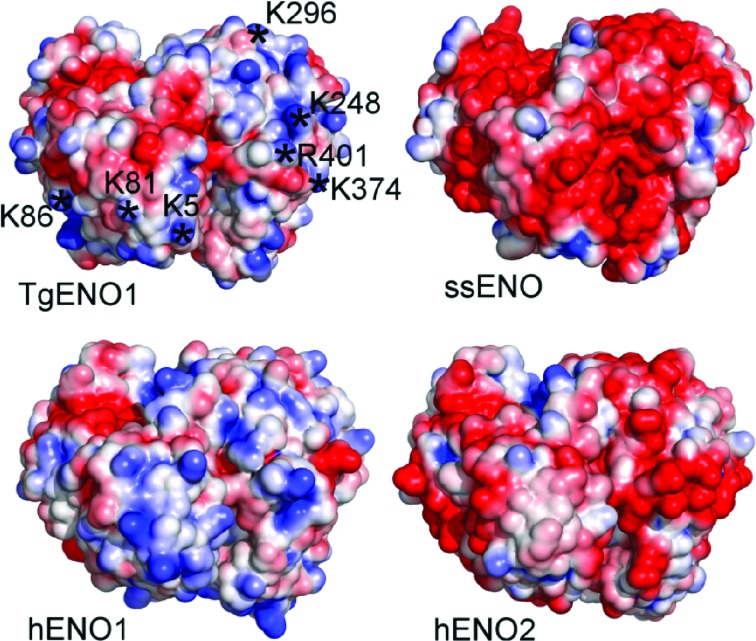
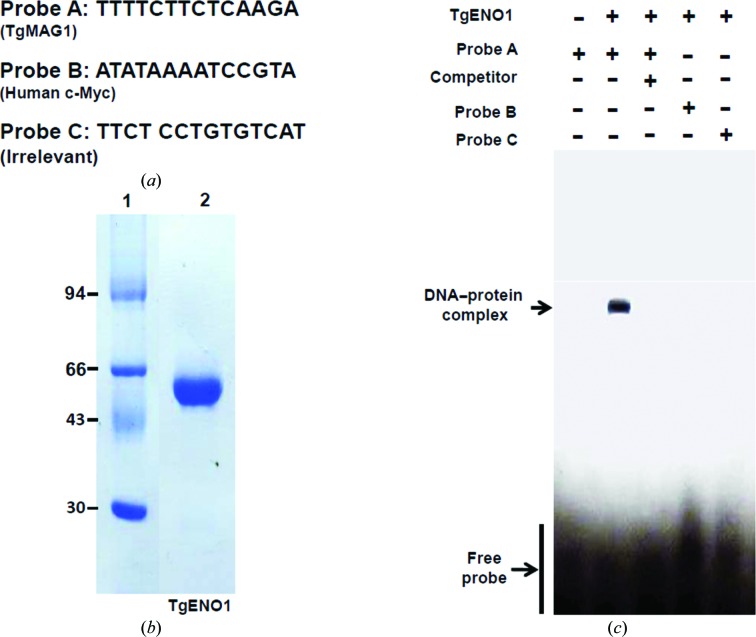
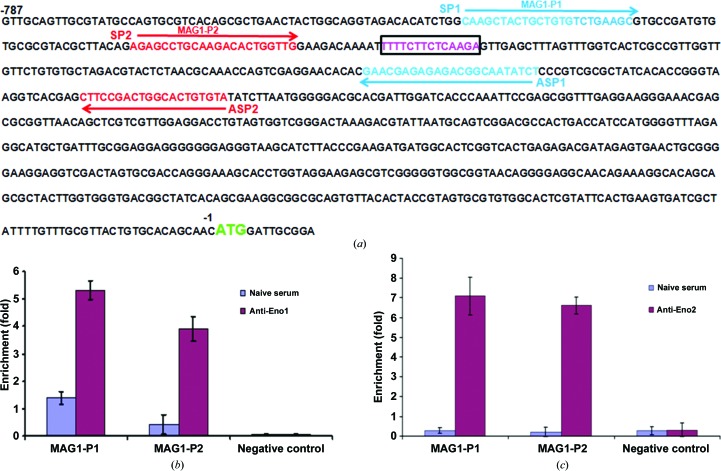
In addition to catalyzing a central step in glycolysis, enolase assumes a remarkably diverse set of secondary functions in different organisms, including transcription regulation as documented for the oncogene c-Myc promoter-binding protein 1. The apicomplexan parasite Toxoplasma gondii differentially expresses two nuclear-localized, plant-like enolases: enolase 1 (TgENO1) in the latent bradyzoite cyst stage and enolase 2 (TgENO2) in the rapidly replicative tachyzoite stage. A 2.75 Å resolution crystal structure of bradyzoite enolase 1, the second structure to be reported of a bradyzoite-specific protein in Toxoplasma, captures an open conformational state and reveals that distinctive plant-like insertions are located on surface loops. The enolase 1 structure reveals that a unique residue, Glu164, in catalytic loop 2 may account for the lower activity of this cyst-stage isozyme. Recombinant TgENO1 specifically binds to a TTTTCT DNA motif present in the cyst matrix antigen 1 (TgMAG1) gene promoter as demonstrated by gel retardation. Furthermore, direct physical interactions of both nuclear TgENO1 and TgENO2 with the TgMAG1 gene promoter are demonstrated in vivo using chromatin immunoprecipitation (ChIP) assays. Structural and biochemical studies reveal that T. gondii enolase functions are multifaceted, including the coordination of gene regulation in parasitic stage development. Enolase 1 provides a potential lead in the design of drugs against Toxoplasma brain cysts.
Overview
The claims and statistics of this paper haven’t been checked yet.
Run the check — free, no account needed. It reads the open-access text and checks the sources it cites.
Integrity signals
Registry
Cites
Statistics
Figures
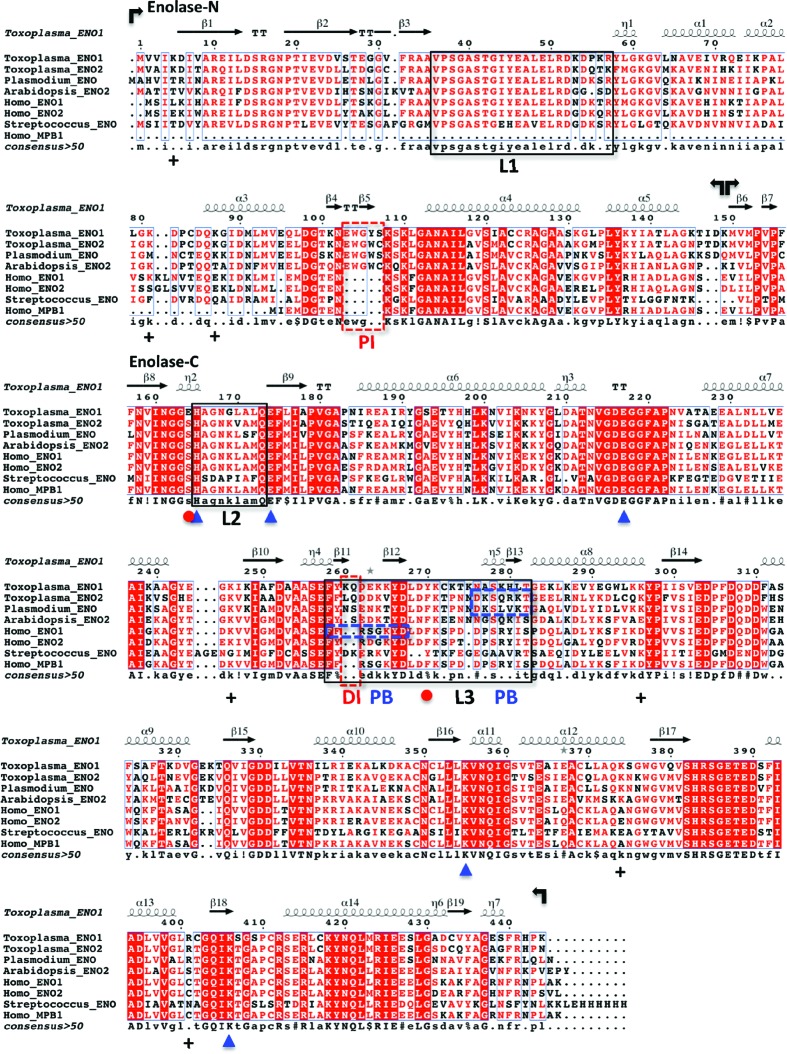
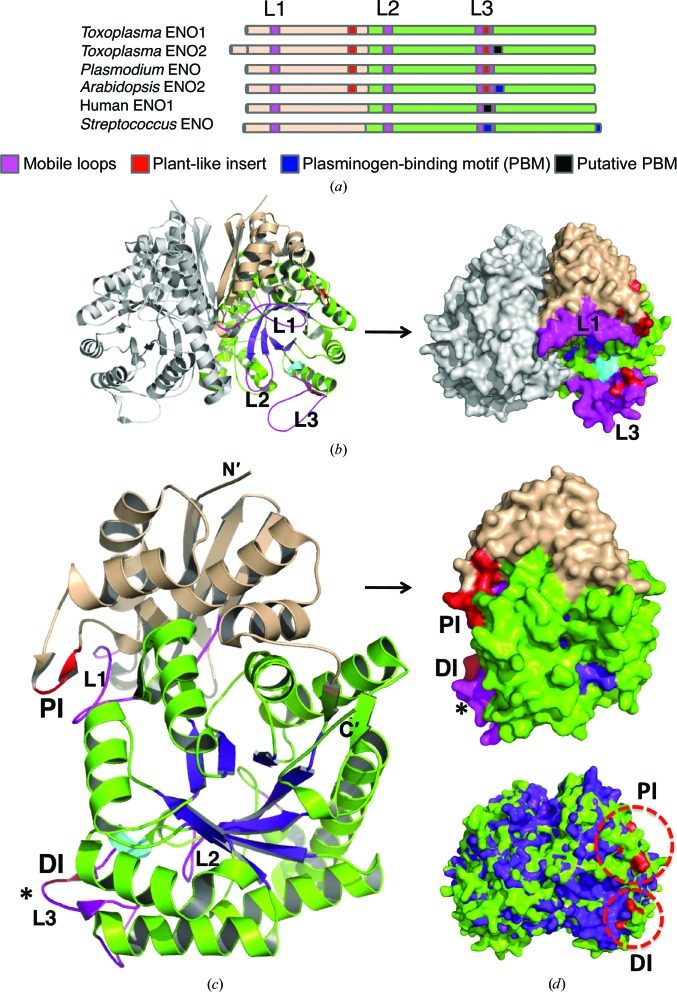
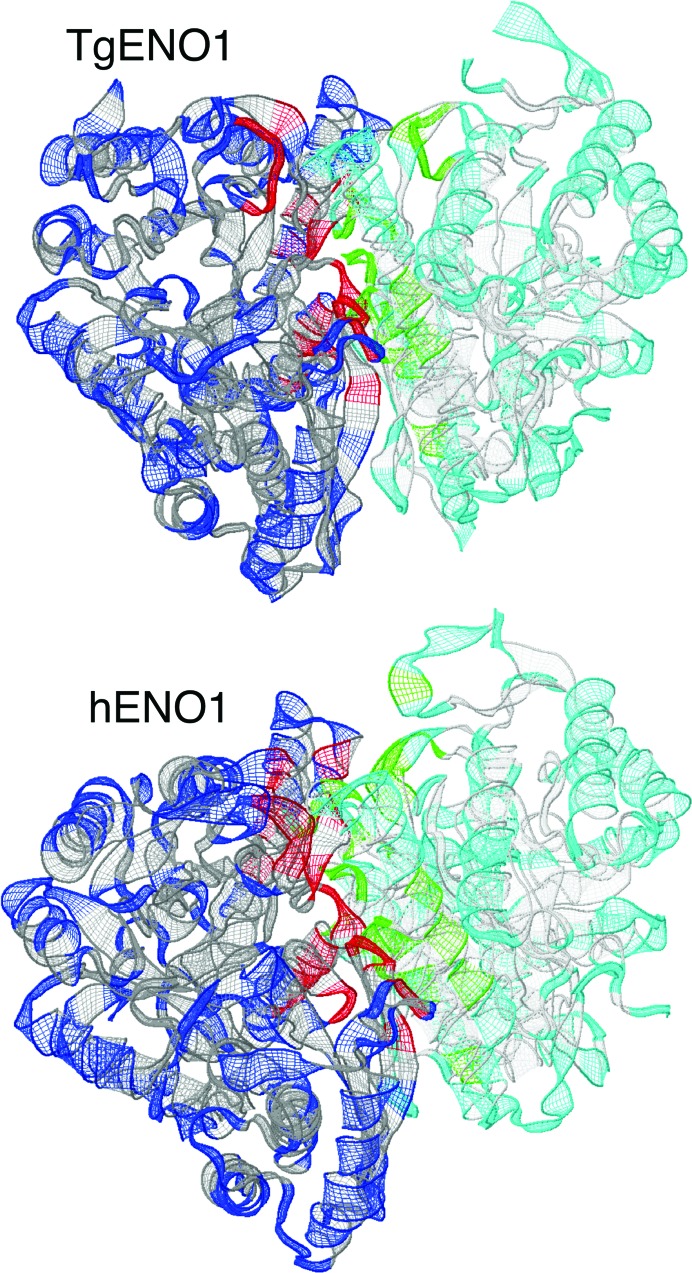
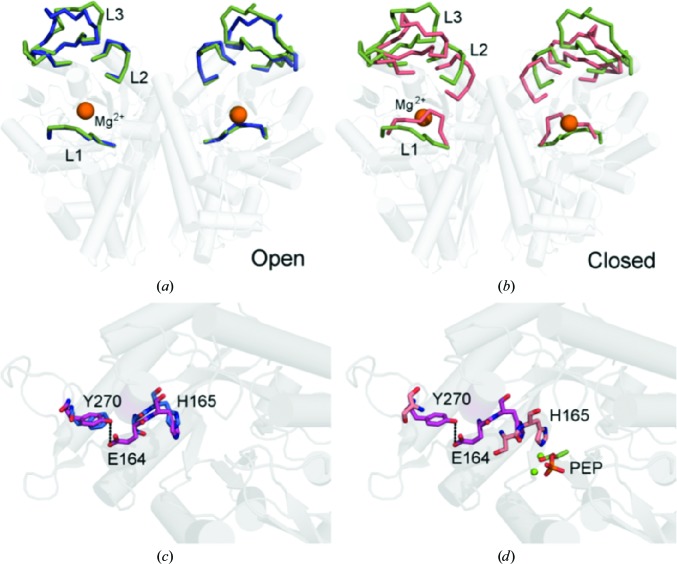
Verification
Claims the paper makes
The claims and statistics of this paper haven’t been checked yet.
Run the check — free, no account needed. It reads the open-access text and checks the sources it cites.
Claims other papers make about this one
Each is checked against this paper’s own text: does it say what the citing paper says it does?
In the citing paper
“T. gondii enolase may be expressed on the parasite surface and participate in host cell invasion”
From Parasites and allergies: a complex bidirectional relationship from evolutionary origins to modern therapeutics (2026) · cites this paper as Ruan et al. 2015
In the citing paper
“C. albicans enolase is both an intracellular enzyme and a cell wall-associated antigen”
From Parasites and allergies: a complex bidirectional relationship from evolutionary origins to modern therapeutics (2026) · cites this paper as Ruan et al. 2015
In the citing paper
“These features increase immune exposure and may explain why enolase can act as an immunogenic molecule in different infectious contexts.”
From Parasites and allergies: a complex bidirectional relationship from evolutionary origins to modern therapeutics (2026) · cites this paper as Ruan et al. 2015
Self-check
Percentages, sums and reported differences re-computed from the paper’s own numbers.
The self-check needs the paper’s full text.
Citations
Cites
No references could be resolved yet.
Research works printed but not linked: 40
- Bergmann, 2005, Thromb. Haemost., 94, 304, 10.1160/TH05-05-0369 · DOI
- Brandina, 2006, Biochim. Biophys. Acta, 1757, 1217, 10.1016/j.bbabio.2006.07.001 · DOI
- Broennimann, 2006, J. Synchrotron Rad., 13, 120, 10.1107/S0909049505038665 · DOI
- Chai, 2004, J. Mol. Biol., 341, 1015, 10.1016/j.jmb.2004.05.068 · DOI
- Chandran, 2006, J. Mol. Biol., 358, 8, 10.1016/j.jmb.2006.02.012 · DOI
- Coppin, 2003, Biochimie, 85, 353, 10.1016/S0300-9084(03)00076-2 · DOI
- Dzierszinski, 2001, J. Mol. Biol., 309, 1017, 10.1006/jmbi.2001.4730 · DOI
- Dzierszinski, 2004, Eukaryot. Cell, 3, 992, 10.1128/EC.3.4.992-1003.2004 · DOI
- Dzierszinski, 1999, J. Biol. Chem., 274, 24888, 10.1074/jbc.274.35.24888 · DOI
- Emsley, 2004, Acta Cryst. D, 60, 2126, 10.1107/S0907444904019158 · DOI · Paper page
- Ferguson, 2002, Int. J. Parasitol., 32, 1399, 10.1016/S0020-7519(02)00129-7 · DOI
- Flegr, 2013, Trends Parasitol., 29, 156, 10.1016/j.pt.2013.01.007 · DOI
- Gajria, 2008, Nucleic Acids Res., 36, D553, 10.1093/nar/gkm981 · DOI
- Gerlt, 2012, J. Biol. Chem., 287, 29, 10.1074/jbc.R111.240945 · DOI
- Ghosh, 2011, Proc. Natl Acad. Sci. USA, 108, 17153, 10.1073/pnas.1103657108 · DOI
- Harper, 2004, Gene, 340, 227, 10.1016/j.gene.2004.06.048 · DOI
- Hsu, 2009, Mol. Biol. Cell, 20, 5127, 10.1091/mbc.E09-05-0386 · DOI
- Kannan, 2012, Schizophr. Bull., 38, 1155, 10.1093/schbul/sbs079 · DOI
- Kang, 2008, Acta Cryst. D, 64, 651, 10.1107/S0907444908008561 · DOI
- Kibe, 2005, Nucleic Acids Res., 33, 1722, 10.1093/nar/gki314 · DOI
- Laskowski, 2011, J. Chem. Inf. Model., 51, 2778, 10.1021/ci200227u · DOI
- Lebioda, 1989, J. Biol. Chem., 264, 3685, 10.1016/S0021-9258(19)84906-2 · DOI
- Lee, 2002, EMBO J., 21, 2692, 10.1093/emboj/21.11.2692 · DOI
- Lu, 2012, Protein Cell, 3, 769, 10.1007/s13238-012-2040-7 · DOI
- McCoy, 2005, Acta Cryst. D, 61, 458, 10.1107/S0907444905001617 · DOI
- Mouveaux, 2014, PLoS One, 9, e105820, 10.1371/journal.pone.0105820 · DOI
- Murshudov, 2011, Acta Cryst. D, 67, 355, 10.1107/S0907444911001314 · DOI
- Nadassy, 1999, Biochemistry, 38, 1999, 10.1021/bi982362d · DOI
- Nurmohamed, 2010, Acta Cryst. D, 66, 1036, 10.1107/S0907444910030015 · DOI
- Olguin-Lamas, 2011, PLoS Pathog., 7, e1001328, 10.1371/journal.ppat.1001328 · DOI
- Pal-Bhowmick, 2009, Malar. J., 8, 179, 10.1186/1475-2875-8-179 · DOI
- Pal-Bhowmick, 2007, Malar. J., 6, 45, 10.1186/1475-2875-6-45 · DOI
- Qin, 2012, J. Inorg. Biochem., 111, 187, 10.1016/j.jinorgbio.2012.02.011 · DOI
- Sedoris, K. C., Thomas, S. D. & Miller, D. M. (2010). BMC Cancer, 10, 157. · DOI
- Tomavo, 2001, Int. J. Parasitol., 31, 1023, 10.1016/S0020-7519(01)00193-X · DOI
- Tovy, 2010, PLoS Pathog., 6, e1000775, 10.1371/journal.ppat.1000775 · DOI
- Vora, 2009, Arch. Biochem. Biophys., 485, 128, 10.1016/j.abb.2009.02.012 · DOI
- Wedekind, 1995, Biochemistry, 34, 4325, 10.1021/bi00013a022 · DOI
- Xu, 2008, J. Mol. Biol., 381, 487, 10.1016/j.jmb.2008.06.002 · DOI
- Zhang, 1997, Biochemistry, 36, 12526, 10.1021/bi9712450 · DOI
Cited by
Sorted by citations
Packi, K., Świerczewski, D., Klimczak, S., Ochab, D., Gałęziewska, J., Gromek, P., Kruczkowska, W., Płuciennik, E., Kałuzińska-Kołat, Ż., & Kołat, D. (2026) · Antonie van Leeuwenhoek · doi:10.1007/s10482-026-02425-4
Metadata
- Authors
- Ruan, J., Mouveaux, T., Light, S. H., Minasov, G., Anderson, W. F., Tomavo, S., & Ngô, H. M.
- Venue
- Acta Crystallographica Section D Biological Crystallography
- Published
- 2015-02-26
- Volume
- 71
- Issue
- 3
- Pages
- 417-426
- ISSN
- 1399-0047
- PMC
- PMC4356359
- Cited by
- 20
- References
- 0
About these checks
Registry, retraction, Cites and statistics results are computed, not judged, with one exception: a printed reference that no index lists is read once by a model before it counts as a citation error. Claims are extracted by a model and kept only when their quote appears verbatim in the text; each cited source is then checked, with a model’s help, for whether it says what the claim relies on. Those verdicts can be wrong — read the claim’s quote and the cited source before relying on one.
Statistics and arithmetic are recomputed, not judged.
Confidence bands are shown only for fields calibrated on our annotated test set. None is calibrated yet, so no band is shown.
What counts as a claim ›How we measure confidence ›How we check this ›
Are you an author, or do you see a problem with this page? Request a review
How to cite
Cite CoChat for the checks on this page, and the paper for its own findings.
- This page
- CoChat. (2026). Citation check: The structure of bradyzoite-specific enolase from Toxoplasma gondii reveals insights into its dual cytoplasmic and nuclear functions. https://app.cochat.ai/papers/10.1107/s1399004714026479
- The paper
- Ruan, J., Mouveaux, T., Light, S. H., Minasov, G., Anderson, W. F., Tomavo, S., & Ngô, H. M. (2015). The structure of bradyzoite-specific enolase from Toxoplasma gondii reveals insights into its dual cytoplasmic and nuclear functions. Acta Crystallographica Section D Biological Crystallography. https://doi.org/10.1107/s1399004714026479
