

Still challenging “resistance to change”
Open accessThe DOI matches its Crossref record; 72 of the 73 references it cites were found in a registry or an index, and 1 are not checked yet; none of the 36 sources its claims cite is checked for support yet.
Abstract
Purpose: This study aims to challenge the conventional view of “resistance to change” (RtoC) in organizational contexts, proposing a multilevel Force-Field framework (FFF) to reconceptualize RtoC, better characterized as reactions to change and integrate micro and macro perspectives on change management. Design/methodology/approach: A literature search (1999–2024) across several databases identified 56 empirical and theoretical articles on RtoC, focusing on peer-reviewed studies from high-quality journals listed by the Australian Business Deans’ Council. Findings: The review reveals that RtoC is not a universal or automatic response. The classic, overly simplistic RtoC formulation is individuals resisting change and organizations executing overcoming resistance strategies. The proposed FFF organizes helping and hindering forces across individual, organizational and environmental levels, highlighting nuanced responses such as support for change, dispositional resistance and ethical resistance. Organizational helping forces (e.g. leadership, communication) mitigate RtoC, while environmental forces such as social pressure influence change dynamics. Research limitations/implications: The study is limited by its focus on articles using the search term “resistance to change.” Consequently, few or no articles were found in the organizational hindering and environmental hindering and helping categories, although in some cases there are rich literatures that could be accessed using different search terms. Future research should provide a holistic, integrative review exploring individual, organizational and environmental helping and hindering forces and multilevel interactions to enhance the understanding of responses to change. Originality/value: This study introduces the FFF, a novel framework integrating micro and macro RtoC research, addressing calls for conceptual clarity and identifying new research frontiers, particularly at environmental and organizational levels.
Checked 2026-11-24 · 1 reference not checked yet
Overview
CoChat Summary
TL;DR
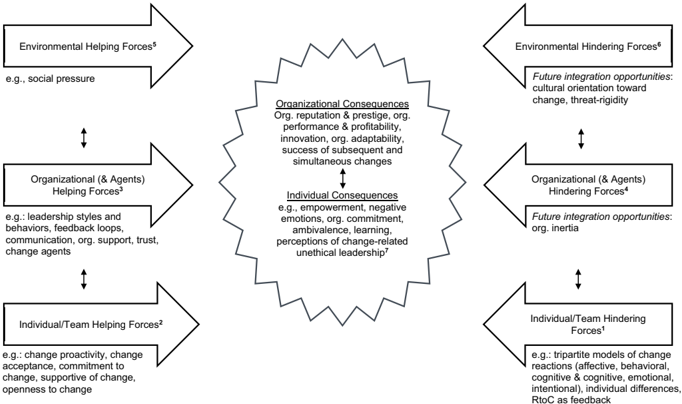
This narrative review of 56 articles (1999–2024) challenges the conventional view of “resistance to change” (RtoC), arguing that RtoC is not an automatic or universal response and is better characterized as reactions to change. It proposes a multilevel Force-Field framework (FFF) that organizes helping and hindering forces across individual/team, organizational/agent, and environmental levels.
Key findings
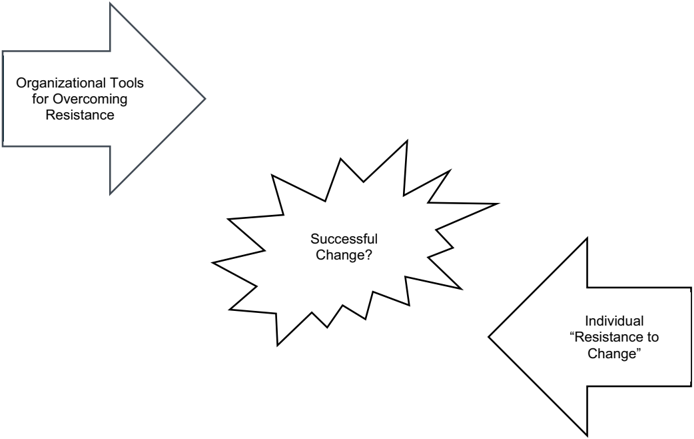
- The review finds that RtoC is not a universal or automatic response; the classic formulation—individuals resisting change while organizations execute “overcoming resistance” strategies—is overly simplistic. Dent & Powley (2002) found employees accept 1.9 major organizational changes for every one they oppose, and Cinite & Duxbury (2018) noted active overt resistance to change is relatively rare and/or seldom has a behavioral component.
- The proposed FFF organizes helping and hindering forces across individual/team, organizational/agent, and environmental levels, highlighting nuanced responses such as support for change, dispositional resistance, and ethical resistance. Organizational helping forces (e.g., leadership, communication) mitigate RtoC, while environmental forces such as social pressure influence change dynamics.
- The search on “resistance to change” revealed no studies specifically addressing organizational hindering forces and no articles addressing environmental hindering forces. Related literatures—organizational inertia, cultural orientation toward change, and threat-rigidity—address similar phenomena from macro perspectives and are identified as future integration opportunities. Oreg & Sverdlik (2018) examined 6,487 individuals across 27 countries and found three dimensions of cultural orientation toward change: cultural rigidity, affective reactance, and routine seeking.
- The paper identifies future research directions at each FFF level, including team-level change research and multilevel/mutually causal perspectives; it notes that dispositional RtoC exists at the team level, predicting RtoC above and beyond individual dispositional RtoC (Sverdlik & Oreg, 2023).
Methods
- Narrative review using a database-driven approach with journal quality criteria; databases included ABI-Inform Collection, Academic Search Complete (Ebsco), EBSCOhost (All Ebsco databases), and Business Source Ultimate. The primary search term was “resistance to change,” and the time period was restricted because the critique of the RtoC term originated in 1999.
- The initial search resulted in over 88,000 hits; the list was narrowed using the Australian Business Deans’ Council list to 367 potential articles, then further narrowed to empirical studies, referencing theoretical articles only when repeatedly cited by empirical studies. Ultimately, 56 articles were identified.
- Analysis used Force-Field analysis derived from Lewin’s foundational theory of change, comparing helping forces for change to hindering forces against change; the authors developed an expanded, multilevel FFF to situate the reviewed research.
Limitations
- The paper states it is limited by its focus on articles using the search term “resistance to change.” Consequently, few or no articles were found in the organizational hindering and environmental hindering and helping categories, although in some cases rich literatures could be accessed using different search terms.
- The paper states that the search term “resistance to change” is used more in micro research, and a thorough, systematic review using additional search terms more common at the macro level is beyond its scope. It calls for future research to provide a holistic, integrative review exploring individual, organizational, and environmental helping and hindering forces and multilevel interactions.
- Evident from the text: as a narrative review, it does not conduct the iterative, expanded systematic search the authors later call for, and space limitations prevented a holistic, integrative, systematic literature review.
Model-written summary. Check it against the paper before relying on it.
Integrity signals
Registry
Cites
Statistics
Figures
Verification
Claims the paper makes
0 Valid · 3 Not valid · 39 Not checked · 40 Own results and interpretations
None of the sources cited for this claim have been checked yet.
In the paper
“An important development in the RtoC literature has been the recognition that RtoC itself is not the only individual-level hindering force, but rather, one of many possible individual responses to change.”
§ Still challenging "resistance to change" > Novel resistance to change perspectives
plain- Asserted: passes — The authors put it forward as true.
- Checkable: passes — It can be checked against evidence.
- Load-bearing: passes — The paper’s conclusions depend on it.
- Based: passes — The paper gives a reason why it holds.
- Rests on 2 assumptions not shown here.
None of the sources cited for this claim have been checked yet.
In the paper
“In addition, rather than being uniformly true for all employees, research has acknowledged that individuals vary in their propensity to resist change.”
§ Still challenging "resistance to change" > Individual/team hindering forces
plain- Asserted: passes — The authors put it forward as true.
- Checkable: passes — It can be checked against evidence.
- Load-bearing: passes — The paper’s conclusions depend on it.
- Based: passes — The paper gives a reason why it holds.
- Rests on 2 assumptions not shown here.
None of the sources cited for this claim have been checked yet.
In the paper
“As can be seen in Figure 2, the FFF is a multilevel framework that acknowledges the fact that research on RtoC has addressed topics at multiple levels of analysis, with the logical implication that these levels likely interact to impact change consequences.”
§ Still challenging "resistance to change" > Multilevel research
plain- Asserted: passes — The authors put it forward as true.
- Checkable: passes — It can be checked against evidence.
- Load-bearing: passes — The paper’s conclusions depend on it.
- Based: passes — The paper gives a reason why it holds.
A result the paper states — it cites no source for it, so there is none to check. The quote shows it is in the paper.
In the paper
“Although this construct has clear implications for organizational RtoC, particularly as an environmental hindering force, cultural orientation toward change remains underdeveloped.”
§ Still challenging "resistance to change" > Cultural orientation toward change
plain- Asserted: passes — The authors put it forward as true.
- Checkable: passes — It can be checked against evidence.
- Load-bearing: passes — The paper’s conclusions depend on it.
- Based: passes — The paper gives a reason why it holds.
A result the paper states — it cites no source for it, so there is none to check. The quote shows it is in the paper.
In the paper
“Organizational helping forces (e.g.leadership, communication) mitigate RtoC, while environmental forces such as social pressure influence change dynamics.”
§ Still challenging "resistance to change" > Abstract
plainstates a cause- Asserted: passes — The authors put it forward as true.
- Checkable: passes — It can be checked against evidence.
- Load-bearing: passes — The paper’s conclusions depend on it.
- Based: passes — The paper gives a reason why it holds.
- Rests on 2 assumptions not shown here.
30 more claims
Create a free account to see all 82 claims and to verify the 31 references still open.
- It may state two separate claims as one. 12
- Probably not a substantial claim. 38
- The quote only partly states this claim. 2
Citations
Cites
DiMaggio, P. J., & Powell, W. W. (1983) · American Sociological Review · doi:10.2307/2095101 · Cited by 38,435
Literature review as a research methodology: An overview and guidelines
Snyder, H. (2019) · Journal of Business Research · doi:10.1016/j.jbusres.2019.07.039 · Cited by 11,524
Structural inertia and organizational change
Hannan, M. T., & Freeman, J. (1984) · American Sociological Review · doi:10.2307/2095567 · Cited by 7,244
Change Recipients’ Reactions to Organizational Change: A 60-Year Review of Quantitative Studies
Oreg, S., Vakola, M., & Armenakis, A. (2011) · The Journal of Applied Behavioral Science · doi:10.1177/0021886310396550 · Cited by 1,595
Resistance to Change: The Rest of the Story
Ford, J. D., Ford, L. W., & D'Amelio, A. (2008) · Academy of Management Review · doi:10.5465/amr.2008.31193235 · Cited by 1,084
Challenging “Resistance to Change”
Dent, E. B., & Goldberg, S. G. (1999) · The Journal of Applied Behavioral Science · doi:10.1177/0021886399351003 · Cited by 953
Self-citationThe Why and How of the Integrative Review
Cronin, M. A., & George, E. (2023) · Organizational Research Methods · doi:10.1177/1094428120935507 · Cited by 677
Sample Selection in Systematic Literature Reviews of Management Research
Hiebl, M. R. W. (2023) · Organizational Research Methods · doi:10.1177/1094428120986851 · Cited by 635
Social Activism in and Around Organizations
Briscoe, F., & Gupta, A. (2016) · The Academy of Management Annals · doi:10.1080/19416520.2016.1153261 · Cited by 392
Uncertainty during Organizational Change: Managing Perceptions through Communication
Allen, J., Jimmieson, N. L., Bordia, P., & Irmer, B. E. (2007) · Journal of Change Management · doi:10.1080/14697010701563379 · Cited by 378
Research works printed but not linked: 1
- Caruth, D. L., & Caruth, G. D. (2018). Managing workplace resistance to change. Industrial Management, 60(4), 21-23.
Cited by
Mallais, J. (2026) · Scholarship@Western (Western University)
Ashiq, K. (2026) · Osuva (University of Vaasa)
Laakso, J., & Touru, S. (2026) · Osuva (University of Vaasa)
Leading employees in organizational change : from anxiety to engagement
Manninen, P. (2026) · Theseus (Ammattikorkeakoulujen)
Hutahaean, R. (2026) · Journal of Social and Economics Research · doi:10.54783/jser.v8i1.1506
Metadata
- Authors
- Dent, E. B., Liu, J. T., & Knoche, T.
- Affiliations
- Florida Gulf Coast University (US)
- University of Central Oklahoma Department of Management, , Edmond, ,
- Corresponding author
- Dent, Eric B.
- Venue
- Organization Management Journal
- Publisher
- Emerald
- Published
- 2025-11-14
- Volume
- 23
- Issue
- 1
- Pages
- 34-52
- ISSN
- 1541-6518 (ISSN-L)
- 2753-8567
- OpenAlex
- W4416186214
- Cited by
- 6
- References
- 70
- Citations by year
- 2026: 5
- FWCI
- 2.72
- Type
- journal article
- Language
- en
- Open access
- diamond
- doi.org
- Licence
- Locations
- Organization Management Journal (publishedVersion, cc-by)
- Topics
- Social Sciences › Business, Management and Accounting › Organizational Behavior and Human Resource Management › Organizational Change and Leadership
- Social Sciences › Business, Management and Accounting › Organizational Behavior and Human Resource Management › Organizational Management and Change
- Social Sciences › Business, Management and Accounting › Organizational Behavior and Human Resource Management › Management and Organizational Studies
- Keywords
- resistance to change, change management, ethical resistance, leadership, organizational communication, social pressure, multilevel analysis
About these checks
Registry, retraction, Cites and statistics results are computed, not judged, with one exception: a printed reference that no index lists is read once by a model before it counts as a citation error. Claims are extracted by a model and kept only when their quote appears verbatim in the text; each cited source is then checked, with a model’s help, for whether it says what the claim relies on. Those verdicts can be wrong — read the claim’s quote and the cited source before relying on one.
A language model drew the claims from the paper on 2026-11-24, under version 3 of the claim definition (model deepseek-v4.1-flash, prompt extract-v3).
A second model labelled each claim on 2026-11-24 (model jev-1.13-20260917, definition revision gold-guideline-v0.2).
Statistics and arithmetic are recomputed, not judged.
Confidence bands are shown only for fields calibrated on our annotated test set. None is calibrated yet, so no band is shown.
What counts as a claim ›How we measure confidence ›How we check this ›
Are you an author, or do you see a problem with this page? Request a review
How to cite
Cite CoChat for the checks on this page, and the paper for its own findings.
- This page
- CoChat. (2026). Citation check: Still challenging “resistance to change”. https://app.cochat.ai/papers/10.1108/omj-09-2024-2309
- The paper
- Dent, E. B., Liu, J. T., & Knoche, T. (2026). Still challenging “resistance to change”. Organization Management Journal. https://doi.org/10.1108/omj-09-2024-2309
Data sources
Bibliographic data: Semantic Scholar, OpenAlex, Crossref.
Contains information from the Semantic Scholar Academic Graph Datasets, made available under the ODC Attribution License (ODC-BY 1.0).
Semantic Scholar’s data is described in: Kinney, R., et al. (2023). The Semantic Scholar Open Data Platform. arXiv:2301.10140.
