

Joint Quantum-Assisted Channel Estimation and Data Detection
Open accessThe DOI matches its Crossref record; 46 of the 46 references it cites were found in a registry or an index.
Abstract
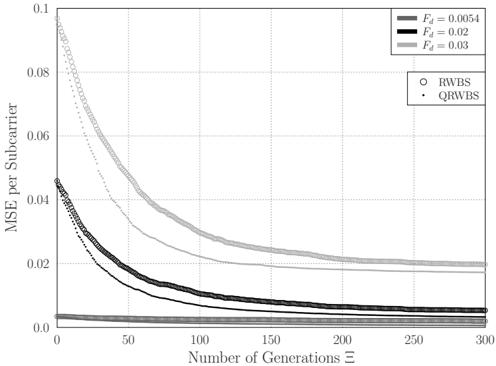
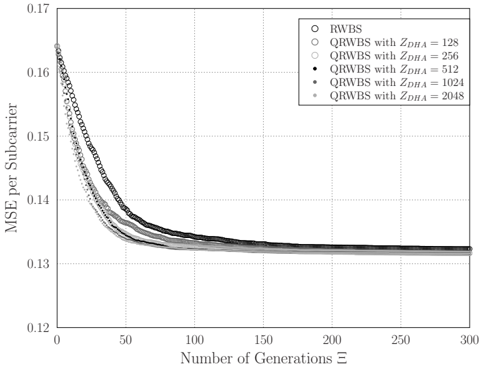
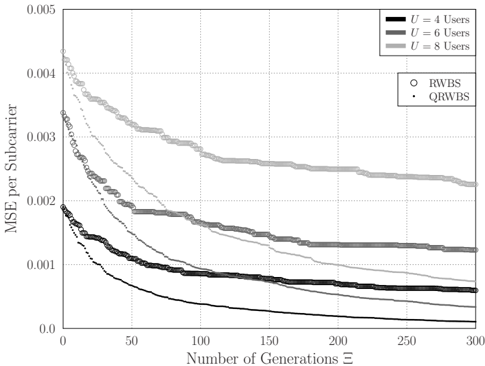
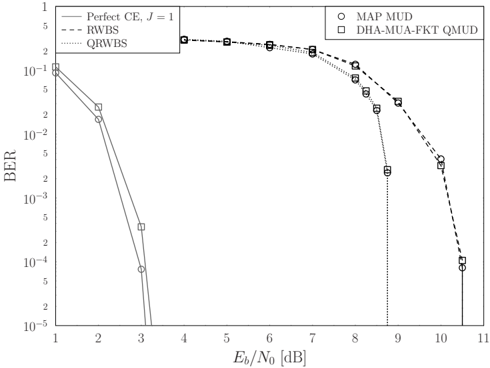
Joint channel estimation (CE) and multi-user detection (MUD) have become a crucial part of iterative receivers. In this paper, we propose a quantum-assisted repeated weighted boosting search (QRWBS) algorithm for CE and we employ it in the uplink of multiple-input multiple-output orthogonal frequency division multiplexing systems, in conjunction with the maximum a posteriori probability (MAP) MUD and a near-optimal quantum-assisted MUD (QMUD). The performance of the QRWBS-aided CE is evaluated in rank-deficient systems, where the number of receive antenna elements (AEs) at the base station (BS) is lower than the number of supported users. The effect of the channel impulse response prediction filters, of the power delay profile of the channels, and of the Doppler frequency on the attainable system performance is also quantified. The proposed QRWBS-aided CE is shown to outperform the RWBS-aided CE, despite requiring a lower complexity, in systems where iterations are invoked between the MUD, the CE, and the channel decoders at the receiver. In a system, where U = 7 users are supported with the aid of P = 4 receive AEs, the joint QRWBS-aided CE and QMUD achieves a 2-dB gain, when compared with the joint RWBS-aided CE and MAP MUD, despite imposing 43% lower complexity.
Overview
The claims and statistics of this paper haven’t been checked yet.
Free: it reads the open-access text and checks the first 5 claims that cite a source we can check. Create a free account to check every claim.
Integrity signals
Registry
Cites
Statistics
Figures






Verification
Claims the paper makes
The claims and statistics of this paper haven’t been checked yet.
Free: it reads the open-access text and checks the first 5 claims that cite a source we can check. Create a free account to check every claim.
Self-check
Percentages, sums and reported differences re-computed from the paper’s own numbers.
The self-check needs the paper’s full text.
Citations
Cites
Quantum Computation and Quantum Information
Nielsen, M. A., Chuang, I., & Grover, L. K. (2002) · American Journal of Physics · doi:10.1119/1.1463744 · Cited by 21,895
Quantum computation and quantum information
Law, J. (2001) · ACM SIGSOFT Software Engineering Notes · doi:10.1145/505482.505499 · Cited by 18,842
A fast quantum mechanical algorithm for database search
Grover, L. K. (1996) · Proceedings of the twenty-eighth annual ACM symposium on Theory of computing - STOC '96 · doi:10.1145/237814.237866 · Cited by 8,830
Quantum Mechanics Helps in Searching for a Needle in a Haystack
Grover, L. K. (1997) · Physical Review Letters · doi:10.1103/physrevlett.79.325 · Cited by 4,306 · cited 8×
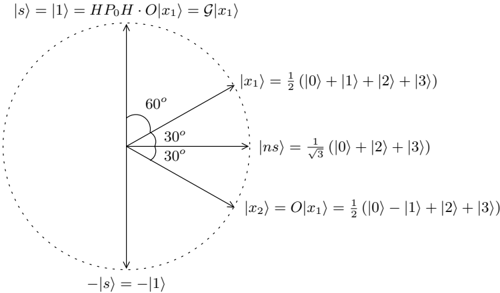
“Afterwards, the Grover561 operator [24]562 G = HP0H · O (20)563 is applied Lopt number of times to the initial quantum state564 of (19), where H is the Hadamard operator, P0 is a unitary565 operator that evolves |x〉 to−|x〉 if and only if |x〉 = |0〉, O is566 a unitary operator termed as the Oracle [25], which evolves567…”
BackgroundInfluentialLTE - The UMTS Long Term Evolution: From Theory to Practice
Sesia, S., Toufik, I., & Baker, M. (2011) · Cited by 2,457
LTE – The UMTS Long Term Evolution: From Theory to Practice
(2009) · Wiley eBooks · doi:10.1002/9780470742891 · Cited by 1,816
OFDM and MC‐CDMA for Broadband Multi‐User Communications, WLANs and Broadcasting
Hanzo, L., Münster, M., Choi, B. J., & Keller, T. (2003) · Wiley eBooks · doi:10.1002/9780470861813 · Cited by 1,095
Self-citation(1996) · Cited by 824
Channel estimation for OFDM systems with transmitter diversity in mobile wireless channels
Li, Y., Seshadri, N., & Ariyavisitakul, S. (1999) · IEEE Journal on Selected Areas in Communications · doi:10.1109/49.753731 · Cited by 799
Simplified channel estimation for OFDM systems with multiple transmit antennas
Li, Y. (2002) · IEEE Transactions on Wireless Communications · doi:10.1109/7693.975446 · Cited by 628
Cited by
Quantum Machine Learning for 6G Communication Networks: State-of-the-Art and Vision for the Future
Nawaz, S. J., Sharma, S. K., Wyne, S., Patwary, M. N., & Asaduzzaman, M. (2019) · IEEE Access · doi:10.1109/access.2019.2909490 · Cited by 658
Quantum Search Algorithms for Wireless Communications
Botsinis, P., Alanis, D., Babar, Z., Nguyen, H. V., Chandra, D., Ng, S. X., & Hanzo, L. (2019) · IEEE Communications Surveys & Tutorials · doi:10.1109/comst.2018.2882385 · Cited by 149
Self-citationJawad, A. T., Mâaloul, R., & Chaari, L. (2023) · Computer Networks · doi:10.1016/j.comnet.2023.110085 · Cited by 112
Enabling technologies for AI empowered 6G massive radio access networks
Shahjalal, M. A., Kim, W., Khalid, W., Moon, S., Khan, M. A., Liu, S., Lim, S., Kim, E., Yun, D.-W., Lee, J., et al. (2022) · ICT Express · doi:10.1016/j.icte.2022.07.002 · Cited by 98
Boas, E. C. V., Silva, J. D. S. E., de Figueiredo, F. A. P., Mendes, L. L., & de Souza, R. A. A. (2022) · EURASIP Journal on Wireless Communications and Networking · doi:10.1186/s13638-022-02195-3 · Cited by 59
Hybrid Quantum-Classical Neural Networks for Downlink Beamforming Optimization
Zhang, J., Zheng, G., Koike–Akino, T., Wong, K., & Burton, F. A. (2024) · IEEE Transactions on Wireless Communications · doi:10.1109/twc.2024.3442091 · Cited by 42
Quantum Information Processing, Sensing, and Communications: Their Myths, Realities, and Futures
Hanzo, L., Babar, Z., Cai, Z., Chandra, D., Djordjević, I. B., Koczor, B., Ng, S. X., Razavi, M., & Simeone, O. (2025) · Proceedings of the IEEE · doi:10.1109/jproc.2024.3510394 · Cited by 54
Self-citationBotsinis, P., Alanis, D., Feng, S., Babar, Z., Nguyen, H. V., Chandra, D., Ng, S. X., Zhang, R., & Hanzo, L. (2017) · IEEE Access · doi:10.1109/access.2017.2733557 · Cited by 37
Self-citationChannel Decoding with Quantum Approximate Optimization Algorithm
Matsumine, T., Koike–Akino, T., & Wang, Y. (2019) · IEEE International Symposium on Information Theory (ISIT) · doi:10.1109/isit.2019.8849710 · Cited by 34
Mondal, S., Laskar, M. R., & Dutta, A. K. (2021) · IEEE Transactions on Vehicular Technology · doi:10.1109/tvt.2021.3055537 · Cited by 23
Quantum Transfer Learning for Wi-Fi Sensing
Koike–Akino, T., Wang, P. P., & Wang, Y. (2022) · International Conference on Communications · doi:10.1109/icc45855.2022.9839011 · Cited by 23
Channel Estimation in MIMO-OFDM System: A Review
Kaur, H., Khosla, M., & Sarin, R. K. (2018) · International Conference on Electronics, Communication and Aerospace Technology (ICECA) · doi:10.1109/iceca.2018.8474747 · Cited by 19
Deterministic Pilot Pattern Placement Optimization for OFDM Sparse Channel Estimation
Nie, Y. (2020) · IEEE Access · doi:10.1109/access.2020.3007916 · Cited by 14
Quantum Search-Aided Multi-User Detection of IDMA-Assisted Multi-Layered Video Streaming
Botsinis, P., Huo, Y., Alanis, D., Babar, Z., Ng, S. X., & Hanzo, L. (2017) · IEEE Access · doi:10.1109/access.2017.2732358 · Cited by 11
“In [18] a joint quantum-assisted channel and data detector was proposed for the uplink of NOMA, where quantum computing was amalgamated with the evolutionary repeated weighted boosting search algorithm [19].”
MethodSelf-citationLehmann, F. (2018) · IEEE Transactions on Vehicular Technology · doi:10.1109/tvt.2018.2841190 · Cited by 11
Laskar, M. R., Mondal, S., & Dutta, A. K. (2022) · IEEE Transactions on Communications · doi:10.1109/tcomm.2022.3167057 · Cited by 9
On the Road to Quantum Communications
Chandra, D., Botsinis, P., Alanis, D., Babar, Z., Ng, S. X., & Hanzo, L. (2022) · Híradástechnika/Infocommunications journal · doi:10.36244/icj.2022.3.1 · Cited by 8
Self-citationWhen are Quantum Algorithms Applicable for Signal Decoding in Wireless Communication?
Alsaui, A. A., Al-Nahhal, I., & Dobre, O. A. (2024) · IEEE Open Journal of the Communications Society · doi:10.1109/ojcoms.2024.3461334 · Cited by 6
A Survey of AI-Enabled Architectures for Next-Generation Wireless Communication Networks
Javed, A., Ahmed, I., Basit, A., Akhtar, F., Ali, H., & Khalid, M. (2026) · Wireless Personal Communications · doi:10.1007/s11277-026-12228-5 · Cited by 8
Variational Quantum Demodulation for Coherent Optical Multi-Dimensional QAM
Koike–Akino, T., Matsumine, T., Wang, Y., Millar, D. S., Kojima, K., & Parsons, K. (2020) · Optical Fiber Communication Conference · doi:10.1364/ofc.2020.t3d.6 · Cited by 4
QRADCOM: Quantum Assisted Framework for Joint Detection and Estimation in Radar Communications
Laskar, M. R., Naskar, S., & Dutta, A. K. (2023) · IEEE Vehicular Technology Conference · doi:10.1109/vtc2023-spring57618.2023.10200135 · Cited by 3
A Proposed Quantum Classification Algorithm for Symbol Detection with Noisy Observation
Koya, S., Laskar, M. R., & Dutta, A. K. (2023) · IEEE Vehicular Technology Conference · doi:10.1109/vtc2023-spring57618.2023.10200127 · Cited by 5
Aiding Classical-Quantum Protocol Stack with Classical Error Correction: An IoT Perspective
Das, S., Bassoli, R., & Fitzek, F. H. P. (2024) · IEEE World Forum on Internet of Things (WF-IoT) · doi:10.1109/wf-iot62078.2024.10811366 · Cited by 1
Naskar, S., Laskar, M. R., & Dutta, A. K. (2025) · IEEE Transactions on Cognitive Communications and Networking · doi:10.1109/tccn.2025.3570687 · Cited by 1
Convergence Improvement in Repeating Weighted Boosting Search Algorithm for Channel Estimation
Taniguchi, Y., & Yukitoshi, S. (2019) · IEEE Vehicular Technology Conference · doi:10.1109/vtcfall.2019.8891175 · Cited by 1
Glisic, S., & Lorenzo, B. (2022) · Wiley eBooks · doi:10.1002/9781119790327.ch14 · Cited by 1
Quantum Classifiers applied to Multi-User Detector in Communications Systems
Dias, J. T., Gonçalves, D., Silva, F. D. A., & Neves, D. C. (2023) · Anais de XXXV Simpósio Brasileiro de Telecomunicações e Processamento de Sinais · doi:10.14209/sbrt.2023.1570916643
Quantum Support Vector Regressor for Robust Channel Estimation in OFDM Systems
Neves, D. C., Dias, J. T., Gonçalves, D., & Silva, F. D. A. (2023) · Anais de XXXV Simpósio Brasileiro de Telecomunicações e Processamento de Sinais · doi:10.14209/sbrt.2023.1570923706
Ji, N., Zheng, G., Zhang, J., Krikidis, I., & Wong, K. (2026) · IEEE Journal on Selected Areas in Communications · doi:10.1109/jsac.2026.3672548 · Cited by 1
Metadata
- Authors
- Botsinis, P., Alanis, D., Babar, Z., Ng, S. X., & Hanzo, L.
- Affiliations
- University of Southampton (GB)
- Venue
- IEEE Access
- Published
- 2016
- Volume
- 4
- Pages
- 7658-7681
- ISSN
- 2169-3536 (ISSN-L)
- OpenAlex
- W2539677907
- Cited by
- 29
- References
- 46
- Citations by year
- 2026: 2 · 2025: 2 · 2024: 3 · 2023: 5 · 2022: 6 · 2021: 1 · 2020: 2 · 2019: 3 · 2018: 3 · 2017: 2
- FWCI
- 1.23
- Type
- journal article
- Language
- en
- Open access
- gold
- doi.org
- Locations
- IEEE Access (publishedVersion, cc-by)
- ePrints Soton (University of Southampton) (submittedVersion)
- DOAJ (DOAJ: Directory of Open Access Journals) (submittedVersion, cc-by-sa)
- Funders
- Engineering and Physical Sciences Research Council (EP/L018659/1)
- Topics
- Physical Sciences › Engineering › Electrical and Electronic Engineering › Advanced Wireless Communication Techniques
- Physical Sciences › Computer Science › Computer Networks and Communications › Wireless Communication Networks Research
- Physical Sciences › Engineering › Electrical and Electronic Engineering › Ultra-Wideband Communications Technology
- Keywords
- multiuser detection, rank-deficient systems, power delay profile, Doppler shift, iterative receiver, receiver complexity reduction
About these checks
Registry, retraction, Cites and statistics results are computed, not judged, with one exception: a printed reference that no index lists is read once by a model before it counts as a citation error. Claims are extracted by a model and kept only when their quote appears verbatim in the text; each cited source is then checked, with a model’s help, for whether it says what the claim relies on. Those verdicts can be wrong — read the claim’s quote and the cited source before relying on one.
Statistics and arithmetic are recomputed, not judged.
Confidence bands are shown only for fields calibrated on our annotated test set. None is calibrated yet, so no band is shown.
What counts as a claim ›How we measure confidence ›How we check this ›
Are you an author, or do you see a problem with this page? Request a review
Data sources
Bibliographic data: Semantic Scholar, OpenAlex, Crossref.
Contains information from the Semantic Scholar Academic Graph Datasets, made available under the ODC Attribution License (ODC-BY 1.0).
Semantic Scholar’s data is described in: Kinney, R., et al. (2023). The Semantic Scholar Open Data Platform. arXiv:2301.10140.
