

A Heuristic Method to Evaluate Web Accessibility for Users With Low Vision
Open accessThe DOI matches its Crossref record; 40 of the 40 references it cites were found in a registry or an index; none of the 7 sources its claims cite is checked for support yet.
Abstract
Checking the accessibility of a website is a significant challenge for accessibility experts. Users who suffer from age-related changes, such as low vision, poor hearing, and diminishing motor skills, among others, have problems accessing the services offered by the web. Currently, there are qualitative and quantitative methods to check if a website is accessible. Most methods apply automatic tools because they are low cost, but they do not present an ideal solution. Instead, heuristic methods require manual support that will help the expert to assess accessibility by establishing severity ranges. This research used a modification of the Barrier Walkthrough method proposed by Giorgio Brajnik considering the Web Content Accessibility Guidelines 2.1. The modification consisted of including persistence to determine the severity of an accessibility barrier. This method enabled the measurement of the accessibility of websites to test a new heuristic process and to obtain sample data for analysis. The method was applied to 40 websites, including those of 30 universities in Latin America, according to the Webometrics ranking, and 10 websites among the most visited, according to Alexa ranking. With this heuristic method, the evaluators concluded that although a website is in a high-ranking position, this does not imply that it is accessible and inclusive. However, the manual method takes too long, and it is therefore too costly to solve accessibility problems. This research can serve as a starting point for future studies related to web accessibility heuristics.
Overview
CoChat Summary
TL;DR
The paper proposes and tests a modified Barrier Walkthrough heuristic, incorporating persistence, to evaluate web accessibility for users with low vision against WCAG 2.1. Across 40 websites, it finds that high ranking does not imply accessibility, with critical barriers common and no sampled site reaching an acceptable level.
Key findings
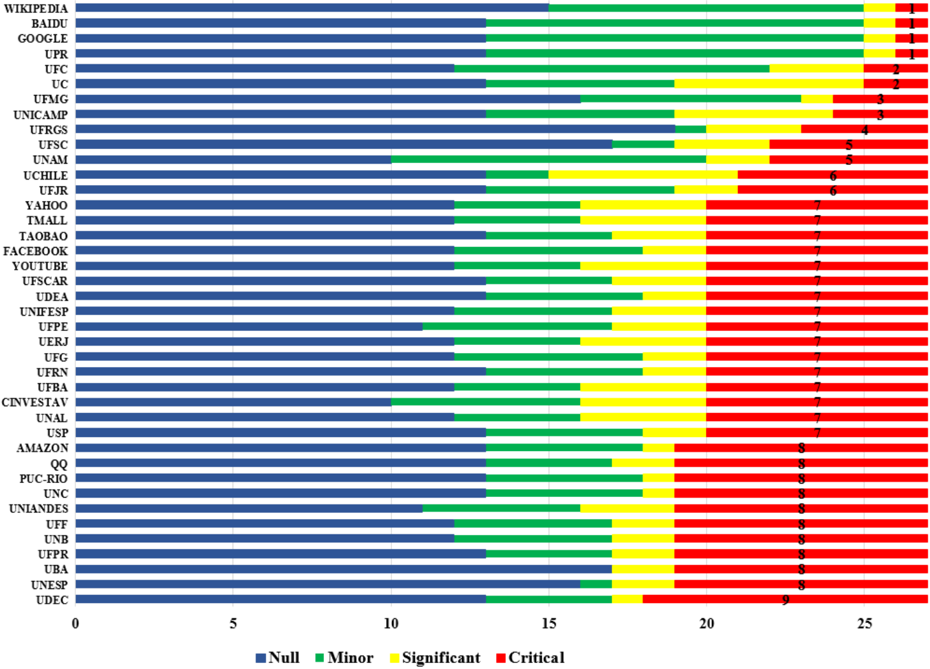
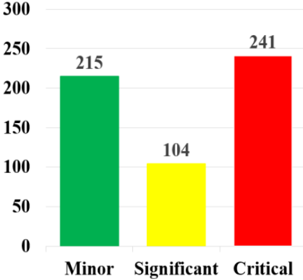
- Of 40 websites evaluated, severity totals were 520 null (48.1%), 215 minor (19.9%), 104 significant (9.6%), and 241 critical (22.3%); excluding null severity, critical severity was 43.0%.
- Critical-severity barriers violated WCAG 2.1 principles: 58.9% “perceivable,” 40.7% “operable,” and 0.4% “robust.”
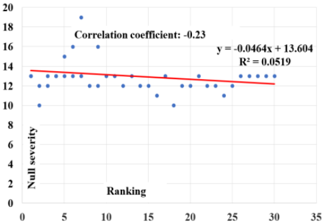
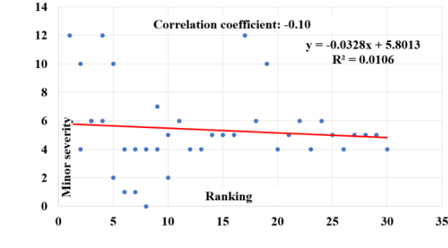
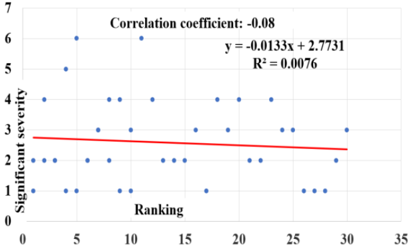
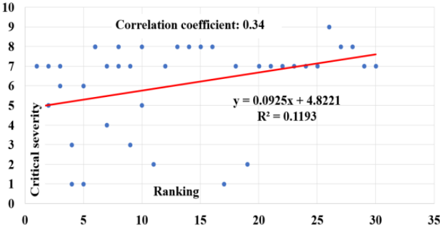
- Ranking correlations with severity were negative and weak for null (−0.23), minor (−0.10), and significant (−0.08), but positive and moderate for critical (0.34).
- The most severe barriers were “color is necessary,” “insufficient visual contrast,” and “too many links”; the authors conclude no sampled website reached an acceptable level of accessibility.
Methods
- The study modified Brajnik’s Barrier Walkthrough method with WCAG 2.1, adding persistence and widening the impact/persistence scale from 0 to 3 to assign severity.
- Two web accessibility experts evaluated 40 home pages: 30 Latin American university websites from Webometrics and 10 most-visited websites from Alexa; five users with low vision (average age 40.8 years) participated using magnifiers.
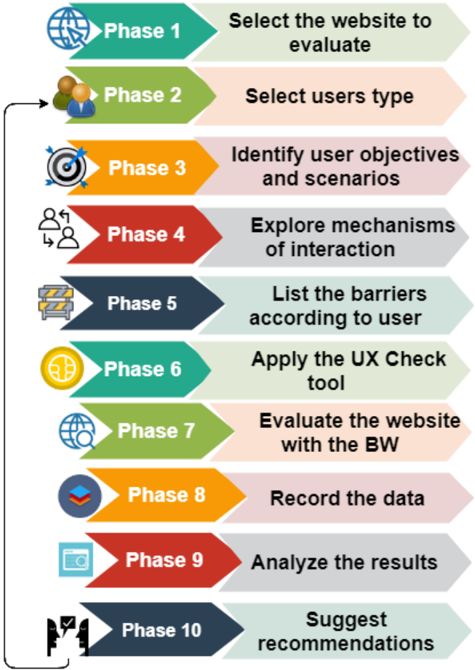
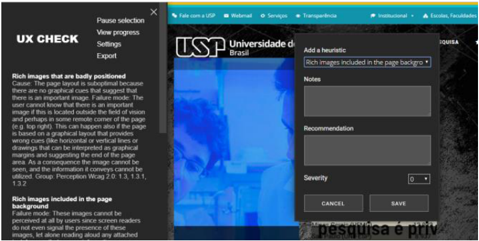
- The method had 10 phases, used 27 barriers for low vision users, applied UX Check, and analyzed results with descriptive statistics and correlation coefficients.
Limitations
- The paper states the manual method takes too much time and is too costly to solve accessibility problems, and that analytical evaluation methods depend on evaluator experience and adopted guidelines.
- The paper states the method is long and expensive for finding all accessibility barriers and suggests combining automatic tools with heuristic methods, while noting no tool can replace expert evaluation.
- Evident from the text: the evaluation is limited to home pages of 40 websites, only users with low vision, two expert evaluators, and five users, so findings may not generalize to other pages, disabilities, or larger evaluator/user samples.
Model-written summary. Check it against the paper before relying on it.
Integrity signals
Registry
Cites
Statistics
Figures



Verification
Claims the paper makes
0 Valid · 0 Not valid · 6 Not checked · 41 Own results and interpretations
A result the paper reports from its own data — it cites no other source for it, so there is none to check. The quote shows it is in the paper.
In the paper
“The evaluators identified several violations of the WCAG 2.1 guidelines, such as images without textual alternatives, broken links, and low color contrasts.”
§ A Heuristic Method to Evaluate Web Accessibility for Users With Low Vision > I. INTRODUCTION
plain- Asserted: passes — The authors put it forward as true.
- Checkable: passes — It can be checked against evidence.
- Load-bearing: passes — The paper’s conclusions depend on it.
- Based: passes — The paper gives a reason why it holds.
- Rests on an assumption not shown here.
A result the paper reports from its own data — it cites no other source for it, so there is none to check. The quote shows it is in the paper.
In the paper
“With this heuristic method, the evaluators concluded that although a website is in a high-ranking position, this does not imply that it is accessible and inclusive.”
- Also stated in: § I. INTRODUCTION · hedged
“With this heuristic method, the evaluators concluded that although an institution may be in a high-ranking position, this does not necessarily imply that it has an accessible and inclusive website.”
§ A Heuristic Method to Evaluate Web Accessibility for Users With Low Vision > Abstract
plain- Asserted: passes — The authors put it forward as true.
- Checkable: passes — It can be checked against evidence.
- Load-bearing: passes — The paper’s conclusions depend on it.
- Based: passes — The paper gives a reason why it holds.
- Rests on 2 assumptions not shown here.
- Also stated in: § I. INTRODUCTION · hedged
A result the paper reports from its own data — it cites no other source for it, so there is none to check. The quote shows it is in the paper.
In the paper
“In this research, it was observed that the pages analyzed with critical severity violate some WCAG 2.1 principles”
§ A Heuristic Method to Evaluate Web Accessibility for Users With Low Vision > IV. RESULTS ANALYSIS
plain- Asserted: passes — The authors put it forward as true.
- Checkable: passes — It can be checked against evidence.
- Load-bearing: passes — The paper’s conclusions depend on it.
- Based: passes — The paper gives a reason why it holds.
A result the paper reports from its own data — it cites no other source for it, so there is none to check. The quote shows it is in the paper.
In the paper
“In Figure 7, showing the ranking and the significant severity, the correlation coefficient is -0.08; this implies that the correlation is very weak and negative.”
§ A Heuristic Method to Evaluate Web Accessibility for Users With Low Vision > IV. RESULTS ANALYSIS
hedgedstates an association- Asserted: passes — The authors put it forward as true.
- Checkable: passes — It can be checked against evidence.
- Load-bearing: unclear — It is unclear whether the paper’s conclusions depend on it.
- Based: passes — The paper gives a reason why it holds.
A result the paper reports from its own data — it cites no other source for it, so there is none to check. The quote shows it is in the paper.
In the paper
“In Figure 6, showing the ranking and minor severity, the correlation coefficient is -0.10; this implies that the correlation is negative and weak.”
§ A Heuristic Method to Evaluate Web Accessibility for Users With Low Vision > IV. RESULTS ANALYSIS
hedgedstates an association- Asserted: passes — The authors put it forward as true.
- Checkable: passes — It can be checked against evidence.
- Load-bearing: unclear — It is unclear whether the paper’s conclusions depend on it.
- Based: passes — The paper gives a reason why it holds.
8 more claims
Create a free account to see all 47 claims and to verify the 7 references still open.
- It may state two separate claims as one. 22
- Probably not a substantial claim. 23
- The quote only partly states this claim. 1
Claims other papers make about this one
Each is checked against this paper’s own text: does it say what the citing paper says it does?
The cited source says what the claim attributes to it.
In the citing paper
“One paper [68] presented a heuristic review of university websites using the UX Check Tool and a manual evaluation with two experts in web accessibility”
From Accessibility of university websites worldwide: a systematic literature review (2023) · cites this paper as [68]
Self-check
Percentages, sums and reported differences re-computed from the paper’s own numbers.
Each contradiction between two passages listed here was confirmed by an independent check.
Rated minor: it would not touch a result — a value no result rests on, a p-value that stays on the same side of the significance level, or a conflict that is clerical, resolved elsewhere in the paper, or outside its own findings.
In the paper
§ A Heuristic Method to Evaluate Web Accessibility for Users With Low Vision > III. METHOD AND CASE STUDY A. METHOD
“In the sixth phase, the evaluators defined the list of barriers according to the type of disability of the users.”
§ A Heuristic Method to Evaluate Web Accessibility for Users With Low Vision > 6) PHASE 6: APPLY THE UX CHECK TOOL
“## 6) PHASE 6: APPLY THE UX CHECK TOOL”
Rated minor: it would not touch a result — a value no result rests on, a p-value that stays on the same side of the significance level, or a conflict that is clerical, resolved elsewhere in the paper, or outside its own findings.
In the paper
§ A Heuristic Method to Evaluate Web Accessibility for Users With Low Vision > C. HEURISTIC METHOD BASED ON THE BARRIER WALKTHROUGH
“Brajnik [41], and Brajnik and Englefield [42] argued that analytical evaluation methods, based on manual heuristic inspection of the code, do not guarantee full accessibility; instead, they depend on the experience of the evaluator and the guidelines adopted.”
§ A Heuristic Method to Evaluate Web Accessibility for Users With Low Vision > References
“42. G. Brajnik and R. Lomuscio, ''SAMBA: A semi-automatic method for measuring barriers of accessibility,''”
Citations
Cites
Heuristic evaluation of user interfaces
Nielsen, J., & Molich, R. (1990) · Proceedings of the SIGCHI conference on Human factors in computing systems Empowering people - CHI '90 · doi:10.1145/97243.97281 · Cited by 3,533 · cited 3×
“[38] J. Nielsen and M. Rolf, ‘‘Heuristic evaluation of user interfaces,’’ in Proc.”
MethodInfluentialShakespeare, T., & Officer, A. (2011) · Disability and Rehabilitation · doi:10.3109/09638288.2011.590392 · Cited by 1,792
Web content accessibility guidelines 1.0
Chisholm, W., Vanderheiden, G., & Jacobs, I. (2001) · Interactions · doi:10.1145/379537.379550 · Cited by 984
Heuristic Walkthroughs: Finding the Problems Without the Noise
Sears, A. (1997) · International Journal of Human-Computer Interaction · doi:10.1207/s15327590ijhc0903_2 · Cited by 258 · cited 2×
“The method proposes the heuristic walkthroughs of Sears [45], considering the context of the use of the website.”
MethodInfluentialVigo, M., Brown, J., & Conway, V. (2013) · Proceedings of the 10th International Cross-Disciplinary Conference on Web Accessibility · doi:10.1145/2461121.2461124 · Cited by 215 · cited 1×
“Automatic tools cannot detect all accessibility barriers [29]; therefore, to complement this process of evaluation, applying a heuristic method is suggested, which, according to the definition, is based on the use of empirical rules to arrive at a solution.”
MethodMankoff, J., Fait, H., & Tran, T. (2005) · Proceedings of the SIGCHI Conference on Human Factors in Computing Systems · doi:10.1145/1054972.1054979 · Cited by 207 · cited 1×
“[37] presented a comparison of different methods to find accessibility problems that affect users with blindness.”
BackgroundAccessibility of Internet websites through time
Hackett, S., Parmanto, B., & Zeng, X. (2003) · Proceedings of the 6th international ACM SIGACCESS conference on Computers and accessibility · doi:10.1145/1028630.1028638 · Cited by 145 · cited 1×
“It included the web accessibility barrier (WAB) [36] metric to objectively summarize the results and amplify the use of this method to cover all types of evaluation tasks.”
MethodAccessibility of Indian universities’ homepages: An exploratory study
Ismail, A., & Kuppusamy, K. S. (2018) · Journal of King Saud University - Computer and Information Sciences · doi:10.1016/j.jksuci.2016.06.006 · Cited by 114 · cited 1×
“Ismail andKuppusamy [17] presented an exploratory study on the accessibility of the websites of Indian universities.”
BackgroundBeyond Conformance: The Role of Accessibility Evaluation Methods
Brajnik, G. (2008) · Lecture Notes in Computer Science · doi:10.1007/978-3-540-85200-1_9 · Cited by 114 · cited 2×
“In this phase, it was essential to consider a list of potential barriers for low vision users [41] (See Table 5).”
BackgroundAcosta-Vargas, P., Acosta, T., & Lujan-Mora, S. (2018) · IEEE Access · doi:10.1109/access.2018.2848978 · Cited by 92 · cited 1×
“[18] described the barriers of web accessibility identified in 348 websites of Latin American universities according to the Webometrics ranking.”
BackgroundSelf-citation
Research works printed but not linked: 5
- R. AlRoobaea, A. Al-Badi, and P. Mayhew, ''Generating a domain specific inspection evaluation method through an adaptive framework: A compara- tive study on educational Websites,'' Int. J. Hum. Comput. Interact., vol. 4, no. 2, p. 88, 2013.
- G. Brajnik. (2011). Barrier Walkthrough. Accessed: May 3, 2019. [Online]. Available: https://users.dimi.uniud.it/ ~giorgio.brajnik/projects/bw/bw.html
- MILL for Business. (2019). How Many Websites Are There Around the World? Accessed: Jun. 20, 2019. [Online]. Available: https://www. millforbusiness.com/how-many-websites-are-there/
- WebAim. WebAIM: Accessibility of AJAX Applications. Accessed: May 23, 2019. [Online]. Available: https://webaim.org/techniques/ajax/
- Nielsen Norman Group. Why You Only Need to Test With 5 Users. Accessed: Aug. 17, 2019. [Online]. Available: https://www.nngroup. com/articles/why-you-only-need-to-test-with-5-users/
Cited by
Empirical Studies on Web Accessibility of Educational Websites: A Systematic Literature Review
Campoverde-Molina, M., Lujan-Mora, S., & Garcia, L. V. (2020) · IEEE Access · doi:10.1109/access.2020.2994288 · Cited by 94
“It should be noted that the papers [52], [59] published by Ecuador refer to Universities websites in Latin America.”
BackgroundMethodInfluentialAccessibility engineering in web evaluation process: a systematic literature review
Ara, J., Sik‐Lányi, C., & Kelemen, A. (2023) · Universal Access in the Information Society · doi:10.1007/s10209-023-00967-2 · Cited by 96
“…potential errors and violations, even without prior knowledge [43]; (9) proposed a framework for website accessibility barrier measurement according to several variable magnitude techniques [50]; 10) proposed a heuristic method to determine the level of accessibility of high ranked websites [66].”
MethodAccessibility of university websites worldwide: a systematic literature review
Campoverde-Molina, M., Luján-Mora, S., & Valverde, L. (2023) · Universal Access in the Information Society · doi:10.1007/s10209-021-00825-z · Cited by 84
Visualization Accessibility in the Wild: Challenges Faced by Visualization Designers
Joyner, S. C. S., Riegelhuth, A., Garrity, K., Kim, Y., & Kim, N. W. (2022) · CHI Conference on Human Factors in Computing Systems · doi:10.1145/3491102.3517630 · Cited by 53
“Some studies investigate ways to derive quality metrics as an effort to derive an objective, comparative evaluation framework [2, 65], such as using WCAG [67] as a basis.”
BackgroundCombined Method for Evaluating Accessibility in Serious Games
Salvador-Ullauri, L., Acosta-Vargas, P., González, M., & Luján‐Mora, S. (2020) · Applied Sciences · doi:10.3390/app10186324 · Cited by 45
“In this study, we consider web accessibility as a starting point, which implies how users perceive, navigate, understand and interact on the web [13]; therefore, it is essential to keep in mind that the level of accessibility is the fundamental basis to facilitate access to serious games,…”
BackgroundSelf-citationAn inclusive framework for automated web content accessibility evaluation
Ara, J., Sik‐Lányi, C., Kelemen, A., & Guzsvinecz, T. (2024) · Universal Access in the Information Society · doi:10.1007/s10209-024-01164-5 · Cited by 42
“…usability Hybrid evaluation Heuristic Approach Mazalu and Cechich [10] Web accessibility Hybrid evaluation Heuristic Approach Acosta-Vargas et al. [3] Web accessibility Hybrid evaluation Crowdsourcing System Li et al. [4] Web accessibility Hybrid evaluation Heuristic Approach Martins et al. [13]…”
InfluentialAccessibility in Web Development Courses: A Case Study
Ferati, M., & Vogel, B. (2020) · Informatics · doi:10.3390/informatics7010008 · Cited by 47
“People with disabilities and the elderly are increasingly engaging in online learning as well as browsing the web to get access to information for their daily activities [1,2].”
BackgroundMateus, D. A., Silva, C. A., de Oliveira, A. F. B. A., Costa, H. A. X., & Freire, A. P. (2021) · Journal on Interactive Systems · doi:10.5753/jis.2021.1778 · Cited by 38
“(Carvalho et al., 2018b; Loureiro et al., 2015; Power, 2018; Mátrai, 2018; Abdolrahmani and Kuber, 2016; Valencia et al., 2014; Acosta-Vargas et al., 2019b Inappropriate title Page title that does not correctly describe the content.”
BackgroundInfluentialAccessibility challenges of e-commerce websites
Acosta-Vargas, P., Salvador-Acosta, B., Salvador-Ullauri, L., & Jadán-Guerrero, J. (2022) · PeerJ Computer Science · doi:10.7717/peerj-cs.891 · Cited by 32
Self-citationWhy Web Accessibility Is Important for Your Institution
Filipe, F., Pires, I. M., & Gouveia, A. J. (2023) · Procedia Computer Science · doi:10.1016/j.procs.2023.01.259 · Cited by 32
Assessing Ecommerce Websites: Usability and Accessibility Study
Hamid, S., Bawany, N. Z., & Zahoor, K. (2020) · International Conference on Advanced Computer Science and Information Systems · doi:10.1109/icacsis51025.2020.9263162 · Cited by 39
“Acosta-Vargas et al. [20] used a modified version of Barrier Walkthrough method proposed by Giorgio Brajnik [21] to evaluate websites for low vision users.”
Methodİnal, Y., Mishra, D., & Torkildsby, A. B. (2022) · Nordic Conference on Human-Computer Interaction · doi:10.1145/3546155.3547272 · Cited by 29
A Heuristic Method for Evaluating Accessibility in Web-Based Serious Games for Users with Low Vision
Salvador-Ullauri, L., Acosta-Vargas, P., González, M., & Luján‐Mora, S. (2020) · Applied Sciences · doi:10.3390/app10248803 · Cited by 14
“A previous study by the authors [16] indicated that there are qualitative and quantitative methods for checking whether an application is accessible.”
BackgroundMethodInfluentialSelf-citationHewitt, D. H., & He, Y. (2021) · Proceedings of the Human Factors and Ergonomics Society Annual Meeting · doi:10.1177/1071181321651051 · Cited by 17
“While manual methods of accessibility testing are ideal (Acosta-Vargas et al., 2019), this study implements checkers because of the large volume of pages to test and limited time frame for the study due to the time-sensitive data.”
MethodPark, K., & Jung, S. (2021) · Journal of Convention & Event Tourism · doi:10.1080/15470148.2021.1949419 · Cited by 13
Usability Evaluation of SIDUMAS Badung Using Think Aloud, Heuristic Evaluation and SUS
Putra, I. N. G. A. Y., Candiasa, I. M., & Dewi, L. J. E. (2023) · SinkrOn · doi:10.33395/sinkron.v8i1.12034 · Cited by 11
Challenges and Improvements in Website Accessibility for Health Services
Acosta-Vargas, P., Hidalgo-Andrade, P., Acosta-Vargas, G., González, M., Guaña–Moya, J., & Salvador-Acosta, B. (2020) · Advances in intelligent systems and computing · doi:10.1007/978-3-030-39512-4_134 · Cited by 11
Self-citationAljuboori, A., Tawfeeq, L. A., & Al-Karawi, K. A. (2021) · Indonesian Journal of Electrical Engineering and Computer Science · doi:10.11591/ijeecs.v22.i1.pp522-533 · Cited by 11
Gupta, V., & Singh, H. (2021) · International Conference on Computing for Sustainable Global Development · doi:10.1109/indiacom51348.2021.00097 · Cited by 14
“WCAG 2.1 standards and manual evaluation is also there [10].”
BackgroundInfluentialMethod for Assessing Accessibility in Videoconference Systems
Acosta-Vargas, P., Guaña–Moya, J., Acosta-Vargas, G., Villegas-Ch, W. E., & Salvador-Ullauri, L. (2021) · Advances in intelligent systems and computing · doi:10.1007/978-3-030-68017-6_99 · Cited by 11
Self-citationMateus, D. A., da Silva, F. A. C., da Silva, T. S., & Freire, A. P. (2022) · Brazilian Symposium on Human Factors in Computing Systems (IHC) · doi:10.1145/3554364.3559130 · Cited by 11
“Several studies have shown that public and digital interactive applications present accessibility barriers for users with disabilities [4, 9, 11, 12, 19, 23, 38, 44, 47, 48, 52, 53, 55].”
BackgroundA novel heuristic method for quantitative assessment of web accessibility for colorblind
Meenakshi, S., & Singla, A. (2023) · Universal Access in the Information Society · doi:10.1007/s10209-023-01006-w · Cited by 12
“The purpose of these websites is business, social networking, education, administrative tasks by concerned stakeholders like Government authorities, etc. and is used significantly for information exchange to meet the appropriate needs of users [2].”
Wise, K., & Selby‐Pham, J. (2024) · New Zealand Journal of Crop and Horticultural Science · doi:10.1080/01140671.2024.2370565 · Cited by 10
I feel for you! The effect of empathy exercises on accessibility awareness
İnal, Y. (2024) · Universal Access in the Information Society · doi:10.1007/s10209-023-01081-z · Cited by 9
“…number of digital systems (e.g., government, university, tourism, and municipality websites) remain partially or completely inaccessible to individuals with disabilities [2–9] despite the existing efforts to improve accessibility through legal regulations, relevant guidelines, and evaluation tools.”
Improve Accessibility and Visibility of Selected University Websites
Acosta-Vargas, P., Ramos-Galarza, C., Salvador-Ullauri, L., Chanchí, G. E., & Jadán-Guerrero, J. L. (2020) · Advances in intelligent systems and computing · doi:10.1007/978-3-030-51369-6_31 · Cited by 8
Self-citationAccessibility to E-Commerce Websites for People with Disability in Indonesia
Hafiar, H., Lukman, S., Setianti, Y., Subekti, P., & Amin, K. (2023) · Communicatus Jurnal Ilmu komunikasi · doi:10.15575/cjik.v7i1.25406 · Cited by 8
“Users who experience age-related changes, such as poor vision, poor hearing, and reduced motor skills, would have challenges when accessing the website (Acosta-Vargas et al., 2019).”
BackgroundImprovement of Accessibility in Medical and Healthcare Websites
Acosta-Vargas, G., Acosta-Vargas, P., Jadán-Guerrero, J. L., Salvador-Ullauri, L., & González, M. (2021) · Lecture notes in networks and systems · doi:10.1007/978-3-030-79816-1_33 · Cited by 7
Self-citationEnhancing accessibility of web-based SVG buttons: An optimization method and best practices
Zhang, M., Yan, Z., Gao, G., & Liu, H. (2023) · Expert Systems with Applications · doi:10.1016/j.eswa.2023.121883 · Cited by 9
Souza, A. N. D., Filho, J. C. D. S., Bezerra, C. I. M., Alves, V. A., LIMA, L. A., Marques, A. B., & Monteiro, I. T. (2024) · Brazilian Symposium on Human Factors in Computing Systems (IHC) · doi:10.1145/3702038.3702090 · Cited by 10
“The study S30 [1] used a modification of the Barrier Walkthrough (BW) method proposed by Giorgio Brajnik considering the WCAG.”
InfluentialCarvalho, L. P., dos Santos, M. A., de Souza, J. G. R., Prates, R. O., & Freire, A. P. (2021) · Brazilian Symposium on Human Factors in Computing Systems (IHC) · doi:10.1145/3472301.3484365 · Cited by 10
“8372368 [2] Patricia Acosta-Vargas, Luis Antonio Salvador-Ullauri, and Sergio Lujan-Mora.”
BackgroundBrown, J. D. (2021) · SLIS Connecting · doi:10.18785/slis.1002.10 · Cited by 6
“The authors discussed the importance of applying human-led assessments of web accessibility along with available automated tools to design inclusive websites for multiple disabilities (Acosta-Vargas et al., 2019).”
BackgroundUser Interface Evaluation in Metvaerse Gamelan Virtual Reality Using Heuristics Evaluation Method
Jonathan, E., Primasari, C. H., Sidhi, . A. P., Wibisono, Y. P., Setyohadi, D. B., & Cininta, M. (2022) · Journal of Intelligent Software Systems · doi:10.26798/jiss.v1i2.756 · Cited by 6
A Universal Web Accessibility Feedback Form: A Participatory Design Study
Wegener, A., Fausel, K., Haug, S., & Maedche, A. (2024) · International Web for All Conference (W4A) · doi:10.1145/3677846.3677853 · Cited by 6
“Other studies have come to similar conclusions [4, 62].”
The Portable Document Format: An Analysis of PDF Accessibility
Acosta-Vargas, P., González, M., Zambrano, M. R., Medina, A., Zweig, N., & Salvador-Ullauri, L. (2020) · Advances in intelligent systems and computing · doi:10.1007/978-3-030-51369-6_28 · Cited by 5
Self-citationAlMeraj, Z., Doush, I. A., Alhuwail, D., Shama, S., AlBahar, A., & Al-Ramahi, M. A. (2022) · International Journal of Human-Computer Interaction · doi:10.1080/10447318.2022.2051887 · Cited by 6
“Heuristic evaluation is the investigation of a system by evaluating in an interactive way (Acosta-Vargas et al., 2019).”
BackgroundLabour union’s website accessibility and information rights fulfilment among workers with disability
Sumartias, S., Hafiar, H., Amin, K., Limilia, P., & Prastowo, A. A. (2022) · Jurnal Studi Komunikasi (Indonesian Journal of Communications Studies) · doi:10.25139/jsk.v6i3.4952 · Cited by 5
“Besides, accessibility could diminish the digital divide, improve efficiency, increase response time, minimise maintenance costs, maintain the website, and be part of social responsibility (Acosta-Vargas et al., 2019).”
BackgroundDesigning an Accessible Website for Palliative Care Services
Acosta-Vargas, P., Hidalgo-Andrade, P., Acosta-Vargas, G., Salvador-Acosta, B., Salvador-Ullauri, L., & González, M. (2020) · Communications in computer and information science · doi:10.1007/978-3-030-42517-3_28 · Cited by 4
Self-citationCarvalho, L. P., de Souza, J. G. R., Prates, R. O., & Freire, A. P. (2023) · Interacting with Computers · doi:10.1093/iwc/iwad023 · Cited by 5
Mateus, D. A., da Silva, F. A. C., Rigatto, S. H., da Silva, T. S., Júnior, P. A. P., Souza, M. R. D. A., & Freire, A. P. (2024) · Journal of the Brazilian Computer Society · doi:10.5753/jbcs.2024.3259 · Cited by 4
“…of digital systems [Jaeger, 2006; Silva et al ., 2019; Freire, 2012; Harrison and Petrie, 2007; Galkute et al ., 2020; Vigo et al ., 2013; Power et al ., 2012; Rømen and Svanæs, 2012; Yi, 2020; Acosta-Vargas et al ., 2019; Mounika et al ., 2019; Wentz et al ., 2019; Doush and AlMeraj, 2019].”
Web Accessibility Analysis of a Tele-Rehabilitation Platform: The Physiotherapist Perspective
Acosta-Vargas, P., Salvador-Acosta, B., González, M., Pérez-Medina, J.-L., Acosta-Vargas, G., Jimenes-Vargas, K., & Rybarczyk, Y. P. (2020) · Advances in intelligent systems and computing · doi:10.1007/978-3-030-51369-6_29 · Cited by 4
Self-citationSánchez, L. A. V., Idrobo, D. I. G., Ojeda, M. C. C., & Jaramillo, S. G. (2022) · Academia y Virtualidad · doi:10.18359/ravi.5601 · Cited by 6
Heuristic Analysis of the Indonesian Covid-19 Official Website Interface
Asyhari, M. Y., Sussolaikah, K., Sari, E. R. N., & Nita, S. (2022) · International Journal of Advances in Data and Information Systems · doi:10.25008/ijadis.v3i1.1234 · Cited by 4
Crafting Disability Fairness Learning in Data Science: A Student-Centric Pedagogical Approach
Newman, P., Opdahl, T., Liu, Y., Wehrwein, S., & Elglaly, Y. N. (2024) · Proceedings of the 55th ACM Technical Symposium on Computer Science Education V. 1 · doi:10.1145/3626252.3630815 · Cited by 3
“While creating inclusive and accessible smart systems has become an important goal for the ML and DS communities [2, 7, 18], certain challenges, such as a lack of relevant data and nuanced definitions of disabilities, often result in systems inadequately including disability in data sourcing, model…”
BackgroundDeriba, F. G., Saqr, M., & Tukiainen, M. (2026) · Interactive Learning Environments · doi:10.1080/10494820.2026.2647973 · Cited by 3
Sabev, N., Todorova–Ekmekci, M., Bogdanova, G. T., Kapralov, S., & Noev, N. (2024) · Lecture notes in networks and systems · doi:10.1007/978-3-031-53382-2_45 · Cited by 3
Chou, T.-C., & Lu, J.-M. (2024) · International Journal of Human-Computer Interaction · doi:10.1080/10447318.2024.2352206 · Cited by 3
“These methods have been widely used during the development process of mobile applications (Garc � ıa-Holgado et al., 2019; Santos et al., 2016), websites (Acosta-Vargas et al., 2019), and many other products.”
Optimizing manual web accessibility evaluation through a specialized tool
Salton, B. P., Agnol, A. D., Nervis, L., da Silva, T. S., & Silveira, M. S. (2024) · Brazilian Symposium on Human Factors in Computing Systems (IHC) · doi:10.1145/3702038.3702049 · Cited by 3
“Neste sentido, de acordo com Acosta-Vargas et al. [2], a maioria dos métodos utiliza ferramentas automáticas em virtude de baixo custo.”
Pritalia, G. L., Cristian, A. A., & Nastiti, P. (2025) · International Conference on Innovative Research in Applied Science, Engineering and Technology (IRASET) · doi:10.1109/iraset64571.2025.11008331 · Cited by 3
“The researcher employs the heuristic evaluation (HE) method to identify usability issues within the user experience, involving evaluators who are experts in the user interface and user experience [8] [9].”
WEBSİTESİ ERİŞİLEBİLİRLİK DEĞERLENDİRMESİ: BİR BARİYER GEZİNTİ ÇALIŞMASI
Yerlikaya, Z., & Durdu, P. O. (2020) · Sosyal Politika Çalışmaları Dergisi · doi:10.21560/spcd.vi.818272 · Cited by 4
Web Site Accessibility Among Doctor of Physical Therapy Programs in the United States
Ness, B. M., Pathare, N., Wilhelm, M. P., Wonsetler-Jones, E. C., & Parent-Nichols, J. (2025) · Journal of Physical Therapy Education · doi:10.1097/jte.0000000000000357 · Cited by 2
“Of those studies, 12 included Web site accessibility data of higher education institution homepages in the United States, 15-26 where 83% of these studies used some version of an automated online evaluation tool to evaluate acces-sibilitybarriers.”
Web accessibility of university websites in China: An empirical study
Liu, H., Sun, J., He, Z., Huang, H., Liu, X., & Nie, L. (2026) · Journal of King Saud University - Computer and Information Sciences · doi:10.1007/s44443-026-00544-6 · Cited by 2
Nacheva, R. V., Stecyk, A., & Petrov, P. (2023) · Communications in computer and information science · doi:10.1007/978-3-031-44440-1_29 · Cited by 2
Accessibility of Information on Marketplace Websites for Consumers with Disabilities
Hafiar, H., Subekti, P., Setianti, Y., & Dipa, A. K. (2021) · Lincoln (University of Nebraska) · Cited by 2
Fahmy, S. A. (2025) · المجلة الدولية لعلوم المكتبات و المعلومات · doi:10.21608/ijlis.2025.371248.1285 · Cited by 2
Modelo para evaluación de accesibilidad web orientado por tipos de discapacidad
Moreno, O., & Lorena, A. (2020) · Cited by 4
Combined Method for Accessibility Evaluation in Tele-Rehabilitation Platforms for Low Vision Users
Acosta-Vargas, P., Pérez-Medina, J.-L., Acosta-Vargas, G., Salvador-Acosta, B., Esparza, W. D., Jimenes-Vargas, K., & González, M. (2021) · Advances in intelligent systems and computing · doi:10.1007/978-3-030-68017-6_93 · Cited by 2
Self-citationAcosta-Vargas, P., Dueñas-Espín, I., Armijos, L., Fonseca, J., Santillán, N., Jimbo-Sotomayor, R., Rivadeneira, M. F., Sánchez, X., Sevilla, C., Tello, B., et al. (2021) · Lecture notes in networks and systems · doi:10.1007/978-3-030-79816-1_30 · Cited by 2
Self-citationRefining the Acceasy Framework from an accessibility assessment
Germano, R. S., de Sousa, T. A. N., & Eliseo, M. A. (2021) · Iberian Conference on Information Systems and Technologies (CISTI) · doi:10.23919/cisti52073.2021.9476366 · Cited by 2
“Como trabalhos correlatos, destaca-se o trabalho de [9], que analisou o ranking de webometria das universidades mundiais, o qual é uma iniciativa do laboratório de cibermetria, pertencente ao Conselho Superior de Pesquisa Científica Espanhol, responsável por projetar e aplicar indicadores que medem a atividade científ…”
BackgroundSadowska, W. (2023) · Acta Univeristatis Lodziensis Folia Librorum · doi:10.18778/0860-7435.36.05 · Cited by 1
Disability-friendly Website Design with Recommendation System
Lamani, A., Gude, R., Colaco, M., Karpe, P., & Simu, S. (2023) · IEEE North Karnataka Subsection Flagship International Conference (NKCon) · doi:10.1109/nkcon59507.2023.10396590 · Cited by 1
“The paper [6] examines the barriers faced by 40 websites for users with low vision.”
BackgroundUnderstanding Accessibility Needs of Blind Authors on CMS-Based Websites
Vera-Amaro, G., & Rojano-Cáceres, J. R. (2026) · Communications in computer and information science · doi:10.1007/978-3-032-31223-5_21 · Cited by 3
“Observations were converted into quantitative data, following prior studies [1, 32].”
InfluentialYussubaliyeva, M., Konurbayeva, Z., Słoniec, J., & Moro, A. I. (2025) · Asian Journal of University Education · doi:10.24191/ajue.v21i3.46 · Cited by 1
Accessibility Challenges for Blind Users Authoring in Content Management Systems: An Empirical Study
Vera-Amaro, G., & Rojano-Cáceres, J. R. (2026) · IEEE Revista Iberoamericana de Tecnologias del Aprendizaje · doi:10.1109/rita.2026.3681871 · Cited by 3
“The BW approach identifies barriers that hinder CMS usability and allows qualitative observations to be transformed into quantitative data, following prior studies [2], [30].”
InfluentialMétodo de evaluación de accesibilidad web en archivos audiovisuales de Lima-Perú
Pino, D. D., & Huamán, A. M. R. (2022) · Revista de investigación de Sistemas e Informática · doi:10.15381/risi.v14i2.23147 · Cited by 1
“Universidades TAW/Acheker/Examinator 2017 [5]”
Kaliszuk, J., Osmulska, A., Plechawska–Wójcik, M., & Dzieńkowski, M. (2022) · Journal of Computer Sciences Institute · doi:10.35784/jcsi.2997 · Cited by 1
“Informacje na temat dostępności serwisów, stron i aplikacji internetowych dla osób niepełnosprawnych można znaleźć w pracach [1-6].”
A Declarative Model for Web Content Accessibility Evaluation Process
Ara, J., & Sik‐Lányi, C. (2024) · Lecture notes in computer science · doi:10.1007/978-3-031-62846-7_10 · Cited by 1
Accessibility Redesign and Its Effect on Purchase Intent and Customer Experience
Lindgren, E. (2024) · DiVA at Umeå University (Umeå University) · Cited by 1
Peer Review #2 of "Accessibility challenges of e-commerce websites (v0.3)"
(2022) · PeerJ Computer Science · doi:10.7287/peerj-cs.891v0.3/reviews/2
Peer Review #1 of "Accessibility challenges of e-commerce websites (v0.1)"
(2022) · PeerJ Computer Science · doi:10.7287/peerj-cs.891v0.1/reviews/1
Peer Review #2 of "Accessibility challenges of e-commerce websites (v0.1)"
(2022) · PeerJ Computer Science · doi:10.7287/peerj-cs.891v0.1/reviews/2
Peer Review #2 of "Accessibility challenges of e-commerce websites (v0.2)"
(2022) · PeerJ Computer Science · doi:10.7287/peerj-cs.891v0.2/reviews/2
EVALUACIÓN HEURÍSTICA DE LA APLICACIÓN CONOCIMIENTO INCLUSIVO - COIN
Reis, I. A., Berg, C. H., & Ulbricht, V. R. (2022) · Anais ... Congresso Internacional do Conhecimento e Inovação · doi:10.48090/ciki.v1i1.1054
M2M: Universally Designed Multimedia Training and Learning Application for Maternal Health
Betru, B., & Giannoumis, G. A. (2022) · The International journal of Multimedia & Its Applications · doi:10.5121/ijma.2022.14203
“We have used the heuristic web accessibility method with the combination of the barrier walkthrough and the cooperative evaluation technique to evaluate the prototype [38-40].”
MethodEvaluaciones heurísticas para decisiones de accesibilidad: una revisión sistemática de la literatura
Almeida, H. L. N., Correia, W. F. M., & Filho, A. T. D. A. (2023) · Revista Científica Multidisciplinar Núcleo do Conhecimento · doi:10.32749/nucleodoconhecimento.com.br/computer-science/heuristic-evaluations
Almeida, H. L. N., Correia, W. F. M., & Filho, A. T. D. A. (2023) · Revista Científica Multidisciplinar Núcleo do Conhecimento · doi:10.32749/nucleodoconhecimento.com.br/informatique/evaluations-heuristiques
Avaliações heurísticas para decisões de acessibilidade: uma revisão sistemática da literatura
Almeida, H. L. N., Correia, W. F. M., & Filho, A. T. D. A. (2023) · Revista Científica Multidisciplinar Núcleo do Conhecimento · doi:10.32749/nucleodoconhecimento.com.br/ciencia-da-computacao/avaliacoes-heuristicas
User Experience and Ideation Processes in Mobile Prototyping
Gárgoles, M. (2025) · IGI Global eBooks · doi:10.4018/979-8-3373-3678-7.ch008
Sandaruwan, R. M. T., & Somaweera, W. T. S. (2025) · International Journal of Research Publication and Reviews · doi:10.55248/gengpi.6.0625.2289
Bridging Gaps through Accessibility Education: The Impact on Students Mindsets on Disability
Stipe, C. A. (2025) · doi:10.46569/rr1726661 · Cited by 1
Acosta-Vargas, P. (2020) · RUA, Repositorio Institucional de la Universidad de Alicante (Universidad de Alicante) · doi:10.13140/rg.2.2.26106.52167
Self-citationHerrero-Alonso, J., & Escudero-Mancebo, D. (2024) · Hispana · doi:10.52152/11128
Utriainen, S. (2021) · Osuva (University of Vaasa)
Teknisen saavutettavuuden haasteet : Tarkastelussa sosiaali- ja terveysalan järjestöjen verkkosivut
Nieminen, M. T. (2021) · Osuva (University of Vaasa)
Saavutettavuuden toteutuminen näkövammaisille julkishallinnon verkkosivuilla – Tapaustutkimus: Kela
Delahay, I. (2025) · Jyväskylä University Digital Archive (University of Jyväskylä)
Käyttäjien hallinta : käyttäjien luonti ja oikeuksien hallinta
Ylinen, R. (2024) · Theseus (Ammattikorkeakoulujen)
Salvador-Ullauri, L. (2021) · RUA, Repositorio Institucional de la Universidad de Alicante (Universidad de Alicante)
Real-Time Accessibility Dashboards for Higher Education
Patatas, B., Duarte, C., & Pereira, L. S. (2025) · Simpósio Brasileiro de Fatores Humanos em Sistemas Computacionais (IHC) · doi:10.5753/ihc_estendido.2025.13235
Bernerstedt, F. (2023) · Diva portal (Dalarna University Library)
Martín, C. S. (2024) · UNED repository
ENSEÑANZA ACCESIBLE DE CIBERSEGURIDAD BÁSICA PARA PERSONAS CON DISCAPACIDAD VISUAL
Adriano, W. G., Merino, G., Manzano, J., Chagñay, K., León, E., & Pusay, S. (2026) · Revista Científica Multidisciplinaria InvestiGo · doi:10.56519/r5906256
A two-phased model for optimal evaluation of design accessibility index using fuzzy approach
Sarita, K., Kaur, P., & Kaur, S. (2026) · Universal Access in the Information Society · doi:10.1007/s10209-026-01368-x
“More-over, certain studies used the Barrier Walkthrough method, a category of expert-based evaluation [49, 51–53].”
Autoethnographic Evaluation of Insurance Web Accessibility in Indonesia Using WCAG 2.2 and SETARA
Suhendar, B. (2026) · International Journal of Applied Business and International Management · doi:10.32535/ijabim.v11i2.4599
The Long Road to Web Accessibility: Three Decades of Retrospective Analysis
Afroz, M., Dar, M. D., & Chowdhury, O. (2026) · ACM Internet Measurement Conference (IMC) · doi:10.1145/3777912.3839806
“Researchers have devised methods for semi-automatically identifying accessibility violations [1, 7, 30, 39].”
Saavutettavuuden kustomoinnin motivaatiotekijät suomalaisilla uutissivustoilla
Mäenpää, J. (2026) · Jyväskylä University Digital Archive (University of Jyväskylä)
Metadata
- Authors
- Acosta-Vargas, P., Antonio Salvador-Ullauri, L., & Lujan-Mora, S.
- Affiliations
- Universidad de Las Américas (EC)
- Venue
- IEEE Access
- Published
- 2019
- Volume
- 7
- Pages
- 125634-125648
- ISSN
- 2169-3536 (ISSN-L)
- OpenAlex
- W2972056002
- Cited by
- 78
- References
- 40
- Citations by year
- 2026: 5 · 2025: 5 · 2024: 12 · 2023: 14 · 2022: 17 · 2021: 13 · 2020: 12
- FWCI
- 30.74
- Type
- journal article
- Language
- en
- Open access
- gold
- doi.org
- Locations
- IEEE Access (publishedVersion, cc-by)
- LA Referencia (Red Federada de Repositorios Institucionales de Publicaciones Científicas) (submittedVersion, cc-by)
- DOAJ (DOAJ: Directory of Open Access Journals) (submittedVersion, cc-by-sa)
- RUA, Repositorio Institucional de la Universidad de Alicante (Universidad de Alicante) (submittedVersion, cc-by)
- Greater South Information System
- Funders
- Universidad de Las Américas, Ecuador (FGE.PAV.18.10)
- Topics
- Social Sciences › Human Factors and Ergonomics › Digital Accessibility for Disabilities
- Physical Sciences › Computer Science › Human-Computer Interaction › Usability and User Interface Design
- Health Sciences › Health Professions › Occupational Therapy › Assistive Technology in Communication and Mobility
- Keywords
- web accessibility, low vision, heuristic evaluation, access barriers, university websites, Webometrics ranking
About these checks
Registry, retraction, Cites and statistics results are computed, not judged, with one exception: a printed reference that no index lists is read once by a model before it counts as a citation error. Claims are extracted by a model and kept only when their quote appears verbatim in the text; each cited source is then checked, with a model’s help, for whether it says what the claim relies on. Those verdicts can be wrong — read the claim’s quote and the cited source before relying on one.
A language model drew the claims from the paper on 2026-10-05, under version 3 of the claim definition (model deepseek-v4.1-flash, prompt extract-v3).
A second model labelled each claim on 2026-10-05 (model jev-1.13-20260917, definition revision gold-guideline-v0.2).
Statistics and arithmetic are recomputed, not judged.
Confidence bands are shown only for fields calibrated on our annotated test set. None is calibrated yet, so no band is shown.
What counts as a claim ›How we measure confidence ›How we check this ›
Are you an author, or do you see a problem with this page? Request a review
Data sources
Bibliographic data: Semantic Scholar, OpenAlex, Crossref.
Contains information from the Semantic Scholar Academic Graph Datasets, made available under the ODC Attribution License (ODC-BY 1.0).
Semantic Scholar’s data is described in: Kinney, R., et al. (2023). The Semantic Scholar Open Data Platform. arXiv:2301.10140.
