

The DOI matches its Crossref record; the references it cites are not checked yet.
A Neural Network-Based ECG Classification Processor With Exploitation of Heartbeat Similarity
Open accessAbstract
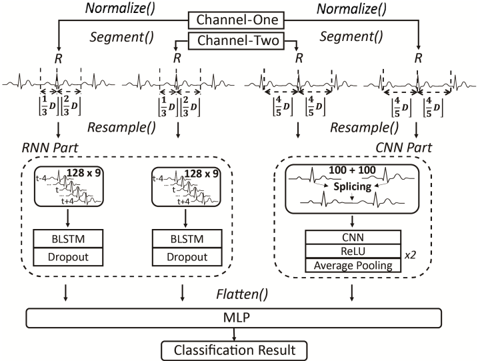
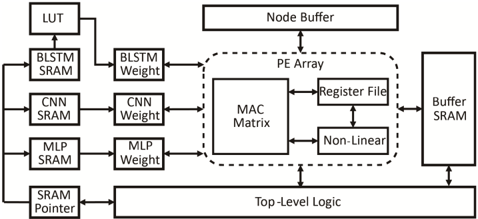
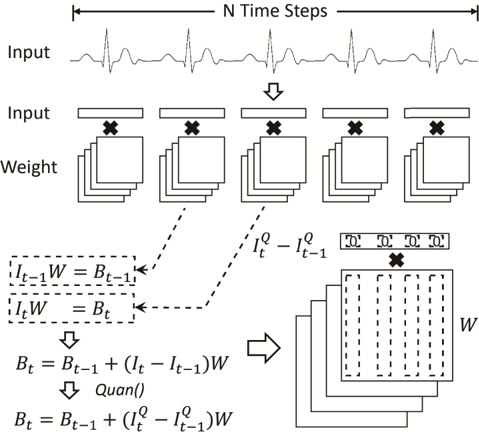
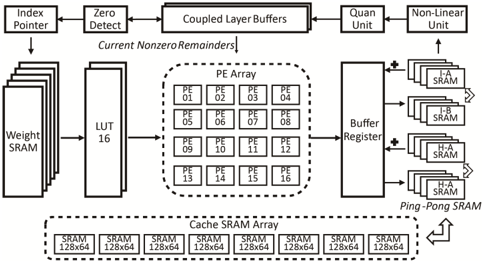
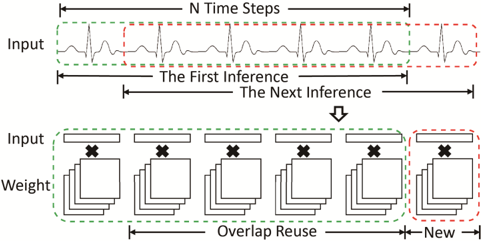
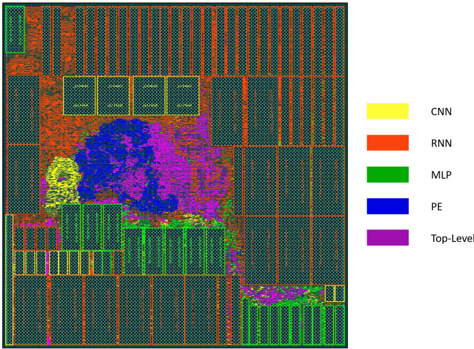
This paper presents a neural network based processor with improved computation efficiency, which aims at multiclass heartbeat recognition in wearable devices. A lightweight classification algorithm that integrates both bi-directional long short-term memory (BLSTM) and convolutional neural networks (CNN) is proposed to deliver high accuracy with minimal network scale. To reduce energy consumption of the classification algorithm, the similarity between consecutive heartbeats is exploited to achieve a high degree of computation reuse in hardware architecture. In addition, neural network compression techniques are adopted in the procedure of inference to save hardware resources. Synthesized in the SMIC 40LL CMOS process, the prototype design has a total area of 1.40 mm2with 186.2 kB of static random-access memory (SRAM) capacity. Based on the simulation, this processor achieves an average energy efficiency of 3.52 GOPS/mW under 1.1 V supply at 100 MHz frequency. Compared with the design without computation reuse, the proposed processor provides a speedup by 2.58x and an energy dissipation reduction by 61.27% per classification. This work is a valuable exploration of neural network based design for long-term arrhythmia monitoring in daily life.
Overview
The claims and statistics of this paper haven’t been checked yet.
Run the check — free, no account needed. It reads the open-access text and checks the sources it cites.
Integrity signals
Registry
Cites
Statistics
Figures




Verification
Claims the paper makes
The claims and statistics of this paper haven’t been checked yet.
Run the check — free, no account needed. It reads the open-access text and checks the sources it cites.
Claims other papers make about this one
Each is checked against this paper’s own text: does it say what the citing paper says it does?
In the citing paper
“its application in electrocardiogram (ECG) diagnosis is particularly well suited27,28.”
From Flexible self-rectifying synapse array for energy-efficient edge multiplication in electrocardiogram diagnosis (2025) · cites this paper as [27]
Self-check
Percentages, sums and reported differences re-computed from the paper’s own numbers.
The self-check needs the paper’s full text.
Citations
The citation lists are queued
They are fetched later and appear here then.
References 23 · Cited by 23
Research works printed but not linked: 3
- 1987, Recommended practice for testing and reporting performance results of ventricular arrhythmia detection algorithms, Journal of Assoc Advancement of Medical Instr, 69
- saadatnejad, 0, LSTM-based ECG classification for continuous monitoring on personal wearable devices, IEEE J Biomed Health Inform
- mark, 1988, MIT-BIH arrhythmia database directory
Metadata
- Authors
- Wu, J., Li, F., Chen, Z., Pu, Y., & Zhan, M.
- Affiliations
- Zhejiang University (CN)
- Affiliated Hospital of Qingdao University (CN)
- Venue
- IEEE Access
- Published
- 2019
- Volume
- 7
- Pages
- 172774-172782
- ISSN
- 2169-3536 (ISSN-L)
- OpenAlex
- W2990225235
- Cited by
- 23
- References
- 23
- Citations by year
- 2026: 2 · 2025: 4 · 2024: 6 · 2023: 1 · 2022: 5 · 2021: 5
- FWCI
- 1.83
- Type
- journal article
- Language
- en
- Open access
- gold
- doi.org
- Locations
- IEEE Access (publishedVersion, cc-by)
- DOAJ (DOAJ: Directory of Open Access Journals) (submittedVersion, cc-by-sa)
- Funders
- National Natural Science Foundation of China (61801425)
- Topics
- Health Sciences › Medicine › Cardiology and Cardiovascular Medicine › ECG Monitoring and Analysis
- Physical Sciences › Engineering › Electrical and Electronic Engineering › Analog and Mixed-Signal Circuit Design
- Physical Sciences › Engineering › Electrical and Electronic Engineering › Low-power high-performance VLSI design
- Keywords
- ECG classification, wearable devices, multi-class classification, bidirectional LSTM, convolutional neural networks, computation reuse, energy efficiency, neural network compression, hardware accelerators, arrhythmia monitoring, CMOS VLSI design
About these checks
Registry, retraction, Cites and statistics results are computed, not judged, with one exception: a printed reference that no index lists is read once by a model before it counts as a citation error. Claims are extracted by a model and kept only when their quote appears verbatim in the text; each cited source is then checked, with a model’s help, for whether it says what the claim relies on. Those verdicts can be wrong — read the claim’s quote and the cited source before relying on one.
Statistics and arithmetic are recomputed, not judged.
Confidence bands are shown only for fields calibrated on our annotated test set. None is calibrated yet, so no band is shown.
What counts as a claim ›How we measure confidence ›How we check this ›
Are you an author, or do you see a problem with this page? Request a review
How to cite
Cite CoChat for the checks on this page, and the paper for its own findings.
- This page
- CoChat. (2026). Citation check: A Neural Network-Based ECG Classification Processor With Exploitation of Heartbeat Similarity. https://app.cochat.ai/papers/10.1109/access.2019.2956179
- The paper
- Wu, J., Li, F., Chen, Z., Pu, Y., & Zhan, M. (2019). A Neural Network-Based ECG Classification Processor With Exploitation of Heartbeat Similarity. IEEE Access. https://doi.org/10.1109/access.2019.2956179
Data sources
Bibliographic data: Semantic Scholar, OpenAlex, Crossref.
Contains information from the Semantic Scholar Academic Graph Datasets, made available under the ODC Attribution License (ODC-BY 1.0).
Semantic Scholar’s data is described in: Kinney, R., et al. (2023). The Semantic Scholar Open Data Platform. arXiv:2301.10140.
