

The DOI matches its Crossref record; 67 of the 67 references it cites were found in a registry or an index; 19 of the 65 sources its claims cite were checked for support.
Flexible self-rectifying synapse array for energy-efficient edge multiplication in electrocardiogram diagnosis
Open accessPublished version of a preprint
Abstract
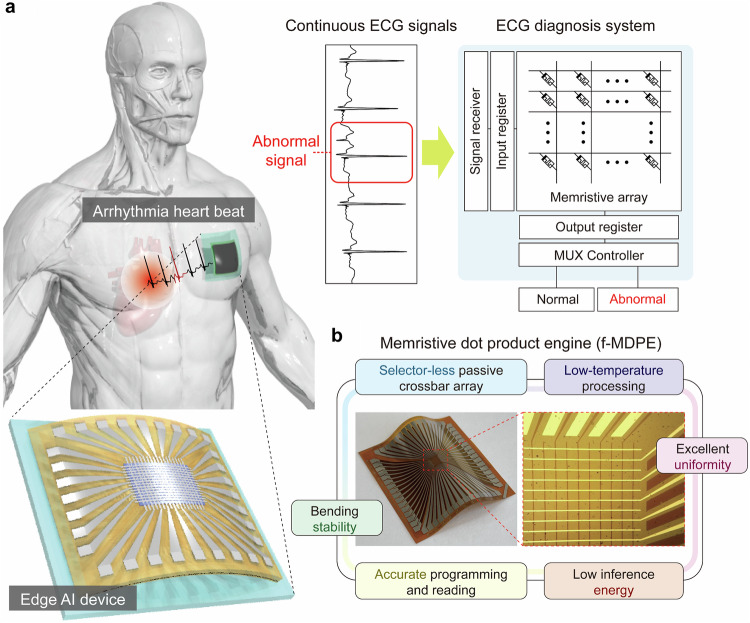
Edge computing devices, which generate, collect, process, and analyze data near the source, enhance the data processing efficiency and improve the responsiveness in real-time applications or unstable network environments. To be utilized in wearable and skin-attached electronics, these edge devices must be compact, energy efficient for use in low-power environments, and fabricable on soft substrates. Here, we propose a flexible memristive dot product engine (f-MDPE) designed for edge use and demonstrate its feasibility in a real-time electrocardiogram (ECG) monitoring system. The f-MDPE comprises a 32 × 32 crossbar array embodying a low-temperature processed self-rectifying charge trap memristor on a flexible polyimide substrate and exhibits high uniformity and robust electrical and mechanical stability even under 5-mm bending conditions. Then, we design a neural network training algorithm through hardware-aware approaches and conduct real-time edge ECG diagnosis. This approach achieved an ECG classification accuracy of 93.5%, while consuming only 0.3% of the energy compared to digital approaches, highlighting the strong potential of this approach for emerging edge neuromorphic hardware. Edge computing devices must be compact and energy efficient for use in low-power environments. Here, the authors propose a flexible memristive dot product engine designed for edge use with 0.3% energy consumption compared to digital approaches.
Overview
CoChat Summary
## TL;DR
The paper presents a flexible, self-rectifying memristive dot product engine (f-MDPE) on a polyimide substrate for edge ECG inference. It reports 93.5% ECG classification accuracy and only 0.3% of the energy of digital approaches, with stable operation under 5 mm bending.
## Key findings
- The f-MDPE is a 32 × 32 crossbar array of low-temperature processed charge-trap memristors on flexible polyimide, and the array showed 100% yield across 160 cells (32 × 5).
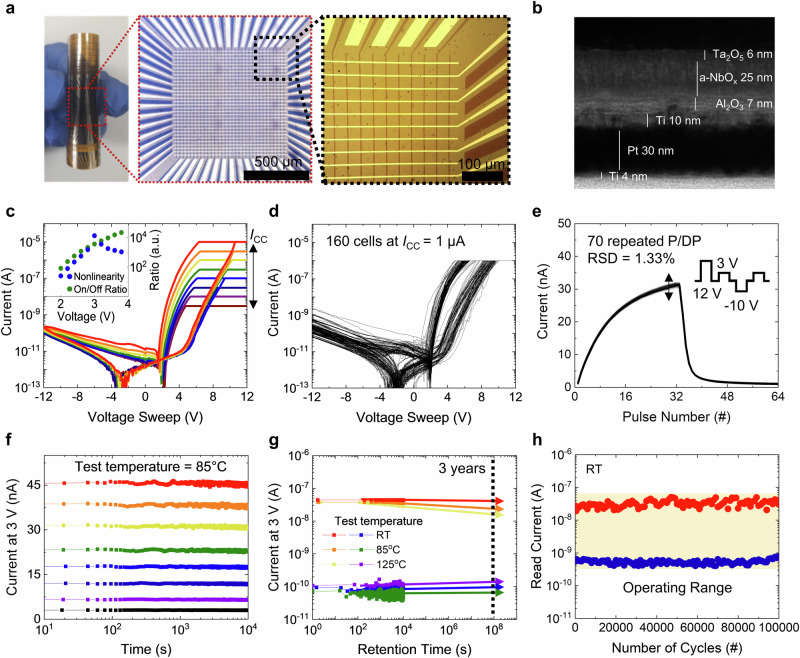
- The device demonstrated strong electrical performance, including a maximum on/off ratio of ~10^4 at 3 V, a rectifying ratio of ~10^3 at a read voltage of ±3 V, retention for 10^4 s at 85 °C, and endurance up to 10^5 cycles.
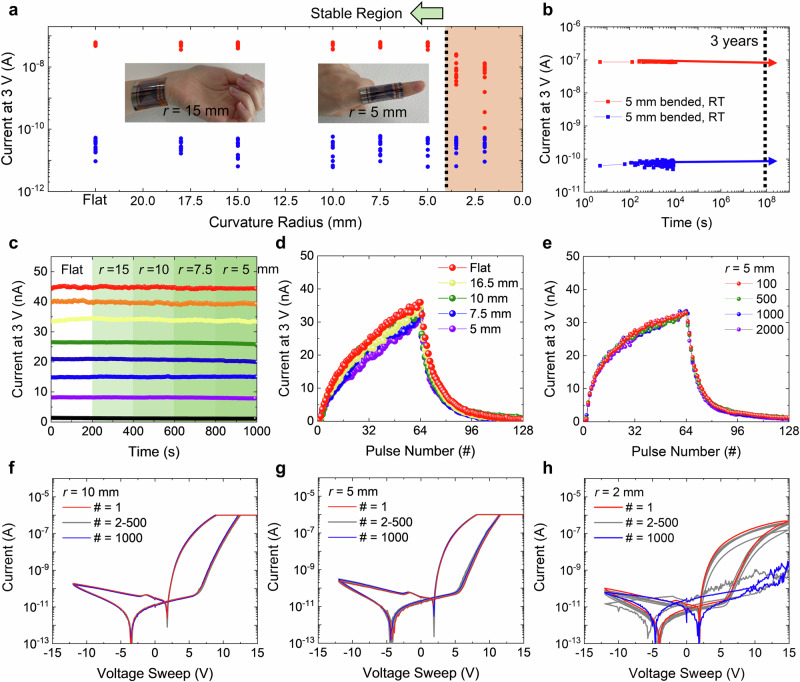
- Under bending, the device operated well down to a 5 mm curvature radius, and retained stability over 10^3 s at r = 5 mm; performance degraded below 5 mm.
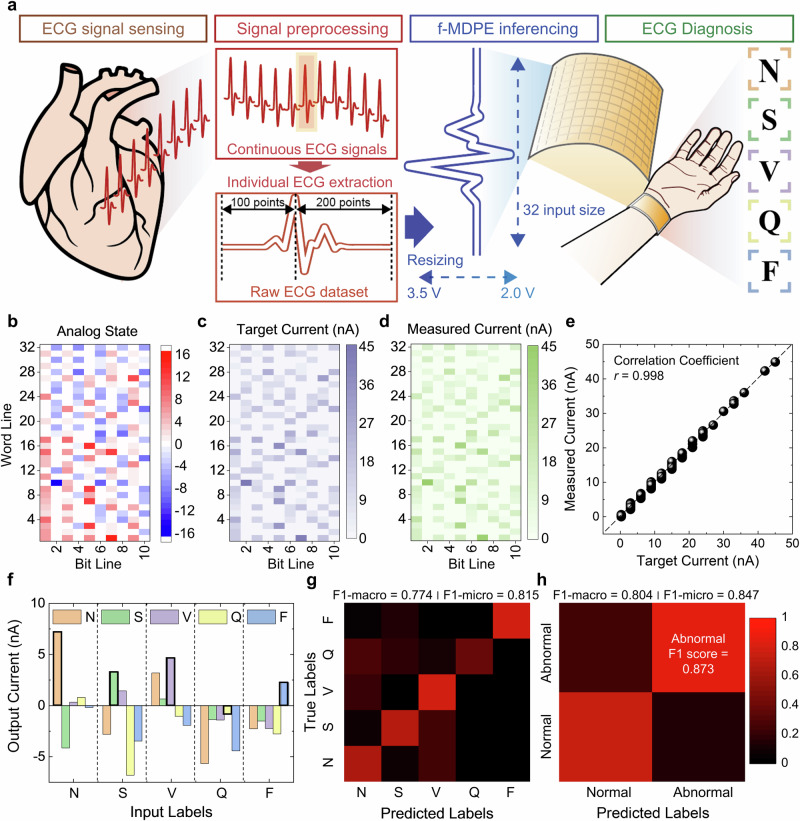
- For ECG classification, the hardware-aware SLP on the MIT-BIH dataset achieved an F1-macro score of 0.774 and F1-micro score of 0.815 on the 4255-test set; after normal/abnormal reconstruction, the scores improved to 0.804 and 0.847, and abnormal-signal accuracy was 0.873.
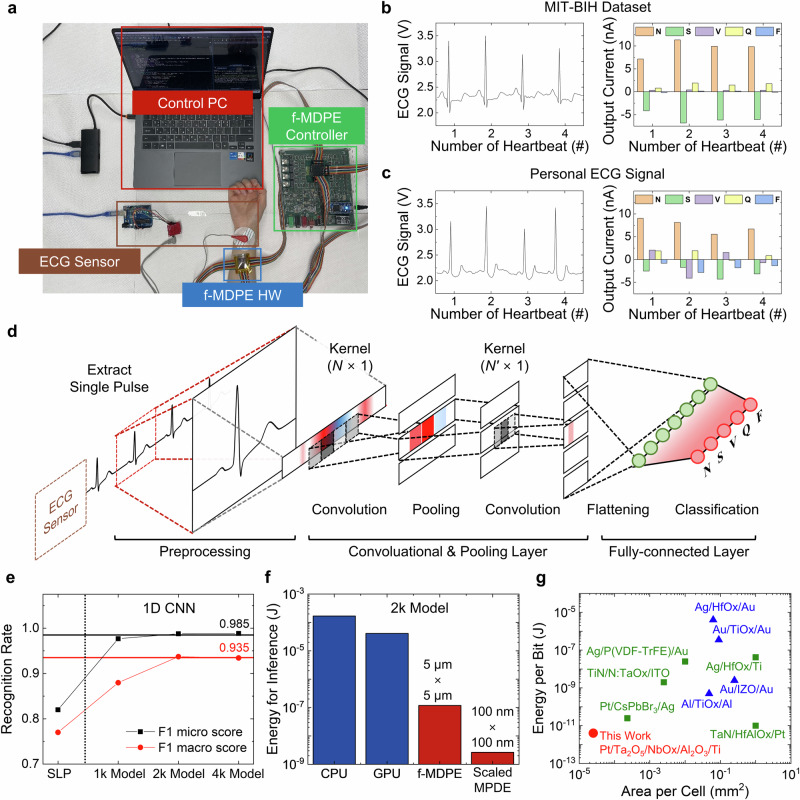
- In the real-time ECG diagnosis demonstration, the system achieved 93.5% classification accuracy while using only 0.3% of the energy of digital approaches; the estimated inference energy was 120 nJ for the 5-µm-line-width device, versus 168 µJ for CPU and 41 µJ for GPU.
- In virtual scaling, the 2k model saturated at F1-micro 0.99 and F1-macro 0.94; the authors estimate energy could drop to 2.64 nJ with 100-nm line width.
## Methods
- Device design/fabrication: a Pt/Ta2O5/NbOx/Al2O3/Ti/Pt/Ti stack was fabricated on a 50-µm polyimide film using low-temperature processes below 180 °C, then patterned into a 32 × 32 crossbar with 5 µm line width.
- Data/sample: ECG classification used the MIT-BIH arrhythmia database, five classes (N, S, V, Q, F), with ECG signals resized to 32 time frames and amplitudes adjusted to 2.0–3.5 V; real-time validation used personal ECG signals from the main authors with IRB exemption and consent.
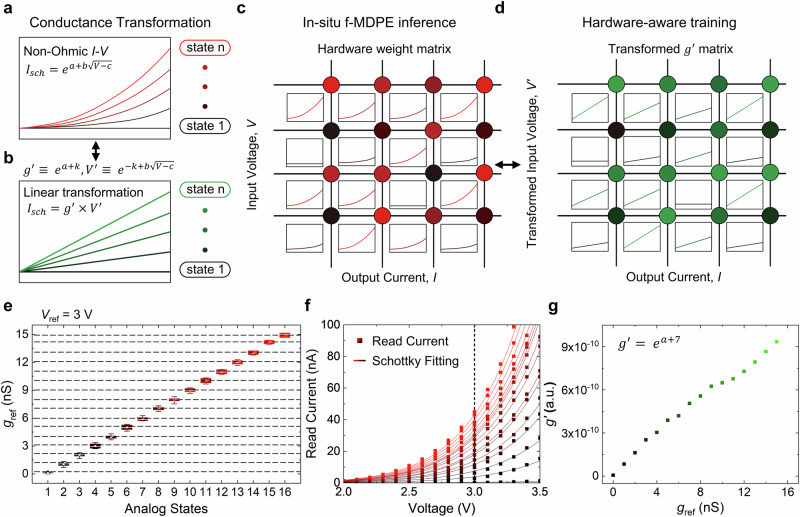
- Analysis: the authors trained a single-layer perceptron with hardware-aware handling of non-Ohmic Schottky conduction and 16 quantized conductance states, mapped trained weights to conductance, programmed the array with ISPP verify, and tested both offline classification and a lab-scale real-time inference system; they also simulated larger virtual f-MDPE arrays with 1D CNNs.
## Limitations
- The paper states that the prototype hardware is only 32 × 32 and that the demonstrated ECG model is a simple SLP; better performance at larger sizes was still needed, so larger arrays were simulated rather than physically fabricated.
- The real-time ECG demonstration was explicitly not an actual diagnosis: it used a regular person and the authors say the purpose was to demonstrate system operation only.
- The text makes evident that training on hardware was not demonstrated; the f-MDPE was programmed only for inference, and the authors note that expanding functionality beyond inference to training remains a challenge.
Model-written summary. Check it against the paper before relying on it.
Integrity signals
Registry
Cites
Statistics
Figures
Verification
Claims the paper makes
9 Valid · 6 Not valid · 9 Not checked · 56 Own results and interpretations
At least one cited source doesn’t support this claim or points to a different paper, and none confirmed it — see the verdicts below.
In the paper
“Owing to its self-rectifying characteristics, the device may operate accurately even in a 1k × 1k array without sneak path disturbance34,35”
§ Flexible self-rectifying synapse array for energy-efficient edge multiplication in electrocardiogram diagnosis > Results > Electrical characteristics, reliabilities, and bending durability of an f-MDPE array Figure 2a shows optical images of the f-MDPE array. The layered structure of the charge trap memristor (Ti/Pt/Ti/Al2O3/NbOx/Ta2O5/Pt, from bottom to top) was integrated on a flexible PI substrate. We have previously proposed this structure, but it was on a SiO2/Si substrate22, so the device itself may not be novel. However, to implement this structure on a flexible substrate and overcome the slow operation speed of conventional devices, we introduced three key modifications in this study. First, since the PI substrate is vulnerable to high temperatures, we developed and applied low-temperature processes below 180 °C for all layers. Second, we replaced the oxidant for the Al2O3 tunneling layer from H2O to O3 to reduce the H-passivated traps30–33, thereby improving the programming speed (see Supplementary Fig. 1 in the supplementary information (SI) for a detailed discussion on the changes in the Al2O3 deposition process and their impact on the programming speed). Third, we inserted a 30-nm-thick Pt layer in the middle of the Ti layer (i.e., Ti/Pt/Ti) to enhance the flexibility of the bottom electrode (BE), as Ti alone is mechanically brittle. More details on the device fabrication process can be found in the Method section. The cross-sectional transmission electron microscopy (TEM) image in Fig. 2b confirms the thicknesses of the oxide layers: 7 nm for Al2O3, 25 nm for NbOx, and 6 nm for Ta2O5. The NbOx layer is non-stoichiometric and amorphous, which is a key factor that acts as a charge trap layer22. The Al2O3 and Ta2O5 layers act as tunneling and blocking oxides, respectively, stabilizing the trapped electrons. The device exhibited analog set switching characteristics, with its conductance being tunable by a compliance current (ICC), as shown in Fig. 2c, with a maximum on/off ratio of ~104 at 3 V, as shown in the inset. The analog switching characteristics are attributed to the Schottky barrier height modulation accompanied by electron trapping and detrapping in the NbOx layer22. Additionally, the device showed a rectifying ratio of ~103 at a read voltage of ±3 V, as shown in the inset. Owing to its self-rectifying characteristics, the device may operate accurately even in a 1k × 1k array without sneak path disturbance34,35 (see Supplementary Fig. 2 in the SI for a discussion on the available array size and read margin of the f-MDPE array). To further evaluate the impact of voltage drop caused by wire resistance in a scaled-up device, we conducted cell voltage distribution simulations (see Supplementary Fig. 3). In the simulation, the conductance of each cell was randomly assigned a value between 1 nS and 15 nS, while the wire resistance between cells was assumed to be 10 Ω36. A read voltage of 3 V was applied, and the voltage drop was analyzed across array sizes ranging from 32 × 32 to 1024 × 1024. The results indicate that the wire resistance has little impact on f-MDPE operation, suggesting its highly reliable performance even in large-scale arrays. Figure 2d shows I–V curves of 160 cells (32 × 5) in the array at an ICC of 10−6 A, confirming a 100% yield and high array-level uniformity (see Supplementary Fig. 4 in the SI for the 160 raw I–V curves). Figure 2e shows 70 cycles of potentiation and depression (P/DP) curves from a representative cell. To obtain the P/DP characteristics, 100 µs of +12 V, 100 µs of −10 V, and 500 µs of +3 V were used as the programming, erasing, and reading voltages, respectively, as shown in the inset. The results demonstrate the high feasibility and uniformity of these devices when they are suitable for analog devices. The retention characteristics of eight different conductance states were confirmed at 85 °C, as shown in Fig. 2f. All conductance states were stable up to 104 s without significant changes. This gives an operating conductance window from 0.1 nS to 15 nS at 3 V. Figure 2g shows the retention characteristics of the high resistance state (HRS) and low resistance state (LRS) for 104 s at different temperatures (RT, 85 °C, and 125 °C). The Arrhenius plot suggested that both the HRS and LRS could be maintained for more than 3 years (see Supplementary Fig. 5 in the SI for the Arrhenius plot with the failure time at 20% conductance change). Additionally, Fig. 2h shows the endurance of the device for up to 105 cycles, using 5 ms of +12 V pulse for programming and 5 ms of −10 V pulse for erasing, respectively. Here, the on/off ratio was smaller than in Fig. 2g, where a DC sweep was used, due to the shorter pulse duration. Although this is not the full on/off ratio, we still achieve an on/off ratio of approximately 70, which we believe is sufficient for verifying the endurance characteristic. These results confirm the practical feasibility of the f-MDPE approach. We also examined the bending durability of the f-MDPE for wearable applications. Figure 3a shows the memory windows of ten randomly selected cells at various bending radii. The results showed that the cells operated well down to a curvature radius (r) of 5 mm but deteriorated to less than 5 mm. This is likely due to an increase in electrode resistance under bending conditions, which results in the inability to apply voltage to the cell. Nevertheless, considering that the curvatures of the human body are greater than 5 mm (insets, r = 15 mm at a wrist and r = 5 mm at a finger), the stability at r = 5 mm is practically meaningful. In addition, retention characteristics were examined at r = 5 mm, revealing that the bending stress did not negatively affect the stability over 3 years, as shown in Fig. 3b. Figure 3c shows the high stability of multiple conductance states while changing curvatures from flat to r = 5 mm for 200 s at each curvature (total 103 s). For this measurement, we first programmed the device into specific conductance states and measured the retention for 200 s at each bending radius while gradually decreasing the radius to 15 mm, 10 mm, 7.5 mm, and 5 mm. We repeated this measurement for 8 different conductance states. Furthermore, the device exhibited reliable synaptic characteristics under bending conditions. Figure 3d shows the P/DP characteristics under various bending conditions (i.e., flat, 16.5, 10, 7.5, and 5 mm bending radii). Figure 3e confirms the high bending durability of the synaptic characteristics over bending cycles (100, 500, 1000, and 2000 cycles) at r = 5 mm.
What the sources say
- Not checked — no full text of the sourcecites [34] Ni, R. et al. Controlled majority-inverter graph logic with highly nonlinear, self-rectifying memristor. IEEE Trans. Electron Devices 68, 4897–4902 (2021). source
- Disputedcites [35] Sung, S. H., Kim, T. J., Shin, H., Im, T. H. & Lee, K. J. Simultaneous emulation of synaptic and intrinsic plasticity using a memristive synapse. Nat. Commun. 13, 2811 (2022). sourceExperimental — accuracy not yet measured
The Results section (‘Operation of volatile TS, nonvolatile PCM, and unified TS-PCM’; page unavailable) says the TS layer prevents sneak currents, but reports a calculated maximum array size of 316 × 316 at a 10% readout margin, or 214 × 214 in the maximum-noise case. It does not support accurate operation at 1k × 1k; its stated size limits are substantially smaller. (LLM, conf=0.88)
Checked by a reasoning model — may be wrong.
hedgedstates a possible cause- Asserted: passes — The authors put it forward as true.
- Checkable: passes — It can be checked against evidence.
- Load-bearing: passes — The paper’s conclusions depend on it.
- Based: passes — The paper gives a reason why it holds.
At least one cited source doesn’t support this claim or points to a different paper, and none confirmed it — see the verdicts below.
In the paper
“This is not a specific problem in our device but is an inherent challenge in low-current devices, where the conduction mechanism is non-Ohmic38,39.”
§ Flexible self-rectifying synapse array for energy-efficient edge multiplication in electrocardiogram diagnosis > Results > Hardware-aware training for addressing non-Ohmic conduction behavior
What the sources say
- Not checked — no full text of the sourcecites [38] Ren, S. G. et al. Self-rectifying memristors for three-dimensional in-memory computing. Adv. Mater. 36, 2307218 (2024). source
- Disputedcites [39] Jeon, K. et al. Purely self-rectifying memristor-based passive crossbar array for artificial neural network accelerators. Nat. Commun. 15, 129 (2024). sourceExperimental — accuracy not yet measured
The Results section (Electrical characteristics of the SRM-based 1 kb passive CA; page unavailable) says low-current memristors often show current drops at specific voltages, but attributes those drops to measurement-equipment resolution, not an inherent device characteristic. It does not identify non-Ohmic conduction as the cause or as an inherent challenge of low-current devices. (LLM, conf=0.78)
Checked by a reasoning model — may be wrong.
plainstates a cause- Asserted: passes — The authors put it forward as true.
- Checkable: passes — It can be checked against evidence.
- Load-bearing: passes — The paper’s conclusions depend on it.
- Based: passes — The paper gives a reason why it holds.
The cited sources that could be checked couldn’t confirm or dispute this claim.
In the paper
“the device is highly compatible with the conventional CMOS process.”
§ Flexible self-rectifying synapse array for energy-efficient edge multiplication in electrocardiogram diagnosis > Introduction
What the sources say
- Not checked — no full text of the sourcecites [20] Gao, S. et al. Forming-free and self-rectifying resistive switching of the simple Pt/TaO x/n-Si structure for access device-free high-density memory application. Nanoscale 7, 6031–6038 (2015). source
- Not checked — no full text of the sourcecites [21] Kim, K. M. et al. Low-power, self-rectifying, and forming-free memristor with an asymmetric programing voltage for a high-density crossbar application. Nano Lett. 16, 6724–6732 (2016). source
- Could not verifycites [22] Kim, G. et al. Retention secured nonlinear and self-rectifying analog charge trap memristor for energy-efficient neuromorphic hardware. Adv. Sci. 10, 2205654 (2023). sourceExperimental — accuracy not yet measured
The Experimental Section describes photolithography, deposition, and lift-off on a SiO2/Si substrate, but does not assess compatibility with a conventional CMOS process. The Introduction compares the device’s mechanism with charge-trap flash memory; that comparison does not establish the claimed process compatibility. Searched for CMOS compatibility and fabrication-process integration; page numbers were not available in our copy. (LLM, conf=0.72)
- Not checked — no full text of the sourcecites [23] Yoon, J. H. et al. Pt/Ta2O5/HfO2−x/Ti resistive switching memory competing with multilevel NAND flash. Adv. Mater. 27, 3811–3816 (2015). source
- Not checked — no full text of the sourcecites [24] Yoon, J. H. et al. Highly uniform, electroforming-free, and self-rectifying resistive memory in the Pt/Ta2O5/HfO2-x/TiN structure. Adv. Funct. Mater. 24, 5086–5095 (2014). source
- Not checked — no full text of the sourcecites [25] Kim, G. et al. Threshold modulative artificial GABAergic nociceptor. Adv. Mater. 35, 2304148 (2023). source
- Not checked — no full text of the sourcecites [26] Kim, Y. et al. Nociceptive memristor. Adv. Mater. 30, 1704320 (2018). source
plainstates an association- Asserted: passes — The authors put it forward as true.
- Checkable: passes — It can be checked against evidence.
- Load-bearing: passes — The paper’s conclusions depend on it.
- Based: passes — The paper gives a reason why it holds.
The sources with a verdict support this claim; the rest weren’t checked yet, have no full text we could read, or their verdicts aren’t rated yet.
In the paper
“the self-rectifying characteristics of the device enable large-array operation without complex transistor or selector processes”
§ Flexible self-rectifying synapse array for energy-efficient edge multiplication in electrocardiogram diagnosis > Introduction
What the sources say
- Not checked — no full text of the sourcecites [20] Gao, S. et al. Forming-free and self-rectifying resistive switching of the simple Pt/TaO x/n-Si structure for access device-free high-density memory application. Nanoscale 7, 6031–6038 (2015). source
- Not checked — no full text of the sourcecites [21] Kim, K. M. et al. Low-power, self-rectifying, and forming-free memristor with an asymmetric programing voltage for a high-density crossbar application. Nano Lett. 16, 6724–6732 (2016). source
- Supportedcites [22] Kim, G. et al. Retention secured nonlinear and self-rectifying analog charge trap memristor for energy-efficient neuromorphic hardware. Adv. Sci. 10, 2205654 (2023). source
The Introduction explains that adding a separate selector burdens integration, while the charge trap memristor is inherently self-rectifying. The paper reports a 32 × 32 crossbar array, and its Abstract describes the device as enabling a selector-less array. This supports the claim without establishing operation at array sizes beyond those reported. (LLM, conf=0.90)
- Not checked — no full text of the sourcecites [23] Yoon, J. H. et al. Pt/Ta2O5/HfO2−x/Ti resistive switching memory competing with multilevel NAND flash. Adv. Mater. 27, 3811–3816 (2015). source
- Not checked — no full text of the sourcecites [24] Yoon, J. H. et al. Highly uniform, electroforming-free, and self-rectifying resistive memory in the Pt/Ta2O5/HfO2-x/TiN structure. Adv. Funct. Mater. 24, 5086–5095 (2014). source
- Not checked — no full text of the sourcecites [25] Kim, G. et al. Threshold modulative artificial GABAergic nociceptor. Adv. Mater. 35, 2304148 (2023). source
- Not checked — no full text of the sourcecites [26] Kim, Y. et al. Nociceptive memristor. Adv. Mater. 30, 1704320 (2018). source
plainstates a cause- Asserted: passes — The authors put it forward as true.
- Checkable: passes — It can be checked against evidence.
- Load-bearing: passes — The paper’s conclusions depend on it.
- Based: passes — The paper gives a reason why it holds.
The cited sources support only part of this claim — read each source’s verdict below.
In the paper
“compared with other flexible or stretchable memristive arrays, the f-MDPE offers advantages in terms of energy efficiency and size (Fig. 6g)15,16,18,57–62.”
§ Flexible self-rectifying synapse array for energy-efficient edge multiplication in electrocardiogram diagnosis > Results > A scale-up feasibility demonstration via virtual f-MDPE hardware We adopted a small network size of 32 × 5 and a simple network structure of SLP to fit the f-MDPE. As a result, we achieved an F1 macro score of 0.774, indicating the potential of the ECG diagnosis system. However, there is also a need to achieve better performance at larger sizes. Therefore, we simulated a large-scale neural network using virtual f-MDPE hardware built into software and evaluated the behavior of the f-MDPE. Additionally, we adopted a method of partitioning a single piece of hardware to operate a multilayer perceptron. Here, we employed a one-dimensional convolutional neural network (1D CNN), whose network structure is shown in Fig. 6d, as it is known to be the best for pattern recognition tasks52. We built three 1D CNN network models, namely, 1k, 2k, and 4k, referring to the available number of weights in 32 × 32 (1k), 64 × 32 (2k), and 64 × 64 (4k) arrays of the virtual f-MDPE, respectively (details of 1D CNN architectures across varying network sizes are described in Supplementary Table 4). Although the 2k and 4k arrays were not physically fabricated, they were simulated assuming that the 1k-sized f-MDPE array was directly scaled up. This virtual scaling approach is widely applied in other studies as well13,53, as it provides valuable insights into large-scale performance with high reliability in advance. Figure 6e shows the F1-macro score and F1-micro score for the proposed 1D CNN models. The table also includes the experimental SLP scores for reference. The results suggested that the recognition rate was saturated in the 2k model, with 0.99 for the F1-micro score and 0.94 for the F1-macro score. Supplementary Fig. 14 shows the confusion matrix obtained by the 2k model, revealing its high performance. The hardware-aware training method is also applicable to 2D CNNs, indicating its broad applicability across various applications (see Supplementary Fig. 15 for more details of hardware-aware training models). Figure 6f shows the estimated energy consumption for ECG inference on various computing platforms when the 2k model is used. Note that this comparison focuses on the energy consumption of running neural networks, excluding other sources of energy consumption, such as ECG sensors. The energy consumption per inference by the conventional CPU and GPU approaches was 168 µJ and 41 µJ, respectively13,54. However, the f-MDPE with a 5-µm-line width required only 120 nJ, far below that of conventional computing approaches. This energy consumption can be further reduced by scaling the array with a 100-nm-line width55,56. We anticipate that the energy consumption can reach 2.64 nJ, outperforming GPU-based inference by more than four orders of magnitude (detailed energy consumption and latency are described in Supplementary Figs. 16–18 and Tables 5 and 6). Furthermore, compared with other flexible or stretchable memristive arrays, the f-MDPE offers advantages in terms of energy efficiency and size (Fig. 6g)15,16,18,57–62.
What the sources say
- Not checked — no full text of the sourcecites [15] Cho, H. et al. Real-time finger motion recognition using skin-conformable electronics. Nat. Electron. 6, 619–629 (2023). source
- Not checked — no full text of the sourcecites [16] Kim, S. H. et al. A bioinspired stretchable sensory-neuromorphic system. Adv. Mater. 33, 2104690 (2021). source
- Partly supportedcites [18] Ham, S. et al. One-dimensional organic artificial multi-synapses enabling electronic textile neural network for wearable neuromorphic applications. Sci. Adv. 6, eaba1178 (2020). sourceExperimental — accuracy not yet measured
The Results and Discussion sections on fabrication and the NOR-type textile array describe a flexible synaptic array, and Materials and Methods gives its device dimensions. The source calls its devices ferroelectric organic transistors, not memristors, and does not establish that the f-MDPE is more energy-efficient or smaller. (LLM, conf=0.83)
- Not checked — no full text of the sourcecites [57] Kim, M. et al. Forming-less flexible memristor crossbar array for neuromorphic computing applications produced using low-temperature atomic layer deposition. Appl. Mater. Today 38, 102204 (2024). source
- Not checked — no full text of the sourcecites [58] Zhu, S. et al. In-depth physical mechanism analysis and wearable applications of HfO x-based flexible memristors. ACS Appl. Mater. Interfaces 15, 5420–5431 (2023). source
- Not checked yetcites [59] Wang, T. Y. et al. Flexible 3D memristor array for binary storage and multi‐states neuromorphic computing applications. InfoMat 3, 212–221 (2021). source
Checked before — its earlier verdict is held back until a new check runs.
- Supportedcites [60] Sun, L. et al. Self-selective van der Waals heterostructures for large scale memory array. Nat. Commun. 10, 3161 (2019). source
The citation identifies a comparator, not a source expected to assess f-MDPE. The Results describe a 12 × 12 memristive crossbar array, give its dimensions and write energy, and validate a self-selective memory cell on flexible PET; the Discussion describes crossbar arrays on flexible substrates. The claimed advantage of f-MDPE is the citing authors’ comparison, not a finding attributed to this paper. (LLM, conf=0.84)
- Not checked — no full text of the sourcecites [61] Wang, T. et al. Mechanically durable memristor arrays based on a discrete structure design. Adv. Mater. 34, 2106212 (2022). source
- Supportedcites [62] Sim, K. et al. Metal oxide semiconductor nanomembrane–based soft unnoticeable multifunctional electronics for wearable human-machine interfaces. Sci. Adv. 5, eaav9653 (2019). source
The Results section (‘Ultrathin, mechanically imperceptible, multifunctional HMI device’; page unavailable) identifies an IZO nanomembrane–based ReRAM array and describes its stretchable serpentine electrodes. This supports citing the paper as an example of the flexible or stretchable arrays used for comparison; the f-MDPE’s claimed advantages are the citing authors’ comparison, not a finding attributed to this source. (LLM, conf=0.88)
plainstates a cause- Asserted: passes — The authors put it forward as true.
- Checkable: passes — It can be checked against evidence.
- Load-bearing: passes — The paper’s conclusions depend on it.
- Based: passes — The paper gives a reason why it holds.
36 more claims · 3 with their cited sources checked
Create a free account to see all 80 claims and to verify the 6 references still open.
- Probably not a substantial claim. 16
- It may state two separate claims as one. 27
- The quote only partly states this claim. 1
Citations
Cites
LeCun, Y., Bengio, Y., & Hinton, G. (2015) · Nature · doi:10.1038/nature14539 · Cited by 84,126
The impact of the MIT-BIH Arrhythmia Database
Moody, G. B., & Mark, R. G. (2001) · IEEE Engineering in Medicine and Biology Magazine · doi:10.1109/51.932724 · Cited by 4,812
Fully hardware-implemented memristor convolutional neural network
Yao, P., Wu, H., Gao, B., Tang, J., Zhang, Q., Zhang, W., Yang, J. J., & Qian, H. (2020) · Nature · doi:10.1038/s41586-020-1942-4 · Cited by 2,179 · cited 1×
“In suchcases, a commonapproach is to represent one weight using a pair of columns, each representing positive or negative weight values 8,48,49 .”
A Review on Conduction Mechanisms in Dielectric Films
Chiu, F.-C. (2014) · Advances in Materials Science and Engineering · doi:10.1155/2014/578168 · Cited by 1,574
A deep convolutional neural network model to classify heartbeats
Acharya, U. R., Oh, S. L., Hagiwara, Y., Tan, J. H., Adam, M., Gertych, A., & Tan, R. S. (2017) · Computers in Biology and Medicine · doi:10.1016/j.compbiomed.2017.08.022 · Cited by 1,421
Efficient and self-adaptive in-situ learning in multilayer memristor neural networks
Li, C., Belkin, D., Li, Y., Yan, P., Hu, M., Ge, N., Jiang, H., Montgomery, E., Lin, P., Wang, Z., et al. (2018) · Nature Communications · doi:10.1038/s41467-018-04484-2 · Cited by 931 · cited 1×
“In suchcases, a commonapproach is to represent one weight using a pair of columns, each representing positive or negative weight values 8,48,49 .”
Memristor‐Based Analog Computation and Neural Network Classification with a Dot Product Engine
Hu, M., Graves, C. E., Li, C., Li, Y., Ge, N., Montgomery, E., Davila, N., Jiang, H., Williams, R. S., Yang, J. J., et al. (2018) · Advanced Materials · doi:10.1002/adma.201705914 · Cited by 751 · cited 1×
“InconventionalMDPEs,the conductance ( g ij ) is assumed to be constant regardless of the input voltage (i.e., Ohmic conduction), so multiple input voltages can be easily applied 7,37 .”
A review on deep learning methods for ECG arrhythmia classification
Ebrahimi, Z., Loni, M., Daneshtalab, M., & Gharehbaghi, A. (2020) · Expert Systems with Applications: X · doi:10.1016/j.eswax.2020.100033 · Cited by 447
Long short-term memory networks in memristor crossbar arrays
Li, C., Wang, Z., Rao, M., Belkin, D., Song, W., Jiang, H., Yan, P., Li, Y., Lin, P., Hu, M., et al. (2019) · Nature Machine Intelligence · doi:10.1038/s42256-018-0001-4 · Cited by 429
A wireless wearable ECG sensor for long-term applications
Nemati, E., Deen, M., & Mondal, T. (2012) · IEEE Communications Magazine · doi:10.1109/mcom.2012.6122530 · Cited by 418
Cited by
Xu, J., Zhang, Y., Wang, J., Zhang, W., Li, T., Zhang, K., & Yan, X. (2025) · Advanced Materials · doi:10.1002/adma.202509174 · Cited by 25
Guo, Y., Huo, P., Huang, S., Gou, G., & Li, Q. (2025) · Advanced Healthcare Materials · doi:10.1002/adhm.202502901 · Cited by 31
Emerging memory devices for neuromorphic computing in the Internet of Medical Things
Cao, T., Shen, C., Wang, D., Zhao, H.-N., Tan, R., Zhou, Z., Li, H., Li, B., Zhao, M., & Huang, H. (2025) · Cell Reports Physical Science · doi:10.1016/j.xcrp.2025.102735 · Cited by 15
Wu, Y., Bao, K., Liang, J., Li, Z., Shi, Y., Tang, R., Xu, K. J., Wei, M., Chen, Z., Jian, J., et al. (2025) · Small Methods · doi:10.1002/smtd.202500727 · Cited by 6
Gao, Y., Han, X.-E., Gao, X., Xue, F.-L., Chen, J.-R., Zhong, Y., Xu, J.-L., & Wang, S. (2025) · Materials & Design · doi:10.1016/j.matdes.2025.114152 · Cited by 6
Metadata
- Authors
- Lee, Y., Rhee, H., Kim, G., Cheong, W. H., Kim, D. H., Song, H., Kay, S. N., Lee, J., & Kim, K. M.
- Affiliations
- Korea Advanced Institute of Science and Technology (KR)
- Chungnam National University (KR)
- Corresponding author
- Lee, Jongwon
- Kim, Kyung Min
- ORCID
- Venue
- Nature Communications
- Published
- 2025-05-09
- Volume
- 16
- Issue
- 1
- Pages
- 4312-4312
- ISSN
- 2041-1723 (ISSN-L)
- PMC
- PMC12062262
- OpenAlex
- W4410197042
- Semantic Scholar
- 64f5fb8a2371d7eb7fc539e34da898b5357fa2f4
- Cited by
- 19
- References
- 67
- Citations by year
- 2026: 10 · 2025: 9
- FWCI
- 4.22
- Type
- journal article
- Language
- en
- Open access
- gold
- doi.org
- Licence
- cc-by-nc-nd
- creativecommons.org/licenses/by-nc-nd/4.0 (tdm)
- creativecommons.org/licenses/by-nc-nd/4.0 (vor)
- Locations
- Nature Communications (publishedVersion, cc-by-nc-nd)
- Research Square (acceptedVersion, cc-by)
- PubMed Central (publishedVersion, cc-by-nc-nd)
- PubMed (publishedVersion)
- RePEc: Research Papers in Economics (submittedVersion)
- DOAJ (DOAJ: Directory of Open Access Journals) (submittedVersion, cc-by-sa)
- Funders
- National Research Foundation of Korea (RS-2023-00216619, 2022M3F3A2A01076569, 2022M3I7A4085484, 2023R1A2C2005159)
- National Nano Fab Center (NNFC) : National Nano Fab Center (NNFC) is affiliated institution of KAIST.
- Topics
- Physical Sciences › Engineering › Electrical and Electronic Engineering › Advanced Memory and Neural Computing
- Physical Sciences › Engineering › Electrical and Electronic Engineering › Analog and Mixed-Signal Circuit Design
- Physical Sciences › Engineering › Electrical and Electronic Engineering › Ferroelectric and Negative Capacitance Devices
- Keywords
- flexible memristors, crossbar arrays, edge computing, neuromorphic hardware, ECG classification, ECG monitoring, energy-efficient hardware, polyimide substrate, wearable electronics, soft electronics, energy-efficient computing
- MeSH terms
- Wearable Electronic Devices, Algorithms, Electrocardiography, Equipment Design, Humans, Signal Processing, Computer-Assisted, Neural Networks, Computer
About these checks
Registry, retraction, Cites and statistics results are computed, not judged, with one exception: a printed reference that no index lists is read once by a model before it counts as a citation error. Claims are extracted by a model and kept only when their quote appears verbatim in the text; each cited source is then checked, with a model’s help, for whether it says what the claim relies on. Those verdicts can be wrong — read the claim’s quote and the cited source before relying on one.
The claim verdicts this report counts are experimental: their accuracy is not yet measured.
A language model drew the claims from the paper on 2026-10-10, under version 3 of the claim definition (model deepseek-v4.1-flash, prompt extract-v3).
A second model labelled each claim on 2026-10-10 (model jev-1.13-20260917, definition revision gold-guideline-v0.2).
Cited sources are checked with a language model’s help (gpt-6-sol).
Statistics and arithmetic are recomputed, not judged.
Confidence bands are shown only for fields calibrated on our annotated test set. None is calibrated yet, so no band is shown.
What counts as a claim ›How we measure confidence ›How we check this ›
Are you an author, or do you see a problem with this page? Request a review
How to cite
Cite CoChat for the checks on this page, and the paper for its own findings.
- This page
- CoChat. (2026). Citation check: Flexible self-rectifying synapse array for energy-efficient edge multiplication in electrocardiogram diagnosis. https://app.cochat.ai/papers/10.1038/s41467-025-59589-2
- The paper
- Lee, Y., Rhee, H., Kim, G., Cheong, W. H., Kim, D. H., Song, H., Kay, S. N., Lee, J., & Kim, K. M. (2025). Flexible self-rectifying synapse array for energy-efficient edge multiplication in electrocardiogram diagnosis. Nature Communications. https://doi.org/10.1038/s41467-025-59589-2
Data sources
Bibliographic data: Semantic Scholar, OpenAlex, Crossref.
Contains information from the Semantic Scholar Academic Graph Datasets, made available under the ODC Attribution License (ODC-BY 1.0).
Semantic Scholar’s data is described in: Kinney, R., et al. (2023). The Semantic Scholar Open Data Platform. arXiv:2301.10140.
