

The DOI matches its Crossref record; 59 of the 59 references it cites were found in a registry or an index; 1 of the 14 sources its claims cite were checked for support.
A Robust Image Encryption Algorithm Based on a 32-bit Chaotic System
Open accessAbstract
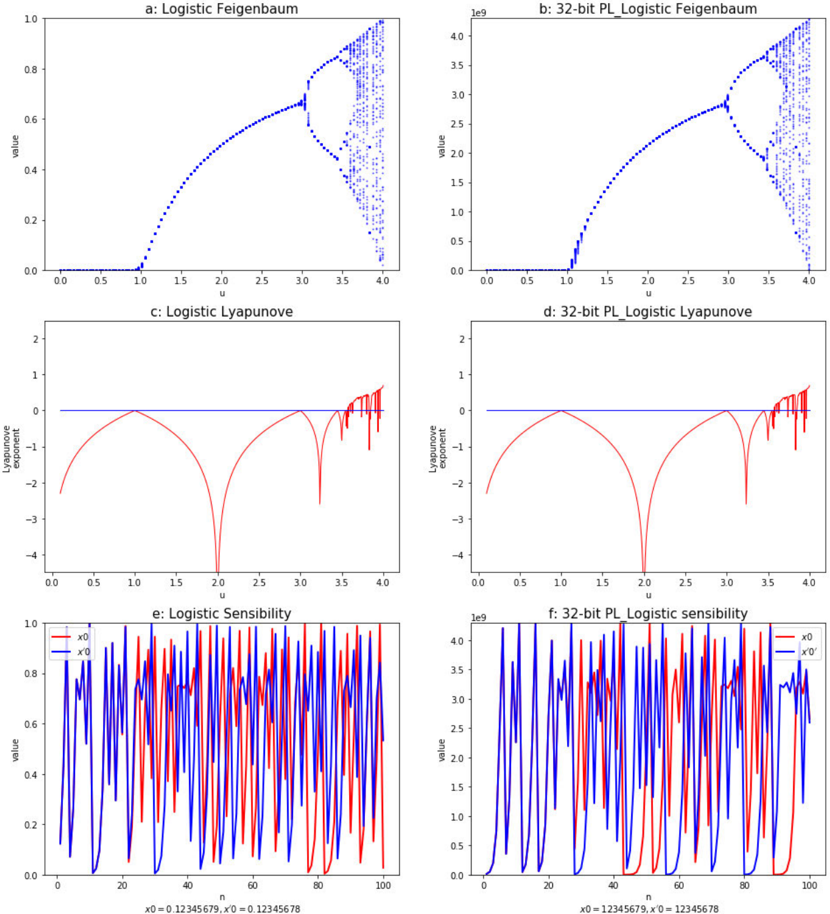
In these years, image encryption systems based on chaotic maps have received considerable attention from researchers. For the security of encryption algorithms, it is important to ensure that chaotic systems can produce high quality pseudo-random sequences. However, when a chaotic system that theoretically has good random performance is deployed in a limited precision platform, its random performance will deteriorate. We prove that even if the precision reaches 256-bit, the piecewise linear chaotic map still fails to achieve the desired random performance. Moreover, in the case of low precision, the cascade structure commonly used in mixed chaotic maps will aggravate the problem of random degeneration. To generate good pseudo-random numbers in low-precision platforms, we propose a positive integer random sequence generator, called 32-bit PL_PWLCM&LM, which comprises two 32-bit PL_PWLCMs and one 32-bit logistic map in parallel. In our proposed image encryption system, we adopt the permutation algorithm with four pixels as a permutation unit and the diffusion algorithm based on rows and columns. The security and performance analyses prove that the proposed scheme is a secure, robust, and fast image encryption algorithm. Source codes are shared on GitHub: https://github.com/cuclihao/Pic_Enc_V3.
Overview
CoChat Summary
TL;DR
The paper proposes a 32-bit integer-domain parallel chaotic PRNG, 32-bit PL_PWLCM&LM, combining two 32-bit PL_PWLCMs and one 32-bit logistic map, and uses it in a two-round permutation-diffusion image encryption scheme. It reports that the PRNG passes all 15 NIST STS tests at 32-bit precision and that the encryption scheme is secure, robust to noise/data loss, and fast in experiments.
Key findings
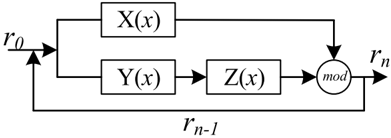
- At 32-bit precision, the proposed 32-bit PL_PWLCM&LM passes all 15 NIST STS tests; 32-bit PL_LM passes only 3/15, 32-bit PL_PWLCM passes 12/15, and the cascade model passes only 1/15. The paper also states that even at 256-bit precision, PWLCM cannot pass all 15 NIST tests. In TestU01, 32-bit PL_LM, PL_PWLCM, and PL_STM cannot pass, while the proposed system passes all subtests.
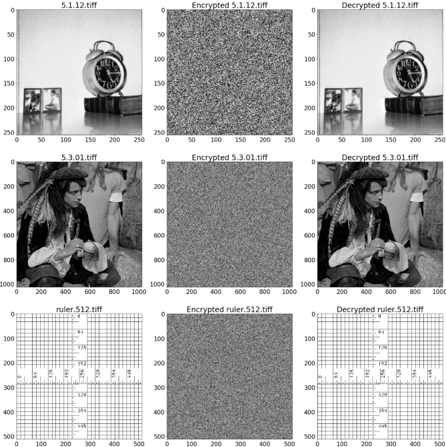
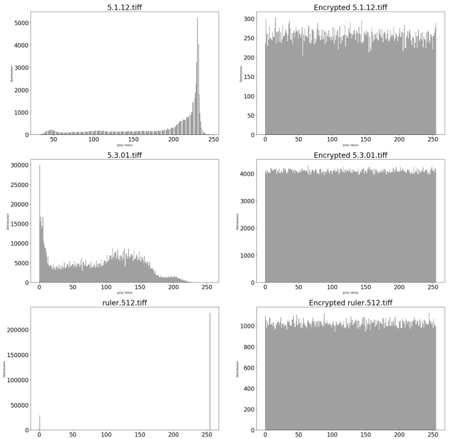
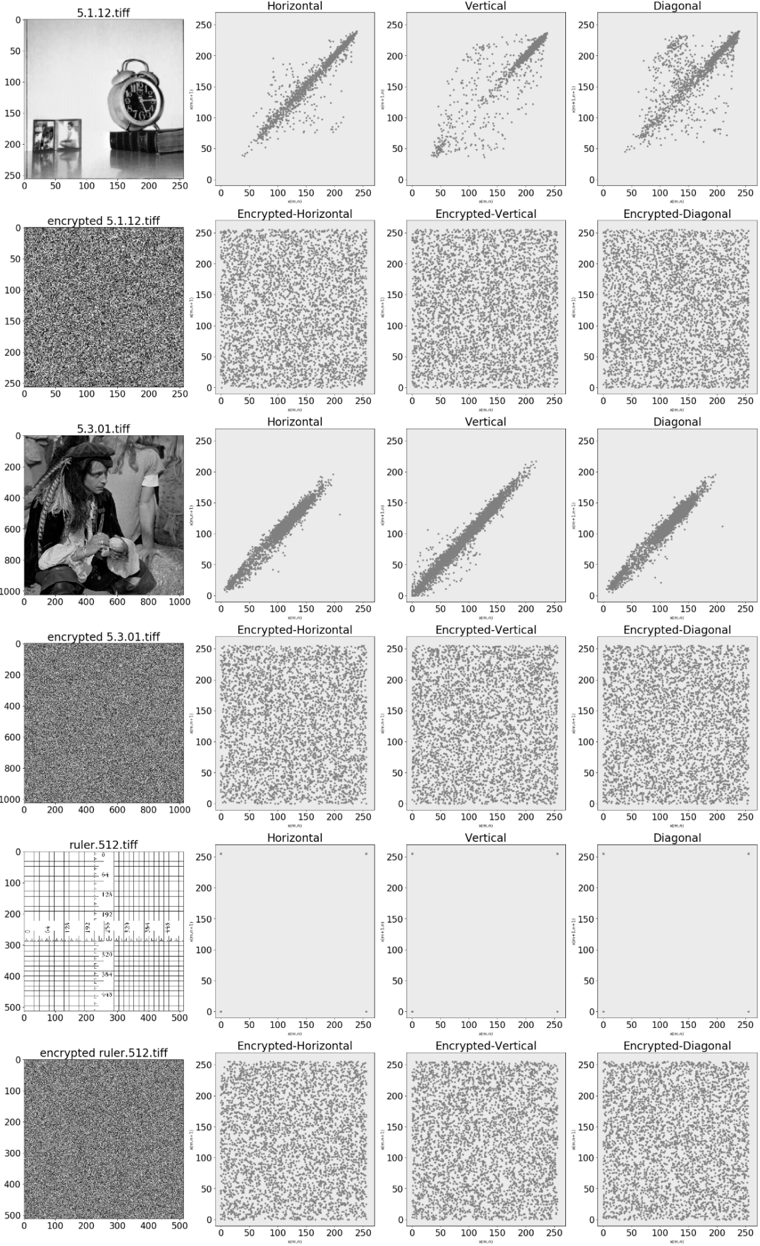
- Security results include average NPCR of 99.6057% and average UACI of 33.4742%, a key space of 2^312, cipher-image global entropy close to 8, all cipher images passing the local Shannon entropy test, chi-square values below the theoretical 294, histogram variances of 5425.2601, 5463.3017, and 5455.9226 for three cipher images, and adjacent-pixel correlation coefficients close to 0.
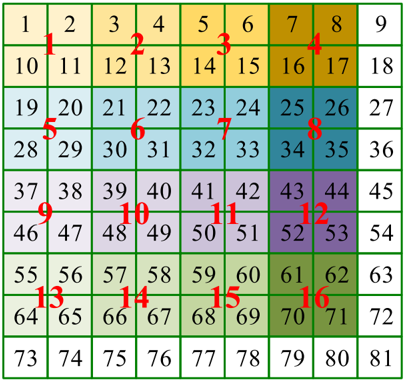
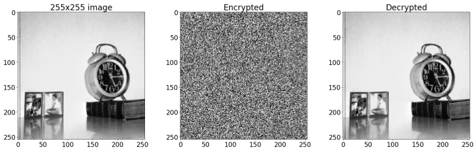
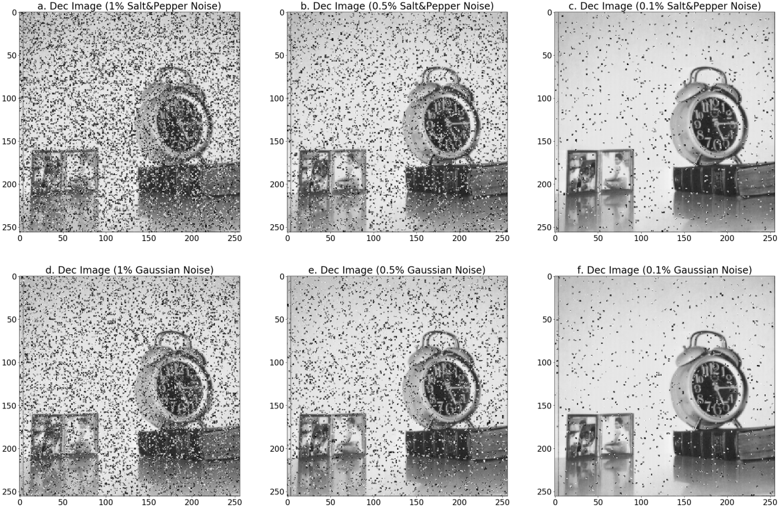
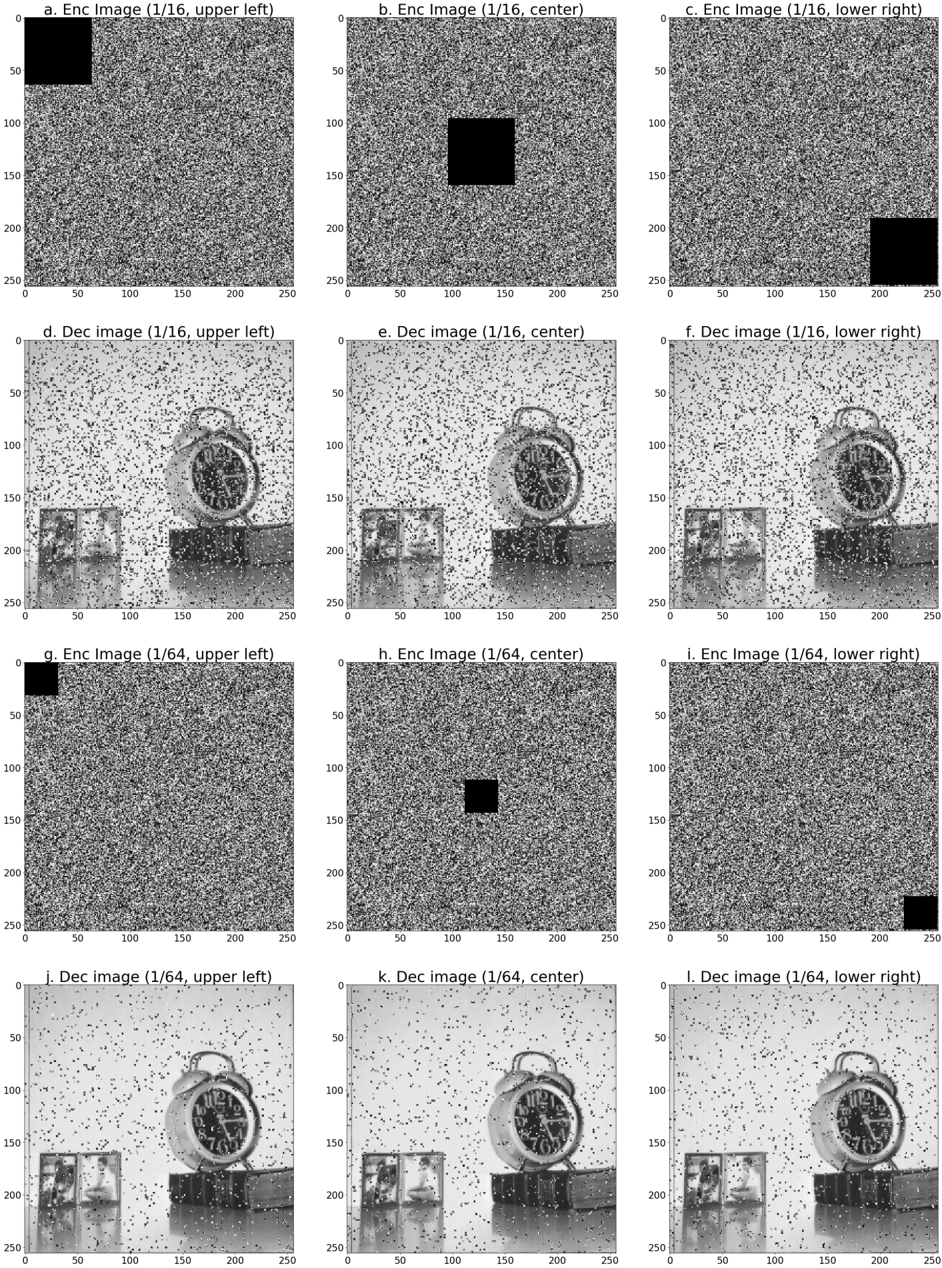
- Robustness and speed results include PSNR >11 dB under 1% noise, PSNR values of 21.3275 dB and 20.3744 dB under 0.1% noise, PSNR of about 13 dB at 1/16 data loss, 16 dB at 1/32 data loss, and >18 dB at 1/64 data loss; average encryption speed is 1.8271 Mbps and average decryption speed is 1.8677 Mbps. For a 255×255 odd-size image, only 511 pixels, or 0.78%, are not involved in permutation.
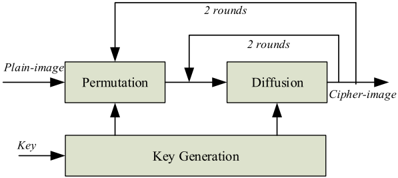
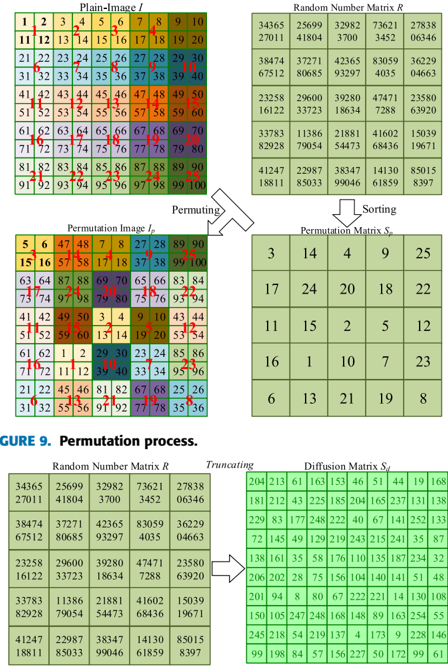
- The permutation uses four adjacent pixels as a unit, requiring a pseudo-random sequence only 25% of the plain-image size and one PRNG execution per encryption round; the reported time complexity is WH + 4(W + H).
Methods
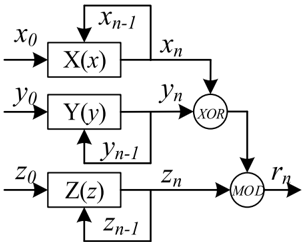
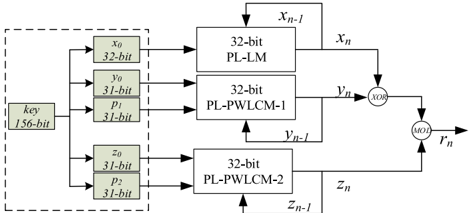
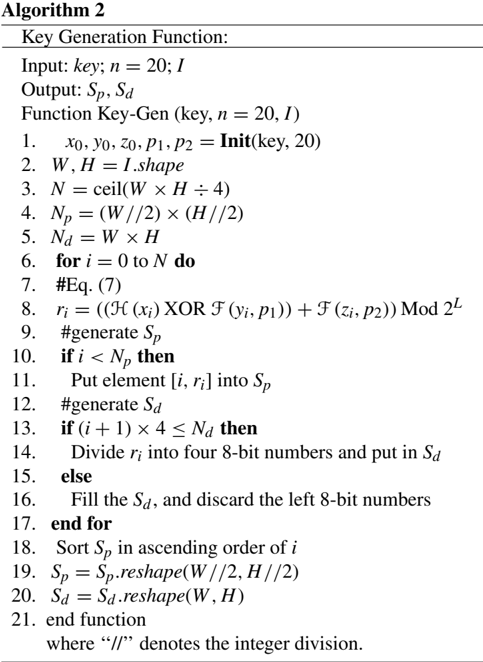
- Design: a parallel chaotic system uses two 32-bit PL_PWLCMs and one 32-bit PL_LM, with output r_n = ((x_n XOR y_n) + z_n) Mod 2^L; each PRNG takes a 156-bit key and uses n = 20 initialization iterations. Encryption uses a two-round permutation-diffusion network: permutation with four adjacent pixels as a unit and diffusion based on rows and columns, with two diffusion rounds per encryption round.
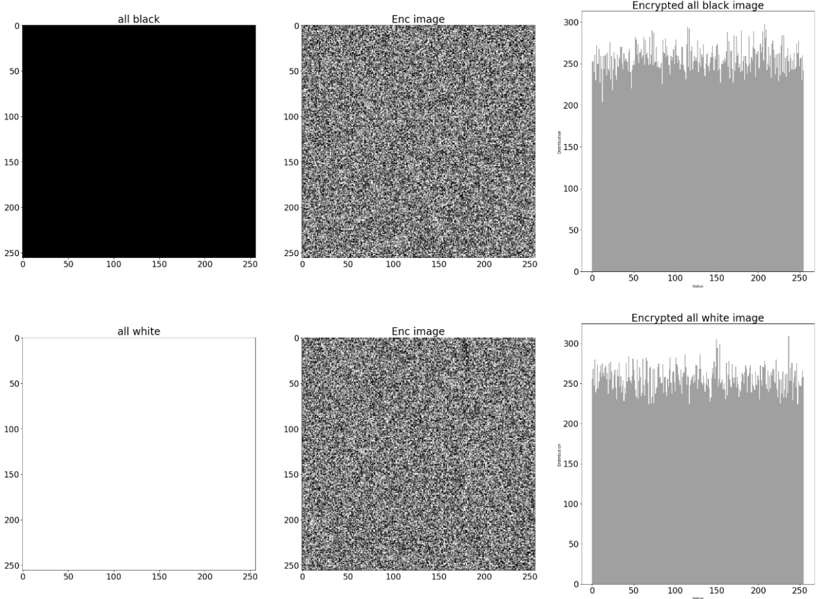
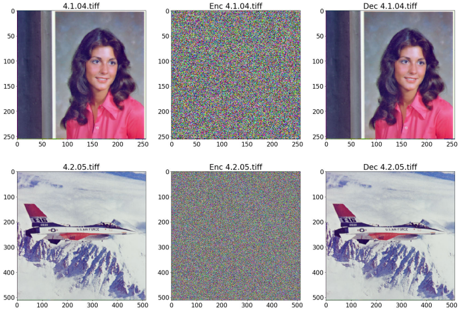
- Data and experiments: images from the USC-SIPI image database, including grayscale images of different sizes, 512×512 images for local entropy, a 255×255 odd-size image, all-black and all-white images, and color images. Experiments were implemented in Python on an Intel Core i5-8300H CPU @ 2.30GHz, 8GB RAM, Windows 10 64-bit system. Randomness tests used NIST STS with α = 0.01, m = 800, 19 MB sequences, and 100,000-bit blocks, plus TestU01-1.2.3 subtests Rabbit, Alphabit, and BlockAlphabit.
- Analysis: security analysis covered visual perception, histogram, chi-square, correlation, information entropy, image sensitivity via NPCR/UACI, key space and sensitivity, and classical attacks; robustness analysis covered odd-size images, noise, and data loss via PSNR; speed was assessed by time complexity and encryption/decryption speed comparisons.
Limitations
- Stated in the paper: when the image size is not a multiple of 4, the last row or column is not permuted; for a 255×255 image, 511 pixels (0.78%) are not involved in permutation, although all pixels are involved in diffusion. The authors also state future work will improve efficiency and extend the approach to video protection.
- Stated/evident from the text: the reported speed is from a non-parallel implementation, and the authors say higher speed is expected after careful design and parallel processing. Evident from the text: security and robustness claims are based on experiments on selected USC-SIPI images and comparisons, with no formal cryptanalytic proof presented.
Model-written summary. Check it against the paper before relying on it.
Integrity signals
Registry
Cites
Statistics
Figures



Verification
Claims the paper makes
0 Valid · 5 Not valid · 9 Not checked · 91 Own results and interpretations
A result the paper reports from its own data — it cites no other source for it, so there is none to check. The quote shows it is in the paper.
In the paper
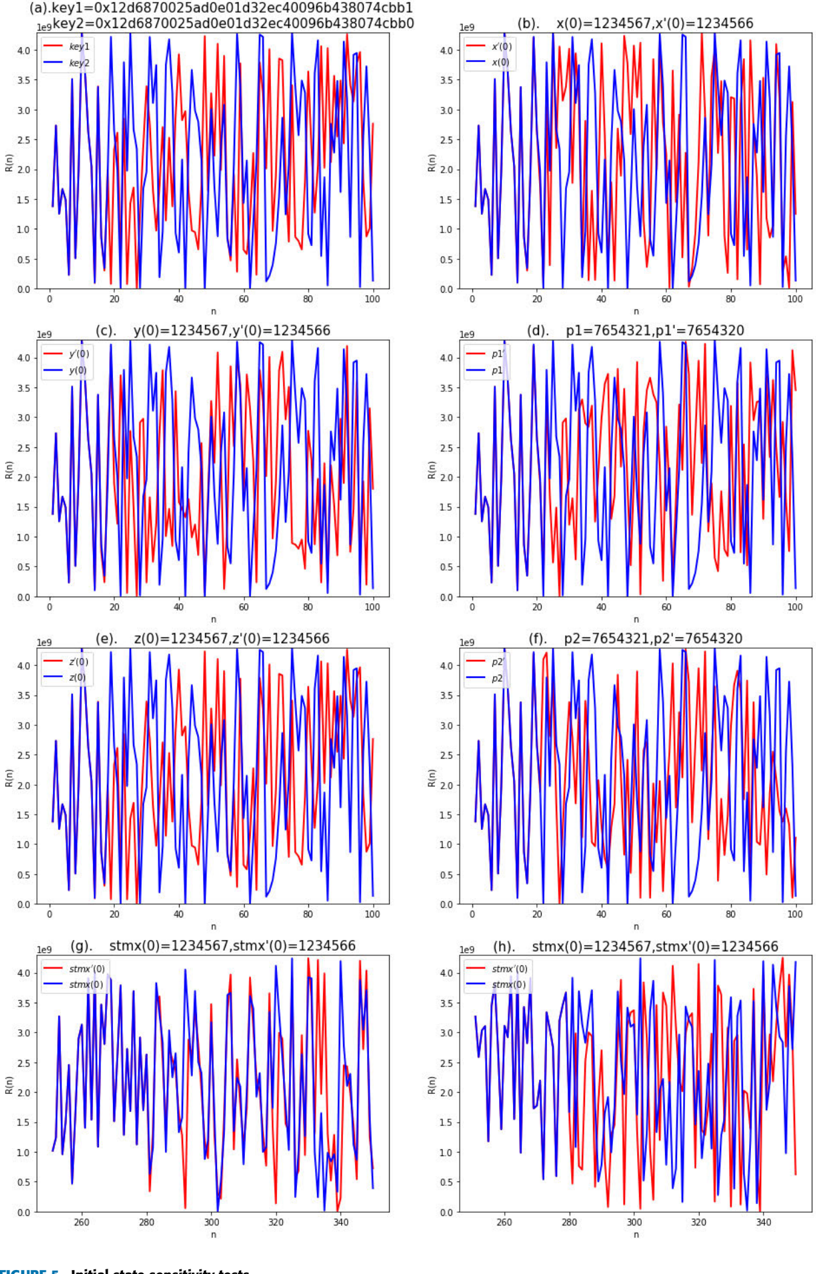
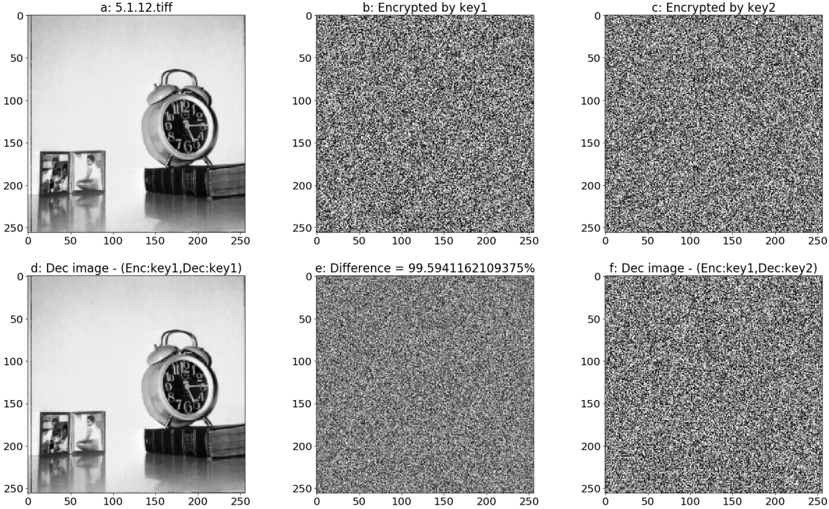
“Fig. 14 (e) shows that when the same image is encrypted with two keys, key1 and key2, the difference of cipher images is 99.5941%.”
§ A Robust Image Encryption Algorithm Based on a 32-bit Chaotic System > b: KEY SENSITIVITY
plainstates a causeSingle case- Asserted: passes — The authors put it forward as true.
- Checkable: passes — It can be checked against evidence.
- Load-bearing: passes — The paper’s conclusions depend on it.
- Based: passes — The paper gives a reason why it holds.
A result the paper reports from its own data — it cites no other source for it, so there is none to check. The quote shows it is in the paper.
In the paper
“(3) In the low limited precision form, cascade will considerably degrade the random performance.”
§ A Robust Image Encryption Algorithm Based on a 32-bit Chaotic System > a: NIST STS TEST
plainstates a cause- Asserted: passes — The authors put it forward as true.
- Checkable: passes — It can be checked against evidence.
- Load-bearing: passes — The paper’s conclusions depend on it.
- Based: passes — The paper gives a reason why it holds.
A result the paper reports from its own data — it cites no other source for it, so there is none to check. The quote shows it is in the paper.
In the paper
“When the noise ratio is 0.1% (Fig. 18 (c,f)), the decrypted image can visually recover almost all the information of the original image.”
§ A Robust Image Encryption Algorithm Based on a 32-bit Chaotic System > a: ROBUSTNESS AGAINST NOISE
plainstates a cause- Asserted: passes — The authors put it forward as true.
- Checkable: passes — It can be checked against evidence.
- Load-bearing: passes — The paper’s conclusions depend on it.
- Based: passes — The paper gives a reason why it holds.
- Rests on an assumption not shown here.
A result the paper reports from its own data — it cites no other source for it, so there is none to check. The quote shows it is in the paper.
In the paper
“The odd size image can be encrypted properly using our proposed algorithm.”
§ A Robust Image Encryption Algorithm Based on a 32-bit Chaotic System > B. ROBUSTNESS ANALYSIS 1) ODD SIZE IMAGE ENCRYPTION
plainstates a cause- Asserted: passes — The authors put it forward as true.
- Checkable: passes — It can be checked against evidence.
- Load-bearing: passes — The paper’s conclusions depend on it.
- Based: passes — The paper gives a reason why it holds.
A result the paper reports from its own data — it cites no other source for it, so there is none to check. The quote shows it is in the paper.
In the paper
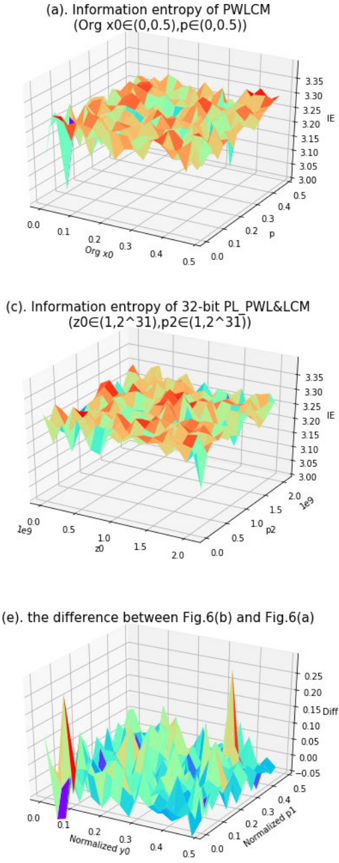
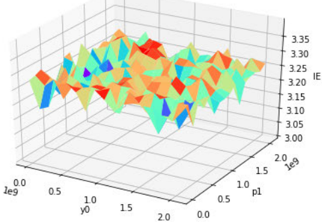
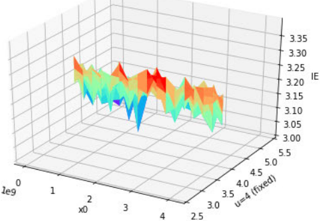
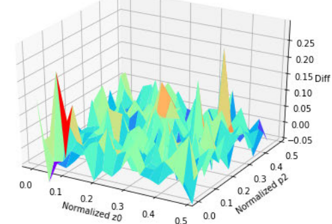
“When the change parameter of 32-bit PL_PWLCM&LM is x 0 , the minimum value of Fig. 7 (d) is higher than that of Fig. 7 (a), i.e., 0.021844.”
§ A Robust Image Encryption Algorithm Based on a 32-bit Chaotic System > C. PERFORMANCE EVALUATION 1) INITIAL STATE SENSITIVITY
plainstates a cause- Asserted: passes — The authors put it forward as true.
- Checkable: passes — It can be checked against evidence.
- Load-bearing: passes — The paper’s conclusions depend on it.
- Based: passes — The paper gives a reason why it holds.
63 more claims
Create a free account to see all 105 claims and every source verdict.
- The quote only partly states this claim. 3
- It may state two separate claims as one. 31
- Probably not a substantial claim. 6
Claims other papers make about this one
Each is checked against this paper’s own text: does it say what the citing paper says it does?
In the citing paper
“Compared with the image encryption in [35,36,37] and the video encryption in [38], our scheme provides a much faster decryption speed, reaching 91.47 Mb/s.”
From Secure Video Surveillance Framework in Smart City (2021) · cites this paper as [37]
Self-check
Percentages, sums and reported differences re-computed from the paper’s own numbers.
Each contradiction between two passages listed here was confirmed by an independent check.
Rated minor: it would not touch a result — a value no result rests on, a p-value that stays on the same side of the significance level, or a conflict that is clerical, resolved elsewhere in the paper, or outside its own findings.
In the paper
§ A Robust Image Encryption Algorithm Based on a 32-bit Chaotic System > C. SKEW TENT MAP
“(1-x n ) (1-p) 0 < x n ≤ p (5”
§ A Robust Image Encryption Algorithm Based on a 32-bit Chaotic System > C. SKEW TENT MAP
“The transformation is continuous and piecewise linear with the linear regions (0, p] and (p, 1].”
Citations
Cites
SOME BASIC CRYPTOGRAPHIC REQUIREMENTS FOR CHAOS-BASED CRYPTOSYSTEMS
ALVAREZ, G., & LI, S. (2006) · International Journal of Bifurcation and Chaos · doi:10.1142/s0218127406015970 · Cited by 2,119 · cited 1×
“[47] We used two 32-bit PL_PWLCM&LMs to generate the pseudo-random number sequences.”
MethodSymmetric Ciphers Based on Two-Dimensional Chaotic Maps
Fridrich, J. (1998) · International Journal of Bifurcation and Chaos · doi:10.1142/s021812749800098x · Cited by 1,917 · cited 4×
“PDN is used in our image encryption system (Fig.”
MethodInfluentialTestU01: A C library for empirical testing of random number generators
L'Ecuyer, P., & Simard, R. (2007) · ACM Transactions on Mathematical Software · doi:10.1145/1268776.1268777 · Cited by 1,014
2D Sine Logistic modulation map for image encryption
Hua, Z., Zhou, Y., Pun, C.-M., & Chen, C. L. P. (2015) · Information Sciences · doi:10.1016/j.ins.2014.11.018 · Cited by 777
Cosine-transform-based chaotic system for image encryption
Hua, Z., Zhou, Y., & Huang, H. (2019) · Information Sciences · doi:10.1016/j.ins.2018.12.048 · Cited by 776 · cited 1×
“[4], [7], [16], [27], PWLCM [28]–[31] and STM [8], [29], [32], [33], all of which are widely used in image encryption.”
BackgroundImage encryption using 2D Logistic-adjusted-Sine map
Hua, Z., & Zhou, Y. (2016) · Information Sciences · doi:10.1016/j.ins.2016.01.017 · Cited by 736 · cited 1×
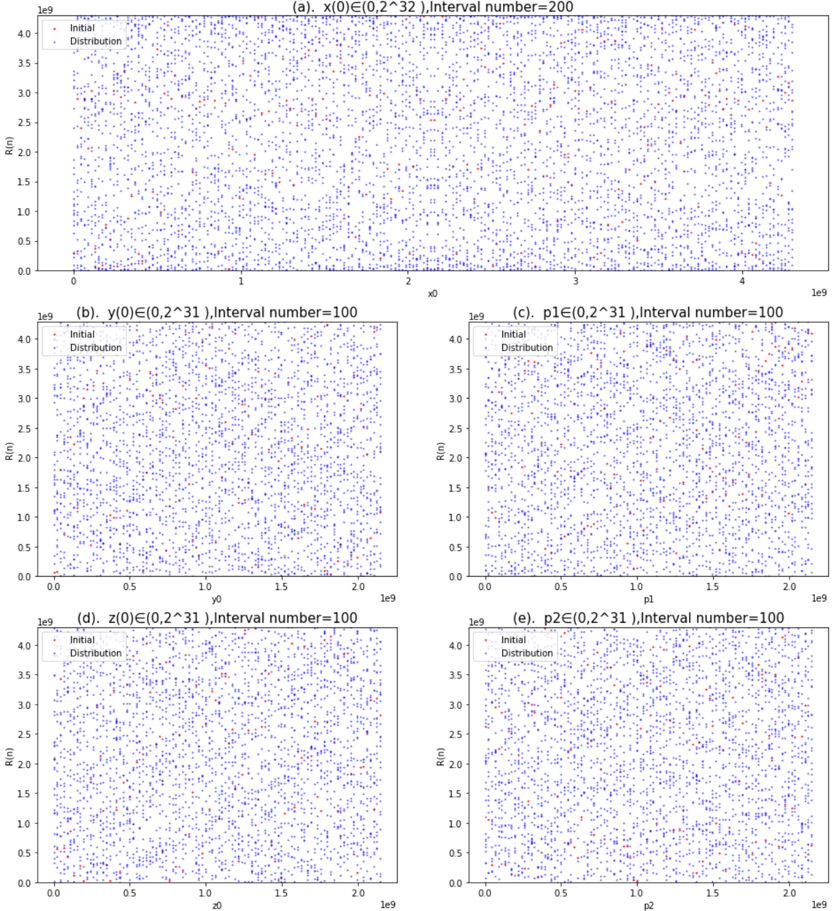
“[37] The intervals of y0, p1, z0, p2 ∈ (0, 231) are evenly divided into 100 sub-intervals, and the interval of x0 ∈ (0, 232) is divided into 200 sub-intervals.”
BackgroundLocal Shannon entropy measure with statistical tests for image randomness
Wu, Y., Zhou, Y., Saveriades, G., Agaian, S., Noonan, J. P., & Natarajan, P. (2013) · Information Sciences · doi:10.1016/j.ins.2012.07.049 · Cited by 722
A novel colour image encryption algorithm based on chaos
Wang, X., Teng, L., & Qin, X. (2012) · Signal Processing · doi:10.1016/j.sigpro.2011.10.023 · Cited by 715 · cited 2×
“The pixel values of cipherimages are evenly distributed in [0-255].”
BackgroundImage encryption using DNA complementary rule and chaotic maps
Liu, H., Wang, X., & kadir, A. (2012) · Applied Soft Computing · doi:10.1016/j.asoc.2012.01.016 · Cited by 626 · cited 1×
“The diffusion unit can be a bit-level [14], DNA-level [15], or pixel-level unit [16].”
BackgroundColor image encryption using spatial bit-level permutation and high-dimension chaotic system
Liu, H., & Wang, X. (2011) · Optics Communications · doi:10.1016/j.optcom.2011.04.001 · Cited by 591
Research works printed but not linked: 1
- 2020, GMP The GNU Multiple Precision Arithmetic Library
Cited by
Secure Surveillance System Using Chaotic Image Encryption Technique
Ghosh, G., Kavita, K., Verma, S., Jhanjhi, N. Z., & Talib, M. (2020) · IOP Conference Series Materials Science and Engineering · doi:10.1088/1757-899x/993/1/012062 · Cited by 111
IEPSBP: A Cost-Efficient Image Encryption Algorithm Based on Parallel Chaotic System for Green IoT
Gu, Z., Li, H., Khan, S., Deng, L., Du, X., Guizani, M., & Tian, Z. (2021) · IEEE Transactions on Green Communications and Networking · doi:10.1109/tgcn.2021.3095707 · Cited by 105
Self-citationWang, X., Zhang, X., Gao, M., Tian, Y., Wang, C., & Iu, H. H. (2023) · Mathematics · doi:10.3390/math11030567 · Cited by 58
Color image encryption based on joint permutation and diffusion
Li, T., Shi, J., & Zhang, D. (2021) · Journal of Electronic Imaging · doi:10.1117/1.jei.30.1.013008 · Cited by 48
“EQ-TARGET;temp:intralink-;e012;116;170 δði; jÞ 1⁄4 0; Ci;j 1⁄4 Di;j 1; Ci;j ≠ Di;j : (12)”
A new cryptographic algorithm via a two-dimensional chaotic map
Elghandour, A., Salah, A., & Karawia, A. A. (2021) · Ain Shams Engineering Journal · doi:10.1016/j.asej.2021.05.004 · Cited by 49
Metadata
- Authors
- Li, H., Deng, L., & Gu, Z.
- Affiliations
- Guangzhou University (CN)
- Venue
- IEEE Access
- Published
- 2020
- Volume
- 8
- Pages
- 30127-30151
- ISSN
- 2169-3536 (ISSN-L)
- OpenAlex
- W3005163853
- Cited by
- 51
- References
- 59
- Citations by year
- 2026: 7 · 2025: 6 · 2024: 6 · 2023: 5 · 2022: 6 · 2021: 14 · 2020: 7
- FWCI
- 3.11
- Type
- journal article
- Language
- en
- Open access
- gold
- doi.org
- Locations
- IEEE Access (publishedVersion, cc-by)
- DOAJ (DOAJ: Directory of Open Access Journals) (submittedVersion, cc-by-sa)
- Funders
- National Key R&D Program of China (2019YFB1706003)
- China Postdoctoral Science Foundation (2019M663358)
- National Natural Science Foundation of China (61902082)
- China (U1636215)
- Topics
- Physical Sciences › Computer Science › Computer Vision and Pattern Recognition › Chaos-based Image/Signal Encryption
- Physical Sciences › Computer Science › Artificial Intelligence › Computer Science and Engineering
- Physical Sciences › Mathematics › Mathematical Physics › Mathematical Dynamics and Fractals
- Keywords
- image encryption, chaotic maps, piecewise linear chaotic map, pseudorandom number generation, low-precision arithmetic, logistic map, permutation-diffusion
About these checks
Registry, retraction, Cites and statistics results are computed, not judged, with one exception: a printed reference that no index lists is read once by a model before it counts as a citation error. Claims are extracted by a model and kept only when their quote appears verbatim in the text; each cited source is then checked, with a model’s help, for whether it says what the claim relies on. Those verdicts can be wrong — read the claim’s quote and the cited source before relying on one.
The claim verdicts this report counts are experimental: their accuracy is not yet measured.
A language model drew the claims from the paper on 2026-09-29, under version 3 of the claim definition (model deepseek-v4.1-flash, prompt extract-v3).
A second model labelled each claim on 2026-09-29 (model jev-1.13-20260917, definition revision gold-guideline-v0.2).
Statistics and arithmetic are recomputed, not judged.
Confidence bands are shown only for fields calibrated on our annotated test set. None is calibrated yet, so no band is shown.
What counts as a claim ›How we measure confidence ›How we check this ›
Are you an author, or do you see a problem with this page? Request a review
How to cite
Cite CoChat for the checks on this page, and the paper for its own findings.
- This page
- CoChat. (2026). Citation check: A Robust Image Encryption Algorithm Based on a 32-bit Chaotic System. https://app.cochat.ai/papers/10.1109/access.2020.2972296
- The paper
- Li, H., Deng, L., & Gu, Z. (2020). A Robust Image Encryption Algorithm Based on a 32-bit Chaotic System. IEEE Access. https://doi.org/10.1109/access.2020.2972296
Data sources
Bibliographic data: Semantic Scholar, OpenAlex, Crossref.
Contains information from the Semantic Scholar Academic Graph Datasets, made available under the ODC Attribution License (ODC-BY 1.0).
Semantic Scholar’s data is described in: Kinney, R., et al. (2023). The Semantic Scholar Open Data Platform. arXiv:2301.10140.
