

Variational Quantum Classifier for Binary Classification: Real vs Synthetic Dataset
Open accessThe DOI matches its Crossref record; 47 of the 47 references it cites were found in a registry or an index; 6 of the 18 sources its claims cite were checked for support.
Abstract
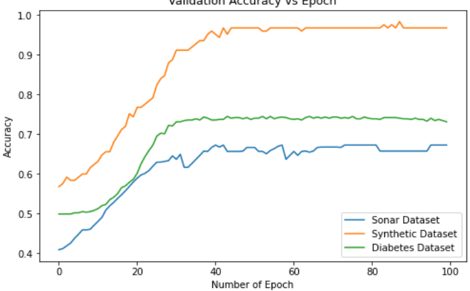
Nowadays, quantum-enhanced methods have been widely studied to solve machine learning related problems. This article presents the application of a Variational Quantum Classifier (VQC) for binary classification. We utilized three datasets: a synthetic dataset with randomly generated values between 0 and 1, the publicly available University of California Intelligence Machine learning (UCI) sonar dataset consisting of mining data, and a proprietary diabetes dataset related to diabetes with acute diseases and diabetes without acute disease. To deal with the limitation of noisy intermediate-scale quantum systems (NISQ), we used a pre-processing method to enhance the prediction rate when applying the VQC method. The process includes feature selection and state preparation. Quantum state preparation is critical for obtaining a functioning pipeline in a quantum machine learning (QML) model. Amplitude encoding is a state preparation approach that enhances the performance of data encoding and the learning of quantum models. As a result, our proposed methods achieved accuracies of 75%, 71.4%, and 68.73% by using VQC model and in contrast, the amplitude encoding-based VQC achieved 98.40%, 67.3%, and 74.50% accuracies on the synthetic, sonar, and diabetes dataset, respectively.
Overview
CoChat Summary
TL;DR
The paper evaluates variational quantum classifier (VQC) binary classification on three datasets—synthetic, UCI Sonar, and a proprietary diabetes dataset—and compares basis encoding with amplitude encoding. Amplitude encoding improved performance on the synthetic and diabetes datasets, but not on Sonar.
Key findings
- The paper reports VQC accuracies of 75% on the synthetic dataset, 71.4% on Sonar, and 68.73% on diabetes.
- With amplitude encoding-based VQC, the reported accuracies were 98.40% on the synthetic dataset, 67.3% on Sonar, and 74.50% on diabetes.
- On the synthetic dataset, classical SVM achieved 100% accuracy, compared with 94% for QSVM and 75% for VQC; the amplitude-encoding VQC reached 98.40%.
- On Sonar, classical SVM achieved 85.71% accuracy, versus 76.19% for QSVM and 71.4% for VQC; on diabetes, SVM achieved 75.32% versus 74.19% for QSVM and 68.73% for VQC.
Methods
- The study uses three datasets: a synthetic dataset with 500 samples and 25 attributes (balanced 250/250), the UCI Sonar dataset with 208 samples and 60 attributes (111 metal cylinder, 97 rock), and a proprietary diabetes dataset derived from Osakidetza EHRs and the PREST database.
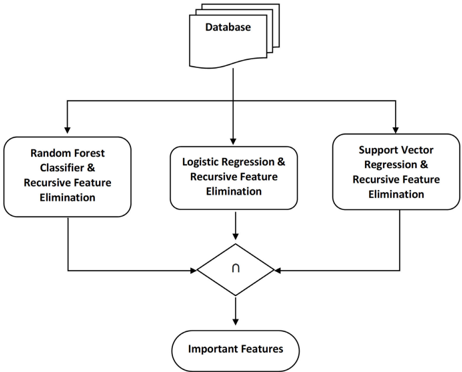
- A preprocessing pipeline is applied: recursive feature elimination / feature selection, then min-max normalization to the 0–1 range, then quantum state preparation using basis encoding or amplitude encoding.
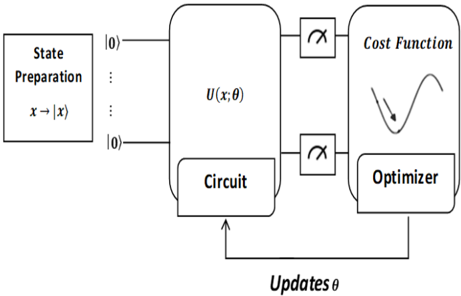
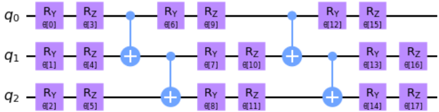
- The main model is a Variational Quantum Classifier (VQC) implemented in IBM Qiskit, using feature maps such as FirstOrderExpansion, SecondOrderExpansion, and SecondOrderPauliExpansion, with COBYLA optimization; the data split is 80% training / 20% testing.
Limitations
- The paper itself notes that NISQ device limitations constrain QML techniques and motivate preprocessing; this is stated explicitly in the Methods section.
- The paper says the amplitude encoding VQC improved synthetic and diabetes results but had little influence on Sonar performance.
- Evident from the text: the diabetes dataset is proprietary, and the paper does not provide full raw dataset details beyond aggregated counts and variable descriptions, which limits reproducibility.
Model-written summary. Check it against the paper before relying on it.
Integrity signals
Registry
Cites
Statistics
Figures




Verification
Claims the paper makes
5 Valid · 0 Not valid · 10 Not checked · 35 Own results and interpretations
A result the paper reports from its own data — it cites no other source for it, so there is none to check. The quote shows it is in the paper.
In the paper
“As a result, our proposed methods achieved accuracies of 75%, 71.4%, and 68.73% by using VQC model and in contrast, the amplitude encoding-based VQC achieved 98.40%, 67.3%, and 74.50% accuracies on the synthetic, sonar, and diabetes dataset, respectively.”
§ Variational Quantum Classifier for Binary Classification: Real vs Synthetic Dataset > Abstract
plain- Asserted: passes — The authors put it forward as true.
- Checkable: passes — It can be checked against evidence.
- Load-bearing: passes — The paper’s conclusions depend on it.
- Based: passes — The paper gives a reason why it holds.
A result the paper states — it cites no source for it, so there is none to check. The quote shows it is in the paper.
In the paper
“these three classifiers extracted the eight important features from all datasets, including the synthetic dataset, the sonar dataset, and the diabetes dataset, as illustrated in Figure 1.”
§ Variational Quantum Classifier for Binary Classification: Real vs Synthetic Dataset > 1) PRE-PROCESSING
plainstates a cause- Asserted: passes — The authors put it forward as true.
- Checkable: passes — It can be checked against evidence.
- Load-bearing: unclear — It is unclear whether the paper’s conclusions depend on it.
- Based: passes — The paper gives a reason why it holds.
A result the paper reports from its own data — it cites no other source for it, so there is none to check. The quote shows it is in the paper.
In the paper
“As a result, our proposed methods achieved accuracies of 75%, 71.4%, and 68.73% by using VQC model and in contrast, the amplitude encoding-based VQC achieved 98.40%, 67.3%, and 74.50% accuracies on the synthetic, sonar, and diabetes dataset, respectively.”
§ Variational Quantum Classifier for Binary Classification: Real vs Synthetic Dataset > Abstract
plain- Asserted: passes — The authors put it forward as true.
- Checkable: passes — It can be checked against evidence.
- Load-bearing: passes — The paper’s conclusions depend on it.
- Based: passes — The paper gives a reason why it holds.
24 more claims
Create a free account to see all 50 claims and to verify the 10 references still open.
- Probably not a substantial claim. 15
- The quote only partly states this claim. 1
- It may state two separate claims as one. 9
Citations
Cites
Biamonte, J., Wittek, P., Pancotti, N., Rebentrost, P., Wiebe, N., & Lloyd, S. (2017) · Nature · doi:10.1038/nature23474 · Cited by 4,779
Supervised learning with quantum-enhanced feature spaces
Havlíček, V., Córcoles, A. D., Temme, K., Harrow, A. W., Kandala, A., Chow, J. M., & Gambetta, J. M. (2019) · Nature · doi:10.1038/s41586-019-0980-2 · Cited by 2,572
Quantum Support Vector Machine for Big Data Classification
Rebentrost, P., Mohseni, M., & Lloyd, S. (2014) · Physical Review Letters · doi:10.1103/physrevlett.113.130503 · Cited by 1,951
Quantum Machine Learning in Feature Hilbert Spaces
Schuld, M., & Killoran, N. (2019) · Physical Review Letters · doi:10.1103/physrevlett.122.040504 · Cited by 1,840 · cited 2×
“This process reduces experimental overhead in terms of resources and assists in avoiding of non-linearities in data [5], [16], allowing linear classifiers and kernel-based techniques to perform better in terms of predictions [17], [18], as well as the use of near-term Quantum processors with…”
BackgroundQuantum principal component analysis
Lloyd, S., Mohseni, M., & Rebentrost, P. (2014) · Nature Physics · doi:10.1038/nphys3029 · Cited by 1,385
An introduction to quantum machine learning
Schuld, M., Sinayskiy, I., & Petruccione, F. (2015) · Contemporary Physics · doi:10.1080/00107514.2014.964942 · Cited by 1,381 · cited 1×
“There are four possible approaches in QML based on data and the correspondent processing device, whether classical or quantum [9].”
MethodAnalysis of hidden units in a layered network trained to classify sonar targets
Gorman, R. P., & Sejnowski, T. J. (1988) · Neural Networks · doi:10.1016/0893-6080(88)90023-8 · Cited by 1,114
Circuit-centric quantum classifiers
Schuld, M., Bocharov, A., Svore, K. M., & Wiebe, N. (2020) · Physical Review A · doi:10.1103/physreva.101.032308 · Cited by 1,057 · cited 2×
“Encoding methods for various feature maps are as follows [12], [17], [19].”
MethodQuantum optimization using variational algorithms on near-term quantum devices
Moll, N., Barkoutsos, P., Bishop, L. S., Chow, J. M., Cross, A., Egger, D. J., Filipp, S., Fuhrer, A., Gambetta, J. M., Ganzhorn, M., et al. (2018) · Quantum Science and Technology · doi:10.1088/2058-9565/aab822 · Cited by 744 · cited 1×
“…neural networks [13] and have been related to the applications, such as hybridized low-depth VQC classification methods with simple error-mitigation [14] and pre-processing methodologies such as Principle Component Analysis (PCA) [15], resulting in an improvement in performance for categorization.”
MethodClassification with Quantum Neural Networks on Near Term Processors
Farhi, E., & Neven, H. (2018) · arXiv · doi:10.48550/arxiv.1802.06002 · Cited by 598
Research works printed but not linked: 2
- 28. International Diabetes Federation-Facts & Figures. Available: https://idf.org/aboutdiabetes/what-is-diabetes/facts-figures.html
- 42. J. Environ. Res. Public Health, vol. 18, no. 20, p. 10769, Oct. 2021.
Cited by
Ullah, U., & Garcia-Zapirain, B. (2024) · IEEE Access · doi:10.1109/access.2024.3353461 · Cited by 188
Self-citationQuantum Machine Learning Applications in the Biomedical Domain: A Systematic Review
Maheshwari, D., García-Zapirain, B., & Sierra-Sosa, D. (2022) · IEEE Access · doi:10.1109/access.2022.3195044 · Cited by 197
Self-citationRanga, D., Rana, A., Prajapat, S., Kumar, P., Kumar, K., & Vasilakos, A. V. (2024) · Mathematics · doi:10.3390/math12213318 · Cited by 149
Quantum Machine Learning: Recent Advances, Challenges, and Perspectives
Lamichhane, P., & Rawat, D. B. (2025) · IEEE Access · doi:10.1109/access.2025.3573244 · Cited by 117
A Fully Connected Quantum Convolutional Neural Network for Classifying Ischemic Cardiopathy
Ullah, U., García-Olea, A., Gonzalez, I. D., & García-Zapirain, B. (2022) · IEEE Access · doi:10.1109/access.2022.3232307 · Cited by 55
Self-citationGupta, A., Maurya, M. K., Dhere, K., & Chaurasiya, V. K. (2024) · IEEE Access · doi:10.1109/access.2024.3464240 · Cited by 50
Advancements in Quantum Computing—Viewpoint: Building Adoption and Competency in Industry
Pfaendler, S. M.-L., Konson, K., & Greinert, F. (2024) · Datenbank-Spektrum · doi:10.1007/s13222-024-00467-4 · Cited by 43
Quantum machine learning regression optimisation for full-scale sewage sludge anaerobic digestion
Mohamed, Y., Elghadban, A., Lei, H. I., Shih, A. A., & Lee, P.-H. H. (2025) · npj Clean Water · doi:10.1038/s41545-025-00440-y · Cited by 28
An efficient and scalable variational quantum circuits approach for deep reinforcement learning
Bar, N. F., Yetış, H., & Karaköse, M. (2023) · Quantum Information Processing · doi:10.1007/s11128-023-04051-9 · Cited by 22
Quantum Kernel-Based Long Short-term Memory for Climate Time-Series Forecasting
Hsu, Y.-C., Chen, N.-Y., Li, T.-Y., Lee, P.-H. H., & Chen, K. (2025) · International Conference on Quantum Communications, Networking, and Computing (QCNC) · doi:10.1109/qcnc64685.2025.00072 · Cited by 42
Majid, B., Sofi, S. A., & Jabeen, Z. (2025) · Quantum Machine Intelligence · doi:10.1007/s42484-025-00266-4 · Cited by 22
Potential of quantum machine learning for solving the real-world problem of cancer classification
Ghobadi, M. Z., & Afsaneh, E. (2024) · Discover Applied Sciences · doi:10.1007/s42452-024-06220-6 · Cited by 30
Ajibosin, S. S., & Çetinkaya, D. (2024) · Software · doi:10.3390/software3040024 · Cited by 31
Mei, P., & Zhang, F. (2024) · Frontiers in Digital Health · doi:10.3389/fdgth.2024.1502745 · Cited by 16
Quantum-Enhanced Support Vector Classifier for Image Classification
Golchha, R., & Verma, G. K. (2023) · IEEE International Conference for Convergence in Technology (I2CT) · doi:10.1109/i2ct57861.2023.10126421 · Cited by 16
Quantum classifier for recognition and identification of leaf profile features
Kumar, A., Mai, N. N., Kumar, A., Chand, N. V., & Assaf, M. H. (2022) · The European Physical Journal D · doi:10.1140/epjd/s10053-022-00429-z · Cited by 14
Time series quantum classifiers with amplitude embedding
Cuéllar, M. P., Cano, C., Ruiz, L. G. B., & Servadei, L. (2023) · Quantum Machine Intelligence · doi:10.1007/s42484-023-00133-0 · Cited by 19
Quantum Kernel-Based Long Short-term Memory
Hsu, Y.-C., Li, T.-Y., & Chen, K. (2025) · IEEE International Conference on Acoustics, Speech, and Signal Processing Workshops (ICASSPW) · doi:10.1109/icasspw65056.2025.11011010 · Cited by 27
Quantum Support Vector Machine for Prostate Cancer Detection: A Performance AnalysisPreprint
Maouaki, W. E., Said, T., & Bennai, M. (2024) · Research Square · doi:10.21203/rs.3.rs-3867096/v1 · Cited by 17
VIOLET: Visual Analytics for Explainable Quantum Neural Networks
Ruan, S., Liang, Z., Guan, Q., Griffin, P., Wen, X., Lin, Y., & Wang, Y. (2024) · IEEE Transactions on Visualization and Computer Graphics · doi:10.1109/tvcg.2024.3388557 · Cited by 23
Quantum machine learning models in healthcare: future trends and challenges in healthcare
Sonavane, A. S., Jaiswar, S., Mistry, M., Aylani, A., & Hajoary, D. (2025) · Elsevier eBooks · doi:10.1016/b978-0-443-29297-2.00003-4 · Cited by 19
Padha, A., & Sahoo, A. (2023) · Quantum Machine Intelligence · doi:10.1007/s42484-023-00108-1 · Cited by 12
Kwon, S., Huh, J., Kwon, S. J., Choi, S.-H., & Kwon, O. (2025) · Symmetry · doi:10.3390/sym17020186 · Cited by 13
Severity Classification of COVID-19 Patients Data using Quantum Machine Learning Approaches
Ullah, U., Maheshwari, D., Gloyna, H. H., & García-Zapirain, B. (2022) · International Conference on Electrical, Computer, Communications and Mechatronics Engineering (ICECCME) · doi:10.1109/iceccme55909.2022.9987991 · Cited by 14
Self-citationQuantum Text Encoding for Classification Tasks
Alexander, A., & Widdows, D. (2022) · IEEE/ACM Symposium on Edge Computing (SEC) · doi:10.1109/sec54971.2022.00052 · Cited by 14
Comparative Analysis of a Quantum SVM With an Optimized Kernel Versus Classical SVMs
Hidalgo, M. C. (2025) · IEEE Access · doi:10.1109/access.2025.3567352 · Cited by 11
Quantum deep neural networks for time series analysis
Padha, A., & Sahoo, A. (2024) · Quantum Information Processing · doi:10.1007/s11128-024-04404-y · Cited by 16
Kim, R. (2023) · IEEE International Conference on Quantum Computing and Engineering (QCE) · doi:10.1109/qce57702.2023.10231 · Cited by 19
Hybrid classical and quantum computing for enhanced glioma tumor classification using TCGA data
Akpinar, E., & Oduncuoğlu, M. (2025) · Scientific Reports · doi:10.1038/s41598-025-97067-3 · Cited by 31
Nadim, M., Hassan, M. M., Mandal, A. K., & Roy, C. K. (2025) · IEEE/ACM International Workshop on Quantum Software Engineering (Q-SE) · doi:10.1109/q-se66736.2025.00012 · Cited by 27
Fingerprinting-Based Indoor Localization With Hybrid Quantum-Deep Neural Network
Numan, P. E., Jeong, M., Park, H., Choi, S. W., & Kim, S. (2023) · IEEE Access · doi:10.1109/access.2023.3341972 · Cited by 11
A Reconfigurable Framework for Hybrid Quantum–Classical Computing
Pratibha, P., & Mahmud, N. (2025) · Algorithms · doi:10.3390/a18050271 · Cited by 14
Radar HRRP Target Recognition Based on Hybrid Quantum Neural Networks
Liu, X., Zhou, D., & Huang, Q. (2025) · IEEE Transactions on Aerospace and Electronic Systems · doi:10.1109/taes.2025.3526112 · Cited by 14
Quantum Enhanced Machine Learning for Unobtrusive Stress Monitoring
Padha, A., & Sahoo, A. (2022) · International Conference on Contemporary Computing · doi:10.1145/3549206.3549288 · Cited by 11
Enhanced deep learning and quantum variational classifier for large-scale data analysis
Sudha, D. N., Anju, A., & Ezhilarasi, K. (2025) · Knowledge-Based Systems · doi:10.1016/j.knosys.2025.114611 · Cited by 9
A Systematic Review on Quantum Machine Learning Applications in Classification
MohammadiSavadkoohi, E., Shafiabady, N., & Vakilian, J. (2025) · IEEE Transactions on Artificial Intelligence · doi:10.1109/tai.2025.3567960 · Cited by 25
A Fusion of Supervised Contrastive Learning and Variational Quantum Classifiers
Don, A. K. K., Khalil, I., & Atiquzzaman, M. (2024) · IEEE Transactions on Consumer Electronics · doi:10.1109/tce.2024.3351649 · Cited by 23
An Approach Based on Quantum Reinforcement Learning for Navigation Problems
Bar, N. F., Yetış, H., & Karaköse, M. (2022) · International Conference on Data Analytics for Business and Industry (ICDABI) · doi:10.1109/icdabi56818.2022.10041570 · Cited by 15
Cuéllar, M. P. (2024) · Quantum Machine Intelligence · doi:10.1007/s42484-024-00210-y · Cited by 10
Quantum as a Service Architecture for Security in a Smart City
Barletta, V. S., Caivano, D., Lako, A., & Pal, A. (2023) · Communications in computer and information science · doi:10.1007/978-3-031-43703-8_6 · Cited by 14
Why consider quantum instead classical pattern recognition techniques?
Barreto, A. G., Fanchini, F., Papa, J. P., & de Albuquerque, V. D. (2024) · Applied Soft Computing · doi:10.1016/j.asoc.2024.112096 · Cited by 9
Quantum Machine Learning in the Cognitive Domain: Alzheimer's Disease Study
Akpinar, E. (2024) · IEEE High Performance Extreme Computing Conference · doi:10.1109/hpec62836.2024.10938482 · Cited by 15
QRLaXAI: quantum representation learning and explainable AI
Don, A. K. K., & Khalil, I. (2025) · Quantum Machine Intelligence · doi:10.1007/s42484-025-00253-9 · Cited by 21
Hybrid Quantum Neural Network Image Anti-Noise Classification Model Combined with Error Mitigation
Ji, N., Bao, R., Zhao, C., Yu, Y., & Ma, H. (2024) · Applied Sciences · doi:10.3390/app14041392 · Cited by 11
Prasanna, K., Tak, T. K., Kshirsagar, P. R., Ginnela, G., & Akula, V. K. (2025) · Computers, materials & continua/Computers, materials & continua (Print) · doi:10.32604/cmc.2025.065287 · Cited by 15
Correr, G. I., Medina, I., Azado, P. C., Drinko, A., & Soares-Pinto, D. O. (2024) · Quantum Science and Technology · doi:10.1088/2058-9565/ad80be · Cited by 17
Geometric properties of quantum entanglement and machine learning
Zuev, S. (2023) · Russian Technological Journal · doi:10.32362/2500-316x-2023-11-5-19-33 · Cited by 7
Alsubai, S., Alqahtani, A., Binbusayyis, A., Sha, M., Gumaei, A., & Wang, S. (2023) · Mathematics · doi:10.3390/math11112513 · Cited by 7
Bridging Deep Learning and Quantum Computing for EEG-Driven P300 Targeted ASD Response Detection
Turjya, S. M., & Fawakherji, M. (2025) · IEEE Access · doi:10.1109/access.2025.3646589 · Cited by 5
QEKLR: quantum-enhanced kernel logistic regression for classification
Misra, S., & Rani, P. (2025) · The Journal of Supercomputing · doi:10.1007/s11227-025-07266-y · Cited by 6
Hybrid Quantum-Classical Machine Learning for Dementia Detection
Kim, R. (2023) · IEEE MIT Undergraduate Research Technology Conference (URTC) · doi:10.1109/urtc60662.2023.10535034 · Cited by 4
Quantum Exploration in Ransomware Detection with Conventional Machine Learning Approaches
Kaur, M., Jain, K., Singla, A., & Kadian, K. (2024) · IEEE International Conference on Contemporary Computing and Communications (InC4) · doi:10.1109/inc460750.2024.10649082 · Cited by 4
Munasinghe, T., Lai, P., Wei, J., Hendler, J., & Cornell, K. A. (2024) · IEEE International Conference on Big Data (BigData) · doi:10.1109/bigdata62323.2024.10825181 · Cited by 6
Chaipunha, N., Panya, V., & Leelasantitham, A. (2024) · Technology Innovation Management and Engineering Science International Conference (TIMES-iCON) · doi:10.1109/times-icon61890.2024.10630768 · Cited by 5
Sarcopenia risk prediction and feature selection by using quantum machine learning algorithms
Ullah, U., Maheshwari, D., Castillo-Olea, C., & García-Zapirain, B. (2024) · Quantum Machine Intelligence · doi:10.1007/s42484-024-00218-4 · Cited by 3
Self-citationA Quantum Machine Learning Model for Medical Data Classification
Ahmed, H. K., Tantawi, B., Magdy, M., & Sayed, G. I. (2023) · Studies in computational intelligence · doi:10.1007/978-3-031-37454-8_5 · Cited by 3
Ranga, D., Prajapat, S., Kumar, P., Akhtar, Z., & Al-Khalidi, M. (2025) · Physica Scripta · doi:10.1088/1402-4896/ae0831 · Cited by 5
Munasinghe, T., Cornell, K. A., Wei, J., Berg, G., & Hendler, J. (2024) · IEEE International Conference on Big Data (BigData) · doi:10.1109/bigdata62323.2024.10826005 · Cited by 3
Quantum Variational Autoencoder for Feature Compression and Classification of Cancer Images
Andra, M. B., Zilvan, V., Yuwana, R. S., Krisnandi, D., Suryawati, E., Heryana, A., & Pardede, H. F. (2026) · SN Computer Science · doi:10.1007/s42979-026-04742-x · Cited by 4
Learning Robust Observable to Address Noise in Quantum Machine Learning
Khanal, B., & Rivas, P. (2025) · Communications in computer and information science · doi:10.1007/978-3-031-85884-0_4 · Cited by 6
Benchmarking quantum machine learning methods for intrusion detection on noisy quantum computers
Cirillo, F., Esposito, C., & Seo, J. T. (2026) · Quantum Machine Intelligence · doi:10.1007/s42484-026-00379-4 · Cited by 7
QUESC: Environmental Sound classification Using Quantum Quantized Networks
Dutta, S., Bhanushali, M., Bhan, S., Varma, L., Kanani, P., & Narvekar, M. (2023) · Procedia Computer Science · doi:10.1016/j.procs.2023.12.111 · Cited by 6
Majumder, S., Ray, S., Dasgupta, M., Bhattacharya, P., Gadekallu, T. R., & Srivastava, G. (2025) · IEEE Transactions on Services Computing · doi:10.1109/tsc.2025.3635525 · Cited by 6
Quantum-enhanced brain tumor detection using QSVM and VQC
Kumar, T., Singh, G., & Kaur, M. (2025) · International Journal of Modern Physics C · doi:10.1142/s0129183125430041 · Cited by 2
PIMA Diabetes Prediction Using Machine Learning and Quantum Machine Learning Techniques
Vimal, D. (2024) · ITU Kaleidoscope Academic Conference (ITU K) · doi:10.23919/ituk62727.2024.10772814 · Cited by 6
Securing Smart Cities: Unraveling Quantum as a Service
Caivano, D., Vincentiis, M. D., Pal, A., & Ragone, A. (2023) · doi:10.1145/3617570.3617865 · Cited by 3
Bayesian Parameterized Quantum Circuit Optimization (BPQCO): a task and hardware-dependent approach
Benítez-Buenache, A., & Portell-Montserrat, Q. (2025) · Quantum Machine Intelligence · doi:10.1007/s42484-025-00308-x · Cited by 9
Predicting Heat Plume Temperature and Spatial Location Using Quantum Convolutional Neural Networks
(2025) · doi:10.1109/qcnc64685.2025.00103 · Cited by 1
Self-citationBabitha Lincy, R., Jency Rubia, J., Shibi, C. S., & Nivetha, G. (2024) · International Conference on Communication and Electronics Systems (ICCES) · doi:10.1109/icces63552.2024.10859869 · Cited by 2
Quantum Machine Learning for Anomaly Detection in 5G and Beyond Mobile Networks
Alalyan, F., Saidi, J., Jaafar, W., & Langar, R. (2026) · Global Information Infrastructure and Networking Symposium · doi:10.1109/giis69881.2026.11585757 · Cited by 1
VQA-Classification-Algorithm-Oriented Performance Benchmarks for Quantum Computing
Zhang, M., Wang, J., Yao, F., & Lai, J. (2023) · International Conference on Cloud Computing and Big Data Analytics (ICCCBDA) · doi:10.1109/icccbda56900.2023.10154749 · Cited by 1
Quantum-Infused Deep Learning Frameworks Utilizing Quantum-Enhanced Feature Extraction to Propel AGI
Nair, A. M., Meenatchi, K. V., Sabitha, M. G., & Doss, S. (2025) · Springer eBooks · doi:10.1007/978-3-031-87931-9_15 · Cited by 1
Quantum-Enabled Cloud Computing for Next-Generation Distributed Systems
Sivaraj, A., S.R.Nirmaliswarran, Saranya, P. J., et al. (2025) · doi:10.1109/icecmsn68058.2025.11383200 · Cited by 1
Souza, A. B. M., Cruz, C., Moret, M. A., & Pires, O. M. (2025) · IEEE CHILEAN Conference on Electrical, Electronics Engineering, Information and Communication Technologies (CHILECON) · doi:10.1109/chilecon66915.2025.11476147 · Cited by 1
On the Stability of Local Interpretable Model-Agnostic Explanations for Quantum Classifiers
Acampora, G., & Vitiello, A. (2026) · Machine Learning · doi:10.1007/s10994-026-07071-5 · Cited by 3
Forecasting the Weather behind Pa Sak Jolasid Dam using Quantum Machine Learning
Khemapatapan, C., & Thepsena, T. (2023) · Advances in Science Technology and Engineering Systems Journal · doi:10.25046/aj080307 · Cited by 2
A Comparative Study: Predicting Time Series Data with Quantum and Classical Machine Learning
Sharma, A., & Mandrai, R. (2024) · International Conference on Electrical and Computer Engineering Researches (ICECER) · doi:10.1109/icecer62944.2024.10920470
Prasanth, S. (2025) · EPJ Web of Conferences · doi:10.1051/epjconf/202532801030
Carratù, M., Leo, G. D., Gallo, V., et al. (2026) · doi:10.1109/mnc69143.2026.11680802
Quantum Machine Learning for Stock Price Movement Prediction
Gandhudi, M., Alphonse, P. J. A., & Gangadharan, G. R. (2025) · Uncertainty and operations research · doi:10.1007/978-981-95-2429-7_7
Exploring the State Vector Classification Algorithm and Its Quantum Equivalent
Hunt, E., Nguyen, H., & Nguyen, T. N. (2024) · IEEE International Conference on Quantum Computing and Engineering (QCE) · doi:10.1109/qce60285.2024.00193
Yalçın, Ş., & Uysal, A. K. (2025) · Journal of Physics G Nuclear and Particle Physics · doi:10.1088/1361-6471/ae20b0 · Cited by 1
Şoptelea, S., Kallay, P., Mihoc, T. D., & Lung, R. I. (2026) · Lecture notes in computer science · doi:10.1007/978-3-032-29292-6_35
Benchmarks of the Quantum Inner Product as the BLAS Solver in the Multiple Quantum-Related Scenarios
Pan, K., Liang, W., Xu, F., He, L., & Ma, Y. (2026) · Communications in computer and information science · doi:10.1007/978-981-95-4791-3_9
Stabilization and Dissipative Information Transfer of a Superconducting Kerr-Cat Qubit
Korkmaz, U., & Türkpençe, D. (2023) · Balkan Journal of Electrical and Computer Engineering · doi:10.17694/bajece.1211876
Correr, G. I. (2024) · Digital Library of Theses and Dissertations (Universidade de São Paulo) · doi:10.11606/d.76.2024.tde-24042024-083735
Metadata
- Authors
- Maheshwari, D., Sierra-Sosa, D., & Garcia-Zapirain, B.
- Affiliations
- Universidad de Deusto (ES)
- Hood College (US)
- Venue
- IEEE Access
- Published
- 2022
- Volume
- 10
- Pages
- 3705-3715
- ISSN
- 2169-3536 (ISSN-L)
- OpenAlex
- W4206799920
- Semantic Scholar
- 1f4cebad8ead7d10cfa2c4e6454c4decdcb99244
- Cited by
- 108
- References
- 47
- Citations by year
- 2026: 18 · 2025: 38 · 2024: 28 · 2023: 16 · 2022: 8
- FWCI
- 4.60
- Type
- journal article
- Language
- en
- Open access
- gold
- doi.org
- Licence
- Locations
- IEEE Access (publishedVersion, cc-by)
- DOAJ (DOAJ: Directory of Open Access Journals) (submittedVersion, cc-by-sa)
- Funders
- eVIDA Research Group, University of Deusto, Bilbao, Spain, through the Basque Government’s (IT 905-16)
- Topics
- Physical Sciences › Computer Science › Artificial Intelligence › Quantum Computing Algorithms and Architecture
- Physical Sciences › Physics and Astronomy › Atomic and Molecular Physics, and Optics › Quantum Information and Cryptography
- Physical Sciences › Physics and Astronomy › Atomic and Molecular Physics, and Optics › Quantum many-body systems
- Keywords
- variational quantum classifier, binary classification, quantum machine learning, amplitude encoding, quantum state preparation, feature selection, diabetes dataset, synthetic data
About these checks
Registry, retraction, Cites and statistics results are computed, not judged, with one exception: a printed reference that no index lists is read once by a model before it counts as a citation error. Claims are extracted by a model and kept only when their quote appears verbatim in the text; each cited source is then checked, with a model’s help, for whether it says what the claim relies on. Those verdicts can be wrong — read the claim’s quote and the cited source before relying on one.
The claim verdicts this report counts are experimental: their accuracy is not yet measured.
A language model drew the claims from the paper on 2026-10-10, under version 3 of the claim definition (model deepseek-v4.1-flash, prompt extract-v3).
A second model labelled each claim on 2026-10-10 (model jev-1.13-20260917, definition revision gold-guideline-v0.2).
Statistics and arithmetic are recomputed, not judged.
Confidence bands are shown only for fields calibrated on our annotated test set. None is calibrated yet, so no band is shown.
What counts as a claim ›How we measure confidence ›How we check this ›
Are you an author, or do you see a problem with this page? Request a review
Data sources
Bibliographic data: Semantic Scholar, OpenAlex, Crossref.
Contains information from the Semantic Scholar Academic Graph Datasets, made available under the ODC Attribution License (ODC-BY 1.0).
Semantic Scholar’s data is described in: Kinney, R., et al. (2023). The Semantic Scholar Open Data Platform. arXiv:2301.10140.
