

Variational Quantum Classifier for Binary Classification: Real vs Synthetic Dataset
Open accessThe DOI matches its Crossref record; 47 of the 47 references it cites were found in a registry or an index; 6 of the 18 sources its claims cite were checked for support.
Abstract
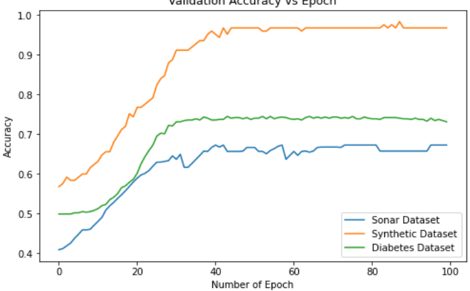
Nowadays, quantum-enhanced methods have been widely studied to solve machine learning related problems. This article presents the application of a Variational Quantum Classifier (VQC) for binary classification. We utilized three datasets: a synthetic dataset with randomly generated values between 0 and 1, the publicly available University of California Intelligence Machine learning (UCI) sonar dataset consisting of mining data, and a proprietary diabetes dataset related to diabetes with acute diseases and diabetes without acute disease. To deal with the limitation of noisy intermediate-scale quantum systems (NISQ), we used a pre-processing method to enhance the prediction rate when applying the VQC method. The process includes feature selection and state preparation. Quantum state preparation is critical for obtaining a functioning pipeline in a quantum machine learning (QML) model. Amplitude encoding is a state preparation approach that enhances the performance of data encoding and the learning of quantum models. As a result, our proposed methods achieved accuracies of 75%, 71.4%, and 68.73% by using VQC model and in contrast, the amplitude encoding-based VQC achieved 98.40%, 67.3%, and 74.50% accuracies on the synthetic, sonar, and diabetes dataset, respectively.
Overview
CoChat Summary
TL;DR
The paper evaluates variational quantum classifier (VQC) binary classification on three datasets—synthetic, UCI Sonar, and a proprietary diabetes dataset—and compares basis encoding with amplitude encoding. Amplitude encoding improved performance on the synthetic and diabetes datasets, but not on Sonar.
Key findings
- The paper reports VQC accuracies of 75% on the synthetic dataset, 71.4% on Sonar, and 68.73% on diabetes.
- With amplitude encoding-based VQC, the reported accuracies were 98.40% on the synthetic dataset, 67.3% on Sonar, and 74.50% on diabetes.
- On the synthetic dataset, classical SVM achieved 100% accuracy, compared with 94% for QSVM and 75% for VQC; the amplitude-encoding VQC reached 98.40%.
- On Sonar, classical SVM achieved 85.71% accuracy, versus 76.19% for QSVM and 71.4% for VQC; on diabetes, SVM achieved 75.32% versus 74.19% for QSVM and 68.73% for VQC.
Methods
- The study uses three datasets: a synthetic dataset with 500 samples and 25 attributes (balanced 250/250), the UCI Sonar dataset with 208 samples and 60 attributes (111 metal cylinder, 97 rock), and a proprietary diabetes dataset derived from Osakidetza EHRs and the PREST database.
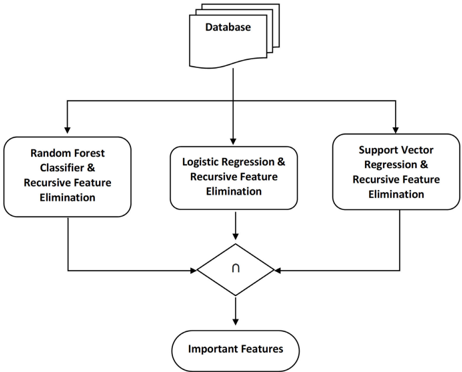
- A preprocessing pipeline is applied: recursive feature elimination / feature selection, then min-max normalization to the 0–1 range, then quantum state preparation using basis encoding or amplitude encoding.
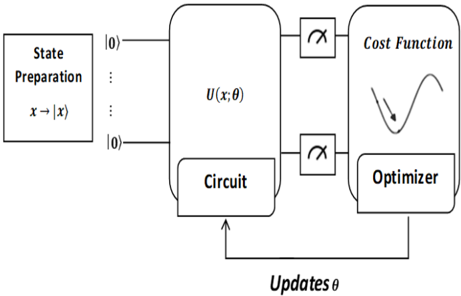
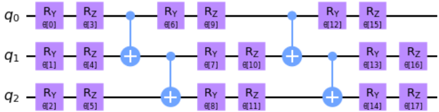
- The main model is a Variational Quantum Classifier (VQC) implemented in IBM Qiskit, using feature maps such as FirstOrderExpansion, SecondOrderExpansion, and SecondOrderPauliExpansion, with COBYLA optimization; the data split is 80% training / 20% testing.
Limitations
- The paper itself notes that NISQ device limitations constrain QML techniques and motivate preprocessing; this is stated explicitly in the Methods section.
- The paper says the amplitude encoding VQC improved synthetic and diabetes results but had little influence on Sonar performance.
- Evident from the text: the diabetes dataset is proprietary, and the paper does not provide full raw dataset details beyond aggregated counts and variable descriptions, which limits reproducibility.
Model-written summary. Check it against the paper before relying on it.
Integrity signals
Registry
Cites
Statistics
Figures




Verification
Claims the paper makes
5 Valid · 0 Not valid · 10 Not checked · 35 Own results and interpretations
A result the paper reports from its own data — it cites no other source for it, so there is none to check. The quote shows it is in the paper.
In the paper
“As a result, our proposed methods achieved accuracies of 75%, 71.4%, and 68.73% by using VQC model and in contrast, the amplitude encoding-based VQC achieved 98.40%, 67.3%, and 74.50% accuracies on the synthetic, sonar, and diabetes dataset, respectively.”
§ Variational Quantum Classifier for Binary Classification: Real vs Synthetic Dataset > Abstract
plain- Asserted: passes — The authors put it forward as true.
- Checkable: passes — It can be checked against evidence.
- Load-bearing: passes — The paper’s conclusions depend on it.
- Based: passes — The paper gives a reason why it holds.
A result the paper states — it cites no source for it, so there is none to check. The quote shows it is in the paper.
In the paper
“these three classifiers extracted the eight important features from all datasets, including the synthetic dataset, the sonar dataset, and the diabetes dataset, as illustrated in Figure 1.”
§ Variational Quantum Classifier for Binary Classification: Real vs Synthetic Dataset > 1) PRE-PROCESSING
plainstates a cause- Asserted: passes — The authors put it forward as true.
- Checkable: passes — It can be checked against evidence.
- Load-bearing: unclear — It is unclear whether the paper’s conclusions depend on it.
- Based: passes — The paper gives a reason why it holds.
A result the paper reports from its own data — it cites no other source for it, so there is none to check. The quote shows it is in the paper.
In the paper
“As a result, our proposed methods achieved accuracies of 75%, 71.4%, and 68.73% by using VQC model and in contrast, the amplitude encoding-based VQC achieved 98.40%, 67.3%, and 74.50% accuracies on the synthetic, sonar, and diabetes dataset, respectively.”
§ Variational Quantum Classifier for Binary Classification: Real vs Synthetic Dataset > Abstract
plain- Asserted: passes — The authors put it forward as true.
- Checkable: passes — It can be checked against evidence.
- Load-bearing: passes — The paper’s conclusions depend on it.
- Based: passes — The paper gives a reason why it holds.
24 more claims
Create a free account to see all 50 claims and to verify the 10 references still open.
- Probably not a substantial claim. 15
- The quote only partly states this claim. 1
- It may state two separate claims as one. 9
Citations
Cites
Biamonte, J., Wittek, P., Pancotti, N., Rebentrost, P., Wiebe, N., & Lloyd, S. (2017) · Nature · doi:10.1038/nature23474 · Cited by 4,779
Supervised learning with quantum-enhanced feature spaces
Havlíček, V., Córcoles, A. D., Temme, K., Harrow, A. W., Kandala, A., Chow, J. M., & Gambetta, J. M. (2019) · Nature · doi:10.1038/s41586-019-0980-2 · Cited by 2,572
Quantum Support Vector Machine for Big Data Classification
Rebentrost, P., Mohseni, M., & Lloyd, S. (2014) · Physical Review Letters · doi:10.1103/physrevlett.113.130503 · Cited by 1,951
Quantum Machine Learning in Feature Hilbert Spaces
Schuld, M., & Killoran, N. (2019) · Physical Review Letters · doi:10.1103/physrevlett.122.040504 · Cited by 1,840 · cited 2×
“This process reduces experimental overhead in terms of resources and assists in avoiding of non-linearities in data [5], [16], allowing linear classifiers and kernel-based techniques to perform better in terms of predictions [17], [18], as well as the use of near-term Quantum processors with…”
BackgroundQuantum principal component analysis
Lloyd, S., Mohseni, M., & Rebentrost, P. (2014) · Nature Physics · doi:10.1038/nphys3029 · Cited by 1,385
An introduction to quantum machine learning
Schuld, M., Sinayskiy, I., & Petruccione, F. (2015) · Contemporary Physics · doi:10.1080/00107514.2014.964942 · Cited by 1,381 · cited 1×
“There are four possible approaches in QML based on data and the correspondent processing device, whether classical or quantum [9].”
MethodAnalysis of hidden units in a layered network trained to classify sonar targets
Gorman, R. P., & Sejnowski, T. J. (1988) · Neural Networks · doi:10.1016/0893-6080(88)90023-8 · Cited by 1,114
Circuit-centric quantum classifiers
Schuld, M., Bocharov, A., Svore, K. M., & Wiebe, N. (2020) · Physical Review A · doi:10.1103/physreva.101.032308 · Cited by 1,057 · cited 2×
“Encoding methods for various feature maps are as follows [12], [17], [19].”
MethodQuantum optimization using variational algorithms on near-term quantum devices
Moll, N., Barkoutsos, P., Bishop, L. S., Chow, J. M., Cross, A., Egger, D. J., Filipp, S., Fuhrer, A., Gambetta, J. M., Ganzhorn, M., et al. (2018) · Quantum Science and Technology · doi:10.1088/2058-9565/aab822 · Cited by 744
Classification with Quantum Neural Networks on Near Term Processors
Farhi, E., & Neven, H. (2018) · arXiv · doi:10.48550/arxiv.1802.06002 · Cited by 598
Quantum autoencoders for efficient compression of quantum data
Romero, J., Olson, J. P., & Aspuru-Guzik, A. (2017) · Quantum Science and Technology · doi:10.1088/2058-9565/aa8072 · Cited by 559 · cited 1×
“process reduces experimental overhead in terms of resources and assists in avoiding of non-linearities in data [5], [16], allowing linear classifiers and kernel-based techniques to perform better in terms of predictions [17], [18], as well as the use of near-term Quantum processors with exponential speedup in such met…”
MethodQuantum machine learning: a classical perspective
Ciliberto, C., Herbster, M., Ialongo, A. D., Pontil, M., Rocchetto, A., Severini, S., & Wossnig, L. (2018) · Proceedings of the Royal Society A: Mathematical, Physical and Engineering Sciences · doi:10.1098/rspa.2017.0551 · Cited by 518
Classification with Quantum Neural Networks on Near Term Processors
Farhi, E., & Neven, H. (2020) · doi:10.37686/qrl.v1i2.80 · Cited by 332
Breast Cancer Histopathology Image Classification Using an Ensemble of Deep Learning Models
Hameed, Z., Zahia, S., Garcia-Zapirain, B., Javier Aguirre, J., & María Vanegas, A. (2020) · Sensors · doi:10.3390/s20164373 · Cited by 277 · cited 1×
“The Feature Selection (FS) technique is extensively used in ML and DL [33] to select the best features from the set of features that allows effective prediction of the outputs.”
MethodSentiment Classification Using a Single-Layered BiLSTM Model
Hameed, Z., & Garcia-Zapirain, B. (2020) · IEEE Access · doi:10.1109/access.2020.2988550 · Cited by 269
Self-citationGupta, H., Varshney, H., Sharma, T. K., Pachauri, N., & Verma, O. P. (2022) · Complex & Intelligent Systems · doi:10.1007/s40747-021-00398-7 · Cited by 191 · cited 2×
“H. Gupta et al. [24] employed the VQC model to predict related to diabetic disease using the Diabetes dataset, and they obtained a maximum accuracy of 74%.”
Method(2007) · Cited by 175
Supervised quantum machine learning models are kernel methods
Schuld, M. (2021) · arXiv · doi:10.48550/arxiv.2101.11020 · Cited by 173
A divide-and-conquer algorithm for quantum state preparation
Araujo, I. F., Park, D. K., Petruccione, F., & da Silva, A. J. (2021) · Scientific Reports · doi:10.1038/s41598-021-85474-1 · Cited by 166
Transformation of quantum states using uniformly controlled rotations
Mottonen, M., Vartiainen, J. J., Bergholm, V., & Salomaa, M. M. (2005) · Quantum Information and Computation · doi:10.26421/qic5.6-5 · Cited by 161
Constructing exact representations of quantum many-body systems with deep neural networks
Carleo, G., Nomura, Y., & Imada, M. (2018) · Nature Communications · doi:10.1038/s41467-018-07520-3 · Cited by 154
Binary biogeography-based optimization based SVM-RFE for feature selection
Albashish, D., Hammouri, A. I., Braik, M., Atwan, J., & Sahran, S. (2021) · Applied Soft Computing · doi:10.1016/j.asoc.2020.107026 · Cited by 154
Quantum Algorithm for K-Nearest Neighbors Classification Based on the Metric of Hamming Distance
Ruan, Y., Xue, X., Liu, H., Tan, J., & Li, X. (2017) · International Journal of Theoretical Physics · doi:10.1007/s10773-017-3514-4 · Cited by 142
Constructing exact representations of quantum many-body systems with deep neural networks
Carleo, G., Nomura, Y., & Imada, M. (2018) · RePEc: Research Papers in Economics · doi:10.3929/ethz-b-000313237 · Cited by 133
Quantum Machine Learning: A tutorial
Martín-Guerrero, J. D., & Lamata, L. (2022) · Neurocomputing · doi:10.1016/j.neucom.2021.02.102 · Cited by 106
A quantum algorithm to train neural networks using low-depth circuits
Verdon, G., Broughton, M., & Biamonte, J. (2017) · arXiv · doi:10.48550/arxiv.1712.05304 · Cited by 87
Quantum Simulations of Physics Problems
Somma, R., Ortiz, G., Knill, E., & Gubernatis, J. (2003) · International Journal of Quantum Information · doi:10.1142/s0219749903000140 · Cited by 85
Wiebe, N., Kapoor, A., & Svore, K. M. (2016) · Quantum Information and Computation · doi:10.26421/qic16.7-8-1 · Cited by 85 · cited 1×
“The use of QML improves the performance and speeds up the data processing on QC [6], [7].”
MethodClassification with Quantum Machine Learning: A Survey
Abohashima, Z., Elhosen, M., Houssein, E. H., & Mohamed, W. M. (2020) · arXiv · doi:10.48550/arxiv.2006.12270 · Cited by 68
Dyslexia detection using 3D convolutional neural networks and functional magnetic resonance imaging
Zahia, S., Garcia-Zapirain, B., Saralegui, I., & Fernandez-Ruanova, B. (2020) · Computer Methods and Programs in Biomedicine · doi:10.1016/j.cmpb.2020.105726 · Cited by 67
Self-citationScalable Healthcare Assessment for Diabetic Patients Using Deep Learning on Multiple GPUs
Sierra-Sosa, D., Garcia-Zapirain, B., Castillo, C., Oleagordia, I., Nuno-Solinis, R., Urtaran-Laresgoiti, M., & Elmaghraby, A. (2019) · IEEE Transactions on Industrial Informatics · doi:10.1109/tii.2019.2919168 · Cited by 64
Self-citationA Variational Algorithm for Quantum Neural Networks
Macaluso, A., Clissa, L., Lodi, S., & Sartori, C. (2020) · Lecture notes in computer science · doi:10.1007/978-3-030-50433-5_45 · Cited by 58
Classification of Apple Disease Based on Non-Linear Deep Features
Ayaz, H., Rodríguez-Esparza, E., Ahmad, M. I., Oliva, D. A., Pérez‐Cisneros, M., & Sarkar, R. (2021) · Applied Sciences · doi:10.3390/app11146422 · Cited by 54
Quantum simulations of physics problems
Somma, R. D., Ortiz, G., Knill, E. H., & Gubernatis, J. (2003) · SPIE Proceedings · doi:10.1117/12.487249 · Cited by 53
A hybrid quantum feature selection algorithm using a quantum inspired graph theoretic approach
Chakraborty, S., Shaikh, S. H., Chakrabarti, A., & Ghosh, R. (2020) · Applied Intelligence · doi:10.1007/s10489-019-01604-3 · Cited by 51 · cited 3×
“For example, S. Chakraborty et al. [22] utilized a hybrid quantum feature selection algorithm (HQFSA) to forecast metal and rocks, achieving an accuracy of 74% on a sonar dataset containing 60 features.”
BackgroundMethodTensorFlow Quantum: Impacts of Quantum State Preparation on Quantum Machine Learning Performance
Sierra-Sosa, D., Telahun, M., & Elmaghraby, A. (2020) · IEEE Access · doi:10.1109/access.2020.3040798 · Cited by 46
Self-citationPredicting Physical Exercise Adherence in Fitness Apps Using a Deep Learning Approach
Jossa-Bastidas, O., Zahia, S., Fuente-Vidal, A., Férez, N. S., Noguera, O. R., Montané, J., & García-Zapirain, B. (2021) · International Journal of Environmental Research and Public Health · doi:10.3390/ijerph182010769 · Cited by 42
Self-citationAustin, P. C., Newman, A. M., & Kurdyak, P. A. (2012) · Psychiatry Research · doi:10.1016/j.psychres.2011.09.023 · Cited by 42
Machine learning applied to diabetes dataset using Quantum versus Classical computation
Maheshwari, D., García-Zapirain, B., & Sierra-Soso, D. (2020) · IEEE International Symposium on Signal Processing and Information Technology (ISSPIT) · doi:10.1109/isspit51521.2020.9408944 · Cited by 39
Self-citationMachine learning in quantum spaces
Schuld, M. (2019) · Nature · doi:10.1038/d41586-019-00771-0 · Cited by 39
Austin, P. C., Shah, B. R., Newman, A. M., & Anderson, G. M. (2011) · Diabetic Medicine · doi:10.1111/j.1464-5491.2011.03568.x · Cited by 36
A Unitary Weights Based One-Iteration Quantum Perceptron Algorithm for Non-Ideal Training Sets
Liu, W., Gao, P., Wang, Y., Yu, W., & Zhang, M. (2019) · IEEE Access · doi:10.1109/access.2019.2896316 · Cited by 33
Dementia Prediction Applying Variational Quantum ClassifierPreprint
Sierra-Sosa, D., Arcila-Moreno, J. D., García-Zapirain, B., Castillo-Olea, C., & Elmaghraby, A. S. (2020) · arXiv (Cornell University) · doi:10.48550/arxiv.2007.08653 · Cited by 31
Self-citationDu, G., Su, Y., Yao, H., Zhu, J., Ma, Q., Tuerdi, A., He, X., Wang, L., Wang, Z.-Q., Xiao, S., et al. (2016) · PLoS ONE · doi:10.1371/journal.pone.0162611 · Cited by 30
The Importance of Feature Processing in Deep-Learning-Based Condition Monitoring of Motors
Kumar, D., Daudpoto, J., Harris, N. R., Hussain, M., Mehran, S., Kalwar, I. H., Hussain, T., & Memon, T. D. (2021) · Mathematical Problems in Engineering · doi:10.1155/2021/9927151 · Cited by 25
Entropy-Based Classifier Enhancement to Handle Imbalanced Class Problem
Kiršners, A., Parshutin, S., & Gorskis, H. (2017) · Procedia Computer Science · doi:10.1016/j.procs.2017.01.176 · Cited by 20
Diabetes Type 2: Poincar�Data Preprocessing for Quantum Machine Learning
Sierra-Sosa, D., D. Arcila-Moreno, J., Garcia-Zapirain, B., & Elmaghraby, A. (2021) · Computers, Materials & Continua · doi:10.32604/cmc.2021.013196 · Cited by 16
Self-citation
Research works printed but not linked: 3
- 2021, QPU Topology—Ocean Documentation 3.1.1 Documentation
- International Diabetes Federation—Facts & Figures
- Abraham, 2021, Qiskit 0.34.0 Documentation
Cited by
Ullah, U., & Garcia-Zapirain, B. (2024) · IEEE Access · doi:10.1109/access.2024.3353461 · Cited by 188
Self-citationQuantum Machine Learning Applications in the Biomedical Domain: A Systematic Review
Maheshwari, D., García-Zapirain, B., & Sierra-Sosa, D. (2022) · IEEE Access · doi:10.1109/access.2022.3195044 · Cited by 197
Self-citationRanga, D., Rana, A., Prajapat, S., Kumar, P., Kumar, K., & Vasilakos, A. V. (2024) · Mathematics · doi:10.3390/math12213318 · Cited by 149
Quantum Machine Learning: Recent Advances, Challenges, and Perspectives
Lamichhane, P., & Rawat, D. B. (2025) · IEEE Access · doi:10.1109/access.2025.3573244 · Cited by 117
A Fully Connected Quantum Convolutional Neural Network for Classifying Ischemic Cardiopathy
Ullah, U., García-Olea, A., Gonzalez, I. D., & García-Zapirain, B. (2022) · IEEE Access · doi:10.1109/access.2022.3232307 · Cited by 55
Self-citation
Metadata
- Authors
- Maheshwari, D., Sierra-Sosa, D., & Garcia-Zapirain, B.
- Affiliations
- Universidad de Deusto (ES)
- Hood College (US)
- Venue
- IEEE Access
- Published
- 2022
- Volume
- 10
- Pages
- 3705-3715
- ISSN
- 2169-3536 (ISSN-L)
- OpenAlex
- W4206799920
- Semantic Scholar
- 1f4cebad8ead7d10cfa2c4e6454c4decdcb99244
- Cited by
- 108
- References
- 47
- Citations by year
- 2026: 18 · 2025: 38 · 2024: 28 · 2023: 16 · 2022: 8
- FWCI
- 4.60
- Type
- journal article
- Language
- en
- Open access
- gold
- doi.org
- Licence
- Locations
- IEEE Access (publishedVersion, cc-by)
- DOAJ (DOAJ: Directory of Open Access Journals) (submittedVersion, cc-by-sa)
- Funders
- eVIDA Research Group, University of Deusto, Bilbao, Spain, through the Basque Government’s (IT 905-16)
- Topics
- Physical Sciences › Computer Science › Artificial Intelligence › Quantum Computing Algorithms and Architecture
- Physical Sciences › Physics and Astronomy › Atomic and Molecular Physics, and Optics › Quantum Information and Cryptography
- Physical Sciences › Physics and Astronomy › Atomic and Molecular Physics, and Optics › Quantum many-body systems
- Keywords
- variational quantum classifier, binary classification, quantum machine learning, amplitude encoding, quantum state preparation, feature selection, diabetes dataset, synthetic data
About these checks
Registry, retraction, Cites and statistics results are computed, not judged, with one exception: a printed reference that no index lists is read once by a model before it counts as a citation error. Claims are extracted by a model and kept only when their quote appears verbatim in the text; each cited source is then checked, with a model’s help, for whether it says what the claim relies on. Those verdicts can be wrong — read the claim’s quote and the cited source before relying on one.
The claim verdicts this report counts are experimental: their accuracy is not yet measured.
A language model drew the claims from the paper on 2026-10-10, under version 3 of the claim definition (model deepseek-v4.1-flash, prompt extract-v3).
A second model labelled each claim on 2026-10-10 (model jev-1.13-20260917, definition revision gold-guideline-v0.2).
Statistics and arithmetic are recomputed, not judged.
Confidence bands are shown only for fields calibrated on our annotated test set. None is calibrated yet, so no band is shown.
What counts as a claim ›How we measure confidence ›How we check this ›
Are you an author, or do you see a problem with this page? Request a review
Data sources
Bibliographic data: Semantic Scholar, OpenAlex, Crossref.
Contains information from the Semantic Scholar Academic Graph Datasets, made available under the ODC Attribution License (ODC-BY 1.0).
Semantic Scholar’s data is described in: Kinney, R., et al. (2023). The Semantic Scholar Open Data Platform. arXiv:2301.10140.
