

The DOI matches its Crossref record; 153 of the 154 references it cites were found in a registry or an index.
Innovative Trends in the 6G Era: A Comprehensive Survey of Architecture, Applications, Technologies, and Challenges
Open accessAbstract
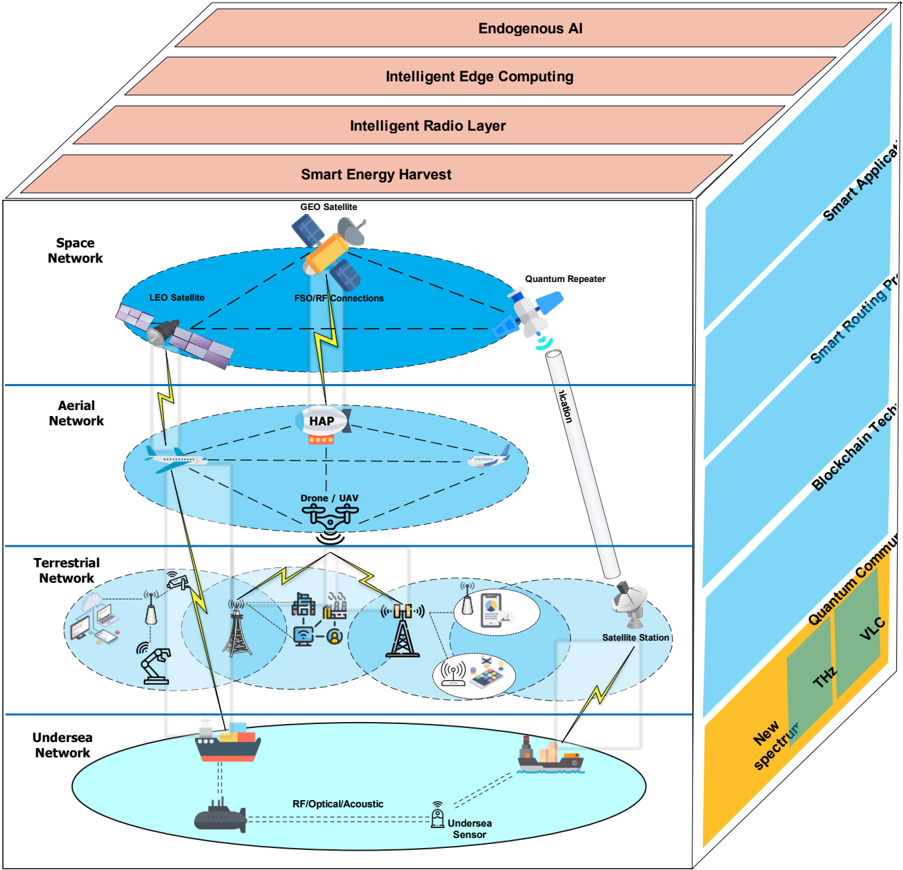
While the fifth-generation mobile network is being commercialized worldwide, researchers have recently started looking towards the next generation, called the 6G network. Unlike 5G and previous generations of wireless technologies designed to improve network performance for greater bandwidth, lower latency and greater reliability, 6G ecosystems is considered a platform conducive to innovations in the fields of computing, artificial intelligence, connectivity and sensors, virtualization and more. It is designed to meet the requirements of higher global coverage, greater spectral efficiency, a reduced carbon footprint, with an emphasis on sustainability, equity, trust and security through unprecedented architectural evolutions and technology. 6G will be an integrated network system that includes a traditional terrestrial mobile network, space network, and underwater network to provide ubiquitous network access. Even if there are studies on vision of 6G network that have already been published, there is still a significant amount of ground to cover. There is no decision made yet regarding anything and nothing has been ruled out. The focus of this study is to identify a complete picture of changes in architectures, technologies, and challenges that will shape the 6G network. We hope the research results will provide indications for further studies on 6G ecosystems.
Overview
The claims and statistics of this paper haven’t been checked yet.
Run the check — free, no account needed. It reads the open-access text and checks the sources it cites.
Integrity signals
Registry
Cites
Statistics
Figures



Verification
Claims the paper makes
The claims and statistics of this paper haven’t been checked yet.
Run the check — free, no account needed. It reads the open-access text and checks the sources it cites.
Claims other papers make about this one
Each is checked against this paper’s own text: does it say what the citing paper says it does?
In the citing paper
“Thus, the next-generation communication networks, such as 6G, play a crucial role in enabling the above vision [83].”
From New Era of Artificial Intelligence in Education: Towards a Sustainable Multifaceted Revolution (2023) · cites this paper as [83]
Self-check
Percentages, sums and reported differences re-computed from the paper’s own numbers.
The self-check needs the paper’s full text.
Citations
Cites
6G Wireless Networks: Vision, Requirements, Architecture, and Key Technologies
Zhang, Z., Xiao, Y., Ma, Z., Xiao, M., Ding, Z., Lei, X., Karagiannidis, G. K., & Fan, P. (2019) · IEEE Vehicular Technology Magazine · doi:10.1109/mvt.2019.2921208 · Cited by 2,575
The Roadmap to 6G: AI Empowered Wireless Networks
Letaief, K. B., Chen, W., Shi, Y., Zhang, J., & Zhang, Y.-J. A. (2019) · IEEE Communications Magazine · doi:10.1109/mcom.2019.1900271 · Cited by 2,207
A Metaverse: Taxonomy, Components, Applications, and Open Challenges
Park, S., & Kim, Y. (2022) · IEEE Access · doi:10.1109/access.2021.3140175 · Cited by 2,046
Deep Learning in Mobile and Wireless Networking: A Survey
Zhang, C., Patras, P., & Haddadi, H. (2019) · IEEE Communications Surveys & Tutorials · doi:10.1109/comst.2019.2904897 · Cited by 1,913
The Road Towards 6G: A Comprehensive Survey
Jiang, W., Han, B., Habibi, M. A., & Schotten, H. D. (2021) · IEEE Open Journal of the Communications Society · doi:10.1109/ojcoms.2021.3057679 · Cited by 1,757
A Survey on Metaverse: Fundamentals, Security, and Privacy
Wang, Y., Su, Z., Zhang, N., Xing, R., Liu, D., Luan, T. H., & Shen, X. (2022) · IEEE Communications Surveys & Tutorials · doi:10.1109/comst.2022.3202047 · Cited by 1,655
Convergence of Edge Computing and Deep Learning: A Comprehensive Survey
Wang, X., Han, Y., Leung, V. C. M., Niyato, D., Yan, X., & Chen, X. (2020) · IEEE Communications Surveys & Tutorials · doi:10.1109/comst.2020.2970550 · Cited by 1,498 · cited 1×
“Therefore, it is also proposed as one of the attractive technologies for 6G. • Edge computing: is considered the revolution of 6G. Edge computing (EC) allows for a significant increase in the computing capacity of the network [59], [72], [73], [151].”
Background6G and Beyond: The Future of Wireless Communications Systems
Akyildiz, I. F., Kak, A., & Nie, S. (2020) · IEEE Access · doi:10.1109/access.2020.3010896 · Cited by 1,472
6G Internet of Things: A Comprehensive Survey
Nguyen, D. C., Ding, M., Pathirana, P. N., Seneviratne, A. P., Li, J., Niyato, D. T., Dobre, O. A., & Poor, H. V. (2021) · IEEE Internet of Things Journal · doi:10.1109/jiot.2021.3103320 · Cited by 1,468
Satellite-Relayed Intercontinental Quantum Network
Liao, S., Cai, W., Handsteiner, J., Liu, B., Yin, J., Zhang, L., Rauch, D., Fink, M., Ren, J.-G., Liu, W.-Y., et al. (2018) · Physical Review Letters · doi:10.1103/physrevlett.120.030501 · Cited by 832
Research works printed but not linked: 1
- 10.1109/COMST.2019.2902862 · DOI · Paper page
Cited by
Sorted by citations
New Era of Artificial Intelligence in Education: Towards a Sustainable Multifaceted Revolution
Kamalov, F., Santandreu Calonge, D., & Gurrib, I. (2023) · Sustainability · doi:10.3390/su151612451 · Cited by 1,089
“Thus, the next-generation communication networks, such as 6G, play a crucial role in enabling the above vision [59].”
Background6G Networks and the AI Revolution—Exploring Technologies, Applications, and Emerging Challenges
Chataut, R., Nankya, M., & Akl, R. (2024) · Sensors · doi:10.3390/s24061888 · Cited by 262
A Review of 6G and AI Convergence: Enhancing Communication Networks With Artificial Intelligence
Sanjalawe, Y. K., Fraihat, S., Al-E’mari, S., Abualhaj, M. M., Makhadmeh, S. N., & Alzubi, E. A. (2025) · IEEE Open Journal of the Communications Society · doi:10.1109/ojcoms.2025.3553302 · Cited by 138
From Efficiency to Sustainability: Exploring the Potential of 6G for a Greener Future
Kumar, R., Gupta, S. K., Wang, H.-C., Kumari, C. S., & Korlam, S. S. V. P. (2023) · Sustainability · doi:10.3390/su152316387 · Cited by 112
Akbar, M. S., Hussain, Z., Ikram, M., Sheng, Q. Z., & Mukhopadhyay, S. C. (2024) · Journal of Network and Computer Applications · doi:10.1016/j.jnca.2024.104040 · Cited by 174
Metadata
- Authors
- Quy, V. K., Chehri, A., Quy, N. M., Han, N. D., & Ban, N. T.
- Affiliations
- Hung Yen University of Technology and Education, Hung Yen, Vietnam
- Royal Military College of Canada (CA)
- Trường Đại học Khoa học và Công nghệ Hà Nội (VN)
- Posts and Telecommunications Institute of Technology (VN)
- Venue
- IEEE Access
- Published
- 2023
- Volume
- 11
- Pages
- 39824-39844
- ISSN
- 2169-3536 (ISSN-L)
- OpenAlex
- W4366721991
- Cited by
- 164
- References
- 154
- Citations by year
- 2026: 18 · 2025: 55 · 2024: 59 · 2023: 31
- FWCI
- 12.12
- Type
- journal article
- Language
- en
- Open access
- gold
- doi.org
- Licence
- Locations
- IEEE Access (publishedVersion, cc-by-nc-nd)
- DOAJ (DOAJ: Directory of Open Access Journals) (submittedVersion, cc-by-sa)
- Funders
- Natural Sciences and Engineering Research Council of Canada (RGPIN-2022-3256)
- Topics
- Physical Sciences › Engineering › Electrical and Electronic Engineering › Advanced Wireless Communication Technologies
- Physical Sciences › Computer Science › Computer Networks and Communications › Software-Defined Networks and 5G
- Physical Sciences › Engineering › Aerospace Engineering › Satellite Communication Systems
- Keywords
- 6G, network architecture, 6G applications, space networks, underwater networks, ubiquitous connectivity, sustainability, network security, artificial intelligence in networks, virtualization
About these checks
Registry, retraction, Cites and statistics results are computed, not judged, with one exception: a printed reference that no index lists is read once by a model before it counts as a citation error. Claims are extracted by a model and kept only when their quote appears verbatim in the text; each cited source is then checked, with a model’s help, for whether it says what the claim relies on. Those verdicts can be wrong — read the claim’s quote and the cited source before relying on one.
Statistics and arithmetic are recomputed, not judged.
Confidence bands are shown only for fields calibrated on our annotated test set. None is calibrated yet, so no band is shown.
What counts as a claim ›How we measure confidence ›How we check this ›
Are you an author, or do you see a problem with this page? Request a review
