

SDN-Based VANET Routing: A Comprehensive Survey on Architectures, Protocols, Analysis, and Future Challenges
Open accessThe DOI matches its Crossref record; 224 of the 224 references it cites were found in a registry or an index.
Abstract
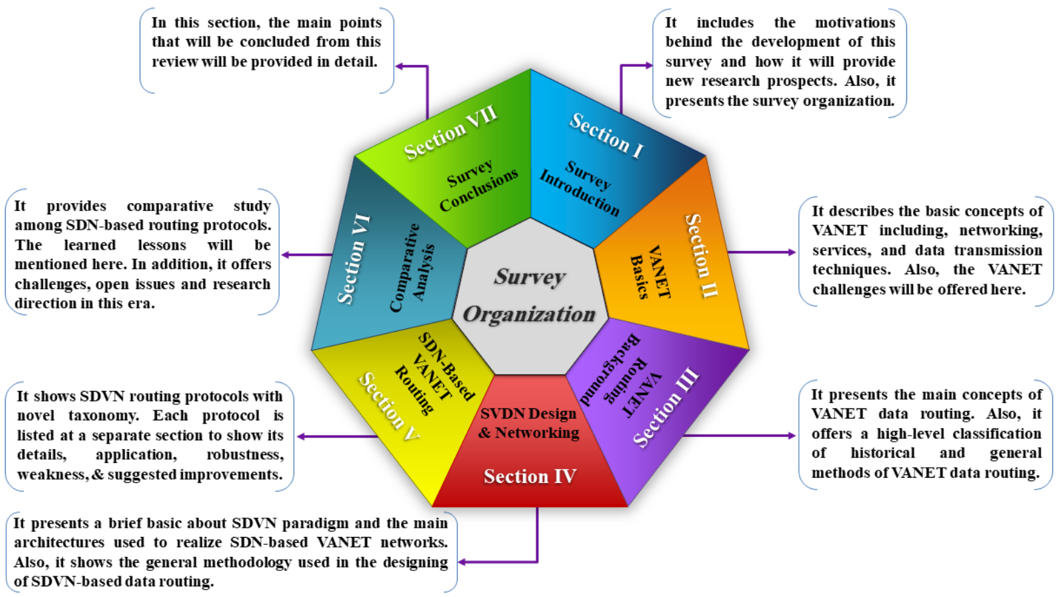
As the automotive and telecommunication industries advance, more vehicles are becoming connected, leading to the realization of intelligent transportation systems (ITS). Vehicular ad-hoc network (VANET) supports various ITS services, including safety, convenience, and infotainment services for drivers and passengers. Generally, such services are realized through data sharing among vehicles and nearby infrastructures or vehicles over multi-hop data routing mechanisms. Vehicular data routing faces many challenges caused by vehicle dynamicity, intermittent connectivity, and diverse application requirements. Consequently, the software-defined networking (SDN) paradigm offers unique features such as programmability and flexibility to enhance vehicular network performance and management and meet the quality of services (QoS) requirements of various VANET services. Recently, VANET routing protocols have been improved using the multilevel knowledge and an up-to-date global view of traffic conditions offered by SDN technology. The primary objective of this study is to furnish comprehensive information regarding the current SDN-based VANET routing protocols, encompassing intricate details of their underlying mechanisms, forwarding algorithms, and architectural considerations. Each protocol will be thoroughly examined individually, elucidating its strengths, weaknesses, and proposed enhancements. Also, the software-defined vehicular network (SDVN) architectures are presented according to their operation modes and controlling degree. Then, the potential of SDN-based VANET is explored from the aspect of routing and the design requirements of routing protocols in SDVNs. SDVN routing algorithms are uniquely classified according to various criteria. In addition, a complete comparative analysis will be achieved to analyze the protocols regarding performance, optimization, and simulation results. Finally, the challenges and upcoming research directions for developing such protocols are widely stated here. By presenting such insights, this paper provides a comprehensive overview and inspires researchers to enhance existing protocols and explore novel solutions, thereby paving the way for innovation in this field.
Overview
The claims and statistics of this paper haven’t been checked yet.
Free: it reads the open-access text and checks the first 5 claims that cite a source we can check. Create a free account to check every claim.
Integrity signals
Registry
Cites
Statistics
Figures















Verification
Claims the paper makes
The claims and statistics of this paper haven’t been checked yet.
Free: it reads the open-access text and checks the first 5 claims that cite a source we can check. Create a free account to check every claim.
Claims other papers make about this one
Each is checked against this paper’s own text: does it say what the citing paper says it does?
The source backs part of the claim, not all of it — or backs it for a different population, condition or comparison.
In the citing paper
“This appendix provides a comprehensive list of vulnerabilities in VANETs categorized into six main groups.”
From Enhancing Intelligent Transport Systems Through Decentralized Security Frameworks in Vehicle-to-Everything Networks (2025) · cites this paper as [6]
Experimental — accuracy not yet measured
Self-check
Percentages, sums and reported differences re-computed from the paper’s own numbers.
The self-check needs the paper’s full text.
Citations
Cites
2 retracted
Gawas, M. A., & Govekar, S. S. (2020) · Wireless Personal Communications · doi:10.1007/s11277-020-07790-5 · Cited by 34
RetractedWITHDRAWN: Performance analysis of routing protocols IN vehicular adhoc networks
Devi, Y. S., & Roopa, M. (2021) · Materials Today Proceedings · doi:10.1016/j.matpr.2021.02.556 · Cited by 5
RetractedMcKeown (2008) · doi:10.1145/1355734.1355746 · Cited by 8,513
A Survey of Autonomous Driving: Common Practices and Emerging Technologies
Yurtsever, E., Lambert, J., Carballo, A., & Takeda, K. (2020) · IEEE Access · doi:10.1109/access.2020.2983149 · Cited by 1,889
Routing in vehicular ad hoc networks: A survey
Li, F., & Wang, Y. (2007) · IEEE Vehicular Technology Magazine · doi:10.1109/mvt.2007.912927 · Cited by 1,124
Future Intelligent and Secure Vehicular Network Toward 6G: Machine-Learning Approaches
Tang, F., Kawamoto, Y., Kato, N., & Liu, J. (2020) · Proceedings of the IEEE · doi:10.1109/jproc.2019.2954595 · Cited by 620
Microscopic Traffic Flow Simulator VISSIM
Fellendorf, M., & Vortisch, P. (2010) · International Series in Operations Research & Management Science · doi:10.1007/978-1-4419-6142-6_2 · Cited by 551
Routing in Internet of Vehicles: A Review
Cheng, J., Cheng, J., Zhou, M., Liu, F., Gao, S., & Liu, C. (2015) · IEEE Transactions on Intelligent Transportation Systems · doi:10.1109/tits.2015.2423667 · Cited by 417
Quality of Service (QoS) in Software Defined Networking (SDN): A survey
Karakus, M., & Durresi, A. (2017) · Journal of Network and Computer Applications · doi:10.1016/j.jnca.2016.12.019 · Cited by 414
Vehicular communication ad hoc routing protocols: A survey
Sharef, B. T., Alsaqour, R. A., & Ismail, M. (2014) · Journal of Network and Computer Applications · doi:10.1016/j.jnca.2013.09.008 · Cited by 332
Research works printed but not linked: 3
- Altayeb, 2013, A survey of vehicular ad hoc networks routing techniques, Int. J. Innov. Appl. Stud., 3, 829
- Houssaini, 2017, Comparative study of routing protocols performance for vehicular ad-hoc networks, Int. J. Appl. Eng. Res., 12, 3867
- Kumari, 2022, A review on video based vehicle detection and tracking using image processing, Int. J. Res. Publ. Rev., 2582, 7421
Cited by
Security Challenges in Internet of Vehicles (IoV) for ITS: A Survey
Khezri, E., Hassanzadeh, H., Yahya, R. O., & Mir, M. (2025) · Tsinghua Science & Technology · doi:10.26599/tst.2024.9010083 · Cited by 85
Comprehensive Analysis of DDoS Anomaly Detection in Software-Defined Networks
Hirsi, A., Alhartomi, M. A., Audah, L., Salh, A., Sahar, N. M., Ahmed, S., Ansa, G. O., & Farah, A. (2025) · IEEE Access · doi:10.1109/access.2025.3535943 · Cited by 71
Khan, W., Ahmad, J. E., Alasbali, N. A., Mazroa, A. A., Alshehri, M. S., & Khan, M. S. (2025) · Computer Networks · doi:10.1016/j.comnet.2025.111575 · Cited by 30
Polat, O., Oyucu, S., Türkoğlu, M., Polat, H., Aksöz, A., & Yardımcı, F. (2024) · Applied Sciences · doi:10.3390/app142210501 · Cited by 26
SDN-Based Edge Computing in Vehicular Communication Networks: A Survey of Existing Approaches
Haq, S. A. U., Imran, M., Shah, N., & Muntean, G. (2025) · IEEE Access · doi:10.1109/access.2025.3561083 · Cited by 24
Metadata
- Authors
- Hameed Hussein, N., Siaw Paw Koh, J., Yaw, C. T., Kiong Tiong, S., Benedict, F., Yusaf, T., Kadirgama, K., & Chung Hong, T.
- Affiliations
- Universiti Tenaga Nasional (The Energy University)
- Institute of Sustainable Energy, Universiti Tenaga Nasional (The Energy University)
- Universiti Tenaga Nasional (MY)
- Enhance Track Sdn. Bhd.
- Almaaqal University (IQ)
- Universiti Malaysia Pahang Al-Sultan Abdullah (MY)
- ORCID
- Venue
- IEEE Access
- Published
- 2025
- Volume
- 13
- Pages
- 126801-126861
- ISSN
- 2169-3536 (ISSN-L)
- OpenAlex
- W4390956335
- Cited by
- 59
- References
- 223
- Citations by year
- 2026: 15 · 2025: 31
- FWCI
- 6.12
- Type
- journal article
- Language
- en
- Open access
- gold
- doi.org
- Licence
- Locations
- IEEE Access (publishedVersion, cc-by-nc-nd)
- DOAJ (DOAJ: Directory of Open Access Journals) (submittedVersion, cc-by-sa)
- Figshare (submittedVersion, cc-by-nc-nd)
- Funders
- Tenaga Nasional Berhad (TNB) and Universiti Tenaga Nasional (UNITEN) through the BOLD Refresh Publication Fund (J510050002-IC-6 BOLDREFRESH2025-Centre of Excellence)
- Topics
- Physical Sciences › Engineering › Electrical and Electronic Engineering › Vehicular Ad Hoc Networks (VANETs)
- Physical Sciences › Engineering › Control and Systems Engineering › Traffic control and management
- Physical Sciences › Computer Science › Computer Networks and Communications › Software-Defined Networks and 5G
- Keywords
- software-defined networking, vehicular ad hoc networks, VANET routing protocols, software-defined vehicular networks, intelligent transportation systems, SDN architecture, quality of service, multi-hop routing, intermittent connectivity
About these checks
Registry, retraction, Cites and statistics results are computed, not judged, with one exception: a printed reference that no index lists is read once by a model before it counts as a citation error. Claims are extracted by a model and kept only when their quote appears verbatim in the text; each cited source is then checked, with a model’s help, for whether it says what the claim relies on. Those verdicts can be wrong — read the claim’s quote and the cited source before relying on one.
Statistics and arithmetic are recomputed, not judged.
Confidence bands are shown only for fields calibrated on our annotated test set. None is calibrated yet, so no band is shown.
What counts as a claim ›How we measure confidence ›How we check this ›
Are you an author, or do you see a problem with this page? Request a review
How to cite
Cite CoChat for the checks on this page, and the paper for its own findings.
- This page
- CoChat. (2026). Citation check: SDN-Based VANET Routing: A Comprehensive Survey on Architectures, Protocols, Analysis, and Future Challenges. https://app.cochat.ai/papers/10.1109/access.2024.3355313
- The paper
- Hameed Hussein, N., Siaw Paw Koh, J., Yaw, C. T., Kiong Tiong, S., Benedict, F., Yusaf, T., Kadirgama, K., & Chung Hong, T. (2025). SDN-Based VANET Routing: A Comprehensive Survey on Architectures, Protocols, Analysis, and Future Challenges. IEEE Access. https://doi.org/10.1109/access.2024.3355313
Data sources
Bibliographic data: Semantic Scholar, OpenAlex, Crossref.
Contains information from the Semantic Scholar Academic Graph Datasets, made available under the ODC Attribution License (ODC-BY 1.0).
Semantic Scholar’s data is described in: Kinney, R., et al. (2023). The Semantic Scholar Open Data Platform. arXiv:2301.10140.
