

Feature Pyramid Networks for Object Detection
The DOI matches its Crossref record; 49 of the 64 references it cites were found in a registry or an index, and 1 are not checked yet; 14 of the 44 sources its claims cite were checked for support.
Abstract
Feature pyramids are a basic component in recognition systems for detecting objects at different scales. But pyramid representations have been avoided in recent object detectors that are based on deep convolutional networks, partially because they are slow to compute and memory intensive. In this paper, we exploit the inherent multi-scale, pyramidal hierarchy of deep convolutional networks to construct feature pyramids with marginal extra cost. A top-down architecture with lateral connections is developed for building high-level semantic feature maps at all scales. This architecture, called a Feature Pyramid Network (FPN), shows significant improvement as a generic feature extractor in several applications. Using a basic Faster R-CNN system, our method achieves state-of-the-art single-model results on the COCO detection benchmark without bells and whistles, surpassing all existing single-model entries including those from the COCO 2016 challenge winners. In addition, our method can run at 5 FPS on a GPU and thus is a practical and accurate solution to multi-scale object detection. Code will be made publicly available.
Verified 2026-11-25 · 1 reference not checked yet
Overview
CoChat Summary
TL;DR
Feature Pyramid Networks (FPN) build in-network feature pyramids from a single-scale image using a top-down pathway and lateral connections, giving semantically strong features at all scales with marginal extra cost. FPN improves region proposal and object detection accuracy over strong single-scale baselines and achieves state-of-the-art single-model COCO results without image pyramids.
Key findings
- RPN with FPN improves COCO minival AR\(_{1k}\) to 56.3 from 48.3 for the single-scale C4 baseline (+8.0 points), and small-object AR\(_{1k}^s\) to 44.9 from 32.0 (+12.9 points).
- Fast R-CNN on fixed proposals improves AP to 33.9 with FPN versus 31.9 for the C4 baseline (+2.0) and 28.8 for the 2fc C5 baseline (+5.1); AP@0.5 is 56.9.
- Faster R-CNN with FPN reaches 33.9 AP and 56.9 AP@0.5 on minival, improving over a strong single-scale baseline by 2.3 AP and 3.8 AP@0.5. On COCO test-dev with ResNet-101, it reaches 36.2 AP and 59.1 AP@0.5, surpassing single-model competition winners such as G-RMI (34.7 AP) and AttractioNet (35.7 AP).
- For segmentation proposals, FPN with dual MLPs, 2× mask resolution, and 2× training schedule reaches 48.1 AR, outperforming DeepMask (37.1), SharpMask (39.8), and InstanceFCN (39.2) by over 8.3 points AR, while running at 6–7 FPS.
Methods
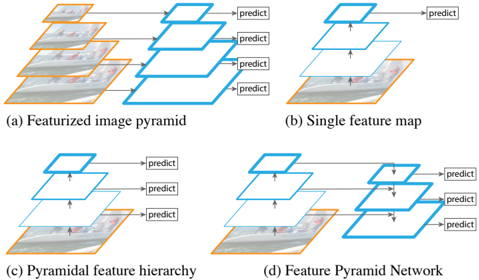
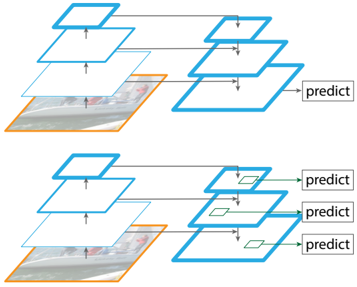
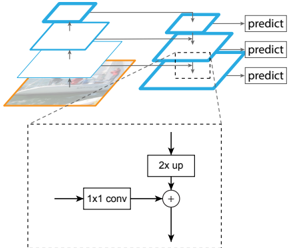
- FPN uses a bottom-up ResNet pathway (C2–C5), a top-down pathway that upsamples coarser maps by 2× with nearest-neighbor interpolation, and lateral 1×1 convolutions merged by element-wise addition; a 3×3 convolution is appended to each merged map. Detection uses d = 256 and pyramid levels P2–P5, with P6 added for RPN’s 512² anchor scale.
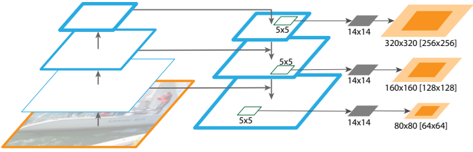
- For RPN, heads are attached to each pyramid level with single-scale anchors of areas {32², 64², 128², 256², 512²} on {P2, P3, P4, P5, P6} and aspect ratios {1:2, 1:1, 2:1}, totaling 15 anchors. For Fast R-CNN, RoIs are assigned to pyramid levels using the canonical 224² size and k₀ = 4, with shared heads and a 2fc MLP.
- Experiments use the 80-category COCO dataset, training on trainval35k (80k train + 35k val subset), ablating on minival (5k val images), and reporting test-std results. Backbones are ImageNet1k-pretrained ResNet-50/101; training uses synchronized SGD on 8 GPUs with input shorter side 800 pixels. RPN training takes about 8 hours and Fast R-CNN about 10 hours on COCO; inference is 0.148 s per image for ResNet-50 and 0.172 s for ResNet-101 on an NVIDIA M40 GPU.
Limitations
- The paper states that designing better connection modules is not its focus and opts for a simple design; more sophisticated blocks gave only marginally better results. It also notes that the ResNet-101 model was not sufficiently trained with the default schedule, and that the feature-sharing version of the COCO leaderboard model was not evaluated due to limited time.
- The paper states that its method does not exploit popular improvements such as iterative regression, hard negative mining, context modeling, or stronger data augmentation, which are complementary and could boost accuracy further.
- Evident from the text: there is no dedicated limitations section, and the empirical evaluation is limited to COCO detection and mask proposal generation, not full instance segmentation or other datasets.
Model-written summary. Check it against the paper before relying on it.
Integrity signals
Registry
Cites
Statistics
Figures
Verification
Claims the paper makes
8 Valid · 4 Not valid · 14 Not checked · 82 Own results and interpretations
The cited sources that could be checked couldn’t confirm or dispute this claim.
In the paper
“For these reasons, Fast and Faster R-CNN [11, 29] opt to not use featurized image pyramids under default settings.”
What the sources say
- Not matchedcites [11] [11] R. Girshick. Fast R-CNN. In ICCV , 2015. -
We searched by its title and found no matching paper.
- Could not verifycites [29] [29] S. Ren, K. He, R. Girshick, and J. Sun. Faster R-CNN: Towards real-time object detection with region proposal networks. In NIPS , 2015. - sourceExperimental — accuracy not yet measured
The Related Work section (p. 3) discusses multi-resolution features for semantic segmentation, and the results (p. 8) discuss multi-scale testing of the authors’ model. Neither passage addresses whether Fast or Faster R-CNN omit featurized image pyramids by default; searches for those models and that setting found no supporting passage in our copy. (LLM, conf=0.77)
plain- Asserted: passes — The authors put it forward as true.
- Checkable: passes — It can be checked against evidence.
- Load-bearing: passes — The paper’s conclusions depend on it.
- Based: passes — The paper gives a reason why it holds.
- Not matched
The cited sources support only part of this claim — read each source’s verdict below.
In the paper
“Recently, FPN has enabled new top results in all tracks of the COCO competition, including detection, instance segmentation, and keypoint estimation. See [14] for details.”
What the sources say
- Partly supportedcites [14] [14] K. He, G. Gkioxari, P. Doll´ ar, and R. Girshick. Mask r-cnn. arXiv:1703.06870 , 2017. - sourceExperimental — accuracy not yet measured
The paper reports strong COCO results using FPN backbones: its instance-segmentation model surpasses earlier winners (Section 4.1, p. 5), its detection model exceeds earlier single-model results (Section 4.3, p. 7), and its keypoint model exceeds the 2016 winner (Section 5, p. 8). But it does not establish that FPN enabled top competition results in all three tracks; Appendix B (p. 10) discusses 2017 winning teams only for instance segmentation and credits the Mask R-CNN framework. (LLM, conf=0.87)
plainstates a cause- Asserted: passes — The authors put it forward as true.
- Checkable: passes — It can be checked against evidence.
- Load-bearing: unclear — It is unclear whether the paper’s conclusions depend on it.
- Based: passes — The paper gives a reason why it holds.
- Partly supported
The sources with a verdict support this claim; the rest weren’t checked yet, have no full text we could read, or their verdicts aren’t rated yet.
In the paper
“All recent top entries in the ImageNet [33] and COCO [21] detection challenges use multi-scale testing on featurized image pyramids ( e.g ., [16, 35]).”
What the sources say
- Not checked yetcites [16] [16] K. He, X. Zhang, S. Ren, and J. Sun. Deep residual learning for image recognition. In CVPR , 2016. - source
Checked before — its earlier verdict is held back until a new check runs.
- Supportedcites [35] [35] A. Shrivastava, A. Gupta, and R. Girshick. Training regionbased object detectors with online hard example mining. In CVPR , 2016. - source
As an example citation, this paper supports the COCO part of the sentence. The Multi-scale (M) section (page unavailable) says it runs inference at all scales during testing, and the Ablation analysis (page unavailable) says a variant finished fourth in the 2015 COCO Detection Challenge. (LLM, conf=0.85)
plain- Asserted: passes — The authors put it forward as true.
- Checkable: passes — It can be checked against evidence.
- Load-bearing: passes — The paper’s conclusions depend on it.
- Based: passes — The paper gives a reason why it holds.
- Not checked yet
The cited sources support only part of this claim — read each source’s verdict below.
In the paper
“Existing mask proposal methods [27, 28, 4] are based on densely sampled image pyramids ( e.g ., scaled by 2 {-2:0 . 5:1 } in [27, 28]), making them computationally expensive.”
What the sources say
- Partly supportedcites [27] [27] P. O. Pinheiro, R. Collobert, and P. Dollar. Learning to segment object candidates. In NIPS , 2015. - sourceExperimental — accuracy not yet measured
The Introduction says prevalent object-detection methods use image or filter pyramids, and §3.3 says avoiding those pyramids saves running time. The paper does not establish that existing mask proposal methods rely on densely sampled image pyramids or document the specified scale sampling. (LLM, conf=0.86)
- Not matchedcites [28] [28] P. O. Pinheiro, T.-Y. Lin, R. Collobert, and P. Doll´ ar. Learning to refine object segments. In ECCV , 2016. -
More than one paper fits this citation.
- Not checked — no full text of the sourcecites [4] [4] J. Dai, K. He, Y. Li, S. Ren, and J. Sun. Instance-sensitive fully convolutional networks. In ECCV , 2016. -
plainstates a cause- Asserted: passes — The authors put it forward as true.
- Checkable: passes — It can be checked against evidence.
- Load-bearing: passes — The paper’s conclusions depend on it.
- Based: passes — The paper gives a reason why it holds.
- Partly supported
Every source the paper cites for this claim was checked and supports it.
In the paper
“The Single Shot Detector (SSD) [22] is one of the first attempts at using a ConvNet's pyramidal feature hierarchy as if it were a featurized image pyramid (Fig. 1(c)).”
What the sources say
- Supportedcites [22] [22] W. Liu, D. Anguelov, D. Erhan, C. Szegedy, and S. Reed. SSD: Single shot multibox detector. In ECCV , 2016. - source
Section 2.2 (p. 6) says SSD uses feature maps from several layers to mimic the effect of processing an image at different sizes. Section 2.1 (p. 3) describes progressively smaller feature layers for multi-scale detection, and the paper presents this as a contribution relative to earlier single-scale detectors. Together, these support the characterization of SSD as an early use of a ConvNet feature hierarchy in place of an image pyramid. (LLM, conf=0.88)
plain- Asserted: passes — The authors put it forward as true.
- Checkable: passes — It can be checked against evidence.
- Load-bearing: unclear — It is unclear whether the paper’s conclusions depend on it.
- Based: passes — The paper gives a reason why it holds.
- Supported
65 more claims · 4 with their cited sources checked
Create a free account to see all 108 claims and to verify the 11 references still open.
- It may state two separate claims as one. 23
- Probably not a substantial claim. 17
- The quote only partly states this claim. 3
Claims other papers make about this one
Each is checked against this paper’s own text: does it say what the citing paper says it does?
The source backs part of the claim, not all of it — or backs it for a different population, condition or comparison.
In the citing paper
“Feature Pyramid Network (FPN) [42] is one of the important two stage object detectors, tried to overcome few of the aforementioned challenges successfully by extracting features at multiple scales of an image in the object detection process.”
From Object detection using YOLO: challenges, architectural successors, datasets and applications (2023) · cites this paper as [42]
Experimental — accuracy not yet measuredThe source backs part of the claim, not all of it — or backs it for a different population, condition or comparison.
In the citing paper
“Its performance can be improved further by exploiting and enhancing the feature hierarchy of deep convolutional networks [80], employing non-local attention [81], and leveraging the reciprocal relationship between detection and segmentation via hybrid task cascade [82].”
From Empowering things with intelligence: a survey of the progress, challenges, and opportunities in artificial intelligence of things (2021) · cites this paper as [80]
Experimental — accuracy not yet measuredThe source backs part of the claim, not all of it — or backs it for a different population, condition or comparison.
In the citing paper
“To improve the accuracy of small defect detection, this paper uses SPP and FPN to increase the effect of multi-scale feature extraction.”
From Automatic Detection and Classification of Steel Surface Defect Using Deep Convolutional Neural Networks (2021) · cites this paper as [26]
Experimental — accuracy not yet measuredThe source backs part of the claim, not all of it — or backs it for a different population, condition or comparison.
In the citing paper
“YOLOv3 introduced a foundational generic architecture inspired by the Feature Pyramid Network (FPN) [22], integrating elements such as residual blocks, skip connections, and up-sampling.”
From YOLOv1 to v8: Unveiling Each Variant–A Comprehensive Review of YOLO (2024) · cites this paper as [22]
Experimental — accuracy not yet measuredThe cited source says what the claim attributes to it.
In the citing paper
“Unlike the word tokens that serve as the basic elements of processing in language Transformers, visual elements can vary substantially in scale, a problem that receives attention in tasks such as object detection [42, 53, 54].”
From Swin Transformer: Hierarchical Vision Transformer using Shifted Windows (2021) · cites this paper as [42]
14 more claims about this paper
Create a free account to see every claim other papers make about this one.
Self-check
Percentages, sums and reported differences re-computed from the paper’s own numbers.
Each contradiction between two passages listed here was confirmed by an independent check.
Rated minor: it would not touch a result — a value no result rests on, a p-value that stays on the same side of the significance level, or a conflict that is clerical, resolved elsewhere in the paper, or outside its own findings.
In the paper
§ 6.1. Segmentation Proposal Results · p. 8
“Our approach, based on FPNs, is substantially faster (our models run at 6 to 7 FPS).”
§ 6. Extensions: Segmentation Proposals · p. 8
“| + 2x train schedule | | 48.1 | 32.6 | 54.2 | 65.6 | 0.25 |”
Rated minor: it would not touch a result — a value no result rests on, a p-value that stays on the same side of the significance level, or a conflict that is clerical, resolved elsewhere in the paper, or outside its own findings.
In the paper
§ 5.1.1 Ablation Experiments · p. 5
“This architecture simulates the effect of reusing the pyramidal feature hierarchy (Fig. 1(b)).”
§ Feature Pyramid Networks for Object Detection · p. 1
“(b) Recent detection systems have opted to use only single scale features for faster detection. (c) An alternative is to reuse the pyramidal feature hierarchy computed by a ConvNet as if it were a featurized image pyramid.”
Citations
Cites
Deep Residual Learning for Image Recognition
He, K., Zhang, X., Ren, S., & Sun, J. (2016) · 2016 IEEE Conference on Computer Vision and Pattern Recognition (CVPR) · doi:10.1109/cvpr.2016.90 · Cited by 235,474 · cited 9×
“Analogous to the ResNet-based Faster R-CNN system [16] that uses C 4 as the single-scale feature map, we set k 0 to 4.”
BackgroundMethodResultInfluentialSelf-citationVery Deep Convolutional Networks for Large-Scale Image Recognition
Simonyan, K., & Zisserman, A. (2014) · arXiv · doi:10.48550/arxiv.1409.1556 · Cited by 114,148 · cited 2×
“But to avoid using low-level features SSD foregoes reusing already computed layers and instead builds the pyramid starting from high up in the network ( e.g ., conv4 3 of VGG nets [36]) and then by adding several new layers.”
BackgroundResultImageNet classification with deep convolutional neural networks
Krizhevsky, A., Sutskever, I., & Hinton, G. E. (2017) · Communications of the ACM · doi:10.1145/3065386 · Cited by 112,155 · cited 3×
“With the development of modern deep ConvNets [19], object detectors like OverFeat [34] and R-CNN [12] showed dramatic improvements in accuracy.”
MethodResultU-Net: Convolutional Networks for Biomedical Image Segmentation
Ronneberger, O., Fischer, P., & Brox, T. (2015) · Lecture notes in computer science · doi:10.1007/978-3-319-24574-4_28 · Cited by 99,404 · cited 1×
“rarchy without combining features or scores. There are recent methods exploiting lateral/skip connections that associate low-level feature maps across resolutions and semantic levels, including U-Net [31] and SharpMask [28] for segmentation, Recombinator networks [17] for face detection, and Stacked Hourglass networks…”
MethodFaster R-CNN: Towards Real-Time Object Detection with Region Proposal Networks
Ren, S., He, K., Girshick, R., & Sun, J. (2017) · IEEE Transactions on Pattern Analysis and Machine Intelligence · doi:10.1109/tpami.2016.2577031 · Cited by 73,472 · cited 10×
“For these reasons, Fast and Faster R-CNN [11, 29] opt to not use featurized image pyramids under default settings.”
BackgroundMethodInfluentialSelf-citationFaster R-CNN: Towards Real-Time Object Detection with Region Proposal Networks
Ren, S., He, K., Girshick, R., & Sun, J. (2015) · arXiv · doi:10.48550/arxiv.1506.01497 · Cited by 70,812 · cited 10×
“For these reasons, Fast and Faster R-CNN [11, 29] opt to not use featurized image pyramids under default settings.”
BackgroundMethodInfluentialSelf-citationDistinctive Image Features from Scale-Invariant Keypoints
Lowe, D. G. (2004) · International Journal of Computer Vision · doi:10.1023/b:visi.0000029664.99615.94 · Cited by 62,647
Microsoft COCO: Common Objects in Context
Lin, T.-Y., Maire, M., Belongie, S., Hays, J., Perona, P., Ramanan, D., Dollár, P., & Zitnick, C. L. (2014) · Lecture Notes in Computer Science · doi:10.1007/978-3-319-10602-1_48 · Cited by 45,460 · cited 6×
“All recent top entries in the ImageNet [33] and COCO [21] detection challenges use multi-scale testing on featurized image pyramids ( e.g ., [16, 35]).”
BackgroundMethodInfluentialSelf-citationImageNet Large Scale Visual Recognition Challenge
Russakovsky, O., Deng, J., Su, H., Krause, J., Satheesh, S., Ma, S., Huang, Z., Karpathy, A., Khosla, A., Bernstein, M., et al. (2015) · International Journal of Computer Vision · doi:10.1007/s11263-015-0816-y · Cited by 39,380 · cited 2×
“Thus we can adapt the assignment strategy of region-based detectors [15, 11] in the case when they are run on image pyramids.”
MethodFully convolutional networks for semantic segmentation
Long, J., Shelhamer, E., & Darrell, T. (2015) · 2015 IEEE Conference on Computer Vision and Pattern Recognition (CVPR) · doi:10.1109/cvpr.2015.7298965 · Cited by 38,834 · cited 1×
“FCN [24] sums partial scores for each category over multiple scales to compute semantic segmentations.”
Background
Research works printed but not linked: 1
- [1] E. H. Adelson, C. H. Anderson, J. R. Bergen, P. J. Burt, and J. M. Ogden. Pyramid methods in image processing. RCA engineer , 1984. -
Cited by
Items 21,801–21,900 of 29,875
Fan, Z., Guo, L., & Fan, L. (2026) · IEEE Access · doi:10.1109/access.2026.3667402 · Cited by 1
LEM-YOLO: Locality-Enhanced Mamba-YOLO Algorithm for Ship Detection in Remote Sensing Imagery
Yao, F., Sun, Q., Ding, Y., et al. (2025) · doi:10.1109/iccvit67848.2025.11391455 · Cited by 1
Chen, L., Li, Z., Zhao, Z., Lu, Z., Wang, H., & Yang, C. (2026) · IEEE Transactions on Automation Science and Engineering · doi:10.1109/tase.2026.3667740 · Cited by 1
Improved RT-DETR Combined with Digital Twin for Accurate Posture Detection of Sows
Chen, G., Liu, Y., Cheng, Y., Wu, J., & Liu, L. (2026) · Agriculture · doi:10.3390/agriculture16050509 · Cited by 1
A Small Object Detection Model for UAV Aerial Images Based on an Improved YOLOv11s Approach
李, 云. (2026) · Computer Science and Application · doi:10.12677/csa.2026.162081 · Cited by 1
MuRDE-FPN: Precise UAV Localization Using Enhanced Feature Pyramid Network
Kisieliūtė, M., & Daugėla, I. (2026) · Drones · doi:10.3390/drones10030162 · Cited by 1
ESO-Det: An Efficient Small Object Detector for Real-Time UAV Perception
Deng, H., Zhou, S., & Yang, W. (2026) · Sensors · doi:10.3390/s26051512 · Cited by 2
DDANet: enhancing context and boundaries for semantic segmentation in autonomous driving
Wang, W., Yu, W., Liu, Y., Cui, Z., Shan, L., Xie, L., & Song, Y. (2026) · The Journal of Supercomputing · doi:10.1007/s11227-026-08345-4 · Cited by 1
Text-Pass Filter: An Efficient Scene Text Detector
Yang, C., Ma, H., Han, X., Yuan, Y., & Wang, Q. (2026) · IEEE Transactions on Multimedia · doi:10.1109/tmm.2026.3668365 · Cited by 3
“The structure of FPN can be referred to [50] except for the channel of output fusion feature is set to 512.”
Cui, G.-Q., Lin, H., Sun, L., Peng, H., Bao, H.-Y., Cai, S., Lan, Q., Lin, J., & Yang, C.-H. (2026) · Scientific Reports · doi:10.1038/s41598-026-40690-5 · Cited by 2
“Medical image segmentation focuses on pixel-level classification to accurately identify anatomical structures such as organs, tumors, and lesions in various imaging modalities 33 .”
Zabolotskiy, A. V., & Sobyanin, K. V. (2025) · Doklady Mathematics · doi:10.1134/s1064562425700358 · Cited by 1
DAS-YOLOv13: Dual-Axis Attention and Feature Fusion Model for Wafer Surface Defect Detection
Zhang, J., Sun, R., Li, B., Kong, D., Zhao, D., & Zhang, J. (2026) · Sensors · doi:10.3390/s26051574 · Cited by 3
“Although the Feature Pyramid Network (FPN) [23] of YOLOv13 enables multi-scale feature fusion, its adaptability to extreme scale differences is limited.”
Wang, Y., Guo, X., Huang, J., Chen, C., Zhuge, X., Wen, C., & Hao, X. (2026) · Plant Phenomics · doi:10.1016/j.plaphe.2026.100190 · Cited by 2
“However, conventional multi-level feature fusion methods, such as concatenation, element-wise addition, or Feature Pyramid Networks [38], fuse features from all hierarchical levels indiscriminately.”
Li, Y., Tang, M., Hu, J., Li, L., & Liu, D. (2026) · Biomedical Signal Processing and Control · doi:10.1016/j.bspc.2026.110043 · Cited by 1
Enhanced YOLO with Radar Attention and Multi-Scale Fusion for Maritime Target Detection
Cen, Z., Chen, H., Huang, X., et al. (2025) · doi:10.1109/ipmml68499.2025.11406982 · Cited by 1
“Multi-scale detection strategies [8], [9] address scale variation in natural images but struggle with radar's extreme small-target challenge where distant vessels occupy fewer than 16 pixels—at conventional detection resolutions (stride 8+), such targets degrade to single-pixel activations.”
HF-DETR: High-Frequency Feature Enhancement for Small Object Detection
Zhu, J., & Zhang, Y. (2026) · IEEE Signal Processing Letters · doi:10.1109/lsp.2026.3670742 · Cited by 2
Precise RF-Vision Fusion UAV Positioning and Identification for 6G Spectrum Security
Wan, Y., Liang, H., Wu, G., Zhou, F., Crispo, B., & Wu, Q. (2026) · IEEE Journal on Selected Areas in Communications · doi:10.1109/jsac.2026.3671229 · Cited by 3
Lu, N., Zhu, Y., Li, X., Luo, Z., & Shen, T. (2026) · Journal of Marine Science and Engineering · doi:10.3390/jmse14050501 · Cited by 2
MCS-YOLO: A novel remote sensing image segmentation algorithm for mountain crops
Chen, K., Li, Y., Quan, H., Liu, J., & Xiao, W. (2026) · Computers and Electronics in Agriculture · doi:10.1016/j.compag.2026.111592 · Cited by 1
A Cascaded Framework for Vehicle Detection in Low-Resolution Traffic Surveillance Videos
Yu, T., & Sevilla-Lara, L. (2026) · Electronics · doi:10.3390/electronics15051119 · Cited by 2
VDBAN: Suppressing Intermodal Information Interference Faced by Multimodal Object Detection
Wang, H., Cheng, Y., Liu, X., & Wang, X. (2026) · IEEE Transactions on Multimedia · doi:10.1109/tmm.2026.3672267 · Cited by 1
Liang, X., Xu, P., Cao, F., & Kong, Q. (2026) · International Journal of Machine Learning and Cybernetics · doi:10.1007/s13042-026-03028-1 · Cited by 1
Application of PaddleOCR in Power Consumption Environment Text Recognition
Wang, B., Zhao, T., Dong, L., et al. (2025) · International Academic Exchange Conference on Science and Technology Innovation (IAECST) · doi:10.1109/iaecst68792.2025.11415173 · Cited by 1
“The optimization of the teacher model changes the convolution kernel in the path augmentation of the PAN structure from 3 * 3 to 9 * 9,A lightweight PAN-based structure LK-PAN with a larger receptive field was proposed[8].”
Sun, Z., Kongsorot, Y., Musikawan, P., Aimtongkham, P., & So–In, C. (2026) · IEEE Access · doi:10.1109/access.2026.3673660 · Cited by 1
Li, X., Wei, K., Huang, Z., & Huang, Z. (2026) · Frontiers in Bioinformatics · doi:10.3389/fbinf.2026.1764743 · Cited by 1
DCDRNet: Detail–Context Decoupled Representation Learning Network for Efficient Crack Segmentation
Huang, R., Feng, M., & Hu, Y. (2026) · Algorithms · doi:10.3390/a19030219 · Cited by 1
Beyond Pretty Pictures: Combined Single- and Multiimage Super-Resolution for Sentinel-2 Images
Retnanto, A., Le, S., Mueller, S., et al. (2026) · IEEE Journal of Selected Topics in Applied Earth Observations and Remote Sensing · doi:10.1109/jstars.2026.3674579 · Cited by 1
“To account for model uncertainty andthestochasticnatureofneuralnetworktraining,eachmethod istrainedfivetimesusingidenticalhyperparametersbutdifferent random seeds.”
Keypoint-Guided Medical Video Segmentation Model With Spatiotemporal Feature Fusion
Wang, M., Du, S., huo, H., Jiang, J., Zhang, D., Han, H., Hou, S., & Wang, J. (2026) · IEEE Transactions on Medical Imaging · doi:10.1109/tmi.2026.3674130 · Cited by 1
“1) Image Encoder: The Image Encoder is composed of ResNet-34 [36] and a Feature Pyramid Network (FPN) [37] in series, in which ResNet-34 extracts hierarchical semantic features, and FPN fuses multi-scale representations to enhance both global context and fine-grained details. where V ∈ R T × 3 × H ×…”
A lightweight deep learning architecture for automatic shrimp disease classification
Sharma, S., Rumahorbo, P. S., Kondo, S., Watanabe, S., Okada, Y., Gautam, B. P., & Sato, K. (2026) · Scientific Reports · doi:10.1038/s41598-026-44195-z · Cited by 4
“The core consists of four CSPStages to construct a multi-scale feature pyramid, which is essential for capturing both low-level details and high-level semantic information 25,26 .”
Track-On2: Enhancing Online Point Tracking With Memory
Aydemir, G., Xie, W., & Güney, F. (2026) · IEEE Transactions on Pattern Analysis and Machine Intelligence · doi:10.1109/tpami.2026.3675257 · Cited by 6
“To fuse multi-scale features at the highest resolution, we fuse them using a simple Feature Pyramid Network (FPN) [48] Φ fpn : Each scale is first encoded with a lightweight layer, and features are then progressively upsampled from coarse to fine and summed with higher-resolution features.”
Deformable 1D Directional Convolution with Bidirectional Offsets for Oriented Object Detection
Li, Y., Li, X., & Zhang, C. (2026) · Remote Sensing · doi:10.3390/rs18060934 · Cited by 1
“The feature pyramid network (FPN) [49], originally designed for generic object detection, leverages the multi-scale and pyramidal hierarchy of the classic ResNet [50] to construct feature pyramids.”
From Simulation to Reality: GAN-Based Transformation of Pavement Defect Images for YOLO Detection
Yang, J., Yu, S., Yao, Y., Cao, S., & Ai, X. (2026) · Applied Sciences · doi:10.3390/app16062978 · Cited by 1
Wu, S., Kunapareddy, M., & Wang, N. (2026) · Electronics · doi:10.3390/electronics15061264 · Cited by 1
Edge-Graph Enhanced Network for Multi-Object Tracking in UAV Videos
Xu, Y., Hongbing, J. I., & Zhang, Y. (2026) · Remote Sensing · doi:10.3390/rs18060936 · Cited by 1
Zhou, Z., Zhao, X., Zhao, X., Zhu, Y., Zhao, Z., & Li, L. (2026) · IEEE Transactions on Geoscience and Remote Sensing · doi:10.1109/tgrs.2026.3676015 · Cited by 7
Wang, S., Jia, C., Liu, H., et al. (2026) · IEEE Transactions on Geoscience and Remote Sensing · doi:10.1109/tgrs.2026.3676813 · Cited by 1
Glare-Aware Resi-YOLO: Tiny-Vessel Detection with Dual-Brain Edge Deployment for Maritime UAVs
Tsai, S.-E., & Hsieh, C.-H. (2026) · Drones · doi:10.3390/drones10030226 · Cited by 6
Cao, L., Liu, Z., Wang, Y., & Gao, R. (2026) · Journal of Imaging · doi:10.3390/jimaging12030141 · Cited by 2
“Among them, multi-scale feature analysis methods [20–22] have included multi-level feature pyramid networks (FPN).”
A dual-attention guided network for robust crack detection in civil infrastructure
Li, G., Jing, H., Li, X., Liu, X., Yu, M., & Zhang, X. (2026) · Nondestructive Testing And Evaluation · doi:10.1080/10589759.2026.2647062 · Cited by 1
Li, M., Liu, Y., Wang, Q., & Chen, D. (2026) · Sensors · doi:10.3390/s26072011 · Cited by 1
CAGNet: A Framework for Automotive Crash Test Scene Image Classification
Lu, J., Long, S., Yang, X., Hu, W., & Zhou, L. (2025) · International Symposium on Artificial Intelligence and Big Data (AIBDF) · doi:10.1109/aibdf67964.2025.11440851 · Cited by 1
“…lacking explicit cross-scale alignment and content-adaptive fusion; while multi-scale fusion methods such as pyramid-style designs are widely used [7], [8], their scale aggregation is often input-agnostic, making it difficult to highlight fine-grained damage while preserving overall deformation…”
Wang, S., Hu, Y., Liu, X., Wang, S., Wang, G., Xu, C., Liu, J., & Chen, P. (2026) · IEEE Transactions on Image Processing · doi:10.1109/tip.2026.3675432 · Cited by 4
“…E s , we use the network architecture from the FSAS solution ADi ff [4]: A pretrained ResNet-50 network [53] is used as backbone to extract features from input mask images, while features from multiple layers of the backbone are fed into a Feature Pyramid Network [54] to obtain the fused feature.”
Enhancing small-object detection through hierarchical feature fusion and calibration
Zhu, Z., Wang, S., Tang, W., Jing, Z., & Sun, F. (2026) · The Visual Computer · doi:10.1007/s00371-026-04443-9 · Cited by 2
Hong, C., Wang, Z., Ma, Z., Zhi, M., & Li, B. (2026) · IEEE Transactions on Geoscience and Remote Sensing · doi:10.1109/tgrs.2026.3677871 · Cited by 2
Xiang, Z., Xu, Z., Wu, Q., & Wu, W. (2026) · Journal of Intelligent Manufacturing · doi:10.1007/s10845-026-02846-y · Cited by 1
Jia, Y., Zhang, X., Meng, J., & Zang, J. (2026) · Electronics · doi:10.3390/electronics15071408 · Cited by 1
A Review of Colorectal Polyp Segmentation Methods
Zhang, W.-W., Su, B.-S., Fu, C. H., & Zhang, L.-H. (2026) · Journal of Computing and Electronic Information Management · doi:10.54097/pqj8hf46 · Cited by 1
“The Feature Pyramid Network (FPN) [30] is one of the representative methods.”
IPeDet: An end-to-end fine-grained feature aggregation network for UAV infrared pedestrian detection
Li, Y., Xu, H., Zhu, X., Li, H., Sun, Y., Wang, R., & Xu, L. (2026) · Advanced Engineering Informatics · doi:10.1016/j.aei.2026.104639 · Cited by 2
Spatial-Temporal Scene Graph Generation for Open-Vocabulary Multiple Object Tracking
Li, G., Zhuang, S., Jian, Y., Yan, Y., & Wang, H. (2026) · IEEE Transactions on Image Processing · doi:10.1109/tip.2026.3676899 · Cited by 1
Li, H., Tao, H., Qiu, J., et al. (2026) · Engineering Research Express · doi:10.1088/2631-8695/ae590f · Cited by 1
Dual-Modal Chicken Mortality Detection Using Dynamic Hybrid Convolution-Based Feature Fusion
Hua, T., Fan, Q., Chen, R., Bi, Y., Bai, H., Wang, Z., Zhao, W., & Chang, G. (2026) · Animals · doi:10.3390/ani16071057 · Cited by 1
CFANet: coarse-to-fine adaptive network for oriented object detection in remote sensing images
Deng, L., Dong, R., & Zhou, T. (2026) · Physica Scripta · doi:10.1088/1402-4896/ae54e9 · Cited by 1
Multi-stage feature fusion network for UAV aerial object detection
Zhao, X., Ma, X., & Zhou, W. (2026) · Signal Image and Video Processing · doi:10.1007/s11760-026-05291-9 · Cited by 1
Packaging anti-counterfeiting and brand protection based on improved YOLOv8
Jiang, Y., & Liu, Y. (2026) · Discover Applied Sciences · doi:10.1007/s42452-026-08572-7 · Cited by 1
“0.1 mm) [23, 24] and submerged in complex background textures [25].”
InfluentialRT-FCOSH: bridging accuracy and efficiency in low-resolution object detection for autonomous driving
Mboutayeb, S., Majda, A., & Zenkouar, K. (2026) · Multimedia Tools and Applications · doi:10.1007/s11042-026-21520-2 · Cited by 1
EdgeEnhance-YOLO: A Lightweight Small Object Detection Model With Multidimensional Edge Enhancement
Liu, N., Kong, W., Jiang, Y., Shan, W., Xiao, H., & Li, X. (2026) · IEEE Transactions on Aerospace and Electronic Systems · doi:10.1109/taes.2026.3680376 · Cited by 3
EgoPoseVR: Spatiotemporal Multi-Modal Reasoning for Egocentric Full-Body Pose in Virtual Reality
Cheng, H., Ong, S. J. H., Cai, S., Koh, A. T. Y., Ouyang, F., & Khoo, E. T. (2026) · IEEE Transactions on Visualization and Computer Graphics · doi:10.1109/tvcg.2026.3680618 · Cited by 1
“To utilize the RGB-D stream effectively, a convolutional heatmap encoder, i.e., a ResNet backbone with a feature pyramid network (FPN) [31], first processes the RGB-D input to estimate 3 D joint keypoint sequence Z ∈ R 𝑇 × 𝐽 × 3 .”
Systematic Evaluation of YOLOv8 Variants for UAV-Based Object Detection
Liu, C.-M., & Juang, J. (2026) · Applied Sciences · doi:10.3390/app16073559 · Cited by 3
FEAPN: Feature Enhancement and Alignment Pyramid Network for Underwater Object Detection
Tian, W., & Wu, G. (2026) · Journal of Marine Science and Engineering · doi:10.3390/jmse14070671 · Cited by 1
Daytime Visual Walkability: A Systematic Review
Wang, C. S., Tourre, V., Leduc, T., et al. (2026) · Transactions in GIS · doi:10.1111/tgis.70249 · Cited by 1
Li, K., Wang, X., Jiang, J., Qiao, X., Cui, X., Xiong, K., & Zhang, W. (2026) · Energy · doi:10.1016/j.energy.2026.140976 · Cited by 2
Qin, M., Li, H., Huang, Y., Tong, X., & Liang, Z. (2026) · Sensors · doi:10.3390/s26072254 · Cited by 1
Li, Z., & Mansor, M. S. A. (2026) · Scientific Reports · doi:10.1038/s41598-026-44342-6 · Cited by 1
A benchmark for environmental microorganism object detection on EMDS-7
Guo, J., Guo, J., & Yan, B. (2026) · Frontiers in Microbiology · doi:10.3389/fmicb.2026.1821911 · Cited by 1
“In modern deep learning pipelines, an OD system is usually composed of (i) a backbone network for feature extraction (He et al., 2016), (ii) a feature aggregation module (often multi-scale) (Lin et al., 2017a), and (iii) prediction heads for classification and bounding-box regression.”
Wang, Q., & An, H. (2026) · IEEE Journal of Selected Topics in Applied Earth Observations and Remote Sensing · doi:10.1109/jstars.2026.3682662 · Cited by 1
Lightweight Semantic-Guided FCOS for In-Line Micro-Defect Inspection in Semiconductor Manufacturing
Zhang, T., Yan, S., & Qin, G. (2026) · Micromachines · doi:10.3390/mi17040473 · Cited by 1
“Among anchor-free frameworks, FCOS [27] stands out due to its fully convolutional design, multi-scale feature pyramid (FPN) [28], and center-ness branch for suppressing low-quality proposals.”
SAMDistill: SAM-based Spatial-temporal Distillation for Robust 3D Object Detection
Wang, Z., Shao, D., Zhang, L., Zhang, Z., & Wang, B. (2026) · Machine Intelligence Research · doi:10.1007/s11633-025-1586-9 · Cited by 1
An SSM enhanced ViT model for aerial imagery based disaster risk inspection
Yang, J., & Wang, X. (2026) · Image and Vision Computing · doi:10.1016/j.imavis.2026.105991 · Cited by 2
Chai, B., Wang, J., Zheng, Z., Chen, L., Gong, X., & Liu, W. (2026) · IEEE Transactions on Geoscience and Remote Sensing · doi:10.1109/tgrs.2026.3684509 · Cited by 2
Classification of mushrooms based on AWPF-ResNet18
Zhao, X., Lin, H., Guo, Y., & Sun, N. (2026) · PLoS ONE · doi:10.1371/journal.pone.0346589 · Cited by 2
“This design addresses the limitation that conventional FPNs use a fixed receptive field that cannot adapt to feature content, and it improves discrimination of cap-texture and stipe-pattern cues under complex backgrounds [26,27].”
E 2 -Former: An Edge-Enhanced Transformer for UAV-Based Small Object Detection
Zhang, J., Zhang, Y., Easa, S. M., 谢伯祥, Lin, L., Zhou, X., Zeng, N., Zhang, W., & Song, M. (2026) · IEEE Internet of Things Journal · doi:10.1109/jiot.2026.3684962 · Cited by 7
“Lin et al. [25] proposed the feature pyramid structure, which e ff ectively combines fine-grained textures from shallow layers with high-level semantics from deep layers through top–down information transmission, laying the foundation for subsequent cross-scale fusion in small target detection.”
A deformable convolution and shuffle attention enhanced network for surface defect detection
Tang, Y., Lv, X., & Sun, T. (2026) · Engineering Applications of Artificial Intelligence · doi:10.1016/j.engappai.2026.114864 · Cited by 1
Structure-aware state space modeling with multi-scale feature fusion for railway scene segmentation
Fu, H., Ma, Z., Yang, X., Zhang, W., Hu, L., & Jiang, K. (2026) · Scientific Reports · doi:10.1038/s41598-026-47010-x · Cited by 1
“Early foundational works such as SegNet 27 established encoder-decoder paradigms with efficient memory management, while Feature Pyramid Networks 29 introduced multi-scale processing concepts through hierarchical feature pyramids, and recent transformer-based approaches like META-Unet 28 have explored efficient attent…”
Semba: A semantic–visual fusion method based on MLLM and Mamba for IBD subtype identification
Wang, J., Ruan, G., Hualong, L., Nian, Y., Wei, Y., & Lei, Y. (2026) · Biomedical Signal Processing and Control · doi:10.1016/j.bspc.2026.110358 · Cited by 1
ASGNet: Adaptive Spectrum Guidance Network for Automatic Polyp Segmentation
Sun, Y., Zhang, H., Qian, J., Yang, J. J., & Luo, L. (2026) · IEEE Transactions on Circuits and Systems for Video Technology · doi:10.1109/tcsvt.2026.3685209 · Cited by 1
“IV (a)) consists of a ResNet50 [57] encoder and a feature pyramid network (FPN) [79] decoder.”
Feng, Y., Chen, Y., Shi, W., et al. (2026) · doi:10.1109/iscait69154.2026.11477237 · Cited by 1
“These approaches often employ generic object detectors (Faster R-CNN [17], YOLO variants [18]) with standard feature pyramids (FPN [19], PANet [20]).”
Toward Adaptive Open-Set Object Detection via Category-Level Collaboration Knowledge Mining
Ji, Y., Ke, J., He, L., Wang, L., & Gao, X. (2026) · IEEE Transactions on Image Processing · doi:10.1109/tip.2026.3683590 · Cited by 2
“During the detection pipeline, the backbones and FPN [53] serve as feature extractors ϕ , responsible for extracting image-level features P s/t from the source and target domains.”
TNET: Terrace Convolutional Decoder Network for Remote Sensing Image Semantic Segmentation
Dai, C., Guo, Y., Luo, Y., Li, S., Qi, H., & Dou, Y. (2026) · IEEE International Conference on Acoustics Speech and Signal Processing · doi:10.1109/icassp55912.2026.11462244 · Cited by 1
GIREG: Geometric-Image Collaborative Point Cloud Regisration
Chen, S., Hou, C., Deng, H., Peng, J., & Wang, L. (2026) · IEEE International Conference on Acoustics Speech and Signal Processing · doi:10.1109/icassp55912.2026.11460483 · Cited by 1
Wang, X., Wang, J., Yu, J., et al. (2026) · Journal of King Saud University - Computer and Information Sciences · doi:10.1007/s44443-026-00641-6 · Cited by 1
Region-Aware Brightness-Adaptive Enhancement Paradigm for Heterogeneous Illumination
Wang, H., Li, R., Yan, L., Song, Y., Liu, H., & Yu, L. (2026) · IEEE International Conference on Acoustics Speech and Signal Processing · doi:10.1109/icassp55912.2026.11460805 · Cited by 2
Yao, X., Shen, Y., & Lei, Y. (2026) · Remote Sensing · doi:10.3390/rs18081254 · Cited by 1
Lei, H., Shang, L., Zhao, H., & Yang, W. (2026) · Pattern Recognition · doi:10.1016/j.patcog.2026.113812 · Cited by 3
Enhanced object detection via complementary feature pyramid networks
Zhang, L., Xu, C., Zhang, K.-B., Zhu, G., Yan, T., & Lu, M. (2026) · Signal Image and Video Processing · doi:10.1007/s11760-026-05372-9 · Cited by 1
“Feature Pyramid Networks (FPN [1]) alleviate this by introducing a top-down pathway.”
Ouyang, R., Jiang, J., Shao, Y., Zhan, J., & Zhang, X. (2026) · Plants · doi:10.3390/plants15091341 · Cited by 1
“Traditional feature pyramid networks (FPN) and their variants achieve cross-level information transfer through simple element-wise addition or channel concatenation [13].”
Enhancing dynamic facial expression recognition through cooperative spatio-temporal feature learning
Yu, C., & Liu, M. (2026) · The Visual Computer · doi:10.1007/s00371-026-04499-7 · Cited by 1
Liu, B., Shi, C., & Zhao, M. (2026) · Sensors · doi:10.3390/s26092717 · Cited by 1
Chen, M., Zhang, J. Q., Li, C., Guo, W., Fang, T., Zhao, Y., Ge, X., Xu, B. C., Hu, H., & Zhu, Q. Q. (2026) · IEEE Transactions on Geoscience and Remote Sensing · doi:10.1109/tgrs.2026.3687990 · Cited by 1
LSGNet: A Local-Pattern Separation and Global-Aware Network for Temporal Action Detection
Gao, Z., Yang, W., Zhao, Y., Ma, C., Li, C., & Wang, R. (2026) · IEEE Transactions on Image Processing · doi:10.1109/tip.2026.3687467 · Cited by 2
Boosting Underwater Object Detection via Differential Attention
Yuan, G., Li, J., Ling, Q., Chen, H., Fu, X., & Wang, Y. (2026) · IEEE Signal Processing Letters · doi:10.1109/lsp.2026.3687791 · Cited by 1
Ranario, E., Mayanja, I. K., Yun, H., Bailey, B. N., & Earles, J. M. (2026) · Plant Phenomics · doi:10.1016/j.plaphe.2026.100214 · Cited by 1
“Feature Pyramid Network (FPN) [63] is designed to efficiently handle multi-scale object recognition by leveraging the inherent pyramidal hierarchy of convolutional neural networks (CNNs).”
Cycle-Consistent Learning for Joint Layout-to-Image Generation and Object Detection
Cai, X., Lai, Q., Pei, G., Shu, X., Yao, Y., & Wang, W. (2025) · IEEE/CVF International Conference on Computer Vision (ICCV) · doi:10.1109/iccv51701.2025.00639 · Cited by 18
“The model employs ResNet-50 [7] pre-trained on ImageNet-1K [5] as its backbone and FPN [14] as the neck.”
When Anchors Meet Cold Diffusion: A Multi-Stage Approach to Lane Detection
Huang, B.-L., Ni, Z.-X., Huang, F.-K., Shuai, H.-H., & Cheng, W.-H. (2025) · IEEE/CVF International Conference on Computer Vision (ICCV) · doi:10.1109/iccv51701.2025.02591 · Cited by 4
“We build our restoration network R θ on CLRNet [53], using a backbone (e.g., ResNet [13] or DLA [50]) plus an FPN [21] to extract multi-scale features.”
Graph Pyramid Pooling Transformer for Graph-Level Representation Learning
Li, Z., Wang, S.-G., Zhang, Q.-H., Wen-jian, L., Gribova, V. V., Федорович, Ф. В., Cohn, A. G., & Huang, D.-S. (2026) · IEEE Transactions on Big Data · doi:10.1109/tbdata.2026.3689004 · Cited by 1
“The main representative pyramid pooling methods are Spatial Pyramid Pooling (SPP) [37], Pyra-mid Scene Parsing Network (PSPNet) [38], Atrous Spatial Pyra-mid Pooling (ASPP) [39], Feature Pyramid Networks (FPN) [40], and Pyramid Pooling Pyramid Pooling Transformer (P2T) [41], etc.”
$I^{\mathbf{2}}$-World: Intra-Inter Tokenization for Efficient Dynamic 4D Scene Forecasting
Liao, Z., Wei, P., Zhang, R., Chen, S., Wang, H., & Ren, Z. (2025) · 2025 IEEE/CVF International Conference on Computer Vision (ICCV) · doi:10.1109/iccv51701.2025.02394 · Cited by 3
“Our method significantly outperforms the previous state-of-the-art method, particularly in 3-second forecasting. clouds [16, 25, 36].”
Few-Shot Pattern Detection via Template Matching and Regression
Jo, E., Kang, D., Kim, S., Choi, Y., & Cho, M. (2025) · IEEE/CVF International Conference on Computer Vision (ICCV) · doi:10.1109/iccv51701.2025.02004 · Cited by 5
“Both aim to reduce the annotation cost of object detection [12, 33, 57, 64] by learning to detect all instances of given support exemplars.”
Al-Ashoor, A., Lilik, F., & Nagy, S. (2026) · Applied Sciences · doi:10.3390/app16094320 · Cited by 2
Self-attention as the backbone: A survey on Vision Transformers
Waseem, A., Ruiu, P., Nixon, S., Lagorio, A., & Tistarelli, M. (2026) · Computer Vision and Image Understanding · doi:10.1016/j.cviu.2026.104791 · Cited by 8
Lei, Z., Dong, Z., Xu, H., Xiao, X., & Xin’an, Q. I. U. (2026) · Sensors · doi:10.3390/s26092844 · Cited by 1
“The feature pyramid level k assigned to the RoI with width w and height h can be expressed as [38]: where 224 is the size of the standard pre-training image. k 0 represents the level of the feature pyramid assigned by the ROI of w × h = 224 2 .”
Temporal-Aware Query Routing for Real-Time Video Instance Segmentation
Cheng, Z., Li, K., Zhao, Y., Zhang, H., Liu, C., & Chen, J. (2025) · IEEE/CVF International Conference on Computer Vision (ICCV) · doi:10.1109/iccv51701.2025.02086 · Cited by 2
“Various FPN variants are available, such as Vanilla FPN [28], Semantic FPN [24], FaPN [20], and BiFPN [37].”
Metadata
- Authors
- Lin, T.-Y., Dollar, P., Girshick, R., He, K., Hariharan, B., & Belongie, S.
- Affiliations
- Cornell University (US)
- Meta (United States) (US)
- Venue
- 2017 IEEE Conference on Computer Vision and Pattern Recognition (CVPR)
- Publisher
- IEEE
- Published
- 2017-07
- Pages
- 936-944
- ISSN
- 1063-6919 (ISSN-L)
- OpenAlex
- W2565639579
- Cited by
- 30,939
- References
- 64
- Citations by year
- 2026: 2864 · 2025: 4496 · 2024: 5179 · 2023: 5172 · 2022: 4516 · 2021: 3861 · 2020: 2506 · 2019: 1759 · 2018: 526 · 2017: 58
- FWCI
- 387.80
- Type
- conference paper
- Language
- en
- Open access
- closed
- Locations
- IEEE Computer Society Conference on Computer Vision and Pattern Recognition/Proceedings - IEEE Computer Society Conference on Computer Vision and Pattern Recognition/Proceedings (publishedVersion)
- Topics
- Physical Sciences › Computer Science › Computer Vision and Pattern Recognition › Advanced Neural Network Applications
- Physical Sciences › Computer Science › Computer Vision and Pattern Recognition › Advanced Image and Video Retrieval Techniques
- Physical Sciences › Computer Science › Computer Vision and Pattern Recognition › Visual Attention and Saliency Detection
- Keywords
- feature pyramid network, multi-scale object detection, lateral connections, Faster R-CNN, COCO benchmark, deep convolutional neural networks, feature extraction
About these checks
Registry, retraction, Cites and statistics results are computed, not judged, with one exception: a printed reference that no index lists is read once by a model before it counts as a citation error. Claims are extracted by a model and kept only when their quote appears verbatim in the text; each cited source is then checked, with a model’s help, for whether it says what the claim relies on. Those verdicts can be wrong — read the claim’s quote and the cited source before relying on one.
The claim verdicts this report counts are experimental: their accuracy is not yet measured.
A language model drew the claims from the paper on 2026-10-10, under version 3 of the claim definition (model deepseek-v4.1-flash, prompt extract-v3).
A second model labelled each claim on 2026-10-10 (model jev-1.13-20260917, definition revision gold-guideline-v0.2).
Cited sources are checked with a language model’s help (gpt-6-sol).
Statistics and arithmetic are recomputed, not judged.
Confidence bands are shown only for fields calibrated on our annotated test set. None is calibrated yet, so no band is shown.
What counts as a claim ›How we measure confidence ›How we check this ›
Are you an author, or do you see a problem with this page? Request a review
Data sources
Bibliographic data: Semantic Scholar, OpenAlex, Crossref.
Contains information from the Semantic Scholar Academic Graph Datasets, made available under the ODC Attribution License (ODC-BY 1.0).
Semantic Scholar’s data is described in: Kinney, R., et al. (2023). The Semantic Scholar Open Data Platform. arXiv:2301.10140.
