

Feature Pyramid Networks for Object Detection
The DOI matches its Crossref record; 49 of the 64 references it cites were found in a registry or an index, and 1 are not checked yet; 14 of the 44 sources its claims cite were checked for support.
Abstract
Feature pyramids are a basic component in recognition systems for detecting objects at different scales. But pyramid representations have been avoided in recent object detectors that are based on deep convolutional networks, partially because they are slow to compute and memory intensive. In this paper, we exploit the inherent multi-scale, pyramidal hierarchy of deep convolutional networks to construct feature pyramids with marginal extra cost. A top-down architecture with lateral connections is developed for building high-level semantic feature maps at all scales. This architecture, called a Feature Pyramid Network (FPN), shows significant improvement as a generic feature extractor in several applications. Using a basic Faster R-CNN system, our method achieves state-of-the-art single-model results on the COCO detection benchmark without bells and whistles, surpassing all existing single-model entries including those from the COCO 2016 challenge winners. In addition, our method can run at 5 FPS on a GPU and thus is a practical and accurate solution to multi-scale object detection. Code will be made publicly available.
Verified 2026-11-25 · 1 reference not checked yet
Overview
CoChat Summary
TL;DR
Feature Pyramid Networks (FPN) build in-network feature pyramids from a single-scale image using a top-down pathway and lateral connections, giving semantically strong features at all scales with marginal extra cost. FPN improves region proposal and object detection accuracy over strong single-scale baselines and achieves state-of-the-art single-model COCO results without image pyramids.
Key findings
- RPN with FPN improves COCO minival AR\(_{1k}\) to 56.3 from 48.3 for the single-scale C4 baseline (+8.0 points), and small-object AR\(_{1k}^s\) to 44.9 from 32.0 (+12.9 points).
- Fast R-CNN on fixed proposals improves AP to 33.9 with FPN versus 31.9 for the C4 baseline (+2.0) and 28.8 for the 2fc C5 baseline (+5.1); AP@0.5 is 56.9.
- Faster R-CNN with FPN reaches 33.9 AP and 56.9 AP@0.5 on minival, improving over a strong single-scale baseline by 2.3 AP and 3.8 AP@0.5. On COCO test-dev with ResNet-101, it reaches 36.2 AP and 59.1 AP@0.5, surpassing single-model competition winners such as G-RMI (34.7 AP) and AttractioNet (35.7 AP).
- For segmentation proposals, FPN with dual MLPs, 2× mask resolution, and 2× training schedule reaches 48.1 AR, outperforming DeepMask (37.1), SharpMask (39.8), and InstanceFCN (39.2) by over 8.3 points AR, while running at 6–7 FPS.
Methods
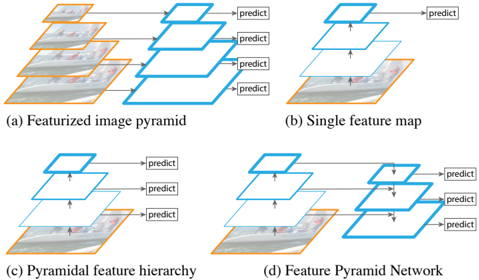
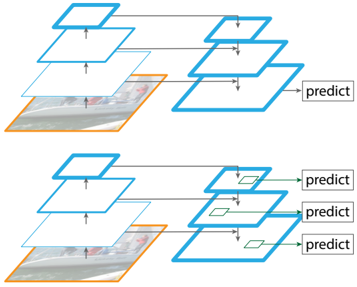
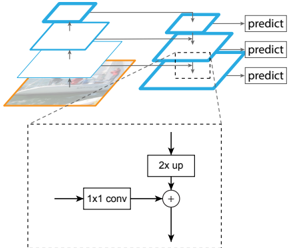
- FPN uses a bottom-up ResNet pathway (C2–C5), a top-down pathway that upsamples coarser maps by 2× with nearest-neighbor interpolation, and lateral 1×1 convolutions merged by element-wise addition; a 3×3 convolution is appended to each merged map. Detection uses d = 256 and pyramid levels P2–P5, with P6 added for RPN’s 512² anchor scale.
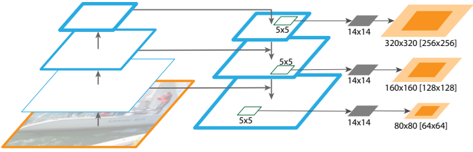
- For RPN, heads are attached to each pyramid level with single-scale anchors of areas {32², 64², 128², 256², 512²} on {P2, P3, P4, P5, P6} and aspect ratios {1:2, 1:1, 2:1}, totaling 15 anchors. For Fast R-CNN, RoIs are assigned to pyramid levels using the canonical 224² size and k₀ = 4, with shared heads and a 2fc MLP.
- Experiments use the 80-category COCO dataset, training on trainval35k (80k train + 35k val subset), ablating on minival (5k val images), and reporting test-std results. Backbones are ImageNet1k-pretrained ResNet-50/101; training uses synchronized SGD on 8 GPUs with input shorter side 800 pixels. RPN training takes about 8 hours and Fast R-CNN about 10 hours on COCO; inference is 0.148 s per image for ResNet-50 and 0.172 s for ResNet-101 on an NVIDIA M40 GPU.
Limitations
- The paper states that designing better connection modules is not its focus and opts for a simple design; more sophisticated blocks gave only marginally better results. It also notes that the ResNet-101 model was not sufficiently trained with the default schedule, and that the feature-sharing version of the COCO leaderboard model was not evaluated due to limited time.
- The paper states that its method does not exploit popular improvements such as iterative regression, hard negative mining, context modeling, or stronger data augmentation, which are complementary and could boost accuracy further.
- Evident from the text: there is no dedicated limitations section, and the empirical evaluation is limited to COCO detection and mask proposal generation, not full instance segmentation or other datasets.
Model-written summary. Check it against the paper before relying on it.
Integrity signals
Registry
Cites
Statistics
Figures
Verification
Claims the paper makes
8 Valid · 4 Not valid · 14 Not checked · 82 Own results and interpretations
The cited sources that could be checked couldn’t confirm or dispute this claim.
In the paper
“For these reasons, Fast and Faster R-CNN [11, 29] opt to not use featurized image pyramids under default settings.”
What the sources say
- Not matchedcites [11] [11] R. Girshick. Fast R-CNN. In ICCV , 2015. -
We searched by its title and found no matching paper.
- Could not verifycites [29] [29] S. Ren, K. He, R. Girshick, and J. Sun. Faster R-CNN: Towards real-time object detection with region proposal networks. In NIPS , 2015. - sourceExperimental — accuracy not yet measured
The Related Work section (p. 3) discusses multi-resolution features for semantic segmentation, and the results (p. 8) discuss multi-scale testing of the authors’ model. Neither passage addresses whether Fast or Faster R-CNN omit featurized image pyramids by default; searches for those models and that setting found no supporting passage in our copy. (LLM, conf=0.77)
plain- Asserted: passes — The authors put it forward as true.
- Checkable: passes — It can be checked against evidence.
- Load-bearing: passes — The paper’s conclusions depend on it.
- Based: passes — The paper gives a reason why it holds.
- Not matched
The cited sources support only part of this claim — read each source’s verdict below.
In the paper
“Recently, FPN has enabled new top results in all tracks of the COCO competition, including detection, instance segmentation, and keypoint estimation. See [14] for details.”
What the sources say
- Partly supportedcites [14] [14] K. He, G. Gkioxari, P. Doll´ ar, and R. Girshick. Mask r-cnn. arXiv:1703.06870 , 2017. - sourceExperimental — accuracy not yet measured
The paper reports strong COCO results using FPN backbones: its instance-segmentation model surpasses earlier winners (Section 4.1, p. 5), its detection model exceeds earlier single-model results (Section 4.3, p. 7), and its keypoint model exceeds the 2016 winner (Section 5, p. 8). But it does not establish that FPN enabled top competition results in all three tracks; Appendix B (p. 10) discusses 2017 winning teams only for instance segmentation and credits the Mask R-CNN framework. (LLM, conf=0.87)
plainstates a cause- Asserted: passes — The authors put it forward as true.
- Checkable: passes — It can be checked against evidence.
- Load-bearing: unclear — It is unclear whether the paper’s conclusions depend on it.
- Based: passes — The paper gives a reason why it holds.
- Partly supported
The sources with a verdict support this claim; the rest weren’t checked yet, have no full text we could read, or their verdicts aren’t rated yet.
In the paper
“All recent top entries in the ImageNet [33] and COCO [21] detection challenges use multi-scale testing on featurized image pyramids ( e.g ., [16, 35]).”
What the sources say
- Not checked yetcites [16] [16] K. He, X. Zhang, S. Ren, and J. Sun. Deep residual learning for image recognition. In CVPR , 2016. - source
Checked before — its earlier verdict is held back until a new check runs.
- Supportedcites [35] [35] A. Shrivastava, A. Gupta, and R. Girshick. Training regionbased object detectors with online hard example mining. In CVPR , 2016. - source
As an example citation, this paper supports the COCO part of the sentence. The Multi-scale (M) section (page unavailable) says it runs inference at all scales during testing, and the Ablation analysis (page unavailable) says a variant finished fourth in the 2015 COCO Detection Challenge. (LLM, conf=0.85)
plain- Asserted: passes — The authors put it forward as true.
- Checkable: passes — It can be checked against evidence.
- Load-bearing: passes — The paper’s conclusions depend on it.
- Based: passes — The paper gives a reason why it holds.
- Not checked yet
The cited sources support only part of this claim — read each source’s verdict below.
In the paper
“Existing mask proposal methods [27, 28, 4] are based on densely sampled image pyramids ( e.g ., scaled by 2 {-2:0 . 5:1 } in [27, 28]), making them computationally expensive.”
What the sources say
- Partly supportedcites [27] [27] P. O. Pinheiro, R. Collobert, and P. Dollar. Learning to segment object candidates. In NIPS , 2015. - sourceExperimental — accuracy not yet measured
The Introduction says prevalent object-detection methods use image or filter pyramids, and §3.3 says avoiding those pyramids saves running time. The paper does not establish that existing mask proposal methods rely on densely sampled image pyramids or document the specified scale sampling. (LLM, conf=0.86)
- Not matchedcites [28] [28] P. O. Pinheiro, T.-Y. Lin, R. Collobert, and P. Doll´ ar. Learning to refine object segments. In ECCV , 2016. -
More than one paper fits this citation.
- Not checked — no full text of the sourcecites [4] [4] J. Dai, K. He, Y. Li, S. Ren, and J. Sun. Instance-sensitive fully convolutional networks. In ECCV , 2016. -
plainstates a cause- Asserted: passes — The authors put it forward as true.
- Checkable: passes — It can be checked against evidence.
- Load-bearing: passes — The paper’s conclusions depend on it.
- Based: passes — The paper gives a reason why it holds.
- Partly supported
Every source the paper cites for this claim was checked and supports it.
In the paper
“The Single Shot Detector (SSD) [22] is one of the first attempts at using a ConvNet's pyramidal feature hierarchy as if it were a featurized image pyramid (Fig. 1(c)).”
What the sources say
- Supportedcites [22] [22] W. Liu, D. Anguelov, D. Erhan, C. Szegedy, and S. Reed. SSD: Single shot multibox detector. In ECCV , 2016. - source
Section 2.2 (p. 6) says SSD uses feature maps from several layers to mimic the effect of processing an image at different sizes. Section 2.1 (p. 3) describes progressively smaller feature layers for multi-scale detection, and the paper presents this as a contribution relative to earlier single-scale detectors. Together, these support the characterization of SSD as an early use of a ConvNet feature hierarchy in place of an image pyramid. (LLM, conf=0.88)
plain- Asserted: passes — The authors put it forward as true.
- Checkable: passes — It can be checked against evidence.
- Load-bearing: unclear — It is unclear whether the paper’s conclusions depend on it.
- Based: passes — The paper gives a reason why it holds.
- Supported
65 more claims · 4 with their cited sources checked
Create a free account to see all 108 claims and to verify the 11 references still open.
- It may state two separate claims as one. 23
- Probably not a substantial claim. 17
- The quote only partly states this claim. 3
Claims other papers make about this one
Each is checked against this paper’s own text: does it say what the citing paper says it does?
The source backs part of the claim, not all of it — or backs it for a different population, condition or comparison.
In the citing paper
“Feature Pyramid Network (FPN) [42] is one of the important two stage object detectors, tried to overcome few of the aforementioned challenges successfully by extracting features at multiple scales of an image in the object detection process.”
From Object detection using YOLO: challenges, architectural successors, datasets and applications (2023) · cites this paper as [42]
Experimental — accuracy not yet measuredThe source backs part of the claim, not all of it — or backs it for a different population, condition or comparison.
In the citing paper
“Its performance can be improved further by exploiting and enhancing the feature hierarchy of deep convolutional networks [80], employing non-local attention [81], and leveraging the reciprocal relationship between detection and segmentation via hybrid task cascade [82].”
From Empowering things with intelligence: a survey of the progress, challenges, and opportunities in artificial intelligence of things (2021) · cites this paper as [80]
Experimental — accuracy not yet measuredThe source backs part of the claim, not all of it — or backs it for a different population, condition or comparison.
In the citing paper
“To improve the accuracy of small defect detection, this paper uses SPP and FPN to increase the effect of multi-scale feature extraction.”
From Automatic Detection and Classification of Steel Surface Defect Using Deep Convolutional Neural Networks (2021) · cites this paper as [26]
Experimental — accuracy not yet measuredThe source backs part of the claim, not all of it — or backs it for a different population, condition or comparison.
In the citing paper
“YOLOv3 introduced a foundational generic architecture inspired by the Feature Pyramid Network (FPN) [22], integrating elements such as residual blocks, skip connections, and up-sampling.”
From YOLOv1 to v8: Unveiling Each Variant–A Comprehensive Review of YOLO (2024) · cites this paper as [22]
Experimental — accuracy not yet measuredThe cited source says what the claim attributes to it.
In the citing paper
“Unlike the word tokens that serve as the basic elements of processing in language Transformers, visual elements can vary substantially in scale, a problem that receives attention in tasks such as object detection [42, 53, 54].”
From Swin Transformer: Hierarchical Vision Transformer using Shifted Windows (2021) · cites this paper as [42]
14 more claims about this paper
Create a free account to see every claim other papers make about this one.
Self-check
Percentages, sums and reported differences re-computed from the paper’s own numbers.
Each contradiction between two passages listed here was confirmed by an independent check.
Rated minor: it would not touch a result — a value no result rests on, a p-value that stays on the same side of the significance level, or a conflict that is clerical, resolved elsewhere in the paper, or outside its own findings.
In the paper
§ 6.1. Segmentation Proposal Results · p. 8
“Our approach, based on FPNs, is substantially faster (our models run at 6 to 7 FPS).”
§ 6. Extensions: Segmentation Proposals · p. 8
“| + 2x train schedule | | 48.1 | 32.6 | 54.2 | 65.6 | 0.25 |”
Rated minor: it would not touch a result — a value no result rests on, a p-value that stays on the same side of the significance level, or a conflict that is clerical, resolved elsewhere in the paper, or outside its own findings.
In the paper
§ 5.1.1 Ablation Experiments · p. 5
“This architecture simulates the effect of reusing the pyramidal feature hierarchy (Fig. 1(b)).”
§ Feature Pyramid Networks for Object Detection · p. 1
“(b) Recent detection systems have opted to use only single scale features for faster detection. (c) An alternative is to reuse the pyramidal feature hierarchy computed by a ConvNet as if it were a featurized image pyramid.”
Citations
Cites
Deep Residual Learning for Image Recognition
He, K., Zhang, X., Ren, S., & Sun, J. (2016) · 2016 IEEE Conference on Computer Vision and Pattern Recognition (CVPR) · doi:10.1109/cvpr.2016.90 · Cited by 235,474 · cited 9×
“Analogous to the ResNet-based Faster R-CNN system [16] that uses C 4 as the single-scale feature map, we set k 0 to 4.”
BackgroundMethodResultInfluentialSelf-citationVery Deep Convolutional Networks for Large-Scale Image Recognition
Simonyan, K., & Zisserman, A. (2014) · arXiv · doi:10.48550/arxiv.1409.1556 · Cited by 114,148 · cited 2×
“But to avoid using low-level features SSD foregoes reusing already computed layers and instead builds the pyramid starting from high up in the network ( e.g ., conv4 3 of VGG nets [36]) and then by adding several new layers.”
BackgroundResultImageNet classification with deep convolutional neural networks
Krizhevsky, A., Sutskever, I., & Hinton, G. E. (2017) · Communications of the ACM · doi:10.1145/3065386 · Cited by 112,155 · cited 3×
“With the development of modern deep ConvNets [19], object detectors like OverFeat [34] and R-CNN [12] showed dramatic improvements in accuracy.”
MethodResultU-Net: Convolutional Networks for Biomedical Image Segmentation
Ronneberger, O., Fischer, P., & Brox, T. (2015) · Lecture notes in computer science · doi:10.1007/978-3-319-24574-4_28 · Cited by 99,404 · cited 1×
“rarchy without combining features or scores. There are recent methods exploiting lateral/skip connections that associate low-level feature maps across resolutions and semantic levels, including U-Net [31] and SharpMask [28] for segmentation, Recombinator networks [17] for face detection, and Stacked Hourglass networks…”
MethodFaster R-CNN: Towards Real-Time Object Detection with Region Proposal Networks
Ren, S., He, K., Girshick, R., & Sun, J. (2017) · IEEE Transactions on Pattern Analysis and Machine Intelligence · doi:10.1109/tpami.2016.2577031 · Cited by 73,472 · cited 10×
“For these reasons, Fast and Faster R-CNN [11, 29] opt to not use featurized image pyramids under default settings.”
BackgroundMethodInfluentialSelf-citationFaster R-CNN: Towards Real-Time Object Detection with Region Proposal Networks
Ren, S., He, K., Girshick, R., & Sun, J. (2015) · arXiv · doi:10.48550/arxiv.1506.01497 · Cited by 70,812 · cited 10×
“For these reasons, Fast and Faster R-CNN [11, 29] opt to not use featurized image pyramids under default settings.”
BackgroundMethodInfluentialSelf-citationDistinctive Image Features from Scale-Invariant Keypoints
Lowe, D. G. (2004) · International Journal of Computer Vision · doi:10.1023/b:visi.0000029664.99615.94 · Cited by 62,647
Microsoft COCO: Common Objects in Context
Lin, T.-Y., Maire, M., Belongie, S., Hays, J., Perona, P., Ramanan, D., Dollár, P., & Zitnick, C. L. (2014) · Lecture Notes in Computer Science · doi:10.1007/978-3-319-10602-1_48 · Cited by 45,460 · cited 6×
“All recent top entries in the ImageNet [33] and COCO [21] detection challenges use multi-scale testing on featurized image pyramids ( e.g ., [16, 35]).”
BackgroundMethodInfluentialSelf-citationImageNet Large Scale Visual Recognition Challenge
Russakovsky, O., Deng, J., Su, H., Krause, J., Satheesh, S., Ma, S., Huang, Z., Karpathy, A., Khosla, A., Bernstein, M., et al. (2015) · International Journal of Computer Vision · doi:10.1007/s11263-015-0816-y · Cited by 39,380 · cited 2×
“Thus we can adapt the assignment strategy of region-based detectors [15, 11] in the case when they are run on image pyramids.”
MethodFully convolutional networks for semantic segmentation
Long, J., Shelhamer, E., & Darrell, T. (2015) · 2015 IEEE Conference on Computer Vision and Pattern Recognition (CVPR) · doi:10.1109/cvpr.2015.7298965 · Cited by 38,834 · cited 1×
“FCN [24] sums partial scores for each category over multiple scales to compute semantic segmentations.”
Background
Research works printed but not linked: 1
- [1] E. H. Adelson, C. H. Anderson, J. R. Bergen, P. J. Burt, and J. M. Ogden. Pyramid methods in image processing. RCA engineer , 1984. -
Cited by
Items 24,601–24,700 of 29,875
Enhanced Efficient YOLOv3-tiny for Object Detection
Cai, H., Xu, L., & Guo, L. (2021) · doi:10.1145/3507548.3507551 · Cited by 1
Steel surface defect detection algorithm combined with attention mechanism
Wang, S., Fu, S., Zhang, X., & Chen, K. (2022) · International Conference on Electronic Information Engineering and Computer Communication (EIECC) · doi:10.1117/12.2634420 · Cited by 1
A Cloud-Based Recognition Service for Agriculture During the COVID-19 Period in Taiwan
Chou, T., Chen, S., & Tsai, F.-S. (2022) · Journal of Global Information Management · doi:10.4018/jgim.302659
Detection method of various types of auto lamps based on improved Faster R-CNN model
Guo, B., Chen, W., Zhang, J., & Zhu, Y. (2021) · China Automation Congress (CAC) · doi:10.1109/cac53003.2021.9728040
Occluded Pedestrian Attention Network : An occluded pedestrian Detector
Li, M., Chen, N., & Yuan, H. (2021) · China Automation Congress (CAC) · doi:10.1109/cac53003.2021.9728404
Research Progress of Computer Automatic Detection of Pulmonary Nodules in Images
Chen, C. (2021) · Computer Science and Application · doi:10.12677/csa.2021.111016
DesPat: Smartphone-based Object Detection for Citizen Science and Urban SurveysPreprint
Getschmann, C., & Echtler, F. (2021) · OSF Preprints (OSF Preprints) · doi:10.31219/osf.io/drs6u
Alaluf, Y., Patashnik, O., & Cohen‐Or, D. (2021) · ACM Transactions on Graphics · doi:10.1145/3476576.3476590
A Pet Detection System Based on YOLOv4
Yuan, Y. (2021) · International Seminar on Artificial Intelligence, Networking and Information Technology (AINIT) · doi:10.1109/ainit54228.2021.00074
Maize-IAS: A Maize Image Analysis Software using Deep Learning for High-throughput Plant PhenotypingPreprint
Zhou, S., Chai, X., Yang, Z., Wang, H., Yang, C., & Sun, T. (2021) · Research Square · doi:10.21203/rs.3.rs-35915/v2
A Lightweight Detection Model for Typical Objects in Streetscape Dataset
Zhao, X., & Zheng, H. G. (2021) · China Automation Congress (CAC) · doi:10.1109/cac53003.2021.9727729 · Cited by 1
Object Detection Of Flexible Object With Arbitrary-Oriented Based On Rotation Adaptive YOLOv5
Wu, J., Su, L., Ji, J., & Li, T. (2021) · China Automation Congress (CAC) · doi:10.1109/cac53003.2021.9727663
Ha, J., Park, T., Kim, H., Shin, Y., Ko, Y., Kim, D. W., Sung, Y. S., Lee, J., Ham, S. J., Khang, S., et al. (2021) · doi:10.2196/preprints.28399
Training Instance Segmentation and Lane Detection Models in One Network Architecture
(2021) · International Workshop on Computer Science and Engineering (WCSE) · doi:10.18178/wcse.2021.06.015
Multi-target relative distance perception based on monocular image
Shi, Z., Zou, D., Wu, W., & Xia, F. (2021) · China Automation Congress (CAC) · doi:10.1109/cac53003.2021.9727461
Scale-invariant Convolutional Capsule Network
Li, Z., Kong, Y., & Yin, B. (2021) · International Conference on Artificial Intelligence and Advanced Manufacture (AIAM) · doi:10.1145/3495018.3495058
Bone lesion detection using attention mechanism and multi-scales feature fusion network
Bai, Z., Fang, C., & Liu, X. (2021) · China Automation Congress (CAC) · doi:10.1109/cac53003.2021.9727250
Robust Lightweight Object Detection
Kumar, S. (2019) · San José State University ScholarWorks (San Jose State University) · doi:10.31979/etd.y2c8-xjtg
Su, T., Shi, Y., Xie, C., Luo, W., Ye, H., & Xu, L. (2022) · Pattern Analysis and Applications · doi:10.1007/s10044-022-01068-1 · Cited by 1
Improving object detection quality with structural constraints
Rong, Z., Wang, S., Kong, D., & Yin, B. (2022) · PLoS ONE · doi:10.1371/journal.pone.0267863
SemSegFPA: Semantic Segmentation Feature Pyramid Network with Attention Module
Yang, D. M., Song, Q., Liu, C., et al. (2022) · IEEE Asia-Pacific Conference on Image Processing, Electronics and Computers (IPEC) · doi:10.1109/ipec54454.2022.9777303
S2FCM: A Two-Stage Fine Classification Model for Students’ Attention Analysis
Zhang, Z., Chai, X., & Luo, H. (2022) · International Conference on Computer Supported Cooperative Work in Design (CSCWD) · doi:10.1109/cscwd54268.2022.9776044
Pixel-level end-to-end dual-channel bill text detection based algorithm
Chen, X., Chang, Y., Zhang, P., et al. (2022) · International Conference on Intelligent Computing and Signal Processing (ICSP) · doi:10.1109/icsp54964.2022.9778469
Dang, Y., Yang, Y., Chen, Y., Zhu, M., & Yin, D. (2022) · International Conference on Cloud Computing and Big Data Analytics (ICCCBDA) · doi:10.1109/icccbda55098.2022.9778930
PENGIMPLEMENTASIAN OCR MENGGUNAKAN CNN UNTUK EKSTRAKSI TEKS PADA GAMBAR
Wijaya, I., & Lubis, C. (2022) · Jurnal Ilmu Komputer dan Sistem Informasi · doi:10.24912/jiksi.v10i1.17836
ACTIVE REINFORCEMENT LEARNING FOR THE SEMANTIC SEGMENTATION OF IMAGES CAPTURED BY MOBILE SENSORS
Rad, M. J., & Armenakis, C. (2022) · The international archives of the photogrammetry, remote sensing and spatial information sciences/International archives of the photogrammetry, remote sensing and spatial information sciences · doi:10.5194/isprs-archives-xliii-b2-2022-593-2022 · Cited by 1
Deep Learning based Traffic Analysis of Motor Cycles in Urban City
Abirami, T., Nivas, C., Naveen, R., & Nithishkumar, T. G. (2022) · International Conference on Intelligent Computing and Control Systems (ICICCS) · doi:10.1109/iciccs53718.2022.9788433 · Cited by 1
Intelligent Hyperspectral Target Detection For Reliable IoV ApplicationsPreprint
Wang, Z., & Jin, L. (2022) · Research Square · doi:10.21203/rs.3.rs-1677053/v1
Vehicle Detection in Low Illumination Based on Attention Mechanism and RetinexNetPreprint
Wu, Y., Jin, S., Wang, Q., & Zhao, X. (2022) · Research Square · doi:10.21203/rs.3.rs-1727102/v1 · Cited by 1
Visual Inspection Method for Metal Rolls Based on Multi-Scale Spatial Location Feature
Xu, D., Li, H., Wu, R., Wang, Y., Huang, Y., & Cai, Y. (2022) · Symmetry · doi:10.3390/sym14071291
MPI Planar Correction of Pulse Based ToF Cameras
Pop, M.-L., & Tamás, L. (2022) · IEEE International Conference on Automation, Quality and Testing, Robotics (AQTR) · doi:10.1109/aqtr55203.2022.9802059
Olesiński, A., & Piotrowski, Z. (2022) · TechRxiv · doi:10.36227/techrxiv.20120219 · Cited by 1
Multi-scale Aerial Object Detection Using Feature Pyramid Networks
Johnson, D. G., Bhat, N., Akshatha, K. R., Karunakar, A. K., & Shenoy, B. S. (2022) · Lecture notes in networks and systems · doi:10.1007/978-981-19-0095-2_31
Olesiński, A., & Piotrowski, Z. (2022) · doi:10.36227/techrxiv.20120219.v1
Wang, X., Chen, J., Tang, H., & Zhu, Z. (2022) · International Conference on Multimedia Retrieval · doi:10.1145/3512527.3531361 · Cited by 1
SpindlesTracker: An Automatic Workflow for Spindles Analysis in Time-lapse ImagesPreprint
Li, Z., Jian, Y., Hu, J., Zhang, C., Meng, X., Wu, F., & Liu, J. (2022) · doi:10.36227/techrxiv.20101451.v1
SpindlesTracker: An Automatic Workflow for Spindles Analysis in Time-lapse ImagesPreprint
Li, Z., Jian, Y., Hu, J., Zhang, C., Meng, X., Wu, F., & Liu, J. (2022) · doi:10.36227/techrxiv.20101451
Kim, S.-J., & Chung, Y.-J. (2022) · The Journal of Korean Institute of Information Technology · doi:10.14801/jkiit.2022.20.6.93
Inappropriate Visual Content Detection Based on the Joint Training Strategy
Wang, X., Liu, J., Liu, X., et al. (2022) · Lecture notes in electrical engineering · doi:10.1007/978-981-19-3387-5_131
Damage assessment with global differences and local attention
梅, 杰., & 程, 明. (2022) · Scientia Sinica Informationis · doi:10.1360/ssi-2021-0384
Efficient pavement Distress Detection Based on Attention Fusion and Feature Integration
Xie, A., Yu, Z., Cao, X., et al. (2022) · Prognostics and Health Management Conference (PHM) · doi:10.1109/phm2022-london52454.2022.00071
Discovering Unknown Labels for Multi-Label Image ClassificationPreprint
Huang, J., Yan, Y., & Zheng, X. (2022) · Research Square · doi:10.21203/rs.3.rs-1813664/v1
Schreck, J. S., Gantos, G., Hayman, M., et al. (2022) · Atmospheric measurement techniques · doi:10.5194/amt-2022-97-rc2
Multi-branch Prediction Network for Multi-label Social Image Classification
Lei, J., Zhao, W., Zhang, S., & Peng, J. (2022) · International Conference on Advanced Cloud and Big Data · doi:10.1109/cbd54617.2021.00042 · Cited by 1
A Semantic Segmentation-Based Collision Recognition Method for Slalom PolesPreprint
Zhou, J., Wu, X., Zhou, W., et al. (2022) · SSRN Electronic Journal · doi:10.2139/ssrn.4109973
Indoor Spatial Layout Estimation Based on Multi-Task Co-Supervised LearningPreprint
Zou, Y., Li, T., Chen, M., Yan, G., & Zhao, L. (2022) · SSRN Electronic Journal · doi:10.2139/ssrn.4117413
Maize Kernel Counting Based on Target Detection
Wu, K., Shi, L., & Zhang, Y. (2022) · Lecture notes in electrical engineering · doi:10.1007/978-981-19-2259-6_25
FourierMask: Instance Segmentation Using Fourier Mapping in Implicit Neural Networks
Riaz, H. U. M., Benbarka, N., Höfer, T., & Zell, A. (2022) · Lecture notes in computer science · doi:10.1007/978-3-031-06430-2_49 · Cited by 1
Image Segmentation Losses with Modules Expressing a Relationship Between Predictions
Hurtík, P., Molek, V., & Zámečníková, H. (2022) · Communications in computer and information science · doi:10.1007/978-3-031-08974-9_27
Online and Real-Time Mask-Guided Multi-Object Tracking and SegmentationPreprint
Seong, J.-K., Ryu, J., & Lim, J. (2022) · SSRN Electronic Journal · doi:10.2139/ssrn.4098769
Target Identification and Detection on SAR Imagery Using Deep Convolution Network
Gupta, A., Penchalaiah, D., & Bhattacharyya, A. (2022) · Advances in intelligent systems and computing · doi:10.1007/978-981-19-0475-2_26
Learning Consistent Gt-Proposal Assignment for Pedestrian DetectionPreprint
Luo, Y., Zhang, C., Shi, C., Sun, J., & Zhang, W. (2022) · SSRN Electronic Journal · doi:10.2139/ssrn.4150173
Fabric Defect Detection Based on Improved Faster R-CNN and Two-Step Clustering Method
You, S., Ye, S., Cui, C., CanHao, & Wang, Y. (2022) · Lecture notes in electrical engineering · doi:10.1007/978-981-19-3927-3_27
Li, Y., Li, X., & Yang, J. (2022) · SSRN Electronic Journal · doi:10.2139/ssrn.4098729
Wang, L., Benmokhtar, R., & Perrotton, X. (2022) · Lecture notes in computer science · doi:10.1007/978-3-031-06430-2_44 · Cited by 2
Li, Q., Zhang, T., Yang, M., Guo, X., Chen, H., & Fan, S. (2022) · SSRN Electronic Journal · doi:10.2139/ssrn.4111789
Anomaly Detection Model for Key Places Based on Improved YOLOv5
Wang, Y., Deyu, Y., Meng, Y., & Meng, D. (2022) · Lecture notes in computer science · doi:10.1007/978-3-031-06788-4_5 · Cited by 1
Leveraging Road Area Semantic Segmentation with Auxiliary Steering Task
Maanpää, J., Melekhov, I., Taher, J., Manninen, P., & Hyyppa, J. M. (2022) · Lecture notes in computer science · doi:10.1007/978-3-031-06427-2_60
Application Research of YOLOv3 Incorporating Self-attention Mechanism
Zhang, J., Jia, Y., & Yu, H. (2022) · Lecture notes in electrical engineering · doi:10.1007/978-981-19-3927-3_45
ATO-EDGE: Adaptive Task Offloading for Deep Learning in Resource-Constrained Edge Computing Systems
Wang, Y., Gao, L. C., Ren, J., Cao, R., Wang, H., Zheng, J., & Gao, Q. (2021) · IEEE International Conference on Parallel and Distributed Systems (ICPADS) · doi:10.1109/icpads53394.2021.00025 · Cited by 1
A practical Deep Learning approach to assist COVID-19 detection based on Chest X-ray images
de Camargo, T. F. O., dos Santos, P. V., Premebida, S. M., Ribeiro, G., Olombrada, M., Soares, V. R., Barbosa, R., Calixto, W. P., Rocha, C. D. S., Gonçalves, C., et al. (2021) · IEEE Latin American Conference on Computational Intelligence (LA-CCI) · doi:10.1109/la-cci48322.2021.9769790
FOCM: Faster Octave Convolution Using Mix-scaling
Hsieh, K.-H., Chen, E., & Lee, C. (2021) · Conference on Technologies and Applications of Artificial Intelligence (TAAI) · doi:10.1109/taai54685.2021.00015 · Cited by 1
Image Translation based on Attention Residual GAN
Zhang, M., He, L., & Wang, X. (2021) · International Conference on Artificial Intelligence and Computer Engineering (ICAICE) · doi:10.1109/icaice54393.2021.00156 · Cited by 1
A Texture Enhanced Feature Fusion Method for Small Object Detection
Zhou, X., & Li, S. (2021) · International Conference on Information Technology in Medicine and Education · doi:10.1109/itme53901.2021.00033 · Cited by 1
Pest Identification System based on YOLOv5
Yu, S., Jin, S., Peng, J., Zhao, Z., Hou, M. Y., & Cheng, W. J. (2021) · IEEE International Conference on Cognitive Informatics & Cognitive Computing (ICCI*CC) · doi:10.1109/iccicc53683.2021.9811296
Linear Substitution Pruning: Consider All Filters Together
Liu, K., & Liu, C. (2022) · International Conference on Computing and Artificial Intelligence (ICCAI) · doi:10.1145/3532213.3532224
Continual Learning with Score Pseudo Label for Instance SegmentationPreprint
Han, Y., Liao, X., Chen, G., xiong, W., Tang, Z., & Ru, Q. (2022) · SSRN Electronic Journal · doi:10.2139/ssrn.4164342
Exploiting Cross-scale Consistency for Object Detection in Aerial Images
Xu, J., Li, Y., & Wang, S. (2022) · 2022 3rd International Conference on Computer Vision, Image and Deep Learning & International Conference on Computer Engineering and Applications (CVIDL & ICCEA) · doi:10.1109/cvidliccea56201.2022.9824076 · Cited by 2
Segmenting against Dense Distribution and Occlusion in Road Scenarios
Zhou, F., Deng, B., & Wang, S. (2022) · 2022 3rd International Conference on Computer Vision, Image and Deep Learning & International Conference on Computer Engineering and Applications (CVIDL & ICCEA) · doi:10.1109/cvidliccea56201.2022.9824938
Research on 3D Object Detection Method Based on Vlidar
Sun, Y., & Hou, Z. (2022) · 2022 3rd International Conference on Computer Vision, Image and Deep Learning & International Conference on Computer Engineering and Applications (CVIDL & ICCEA) · doi:10.1109/cvidliccea56201.2022.9825390
Recognition of Mechanical Parts Based on Improved YOLOv4-Tiny Algorithm
Du, B., Fang, T., Gao, L., et al. (2022) · Lecture notes in computer science · doi:10.1007/978-3-031-10983-6_51
DD-Net: A Dual Detector Network for Multilevel Object Detection in Remote-Sensing Images
Zhang, D., Wang, C., & Fu, Q. (2022) · Journal of Sensors · doi:10.1155/2022/9602100
Joint model for learning state recognition with combining action detection and object detection
Huang, Q., Liu, Z., & Lu, T. (2022) · IEEE International Conference on Imaging Systems and Techniques (IST) · doi:10.1109/ist55454.2022.9827718
Defogging Target Detection based on YOLOv4 and Deblurganv2
Liu, S., & Zhang, L. (2022) · Scientific Journal of Technology · doi:10.54691/sjt.v4i6.880
Hand Gesture Recognition Using CBAM-RetinaNet
Suguna, K. Y., Dutta, H., Bhuyan, M. K., & Laskar, R. H. (2022) · Communications in computer and information science · doi:10.1007/978-3-031-11349-9_38
Efficient Pipeline for Rapid Detection of Catheters and Tubes in Chest Radiographs
Sarhan, H. M., Ali, H., Ehab, E., et al. (2022) · Lecture notes in computer science · doi:10.1007/978-3-031-12053-4_64
Multi-layer analysis of convolutional neural networks for transfer learning applications
Condori, R. H. M. (2022) · Digital Library of Theses and Dissertations (Universidade de São Paulo) · doi:10.11606/t.55.2022.tde-25072022-165116
Yolo-Pai: Real-Time Handheld Call Behavior Detection Algorithm and Embedded ApplicationPreprint
Zhao, Z., Zheng, T., Hao, K., et al. (2022) · SSRN Electronic Journal · doi:10.2139/ssrn.4173734
CCNet: Unpaired Keypoints for Skull Fracture Detection
Liu, G., Ming, J., Wu, X., & Jiang, R. (2022) · Communications in computer and information science · doi:10.1007/978-981-19-4109-2_18 · Cited by 2
Scene Text Detection based on Dual-branch Multi-resolution Feature-aware Enhancement Network
Wang, R., Li, Q., Huang, H., & Li, Q. (2022) · IEEE Joint International Information Technology and Artificial Intelligence Conference (ITAIC) · doi:10.1109/itaic54216.2022.9836553
Zhang, Y., Zhang, Y., Wu, H., et al. (2022) · International Journal of Advanced Computer Science and Applications · doi:10.14569/ijacsa.2022.0130736
Characterization of Real-Time Object Detection Workloads on Vehicular Edge
Tang, S., Whitney, K., Wang, B., Fu, S., & Yang, Q. B. (2022) · International Conference on Connected and Autonomous Driving (MetroCAD) · doi:10.1109/metrocad56305.2022.00010
Schreck, J. S. (2022) · Atmospheric measurement techniques · doi:10.5194/amt-2022-97-ac1
Schreck, J. S. (2022) · Atmospheric measurement techniques · doi:10.5194/amt-2022-97-ac2
Tehranizadeh, A. A., Aziz, M. J., Majedi, H., et al. (2022) · bioRxiv (Cold Spring Harbor Laboratory) · doi:10.1101/2022.08.02.502579
Mishra, A., Mane, N., Mishra, A., Dixit, A., Mishra, S., Agrawal, A., & Pagare, R. A. (2022) · SSRN Electronic Journal · doi:10.2139/ssrn.4187576
Research on small target detection technology on assisted driving road based on Yolov3
Zhou, Q., & Tan, G. (2022) · Highlights in Science Engineering and Technology · doi:10.54097/hset.v7i.1036
High-Voltage Tower Nut Detection and Positioning System Based on Binocular Vision
Cheng, Z., Luo, Y., Zhang, J., Gong, Z., Sun, L., & Xu, L. (2022) · Lecture notes in computer science · doi:10.1007/978-3-031-13870-6_37
Texture and semantic integrated small objects detection in foggy scenes
Fang, Z., Wang, H., Li, S., Hu, Y., & Han, X. (2022) · PLoS ONE · doi:10.1371/journal.pone.0270356
Saini, N., Chattopadhyay, C., & Das, D. (2022) · SSRN Electronic Journal · doi:10.2139/ssrn.4167508
GFENet: Enabling Attention and Adaptive Feature Fusion in Real-time Object Detection
Pan, C., Zhu, X., & Chu, J. (2022) · International Symposium on Electrical, Electronics and Information Engineering (ISEEIE) · doi:10.1109/iseeie55684.2022.00016 · Cited by 1
Multi-stage Attention-Pooling Network for Lane Marking Detection
Bachu, S., Garg, T., Panda, D., Reddy, M., Ibrahim, S., & Bhat, B. (2022) · International Conference on Pattern Recognition Systems (ICPRS) · doi:10.1109/icprs54038.2022.9854074 · Cited by 1
PointTransformer: Encoding Human Local Features for Small Target Detection
Tang, Y., Wang, B., He, W., Qian, F., & Liu, Z. (2022) · Computational Intelligence and Neuroscience · doi:10.1155/2022/9640673 · Cited by 1
Rezaei, M., & Rezaeian, M. (2022) · Journal of Electronic Imaging · doi:10.1117/1.jei.31.4.043046
RWYI: Reading What You Are Interested in with a Learning-Based Text Interactive System
Yu, Z., Wang, H., Yang, H., & Zhou, H. (2022) · Mobile Information Systems · doi:10.1155/2022/6378011
Scene text detection using HRNet and spatial attention mechanismPreprint
Tang, Q., Jiang, Z., Pan, B., et al. (2022) · Research Square · doi:10.21203/rs.3.rs-1896482/v2
Robust Visual Learning with Limited Labels
Li, K. (2021) · Digital Repository Service (Northeastern University) · doi:10.17760/d20409230
Real-time Waste Detection Algorithm Based on Optimized PicoDet
Peng, S., Zhai, Y., Chen, Z., et al. (2022) · International Conference on Intelligent Control, Measurement and Signal Processing (ICMSP) · doi:10.1109/icmsp55950.2022.9858971
Metadata
- Authors
- Lin, T.-Y., Dollar, P., Girshick, R., He, K., Hariharan, B., & Belongie, S.
- Affiliations
- Cornell University (US)
- Meta (United States) (US)
- Venue
- 2017 IEEE Conference on Computer Vision and Pattern Recognition (CVPR)
- Publisher
- IEEE
- Published
- 2017-07
- Pages
- 936-944
- ISSN
- 1063-6919 (ISSN-L)
- OpenAlex
- W2565639579
- Cited by
- 30,939
- References
- 64
- Citations by year
- 2026: 2864 · 2025: 4496 · 2024: 5179 · 2023: 5172 · 2022: 4516 · 2021: 3861 · 2020: 2506 · 2019: 1759 · 2018: 526 · 2017: 58
- FWCI
- 387.80
- Type
- conference paper
- Language
- en
- Open access
- closed
- Locations
- IEEE Computer Society Conference on Computer Vision and Pattern Recognition/Proceedings - IEEE Computer Society Conference on Computer Vision and Pattern Recognition/Proceedings (publishedVersion)
- Topics
- Physical Sciences › Computer Science › Computer Vision and Pattern Recognition › Advanced Neural Network Applications
- Physical Sciences › Computer Science › Computer Vision and Pattern Recognition › Advanced Image and Video Retrieval Techniques
- Physical Sciences › Computer Science › Computer Vision and Pattern Recognition › Visual Attention and Saliency Detection
- Keywords
- feature pyramid network, multi-scale object detection, lateral connections, Faster R-CNN, COCO benchmark, deep convolutional neural networks, feature extraction
About these checks
Registry, retraction, Cites and statistics results are computed, not judged, with one exception: a printed reference that no index lists is read once by a model before it counts as a citation error. Claims are extracted by a model and kept only when their quote appears verbatim in the text; each cited source is then checked, with a model’s help, for whether it says what the claim relies on. Those verdicts can be wrong — read the claim’s quote and the cited source before relying on one.
The claim verdicts this report counts are experimental: their accuracy is not yet measured.
A language model drew the claims from the paper on 2026-10-10, under version 3 of the claim definition (model deepseek-v4.1-flash, prompt extract-v3).
A second model labelled each claim on 2026-10-10 (model jev-1.13-20260917, definition revision gold-guideline-v0.2).
Cited sources are checked with a language model’s help (gpt-6-sol).
Statistics and arithmetic are recomputed, not judged.
Confidence bands are shown only for fields calibrated on our annotated test set. None is calibrated yet, so no band is shown.
What counts as a claim ›How we measure confidence ›How we check this ›
Are you an author, or do you see a problem with this page? Request a review
Data sources
Bibliographic data: Semantic Scholar, OpenAlex, Crossref.
Contains information from the Semantic Scholar Academic Graph Datasets, made available under the ODC Attribution License (ODC-BY 1.0).
Semantic Scholar’s data is described in: Kinney, R., et al. (2023). The Semantic Scholar Open Data Platform. arXiv:2301.10140.
