

Feature Pyramid Networks for Object Detection
The DOI matches its Crossref record; 49 of the 64 references it cites were found in a registry or an index, and 1 are not checked yet; 14 of the 44 sources its claims cite were checked for support.
Abstract
Feature pyramids are a basic component in recognition systems for detecting objects at different scales. But pyramid representations have been avoided in recent object detectors that are based on deep convolutional networks, partially because they are slow to compute and memory intensive. In this paper, we exploit the inherent multi-scale, pyramidal hierarchy of deep convolutional networks to construct feature pyramids with marginal extra cost. A top-down architecture with lateral connections is developed for building high-level semantic feature maps at all scales. This architecture, called a Feature Pyramid Network (FPN), shows significant improvement as a generic feature extractor in several applications. Using a basic Faster R-CNN system, our method achieves state-of-the-art single-model results on the COCO detection benchmark without bells and whistles, surpassing all existing single-model entries including those from the COCO 2016 challenge winners. In addition, our method can run at 5 FPS on a GPU and thus is a practical and accurate solution to multi-scale object detection. Code will be made publicly available.
Verified 2026-11-25 · 1 reference not checked yet
Overview
CoChat Summary
TL;DR
Feature Pyramid Networks (FPN) build in-network feature pyramids from a single-scale image using a top-down pathway and lateral connections, giving semantically strong features at all scales with marginal extra cost. FPN improves region proposal and object detection accuracy over strong single-scale baselines and achieves state-of-the-art single-model COCO results without image pyramids.
Key findings
- RPN with FPN improves COCO minival AR\(_{1k}\) to 56.3 from 48.3 for the single-scale C4 baseline (+8.0 points), and small-object AR\(_{1k}^s\) to 44.9 from 32.0 (+12.9 points).
- Fast R-CNN on fixed proposals improves AP to 33.9 with FPN versus 31.9 for the C4 baseline (+2.0) and 28.8 for the 2fc C5 baseline (+5.1); AP@0.5 is 56.9.
- Faster R-CNN with FPN reaches 33.9 AP and 56.9 AP@0.5 on minival, improving over a strong single-scale baseline by 2.3 AP and 3.8 AP@0.5. On COCO test-dev with ResNet-101, it reaches 36.2 AP and 59.1 AP@0.5, surpassing single-model competition winners such as G-RMI (34.7 AP) and AttractioNet (35.7 AP).
- For segmentation proposals, FPN with dual MLPs, 2× mask resolution, and 2× training schedule reaches 48.1 AR, outperforming DeepMask (37.1), SharpMask (39.8), and InstanceFCN (39.2) by over 8.3 points AR, while running at 6–7 FPS.
Methods
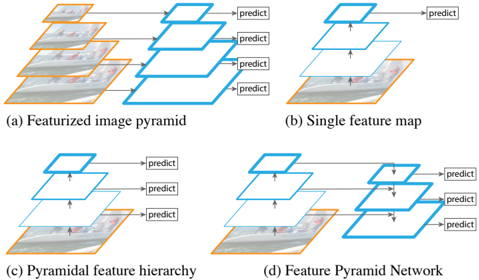
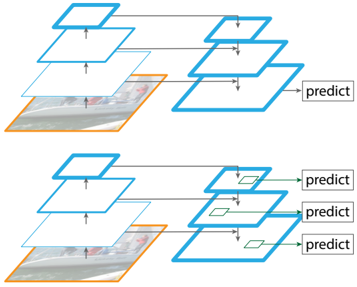
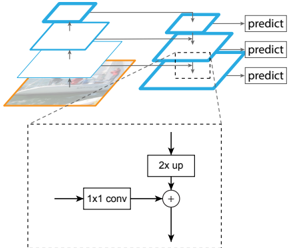
- FPN uses a bottom-up ResNet pathway (C2–C5), a top-down pathway that upsamples coarser maps by 2× with nearest-neighbor interpolation, and lateral 1×1 convolutions merged by element-wise addition; a 3×3 convolution is appended to each merged map. Detection uses d = 256 and pyramid levels P2–P5, with P6 added for RPN’s 512² anchor scale.
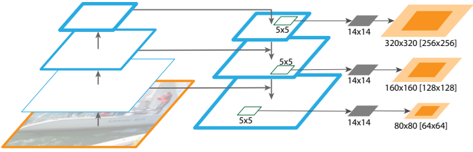
- For RPN, heads are attached to each pyramid level with single-scale anchors of areas {32², 64², 128², 256², 512²} on {P2, P3, P4, P5, P6} and aspect ratios {1:2, 1:1, 2:1}, totaling 15 anchors. For Fast R-CNN, RoIs are assigned to pyramid levels using the canonical 224² size and k₀ = 4, with shared heads and a 2fc MLP.
- Experiments use the 80-category COCO dataset, training on trainval35k (80k train + 35k val subset), ablating on minival (5k val images), and reporting test-std results. Backbones are ImageNet1k-pretrained ResNet-50/101; training uses synchronized SGD on 8 GPUs with input shorter side 800 pixels. RPN training takes about 8 hours and Fast R-CNN about 10 hours on COCO; inference is 0.148 s per image for ResNet-50 and 0.172 s for ResNet-101 on an NVIDIA M40 GPU.
Limitations
- The paper states that designing better connection modules is not its focus and opts for a simple design; more sophisticated blocks gave only marginally better results. It also notes that the ResNet-101 model was not sufficiently trained with the default schedule, and that the feature-sharing version of the COCO leaderboard model was not evaluated due to limited time.
- The paper states that its method does not exploit popular improvements such as iterative regression, hard negative mining, context modeling, or stronger data augmentation, which are complementary and could boost accuracy further.
- Evident from the text: there is no dedicated limitations section, and the empirical evaluation is limited to COCO detection and mask proposal generation, not full instance segmentation or other datasets.
Model-written summary. Check it against the paper before relying on it.
Integrity signals
Registry
Cites
Statistics
Figures
Verification
Claims the paper makes
8 Valid · 4 Not valid · 14 Not checked · 82 Own results and interpretations
The cited sources that could be checked couldn’t confirm or dispute this claim.
In the paper
“For these reasons, Fast and Faster R-CNN [11, 29] opt to not use featurized image pyramids under default settings.”
What the sources say
- Not matchedcites [11] [11] R. Girshick. Fast R-CNN. In ICCV , 2015. -
We searched by its title and found no matching paper.
- Could not verifycites [29] [29] S. Ren, K. He, R. Girshick, and J. Sun. Faster R-CNN: Towards real-time object detection with region proposal networks. In NIPS , 2015. - sourceExperimental — accuracy not yet measured
The Related Work section (p. 3) discusses multi-resolution features for semantic segmentation, and the results (p. 8) discuss multi-scale testing of the authors’ model. Neither passage addresses whether Fast or Faster R-CNN omit featurized image pyramids by default; searches for those models and that setting found no supporting passage in our copy. (LLM, conf=0.77)
plain- Asserted: passes — The authors put it forward as true.
- Checkable: passes — It can be checked against evidence.
- Load-bearing: passes — The paper’s conclusions depend on it.
- Based: passes — The paper gives a reason why it holds.
- Not matched
The cited sources support only part of this claim — read each source’s verdict below.
In the paper
“Recently, FPN has enabled new top results in all tracks of the COCO competition, including detection, instance segmentation, and keypoint estimation. See [14] for details.”
What the sources say
- Partly supportedcites [14] [14] K. He, G. Gkioxari, P. Doll´ ar, and R. Girshick. Mask r-cnn. arXiv:1703.06870 , 2017. - sourceExperimental — accuracy not yet measured
The paper reports strong COCO results using FPN backbones: its instance-segmentation model surpasses earlier winners (Section 4.1, p. 5), its detection model exceeds earlier single-model results (Section 4.3, p. 7), and its keypoint model exceeds the 2016 winner (Section 5, p. 8). But it does not establish that FPN enabled top competition results in all three tracks; Appendix B (p. 10) discusses 2017 winning teams only for instance segmentation and credits the Mask R-CNN framework. (LLM, conf=0.87)
plainstates a cause- Asserted: passes — The authors put it forward as true.
- Checkable: passes — It can be checked against evidence.
- Load-bearing: unclear — It is unclear whether the paper’s conclusions depend on it.
- Based: passes — The paper gives a reason why it holds.
- Partly supported
The sources with a verdict support this claim; the rest weren’t checked yet, have no full text we could read, or their verdicts aren’t rated yet.
In the paper
“All recent top entries in the ImageNet [33] and COCO [21] detection challenges use multi-scale testing on featurized image pyramids ( e.g ., [16, 35]).”
What the sources say
- Not checked yetcites [16] [16] K. He, X. Zhang, S. Ren, and J. Sun. Deep residual learning for image recognition. In CVPR , 2016. - source
Checked before — its earlier verdict is held back until a new check runs.
- Supportedcites [35] [35] A. Shrivastava, A. Gupta, and R. Girshick. Training regionbased object detectors with online hard example mining. In CVPR , 2016. - source
As an example citation, this paper supports the COCO part of the sentence. The Multi-scale (M) section (page unavailable) says it runs inference at all scales during testing, and the Ablation analysis (page unavailable) says a variant finished fourth in the 2015 COCO Detection Challenge. (LLM, conf=0.85)
plain- Asserted: passes — The authors put it forward as true.
- Checkable: passes — It can be checked against evidence.
- Load-bearing: passes — The paper’s conclusions depend on it.
- Based: passes — The paper gives a reason why it holds.
- Not checked yet
The cited sources support only part of this claim — read each source’s verdict below.
In the paper
“Existing mask proposal methods [27, 28, 4] are based on densely sampled image pyramids ( e.g ., scaled by 2 {-2:0 . 5:1 } in [27, 28]), making them computationally expensive.”
What the sources say
- Partly supportedcites [27] [27] P. O. Pinheiro, R. Collobert, and P. Dollar. Learning to segment object candidates. In NIPS , 2015. - sourceExperimental — accuracy not yet measured
The Introduction says prevalent object-detection methods use image or filter pyramids, and §3.3 says avoiding those pyramids saves running time. The paper does not establish that existing mask proposal methods rely on densely sampled image pyramids or document the specified scale sampling. (LLM, conf=0.86)
- Not matchedcites [28] [28] P. O. Pinheiro, T.-Y. Lin, R. Collobert, and P. Doll´ ar. Learning to refine object segments. In ECCV , 2016. -
More than one paper fits this citation.
- Not checked — no full text of the sourcecites [4] [4] J. Dai, K. He, Y. Li, S. Ren, and J. Sun. Instance-sensitive fully convolutional networks. In ECCV , 2016. -
plainstates a cause- Asserted: passes — The authors put it forward as true.
- Checkable: passes — It can be checked against evidence.
- Load-bearing: passes — The paper’s conclusions depend on it.
- Based: passes — The paper gives a reason why it holds.
- Partly supported
Every source the paper cites for this claim was checked and supports it.
In the paper
“The Single Shot Detector (SSD) [22] is one of the first attempts at using a ConvNet's pyramidal feature hierarchy as if it were a featurized image pyramid (Fig. 1(c)).”
What the sources say
- Supportedcites [22] [22] W. Liu, D. Anguelov, D. Erhan, C. Szegedy, and S. Reed. SSD: Single shot multibox detector. In ECCV , 2016. - source
Section 2.2 (p. 6) says SSD uses feature maps from several layers to mimic the effect of processing an image at different sizes. Section 2.1 (p. 3) describes progressively smaller feature layers for multi-scale detection, and the paper presents this as a contribution relative to earlier single-scale detectors. Together, these support the characterization of SSD as an early use of a ConvNet feature hierarchy in place of an image pyramid. (LLM, conf=0.88)
plain- Asserted: passes — The authors put it forward as true.
- Checkable: passes — It can be checked against evidence.
- Load-bearing: unclear — It is unclear whether the paper’s conclusions depend on it.
- Based: passes — The paper gives a reason why it holds.
- Supported
65 more claims · 4 with their cited sources checked
Create a free account to see all 108 claims and to verify the 11 references still open.
- It may state two separate claims as one. 23
- Probably not a substantial claim. 17
- The quote only partly states this claim. 3
Claims other papers make about this one
Each is checked against this paper’s own text: does it say what the citing paper says it does?
The source backs part of the claim, not all of it — or backs it for a different population, condition or comparison.
In the citing paper
“Feature Pyramid Network (FPN) [42] is one of the important two stage object detectors, tried to overcome few of the aforementioned challenges successfully by extracting features at multiple scales of an image in the object detection process.”
From Object detection using YOLO: challenges, architectural successors, datasets and applications (2023) · cites this paper as [42]
Experimental — accuracy not yet measuredThe source backs part of the claim, not all of it — or backs it for a different population, condition or comparison.
In the citing paper
“Its performance can be improved further by exploiting and enhancing the feature hierarchy of deep convolutional networks [80], employing non-local attention [81], and leveraging the reciprocal relationship between detection and segmentation via hybrid task cascade [82].”
From Empowering things with intelligence: a survey of the progress, challenges, and opportunities in artificial intelligence of things (2021) · cites this paper as [80]
Experimental — accuracy not yet measuredThe source backs part of the claim, not all of it — or backs it for a different population, condition or comparison.
In the citing paper
“To improve the accuracy of small defect detection, this paper uses SPP and FPN to increase the effect of multi-scale feature extraction.”
From Automatic Detection and Classification of Steel Surface Defect Using Deep Convolutional Neural Networks (2021) · cites this paper as [26]
Experimental — accuracy not yet measuredThe source backs part of the claim, not all of it — or backs it for a different population, condition or comparison.
In the citing paper
“YOLOv3 introduced a foundational generic architecture inspired by the Feature Pyramid Network (FPN) [22], integrating elements such as residual blocks, skip connections, and up-sampling.”
From YOLOv1 to v8: Unveiling Each Variant–A Comprehensive Review of YOLO (2024) · cites this paper as [22]
Experimental — accuracy not yet measuredThe cited source says what the claim attributes to it.
In the citing paper
“Unlike the word tokens that serve as the basic elements of processing in language Transformers, visual elements can vary substantially in scale, a problem that receives attention in tasks such as object detection [42, 53, 54].”
From Swin Transformer: Hierarchical Vision Transformer using Shifted Windows (2021) · cites this paper as [42]
14 more claims about this paper
Create a free account to see every claim other papers make about this one.
Self-check
Percentages, sums and reported differences re-computed from the paper’s own numbers.
Each contradiction between two passages listed here was confirmed by an independent check.
Rated minor: it would not touch a result — a value no result rests on, a p-value that stays on the same side of the significance level, or a conflict that is clerical, resolved elsewhere in the paper, or outside its own findings.
In the paper
§ 6.1. Segmentation Proposal Results · p. 8
“Our approach, based on FPNs, is substantially faster (our models run at 6 to 7 FPS).”
§ 6. Extensions: Segmentation Proposals · p. 8
“| + 2x train schedule | | 48.1 | 32.6 | 54.2 | 65.6 | 0.25 |”
Rated minor: it would not touch a result — a value no result rests on, a p-value that stays on the same side of the significance level, or a conflict that is clerical, resolved elsewhere in the paper, or outside its own findings.
In the paper
§ 5.1.1 Ablation Experiments · p. 5
“This architecture simulates the effect of reusing the pyramidal feature hierarchy (Fig. 1(b)).”
§ Feature Pyramid Networks for Object Detection · p. 1
“(b) Recent detection systems have opted to use only single scale features for faster detection. (c) An alternative is to reuse the pyramidal feature hierarchy computed by a ConvNet as if it were a featurized image pyramid.”
Citations
Cites
Deep Residual Learning for Image Recognition
He, K., Zhang, X., Ren, S., & Sun, J. (2016) · 2016 IEEE Conference on Computer Vision and Pattern Recognition (CVPR) · doi:10.1109/cvpr.2016.90 · Cited by 235,474 · cited 9×
“Analogous to the ResNet-based Faster R-CNN system [16] that uses C 4 as the single-scale feature map, we set k 0 to 4.”
BackgroundMethodResultInfluentialSelf-citationVery Deep Convolutional Networks for Large-Scale Image Recognition
Simonyan, K., & Zisserman, A. (2014) · arXiv · doi:10.48550/arxiv.1409.1556 · Cited by 114,148 · cited 2×
“But to avoid using low-level features SSD foregoes reusing already computed layers and instead builds the pyramid starting from high up in the network ( e.g ., conv4 3 of VGG nets [36]) and then by adding several new layers.”
BackgroundResultImageNet classification with deep convolutional neural networks
Krizhevsky, A., Sutskever, I., & Hinton, G. E. (2017) · Communications of the ACM · doi:10.1145/3065386 · Cited by 112,155 · cited 3×
“With the development of modern deep ConvNets [19], object detectors like OverFeat [34] and R-CNN [12] showed dramatic improvements in accuracy.”
MethodResultU-Net: Convolutional Networks for Biomedical Image Segmentation
Ronneberger, O., Fischer, P., & Brox, T. (2015) · Lecture notes in computer science · doi:10.1007/978-3-319-24574-4_28 · Cited by 99,404 · cited 1×
“rarchy without combining features or scores. There are recent methods exploiting lateral/skip connections that associate low-level feature maps across resolutions and semantic levels, including U-Net [31] and SharpMask [28] for segmentation, Recombinator networks [17] for face detection, and Stacked Hourglass networks…”
MethodFaster R-CNN: Towards Real-Time Object Detection with Region Proposal Networks
Ren, S., He, K., Girshick, R., & Sun, J. (2017) · IEEE Transactions on Pattern Analysis and Machine Intelligence · doi:10.1109/tpami.2016.2577031 · Cited by 73,472 · cited 10×
“For these reasons, Fast and Faster R-CNN [11, 29] opt to not use featurized image pyramids under default settings.”
BackgroundMethodInfluentialSelf-citationFaster R-CNN: Towards Real-Time Object Detection with Region Proposal Networks
Ren, S., He, K., Girshick, R., & Sun, J. (2015) · arXiv · doi:10.48550/arxiv.1506.01497 · Cited by 70,812 · cited 10×
“For these reasons, Fast and Faster R-CNN [11, 29] opt to not use featurized image pyramids under default settings.”
BackgroundMethodInfluentialSelf-citationDistinctive Image Features from Scale-Invariant Keypoints
Lowe, D. G. (2004) · International Journal of Computer Vision · doi:10.1023/b:visi.0000029664.99615.94 · Cited by 62,647
Microsoft COCO: Common Objects in Context
Lin, T.-Y., Maire, M., Belongie, S., Hays, J., Perona, P., Ramanan, D., Dollár, P., & Zitnick, C. L. (2014) · Lecture Notes in Computer Science · doi:10.1007/978-3-319-10602-1_48 · Cited by 45,460 · cited 6×
“All recent top entries in the ImageNet [33] and COCO [21] detection challenges use multi-scale testing on featurized image pyramids ( e.g ., [16, 35]).”
BackgroundMethodInfluentialSelf-citationImageNet Large Scale Visual Recognition Challenge
Russakovsky, O., Deng, J., Su, H., Krause, J., Satheesh, S., Ma, S., Huang, Z., Karpathy, A., Khosla, A., Bernstein, M., et al. (2015) · International Journal of Computer Vision · doi:10.1007/s11263-015-0816-y · Cited by 39,380 · cited 2×
“Thus we can adapt the assignment strategy of region-based detectors [15, 11] in the case when they are run on image pyramids.”
MethodFully convolutional networks for semantic segmentation
Long, J., Shelhamer, E., & Darrell, T. (2015) · 2015 IEEE Conference on Computer Vision and Pattern Recognition (CVPR) · doi:10.1109/cvpr.2015.7298965 · Cited by 38,834 · cited 1×
“FCN [24] sums partial scores for each category over multiple scales to compute semantic segmentations.”
Background
Research works printed but not linked: 1
- [1] E. H. Adelson, C. H. Anderson, J. R. Bergen, P. J. Burt, and J. M. Ogden. Pyramid methods in image processing. RCA engineer , 1984. -
Cited by
Items 25,801–25,900 of 29,875
Steel defect detection based on multi-angle and multi-feature fusion network
Yu, F., & Zhang, J. (2024) · European Journal of Mathematics and Applications · doi:10.28919/ejma.2024.4.13
Meng, C., Sun, Z., Li, T., et al. (2024) · SSRN Electronic Journal · doi:10.2139/ssrn.4830894
Zhang, W., Guo, Z., Xu, J., Li, X., & Zhu, X. (2024) · Learning and analytics in intelligent systems · doi:10.1007/978-3-031-56521-2_1
Transport Object Detection in Street View Imagery Using Decomposed Convolutional Neural Networks
Bai, Y., Shang, C., Li, Y., Shen, L., Zeng, X., & Shen, Q. (2024) · Advances in intelligent systems and computing · doi:10.1007/978-3-031-55568-8_34
Multi-layer Cross-Scale Coupling Feature Pyramid Network for Food Logo Detection
Zhang, B., Hou, S., Zhao, S., Hou, Q., Li, X., & Yan, W. (2024) · Learning and analytics in intelligent systems · doi:10.1007/978-3-031-56521-2_11
Li, C., Gao, Z. Y., Lin, Z., Ye, T., & Li, Z. (2024) · The Photogrammetric Record · doi:10.1111/phor.12500
“For comparison with other methods, we use ResNet101-DCN (Dai et al., 2017 ) with the initial weights from FCOS3D (Wang, Zhu, et al., 2021 ) as our backbone, after passing through the Feature Pyramid Network (FPN) (Lin et al., 2017 ), the last three feature maps are used as inputs for the subsequent three transformer b…”
Segmentation and Labeling of Polished Section Images Based on Deep LearningPreprint
Tang, H., He, L., Huang, S., et al. (2024) · SSRN Electronic Journal · doi:10.2139/ssrn.4833313
Contour refinement instance segmentation for occluded objects
Wei, L., Ya, H., Xin-yuan, Z., & Han, G. (2024) · Journal of Image and Graphics · doi:10.11834/jig.230194 · Cited by 1
Özen, S., Kuter, S., & Akyürek, Z. (2024) · SSRN Electronic Journal · doi:10.2139/ssrn.4836425
RSF-SSD: An Improved SSD Algorithm Based on Multi-level Feature Enhancement
Yang, W., Zeng, S., Liu, C., Li, H., & Kang, Z. (2024) · Lecture notes in computer science · doi:10.1007/978-981-97-1417-9_12
Wang, X., Liu, W., Wang, L., Zhang, Z., Zhang, J., & Wang, X. (2024) · International Conference on Machine Learning and Computer Application (ICMLCA) · doi:10.1117/12.3028972
“The function of a Feature Pyramid Network (FPN) [1] can be said as a fusion of shallow to deep feature maps, thus making full use of features at all levels.”
BackgroundOccluded Pedestrian Detection Model in Dense Scenes Based on Improved Yolov8Preprint
Zhang, Y., Zhao, C., Liu, L., Song, Z., Ma, L., & Chen, Q. (2024) · SSRN Electronic Journal · doi:10.2139/ssrn.4837937
A Novel Ol-Mapping Operator-Based Edge Detection Approach and its Application in Image SegmentationPreprint
Han, Q., Li, S., Hou, M., et al. (2024) · SSRN Electronic Journal · doi:10.2139/ssrn.4837230
Dynamic Fire and Smoke Detection Module with Enhanced Feature Integration and Attention MechanismsPreprint
Amjad, A., Tsung, C. H., & Tai, L. (2024) · SSRN Electronic Journal · doi:10.2139/ssrn.4837938
Simultaneous Image Patch Attention and Pruning for Patch Selective TransformerPreprint
Kim, S., Yoon, G.-J., Song, J., et al. (2024) · SSRN Electronic Journal · doi:10.2139/ssrn.4831516
RS-YOLO: A YOLO-Based Method for Small Object Detection in Remote SensingPreprint
Ao, D., Zhao, W., Zhang, Y., et al. (2024) · Research Square · doi:10.21203/rs.3.rs-4416811/v1
Dual Subnet Label Assignment for End-to-End Fully Convolutional Pedestrian Detection in Crowd Scenes
Wang, J. (2024) · Academic Journal of Computing & Information Science · doi:10.25236/ajcis.2024.070501
Byun, J., Kang, B., Mun, D., Lee, G., & Kim, H. (2024) · SSRN Electronic Journal · doi:10.2139/ssrn.4841942
Enhanced Defect Classification With CNN’s And path Aggregation Network
Khedidja, M., Abbas, F., & Hemam, M. (2024) · International Conference on Image and Signal Processing and their Applications (ISPA) · doi:10.1109/ispa59904.2024.10536835
“Tsung et al. [11] proposed a feature pyramid network for multi-scale feature fusion to accurately recognize the exact location of objects, facilitating object classification and detection.”
BackgroundBehavior and efficiency analysis of Asian neighborhood transportation based on object detection
Gong, X. (2024) · Applied and Computational Engineering · doi:10.54254/2755-2721/66/20240919
SFNet: A Scaling-down Fusion Network for Infrared and Visible Images with Texture Attention
Li, Y., He, K., & Xu, D. (2024) · Asia Conference on Algorithms, Computing and Machine Learning (CACML) · doi:10.1145/3654823.3654843
“With each pooling and convolution, the resolution of image features decreases, and textures gradually diminish, while semantic information becomes more enriched [18].”
BackgroundSelf-citationIntroduction to Logo Detection
Chen, Y., Ruan, X., & Jain, R. K. (2024) · Intelligent systems reference library · doi:10.1007/978-3-031-59811-1_2
Mitigating Domain Shift in Logo Detection: An Adversarial Learning-Based Approach
Chen, Y., Ruan, X., & Jain, R. K. (2024) · Intelligent systems reference library · doi:10.1007/978-3-031-59811-1_5
Rotating Target Detection Model of Water Surface Garbage Based on YOLOv5
赵, 政. (2024) · Modeling and Simulation · doi:10.12677/mos.2024.133273
Xiao, Y., Chen, R., Zhu, H., Zhang, C., & Gu, M. (2024) · SSRN Electronic Journal · doi:10.2139/ssrn.4849481
Animal Fiber Detection Based on Image Recognition Techniques
Li, F., Cai, Y., Li, W., et al. (2024) · doi:10.1145/3653804.3656263
“The YOLO series employs PAN and FPN[20] for feature fusion, integrating the feature information of each scale through lateral connections and a pyramid hierarchy.”
MethodExploring Enhanced Object Detection and Classification Methods for Alstroemeria Genus Morado
Huang, Y., & Wang, Y. (2024) · International Journal of Advanced Computer Science and Applications · doi:10.14569/ijacsa.2024.01505116
SpanEffiDet: Span-Scale and Span-Path Feature Fusion for Object Detection
Liu, Q., Zhao, Y., Gao, R., Bu, X., & HANAJIMA, N. (2024) · Neural Processing Letters · doi:10.1007/s11063-024-11653-6
МЕТОДИ МАШИННОГО НАВЧАННЯ ДЛЯ АНАЛІЗУ СТРУКТУРИ ДОКУМЕНТІВ
Коростіль, М., & Лагун, І. І. (2024) · Наука і техніка сьогодні · doi:10.52058/2786-6025-2024-5(33)-1200-1215
THE CONSTRUCTION OF THE MODEL FOR DAMAGE LEVEL ASSESSMENT OF CRITICAL INFRASTRUCTURE OBJECTS
САКОВИЧ, Б. (2024) · Наука і техніка сьогодні · doi:10.52058/2786-6025-2024-5(33)-1060-1082
STOD: toward semi-supervised tiny object detection
Guo, Y., Feng, Y., Du, K., & Cao, L. (2024) · Neural Computing and Applications · doi:10.1007/s00521-024-09936-z · Cited by 2
Acp-Net: Asymmetric Center Positioning Network for Real-Time Text DetectionPreprint
Zhu, B., Liu, F., Chen, X. T., et al. (2024) · SSRN Electronic Journal · doi:10.2139/ssrn.4855396
A review of YOLO-based traffic sign target detection
Liu, S. (2024) · Science and Technology of Engineering Chemistry and Environmental Protection · doi:10.61173/gv1hwn77 · Cited by 1
Effectiveness Study of Machine Learning Task of Detection Hands Position by Keypoints
Shtekhin, S. E., Karachev, D. K., & Stadnik, A. V. (2024) · Physics of Particles and Nuclei · doi:10.1134/s1063779624030778
“In recent years, significant progress has been made in the field of object detection [1–4].”
AET:Auxiliary and Embedded Teacher for Online Mutual Knowledge Distillation for Image ClassificationPreprint
Liu, W., Liang, X., Bi, F., & Lin, Y. (2024) · Research Square · doi:10.21203/rs.3.rs-4478667/v1
Automatic segmentation using knowledge distillation with ensemble models (ASKDEM)
Buschiazzo, A., Russell, M., Osteen, P., & Uplinger, J. (2024) · SPIE Unmanned Systems Technology · doi:10.1117/12.3013678
“A Feature Pyramid Network [14] (FPN) model with an efficientnet-b3 backbone, an FPN model with a resnet34 backbone, an FPN model with a resnet34 backbone and normalized class weighting during training, an FPN model with a resnet101 backbone and normalized class weighting during training, a U-Net…”
MethodNavigating Style Variations in Scene Text Image Super-Resolution through Multi-Scale Perception
Xu, F., & Yu, Z. (2024) · International Conference on Multimedia Retrieval · doi:10.1145/3652583.3658070
“To make the image better adapt to the effect of its size change, we raise the MAF module inspired by the structural pattern of the feature pyramid [19].”
MethodBSMO: enhancing multi-task learning through batch swapping optimization
Spencer, Z., Schirner, G., & Tabkhi, H. (2024) · Real-Time Image Processing and Deep Learning · doi:10.1117/12.3013609
“…networks like ResNet 16 without the final classification layer, 8,13,22,29 Necks typically extract features from the backbone while utilizing multi-scale fusion, 30 and Heads take the neck’s representation and perform the final tasks such as bounding box regression as seen in RetinaNet 31 and FCOS.”
MethodEfficient Object Recognition of a Deep Dive into Computer Vision Algorithms
Yao, Z. (2024) · IEEE International Conference on Control, Electronics and Computer Technology (ICCECT) · doi:10.1109/iccect60629.2024.10545788
“[11][12] Chasing proficiency, the writing accentuates the job of enhancement methods.”
BackgroundMulti-View Stereo Reconstruction Based on Adaptive Aggregation and Coordinate Attention Mechanism
Wang, C., Song, Z., Zhao, C., Lang, Y., & Li, M. (2024) · IEEE International Conference on Control, Electronics and Computer Technology (ICCECT) · doi:10.1109/iccect60629.2024.10546032
“…to robustly estimate the depth map directly from a series of images by first extracting image features using a Feature Pyramid Network (FPN) [2], then warping the image features into a reference camera truncated body to construct a 3D cost volume via a differentiable univariate reactivity…”
MethodSACNet: Supervised-attention Constraint Feature Fusion for Tiny Object DetectionPreprint
Gong, S., Qi, Y., Wang, Y., & Liu, B. (2024) · SSRN Electronic Journal · doi:10.2139/ssrn.4856792
Fusing lightweight Retinaface network for fatigue driving detection
Zhiqin, W. (2024) · International Conference on Algorithms, Microchips, and Network Applications (AMNA) · doi:10.1117/12.3031940
“The Retinaface network uses the five levels of FPN [3] to extract facial features, which are divided into feature pyramid levels from P2 to P6, where P2 to P5 are the top-down and horizontal output features of the ResNet residual connection network using C2 to C5 Figure calculated.”
MethodVisual and semantic guided scene text retrieval
Luo, H., Ibrayim, M., Hamdulla, A., & Deng, Q. (2024) · The Journal of Supercomputing · doi:10.1007/s11227-024-06268-6 · Cited by 1
“In this paper, to balance multiple losses, after several experiments, we set λ 1 , λ 2 , λ 3 , λ 4 , and λ 5 as 1, 1, 1, 0.1, and 2.”
InfluentialClose Proximity Aerial Image for Precision Viticulture. A ReviewPreprint
Molnár, S., & Tamás, L. (2024) · SSRN Electronic Journal · doi:10.2139/ssrn.4860820
Proportional Feature Pyramid Network for Lane Detection
Hui, J., Lian, G., Wu, J., et al. (2023) · doi:10.1109/iccbd-ai62252.2023.00105
A real-time method for detecting Canada Goldenrod based on an improved YOLOv5 network
Zhang, L., He, Z., Yin, S., et al. (2023) · doi:10.1109/iccbd-ai62252.2023.00021
“The Neck adopts a structure that combines the Feature Pyramid Networks (FPN) [15] and Path Aggregation Network (PAN) [16].”
MethodSushama, G., & Menon, G. C. (2024) · SN Computer Science · doi:10.1007/s42979-024-02932-z
“We employed a multi-scale sparsely connected network, incorporating residual connections [22–24], to extract feature maps from colonoscopic images.”
Mlff-Internimage: Pavement Crack Segmentation Model Integrating Multi-Level Fusion FeaturesPreprint
Li, G., Yang, J., Hong, J., & Liu, Y. (2024) · SSRN Electronic Journal · doi:10.2139/ssrn.4861081
Li, X., Wang, C., Wang, S., Zeng, Z., Liu, J., & Zheng, B. (2024) · SSRN Electronic Journal · doi:10.2139/ssrn.4863519
End-to-End Visual Grounding Framework for Multimodal NER in Social Media Posts
Lyu, Y., Hu, J., Xue, Y., & Cai, Q. (2024) · IEEE Transactions on Computational Social Systems · doi:10.1109/tcss.2024.3402738 · Cited by 1
“As pointed out in feature pyramid network [29], the top– down path reuses rich detailed information in the backbone network, which is important for detecting object regions of various scales, especially those small image regions.”
Bian, D., Tang, M., Xu, H., Lin, M. A., Cai, T., Tang, Q., Lv, S., Xiong, J., Wen, Y., & Hu, J. (2024) · SSRN Electronic Journal · doi:10.2139/ssrn.4862981
A Novel Dataset and Deep Learning Object Detection Benchmark for Grapevine Pest SurveillancePreprint
Checola, G., Sonego, P., Zorer, R., et al. (2024) · SSRN Electronic Journal · doi:10.2139/ssrn.4862268
Deep layer nested aggregation: anti-occlusion network for UAV detection and tracking
Ma, J., Li, L., Huang, S., Wang, X., Guo, Y. P., & Jin, D. (2024) · International Conference on Image, Signal Processing and Pattern Recognition (ISPP) · doi:10.1117/12.3033524 · Cited by 1
Han, Y., & Zhang, Z. (2024) · International Symposium on Autonomous Systems (ISAS) · doi:10.1109/isas61044.2024.10552476
“The proposed model, SFD-SSD, incorporates the Squeeze- and-Excitation (SE) attention mechanism [10], Feature Pyra-mid Network (FPN) [11], and Dilation Block (DB): • In the shallow feature layer, the SE attention mechanism leverages global information to assign weights to the feature map based on…”
MethodMultiscale Complementary Semantic Enhancement Network for Welding Seam X-ray Image Defect Detection
Liu, W., Wang, Y., & Chen, H. (2024) · International Symposium on Autonomous Systems (ISAS) · doi:10.1109/isas61044.2024.10552617
“The Feature Pyramid Network (FPN) [2] enhances multiscale feature representation in one-stage networks through lateral connections and a top-down pathway, forming a semantic pyramid across scales.”
BackgroundA Multi-stage Feature Enhancement Network with Second-Attention for Image Captioning
Yang, X., Yang, Y., Wu, J., Ma, S., Hou, Z., & Song, B. (2023) · doi:10.1145/3641584.3641586
Traversability Map Estimation for Agricultural Robots
Sucala, P., & Tamás, L. (2024) · IEEE International Conference on Automation, Quality and Testing, Robotics (AQTR) · doi:10.1109/aqtr61889.2024.10554140
“We are using Panoptic Segmentation based on Detectron2 platform [18], which is based on Mask R-CNN [7] and Feature Piramid Networks [14].”
MethodHierarchical Processing: Better Utilizing RPN in Few-Shot Object DetectionPreprint
Hu, P. P., Chen, S.-B., & Luo, B. (2024) · SSRN Electronic Journal · doi:10.2139/ssrn.4865113
Guo, Y., Chen, S., Yan, G., et al. (2024) · SSRN Electronic Journal · doi:10.2139/ssrn.4867998
Ranking-Based Adaptive Query Generation for Detrs in Crowded Pedestrian DetectionPreprint
Gao, F., Leng, J., Gan, J., & Gao, X. (2024) · SSRN Electronic Journal · doi:10.2139/ssrn.4867991
Multi-view Learning for Camouflaged Object Detection with PVTv2Preprint
Yan, P., Ruan, K., Wang, L., et al. (2024) · Research Square · doi:10.21203/rs.3.rs-4520181/v1
Shipping Risk Assessment Ship Inspection Method Based on Improved YOLOv5
Wang, Z. R., Li, H., Sun, M., et al. (2024) · Lecture notes in electrical engineering · doi:10.1007/978-981-97-2200-6_9
Efficient Cross-Scale Integration For UAV Object Detection
Wang, Z., Yu, Y., Hu, Z., & Zhu, Y. (2024) · International Conference on Advanced Algorithms and Control Engineering (ICAACE) · doi:10.1109/icaace61206.2024.10549428
“Feature Pyramid Networks (FPN) [2] propose a top-down multi-scale feature interaction mechanism that allows shallow features to obtain global contextual information of deeper features.”
BackgroundHigh similarity controllable face anonymization based on dynamic identity perception
Xu, J., Tan, X., Ju, Y., Mao, X., & Zhang, S. (2024) · The Visual Computer · doi:10.1007/s00371-024-03526-9
“To keep as much original information as possible, we propose feature selection and preservation network (FSPNet) that utilizes a pyramid approach [41, 47] to extract features from different levels and injects specified features back to the face image.”
Zhou, C., & Shi, F. (2024) · SSRN Electronic Journal · doi:10.2139/ssrn.4868747
Yan, S., Chang, J., Li, L., et al. (2024) · SSRN Electronic Journal · doi:10.2139/ssrn.4868687
CarrDet: Attention–Symmetry-Based Microscopic Carrier Detection for Wastewater Treatment
Liu, S., Chen, H., Liu, R., Shi, H., Hu, C., & Shi, R. (2024) · Applied Sciences · doi:10.3390/app14135393
Sparsegenx: An Improved Sparsity Generative X-Ray Security Object Detection ModelPreprint
Wu, J., & Xu, X. (2024) · SSRN Electronic Journal · doi:10.2139/ssrn.4872120
Hierarchical Processing: Better Utilizing Rpn in Few-Shot Object DetectionPreprint
Hu, P. P., Chen, S.-B., & Luo, B. (2024) · SSRN Electronic Journal · doi:10.2139/ssrn.4872125
Dunhuang Buddhist Art Object Recognition and 3d Reconstruction Based on CenternetPreprint
Liu, S., & Wang, S. (2024) · SSRN Electronic Journal · doi:10.2139/ssrn.4873881
Guo, Y. Q., Huang, X., Chen, W., Nakamoto, I., Chen, H., Feng, J., & Wu, J. (2024) · Research Square · doi:10.21203/rs.3.rs-4553696/v1
Small Object Detection Network Based on Attention Mechanism and Feature FusionPreprint
Wang, Y., Huang, X., Xie, G., & Yuan, J. (2024) · SSRN Electronic Journal · doi:10.2139/ssrn.4876039
Song, J., Zhang, S., Kong, X., Wang, W., & Che, D. (2024) · SSRN Electronic Journal · doi:10.2139/ssrn.4875895
Yang, H., Sun, J., Wang, Y., et al. (2024) · SSRN Electronic Journal · doi:10.2139/ssrn.4869218
A Concise Evaluation of Masked Face Detection Utilizing State-of-the-Art Deep Learning Techniques
Ho, C., Quoc, T. N., & Hoang, V. T. (2023) · IEEE Student Conference on Research and Development (SCOReD) · doi:10.1109/scored60679.2023.10563869 · Cited by 1
“Significant progress in face detection has been achieved due to recent advancements in deep learning methods [1], [2], [3] and the availability of extensive face datasets [4], [5], [6].”
BackgroundLin, H., Chen, H., Zhang, Y., Chen, W., & Chen, C. (2024) · SSRN Electronic Journal · doi:10.2139/ssrn.4872542
Local many-to-many matching via ROI feature decomposition for multi-object tracking
Yang, J., Ban, Y., & Liu, J. (2024) · Signal Image and Video Processing · doi:10.1007/s11760-024-03336-5 · Cited by 2
“Therefore, from an optimization perspective, enhancements in the tracking model could be pursued in both the detection [4, 17, 22, 34, 46] and tracking aspects [5, 36, 43–45].”
A Scene Tibetan Text Detection by Combining Multi-scale and Dual-Channel Features
DangZhi, C., Huang, H., Fan, Y., et al. (2024) · Communications in computer and information science · doi:10.1007/978-3-031-61816-1_11
Fusion Based Object Detection for Autonomous Driving Systems
Dhakal, S. (2024) · University of North Texas Digital Library (University of North Texas) · doi:10.12794/metadc2332584
Zhang, Z., & Kurita, T. (2024) · Communications in computer and information science · doi:10.1007/978-981-97-4249-3_1
Efficient Detection Model Using Feature Maximizer Convolution for Edge Computing
Choi, J., Lee, Y., & Jo, K.-H. (2024) · Communications in computer and information science · doi:10.1007/978-981-97-4249-3_10
A study of rainy ibis detection based on Yolov7-tiny
Huang, J. L., Zhang, P. C., Zhang, J., et al. (2024) · Journal of Mechatronics and Artificial Intelligence in Engineering · doi:10.21595/jmai.2024.24155
“Therefore, the addition of this module to the backbone network does not affect the overall structure of the Feature Pyramid Networks (FPN [18]) and Pixel Aggregation Network (PAN [19]).”
BackgroundA real-time object detection method for electronic screen GUI test systems
Wang, Z. J., Xi, K., Gao, C., Jin, X., Chen, Y., & Lu, C. (2024) · The Journal of Supercomputing · doi:10.1007/s11227-024-06319-y
“Feature Pyramid Network (FPN) [39] provides more accurate localization by aggregating high-level semantic and low-level features through a top-down path.”
A skip feature enhanced multi-source fusion framework for switch state detection
Zhang, S., Bai, R., He, R., et al. (2024) · International Journal of Rail Transportation · doi:10.1080/23248378.2024.2372729
“Existing network fusion modules such as FPN [41], PANet [42], BiFPN [43], or Recursive-FPN [44] have demonstrated commendable efficacy in feature fusion by integrating feature maps of varying scales from the backbone network.”
Qingge, 李. L., Xiaogang, 杨. Y., Ruitao, 卢. L., et al. (2024) · Infrared and Laser Engineering · doi:10.3788/irla20240086
Study on the PCB Defect Detection Method Based on CPH-YOLOv5
Liu, B., & Tang, J. L. (2024) · IEEE Advanced Information Management, Communicates, Electronic and Automation Control Conference (IMCEC) · doi:10.1109/imcec59810.2024.10574941
“The Neck utilizes the structure of a feature pyramid network [15] and a path aggregation network [16] .”
MethodA Pedestrian Detection Algorithm based on Improved YOLOv8
Ren, Y., Li, Y., Gao, H., & Wang, W. (2024) · IEEE Advanced Information Management, Communicates, Electronic and Automation Control Conference (IMCEC) · doi:10.1109/imcec59810.2024.10575299
“YOLOv8 uses a Feature Pyramid Network (FPN) [12] to fuse shallow and deep information by channel splicing.”
MethodLiteFace: A Light-Weight Multi-person Face Detection Model
Anand, K., Murali, N., & Mishra, D. (2024) · Communications in computer and information science · doi:10.1007/978-3-031-58174-8_25
Towards imbalanced motion: part-decoupling network for video portrait segmentation
Yu, T., Xia, C., & Li, J. (2024) · Science China Information Sciences · doi:10.1007/s11432-023-4030-y · Cited by 1
Two-stage re-parameterization and sample disentanglement network for surveillance vehicle detection
Xie, W., Liu, W., & Dai, Y. (2024) · Measurement Science and Technology · doi:10.1088/1361-6501/ad5ea6
“TRSD-Net consists of three components: two-stage depthwise to point-wise re-parameterization (RepTDP), feature pyramid network (FPN) [51], and TSD. RepTDP, FPN, and TSD correspond to the backbone, neck, and head of a one-stage object detector, respectively.”
SAYNet: Self-attention YOLO Network for Human Detection in Thermal and Infrared Images
Hazra, S., Poddar, S., Bhattacharjee, S., Banerjee, S., Khatua, S., & Saha, B. (2024) · Lecture notes in networks and systems · doi:10.1007/978-981-97-2614-1_48
IML-SSOD: Interconnected and multi-layer threshold learning for semi-supervised detection
Ge, B., Li, Y., Liu, H., Xia, C., & Geng, S. (2024) · Journal of Visual Communication and Image Representation · doi:10.1016/j.jvcir.2024.104220
Detecting Mice Depth Shapes with Deployable Tiny Neural Networks in Small Cages
Pau, D. P., Fiorenza, G., & Garzola, M. (2024) · Zooming Innovation in Consumer Technologies Conference (ZINC) · doi:10.1109/zinc61849.2024.10579406
“This solution enabled the model to analyze the input at different scale resolution, proven to be an effective idea; as demonstrated also by Feature Pyramid Network [11] that employs a similar concept.”
MethodVisual Monitoring of Mice Wellness by Tiny Detectors
Pau, D. P., Garzola, M., & Guirges, B. (2024) · Zooming Innovation in Consumer Technologies Conference (ZINC) · doi:10.1109/zinc61849.2024.10579289
“For example Regional CNNs (R-CNNs) [9], Feature Pyramidal Networks (FPN) [10] or Depthwise Separable Convolution [11]; the most performing models are also based on one or more combination of these enabling technologies.”
BackgroundPCB defects detection model based on YOLOv8n-SM
Chen, P., & Lin, Y. (2024) · International Conference on Electronic Information Engineering and Data Processing (EIEDP) · doi:10.1117/12.3032953
Research on in-situ monitoring method for ceramic additive manufacturing process based on YOLOv3
Jia, X., Liu, B., Hu, C., et al. (2024) · International Conference on Electronic Information Engineering and Data Processing (EIEDP) · doi:10.1117/12.3032822
“This is in contrast to two-stage deep learning networks such as Faster-RCNN [7] and Pyramid Networks [8] .”
Розпізнавання пошкоджень меніска засобами глибинних нейронних мереж
Мосіюк, В. В., & Федасюк, Д. В. (2024) · Науковий вісник НЛТУ України · doi:10.36930/40340406
Sdrnet: A Hybrid Approach with Deep Convolutional Networks for Ship Draft ReadingPreprint
Wang, B., Liu, Z., & Shen, Y. (2024) · SSRN Electronic Journal · doi:10.2139/ssrn.4886855 · Cited by 1
Metadata
- Authors
- Lin, T.-Y., Dollar, P., Girshick, R., He, K., Hariharan, B., & Belongie, S.
- Affiliations
- Cornell University (US)
- Meta (United States) (US)
- Venue
- 2017 IEEE Conference on Computer Vision and Pattern Recognition (CVPR)
- Publisher
- IEEE
- Published
- 2017-07
- Pages
- 936-944
- ISSN
- 1063-6919 (ISSN-L)
- OpenAlex
- W2565639579
- Cited by
- 30,939
- References
- 64
- Citations by year
- 2026: 2864 · 2025: 4496 · 2024: 5179 · 2023: 5172 · 2022: 4516 · 2021: 3861 · 2020: 2506 · 2019: 1759 · 2018: 526 · 2017: 58
- FWCI
- 387.80
- Type
- conference paper
- Language
- en
- Open access
- closed
- Locations
- IEEE Computer Society Conference on Computer Vision and Pattern Recognition/Proceedings - IEEE Computer Society Conference on Computer Vision and Pattern Recognition/Proceedings (publishedVersion)
- Topics
- Physical Sciences › Computer Science › Computer Vision and Pattern Recognition › Advanced Neural Network Applications
- Physical Sciences › Computer Science › Computer Vision and Pattern Recognition › Advanced Image and Video Retrieval Techniques
- Physical Sciences › Computer Science › Computer Vision and Pattern Recognition › Visual Attention and Saliency Detection
- Keywords
- feature pyramid network, multi-scale object detection, lateral connections, Faster R-CNN, COCO benchmark, deep convolutional neural networks, feature extraction
About these checks
Registry, retraction, Cites and statistics results are computed, not judged, with one exception: a printed reference that no index lists is read once by a model before it counts as a citation error. Claims are extracted by a model and kept only when their quote appears verbatim in the text; each cited source is then checked, with a model’s help, for whether it says what the claim relies on. Those verdicts can be wrong — read the claim’s quote and the cited source before relying on one.
The claim verdicts this report counts are experimental: their accuracy is not yet measured.
A language model drew the claims from the paper on 2026-10-10, under version 3 of the claim definition (model deepseek-v4.1-flash, prompt extract-v3).
A second model labelled each claim on 2026-10-10 (model jev-1.13-20260917, definition revision gold-guideline-v0.2).
Cited sources are checked with a language model’s help (gpt-6-sol).
Statistics and arithmetic are recomputed, not judged.
Confidence bands are shown only for fields calibrated on our annotated test set. None is calibrated yet, so no band is shown.
What counts as a claim ›How we measure confidence ›How we check this ›
Are you an author, or do you see a problem with this page? Request a review
Data sources
Bibliographic data: Semantic Scholar, OpenAlex, Crossref.
Contains information from the Semantic Scholar Academic Graph Datasets, made available under the ODC Attribution License (ODC-BY 1.0).
Semantic Scholar’s data is described in: Kinney, R., et al. (2023). The Semantic Scholar Open Data Platform. arXiv:2301.10140.
