

Feature Pyramid Networks for Object Detection
The DOI matches its Crossref record; 49 of the 64 references it cites were found in a registry or an index, and 1 are not checked yet; 14 of the 44 sources its claims cite were checked for support.
Abstract
Feature pyramids are a basic component in recognition systems for detecting objects at different scales. But pyramid representations have been avoided in recent object detectors that are based on deep convolutional networks, partially because they are slow to compute and memory intensive. In this paper, we exploit the inherent multi-scale, pyramidal hierarchy of deep convolutional networks to construct feature pyramids with marginal extra cost. A top-down architecture with lateral connections is developed for building high-level semantic feature maps at all scales. This architecture, called a Feature Pyramid Network (FPN), shows significant improvement as a generic feature extractor in several applications. Using a basic Faster R-CNN system, our method achieves state-of-the-art single-model results on the COCO detection benchmark without bells and whistles, surpassing all existing single-model entries including those from the COCO 2016 challenge winners. In addition, our method can run at 5 FPS on a GPU and thus is a practical and accurate solution to multi-scale object detection. Code will be made publicly available.
Verified 2026-11-25 · 1 reference not checked yet
Overview
CoChat Summary
TL;DR
Feature Pyramid Networks (FPN) build in-network feature pyramids from a single-scale image using a top-down pathway and lateral connections, giving semantically strong features at all scales with marginal extra cost. FPN improves region proposal and object detection accuracy over strong single-scale baselines and achieves state-of-the-art single-model COCO results without image pyramids.
Key findings
- RPN with FPN improves COCO minival AR\(_{1k}\) to 56.3 from 48.3 for the single-scale C4 baseline (+8.0 points), and small-object AR\(_{1k}^s\) to 44.9 from 32.0 (+12.9 points).
- Fast R-CNN on fixed proposals improves AP to 33.9 with FPN versus 31.9 for the C4 baseline (+2.0) and 28.8 for the 2fc C5 baseline (+5.1); AP@0.5 is 56.9.
- Faster R-CNN with FPN reaches 33.9 AP and 56.9 AP@0.5 on minival, improving over a strong single-scale baseline by 2.3 AP and 3.8 AP@0.5. On COCO test-dev with ResNet-101, it reaches 36.2 AP and 59.1 AP@0.5, surpassing single-model competition winners such as G-RMI (34.7 AP) and AttractioNet (35.7 AP).
- For segmentation proposals, FPN with dual MLPs, 2× mask resolution, and 2× training schedule reaches 48.1 AR, outperforming DeepMask (37.1), SharpMask (39.8), and InstanceFCN (39.2) by over 8.3 points AR, while running at 6–7 FPS.
Methods
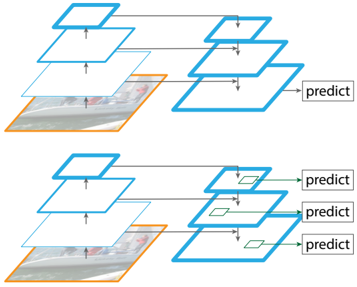
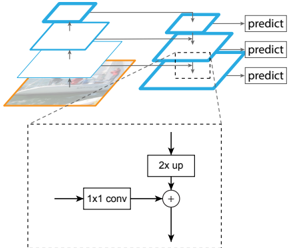
- FPN uses a bottom-up ResNet pathway (C2–C5), a top-down pathway that upsamples coarser maps by 2× with nearest-neighbor interpolation, and lateral 1×1 convolutions merged by element-wise addition; a 3×3 convolution is appended to each merged map. Detection uses d = 256 and pyramid levels P2–P5, with P6 added for RPN’s 512² anchor scale.
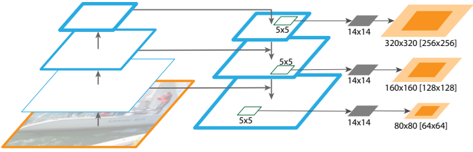
- For RPN, heads are attached to each pyramid level with single-scale anchors of areas {32², 64², 128², 256², 512²} on {P2, P3, P4, P5, P6} and aspect ratios {1:2, 1:1, 2:1}, totaling 15 anchors. For Fast R-CNN, RoIs are assigned to pyramid levels using the canonical 224² size and k₀ = 4, with shared heads and a 2fc MLP.
- Experiments use the 80-category COCO dataset, training on trainval35k (80k train + 35k val subset), ablating on minival (5k val images), and reporting test-std results. Backbones are ImageNet1k-pretrained ResNet-50/101; training uses synchronized SGD on 8 GPUs with input shorter side 800 pixels. RPN training takes about 8 hours and Fast R-CNN about 10 hours on COCO; inference is 0.148 s per image for ResNet-50 and 0.172 s for ResNet-101 on an NVIDIA M40 GPU.
Limitations
- The paper states that designing better connection modules is not its focus and opts for a simple design; more sophisticated blocks gave only marginally better results. It also notes that the ResNet-101 model was not sufficiently trained with the default schedule, and that the feature-sharing version of the COCO leaderboard model was not evaluated due to limited time.
- The paper states that its method does not exploit popular improvements such as iterative regression, hard negative mining, context modeling, or stronger data augmentation, which are complementary and could boost accuracy further.
- Evident from the text: there is no dedicated limitations section, and the empirical evaluation is limited to COCO detection and mask proposal generation, not full instance segmentation or other datasets.
Model-written summary. Check it against the paper before relying on it.
Integrity signals
Registry
Cites
Statistics
Figures
Verification
Claims the paper makes
8 Valid · 4 Not valid · 14 Not checked · 82 Own results and interpretations
The cited sources that could be checked couldn’t confirm or dispute this claim.
In the paper
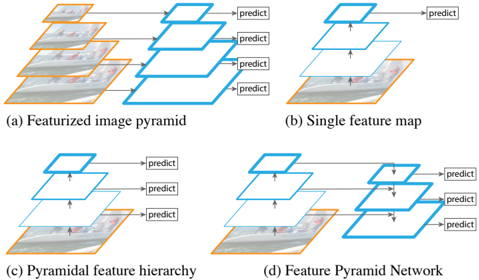
“For these reasons, Fast and Faster R-CNN [11, 29] opt to not use featurized image pyramids under default settings.”
What the sources say
- Not matchedcites [11] [11] R. Girshick. Fast R-CNN. In ICCV , 2015. -
We searched by its title and found no matching paper.
- Could not verifycites [29] [29] S. Ren, K. He, R. Girshick, and J. Sun. Faster R-CNN: Towards real-time object detection with region proposal networks. In NIPS , 2015. - sourceExperimental — accuracy not yet measured
The Related Work section (p. 3) discusses multi-resolution features for semantic segmentation, and the results (p. 8) discuss multi-scale testing of the authors’ model. Neither passage addresses whether Fast or Faster R-CNN omit featurized image pyramids by default; searches for those models and that setting found no supporting passage in our copy. (LLM, conf=0.77)
plain- Asserted: passes — The authors put it forward as true.
- Checkable: passes — It can be checked against evidence.
- Load-bearing: passes — The paper’s conclusions depend on it.
- Based: passes — The paper gives a reason why it holds.
- Not matched
The cited sources support only part of this claim — read each source’s verdict below.
In the paper
“Recently, FPN has enabled new top results in all tracks of the COCO competition, including detection, instance segmentation, and keypoint estimation. See [14] for details.”
What the sources say
- Partly supportedcites [14] [14] K. He, G. Gkioxari, P. Doll´ ar, and R. Girshick. Mask r-cnn. arXiv:1703.06870 , 2017. - sourceExperimental — accuracy not yet measured
The paper reports strong COCO results using FPN backbones: its instance-segmentation model surpasses earlier winners (Section 4.1, p. 5), its detection model exceeds earlier single-model results (Section 4.3, p. 7), and its keypoint model exceeds the 2016 winner (Section 5, p. 8). But it does not establish that FPN enabled top competition results in all three tracks; Appendix B (p. 10) discusses 2017 winning teams only for instance segmentation and credits the Mask R-CNN framework. (LLM, conf=0.87)
plainstates a cause- Asserted: passes — The authors put it forward as true.
- Checkable: passes — It can be checked against evidence.
- Load-bearing: unclear — It is unclear whether the paper’s conclusions depend on it.
- Based: passes — The paper gives a reason why it holds.
- Partly supported
The sources with a verdict support this claim; the rest weren’t checked yet, have no full text we could read, or their verdicts aren’t rated yet.
In the paper
“All recent top entries in the ImageNet [33] and COCO [21] detection challenges use multi-scale testing on featurized image pyramids ( e.g ., [16, 35]).”
What the sources say
- Not checked yetcites [16] [16] K. He, X. Zhang, S. Ren, and J. Sun. Deep residual learning for image recognition. In CVPR , 2016. - source
Checked before — its earlier verdict is held back until a new check runs.
- Supportedcites [35] [35] A. Shrivastava, A. Gupta, and R. Girshick. Training regionbased object detectors with online hard example mining. In CVPR , 2016. - source
As an example citation, this paper supports the COCO part of the sentence. The Multi-scale (M) section (page unavailable) says it runs inference at all scales during testing, and the Ablation analysis (page unavailable) says a variant finished fourth in the 2015 COCO Detection Challenge. (LLM, conf=0.85)
plain- Asserted: passes — The authors put it forward as true.
- Checkable: passes — It can be checked against evidence.
- Load-bearing: passes — The paper’s conclusions depend on it.
- Based: passes — The paper gives a reason why it holds.
- Not checked yet
The cited sources support only part of this claim — read each source’s verdict below.
In the paper
“Existing mask proposal methods [27, 28, 4] are based on densely sampled image pyramids ( e.g ., scaled by 2 {-2:0 . 5:1 } in [27, 28]), making them computationally expensive.”
What the sources say
- Partly supportedcites [27] [27] P. O. Pinheiro, R. Collobert, and P. Dollar. Learning to segment object candidates. In NIPS , 2015. - sourceExperimental — accuracy not yet measured
The Introduction says prevalent object-detection methods use image or filter pyramids, and §3.3 says avoiding those pyramids saves running time. The paper does not establish that existing mask proposal methods rely on densely sampled image pyramids or document the specified scale sampling. (LLM, conf=0.86)
- Not matchedcites [28] [28] P. O. Pinheiro, T.-Y. Lin, R. Collobert, and P. Doll´ ar. Learning to refine object segments. In ECCV , 2016. -
More than one paper fits this citation.
- Not checked — no full text of the sourcecites [4] [4] J. Dai, K. He, Y. Li, S. Ren, and J. Sun. Instance-sensitive fully convolutional networks. In ECCV , 2016. -
plainstates a cause- Asserted: passes — The authors put it forward as true.
- Checkable: passes — It can be checked against evidence.
- Load-bearing: passes — The paper’s conclusions depend on it.
- Based: passes — The paper gives a reason why it holds.
- Partly supported
Every source the paper cites for this claim was checked and supports it.
In the paper
“The Single Shot Detector (SSD) [22] is one of the first attempts at using a ConvNet's pyramidal feature hierarchy as if it were a featurized image pyramid (Fig. 1(c)).”
What the sources say
- Supportedcites [22] [22] W. Liu, D. Anguelov, D. Erhan, C. Szegedy, and S. Reed. SSD: Single shot multibox detector. In ECCV , 2016. - source
Section 2.2 (p. 6) says SSD uses feature maps from several layers to mimic the effect of processing an image at different sizes. Section 2.1 (p. 3) describes progressively smaller feature layers for multi-scale detection, and the paper presents this as a contribution relative to earlier single-scale detectors. Together, these support the characterization of SSD as an early use of a ConvNet feature hierarchy in place of an image pyramid. (LLM, conf=0.88)
plain- Asserted: passes — The authors put it forward as true.
- Checkable: passes — It can be checked against evidence.
- Load-bearing: unclear — It is unclear whether the paper’s conclusions depend on it.
- Based: passes — The paper gives a reason why it holds.
- Supported
65 more claims · 4 with their cited sources checked
Create a free account to see all 108 claims and to verify the 11 references still open.
- It may state two separate claims as one. 23
- Probably not a substantial claim. 17
- The quote only partly states this claim. 3
Claims other papers make about this one
Each is checked against this paper’s own text: does it say what the citing paper says it does?
The source backs part of the claim, not all of it — or backs it for a different population, condition or comparison.
In the citing paper
“Feature Pyramid Network (FPN) [42] is one of the important two stage object detectors, tried to overcome few of the aforementioned challenges successfully by extracting features at multiple scales of an image in the object detection process.”
From Object detection using YOLO: challenges, architectural successors, datasets and applications (2023) · cites this paper as [42]
Experimental — accuracy not yet measuredThe source backs part of the claim, not all of it — or backs it for a different population, condition or comparison.
In the citing paper
“Its performance can be improved further by exploiting and enhancing the feature hierarchy of deep convolutional networks [80], employing non-local attention [81], and leveraging the reciprocal relationship between detection and segmentation via hybrid task cascade [82].”
From Empowering things with intelligence: a survey of the progress, challenges, and opportunities in artificial intelligence of things (2021) · cites this paper as [80]
Experimental — accuracy not yet measuredThe source backs part of the claim, not all of it — or backs it for a different population, condition or comparison.
In the citing paper
“To improve the accuracy of small defect detection, this paper uses SPP and FPN to increase the effect of multi-scale feature extraction.”
From Automatic Detection and Classification of Steel Surface Defect Using Deep Convolutional Neural Networks (2021) · cites this paper as [26]
Experimental — accuracy not yet measuredThe source backs part of the claim, not all of it — or backs it for a different population, condition or comparison.
In the citing paper
“YOLOv3 introduced a foundational generic architecture inspired by the Feature Pyramid Network (FPN) [22], integrating elements such as residual blocks, skip connections, and up-sampling.”
From YOLOv1 to v8: Unveiling Each Variant–A Comprehensive Review of YOLO (2024) · cites this paper as [22]
Experimental — accuracy not yet measuredThe cited source says what the claim attributes to it.
In the citing paper
“Unlike the word tokens that serve as the basic elements of processing in language Transformers, visual elements can vary substantially in scale, a problem that receives attention in tasks such as object detection [42, 53, 54].”
From Swin Transformer: Hierarchical Vision Transformer using Shifted Windows (2021) · cites this paper as [42]
14 more claims about this paper
Create a free account to see every claim other papers make about this one.
Self-check
Percentages, sums and reported differences re-computed from the paper’s own numbers.
Each contradiction between two passages listed here was confirmed by an independent check.
Rated minor: it would not touch a result — a value no result rests on, a p-value that stays on the same side of the significance level, or a conflict that is clerical, resolved elsewhere in the paper, or outside its own findings.
In the paper
§ 6.1. Segmentation Proposal Results · p. 8
“Our approach, based on FPNs, is substantially faster (our models run at 6 to 7 FPS).”
§ 6. Extensions: Segmentation Proposals · p. 8
“| + 2x train schedule | | 48.1 | 32.6 | 54.2 | 65.6 | 0.25 |”
Rated minor: it would not touch a result — a value no result rests on, a p-value that stays on the same side of the significance level, or a conflict that is clerical, resolved elsewhere in the paper, or outside its own findings.
In the paper
§ 5.1.1 Ablation Experiments · p. 5
“This architecture simulates the effect of reusing the pyramidal feature hierarchy (Fig. 1(b)).”
§ Feature Pyramid Networks for Object Detection · p. 1
“(b) Recent detection systems have opted to use only single scale features for faster detection. (c) An alternative is to reuse the pyramidal feature hierarchy computed by a ConvNet as if it were a featurized image pyramid.”
Citations
Cites
Deep Residual Learning for Image Recognition
He, K., Zhang, X., Ren, S., & Sun, J. (2016) · 2016 IEEE Conference on Computer Vision and Pattern Recognition (CVPR) · doi:10.1109/cvpr.2016.90 · Cited by 235,474 · cited 9×
“Analogous to the ResNet-based Faster R-CNN system [16] that uses C 4 as the single-scale feature map, we set k 0 to 4.”
BackgroundMethodResultInfluentialSelf-citationVery Deep Convolutional Networks for Large-Scale Image Recognition
Simonyan, K., & Zisserman, A. (2014) · arXiv · doi:10.48550/arxiv.1409.1556 · Cited by 114,148 · cited 2×
“But to avoid using low-level features SSD foregoes reusing already computed layers and instead builds the pyramid starting from high up in the network ( e.g ., conv4 3 of VGG nets [36]) and then by adding several new layers.”
BackgroundResultImageNet classification with deep convolutional neural networks
Krizhevsky, A., Sutskever, I., & Hinton, G. E. (2017) · Communications of the ACM · doi:10.1145/3065386 · Cited by 112,155 · cited 3×
“With the development of modern deep ConvNets [19], object detectors like OverFeat [34] and R-CNN [12] showed dramatic improvements in accuracy.”
MethodResultU-Net: Convolutional Networks for Biomedical Image Segmentation
Ronneberger, O., Fischer, P., & Brox, T. (2015) · Lecture notes in computer science · doi:10.1007/978-3-319-24574-4_28 · Cited by 99,404 · cited 1×
“rarchy without combining features or scores. There are recent methods exploiting lateral/skip connections that associate low-level feature maps across resolutions and semantic levels, including U-Net [31] and SharpMask [28] for segmentation, Recombinator networks [17] for face detection, and Stacked Hourglass networks…”
MethodFaster R-CNN: Towards Real-Time Object Detection with Region Proposal Networks
Ren, S., He, K., Girshick, R., & Sun, J. (2017) · IEEE Transactions on Pattern Analysis and Machine Intelligence · doi:10.1109/tpami.2016.2577031 · Cited by 73,472 · cited 10×
“For these reasons, Fast and Faster R-CNN [11, 29] opt to not use featurized image pyramids under default settings.”
BackgroundMethodInfluentialSelf-citationFaster R-CNN: Towards Real-Time Object Detection with Region Proposal Networks
Ren, S., He, K., Girshick, R., & Sun, J. (2015) · arXiv · doi:10.48550/arxiv.1506.01497 · Cited by 70,812 · cited 10×
“For these reasons, Fast and Faster R-CNN [11, 29] opt to not use featurized image pyramids under default settings.”
BackgroundMethodInfluentialSelf-citationDistinctive Image Features from Scale-Invariant Keypoints
Lowe, D. G. (2004) · International Journal of Computer Vision · doi:10.1023/b:visi.0000029664.99615.94 · Cited by 62,647
Microsoft COCO: Common Objects in Context
Lin, T.-Y., Maire, M., Belongie, S., Hays, J., Perona, P., Ramanan, D., Dollár, P., & Zitnick, C. L. (2014) · Lecture Notes in Computer Science · doi:10.1007/978-3-319-10602-1_48 · Cited by 45,460 · cited 6×
“All recent top entries in the ImageNet [33] and COCO [21] detection challenges use multi-scale testing on featurized image pyramids ( e.g ., [16, 35]).”
BackgroundMethodInfluentialSelf-citationImageNet Large Scale Visual Recognition Challenge
Russakovsky, O., Deng, J., Su, H., Krause, J., Satheesh, S., Ma, S., Huang, Z., Karpathy, A., Khosla, A., Bernstein, M., et al. (2015) · International Journal of Computer Vision · doi:10.1007/s11263-015-0816-y · Cited by 39,380 · cited 2×
“Thus we can adapt the assignment strategy of region-based detectors [15, 11] in the case when they are run on image pyramids.”
MethodFully convolutional networks for semantic segmentation
Long, J., Shelhamer, E., & Darrell, T. (2015) · 2015 IEEE Conference on Computer Vision and Pattern Recognition (CVPR) · doi:10.1109/cvpr.2015.7298965 · Cited by 38,834 · cited 1×
“FCN [24] sums partial scores for each category over multiple scales to compute semantic segmentations.”
Background
Research works printed but not linked: 1
- [1] E. H. Adelson, C. H. Anderson, J. R. Bergen, P. J. Burt, and J. M. Ogden. Pyramid methods in image processing. RCA engineer , 1984. -
Cited by
Items 28,001–28,100 of 29,875
Li, M., Feng, N., Wang, Q., & Chen, D. (2026) · IEEE Transactions on Instrumentation and Measurement · doi:10.1109/tim.2026.3676165
Improving Image-to-Image Translation via a Rectified Flow Reformulation
Iizuka, S., Okamoto, S., & Fukui, K. (2026) · Lecture notes in computer science · doi:10.1007/978-3-032-37577-3_15
SCLiP-Polyp: Sentence-level clinical priors for language-guided polyp segmentation
Li, X., Lu, H., Jia, Y., Han, L., & Zhang, D. (2026) · Biomimetic Intelligence and Robotics · doi:10.1016/j.birob.2026.100329
Localized Query Attack Toward Transformer-Based Visible Object Detectors
Wang, Y., Li, A., Yang, Z., & Liu, X. (2026) · Sensors · doi:10.3390/s26061987 · Cited by 1
A Deep Neural Network Based Filtered BiFPN object Detector using Scale Integrated Channel Attention
Thilagavathy, J., Juliet, S. E., & Kesavaraja, D. (2025) · International Conference on Signal Processing, Computation, Electronics, Power and Telecommunication (IConSCEPT) · doi:10.1109/iconscept66142.2025.11437042 · Cited by 1
“A framework based on image pyramid such as Feature Pyramid Network (FPN) [16], multilevel feature pyramid [27] has been widely used.”
Chen, H. H., Feng, L., Zhao, Q., & Sun, Y. (2026) · IEEE Transactions on Geoscience and Remote Sensing · doi:10.1109/tgrs.2026.3676605 · Cited by 1
CNN-Transformer Fusion in Computer Vision: A Survey of Applications
Wang, R. (2025) · International Symposium on Artificial Intelligence and Big Data (AIBDF) · doi:10.1109/aibdf67964.2025.11440803
“Representative works like ConvNeXt, PVT, and SegViT show significant progress in classification, detection, and segmentation [1][2][3].”
Masood, R. F., & Taj, I. A. (2026) · Research Square · doi:10.21203/rs.3.rs-9019468/v1
Jin, C., Zhao, J., Zhang, S., et al. (2025) · IEEE International Conference of Safe Production and Informatization (IICSPI) · doi:10.1109/iicspi66775.2025.11438194
Enhanced infrared ship detection via AAF-YOLO: a lightweight and accurate approach
Li, Z., Zhang, D., Xu, M., Su, Y., & Xu, Z. (2026) · The Journal of Supercomputing · doi:10.1007/s11227-026-08419-3
High-precision cloud monitoring for Optimized FSOC Operation
Vialaneix, G., Simon, G., Jabet, F., et al. (2025) · IEEE International Conference on Space Optical Systems and Applications (ICSOS) · doi:10.1109/icsos66026.2025.11443164
Zhou, S., Wu, H., & Zhu, Y. (2026) · Neural Computing and Applications · doi:10.1007/s00521-026-11951-1
HPA-YOLO: Small Ship Detection Method Based on Remote Sensing Images
Yang, J., Yao, Y., Chen, G., et al. (2025) · IEEE International Conference of Safe Production and Informatization (IICSPI) · doi:10.1109/iicspi66775.2025.11438063
Dark-BPP: A Nighttime Single Object Tracking Method Based on Bidirectional Prompt Propagation
Chen, Y., & Fu, R. (2025) · doi:10.1109/aibdf67964.2025.11440797
“Inspired by FPN [3], which enhances shallow features using deep semantics, we propose a bidirectional prompt propagation mechanism.”
Yan, S., Wu, Y., Liu, Z., & Xie, C. (2026) · World Electric Vehicle Journal · doi:10.3390/wevj17040164 · Cited by 1
Robust Alignment for Contact Lithography via Domain-Adaptive MAE and Geometric Consensus
Song, C., Zhang, D., Li, S., et al. (2025) · doi:10.1109/aibdf67964.2025.11440681
“Rather than using complex multi-scale fusion such as FPN [18], which adds computational latency, we employ a streamlined top-down decoding strategy.”
Lightweight Object Detection Network Based on Multi-Scale Feature Fusion
Xu, C. (2025) · IEEE International Conference of Safe Production and Informatization (IICSPI) · doi:10.1109/iicspi66775.2025.11438069
“In terms of improving multi-scale detection accuracy, the Feature Pyramid Network (FPN) [5] has established a standard paradigm.”
Understanding the Effects of Projectors in Knowledge Distillation
Chen, Y., Wang, S., Liu, J., Xu, X., de Hoog, F., Kusý, B., & Huang, Z. H. (2026) · IEEE Transactions on Pattern Analysis and Machine Intelligence · doi:10.1109/tpami.2026.3677028 · Cited by 3
A Multi-Scale and Prior Attention Improvement Network Based on Hallo
Ye, D. Q., Zheng, L., Yang, H., & Fu, L. (2025) · IEEE International Conference on Computer and Communications (ICCC) · doi:10.1109/iccc68654.2025.11437716
“Multi-scale attention [3] extracts features at different levels, allowing the model to account for both global facial structure and subtle local variations.”
An Enhanced YOLO Framework for Multi-Scale Landslide Identification Under Complex Backgrounds
Nie, T., Wu, J., Xu, S., & Liu, Y. (2026) · Sustainability · doi:10.3390/su18073205
SpotFormer: Multi-Scale Spatio-Temporal Transformer for Facial Expression Spotting
Deng, Y., Hayashi, H., & Nagahara, H. (2026) · IEEE Transactions on Affective Computing · doi:10.1109/taffc.2026.3677401 · Cited by 4
“5) Multi-Scale Spatio-Temporal Feature Learning: Multi-scale learning has shown powerful performance in image processing [53], [70] and video understanding [71], [72].”
Zeng, B., Zheng, X., Zhang, L., Jin, X., Huang, S., Zhang, Y., Hu, S., & Tian-Ge, W. (2025) · IEEE International Conference on Computer and Communications (ICCC) · doi:10.1109/iccc68654.2025.11437972
“Feature Pyramid Networks [18] enable multi-scale feature extraction, enhancing detection of defects at various spatial scales.”
Qin, J., Ding, H., & Wu, T. (2026) · Geomorphology · doi:10.1016/j.geomorph.2026.110299
Design of Waste Target Detection Model Based on Image Processing and Edge Intelligence
Hu, F., Mutalib, S., Abdul-Rahman, S., et al. (2025) · IEEE International Conference on Electrical, Automation and Computer Engineering (ICEACE) · doi:10.1109/iceace67491.2025.11439889
“Image processing technology can improve the robustness of target recognition by optimizing image quality and extracting key features, and edge intelligence can break through the latency bottleneck of cloud computing to achieve local real-time inference[3].”
Zou, L., Xu, X., Chen, W., Hong, Q., & Wu, D. (2026) · Remote Sensing · doi:10.3390/rs18070985
YOLOv11n-RDF: A Detail-Enhanced YOLOv11n with Low-Level Feature Fusion for Damper Detection
Zou, W., & Chen, C. (2025) · International Conference on Computer and Communications (ICCC) · doi:10.1109/iccc68654.2025.11438162
“Representative works include the Feature Pyramid Network (FPN[11]) and its subsequent improvements, such as PANet[12] and BiFPN[13].”
Klepac, S., Maldonado, E., Subgranon, A., & Olabarrieta, M. (2026) · Journal of Computing in Civil Engineering · doi:10.1061/jccee5.cpeng-6883 · Cited by 1
Chen, S., Yu, J., Yang, H., Zhao, X., & Zhu, C. (2026) · IEEE Geoscience and Remote Sensing Letters · doi:10.1109/lgrs.2026.3677568
Zhang, Q., Yin, Z., Zhang, F., Feng, S., & Guo, Y. (2025) · IEEE International Conference on Computer and Communications (ICCC) · doi:10.1109/iccc68654.2025.11437696
“…highlights commonly observed on metallic surfaces; 2) a hybrid backbone network combining ResNet-50 with a Feature Pyramid Network (FPN) [6], [9] to extract rich, multi-scale hierarchical features; 3) a dual-task detection and segmentation head that jointly optimizes [4], [8] bounding box…”
Refer-ASV: Referring Multi-Object Tracking in Autonomous Surface Vehicle Navigation Scenes
Xue, B., Yu, Q., Ding, K., Wang, Y., Xiang, S., & Pan, C. (2026) · Journal of Imaging · doi:10.3390/jimaging12040145 · Cited by 1
Su, B., Lu, Y., & Lin, Y. (2026) · Research Square · doi:10.21203/rs.3.rs-8599290/v1
SODNet: a scale-oriented detection network for efficient UAV-based sewage outfall detection
Zeng, L., Liu, X., Dai, B., Wen, L., & Du, Z. (2026) · Scientific Reports · doi:10.1038/s41598-026-45595-x · Cited by 1
“In UAV-based outfall detection, traditional FPN-PAN models treat multi-scale features equally, limiting their ability to suppress background noise.”
Collaborative Visibility-Aware Multi-View Stereo for Power Equipment Reconstruction
Tian, Y., Liu, D., Jiang, H., et al. (2025) · doi:10.1109/bddm68348.2025.11442230
“Given a reference image I 0 and N − 1 neighboring images { I i } N − 1 i =1 , we employ a Feature Pyramid Network (FPN) [10] to extract multi-scale feature maps Our method is dedicated to predicting pixel-wise visibility maps between the reference image and source images, which are used to…”
Performance Comparison of YOLO Architectures for Lung Cancer Detection in Medical Imaging
Bhatt, S. D., & Astik, M. B. (2025) · doi:10.1109/sisimpact67725.2025.11439832
“To generate predictions at scales 3, 2, and 1, the dimensions of the input image were down sampled to 32, 16, and 8 using a FPN [17-18].”
A Spatial-Frequence Semantic-Detail Network for Remote Sensing Object Detection
Fan, Y., Zhang, M., Yu, D., et al. (2026) · IEEE Internet of Things Journal · doi:10.1109/jiot.2026.3678053
“Finally, addressing the scarcity of texture and color information in remote sensing targets necessitates more coarse-grained and fine-grained features to extract richer semantic information and more instructive details [26].”
Research on Traffic Sign Recognition Algorithm Based on Deep Learning
He, Z. (2026) · doi:10.1109/icpege67691.2026.11451463
“…of object detection architectures, two - stage methods such as Faster R - CNN (Ren et al., 2015) generate candidate regions through the Region Proposal Network (RPN) and then perform classification and regression, showing excellent performance in accuracy but with high computational costs [4].”
Scanpath Prediction Based on Areas of Interest
Ohno, T., Hara, J., Tanaka, Y., & Higashi, H. (2026) · International Conference on Consumer Electronics · doi:10.1109/icce67443.2026.11449586
Priya, S., & Amshakala, K. (2026) · International Conference on Intelligent Systems for Communication, IoT and Security (ICISCoIS) · doi:10.1109/iciscois62701.2026.11447775
“The resultant FPN was combined with Faster RCNN (F-RCNN)[4] to improve the speed and accuracy of the model.”
Chen, Y. (2026) · Journal of Computing and Electronic Information Management · doi:10.54097/e5s94861
“Feature Pyramid Network (FPN) improves multi-scale representation by combining high-level semantic features with low-level detailed features through a top-down pathway and lateral connections [12].”
Liu, S., & Lin, J. (2026) · Engineering Research Express · doi:10.1088/2631-8695/ae586b · Cited by 2
BCR-Net: A Scale-Adaptive Business Card Recognition Network with Coordinate Attention
Chen, X., Xu, W., Kuang, X., Yu, C., Yang, F., & Yang, J. (2026) · International Conference on Electrical Automation and Artificial Intelligence (ICEAAI) · doi:10.1109/iceaai68945.2026.11442418
“Traditional Feature Pyramid Networks (FPNs) [6] employ static linear fusion, making it difficult to concurrently handle these high-variance multi-scale features, which in turn results in high miss rates for small-font text.”
InfluentialMSAdaNet: An Adaptive Multi-Scale Network for Surface Defect Detection of Smartphone Components
Wu, J., Chen, H., Yu, X., Yang, S., Huang, W., Xie, F., Hong, H., & Wang, H. (2026) · Sensors · doi:10.3390/s26072091
“Seminal works in this area include the Feature Pyramid Network (FPN) and its derivatives like the Path Aggregation Network (PAN) [32,33].”
Prototype-oriented contrastive mean-teacher for unsupervised domain adaptive object detection
Cao, Q., Tao, J., Dan, Y., & Zhou, D. (2026) · Scientific Reports · doi:10.1038/s41598-026-44991-7 · Cited by 2
Leveraging Template Matching for Efficient Android Screenshot Visual Inspection
Albuquerque, A. M. D., Castro, A., Muniz, C. V. L., Barbosa, H. M. D. S., Silva, A. F., Cordovil, L., Porty, R., & Souto, T. (2026) · International Conference on Consumer Electronics · doi:10.1109/icce67443.2026.11449809 · Cited by 1
“The input image is processed through a feature pyramid network [11], computing six values per point (objectness score, top/left/bottom/right offsets, and rotation angle) from the final feature map to detect text.”
An incremental tiny defect detection system for industrial inspection
Gung, J.-J., Li, Y.-T., & Lin, C.-Y. (2026) · Engineering Applications of Artificial Intelligence · doi:10.1016/j.engappai.2026.114510 · Cited by 1
A brain-inspired computational framework for image-based risk assessment
Zhou, F., Hu, S., Xiaozheng, D. U., Li, N., & Zhou, T. (2026) · Scientific Reports · doi:10.1038/s41598-026-45033-y
“Traditional CNNs have rich semantic information in high-level features but low resolution, while low-level features have high resolution but weak semantic information 34 .”
Shape–texture aware multi-source domain adaptation for industrial anomaly detection
Xie, Y., Li, L., Wang, Z., Zhou, Y., Peng, T., & Hu, X. (2026) · The Visual Computer · doi:10.1007/s00371-026-04377-2
YOLO-based Lightweight Drill Detection for Coal Mines
Zhang, D. (2026) · Journal of Computer Science and Artificial Intelligence · doi:10.54097/zfzay098
“The Feature Pyramid Network (FPN) proposed by Lin et al. achieves top-down feature fusion [12], transferring high-level semantic features to lower layers to improve small object detection.”
He, X., Zhu, M., Li, C., et al. (2026) · Signal Image and Video Processing · doi:10.1007/s11760-026-05267-9
Semi-Supervised Learning Method for Drill Pipe Detection
Zhang, D. (2026) · Academic Journal of Applied Sciences · doi:10.54097/vz9ddf87
“Meanwhile, region proposal-based and multi-scale feature modeling methods also demonstrate strong robustness in complex environments [2,3].”
Zero-Shot Visual Grounding via Cascade Semantic Prototype Learning
Mi, J., Wang, Y., Yang, J., Wei, X., & Zhang, J. (2026) · IEEE Transactions on Circuits and Systems for Video Technology · doi:10.1109/tcsvt.2026.3678930
“We then employ Feature Pyramid Networks (FPN) [78] to process these deep features to acquire multi-scale visual representations f v i , we follow the operation in [37] to encode the spatial feature For the query Q , we adopt the pre-trained CLIP model [79], which is also frozen during training, to…”
Liu, H., Wang, L., Zheng, Q., Zhao, G., & Xu, H. (2026) · Symmetry · doi:10.3390/sym18040587 · Cited by 2
CEA-DETR: A Multi-Scale Feature Fusion-Based Method for Wind Turbine Blade Surface Defect Detection
Luo, X. L., Wang, R., Zhang, J., Zeng, J., & Cai, X. (2026) · Sensors · doi:10.3390/s26072115 · Cited by 1
Kumar, N. M., Huded, S. P., S, J. J., et al. (2025) · doi:10.1109/icdsinc66221.2025.11448129
“P2, P3, P4, and P5 represent the predictions, while C2, C3, C4, and C5 represent the convolutions [11].”
Spiking Feature-Driven Event Simulation with Movement-Aware Polarity Integration
Oh, J., Kang, B., Shin, H., & Kang, D. (2026) · Electronics · doi:10.3390/electronics15071420
NF-DETR: A real-time detection method for military vessels and onboard small targets
Liu, H., Xu, J., Lin, Z., et al. (2026) · The Journal of Supercomputing · doi:10.1007/s11227-026-08477-7
A deep learning-based approach for RGB Micro-LED defect detection using microscopic vision
Tan, X., Xie, Z., & Chen, M. (2026) · Optics & Laser Technology · doi:10.1016/j.optlastec.2026.115179
Chen, J., Wang, X. R., Zhang, L., et al. (2025) · doi:10.1109/cw68232.2025.00042
“Feature Pyramid Network (FPN) [21] adopts simple weighting strategies, and the large amount of low-frequency noise contained in its underlying features may mask the discriminative information of small targets, leading to a decline in detection performance [22].”
Chen, J., Wang, W., Cheng, J., Liang, G., Zhang, L., & Chen, L. (2026) · Biomedical Signal Processing and Control · doi:10.1016/j.bspc.2026.110087
Interaction-Driven Edge Crisping for Underwater Salient Object Detection
Mi, Z., Jiang, S., Li, Y., Li, G., Zhang, J., Wang, H., & Fu, X. (2026) · IEEE Transactions on Circuits and Systems for Video Technology · doi:10.1109/tcsvt.2026.3679543 · Cited by 1
“Deep learning methods mainly use UNet [35] or FPN [36] structure to obtain multi-scale features, and then predict salient regions by features extraction, features fusion, attention mechanism [37], [38], [39], and so on.”
DKM-Net: self-supervised 3D occupancy prediction via multi-scale dynamic kernel method
Zhang, H., Yu, X., & Mei, K. (2026) · Machine Vision and Applications · doi:10.1007/s00138-026-01806-z
Mei, F., Zhou, W., Yu, G., Peng, P., Han, Y., & Chen, G. (2026) · Measurement · doi:10.1016/j.measurement.2026.121251
LSA-YOLO: Improved YOLO with Local Saliency and Asymptotic Feature Pyramid
Zou, X. (2026) · International Conference on Communication Networks and Machine Learning (CNML) · doi:10.1109/cnml68938.2026.11452321
“Secondly, the Asymptotic Feature Pyramid Network (AFPN [8]) is employed to replace the traditional feature fusion structure [9], achieving sufficient interaction of features at different scales through asymptotic fusion strategies, enhancing detection capability for targets of different sizes;…”
DFVNet: Density Feature Guided Small Object Detection in Video
Lv, J., Chen, L., Fu, Y., et al. (2025) · International Conference on Vision, Image and Signal Processing (ICVISP) · doi:10.1109/icvisp68610.2025.11451735
Image Segmentation-Guided Visual Tracking on a Bio-Inspired Quadruped Robot
Xiao, H., Ma, G., & Wu, W. (2026) · Biomimetics · doi:10.3390/biomimetics11040234
AFNet: Lightweight Precision Enhancement for Tiny Drone Detection under Sparse Annotations
Weng, H., & Zhu, Z. (2026) · International Conference on Communication Networks and Machine Learning (CNML) · doi:10.1109/cnml68938.2026.11452260
“FPN-style pyramids strengthen high-resolution semantics [8], and scale-aware training such as SNIPER improves efficiency for high-resolution supervision [12].”
Temporal Action Localization of Clothing Quality Inspection Based on Multi-Scale Self-Attention
Yuan, J., Liu, Y., Wang, X. R., Ma, Y., & Zhang, L. (2025) · International Conference on Cyberworlds (CW) · doi:10.1109/cw68232.2025.00034
Islam, M. M. (2026) · Interdisciplinary Journal of AI Machine Learning & Data Science · doi:10.66261/g609t885
ThreatNet: Multimodal Firearm Threat Assessment Network
Mundu, A., Singh, S. K., & Dubey, S. R. (2025) · IEEE Uttar Pradesh Section International Conference on Electrical, Electronics and Computer Engineering (UPCON) · doi:10.1109/upcon66414.2025.11453747
“It employs a Feature Pyramid Network (FPN) [6] backbone with five pyramid layers (P1 - P5), each stacking convolutions with kernel size 3, stride 2, and padding 1.”
SparseBEV: A Fully Sparse Framework for Multi-View 3D Object Detection
Chen, Y., Liu, H., & Wang, L. (2026) · IEEE Transactions on Pattern Analysis and Machine Intelligence · doi:10.1109/tpami.2026.3679808 · Cited by 2
“This encoder might be a stack of residual blocks with an FPN [35] (e.g. BEVDet [35]) or a transformer encoder with multi-scale deformable attention [87] (e.g. BEVFormer [33]).”
A Method for Pig Body Condition Scoring Based on MobileSAM
Zhang, Z., Sun, L., Chang, X., Qin, W., Shi, W., & Qin, W. (2025) · International Conference on Cyberworlds (CW) · doi:10.1109/cw68232.2025.00071
IM-YOLO: lowering missed detections in real time for tiny defect inspection on paper containers
Xiang, Z., 闫锋欣, Peng, Z., & Wang, J. (2026) · Journal of Real-Time Image Processing · doi:10.1007/s11554-026-01872-6 · Cited by 1
“Among existing methods, the classic Feature Pyramid Network [16] and its variants— such as PANet [19], which adds an extra bottom-up path, and M2Det [34] and NAS-FPN [5], which explore more complex topological structures—have established a paradigm for fus-123 ], Transformer models [26], and the…”
Machine Vision–Based Defect Detection and Quantitative Assessment for Pavement Maintenance
Zhou, C., Sun, Y., Zhou, S., Deng, X., & Wang, P. (2026) · Structural Control and Health Monitoring · doi:10.1155/stc/2744286
P2AW-YOLO11n: Improving Drone-Based Small Object Detection via AFPN and Enhanced Loss Functions
Li, X., Wang, W., Wang, F. L., et al. (2025) · doi:10.1109/cw68232.2025.00032
“Through upsampling, it progressively enlarges deep feature maps and combines them with corresponding shallow feature maps via lateral connections and element-wise addition, enabling each prediction layer to leverage rich, multi-scale information [23].”
Computer Vision for Healthcare and Medicine: Unlocking Insights from Visual Data
Ray, A., Firouzi, F., Farahani, B., & Chakrabarty, K. (2026) · Springer eBooks · doi:10.1007/978-3-032-06286-4_5 · Cited by 1
A Recursive Residual Multi-Scale Context Gating Network for Tiny Object Detection in Aerial Imagery
Pradeepan, P., Gladston Raj, S., & George, J. (2026) · International Conference on Intelligent Sustainable Systems (ICISS) · doi:10.1109/iciss67859.2026.11453773
“Although the baseline architecture, comprising a YOLOv10 backbone and PAN-FPN/PAN-style neck is highly effective for general object detection [15][16], it struggles with the extreme scale variation and feature dilution inherent in UAV imagery.”
A few-shot high-resolution remote sensing image semantic segmentation method
Jiang, H.-L., Wang, N., Geng, B., Li, Z.-K., Wu, R., Li, X.-W., Chen, B., Zhao, E.-M., Ren, G., Zhang, M., et al. (2026) · Scientific Reports · doi:10.1038/s41598-026-46887-y · Cited by 1
Qi, C. (2026) · Journal of Vibration and Control · doi:10.1177/10775463261424425
Ye, S., Ma, H., Zhang, Z., et al. (2026) · Algorithms · doi:10.3390/a19040268
TA-Net: real-time identification of transient actions in manual assembly lines
Shi, J., Huang, X. H., Hou, G., et al. (2026) · Computers & Industrial Engineering · doi:10.1016/j.cie.2026.112013
Zheng, S., Zhang, S., Huang, Z., Sun, K., Gong, Y., Wen, J., & Liu, E. (2026) · Sensors · doi:10.3390/s26072164
“In segmentation, U-Net [27] uses skip connections; FPN [28] constructs multi-scale representations via top-down pathways; CBAM [29] applies channel-and spatial-wise attention for adaptive weighting.”
Klawa, T., & Tanner, F. R. (2026) · Lecture notes in computer science · doi:10.1007/978-3-032-18474-0_28 · Cited by 1
Liu, J., Ye, D., Zhang, Y., Deng, J., Liu, Z., Shang, Y., & Tian, Z. (2026) · IEEE Transactions on Circuits and Systems for Video Technology · doi:10.1109/tcsvt.2026.3679352
“Inspired by the top-down path in Feature Pyramid Networks (FPN [29]), our module incorporates both bottom-up and top-down pathways.”
PMDet: Patch-Aware Enhancement and Fusion for Multispectral Object Detection
Li, J. C., Sui, C., Wang, J., & Zhou, J. (2026) · Remote Sensing · doi:10.3390/rs18071068 · Cited by 1
Multimodal Image Representation Learning With Limited Visual-Tactile Data
Qiu, L., Da, H., Liu, W., Niu, Y., Wang, H., & Zhao, T. (2026) · IEEE Transactions on Image Processing · doi:10.1109/tip.2026.3678361 · Cited by 5
DF-DETR: An Algorithm for Small Object Detection in UAV Aerial Images
Bu, L., Yang, H., & Yang, B. (2026) · Lecture notes in computer science · doi:10.1007/978-981-95-8417-8_42
LMSENet: lightweight multi-scale feature enhancement network for fabric defect detection
Deng, F., Xia, Q., Fu, L., Wu, Y., Li, N., & Xu, Z. (2026) · Engineering Research Express · doi:10.1088/2631-8695/ae5b3d
Improving rare-class detection in deep-sea imagery via generative augmentation with stable diffusion
Deng, J., Duan, M., Wei, D., Song, W., He, X., & Xia, J. (2026) · Scientific Reports · doi:10.1038/s41598-026-45732-6 · Cited by 2
“Future work could explore deconvolution 75 , dilated convolution 76 , slice-aided inference (SAHI) 77 , and multiscale feature fusion schemes to improve recall under conditions involving small objects, low image clarity, and interference from suspended particulates 78,79 .”
zongxiang, H., & Abas, A. (2026) · International Journal of Latest Technology in Engineering Management & Applied Science · doi:10.51583/ijltemas.2026.150300016
Wu, J., Zhang, S., Zheng, W., & Xue, M. (2026) · Surgical Endoscopy · doi:10.1007/s00464-026-12758-w
“Feature Pyramid Network (FPN) [5] is a natural starting point: it builds a multi-level feature pyramid and fuses high-resolution shallow features with semantically rich deep features, which is beneficial for CE lesion detection with large scale variation.”
Conception d'architectures profondes pour l'interprétation de données visuelles
Mordan, T. (2018) · theses.fr (ABES) · doi:10.70675/7263c670z2517z402dzad8fz1f991ba5d034
Bouteiller, P. L. (2018) · theses.fr (ABES) · doi:10.70675/bf39a52fz672az4832za973zf52e3dff2c7e
Estimation de profondeur à partir d'images monoculaires par apprentissage profond
Moukari, M. (2019) · theses.fr (ABES) · doi:10.70675/fe81b7a0z141az4b3az8d5cz5ba785c492f0
Learning to detect visual relations
Peyre, J. (2019) · theses.fr (ABES) · doi:10.70675/e491bc42z84b1z4107zadf9z95414bcd6961
2D Image Processing Applied to 3D LiDAR Point Clouds
Biasutti, P. (2019) · theses.fr (ABES) · doi:10.70675/d0812af5z93f7z4351zb740ze1349e44dcb5
Context-aware intelligent video analysis for the management of smart buildings
Marroquin, R. (2019) · theses.fr (ABES) · doi:10.70675/5ec79f71z693az4e39z81aez4dc508112fb2 · Cited by 1
du Terrail, J. O. (2018) · theses.fr (ABES) · doi:10.70675/083d206az0a4ez4480z866ez53e9de431d15 · Cited by 1
Learning from electrophysiology time series during sleep : from scoring to event detection
Chambon, S. (2018) · theses.fr (ABES) · doi:10.70675/9bc9b3a7z17c4z400ez9f55za529aad4f8f1
Metadata
- Authors
- Lin, T.-Y., Dollar, P., Girshick, R., He, K., Hariharan, B., & Belongie, S.
- Affiliations
- Cornell University (US)
- Meta (United States) (US)
- Venue
- 2017 IEEE Conference on Computer Vision and Pattern Recognition (CVPR)
- Publisher
- IEEE
- Published
- 2017-07
- Pages
- 936-944
- ISSN
- 1063-6919 (ISSN-L)
- OpenAlex
- W2565639579
- Cited by
- 30,939
- References
- 64
- Citations by year
- 2026: 2864 · 2025: 4496 · 2024: 5179 · 2023: 5172 · 2022: 4516 · 2021: 3861 · 2020: 2506 · 2019: 1759 · 2018: 526 · 2017: 58
- FWCI
- 387.80
- Type
- conference paper
- Language
- en
- Open access
- closed
- Locations
- IEEE Computer Society Conference on Computer Vision and Pattern Recognition/Proceedings - IEEE Computer Society Conference on Computer Vision and Pattern Recognition/Proceedings (publishedVersion)
- Topics
- Physical Sciences › Computer Science › Computer Vision and Pattern Recognition › Advanced Neural Network Applications
- Physical Sciences › Computer Science › Computer Vision and Pattern Recognition › Advanced Image and Video Retrieval Techniques
- Physical Sciences › Computer Science › Computer Vision and Pattern Recognition › Visual Attention and Saliency Detection
- Keywords
- feature pyramid network, multi-scale object detection, lateral connections, Faster R-CNN, COCO benchmark, deep convolutional neural networks, feature extraction
About these checks
Registry, retraction, Cites and statistics results are computed, not judged, with one exception: a printed reference that no index lists is read once by a model before it counts as a citation error. Claims are extracted by a model and kept only when their quote appears verbatim in the text; each cited source is then checked, with a model’s help, for whether it says what the claim relies on. Those verdicts can be wrong — read the claim’s quote and the cited source before relying on one.
The claim verdicts this report counts are experimental: their accuracy is not yet measured.
A language model drew the claims from the paper on 2026-10-10, under version 3 of the claim definition (model deepseek-v4.1-flash, prompt extract-v3).
A second model labelled each claim on 2026-10-10 (model jev-1.13-20260917, definition revision gold-guideline-v0.2).
Cited sources are checked with a language model’s help (gpt-6-sol).
Statistics and arithmetic are recomputed, not judged.
Confidence bands are shown only for fields calibrated on our annotated test set. None is calibrated yet, so no band is shown.
What counts as a claim ›How we measure confidence ›How we check this ›
Are you an author, or do you see a problem with this page? Request a review
Data sources
Bibliographic data: Semantic Scholar, OpenAlex, Crossref.
Contains information from the Semantic Scholar Academic Graph Datasets, made available under the ODC Attribution License (ODC-BY 1.0).
Semantic Scholar’s data is described in: Kinney, R., et al. (2023). The Semantic Scholar Open Data Platform. arXiv:2301.10140.
