

Feature Pyramid Networks for Object Detection
The DOI matches its Crossref record; 49 of the 64 references it cites were found in a registry or an index, and 1 are not checked yet; 14 of the 44 sources its claims cite were checked for support.
Abstract
Feature pyramids are a basic component in recognition systems for detecting objects at different scales. But pyramid representations have been avoided in recent object detectors that are based on deep convolutional networks, partially because they are slow to compute and memory intensive. In this paper, we exploit the inherent multi-scale, pyramidal hierarchy of deep convolutional networks to construct feature pyramids with marginal extra cost. A top-down architecture with lateral connections is developed for building high-level semantic feature maps at all scales. This architecture, called a Feature Pyramid Network (FPN), shows significant improvement as a generic feature extractor in several applications. Using a basic Faster R-CNN system, our method achieves state-of-the-art single-model results on the COCO detection benchmark without bells and whistles, surpassing all existing single-model entries including those from the COCO 2016 challenge winners. In addition, our method can run at 5 FPS on a GPU and thus is a practical and accurate solution to multi-scale object detection. Code will be made publicly available.
Verified 2026-11-25 · 1 reference not checked yet
Overview
CoChat Summary
TL;DR
Feature Pyramid Networks (FPN) build in-network feature pyramids from a single-scale image using a top-down pathway and lateral connections, giving semantically strong features at all scales with marginal extra cost. FPN improves region proposal and object detection accuracy over strong single-scale baselines and achieves state-of-the-art single-model COCO results without image pyramids.
Key findings
- RPN with FPN improves COCO minival AR\(_{1k}\) to 56.3 from 48.3 for the single-scale C4 baseline (+8.0 points), and small-object AR\(_{1k}^s\) to 44.9 from 32.0 (+12.9 points).
- Fast R-CNN on fixed proposals improves AP to 33.9 with FPN versus 31.9 for the C4 baseline (+2.0) and 28.8 for the 2fc C5 baseline (+5.1); AP@0.5 is 56.9.
- Faster R-CNN with FPN reaches 33.9 AP and 56.9 AP@0.5 on minival, improving over a strong single-scale baseline by 2.3 AP and 3.8 AP@0.5. On COCO test-dev with ResNet-101, it reaches 36.2 AP and 59.1 AP@0.5, surpassing single-model competition winners such as G-RMI (34.7 AP) and AttractioNet (35.7 AP).
- For segmentation proposals, FPN with dual MLPs, 2× mask resolution, and 2× training schedule reaches 48.1 AR, outperforming DeepMask (37.1), SharpMask (39.8), and InstanceFCN (39.2) by over 8.3 points AR, while running at 6–7 FPS.
Methods
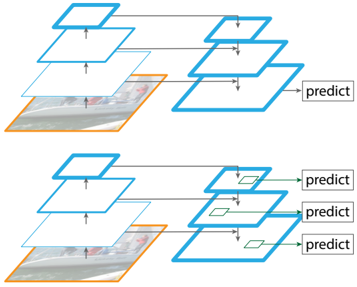
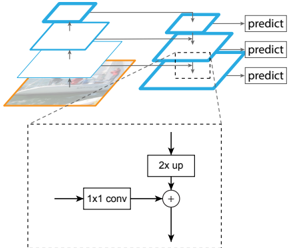
- FPN uses a bottom-up ResNet pathway (C2–C5), a top-down pathway that upsamples coarser maps by 2× with nearest-neighbor interpolation, and lateral 1×1 convolutions merged by element-wise addition; a 3×3 convolution is appended to each merged map. Detection uses d = 256 and pyramid levels P2–P5, with P6 added for RPN’s 512² anchor scale.
- For RPN, heads are attached to each pyramid level with single-scale anchors of areas {32², 64², 128², 256², 512²} on {P2, P3, P4, P5, P6} and aspect ratios {1:2, 1:1, 2:1}, totaling 15 anchors. For Fast R-CNN, RoIs are assigned to pyramid levels using the canonical 224² size and k₀ = 4, with shared heads and a 2fc MLP.
- Experiments use the 80-category COCO dataset, training on trainval35k (80k train + 35k val subset), ablating on minival (5k val images), and reporting test-std results. Backbones are ImageNet1k-pretrained ResNet-50/101; training uses synchronized SGD on 8 GPUs with input shorter side 800 pixels. RPN training takes about 8 hours and Fast R-CNN about 10 hours on COCO; inference is 0.148 s per image for ResNet-50 and 0.172 s for ResNet-101 on an NVIDIA M40 GPU.
Limitations
- The paper states that designing better connection modules is not its focus and opts for a simple design; more sophisticated blocks gave only marginally better results. It also notes that the ResNet-101 model was not sufficiently trained with the default schedule, and that the feature-sharing version of the COCO leaderboard model was not evaluated due to limited time.
- The paper states that its method does not exploit popular improvements such as iterative regression, hard negative mining, context modeling, or stronger data augmentation, which are complementary and could boost accuracy further.
- Evident from the text: there is no dedicated limitations section, and the empirical evaluation is limited to COCO detection and mask proposal generation, not full instance segmentation or other datasets.
Model-written summary. Check it against the paper before relying on it.
Integrity signals
Registry
Cites
Statistics
Figures
Verification
Claims the paper makes
8 Valid · 4 Not valid · 14 Not checked · 82 Own results and interpretations
The cited sources that could be checked couldn’t confirm or dispute this claim.
In the paper
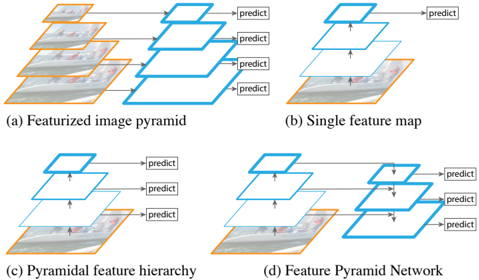
“For these reasons, Fast and Faster R-CNN [11, 29] opt to not use featurized image pyramids under default settings.”
What the sources say
- Not matchedcites [11] [11] R. Girshick. Fast R-CNN. In ICCV , 2015. -
We searched by its title and found no matching paper.
- Could not verifycites [29] [29] S. Ren, K. He, R. Girshick, and J. Sun. Faster R-CNN: Towards real-time object detection with region proposal networks. In NIPS , 2015. - sourceExperimental — accuracy not yet measured
The Related Work section (p. 3) discusses multi-resolution features for semantic segmentation, and the results (p. 8) discuss multi-scale testing of the authors’ model. Neither passage addresses whether Fast or Faster R-CNN omit featurized image pyramids by default; searches for those models and that setting found no supporting passage in our copy. (LLM, conf=0.77)
plain- Asserted: passes — The authors put it forward as true.
- Checkable: passes — It can be checked against evidence.
- Load-bearing: passes — The paper’s conclusions depend on it.
- Based: passes — The paper gives a reason why it holds.
- Not matched
The cited sources support only part of this claim — read each source’s verdict below.
In the paper
“Recently, FPN has enabled new top results in all tracks of the COCO competition, including detection, instance segmentation, and keypoint estimation. See [14] for details.”
What the sources say
- Partly supportedcites [14] [14] K. He, G. Gkioxari, P. Doll´ ar, and R. Girshick. Mask r-cnn. arXiv:1703.06870 , 2017. - sourceExperimental — accuracy not yet measured
The paper reports strong COCO results using FPN backbones: its instance-segmentation model surpasses earlier winners (Section 4.1, p. 5), its detection model exceeds earlier single-model results (Section 4.3, p. 7), and its keypoint model exceeds the 2016 winner (Section 5, p. 8). But it does not establish that FPN enabled top competition results in all three tracks; Appendix B (p. 10) discusses 2017 winning teams only for instance segmentation and credits the Mask R-CNN framework. (LLM, conf=0.87)
plainstates a cause- Asserted: passes — The authors put it forward as true.
- Checkable: passes — It can be checked against evidence.
- Load-bearing: unclear — It is unclear whether the paper’s conclusions depend on it.
- Based: passes — The paper gives a reason why it holds.
- Partly supported
The sources with a verdict support this claim; the rest weren’t checked yet, have no full text we could read, or their verdicts aren’t rated yet.
In the paper
“All recent top entries in the ImageNet [33] and COCO [21] detection challenges use multi-scale testing on featurized image pyramids ( e.g ., [16, 35]).”
What the sources say
- Not checked yetcites [16] [16] K. He, X. Zhang, S. Ren, and J. Sun. Deep residual learning for image recognition. In CVPR , 2016. - source
Checked before — its earlier verdict is held back until a new check runs.
- Supportedcites [35] [35] A. Shrivastava, A. Gupta, and R. Girshick. Training regionbased object detectors with online hard example mining. In CVPR , 2016. - source
As an example citation, this paper supports the COCO part of the sentence. The Multi-scale (M) section (page unavailable) says it runs inference at all scales during testing, and the Ablation analysis (page unavailable) says a variant finished fourth in the 2015 COCO Detection Challenge. (LLM, conf=0.85)
plain- Asserted: passes — The authors put it forward as true.
- Checkable: passes — It can be checked against evidence.
- Load-bearing: passes — The paper’s conclusions depend on it.
- Based: passes — The paper gives a reason why it holds.
- Not checked yet
The cited sources support only part of this claim — read each source’s verdict below.
In the paper
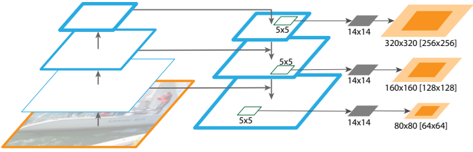
“Existing mask proposal methods [27, 28, 4] are based on densely sampled image pyramids ( e.g ., scaled by 2 {-2:0 . 5:1 } in [27, 28]), making them computationally expensive.”
What the sources say
- Partly supportedcites [27] [27] P. O. Pinheiro, R. Collobert, and P. Dollar. Learning to segment object candidates. In NIPS , 2015. - sourceExperimental — accuracy not yet measured
The Introduction says prevalent object-detection methods use image or filter pyramids, and §3.3 says avoiding those pyramids saves running time. The paper does not establish that existing mask proposal methods rely on densely sampled image pyramids or document the specified scale sampling. (LLM, conf=0.86)
- Not matchedcites [28] [28] P. O. Pinheiro, T.-Y. Lin, R. Collobert, and P. Doll´ ar. Learning to refine object segments. In ECCV , 2016. -
More than one paper fits this citation.
- Not checked — no full text of the sourcecites [4] [4] J. Dai, K. He, Y. Li, S. Ren, and J. Sun. Instance-sensitive fully convolutional networks. In ECCV , 2016. -
plainstates a cause- Asserted: passes — The authors put it forward as true.
- Checkable: passes — It can be checked against evidence.
- Load-bearing: passes — The paper’s conclusions depend on it.
- Based: passes — The paper gives a reason why it holds.
- Partly supported
Every source the paper cites for this claim was checked and supports it.
In the paper
“The Single Shot Detector (SSD) [22] is one of the first attempts at using a ConvNet's pyramidal feature hierarchy as if it were a featurized image pyramid (Fig. 1(c)).”
What the sources say
- Supportedcites [22] [22] W. Liu, D. Anguelov, D. Erhan, C. Szegedy, and S. Reed. SSD: Single shot multibox detector. In ECCV , 2016. - source
Section 2.2 (p. 6) says SSD uses feature maps from several layers to mimic the effect of processing an image at different sizes. Section 2.1 (p. 3) describes progressively smaller feature layers for multi-scale detection, and the paper presents this as a contribution relative to earlier single-scale detectors. Together, these support the characterization of SSD as an early use of a ConvNet feature hierarchy in place of an image pyramid. (LLM, conf=0.88)
plain- Asserted: passes — The authors put it forward as true.
- Checkable: passes — It can be checked against evidence.
- Load-bearing: unclear — It is unclear whether the paper’s conclusions depend on it.
- Based: passes — The paper gives a reason why it holds.
- Supported
65 more claims · 4 with their cited sources checked
Create a free account to see all 108 claims and to verify the 9 references still open.
- It may state two separate claims as one. 23
- Probably not a substantial claim. 17
- The quote only partly states this claim. 3
Claims other papers make about this one
Each is checked against this paper’s own text: does it say what the citing paper says it does?
The source backs part of the claim, not all of it — or backs it for a different population, condition or comparison.
In the citing paper
“Feature Pyramid Network (FPN) [42] is one of the important two stage object detectors, tried to overcome few of the aforementioned challenges successfully by extracting features at multiple scales of an image in the object detection process.”
From Object detection using YOLO: challenges, architectural successors, datasets and applications (2023) · cites this paper as [42]
Experimental — accuracy not yet measuredThe source backs part of the claim, not all of it — or backs it for a different population, condition or comparison.
In the citing paper
“Its performance can be improved further by exploiting and enhancing the feature hierarchy of deep convolutional networks [80], employing non-local attention [81], and leveraging the reciprocal relationship between detection and segmentation via hybrid task cascade [82].”
From Empowering things with intelligence: a survey of the progress, challenges, and opportunities in artificial intelligence of things (2021) · cites this paper as [80]
Experimental — accuracy not yet measuredThe source backs part of the claim, not all of it — or backs it for a different population, condition or comparison.
In the citing paper
“To improve the accuracy of small defect detection, this paper uses SPP and FPN to increase the effect of multi-scale feature extraction.”
From Automatic Detection and Classification of Steel Surface Defect Using Deep Convolutional Neural Networks (2021) · cites this paper as [26]
Experimental — accuracy not yet measuredThe source backs part of the claim, not all of it — or backs it for a different population, condition or comparison.
In the citing paper
“YOLOv3 introduced a foundational generic architecture inspired by the Feature Pyramid Network (FPN) [22], integrating elements such as residual blocks, skip connections, and up-sampling.”
From YOLOv1 to v8: Unveiling Each Variant–A Comprehensive Review of YOLO (2024) · cites this paper as [22]
Experimental — accuracy not yet measuredThe cited source says what the claim attributes to it.
In the citing paper
“Unlike the word tokens that serve as the basic elements of processing in language Transformers, visual elements can vary substantially in scale, a problem that receives attention in tasks such as object detection [42, 53, 54].”
From Swin Transformer: Hierarchical Vision Transformer using Shifted Windows (2021) · cites this paper as [42]
14 more claims about this paper
Create a free account to see every claim other papers make about this one.
Self-check
Percentages, sums and reported differences re-computed from the paper’s own numbers.
Each contradiction between two passages listed here was confirmed by an independent check.
Rated minor: it would not touch a result — a value no result rests on, a p-value that stays on the same side of the significance level, or a conflict that is clerical, resolved elsewhere in the paper, or outside its own findings.
In the paper
§ 6.1. Segmentation Proposal Results · p. 8
“Our approach, based on FPNs, is substantially faster (our models run at 6 to 7 FPS).”
§ 6. Extensions: Segmentation Proposals · p. 8
“| + 2x train schedule | | 48.1 | 32.6 | 54.2 | 65.6 | 0.25 |”
Rated minor: it would not touch a result — a value no result rests on, a p-value that stays on the same side of the significance level, or a conflict that is clerical, resolved elsewhere in the paper, or outside its own findings.
In the paper
§ 5.1.1 Ablation Experiments · p. 5
“This architecture simulates the effect of reusing the pyramidal feature hierarchy (Fig. 1(b)).”
§ Feature Pyramid Networks for Object Detection · p. 1
“(b) Recent detection systems have opted to use only single scale features for faster detection. (c) An alternative is to reuse the pyramidal feature hierarchy computed by a ConvNet as if it were a featurized image pyramid.”
Citations
Cites
Deep Residual Learning for Image Recognition
He, K., Zhang, X., Ren, S., & Sun, J. (2016) · 2016 IEEE Conference on Computer Vision and Pattern Recognition (CVPR) · doi:10.1109/cvpr.2016.90 · Cited by 235,474 · cited 9×
“Analogous to the ResNet-based Faster R-CNN system [16] that uses C 4 as the single-scale feature map, we set k 0 to 4.”
BackgroundMethodResultInfluentialSelf-citationVery Deep Convolutional Networks for Large-Scale Image Recognition
Simonyan, K., & Zisserman, A. (2014) · arXiv · doi:10.48550/arxiv.1409.1556 · Cited by 114,148 · cited 2×
“But to avoid using low-level features SSD foregoes reusing already computed layers and instead builds the pyramid starting from high up in the network ( e.g ., conv4 3 of VGG nets [36]) and then by adding several new layers.”
BackgroundResultImageNet classification with deep convolutional neural networks
Krizhevsky, A., Sutskever, I., & Hinton, G. E. (2017) · Communications of the ACM · doi:10.1145/3065386 · Cited by 112,155 · cited 3×
“With the development of modern deep ConvNets [19], object detectors like OverFeat [34] and R-CNN [12] showed dramatic improvements in accuracy.”
MethodResultU-Net: Convolutional Networks for Biomedical Image Segmentation
Ronneberger, O., Fischer, P., & Brox, T. (2015) · Lecture notes in computer science · doi:10.1007/978-3-319-24574-4_28 · Cited by 99,404 · cited 1×
“rarchy without combining features or scores. There are recent methods exploiting lateral/skip connections that associate low-level feature maps across resolutions and semantic levels, including U-Net [31] and SharpMask [28] for segmentation, Recombinator networks [17] for face detection, and Stacked Hourglass networks…”
MethodFaster R-CNN: Towards Real-Time Object Detection with Region Proposal Networks
Ren, S., He, K., Girshick, R., & Sun, J. (2017) · IEEE Transactions on Pattern Analysis and Machine Intelligence · doi:10.1109/tpami.2016.2577031 · Cited by 73,472 · cited 10×
“For these reasons, Fast and Faster R-CNN [11, 29] opt to not use featurized image pyramids under default settings.”
BackgroundMethodInfluentialSelf-citationFaster R-CNN: Towards Real-Time Object Detection with Region Proposal Networks
Ren, S., He, K., Girshick, R., & Sun, J. (2015) · arXiv · doi:10.48550/arxiv.1506.01497 · Cited by 70,812 · cited 10×
“For these reasons, Fast and Faster R-CNN [11, 29] opt to not use featurized image pyramids under default settings.”
BackgroundMethodInfluentialSelf-citationDistinctive Image Features from Scale-Invariant Keypoints
Lowe, D. G. (2004) · International Journal of Computer Vision · doi:10.1023/b:visi.0000029664.99615.94 · Cited by 62,647
Microsoft COCO: Common Objects in Context
Lin, T.-Y., Maire, M., Belongie, S., Hays, J., Perona, P., Ramanan, D., Dollár, P., & Zitnick, C. L. (2014) · Lecture Notes in Computer Science · doi:10.1007/978-3-319-10602-1_48 · Cited by 45,460 · cited 6×
“All recent top entries in the ImageNet [33] and COCO [21] detection challenges use multi-scale testing on featurized image pyramids ( e.g ., [16, 35]).”
BackgroundMethodInfluentialSelf-citationImageNet Large Scale Visual Recognition Challenge
Russakovsky, O., Deng, J., Su, H., Krause, J., Satheesh, S., Ma, S., Huang, Z., Karpathy, A., Khosla, A., Bernstein, M., et al. (2015) · International Journal of Computer Vision · doi:10.1007/s11263-015-0816-y · Cited by 39,380 · cited 2×
“Thus we can adapt the assignment strategy of region-based detectors [15, 11] in the case when they are run on image pyramids.”
MethodFully convolutional networks for semantic segmentation
Long, J., Shelhamer, E., & Darrell, T. (2015) · 2015 IEEE Conference on Computer Vision and Pattern Recognition (CVPR) · doi:10.1109/cvpr.2015.7298965 · Cited by 38,834 · cited 1×
“FCN [24] sums partial scores for each category over multiple scales to compute semantic segmentations.”
Background
Research works printed but not linked: 1
- [1] E. H. Adelson, C. H. Anderson, J. R. Bergen, P. J. Burt, and J. M. Ogden. Pyramid methods in image processing. RCA engineer , 1984. -
Cited by
Items 29,401–29,500 of 29,875
DSCMamba-TAD-YOLOv8: A Lightweight YOLOv8-Based Model for Power Line Inspection
Li, Z., & Ding, C. (2026) · Computers · doi:10.3390/computers15080550
Blur-guided motion and spatio-temporal swarm graph modeling for UAV intent understanding
Zamir, M., Zhong, T., Zhou, F., & Khan, M. S. (2026) · Knowledge-Based Systems · doi:10.1016/j.knosys.2026.116895
Deployment-oriented pruning for real-time object detection: a survey
Zhou, G., & Zhang, D. (2026) · Applied Intelligence · doi:10.1007/s10489-026-07416-6
“Whileadvanced designs such as multi-scale feature fusion in backbone– neck–head pipelines enhance representational capacity, they also introduce substantial computational and memory-access overhead [10, 11].”
Cai, Y., Zhao, J., Wu, H., & Ma, R. (2026) · Remote Sensing · doi:10.3390/rs18162835
Cao, L., Chen, X., Guo, S., et al. (2026) · Applied Sciences · doi:10.3390/app16168325
Yi, Y., Wei, B., Qiu, Z., Yang, C., & Huang, X. (2026) · Applied Sciences · doi:10.3390/app16168332
“The Feature Pyramid Network (FPN) [35] fuses multi-scale features through a top-down path.”
Liu, Z., Xue, J., Wu, P., Xie, Z., & Wang, X. (2026) · Journal of King Saud University - Computer and Information Sciences · doi:10.1007/s44443-026-01175-7
“One research line adapts general detectors for small, dense, or occluded agricultural targets (Carion et al. 2020; Lin et al. 2017a, b; Liu et al. 2016; Redmon et al. 2016; Ren et al. 2017; Tan et al. 2020; Zhao et al. 2024).”
Shi, J., Yang, Z., & Liu, L. (2026) · doi:10.1109/idsac70973.2026.11650619
“In multi-scale detection, the Feature Pyramid Network (FPN) [10] established the foundational top-down fusion paradigm, while the Bidirectional Feature Pyramid Network (BiFPN) [17] later introduced weighted bidirectional cross-scale connections for improved feature alignment.”
Fabric defect detection based on YOLOv8-TR
Wang, X., Dai, J., Fang, W., & Xiang, S. (2026) · International Journal of Clothing Science and Technology · doi:10.1108/ijcst-07-2024-0163
Li, Y., Zhang, H., Tang, H., Li, Z., Xu, T., & Ren, Z. (2026) · IEEE Transactions on Instrumentation and Measurement · doi:10.1109/tim.2026.3726189
Jia, X., Hou, Z., Hu, S., Yue, H., Ma, S., Yang, X., & Pu, L. (2026) · Computer Vision and Image Understanding · doi:10.1016/j.cviu.2026.104920
MASH-Net: A Multi-Scale Adaptive Shuffle Hybrid Network for Medical Image Segmentation
Liu, S. (2026) · International Conference on Bioinformatics and Intelligent Computing (BIC) · doi:10.1145/3809986.3810114
HGSM-YOLO: A Small-Lesion-Oriented Lightweight YOLO11n Framework for Citrus Leaf Disease Detection
Zheng, R., Zhao, J., Wang, X., et al. (2026) · Sensors · doi:10.3390/s26175345
“The neck follows an FPN/PAN-style scheme [25,26] in which deep semantic features are upsampled and concatenated with shallow features of matching scale, then fused by C3k2 modules and passed back down through downsampling and further concatenation.”
Zhang, P., Zhang, J., Liu, J., Li, X., Liu, Y., & Tan, L. (2026) · Remote Sensing · doi:10.3390/rs18172872
SRGT: Spatial-Resolution-Guided Teacher for Robust Semi-Supervised Aerial Object Detection
Li, Y., Xue, J., Li, F., Wu, H., Jia, C., Dong, K., & Lü, K. (2026) · IEEE Transactions on Image Processing · doi:10.1109/tip.2026.3724725
“We adopt ResNet-50 FPN [32], [33] based Faster R-CNN [34] and FCOS [35] as detectors.”
UAV-based maritime object tracking: A new data set and Dynamic Multi-scale Fusion Transformer
Wang, X., Xiao, J., & Dong, X. (2026) · Ocean Engineering · doi:10.2139/ssrn.7345297
Shinde, S., Aundhakar, V. R., Gramopadhye, A. S., Atugade, S. S., & Avhad, P. M. (2026) · International Conference on Smart Systems and Inventive Technology (ICSSIT) · doi:10.1109/icssit69151.2026.11656588
Benabid, A., Cheng, K., Liu, Y., & Elhassan, M. A. M. (2026) · Journal of King Saud University - Computer and Information Sciences · doi:10.1007/s44443-026-01027-4
Facial Skin Spot Instance Segmentation Using Spot-Mask R-CNN
Weng, Y.-H., Lu, C.-T., Lin, C.-J., et al. (2026) · IEEE International Conference on Consumer Electronics - Taiwan (ICCE-Taiwan) · doi:10.1109/icce-taiwan71481.2026.11652431
“A ResNet-18 combined with a Feature Pyramid Network (FPN) [3] is adopted as the backbone to enhance multi-scale spot detection while reducing the risk of overfitting.”
Yingsheng, Y., Liu, W., Yin, X., & Guo, R. (2026) · Applied Sciences · doi:10.3390/app16178423
YOLO11-FAL: An Improved YOLO11 Model for Tomato Flowering Stage Detection in Greenhouses
Zhang, H., Hu, W., Zhou, Z., Ma, X., Xu, S., Miao, Z., Xie, Y., & Wang, Y. (2026) · Applied Sciences · doi:10.3390/app16178393
“Standard YOLO11 neck networks are usually based on FPN/PAN multi-scale feature fusion structures, achieving information interaction of different-level features through top-https down and bottom-up path enhancements [29,30].”
MBHS-DETR: a lightweight collaborative network for bearing surface defect detection
Wang, S., Li, J., Peng, G., Li, K., Wang, T., Liang, W., Yang, S., & Yang, S. (2026) · Multimedia Systems · doi:10.1007/s00530-026-02616-z
“During deep feature extraction, repeated downsampling operations may gradually eliminate fine-grained spatial details, mak - ing the detection of small-scale defects particularly difficult [8].”
Saliency-Guided RT-DETR for Multi-Class Detection in Processing Tomato Sorting
Jiang, X., Zhang, Y., Wei, X., Peng, X., & Chen, W. (2026) · Agriculture · doi:10.3390/agriculture16171805
Cao, J., Ma, J., Debin, 周. Z., Zhaing, M., & Li, S. (2026) · IEEE Access · doi:10.1109/access.2026.3727116
Aerial Vision-Based Autonomous Target Tracking System (AVATTS)
Chien, H.-Y., Su, H., & Sun, C. C. (2026) · IEEE International Conference on Consumer Electronics - Taiwan (ICCE-Taiwan) · doi:10.1109/icce-taiwan71481.2026.11652391
Multi-Class Waste Segmentation on the TACO Dataset using UNet++
Khandelwal, U. R., & Ajankar, S. (2026) · International Conference on Smart Systems and Inventive Technology (ICSSIT) · doi:10.1109/icssit69151.2026.11656551
GroundMed-SAM: Prompt-based Zero-shot Medical Image Segmentation
Nguyen, V. D., Luong, H. Q., & Pham, P. N. (2026) · International Conference on Communications and Electronics (ICCE) · doi:10.1109/icce70609.2026.11658424
“Conventional segmentation models, including U-Net [6], U-Net++ [38], FPN [39], and SSFormer [40], achieve AUC scores between 88.2 and 92.7, indicating limited explicit localization capability.”
InfluentialBakaye, B., Hannane, R., Oirrak, A. E., & Boushaki, A. E. (2026) · International Conference on Circuit, Systems and Communication (ICCSC) · doi:10.1109/iccsc71566.2026.11650358
“Early works relied on CNN backbones such as ResNet [5] augmented with Feature Pyramid Networks (FPN) [6] for multi-resolution feature combination.”
InfluentialTang, W., Wang, Q., Shao, S., Li, T., & Zhang, G. (2026) · IEEE Access · doi:10.1109/access.2026.3726593 · Cited by 1
Raisi, Z., Sarani, E., Damani, R., et al. (2026) · International Journal of Maritime Technology · doi:10.66224/ijmt.22.2.1
SDE-YOLO: A lightweight synergistic dynamic enhancement framework for small object detection
Gao, L., Luo, Z., & Wang, L. (2026) · Results in Engineering · doi:10.1016/j.rineng.2026.112557
Zhang, D., Zhang, Q., Hu, Y., Deng, H., Cai, L., Lin, Y., & Xu, Y. (2026) · Pattern Recognition · doi:10.1016/j.patcog.2026.114707
LEGR: Learnable-Edge Graph Refinement for Table Structure RecognitionPreprint
Ahmed, S., Mehmood, M. M., Malik, M. I., et al. (2026) · Research Square · doi:10.21203/rs.3.rs-9909962/v1
Validating a Synthetic-to-Real Pipeline for Neuromorphic Avian Detection in Aviation Safety
Yuen, C., Kit, C. W., Ng, M., & Foong, S. (2026) · IEEE/ASME International Conference on Advanced Intelligent Mechatronics · doi:10.1109/aim65483.2026.11658129
“While advancements in Small Object Detection (SOD), such as multi-scale feature fusion [7] and tiling-based inference [8], have improved performance on static datasets, these methodologies largely serve as algorithmic hot fixes for the inherent physical limitations of frame-based sensing.”
Yolov8 with P2 Multi-Scale Fusion and Adaptive ECA for Wheat Head Detection
Zhu, H., & Wu, S. (2026) · World Conference on Computer and Information Security (WCCIS) · doi:10.1109/wccis70285.2026.11650996
“For small objects occupying only a few pixels, the introduction of shallow, high-resolution feature maps (e.g., the P2 layer) is vital [7].”
Lv, H., Li, A., Ou, B., Li, S., Zhang, X., & Li, Z. (2026) · World Conference on Computer and Information Security (WCCIS) · doi:10.1109/wccis70285.2026.11651015
“Its architecture features a ShuffleNetV2 backbone [31] for lightweight feature extraction and a PANet-style Feature Pyramid Network (FPN) [46], [47] for multi-scale fusion.”
Multimodal Instance Segmentation of Building Façade Damage with Frequency-Decoupled Feature Fusion
Xu, S., Chen, Z., Wang, Y., Shi, Y., Lu, H., Gu, H., & Sun, Z. (2026) · Buildings · doi:10.3390/buildings16173396
Doc-Protector: A Self-healing Approach for Digital Documents
Padhi, S. K., Tiwari, A., Kashyap, U., et al. (2026) · Lecture notes in computer science · doi:10.1007/978-3-032-36023-6_5
Person search: a comprehensive survey on image-based person search using deep learning
Bakaye, B., Hannane, R., Oirrak, A. E., & Elboushaki, A. (2026) · International Journal of Multimedia Information Retrieval · doi:10.1007/s13735-026-00416-9
“Generally, multi-scale feature aggregation is achieved with Feature Pyramid Networks (FPN) [57], which combine low-level spatial details with high-level semantic information.”
DGLNet: dynamic global–local context aggregation for lightweight facial expression recognition
Xue, C., Li, Y., Sun, G., & Wang, Z. (2026) · The Visual Computer · doi:10.1007/s00371-026-04707-4
“FPN [30] provides a foundational framework for hierarchical feature fusion, but its dense lateral connections may introduce additional computational overhead.”
Multi-scale landslide detection in complex scenarios based on adaptive sparsity regulation strategy
Luo, J., Lu, S., Guo, C., et al. (2026) · Georisk Assessment and Management of Risk for Engineered Systems and Geohazards · doi:10.1080/17499518.2026.2720516
Zhou, E., Kong, X., Wang, H., & Bai, C. (2026) · Biomedical Physics & Engineering Express · doi:10.1088/2057-1976/ae9e39
“The channel-wise scaling vector is then obtained as: Finally, the recalibrated feature map is computed by channel-wise multiplication: These multi-scale features are then fed into a FPN [29].”
DCG-YOLO: an Efficient Lightweight Model for Field Weed Detection
Yu, P., Xu, X., Hui, Y., Geng, X., Chen, S., Cai, W., & Zhang, X. (2026) · Journal of Plant Diseases and Protection · doi:10.1007/s10343-026-01407-w · Cited by 1
“The backbone employs C3K2 modules to improve feature extraction and reuse efficiency, while the PAN-FPN structure in the neck enables bidirectional fusion of low-level spatial details and high-level semantic information (Lin et al. 2017; Liu et al. 2018).”
Cai, S., Lv, T., Li, X., Shi, C., Wu, C., Li, X., Li, L., & Jia, Z. (2026) · Symmetry · doi:10.3390/sym18091428
Song, Y., Dai, L., Xu, X., & Yang, J. K. (2026) · Journal of Imaging · doi:10.3390/jimaging12090401
“The Vision Transformer [35] and its hierarchical variants [36] have also inspired detector backbones, while Feature Pyramid Networks [37] remain foundational for multi-scale feature extraction.”
Zhu, W., Tu, J., Huang, H., He, Z., Xie, Z., Li, L., & Yao, J. (2026) · Electronics · doi:10.3390/electronics15173844
Yuan, H., Wang, C., Zhang, Y., Cao, W., Peng, X., & Yang, Z. (2026) · Journal of Real-Time Image Processing · doi:10.1007/s11554-026-01958-1
Tian, Y., Xiao, L., Song, P., et al. (2026) · Agriculture Communications · doi:10.1016/j.agrcom.2026.100163
YOLO11-ECA: A Lightweight Tea Bud Detection Method for Complex Tea Plantation Environments
Wang, Z., Liao, X., Jiang, Y., You, H., Liao, W., & Li, Y. (2026) · Sensors · doi:10.3390/s26175398
“…different backbone stages through top-down and bottom-up propagation paths, following the general principles of feature pyramid and path aggregation networks [14,15], and the resulting multi-scale features are delivered to the detection head for object classification and bounding box regression.”
He, Y., Gao, X., Liu, R., Zhou, Y., Zhou, C., Zhao, S., & Yang, Y. (2026) · Journal of King Saud University - Computer and Information Sciences · doi:10.1007/s44443-026-01122-6 · Cited by 1
Dynamic Cross-Modal Interaction and Multi-Scale Edge Enhancement for RGB-Infrared UAV Detection
Zhou, Z., & Zhou, H. (2026) · International Conference on Electronics and Communication, Network and Computer Technology (ECNCT) · doi:10.1109/ecnct70535.2026.11661417
“The deep convolutional downsampling used in modern feature extractors inadvertently smooths out high-frequency physical boundaries, resulting in severe edge feature loss for small objects [4] .”
COMPARISON OF DIFFERENT OBJECT DETECTION TECHNIQUES FOR CENTRAL ASIAN FOOD RECOGNITION
Sharipova, A., Kalmyrzayev, B., Mashrapova, A., et al. (2026) · Scientific Journal of Astana IT University · doi:10.37943/bzif1573
Zhang, C., Ma, Z., Zeng, B., & Zhang, S. (2026) · International Conference on Electronics and Communication, Network and Computer Technology (ECNCT) · doi:10.1109/ecnct70535.2026.11661422
“[11], and general object detectors [1], [2] with multi-scale feature pyramids [12] have been adapted to localize defects on metals, textiles, and electronics.”
Liu, C., Yang, J., Guo, Q., & Yao, L. (2026) · International Conference on Electronics and Communication, Network and Computer Technology (ECNCT) · doi:10.1109/ecnct70535.2026.11661396
“Feature Pyramid Networks (FPN) [9] use top-down pathways and lateral connections to manage scale variants.”
Zhang, J., Yang, F., Li, B., et al. (2026) · Journal of Real-Time Image Processing · doi:10.1007/s11554-026-01960-7
Kim, M.-S., & Kim, H. (2026) · Bioengineering · doi:10.3390/bioengineering13090983
“Representative approaches include Feature Pyramid Network (FPN) [17], Path Aggregation Network (PANet) [18], and Bidirectional Feature Pyramid Network (BiFPN) [19], which effectively integrate multi-scale features for object detection.”
A Dual-Branch Vision–Sonar Fusion Detector for Underwater Robotic Object Detection
Wang, X., Wang, Z., & Bi, D. (2026) · IEEE Access · doi:10.1109/access.2026.3727200
An Improved Approach for Long-Tail Object Detection in UAV Images With DQ-DETR
Liu, S., Yang, B., & Deng, B. (2026) · IEEE Sensors Journal · doi:10.1109/jsen.2026.3725833
Bektemyssova, G., Keresh, A., Nuralykyzy, S., Ziyada, M., Barlykbay, N., & Joldasbayev, S. (2026) · Scientific Journal of Astana IT University · doi:10.37943/tsyt4497
Erlin, L., & Liu, X. (2026) · Journal of Real-Time Image Processing · doi:10.1007/s11554-026-01965-2
“In response to the shortcomings of the traditional PAN-FPN [34, 35] used by YOLOv11, which lacks sufficient cross-scale feature fusion and has channel redundancy, this paper adopts the efficient mixed encoder idea from RT-DETR [36] and introduces its built-in cross-scale feature fusion module, Fig.”
COMPARATIVE EVALUATION OF SEMANTIC SEGMENTATION MODELS FOR CRACK DETECTION
Galiyev, M., Merembayev, T., Toktassyn, O., et al. (2026) · Scientific Journal of Astana IT University · doi:10.37943/wagz5973
Li, J., Sun, L., Zhang, M., et al. (2026) · Big Data and Cognitive Computing · doi:10.3390/bdcc10090287
Yamamoto, T., Ishibashi, R., Ishino, M., et al. (2026) · International Conference on Advanced Mechatronic Systems · doi:10.1109/icamechs71619.2026.11663347
“Despite these advances, nano-scale variants remain challenged by small and medium objects owing to limited channel capacity in the backbone and neck, as small objects occupy few pixels and produce weak, spatially imprecise activations in deep network layers [8].”
Doyama, R., Ishibashi, R., & Meng, L. (2026) · International Conference on Advanced Mechatronic Systems · doi:10.1109/icamechs71619.2026.11663355
“To address these challenges, we extend YOLOv8 with a P2 head (stride = 4) motivated by FPN [8] to improve detection of small defects, and combine it with BiFPN [9] for scale-adaptive feature fusion and CBAM [10] to strengthen discriminative feature representations in the backbone.”
A Review of Deep Learning-Based Defect Detection Technology for Power Line Insulators
He, Z., Xu, Z., & Li, S. (2026) · International Conference on Energy and Electrical Power Systems (ICEEPS) · doi:10.1109/iceeps70377.2026.11662988
“Chuanyang Liu et al. [10] enhanced the YOLOv3 single-stage object detection algorithm by adding multi-layer feature mapping modules and a Feature Pyramid Network (FPN [11]).”
Satsyuk, A., Radkovsky, S., Shekhovtsov, A., et al. (2026) · Informatics and Automation · doi:10.15622/ia.25.3.2
Cascaded Multi-Scale Aggregation With Hierarchical Task Alignment for Aerial Small Object Detection
Cao, B., Yang, Z., Kan, M., Yang, Y., Wang, W., Chen, W., Wang, Y., & Zhou, P. (2026) · IEEE Access · doi:10.1109/access.2026.3727614 · Cited by 1
Hikki, M., Darouichi, A., & Elboushaki, A. (2026) · Lecture notes in networks and systems · doi:10.1007/978-3-032-21200-9_13
Mazumder, R., Das, B., Hossain, A., et al. (2026) · doi:10.1109/peccii70991.2026.11661954
“[33]”
Bilakeri, S., Manisha, & Akshatha, K. R. (2026) · The Visual Computer · doi:10.1007/s00371-026-04700-x
ADFPN-YOLOv8s: Small Object Detection From Low-Altitude UAV Perspective
Lu, S., Zhang, J. J., Huo, J., Tan, L., Liu, Z., Ge, Y., & Wang, C. (2026) · IEEE Access · doi:10.1109/access.2026.3727343
YOLOv8s-SeaFormer for Lightweight and Accurate Railway Catenary Icing Detection
Zhang, R., Li, Z., Wang, Y., et al. (2026) · International Conference on Energy and Electrical Power Systems (ICEEPS) · doi:10.1109/iceeps70377.2026.11662994
“The model retains the C2f backbone, FPN-PAN feature-fusion structure [11], and decoupled anchor-free head of YOLOv8s, with predictions at P3, P4, and P5.”
FBR-DETR: An Efficient End-to-End Network for Real-Time Small-Object Detection in UAV Imagery
Liang, S., Wang, R., Wang, X., Wang, A., Sun, J., & Liu, H. (2026) · Remote Sensing · doi:10.3390/rs18172900 · Cited by 1
Scale-Aware Feature-Level Encoding for Historical Document Stamp Detection
Chelali, M., Cloppet, F., Kurtz, C., et al. (2026) · Lecture notes in computer science · doi:10.1007/978-3-032-36207-0_12
Adaptive wavelet enhancement and stratified feature fusion for robust medical image segmentation
Wang, P., Liang, Y., Wei, B., Yang, C., Cao, Y., Qin, F., Fan, J., Huang, X., & Cao, J. (2026) · Journal of King Saud University - Computer and Information Sciences · doi:10.1007/s44443-026-01097-4
“This choice follows established practices in attention-based fusion: additive aggregation preserves robustness under noise whereas multiplicative gating strengthens semantic guidance in cleaner inputs (Woo et al. 2018; Hu et al. 2018; Oktay et al. 2018; Lin et al. 2017).”
CaTFormer: Prior-Guided Transformer with Hierarchical Supervision for Baggage Re-Identification
Li, A., Zheng, C., Zhang, L., et al. (2026) · Sensors · doi:10.3390/s26175409
“To examine whether explicit multi-level feature fusion is necessary, we compare the proposed direct-concatenation strategy with representative fusion modules, including feature pyramid network (FPN) [42], bidirectional FPN (BiFPN) [43], and attentional feature fusion (AFF) [44].”
Li, J., Zeng, Q., Duan, S., Wu, J., Li, B., Sun, Y., & Gao, Q. (2026) · Drones · doi:10.3390/drones10090652 · Cited by 1
Lightweight Deep Learning Models for Real Time Wildfire Detection
Todt, T. B., Ghali, R., & Akhloufi, M. A. (2026) · Fire Technology · doi:10.1007/s10694-026-01993-1
“This component may integrate additional convolutional layers and feature pyramid networks (FPNs) [58], which operate by downsampling low-level feature maps and subsequently fusing them with higher-level feature maps.”
HybridNet: a deep hybrid CNN-Transformer network for accurate VLSI congestion prediction
Hu, Z., Xu, N., Liu, H., & Cheng, X. (2026) · The Journal of Supercomputing · doi:10.1007/s11227-026-08779-w
“To fully fuse local features at different scales and inject global semantic information generated by AFI into multi-scale representations, the CFF module adopts a bidirectional feature fusion architecture based on the feature pyramid network (FPN) [34] and the path aggregation network (PAN) [35].”
A Lightweight Context-Aware Detector for Small and Occluded Targets in Aerial Power-Line InspectionPreprint
Li, D., Shi, J., Li, X., et al. (2026) · Research Square · doi:10.21203/rs.3.rs-9301249/v1
MMCA-SAM: Multimodal Cross-Attention SAM for Landslide Segmentation with Topographic Guidance
Shi, J., Pan, S., & Meng, Q. (2026) · International Conference on Geoinformatics · doi:10.1109/geoinformatics72247.2026.11665377
ANS-Net: A multi-scale attention network for concrete damage detection
Zhang, J.-X., & Beliaeva, Z. V. (2026) · Advanced Engineering Informatics · doi:10.1016/j.aei.2026.105139
LRA-YOLOv11n: An Improved YOLOv11n Model for Field Detection of Mango Malformation Disease
Li, Y., Duan, J., Jiang, Y., Yuan, H., Yu, J., Xu, X., & Yang, Z. (2026) · Agriculture · doi:10.3390/agriculture16171856
“Drawing on multiscale feature pyramid and spatial attention-based feature selection concepts [31,32], this design enhances target-region responses, suppresses complex background noise during multiscale feature transmission, and clarifies inflorescences boundaries.”
Gao, F., & Liu, C. (2026) · IEEE Access · doi:10.1109/access.2026.3728183 · Cited by 1
Li, W., Guo, J., Dai, S., Wang, R., Shi, X., & Zhang, Y. (2026) · Infrared Physics & Technology · doi:10.1016/j.infrared.2026.106858
A Study on Robotic Arm Grasping for Rail Transit Maintenance Scene Based on Improved GGCNN
Yao, T., & Zhao, H. (2026) · Lecture notes in electrical engineering · doi:10.1007/978-981-92-2258-2_60
Rail Surface Defect Detection Based on Multi-scale Feature Fusion
Song, S., & Li, D. (2026) · Lecture notes in electrical engineering · doi:10.1007/978-981-92-2258-2_35
AquaScan-1K: Paving the Way to Robust Object Detection in Side-Scan Sonar
Yöndem, S. F., Schlereth-Groh, B., & Kolagari, R. T. (2026) · IEEE Canadian Atlantic Ocean Symposium (CAOS) · doi:10.1109/caos69069.2026.11665924
“Crucially, due to the high density of small objects in the AquaScan-1K dataset, we augmented the YOLOv11m architecture with a P2 detection head to enhance performance on the smallest scale targets [16].”
Semantic Segmentation of Bridge Cracks Using an Improved SegFormer Architecture
Qian, L., Yu, C., Qin, F., et al. (2026) · Lecture notes in electrical engineering · doi:10.1007/978-981-92-2258-2_47
CDMS-Net: Complementary Detail and Multiscale Selection for Infrared Small Target Detection
Yang, F., Xiang, W., & Yang, F. (2026) · IEEE Geoscience and Remote Sensing Letters · doi:10.1109/lgrs.2026.3728671
Alhaj, Z. (2026) · Discover Artificial Intelligence · doi:10.1007/s44163-026-02073-7
“DeepLab-style ASPP modules aggregate context through parallel dilated convolutions [14], whereas FPNs construct semantically enriched feature pyramids using top-down fusion and lateral connections [15].”
Ranjitha, P., & Atham, S. B. (2026) · Discover Artificial Intelligence · doi:10.1007/s44163-026-02028-y
“Once the feature is extracted it is subjected to region proposal network to generate to region proposals [39].”
YOLO-Defender: A Lightweight CNN–Transformer Detector for Dike Crack Detection
Xie, X., Wang, C., Huang, H., et al. (2026) · Water · doi:10.3390/w18172139
“Conventional feature pyramid network (FPN) and path aggregation network (PANet) structures based on fixed multi-scale fusion may insufficiently preserve fine spatial details or semantic consistency during feature aggregation [26,27].”
Small-Target Detection via Fusion of Visible and Infrared Image Features
Dong, Y., Xie, C., Zhang, C., et al. (2026) · Sensors · doi:10.3390/s26175517
“FPN strengthens multi-scale semantic representation [5], and RetinaNet addresses dense foreground–background imbalance through Focal Loss [6].”
Xie, Y., & Yan, B. (2026) · Electronics · doi:10.3390/electronics15173888
“The evaluated replacements include: atrous separable convolution [42], low-rank decomposition, grouped convolution, Ghost convolution [43], and the proposed DSAConv.”
Zhan, W., Liu, X., Wang, J., Dai, Z., Wang, C., & Zhang, Z. (2026) · IEEE Access · doi:10.1109/access.2026.3728515
From EventStorming Artifacts to User Stories: A Semi-Automated Requirements Extraction Approach
Jurgelaitis, M., Ramanauskas, A., Ambrozaitis, G., & Stulpinaite, G. (2026) · IEEE Access · doi:10.1109/access.2026.3728512
Kumar, B. N., Suman, P., Chaitanya, S., et al. (2026) · doi:10.1109/insect68872.2026.11663964
“Super-Resolution (SRGAN): SRGAN [4] was applied to 50 low-visibility images, enhancing resolution and texture.”
Automated detection of bridge and road damage in orthophotos using deep learning
Li, X., Liang, J., Zheng, S., Lin, C., Chen, Y., Li, H., & Chun, P. (2026) · AI in Civil Engineering · doi:10.1007/s43503-026-00108-7
“Since the (FPN) was first introduced by Lin et al. (2017), this multi-scale deep learning architecture has been widely applied in image analysis, and its effectiveness has been well demonstrated by numerous studies (Chu & Chun, 2024; Deng et al., 2024; Zhou et al., 2021).”
DAC-Net: Dual-Attention Collaborative Network for Robust Shui Script Detection
Li, M., Song, J., 蒋尚慧, Jing, Y., Qiao, W., Pu, Q., & Han, L. (2026) · Mathematics · doi:10.3390/math14173098
“To verify the superiority of DSAF, we compare it with mainstream feature fusion methods, including BiFPN [41], PAN [14], ASFF [42], and FPN [43] under identical settings, replacing the neck fusion module of the YOLOv9 baseline.”
Metadata
- Authors
- Lin, T.-Y., Dollar, P., Girshick, R., He, K., Hariharan, B., & Belongie, S.
- Affiliations
- Cornell University (US)
- Meta (United States) (US)
- Venue
- 2017 IEEE Conference on Computer Vision and Pattern Recognition (CVPR)
- Publisher
- IEEE
- Published
- 2017-07
- Pages
- 936-944
- ISSN
- 1063-6919 (ISSN-L)
- OpenAlex
- W2565639579
- Cited by
- 30,939
- References
- 64
- Citations by year
- 2026: 2864 · 2025: 4496 · 2024: 5179 · 2023: 5172 · 2022: 4516 · 2021: 3861 · 2020: 2506 · 2019: 1759 · 2018: 526 · 2017: 58
- FWCI
- 387.80
- Type
- conference paper
- Language
- en
- Open access
- closed
- Locations
- IEEE Computer Society Conference on Computer Vision and Pattern Recognition/Proceedings - IEEE Computer Society Conference on Computer Vision and Pattern Recognition/Proceedings (publishedVersion)
- Topics
- Physical Sciences › Computer Science › Computer Vision and Pattern Recognition › Advanced Neural Network Applications
- Physical Sciences › Computer Science › Computer Vision and Pattern Recognition › Advanced Image and Video Retrieval Techniques
- Physical Sciences › Computer Science › Computer Vision and Pattern Recognition › Visual Attention and Saliency Detection
- Keywords
- feature pyramid network, multi-scale object detection, lateral connections, Faster R-CNN, COCO benchmark, deep convolutional neural networks, feature extraction
About these checks
Registry, retraction, Cites and statistics results are computed, not judged, with one exception: a printed reference that no index lists is read once by a model before it counts as a citation error. Claims are extracted by a model and kept only when their quote appears verbatim in the text; each cited source is then checked, with a model’s help, for whether it says what the claim relies on. Those verdicts can be wrong — read the claim’s quote and the cited source before relying on one.
The claim verdicts this report counts are experimental: their accuracy is not yet measured.
A language model drew the claims from the paper on 2026-10-10, under version 3 of the claim definition (model deepseek-v4.1-flash, prompt extract-v3).
A second model labelled each claim on 2026-10-10 (model jev-1.13-20260917, definition revision gold-guideline-v0.2).
Cited sources are checked with a language model’s help (gpt-6-sol).
Statistics and arithmetic are recomputed, not judged.
Confidence bands are shown only for fields calibrated on our annotated test set. None is calibrated yet, so no band is shown.
What counts as a claim ›How we measure confidence ›How we check this ›
Are you an author, or do you see a problem with this page? Request a review
Data sources
Bibliographic data: Semantic Scholar, OpenAlex, Crossref.
Contains information from the Semantic Scholar Academic Graph Datasets, made available under the ODC Attribution License (ODC-BY 1.0).
Semantic Scholar’s data is described in: Kinney, R., et al. (2023). The Semantic Scholar Open Data Platform. arXiv:2301.10140.
