

Feature Pyramid Networks for Object Detection
The DOI matches its Crossref record; 49 of the 64 references it cites were found in a registry or an index, and 1 are not checked yet; 14 of the 44 sources its claims cite were checked for support.
Abstract
Feature pyramids are a basic component in recognition systems for detecting objects at different scales. But pyramid representations have been avoided in recent object detectors that are based on deep convolutional networks, partially because they are slow to compute and memory intensive. In this paper, we exploit the inherent multi-scale, pyramidal hierarchy of deep convolutional networks to construct feature pyramids with marginal extra cost. A top-down architecture with lateral connections is developed for building high-level semantic feature maps at all scales. This architecture, called a Feature Pyramid Network (FPN), shows significant improvement as a generic feature extractor in several applications. Using a basic Faster R-CNN system, our method achieves state-of-the-art single-model results on the COCO detection benchmark without bells and whistles, surpassing all existing single-model entries including those from the COCO 2016 challenge winners. In addition, our method can run at 5 FPS on a GPU and thus is a practical and accurate solution to multi-scale object detection. Code will be made publicly available.
Verified 2026-11-25 · 1 reference not checked yet
Overview
CoChat Summary
TL;DR
Feature Pyramid Networks (FPN) build in-network feature pyramids from a single-scale image using a top-down pathway and lateral connections, giving semantically strong features at all scales with marginal extra cost. FPN improves region proposal and object detection accuracy over strong single-scale baselines and achieves state-of-the-art single-model COCO results without image pyramids.
Key findings
- RPN with FPN improves COCO minival AR\(_{1k}\) to 56.3 from 48.3 for the single-scale C4 baseline (+8.0 points), and small-object AR\(_{1k}^s\) to 44.9 from 32.0 (+12.9 points).
- Fast R-CNN on fixed proposals improves AP to 33.9 with FPN versus 31.9 for the C4 baseline (+2.0) and 28.8 for the 2fc C5 baseline (+5.1); AP@0.5 is 56.9.
- Faster R-CNN with FPN reaches 33.9 AP and 56.9 AP@0.5 on minival, improving over a strong single-scale baseline by 2.3 AP and 3.8 AP@0.5. On COCO test-dev with ResNet-101, it reaches 36.2 AP and 59.1 AP@0.5, surpassing single-model competition winners such as G-RMI (34.7 AP) and AttractioNet (35.7 AP).
- For segmentation proposals, FPN with dual MLPs, 2× mask resolution, and 2× training schedule reaches 48.1 AR, outperforming DeepMask (37.1), SharpMask (39.8), and InstanceFCN (39.2) by over 8.3 points AR, while running at 6–7 FPS.
Methods
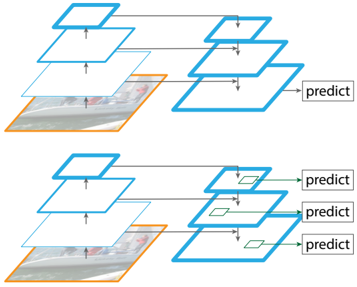
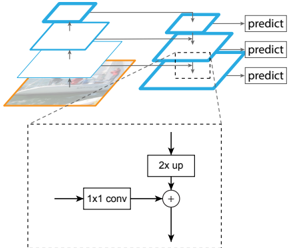
- FPN uses a bottom-up ResNet pathway (C2–C5), a top-down pathway that upsamples coarser maps by 2× with nearest-neighbor interpolation, and lateral 1×1 convolutions merged by element-wise addition; a 3×3 convolution is appended to each merged map. Detection uses d = 256 and pyramid levels P2–P5, with P6 added for RPN’s 512² anchor scale.
- For RPN, heads are attached to each pyramid level with single-scale anchors of areas {32², 64², 128², 256², 512²} on {P2, P3, P4, P5, P6} and aspect ratios {1:2, 1:1, 2:1}, totaling 15 anchors. For Fast R-CNN, RoIs are assigned to pyramid levels using the canonical 224² size and k₀ = 4, with shared heads and a 2fc MLP.
- Experiments use the 80-category COCO dataset, training on trainval35k (80k train + 35k val subset), ablating on minival (5k val images), and reporting test-std results. Backbones are ImageNet1k-pretrained ResNet-50/101; training uses synchronized SGD on 8 GPUs with input shorter side 800 pixels. RPN training takes about 8 hours and Fast R-CNN about 10 hours on COCO; inference is 0.148 s per image for ResNet-50 and 0.172 s for ResNet-101 on an NVIDIA M40 GPU.
Limitations
- The paper states that designing better connection modules is not its focus and opts for a simple design; more sophisticated blocks gave only marginally better results. It also notes that the ResNet-101 model was not sufficiently trained with the default schedule, and that the feature-sharing version of the COCO leaderboard model was not evaluated due to limited time.
- The paper states that its method does not exploit popular improvements such as iterative regression, hard negative mining, context modeling, or stronger data augmentation, which are complementary and could boost accuracy further.
- Evident from the text: there is no dedicated limitations section, and the empirical evaluation is limited to COCO detection and mask proposal generation, not full instance segmentation or other datasets.
Model-written summary. Check it against the paper before relying on it.
Integrity signals
Registry
Cites
Statistics
Figures
Verification
Claims the paper makes
8 Valid · 4 Not valid · 14 Not checked · 82 Own results and interpretations
The cited sources that could be checked couldn’t confirm or dispute this claim.
In the paper
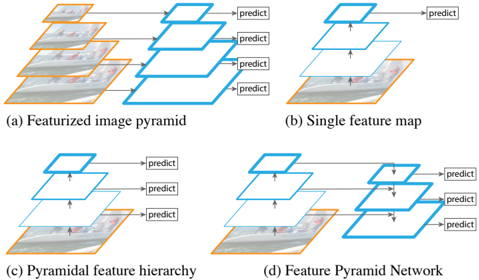
“For these reasons, Fast and Faster R-CNN [11, 29] opt to not use featurized image pyramids under default settings.”
What the sources say
- Not matchedcites [11] [11] R. Girshick. Fast R-CNN. In ICCV , 2015. -
We searched by its title and found no matching paper.
- Could not verifycites [29] [29] S. Ren, K. He, R. Girshick, and J. Sun. Faster R-CNN: Towards real-time object detection with region proposal networks. In NIPS , 2015. - sourceExperimental — accuracy not yet measured
The Related Work section (p. 3) discusses multi-resolution features for semantic segmentation, and the results (p. 8) discuss multi-scale testing of the authors’ model. Neither passage addresses whether Fast or Faster R-CNN omit featurized image pyramids by default; searches for those models and that setting found no supporting passage in our copy. (LLM, conf=0.77)
plain- Asserted: passes — The authors put it forward as true.
- Checkable: passes — It can be checked against evidence.
- Load-bearing: passes — The paper’s conclusions depend on it.
- Based: passes — The paper gives a reason why it holds.
- Not matched
The cited sources support only part of this claim — read each source’s verdict below.
In the paper
“Recently, FPN has enabled new top results in all tracks of the COCO competition, including detection, instance segmentation, and keypoint estimation. See [14] for details.”
What the sources say
- Partly supportedcites [14] [14] K. He, G. Gkioxari, P. Doll´ ar, and R. Girshick. Mask r-cnn. arXiv:1703.06870 , 2017. - sourceExperimental — accuracy not yet measured
The paper reports strong COCO results using FPN backbones: its instance-segmentation model surpasses earlier winners (Section 4.1, p. 5), its detection model exceeds earlier single-model results (Section 4.3, p. 7), and its keypoint model exceeds the 2016 winner (Section 5, p. 8). But it does not establish that FPN enabled top competition results in all three tracks; Appendix B (p. 10) discusses 2017 winning teams only for instance segmentation and credits the Mask R-CNN framework. (LLM, conf=0.87)
plainstates a cause- Asserted: passes — The authors put it forward as true.
- Checkable: passes — It can be checked against evidence.
- Load-bearing: unclear — It is unclear whether the paper’s conclusions depend on it.
- Based: passes — The paper gives a reason why it holds.
- Partly supported
The sources with a verdict support this claim; the rest weren’t checked yet, have no full text we could read, or their verdicts aren’t rated yet.
In the paper
“All recent top entries in the ImageNet [33] and COCO [21] detection challenges use multi-scale testing on featurized image pyramids ( e.g ., [16, 35]).”
What the sources say
- Not checked yetcites [16] [16] K. He, X. Zhang, S. Ren, and J. Sun. Deep residual learning for image recognition. In CVPR , 2016. - source
Checked before — its earlier verdict is held back until a new check runs.
- Supportedcites [35] [35] A. Shrivastava, A. Gupta, and R. Girshick. Training regionbased object detectors with online hard example mining. In CVPR , 2016. - source
As an example citation, this paper supports the COCO part of the sentence. The Multi-scale (M) section (page unavailable) says it runs inference at all scales during testing, and the Ablation analysis (page unavailable) says a variant finished fourth in the 2015 COCO Detection Challenge. (LLM, conf=0.85)
plain- Asserted: passes — The authors put it forward as true.
- Checkable: passes — It can be checked against evidence.
- Load-bearing: passes — The paper’s conclusions depend on it.
- Based: passes — The paper gives a reason why it holds.
- Not checked yet
The cited sources support only part of this claim — read each source’s verdict below.
In the paper
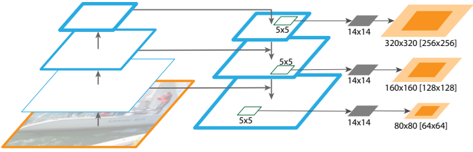
“Existing mask proposal methods [27, 28, 4] are based on densely sampled image pyramids ( e.g ., scaled by 2 {-2:0 . 5:1 } in [27, 28]), making them computationally expensive.”
What the sources say
- Partly supportedcites [27] [27] P. O. Pinheiro, R. Collobert, and P. Dollar. Learning to segment object candidates. In NIPS , 2015. - sourceExperimental — accuracy not yet measured
The Introduction says prevalent object-detection methods use image or filter pyramids, and §3.3 says avoiding those pyramids saves running time. The paper does not establish that existing mask proposal methods rely on densely sampled image pyramids or document the specified scale sampling. (LLM, conf=0.86)
- Not matchedcites [28] [28] P. O. Pinheiro, T.-Y. Lin, R. Collobert, and P. Doll´ ar. Learning to refine object segments. In ECCV , 2016. -
More than one paper fits this citation.
- Not checked — no full text of the sourcecites [4] [4] J. Dai, K. He, Y. Li, S. Ren, and J. Sun. Instance-sensitive fully convolutional networks. In ECCV , 2016. -
plainstates a cause- Asserted: passes — The authors put it forward as true.
- Checkable: passes — It can be checked against evidence.
- Load-bearing: passes — The paper’s conclusions depend on it.
- Based: passes — The paper gives a reason why it holds.
- Partly supported
Every source the paper cites for this claim was checked and supports it.
In the paper
“The Single Shot Detector (SSD) [22] is one of the first attempts at using a ConvNet's pyramidal feature hierarchy as if it were a featurized image pyramid (Fig. 1(c)).”
What the sources say
- Supportedcites [22] [22] W. Liu, D. Anguelov, D. Erhan, C. Szegedy, and S. Reed. SSD: Single shot multibox detector. In ECCV , 2016. - source
Section 2.2 (p. 6) says SSD uses feature maps from several layers to mimic the effect of processing an image at different sizes. Section 2.1 (p. 3) describes progressively smaller feature layers for multi-scale detection, and the paper presents this as a contribution relative to earlier single-scale detectors. Together, these support the characterization of SSD as an early use of a ConvNet feature hierarchy in place of an image pyramid. (LLM, conf=0.88)
plain- Asserted: passes — The authors put it forward as true.
- Checkable: passes — It can be checked against evidence.
- Load-bearing: unclear — It is unclear whether the paper’s conclusions depend on it.
- Based: passes — The paper gives a reason why it holds.
- Supported
65 more claims · 4 with their cited sources checked
Create a free account to see all 108 claims and to verify the 11 references still open.
- It may state two separate claims as one. 23
- Probably not a substantial claim. 17
- The quote only partly states this claim. 3
Claims other papers make about this one
Each is checked against this paper’s own text: does it say what the citing paper says it does?
The source backs part of the claim, not all of it — or backs it for a different population, condition or comparison.
In the citing paper
“Feature Pyramid Network (FPN) [42] is one of the important two stage object detectors, tried to overcome few of the aforementioned challenges successfully by extracting features at multiple scales of an image in the object detection process.”
From Object detection using YOLO: challenges, architectural successors, datasets and applications (2023) · cites this paper as [42]
Experimental — accuracy not yet measuredThe source backs part of the claim, not all of it — or backs it for a different population, condition or comparison.
In the citing paper
“Its performance can be improved further by exploiting and enhancing the feature hierarchy of deep convolutional networks [80], employing non-local attention [81], and leveraging the reciprocal relationship between detection and segmentation via hybrid task cascade [82].”
From Empowering things with intelligence: a survey of the progress, challenges, and opportunities in artificial intelligence of things (2021) · cites this paper as [80]
Experimental — accuracy not yet measuredThe source backs part of the claim, not all of it — or backs it for a different population, condition or comparison.
In the citing paper
“To improve the accuracy of small defect detection, this paper uses SPP and FPN to increase the effect of multi-scale feature extraction.”
From Automatic Detection and Classification of Steel Surface Defect Using Deep Convolutional Neural Networks (2021) · cites this paper as [26]
Experimental — accuracy not yet measuredThe source backs part of the claim, not all of it — or backs it for a different population, condition or comparison.
In the citing paper
“YOLOv3 introduced a foundational generic architecture inspired by the Feature Pyramid Network (FPN) [22], integrating elements such as residual blocks, skip connections, and up-sampling.”
From YOLOv1 to v8: Unveiling Each Variant–A Comprehensive Review of YOLO (2024) · cites this paper as [22]
Experimental — accuracy not yet measuredThe cited source says what the claim attributes to it.
In the citing paper
“Unlike the word tokens that serve as the basic elements of processing in language Transformers, visual elements can vary substantially in scale, a problem that receives attention in tasks such as object detection [42, 53, 54].”
From Swin Transformer: Hierarchical Vision Transformer using Shifted Windows (2021) · cites this paper as [42]
14 more claims about this paper
Create a free account to see every claim other papers make about this one.
Self-check
Percentages, sums and reported differences re-computed from the paper’s own numbers.
Each contradiction between two passages listed here was confirmed by an independent check.
Rated minor: it would not touch a result — a value no result rests on, a p-value that stays on the same side of the significance level, or a conflict that is clerical, resolved elsewhere in the paper, or outside its own findings.
In the paper
§ 6.1. Segmentation Proposal Results · p. 8
“Our approach, based on FPNs, is substantially faster (our models run at 6 to 7 FPS).”
§ 6. Extensions: Segmentation Proposals · p. 8
“| + 2x train schedule | | 48.1 | 32.6 | 54.2 | 65.6 | 0.25 |”
Rated minor: it would not touch a result — a value no result rests on, a p-value that stays on the same side of the significance level, or a conflict that is clerical, resolved elsewhere in the paper, or outside its own findings.
In the paper
§ 5.1.1 Ablation Experiments · p. 5
“This architecture simulates the effect of reusing the pyramidal feature hierarchy (Fig. 1(b)).”
§ Feature Pyramid Networks for Object Detection · p. 1
“(b) Recent detection systems have opted to use only single scale features for faster detection. (c) An alternative is to reuse the pyramidal feature hierarchy computed by a ConvNet as if it were a featurized image pyramid.”
Citations
Cites
Deep Residual Learning for Image Recognition
He, K., Zhang, X., Ren, S., & Sun, J. (2016) · 2016 IEEE Conference on Computer Vision and Pattern Recognition (CVPR) · doi:10.1109/cvpr.2016.90 · Cited by 235,474 · cited 9×
“Analogous to the ResNet-based Faster R-CNN system [16] that uses C 4 as the single-scale feature map, we set k 0 to 4.”
BackgroundMethodResultInfluentialSelf-citationVery Deep Convolutional Networks for Large-Scale Image Recognition
Simonyan, K., & Zisserman, A. (2014) · arXiv · doi:10.48550/arxiv.1409.1556 · Cited by 114,148 · cited 2×
“But to avoid using low-level features SSD foregoes reusing already computed layers and instead builds the pyramid starting from high up in the network ( e.g ., conv4 3 of VGG nets [36]) and then by adding several new layers.”
BackgroundResultImageNet classification with deep convolutional neural networks
Krizhevsky, A., Sutskever, I., & Hinton, G. E. (2017) · Communications of the ACM · doi:10.1145/3065386 · Cited by 112,155 · cited 3×
“With the development of modern deep ConvNets [19], object detectors like OverFeat [34] and R-CNN [12] showed dramatic improvements in accuracy.”
MethodResultU-Net: Convolutional Networks for Biomedical Image Segmentation
Ronneberger, O., Fischer, P., & Brox, T. (2015) · Lecture notes in computer science · doi:10.1007/978-3-319-24574-4_28 · Cited by 99,404 · cited 1×
“rarchy without combining features or scores. There are recent methods exploiting lateral/skip connections that associate low-level feature maps across resolutions and semantic levels, including U-Net [31] and SharpMask [28] for segmentation, Recombinator networks [17] for face detection, and Stacked Hourglass networks…”
MethodFaster R-CNN: Towards Real-Time Object Detection with Region Proposal Networks
Ren, S., He, K., Girshick, R., & Sun, J. (2017) · IEEE Transactions on Pattern Analysis and Machine Intelligence · doi:10.1109/tpami.2016.2577031 · Cited by 73,472 · cited 10×
“For these reasons, Fast and Faster R-CNN [11, 29] opt to not use featurized image pyramids under default settings.”
BackgroundMethodInfluentialSelf-citationFaster R-CNN: Towards Real-Time Object Detection with Region Proposal Networks
Ren, S., He, K., Girshick, R., & Sun, J. (2015) · arXiv · doi:10.48550/arxiv.1506.01497 · Cited by 70,812 · cited 10×
“For these reasons, Fast and Faster R-CNN [11, 29] opt to not use featurized image pyramids under default settings.”
BackgroundMethodInfluentialSelf-citationDistinctive Image Features from Scale-Invariant Keypoints
Lowe, D. G. (2004) · International Journal of Computer Vision · doi:10.1023/b:visi.0000029664.99615.94 · Cited by 62,647
Microsoft COCO: Common Objects in Context
Lin, T.-Y., Maire, M., Belongie, S., Hays, J., Perona, P., Ramanan, D., Dollár, P., & Zitnick, C. L. (2014) · Lecture Notes in Computer Science · doi:10.1007/978-3-319-10602-1_48 · Cited by 45,460 · cited 6×
“All recent top entries in the ImageNet [33] and COCO [21] detection challenges use multi-scale testing on featurized image pyramids ( e.g ., [16, 35]).”
BackgroundMethodInfluentialSelf-citationImageNet Large Scale Visual Recognition Challenge
Russakovsky, O., Deng, J., Su, H., Krause, J., Satheesh, S., Ma, S., Huang, Z., Karpathy, A., Khosla, A., Bernstein, M., et al. (2015) · International Journal of Computer Vision · doi:10.1007/s11263-015-0816-y · Cited by 39,380 · cited 2×
“Thus we can adapt the assignment strategy of region-based detectors [15, 11] in the case when they are run on image pyramids.”
MethodFully convolutional networks for semantic segmentation
Long, J., Shelhamer, E., & Darrell, T. (2015) · 2015 IEEE Conference on Computer Vision and Pattern Recognition (CVPR) · doi:10.1109/cvpr.2015.7298965 · Cited by 38,834 · cited 1×
“FCN [24] sums partial scores for each category over multiple scales to compute semantic segmentations.”
Background
Research works printed but not linked: 1
- [1] E. H. Adelson, C. H. Anderson, J. R. Bergen, P. J. Burt, and J. M. Ogden. Pyramid methods in image processing. RCA engineer , 1984. -
Cited by
Items 4,401–4,500 of 29,875
Location Field Descriptors: Single Image 3D Model Retrieval in the Wild
Grabner, A., Roth, P. M., & Lepetit, V. (2019) · International Conference on 3D Vision (3DV) · doi:10.1109/3dv.2019.00070 · Cited by 47
Cui, X., Zheng, K., Gao, L., Zhang, B., Yang, D., & Ren, J. (2019) · Remote Sensing · doi:10.3390/rs11192220 · Cited by 48
Harmonic convolutional networks based on discrete cosine transform
Uličný, M., Krylov, V. A., & Dahyot, R. (2022) · Pattern Recognition · doi:10.1016/j.patcog.2022.108707 · Cited by 63
Pixel-Attentive Policy Gradient for Multi-Fingered Grasping in Cluttered Scenes
Wu, B., Akinola, I., & Allen, P. K. (2019) · IEEE/RSJ International Conference on Intelligent Robots and Systems (IROS) · doi:10.1109/iros40897.2019.8968263 · Cited by 42
Chen, L., Weng, T., Xing, J., Pan, Z., Yuan, Z., Xing, X., & Zhang, P. (2020) · Remote Sensing · doi:10.3390/rs12030441 · Cited by 40
Visual-Semantic Graph Attention Networks for Human-Object Interaction Detection
Liang, Z., Liu, J., Guan, Y., & Rojas, J. (2021) · IEEE International Conference on Robotics and Biomimetics (ROBIO) · doi:10.1109/robio54168.2021.9739429 · Cited by 57
Cascade Detector With Feature Fusion For Arbitrary-Oriented Objects In Remote Sensing Images
Hou, L., Lü, K., Xue, J., & Li, H. (2020) · IEEE International Conference on Multimedia and Expo (ICME) · doi:10.1109/icme46284.2020.9102807 · Cited by 41
PS-RCNN: Detecting Secondary Human Instances in a Crowd via Primary Object Suppression
Ge, Z., Jie, Z., Huang, X., Xu, R., & Yoshie, O. (2020) · IEEE International Conference on Multimedia and Expo (ICME) · doi:10.1109/icme46284.2020.9102793 · Cited by 46
An integrated rice panicle phenotyping method based on X-ray and RGB scanning and deep learning
Yu, L., Shi, J., Huang, C., Duan, L., Wu, D., Fu, D., Wu, C., Xiong, L., Yang, W., & Liu, Q. (2020) · The Crop Journal · doi:10.1016/j.cj.2020.06.009 · Cited by 49
Regularized Densely-Connected Pyramid Network for Salient Instance Segmentation
Wu, Y.-H., Liu, Y., Zhang, L., Gao, W., & Cheng, M.-M. (2021) · IEEE Transactions on Image Processing · doi:10.1109/tip.2021.3065822 · Cited by 55
Learning Scales from Points: A Scale-aware Probabilistic Model for Crowd Counting
Ma, Z., Wei, X., Hong, X., & Gong, Y. (2020) · ACM International Conference on Multimedia (ACM MM) · doi:10.1145/3394171.3413642 · Cited by 53
Panoptic Segmentation of Individual Pigs for Posture Recognition
Brünger, J., Gentz, M., Traulsen, I., & Koch, R. (2020) · Sensors · doi:10.3390/s20133710 · Cited by 46
Unified Density-Aware Image Dehazing and Object Detection in Real-World Hazy Scenes
Zhang, Z., Zhao, L., Liu, Y., Zhang, S., & Yang, J. J. (2021) · Lecture notes in computer science · doi:10.1007/978-3-030-69538-5_8 · Cited by 51
Arrow R-CNN for handwritten diagram recognition
Schäfer, B., Keuper, M., & Stuckenschmidt, H. (2021) · International Journal on Document Analysis and Recognition (IJDAR) · doi:10.1007/s10032-020-00361-1 · Cited by 58
FastUAV-NET: A Multi-UAV Detection Algorithm for Embedded Platforms
Yavariabdi, A., Kusetoğulları, H., Çelik, T., & Cicek, H. (2021) · Electronics · doi:10.3390/electronics10060724 · Cited by 43
Continual Learning With Structured Inheritance for Semantic Segmentation in Aerial Imagery
Feng, Y., Sun, X., Diao, W., Li, J., Gao, X., & Fu, K. (2021) · IEEE Transactions on Geoscience and Remote Sensing · doi:10.1109/tgrs.2021.3076664 · Cited by 47
A Robust MTMC Tracking System for AI-City Challenge 2021
Jin, Y., Yang, X., Kang, S., He, Y. H., Zhang, W., Huang, L., Jiang, M., Zhang, W., Shi, Y., Xia, M., et al. (2021) · IEEE/CVF Conference on Computer Vision and Pattern Recognition Workshops (CVPRW) · doi:10.1109/cvprw53098.2021.00456 · Cited by 51
Interleaved Deep Artifacts-Aware Attention Mechanism for Concrete Structural Defect Classification
Bhattacharya, G., Mandal, B., & Puhan, N. B. (2021) · IEEE Transactions on Image Processing · doi:10.1109/tip.2021.3100556 · Cited by 50
Visible and Thermal Image-Based Trunk Detection with Deep Learning for Forestry Mobile Robotics
da Silva, D. Q., dos Santos, F. N., Sousa, A. J., & Filipe, V. M. D. J. (2021) · Journal of Imaging · doi:10.3390/jimaging7090176 · Cited by 50
A Survey of Object Detection Based on CNN and Transformer
Arkin, E., Yadikar, N., Muhtar, Y., & Ubul, K. (2021) · 2021 IEEE 2nd International Conference on Pattern Recognition and Machine Learning (PRML) · doi:10.1109/prml52754.2021.9520732 · Cited by 39
Just Noticeable Difference for Deep Machine Vision
Jin, J., Zhang, X., Fu, X., Zhang, H., Lin, W., Lou, J., & Zhao, Y. (2021) · IEEE Transactions on Circuits and Systems for Video Technology · doi:10.1109/tcsvt.2021.3113572 · Cited by 61
WB-DETR: Transformer-Based Detector without Backbone
Liu, F., Wei, H., Zhao, W., Li, G., Peng, J., & Li, Z. (2021) · IEEE/CVF International Conference on Computer Vision (ICCV) · doi:10.1109/iccv48922.2021.00297 · Cited by 51
Automatic Detection and Counting of Blood Cells in Smear Images Using RetinaNet
Drałus, G., Mazur, D., & Czmil, A. (2021) · Entropy · doi:10.3390/e23111522 · Cited by 53
RangeLVDet: Boosting 3D Object Detection in LIDAR With Range Image and RGB Image
Zhang, Z., Liang, Z., Zhang, M., Zhao, X. F., Li, H., Yang, M. Z., Tan, W., & Pu, S. (2021) · IEEE Sensors Journal · doi:10.1109/jsen.2021.3127626 · Cited by 40
BoxeR: Box-Attention for 2D and 3D Transformers
Nguyen, D.-K., Ju, J., Booij, O., Oswald, M. R., & Snoek, C. G. M. (2022) · IEEE Computer Society Conference on Computer Vision and Pattern Recognition/Proceedings - IEEE Computer Society Conference on Computer Vision and Pattern Recognition/Proceedings · doi:10.1109/cvpr52688.2022.00473 · Cited by 49
A Method for Segmenting Disease Lesions of Maize Leaves in Real Time Using Attention YOLACT++
Huang, M., Xu, G., Li, J., & Huang, J. (2021) · Agriculture · doi:10.3390/agriculture11121216 · Cited by 46
A Deep Learning Model to Extract Ship Size From Sentinel-1 SAR Images
Ren, Y., Li, X., & Xu, H. (2021) · IEEE Transactions on Geoscience and Remote Sensing · doi:10.1109/tgrs.2021.3063216 · Cited by 40
Zhou, Q., Qin, J., Xiang, X., Tan, Y., & Ren, Y. (2021) · Knowledge-Based Systems · doi:10.1016/j.knosys.2021.107853 · Cited by 40
Yu, J., Zhou, G., Zhou, S., & Qin, M. (2021) · Remote Sensing · doi:10.3390/rs14010031 · Cited by 39
A Hybrid parallel deep learning model for efficient intrusion detection based on metric learning
Cai, S., Han, D., Yin, X., Li, D., & Chang, C. (2022) · Connection Science · doi:10.1080/09540091.2021.2024509 · Cited by 49
Active Fire Mapping on Brazilian Pantanal Based on Deep Learning and CBERS 04A Imagery
Higa, L. T., Marcato, J., Rodrigues, T. R., Zamboni, P., Silva, R., Almeida, L., Liesenberg, V., Roque, F. D. O., Libonati, R., Gonçalves, W. N., et al. (2022) · Remote Sensing · doi:10.3390/rs14030688 · Cited by 66
Zhang, Y., Liu, X., Wa, S., Chen, S., & Ma, Q. (2022) · Remote Sensing · doi:10.3390/rs14040923 · Cited by 41
Belt Tear Detection for Coal Mining Conveyors
Guo, X., Liu, X., Zhou, H. F., Stanisławski, R., Królczyk, G., & Li, Z. (2022) · Micromachines · doi:10.3390/mi13030449 · Cited by 48
A Task Decomposing and Cell Comparing Method for Cervical Lesion Cell Detection
Chen, T., Zheng, W., Ying, H., Tan, X., Li, K., Li, X., Chen, D. Z., & Wu, J. (2022) · IEEE Transactions on Medical Imaging · doi:10.1109/tmi.2022.3163171 · Cited by 47
Deformable Template Network (DTN) for Object Detection
Wu, S., Xu, Y. D., Zhang, B., Yang, J. J., & Zhang, D. D. (2021) · IEEE Transactions on Multimedia · doi:10.1109/tmm.2021.3075323 · Cited by 41
Text detection, recognition, and script identification in natural scene images: a Review
Naosekpam, V., & Sahu, N. (2022) · International Journal of Multimedia Information Retrieval · doi:10.1007/s13735-022-00243-8 · Cited by 48
Box-Grained Reranking Matching for Multi-Camera Multi-Target Tracking
Yang, X., Ye, J., Lu, J., Gong, C., Jiang, M., Lin, X., Zhang, W., Tan, X., Li, Y., Ye, X., et al. (2022) · IEEE/CVF Conference on Computer Vision and Pattern Recognition Workshops (CVPRW) · doi:10.1109/cvprw56347.2022.00349 · Cited by 53
Ohara, J., Nemoto, T., Maeda, Y., Ogata, N., Kudo, S., & Yamochi, T. (2022) · Journal of Gastroenterology · doi:10.1007/s00535-022-01924-1 · Cited by 44
Effect of image resolution on automated classification of chest X-rays
Haque, M. I. U., Dubey, A., Danciu, I., Justice, A. C., Ovchinnikova, O. S., & Hinkle, J. D. (2023) · Journal of medical imaging · doi:10.1117/1.jmi.10.4.044503 · Cited by 55
Computation Reallocation for Object DetectionPreprint
Liang, F., Chen, L., Guo, R., Sun, M., Wu, W., Yan, J., & Ouyang, W. (2019) · arXiv (Cornell University) · doi:10.48550/arxiv.1912.11234 · Cited by 34
Unbiased Scene Graph Generation from Biased TrainingPreprint
Tang, K., Niu, Y., Huang, J., et al. (2020) · arXiv (Cornell University) · doi:10.48550/arxiv.2002.11949 · Cited by 39
Physical Adversarial Attack on Vehicle Detector in the Carla SimulatorPreprint
Wu, T., Ning, X., Li, W., Huang, R., Yang, H., & Wang, Y. (2020) · arXiv (Cornell University) · doi:10.48550/arxiv.2007.16118 · Cited by 83
Dense Contrastive Learning for Self-Supervised Visual Pre-TrainingPreprint
Wang, X., Zhang, R., Shen, C., Kong, T., & Li, L. (2020) · arXiv (Cornell University) · doi:10.48550/arxiv.2011.09157 · Cited by 38
FcaNet: Frequency Channel Attention NetworksPreprint
Qin, Z., Zhang, P., Wu, F. Q., et al. (2020) · arXiv (Cornell University) · doi:10.48550/arxiv.2012.11879 · Cited by 39
YOLO5Face: Why Reinventing a Face DetectorPreprint
Qi, D., Tan, W., Yao, Q., et al. (2021) · arXiv (Cornell University) · doi:10.48550/arxiv.2105.12931 · Cited by 39
DenseCLIP: Language-Guided Dense Prediction with Context-Aware PromptingPreprint
Rao, Y., Zhao, W., Chen, G., et al. (2021) · arXiv (Cornell University) · doi:10.48550/arxiv.2112.01518 · Cited by 39
Li, Z., Wang, W., Li, H., Xie, E., Sima, C., Lu, T., Yu, Q., & Dai, J. (2022) · arXiv · doi:10.48550/arxiv.2203.17270 · Cited by 1,419
“By default, we utilize the output multi-scale features from FPN [23] with sizes of 1/16, 1/32, 1/64 and the dimension of C=256 .”
MethodIncremental Detection of Remote Sensing Objects With Feature Pyramid and Knowledge Distillation
Chen, J., Wang, S., Chen, L., Cai, H., & Qian, Y. (2020) · IEEE Transactions on Geoscience and Remote Sensing · doi:10.1109/tgrs.2020.3042554 · Cited by 51
A Novel Multi-Stage Residual Feature Fusion Network for Detection of COVID-19 in Chest X-Ray Images
Fang, Z., Ren, J., MacLellan, C., Li, H., Zhao, H., Hussain, A., & Fortino, G. (2021) · IEEE Transactions on Molecular Biological and Multi-Scale Communications · doi:10.1109/tmbmc.2021.3099367 · Cited by 36
Decoupled R-CNN: Sensitivity-Specific Detector for Higher Accurate Localization
Wang, D., Shang, K., Wu, H., & Wang, C. (2022) · IEEE Transactions on Circuits and Systems for Video Technology · doi:10.1109/tcsvt.2022.3167114 · Cited by 39
Depth-aware gaze-following via auxiliary networks for robotics
Jin, T., Yu, Q., Zhu, S., Lin, Z., Ren, J., Zhou, Y., & Song, W. (2022) · Engineering Applications of Artificial Intelligence · doi:10.1016/j.engappai.2022.104924 · Cited by 55
EMCA: Efficient Multiscale Channel Attention Module
Bakr, E. M., El-Sallab, A., & Rashwan, M. (2022) · IEEE Access · doi:10.1109/access.2022.3205602 · Cited by 44
PTSEFormer: Progressive Temporal-Spatial Enhanced TransFormer Towards Video Object Detection
Wang, H., Tang, J., Liu, X., Guan, S., Xie, R., & Song, L. (2022) · Lecture notes in computer science · doi:10.1007/978-3-031-20074-8_42 · Cited by 73
Lan, Q., & Tian, Q. (2022) · IEEE Transactions on Intelligent Vehicles · doi:10.1109/tiv.2022.3217261 · Cited by 47
Category-Aware Transformer Network for Better Human-Object Interaction Detection
Dong, L., Li, Z., Xu, K., Zhang, Z., Yan, L., Zhong, S., & Zou, X. (2022) · IEEE Computer Society Conference on Computer Vision and Pattern Recognition/Proceedings - IEEE Computer Society Conference on Computer Vision and Pattern Recognition/Proceedings · doi:10.1109/cvpr52688.2022.01893 · Cited by 56
Multivariate Probabilistic Monocular 3D Object Detection
Shi, X., Chen, Z., & Kim, T. (2023) · IEEE Winter Conference on Applications of Computer Vision · doi:10.1109/wacv56688.2023.00426 · Cited by 47
Image-Based Pothole Detection Using Multi-Scale Feature Network and Risk Assessment
Heo, D.-H., Choi, J. C., Kim, S., Tak, T.-O., & Zhang, S. (2023) · Electronics · doi:10.3390/electronics12040826 · Cited by 43
DensePPMUNet-a: A Robust Deep Learning Network for Segmenting Water Bodies From Aerial Images
Xiang, D.-Q., Zhang, X., Wu, W., & Liu, H. (2023) · IEEE Transactions on Geoscience and Remote Sensing · doi:10.1109/tgrs.2023.3251659 · Cited by 44
Automation of SME production with a Cobot system powered by learning-based vision
Yang, X., Zhou, Z., Sørensen, J. H., Christensen, C. B., Ünalan, M., & Zhang, X. (2023) · Robotics and Computer-Integrated Manufacturing · doi:10.1016/j.rcim.2023.102564 · Cited by 59
Edge-YOLO: Lightweight Infrared Object Detection Method Deployed on Edge Devices
Li, J., & Ye, J. (2023) · Applied Sciences · doi:10.3390/app13074402 · Cited by 46
A Lightweight Detector Based on Attention Mechanism for Fabric Defect Detection
Luo, X., Ni, Q., Tao, R., & Shi, Y. (2023) · IEEE Access · doi:10.1109/access.2023.3264262 · Cited by 42
Toward Real-Time UAV Multi-Target Tracking Using Joint Detection and Tracking
Keawboontan, T., & Thammawichai, M. (2023) · IEEE Access · doi:10.1109/access.2023.3283411 · Cited by 47
Pests Identification of IP102 by YOLOv5 Embedded with the Novel Lightweight Module
Zhang, L., Zhao, C., Feng, Y., & Li, D. (2023) · Agronomy · doi:10.3390/agronomy13061583 · Cited by 40
TransU²-Net: An Effective Medical Image Segmentation Framework Based on Transformer and U²-Net
Li, X., Fang, X., Yang, G., Su, S., Zhu, L., & Yu, Z. (2023) · IEEE Journal of Translational Engineering in Health and Medicine · doi:10.1109/jtehm.2023.3289990 · Cited by 54
An Improved YOLOv7 Lightweight Detection Algorithm for Obscured Pedestrians
Li, C., Wang, Y., & Liu, X. (2023) · Sensors · doi:10.3390/s23135912 · Cited by 42
NVRadarNet: Real-Time Radar Obstacle and Free Space Detection for Autonomous Driving
Popov, A., Gebhardt, P., Chen, K., & Oldja, R. (2023) · Proceedings - IEEE International Conference on Robotics and Automation/Proceedings · doi:10.1109/icra48891.2023.10160592 · Cited by 57
Solar Cell Surface Defect Detection Based on Optimized YOLOv5
Lu, S., Wu, K., & Chen, J. (2023) · IEEE Access · doi:10.1109/access.2023.3294344 · Cited by 47
Ye, W., Zhang, W., Lei, W., Zhang, W., Chen, X., & Wang, Y. (2023) · Expert Systems with Applications · doi:10.1016/j.eswa.2023.121007 · Cited by 42
Semi-Supervised Few-Shot Object Detection via Adaptive Pseudo Labeling
Tang, Y., Cao, Z., Yang, Y., Liu, J., & Yu, J. (2023) · IEEE Transactions on Circuits and Systems for Video Technology · doi:10.1109/tcsvt.2023.3301854 · Cited by 41
“With the strong learning representation of deep neural networks [4], [5], [6], object detectors trained on large-scale datasets have achieved remarkable performance.”
BackgroundEnd-to-End Learnable Multi-Scale Feature Compression for VCM
Kim, Y., Jeong, H., Yu, J., Kim, Y., Lee, J., Jeong, S., & Kim, H. Y. (2023) · IEEE Transactions on Circuits and Systems for Video Technology · doi:10.1109/tcsvt.2023.3302858 · Cited by 63
Transformer Scale Gate for Semantic Segmentation
Shi, H., Hayat, M., & Cai, J. (2023) · IEEE Computer Society Conference on Computer Vision and Pattern Recognition/Proceedings - IEEE Computer Society Conference on Computer Vision and Pattern Recognition/Proceedings · doi:10.1109/cvpr52729.2023.00298 · Cited by 56
ESA-Net: An efficient scale-aware network for small crop pest detection
Dong, S., Teng, Y., Jiao, L., Du, J., Liu, K., & Wang, R. (2023) · Expert Systems with Applications · doi:10.1016/j.eswa.2023.121308 · Cited by 45
CSSAdet: Real-Time End-to-End Small Object Detection for Power Transmission Line Inspection
Li, Y., Liu, M., Li, Z., & Jiang, X. (2023) · IEEE Transactions on Power Delivery · doi:10.1109/tpwrd.2023.3315579 · Cited by 49
“Techniques such as Feature Pyramid Networks (FPN) [7] and Path Aggregation Network (PANET) [8] have been developed to address these challenges.”
BackgroundMethodZhao, K., Yuan, X., Liu, T., Xiang, Y., Xie, Z., Huang, G., & Feng, L. (2023) · Expert Systems with Applications · doi:10.1016/j.eswa.2023.121918 · Cited by 48
Joint discriminative representation learning for end-to-end person search
Zhang, P., Yu, X., Bai, X. P., Wang, C., Zheng, J. Y., & Ning, X. (2023) · Pattern Recognition · doi:10.1016/j.patcog.2023.110053 · Cited by 43
Towards Accurate Medical Image Segmentation With Gradient-Optimized Dice Loss
Ming, Q., & Xiao, X. (2023) · IEEE Signal Processing Letters · doi:10.1109/lsp.2023.3329437 · Cited by 55
Wang, Y., Shi, M., Li, J., Huang, Z., Cao, Z., Zhang, J., Xian, K., & Lin, G. (2023) · IEEE/CVF International Conference on Computer Vision (ICCV) · doi:10.1109/iccv51070.2023.00868 · Cited by 83
Augmented Box Replay: Overcoming Foreground Shift for Incremental Object Detection
Liu, Y., Cong, Y., Goswami, D., Liu, X., & van de Weijer, J. (2023) · IEEE/CVF International Conference on Computer Vision (ICCV) · doi:10.1109/iccv51070.2023.01044 · Cited by 87
HRYNet: A Highly Robust YOLO Network for Complex Road Traffic Object Detection
Tang, L., Yun, L., Chen, Z., & Cheng, F. (2024) · Sensors · doi:10.3390/s24020642 · Cited by 39
“Additionally, the introduction of feature pyramid networks (FPN) [18], attention mechanisms [19–25], and other structures have further enhanced the detection performance of single-stage object detection algorithms.”
BackgroundChen, F., Deng, M., Gao, H., Yang, X., & Zhang, D. (2024) · IET Image Processing · doi:10.1049/ipr2.13073 · Cited by 50
Sonar Image Generation by MFA-CycleGAN for Boosting Underwater Object Detection of AUVs
Zhou, J., Li, Y., Qin, H., Dai, P., Zhao, Z., & Hu, M. (2024) · IEEE Journal of Oceanic Engineering · doi:10.1109/joe.2024.3350746 · Cited by 45
Skin Cancer Recognition Using Unified Deep Convolutional Neural Networks
Alsadhan, N. A., Alamri, S., Ismail, M. M. B., & Bchir, O. (2024) · Cancers · doi:10.3390/cancers16071246 · Cited by 47
SEB-YOLO: An Improved YOLOv5 Model for Remote Sensing Small Target Detection
Hui, Y., You, S., Hu, X., Yang, P., & Zhao, J. (2024) · Sensors · doi:10.3390/s24072193 · Cited by 44
“Feature aggregation block consists of a modified Path Aggregation Network (PANet) [30], which is an advanced version of a feature pyramid network (FPN) [31], which is used in YOLOv3.”
MethodA two-stage approach for aircraft detection with convolutional neural network
Toghuj, W., & Alraba’nah, Y. (2024) · International Journal of Power Electronics and Drive Systems/International Journal of Electrical and Computer Engineering · doi:10.11591/ijece.v14i4.pp4627-4635 · Cited by 42
“Simultaneously, they integrated enhancements such as feature pyramid network (FPN) [15] into their model, referred to as RetinaNet [16].”
MethodTang, S., Xia, Z., Gu, J., Wang, W., Huang, Z., & Zhang, W. (2024) · Frontiers in Sustainable Food Systems · doi:10.3389/fsufs.2024.1403872 · Cited by 47
Machine learning approaches for improving atomic force microscopy instrumentation and data analytics
Masud, N., Rade, J., Hasib, M. H. H., Krishnamurthy, A., & Sarkar, A. (2024) · Frontiers in Physics · doi:10.3389/fphy.2024.1347648 · Cited by 51
Zhao, C.-T., Wang, R.-F., Tu, Y.-H., Pang, X.-X., & Su, W. (2024) · Agronomy · doi:10.3390/agronomy14122838 · Cited by 51
Zhang, Q., Zhang, J., Li, Y., Zhu, C., & Wang, G. (2025) · IEEE Transactions on Instrumentation and Measurement · doi:10.1109/tim.2025.3527530 · Cited by 72
Bai, C., Zhang, K., Jin, H., Qian, P., Zhai, R., & Lü, K. (2025) · Image and Vision Computing · doi:10.1016/j.imavis.2025.105469 · Cited by 54
Application of the YOLOv11-seg algorithm for AI-based landslide detection and recognition
He, L., Zhou, Y., Liu, L., Zhang, Y., & Ma, J. (2025) · Scientific Reports · doi:10.1038/s41598-025-95959-y · Cited by 59
R-FCN++: Towards Accurate Region-Based Fully Convolutional Networks for Object Detection
Li, Z., Chen, Y., Yu, G., & Deng, Y. S. (2018) · Proceedings of the AAAI Conference on Artificial Intelligence · doi:10.1609/aaai.v32i1.12265 · Cited by 39
Performance Comparison of Deep Learning Techniques for Recognizing Birds in Aerial Images
Liu, Y., Sun, P., Highsmith, M. R., Wergeles, N. M., Sartwell, J., Raedeke, A., Mitchell, M. J., Hagy, H. M., Gilbert, A. D., Lubinski, B. R., et al. (2018) · IEEE International Conference on Data Science in Cyberspace · doi:10.1109/dsc.2018.00052 · Cited by 48
Real-Time Vision-Based System of Fault Detection for Freight Trains
Zhang, Y., Liu, M., Chen, Y., Zhang, H., & Guo, Y. (2019) · IEEE Transactions on Instrumentation and Measurement · doi:10.1109/tim.2019.2955799 · Cited by 40
Lv, Y., Zhang, C., Yun, W., Gao, L., Wang, H., Ma, J., Li, H., & Zhu, D. (2020) · Remote Sensing · doi:10.3390/rs12071074 · Cited by 38
Loo, J., Kriegel, M. F., Tuohy, M. M., Kim, K. H., Prajna, V., Woodward, M. A., & Farsiu, S. (2020) · IEEE Journal of Biomedical and Health Informatics · doi:10.1109/jbhi.2020.2983549 · Cited by 41
Accelerating GluCEST imaging using deep learning for B0 correction
Li, Y., Xie, D., Cember, A., Nanga, R. P. R., Yang, H., Kumar, D., Hariharan, H., Li, B., Detre, J. A., Reddy, R. D., et al. (2020) · Magnetic Resonance in Medicine · doi:10.1002/mrm.28289 · Cited by 42
Building Area Estimation in Drone Aerial Images Based on Mask R-CNN
Chen, J., Wang, G., Luo, L., Gong, W., & Cheng, Z. (2020) · IEEE Geoscience and Remote Sensing Letters · doi:10.1109/lgrs.2020.2988326 · Cited by 42
Yu, D., Zhang, K., Huang, L., Zhao, B., Zhang, X., Guo, X., Li, M., Gu, Z., Fu, G., Hu, M., et al. (2020) · Computer Methods and Programs in Biomedicine · doi:10.1016/j.cmpb.2020.105674 · Cited by 44
Zeng, X., Wen, L., Yang, X., & Ji, C. (2020) · Computer Methods and Programs in Biomedicine · doi:10.1016/j.cmpb.2020.105700 · Cited by 46
An Adaptive Deep Learning Framework for Shipping Container Code Localization and Recognition
Zhang, R., Bahrami, Z., Wang, T., & Liu, Z. (2020) · IEEE Transactions on Instrumentation and Measurement · doi:10.1109/tim.2020.3016108 · Cited by 45
Metadata
- Authors
- Lin, T.-Y., Dollar, P., Girshick, R., He, K., Hariharan, B., & Belongie, S.
- Affiliations
- Cornell University (US)
- Meta (United States) (US)
- Venue
- 2017 IEEE Conference on Computer Vision and Pattern Recognition (CVPR)
- Publisher
- IEEE
- Published
- 2017-07
- Pages
- 936-944
- ISSN
- 1063-6919 (ISSN-L)
- OpenAlex
- W2565639579
- Cited by
- 30,939
- References
- 64
- Citations by year
- 2026: 2864 · 2025: 4496 · 2024: 5179 · 2023: 5172 · 2022: 4516 · 2021: 3861 · 2020: 2506 · 2019: 1759 · 2018: 526 · 2017: 58
- FWCI
- 387.80
- Type
- conference paper
- Language
- en
- Open access
- closed
- Locations
- IEEE Computer Society Conference on Computer Vision and Pattern Recognition/Proceedings - IEEE Computer Society Conference on Computer Vision and Pattern Recognition/Proceedings (publishedVersion)
- Topics
- Physical Sciences › Computer Science › Computer Vision and Pattern Recognition › Advanced Neural Network Applications
- Physical Sciences › Computer Science › Computer Vision and Pattern Recognition › Advanced Image and Video Retrieval Techniques
- Physical Sciences › Computer Science › Computer Vision and Pattern Recognition › Visual Attention and Saliency Detection
- Keywords
- feature pyramid network, multi-scale object detection, lateral connections, Faster R-CNN, COCO benchmark, deep convolutional neural networks, feature extraction
About these checks
Registry, retraction, Cites and statistics results are computed, not judged, with one exception: a printed reference that no index lists is read once by a model before it counts as a citation error. Claims are extracted by a model and kept only when their quote appears verbatim in the text; each cited source is then checked, with a model’s help, for whether it says what the claim relies on. Those verdicts can be wrong — read the claim’s quote and the cited source before relying on one.
The claim verdicts this report counts are experimental: their accuracy is not yet measured.
A language model drew the claims from the paper on 2026-10-10, under version 3 of the claim definition (model deepseek-v4.1-flash, prompt extract-v3).
A second model labelled each claim on 2026-10-10 (model jev-1.13-20260917, definition revision gold-guideline-v0.2).
Cited sources are checked with a language model’s help (gpt-6-sol).
Statistics and arithmetic are recomputed, not judged.
Confidence bands are shown only for fields calibrated on our annotated test set. None is calibrated yet, so no band is shown.
What counts as a claim ›How we measure confidence ›How we check this ›
Are you an author, or do you see a problem with this page? Request a review
Data sources
Bibliographic data: Semantic Scholar, OpenAlex, Crossref.
Contains information from the Semantic Scholar Academic Graph Datasets, made available under the ODC Attribution License (ODC-BY 1.0).
Semantic Scholar’s data is described in: Kinney, R., et al. (2023). The Semantic Scholar Open Data Platform. arXiv:2301.10140.
