

Interactive segmentation, tracking, and kinematic modeling of unknown 3D articulated objects
Open accessThe DOI matches its Crossref record; 16 of the 17 references it cites were found in a registry or an index.
Abstract
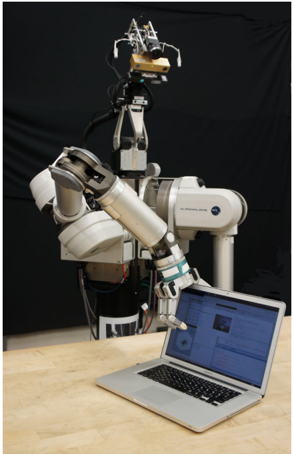
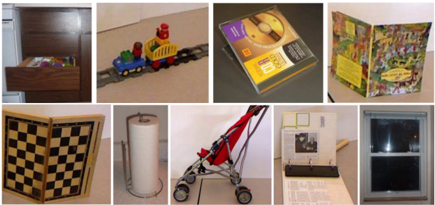
We present an interactive perceptual skill for segmenting, tracking, and modeling the kinematic structure of 3D articulated objects. This skill is a prerequisite for general manipulation in unstructured environments. Robot-environment interactions are used to move an unknown object, creating a perceptual signal that reveals the kinematic properties of the object. The resulting perceptual information can then inform and facilitate further manipulation. The algorithm is computationally efficient, handles partial occlusions, and depends on little object motion; it only requires sufficient texture for visual feature tracking. We conducted experiments with everyday objects on a robotic manipulation platform equipped with an RGB-D sensor. The results demonstrate the robustness of the proposed method to lighting conditions, object appearance, size, structure, and configuration.
Overview
The claims and statistics of this paper haven’t been checked yet.
Free: it reads the open-access text and checks the first 5 claims that cite a source we can check. Create a free account to check every claim.
Integrity signals
Registry
Cites
Statistics
Figures
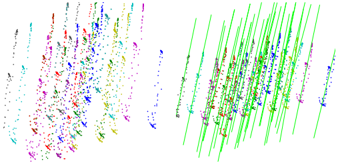
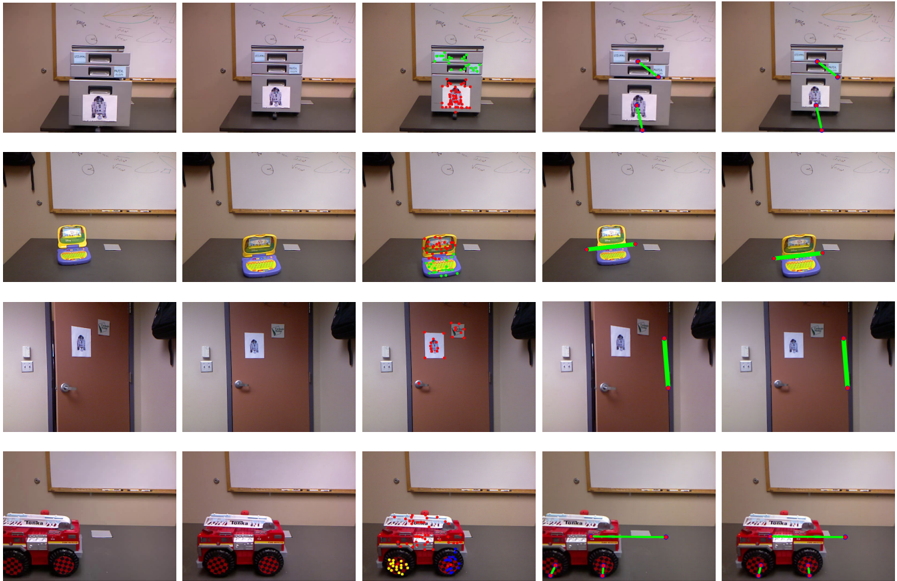
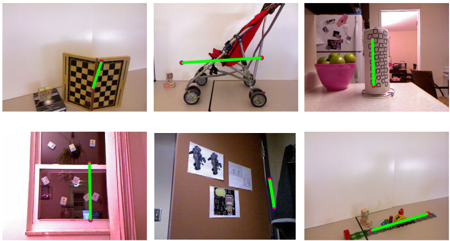
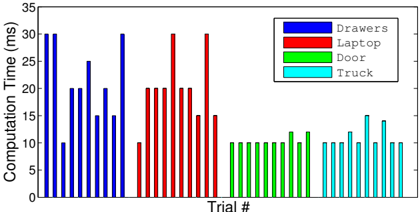
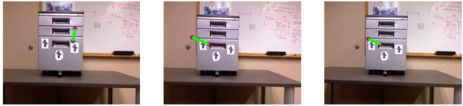
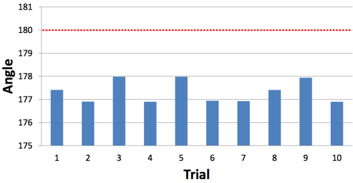
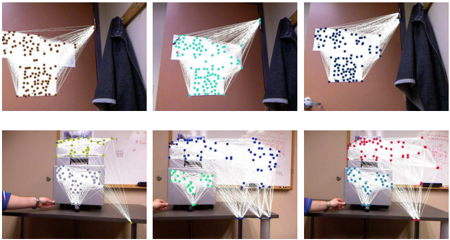
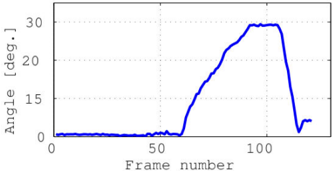
Verification
Claims the paper makes
The claims and statistics of this paper haven’t been checked yet.
Free: it reads the open-access text and checks the first 5 claims that cite a source we can check. Create a free account to check every claim.
Claims other papers make about this one
Each is checked against this paper’s own text: does it say what the citing paper says it does?
The source backs part of the claim, not all of it — or backs it for a different population, condition or comparison.
In the citing paper
“Katz et al. [18] is the pioneer work that introduces interactive perception [2] for articulation model estimation.”
From Ditto in the House: Building Articulation Models of Indoor Scenes through Interactive Perception (2023) · cites this paper as [18]
Experimental — accuracy not yet measured
Self-check
Percentages, sums and reported differences re-computed from the paper’s own numbers.
The self-check needs the paper’s full text.
Citations
Cites
Distinctive Image Features from Scale-Invariant Keypoints
Lowe, D. G. (2004) · International Journal of Computer Vision · doi:10.1023/b:visi.0000029664.99615.94 · Cited by 55,589
(1981) · Cited by 11,963
Least-Squares Fitting of Two 3-D Point Sets
Arun, K. S., Huang, T. S., & Blostein, S. D. (1987) · IEEE Transactions on Pattern Analysis and Machine Intelligence · doi:10.1109/tpami.1987.4767965 · Cited by 3,952 · cited 1×
“To handle measurement noise, we find the optimal transformation by solving a least square minimization problem using singular value decomposition (SVD) [2].”
MethodComputer Vision: A Modern Approach
Forsyth, D. A., & Ponce, J. (2002) · Cited by 3,739
Blake, A., & Yuille, A. (1993) · Cited by 1,383
Aloimonos, J., Weiss, I., & Bandyopadhyay, A. (1988) · International Journal of Computer Vision · doi:10.1007/bf00133571 · Cited by 931 · cited 1×
“Existing segmentation methods typically analyze a single image, identifying discontinuities in color, brightness, texture, or depth [1], [4].”
BackgroundManipulating articulated objects with interactive perception
Katz, D., & Brock, O. (2008) · 2008 IEEE International Conference on Robotics and Automation · doi:10.1109/robot.2008.4543220 · Cited by 135 · cited 2×
“[5], [7] extract kinematic models of planar articulated objects.”
BackgroundSelf-citationInteractive segmentation for manipulation in unstructured environments
Kenney, J., Buckley, T., & Brock, O. (2009) · 2009 IEEE International Conference on Robotics and Automation · doi:10.1109/robot.2009.5152393 · Cited by 99 · cited 1×
“These algorithms [3], [8] rely on the robot’s body to generate motion, thereby revealing a visual signal which can be analyzed to segment the moving rigid bodies.”
BackgroundFirst contact: an active vision approach to segmentation
Fitzpatrick, P. (2004) · IEEE/RSJ International Conference on Intelligent Robots and Systems (IROS) · doi:10.1109/iros.2003.1249191 · Cited by 77 · cited 1×
“These algorithms [3], [8] rely on the robot’s body to generate motion, thereby revealing a visual signal which can be analyzed to segment the moving rigid bodies.”
BackgroundKatz, D., Pyuro, Y., & Brock, O. (2008) · Robotics: Science and Systems IV · doi:10.15607/rss.2008.iv.033 · Cited by 70 · cited 5×
“These interactions can also be random (not efficient), or better: learned from experience [7].”
BackgroundMethodInfluentialSelf-citation
Cited by
Category-Level Articulated Object Pose Estimation
Li, X., Wang, H., Yi, L., Guibas, L. J., Abbott, A. L., & Song, S. (2020) · 2020 IEEE/CVF Conference on Computer Vision and Pattern Recognition (CVPR) · doi:10.1109/cvpr42600.2020.00376 · Cited by 196
URDFormer: A Pipeline for Constructing Articulated Simulation Environments from Real-World Images
Chen, Q., Walsman, A., Memmel, M., Mo, K., Fang, A., Fox, D., & Gupta, A. (2024) · Robotics: Science and Systems · doi:10.15607/rss.2024.xx.124 · Cited by 146
Fast odometry and scene flow from RGB-D cameras based on geometric clustering
Jaimez, M., Kerl, C., González-Jiménez, J., & Cremers, D. (2017) · Proceedings - IEEE International Conference on Robotics and Automation/Proceedings · doi:10.1109/icra.2017.7989459 · Cited by 132
“In general, these methods cannot provide a dense scene flow, but there exist extensions to estimate the motion of multiple rigid objects [5].”
MethodScrewNet: Category-Independent Articulation Model Estimation From Depth Images Using Screw Theory
Jain, A., Lioutikov, R., Chuck, C., & Niekum, S. (2021) · 2021 IEEE International Conference on Robotics and Automation (ICRA) · doi:10.1109/icra48506.2021.9561132 · Cited by 61
“Katz and Brock [21] first studied IP to learn articulated motion models for planar objects [21], and later extended it to learn 3D kinematics of articulated objects [22].”
BackgroundVAT-Mart: Learning Visual Action Trajectory Proposals for Manipulating 3D ARTiculated ObjectsPreprint
Wu, R., Zhao, Y. L., Mo, K., Guo, Z., Wang, Y., Wu, T., Fan, Q., Chen, X., Guibas, L. J., & Dong, H. (2021) · arXiv (Cornell University) · doi:10.48550/arxiv.2106.14440 · Cited by 113
“A vast literature (Yan & Pollefeys, 2006; Katz et al., 2008; Sturm et al., 2009; 2011; Huang et al., 2012; Katz et al., 2013; Martin & Brock, 2014; Höfer et al., 2014; Katz et al., 2014; Schmidt et al., 2014; Hausman et al., 2015; Martı́n-Martı́n et al., 2016; Tzionas & Gall, 2016; Paolillo et…”
BackgroundNeural Implicit Representation for Building Digital Twins of Unknown Articulated Objects
Weng, Y., Wen, B., Tremblay, J., Blukis, V., Fox, D., Guibas, L. J., & Birchfield, S. T. (2024) · IEEE Computer Society Conference on Computer Vision and Pattern Recognition/Proceedings - IEEE Computer Society Conference on Computer Vision and Pattern Recognition/Proceedings · doi:10.1109/cvpr52733.2024.00303 · Cited by 88
Active articulation model estimation through interactive perception
Hausman, K., Niekum, S., Osentoski, S., & Sukhatme, G. S. (2015) · 2015 IEEE International Conference on Robotics and Automation (ICRA) · doi:10.1109/icra.2015.7139655 · Cited by 77
Single-view robot pose and joint angle estimation via render & compare
Labbé, Y., Carpentier, J., Aubry, M., & Šivic, J. (2021) · IEEE Computer Society Conference on Computer Vision and Pattern Recognition/Proceedings - IEEE Computer Society Conference on Computer Vision and Pattern Recognition/Proceedings · doi:10.1109/cvpr46437.2021.00170 · Cited by 79
“The first class of methods aims at discovering properties of the kinematic chain through active manipulation [21, 22, 11, 36] using depth as input and unlike our approach cannot be applied to a single image.”
CLA-NeRF: Category-Level Articulated Neural Radiance Field
Tseng, W.-C., Liao, H.-J., Lin, Y.-C., & Sun, M. (2022) · Proceedings - IEEE International Conference on Robotics and Automation/Proceedings · doi:10.1109/icra46639.2022.9812272 · Cited by 74
Tangled: Learning to untangle ropes with RGB-D perception
Lui, W. H., & Saxena, A. (2013) · 2013 IEEE/RSJ International Conference on Intelligent Robots and Systems · doi:10.1109/iros.2013.6696448 · Cited by 71
“Although knot polynomials are knot-invariant, they are not useful for real-world manipulations because they do not allow us to identify useful manipulation points— they are mainly used for knot isomorphism between two rope configurations.”
BackgroundAct the Part: Learning Interaction Strategies for Articulated Object Part Discovery
Gadre, S. Y., Ehsani, K., & Song, S. (2021) · IEEE/CVF International Conference on Computer Vision (ICCV) · doi:10.1109/iccv48922.2021.01546 · Cited by 65
“In traditional pipelines, agents are carefully programmed to execute informative actions to facilitate visual feature tracking [42, 21, 34].”
BackgroundScrewNet: Category-Independent Articulation Model Estimation From Depth Images Using Screw Theory
Jain, A., Lioutikov, R., Chuck, C., & Niekum, S. (2020) · arXiv · doi:10.48550/arxiv.2008.10518 · Cited by 63
“Katz and Brock [21] first studied IP to learn articulated motion models for planar objects [21], and later extended it to learn 3D kinematics of articulated objects [22].”
BackgroundReal2Code: Reconstruct Articulated Objects via Code Generation
Mandi, Z., Weng, Y., Bauer, D., & Song, S. (2025) · International Conference on Learning Representations · doi:10.48550/arxiv.2406.08474 · Cited by 62
“A common setup is to assume physical interactions on an object to infer its articulation information: classical sampling-based algorithms[24, 25] are proposed to estimate joint parameters based on sensory inputs from an object’s different configuration states; other learning-based methods train…”
BackgroundWhere2Explore: Few-shot Affordance Learning for Unseen Novel Categories of Articulated Objects
Ning, C., Wu, R., Lu, H., Mo, K., & Dong, H. (2023) · neural information processing systems · doi:10.52202/075280-0203 · Cited by 60
ArtGS: Building Interactable Replicas of Complex Articulated Objects via Gaussian Splatting
Liu, Y., Jia, B., Lu, R., Ni, J., Zhu, S. C., & Huang, S. (2025) · International Conference on Learning Representations · doi:10.48550/arxiv.2502.19459 · Cited by 63
“First, prediction-based methods estimate joint parameters from sensory inputs of different object configurations (Huang et al., 2014; Katz et al., 2013) or use end-to-end models (Hu et al., 2017; Yi et al., 2018; Li et al., 2020; Wang et al., 2019; Sun et al., 2023; Liu et al., 2022b; Weng et al.,…”
Martin Martin, R., & Brock, O. (2014) · 2014 IEEE/RSJ International Conference on Intelligent Robots and Systems · doi:10.1109/iros.2014.6942902 · Cited by 55
“Subsequently, this method was adapted for RGB-D sensors [15].”
MethodErsen, M., Öztop, E., & Sarıel, S. (2017) · IEEE Robotics & Automation Magazine · doi:10.1109/mra.2016.2616538 · Cited by 55
Sung, J., Jin, S. H., & Saxena, A. (2018) · Springer Proceedings in Advanced Robotics · doi:10.1007/978-3-319-60916-4_40 · Cited by 52
“Manipulating new instances of objects relies on finding articulation [50, 39] or using interaction [23] but requires tracking with a vision algorithm.”
BackgroundCoupled recursive estimation for online interactive perception of articulated objects
Martín-Martín, R., & Brock, O. (2019) · The International Journal of Robotics Research · doi:10.1177/0278364919848850 · Cited by 51
“Later on, this method was adapted to analyze RGB-D sequences (Katz et al. 2013).”
MethodLearning Articulated Motions From Visual Demonstration
Pillai, S., Walter, M., & Teller, S. (2014) · Robotics: Science and Systems X · doi:10.15607/rss.2014.x.050 · Cited by 39
“Like other feature-based methods [14] our method requires visual texture.”
MethodInfluentialStructure from Action: Learning Interactions for 3D Articulated Object Structure Discovery
Nie, N., Gadre, S. Y., Ehsani, K., & Song, S. (2023) · IEEE/RSJ International Conference on Intelligent Robots and Systems (IROS) · doi:10.1109/iros55552.2023.10342135 · Cited by 40
“Classical approaches use hand-tuned actions to create informative motion for down-stream perception [44], [19], [36].”
BackgroundHand-Eye Calibration of Surgical Instrument for Robotic Surgery Using Interactive Manipulation
Zhong, F., Wang, Z., Chen, W., He, K., Wang, Y., & Liu, Y. (2020) · IEEE Robotics and Automation Letters · doi:10.1109/lra.2020.2967685 · Cited by 37
“It has been widely applied to robot manipulation tasks involving physical interactions with the environment [35], [36].”
BackgroundSaliency-based object discovery on RGB-D data with a late-fusion approach
García, G. M., Potapova, E., Werner, T. A., Zillich, M., Vincze, M., & Frintrop, S. (2015) · Proceedings - IEEE International Conference on Robotics and Automation/Proceedings · doi:10.1109/icra.2015.7139441 · Cited by 30
“Other researches [16],[28] used interaction with the scene do detect objects as parts of the space that are moving together when pushed or carried around.”
BackgroundNothing But Geometric Constraints: A Model-Free Method for Articulated Object Pose EstimationPreprint
Liu, Q., Qiu, W., Wang, W., Hager, G. D., & Yuille, A. (2020) · arXiv (Cornell University) · doi:10.48550/arxiv.2012.00088 · Cited by 30
“One line of work uses a robot manipulator to interact with the articulated objects, then use the 3D points to infer the pose[18, 17, 26].”
BackgroundBrock, O., Park, J., & Toussaint, M. (2016) · Springer handbooks · doi:10.1007/978-3-319-32552-1_40 · Cited by 27
Haptic Perception of Liquids Enclosed in Containers
Matl, C., Matthew, R. P., & Bajcsy, R. K. (2019) · IEEE/RSJ International Conference on Intelligent Robots and Systems (IROS) · doi:10.1109/iros40897.2019.8968528 · Cited by 27
“It has been shown that for objects in this class, such as articulated objects, [20, 21], direct interactions can allow robots to exploit the object’s kinematics and dynamics to improve model information.”
BackgroundReconstructing Articulated Rigged Models from RGB-D Videos
Tzionas, D., & Gall, J. (2016) · Lecture notes in computer science · doi:10.1007/978-3-319-49409-8_53 · Cited by 26
“An early approach [16] uses sparse KLT and SIFT features and groups consistent 3D trajectories with a greedy approach.”
BackgroundMethodLi, Y., Zhang, X., Wu, R., Zhang, Z., Geng, Y., Dong, H., & He, Z. (2026) · Proceedings - IEEE International Conference on Robotics and Automation/Proceedings · doi:10.1109/icra57385.2026.11696858 · Cited by 25
“I. DoorGym [1] claims a large-scale and scalable dataset specifically for door manipulation.”
Sequence-level object candidates based on saliency for generic object recognition on mobile systems
Horbert, E., García, G. M., Frintrop, S., & Leibe, B. (2015) · Proceedings - IEEE International Conference on Robotics and Automation/Proceedings · doi:10.1109/icra.2015.7138990 · Cited by 24
Multi-sensory Feedback Control in Door Approaching and Opening
Winiarski, T., Banachowicz, K., & Seredyński, D. (2014) · Advances in intelligent systems and computing · doi:10.1007/978-3-319-11310-4_6 · Cited by 23
Estimating Mass Distribution of Articulated Objects using Non-prehensile ManipulationPreprint
Kumar, K. N., Essa, I. A., Ha, S., & Liu, C. K. (2019) · arXiv (Cornell University) · doi:10.48550/arxiv.1907.03964 · Cited by 25
“For example, the degrees of freedom and the range of motion of an articulated rigid body system can be identified from videos of motion [24, 25], or from a robot actively interacting with the object [26, 27, 28].”
BackgroundDitto in the House: Building Articulation Models of Indoor Scenes through Interactive Perception
Hsu, C.-C., Jiang, Z., & Zhu, Y. (2023) · 2023 IEEE International Conference on Robotics and Automation (ICRA) · doi:10.1109/icra48891.2023.10161431 · Cited by 21
“[18] is the pioneer work that introduces interactive perception [2] for articulation model estimation.”
BackgroundLearning Hybrid Object Kinematics for Efficient Hierarchical Planning Under Uncertainty
Jain, A., & Niekum, S. (2020) · IEEE/RSJ International Conference on Intelligent Robots and Systems (IROS) · doi:10.1109/iros45743.2020.9340749 · Cited by 21
“it to use RGB-D data to learn 3D kinematics of articulated objects [18].”
MethodSPLART: Articulation Estimation and Part-Level Reconstruction with 3D Gaussian Splatting
Lin, S., Fang, J., Irshad, M. Z., Guizilini, V., Ambruş, R., Shakhnarovich, G., & Walter, M. R. (2025) · IEEE/CVF International Conference on Computer Vision (ICCV) · doi:10.1109/iccv51701.2025.00827 · Cited by 22
“…objects, such as drawers, doors, and scissors, are ubiquitous in our daily lives, yet their dynamic nature poses significant challenges for 3D reconstruction— a critical task for applications in augmented/virtual reality [36, 51], robotics [1, 5, 16, 24, 50, 57], and computer vision [20, 45].”
Rethinking Click Embedding for Deep Interactive Image Segmentation
Ding, Z., Wang, T., Sun, Q., & Chen, F. (2022) · IEEE Transactions on Industrial Informatics · doi:10.1109/tii.2022.3157319 · Cited by 20
“this approach has been widely used in many industrial tasks, such as surface defect detection [1], object tracking [2], change detection [3], robot vision [4], and automatic inspection [5].”
MethodEfficient Optimization for Autonomous Robotic Manipulation of Natural Objects
Boularias, A., Bagnell, J. A., & Stentz, A. (2014) · Proceedings of the AAAI Conference on Artificial Intelligence · doi:10.1609/aaai.v28i1.9052 · Cited by 20
“We used the approach of (Katz et al. 2013) in order to segment the clutter into facets (curved 3-D rectangles) defined by their centers and principal and secondary axis.”
MethodResultInfluentialSelf-citationLearning Articulated Motions From Visual DemonstrationPreprint
Pillai, S., Walter, M. R., & Teller, S. J. (2015) · arXiv (Cornell University) · doi:10.48550/arxiv.1502.01659 · Cited by 18
“Like other feature-based methods [14] our method requires visual texture.”
MethodInfluentialAction Selection for Interactive Object Segmentation in Clutter
Patten, T., Zillich, M., & Vincze, M. (2018) · IEEE/RSJ International Conference on Intelligent Robots and Systems (IROS) · doi:10.1109/iros.2018.8593918 · Cited by 17
“Many methods, however, are passive with respect to the segmentation task as actions are pre-planned according to expected object kinematics [6], [7] or any action expected to move an object hypothesis is chosen [8], [9], [10], [11], [12].”
BackgroundDistributional Depth-Based Estimation of Object Articulation ModelsPreprint
Jain, A., Giguere, S., Lioutikov, R., & Niekum, S. (2021) · arXiv (Cornell University) · doi:10.48550/arxiv.2108.05875 · Cited by 17
“Interactive perception (IP): Katz and Brock [3] introduced IP as a method to leverage a robot’s interaction with objects to generate a rich perceptual signal for articulation model estimation for planar objects, and extended it to learn 3D articulation models for objects [4].”
MethodRobot–Camera Calibration in Tightly Constrained Environment Using Interactive Perception
Zhong, F., Li, B., Chen, W., & Liu, Y. (2023) · IEEE Transactions on Robotics · doi:10.1109/tro.2023.3299533 · Cited by 16
CAPT: Category-level Articulation Estimation from a Single Point Cloud Using Transformer
Fu, L., Ishikawa, R., Sato, Y., & Oishi, T. (2024) · Proceedings - IEEE International Conference on Robotics and Automation/Proceedings · doi:10.1109/icra57147.2024.10611073 · Cited by 15
“Interaction methods provide sufficient dynamic information for articulation estimation, as made clear in numerous studies [5] in the observations before and after the interaction to help estimate an initial guess of the articulation model [9] or build up an implicit neural-representation of the…”
MethodKinematic Structure Correspondences via Hypergraph Matching
Chang, H. J., Fischer, T., Petit, M., Zambelli, M., & Demiris, Y. (2016) · IEEE Computer Society Conference on Computer Vision and Pattern Recognition/Proceedings - IEEE Computer Society Conference on Computer Vision and Pattern Recognition/Proceedings · doi:10.1109/cvpr.2016.457 · Cited by 15
“Building kinematic structures of articulated objects from visual input data is an active research topic in computer vision and robotics [27, 11, 17, 3].”
BackgroundMethodLearning Articulated Constraints From a One-Shot Demonstration for Robot Manipulation Planning
Liu, Y., Zha, F., Sun, L., Li, J., Li, M., & Wang, X. (2019) · IEEE Access · doi:10.1109/access.2019.2953894 · Cited by 15
“[23], [24] perceive the three-dimensional kinematic structure of the articulated objects through interaction.”
BackgroundRobobarista: Learning to Manipulate Novel Objects via Deep Multimodal EmbeddingPreprint
Sung, J., Jin, S. H., Lenz, I., & Saxena, A. (2016) · arXiv (Cornell University) · doi:10.48550/arxiv.1601.02705 · Cited by 15
“For the more general task of manipulating new instances of objects, previous approaches rely on finding articulation [58, 50] or using interaction [29], but they are limited by tracking performance of a vision algorithm.”
MethodSpotLight: Robotic Scene Understanding Through Interaction and Affordance Detection
Engelbracht, T., Zurbrügg, R., Pollefeys, M., Blum, H., & Bauer, Z. (2025) · IEEE-RAS International Conference on Humanoid Robots (Humanoids) · doi:10.1109/humanoids65713.2025.11203097 · Cited by 14
A Multiview Approach to Learning Articulated Motion Models
Daniele, A. F., Howard, T. M., & Walter, M. R. (2019) · Springer proceedings in advanced robotics · doi:10.1007/978-3-030-28619-4_30 · Cited by 14
“Table 1 provides a summary that compares the performance of our multimodal learning method against that of the vision-only baseline [39], which the authors have previously compared favorably to alternative state-of-theart formulations [23].”
BackgroundMethodResultInfluentialOcclusion-aware multi-view reconstruction of articulated objects for manipulation
Huang, X., Walker, I. D., & Birchfield, S. T. (2013) · Robotics and Autonomous Systems · doi:10.1016/j.robot.2013.12.006 · Cited by 15
Learning Kinematic Structure Correspondences Using Multi-Order Similarities
Chang, H. J., Fischer, T., Petit, M., Zambelli, M., & Demiris, Y. (2017) · IEEE Transactions on Pattern Analysis and Machine Intelligence · doi:10.1109/tpami.2017.2777486 · Cited by 14
“Some application areas are learning by imitation [4], human motion retargeting to robots [5], [6], human action recognition from different sensors [7], behaviour discovery and alignment [8], affordance based object/tool categorisation [9], body scheme learning for robotic manipulators [10], and articulated object mani…”
BackgroundMethodHighly Articulated Kinematic Structure Estimation Combining Motion and Skeleton Information
Chang, H. J., & Demiris, Y. (2017) · IEEE Transactions on Pattern Analysis and Machine Intelligence · doi:10.1109/tpami.2017.2748579 · Cited by 13
“This information is beneficial to many higher level tasks such as human action recognition [2], body scheme learning for robotic manipulators [3], articulated objects kinematics recognition and manipulation [4], and finding kinematic correspondences between articulated objects [5].”
BackgroundBimanual folding assembly: Switched control and contact point estimation
Almeida, D., Vina, F., & Karayiannidis, Y. (2016) · IEEE-RAS International Conference on Humanoid Robots (Humanoids) · doi:10.1109/humanoids.2016.7803279 · Cited by 12
“Vision alone is usually not sufficient for effective manipulation, and interactive perception techniques may be used to improve results [12], [13].”
BackgroundMartín-Martín, R., & Brock, O. (2017) · National Conference on Artificial Intelligence · Cited by 12
Interaction-Driven Active 3D Reconstruction with Object Interiors
Yan, Z., Su, F., Wang, M., Hu, R., Zhang, H., & Huang, H. F. (2023) · ACM Transactions on Graphics · doi:10.1145/3618327 · Cited by 11
“Katz et al. [2013] present an interactive perceptual skill for segmenting, tracking, and modeling the kinematic structure of 3D articulated objects.”
BackgroundSimultaneous Drone Localisation and Wind Turbine Model Fitting During Autonomous Surface Inspection
Moolan-Feroze, O., Karachalios, K., Nikolaidis, D., & Calway, A. D. (2019) · IEEE/RSJ International Conference on Intelligent Robots and Systems (IROS) · doi:10.1109/iros40897.2019.8968247 · Cited by 11
“[12] also make use of a kinematic chain, extracting and tracking visual features as a robot is interacting with articulated objects.”
BackgroundTask-oriented planning for manipulating articulated mechanisms under model uncertainty
Narayanan, V., & Likhachev, M. A. (2015) · Proceedings - IEEE International Conference on Robotics and Automation/Proceedings · doi:10.1109/icra.2015.7139624 · Cited by 11
“The same group extended their work to handle identification of 3D articulated objects in [8].”
BackgroundKineverse: A Symbolic Articulation Model Framework for Model-Agnostic Mobile Manipulation
Rofer, A., Bartels, G., Burgard, W., Valada, A., & Beetz, M. (2022) · IEEE Robotics and Automation Letters · doi:10.1109/lra.2022.3146515 · Cited by 10
Cooperative Manipulation and Identification of a 2-DOF Articulated Object by a Dual-Arm Robot
Almeida, D., & Karayiannidis, Y. (2018) · Proceedings - IEEE International Conference on Robotics and Automation/Proceedings · doi:10.1109/icra.2018.8460511 · Cited by 10
“Interactive perception algorithms are a possible approach to determine the kinematics of articulated objects [2], [6]–[8].”
BackgroundArticulated pose estimation using tangent space approximations
Brookshire, J., & Teller, S. J. (2015) · The International Journal of Robotics Research · doi:10.1177/0278364915598850 · Cited by 9
“Katz et al. (2012) also give a method to recover the DOFs of an articulated system.”
MethodArticulated Pose Estimation via Over-parametrization and Noise Projection
Brookshire, J., & Teller, S. J. (2014) · Robotics: Science and Systems · doi:10.15607/rss.2014.x.009 · Cited by 9
“Sturm [13] and Katz [11] demonstrate a prior estimation process, recovering the kinematic model of an unknown object while observing and/or manipulating it.”
BackgroundHierarchical object discovery and dense modelling from motion cues in RGB-D video
Stückler, J., & Behnke, S. (2013) · OPUS (Augsburg University) · Cited by 9
Kim, Y., Lim, H., Ahn, S. C., & Kim, A. (2016) · IEEE/RSJ International Conference on Intelligent Robots and Systems (IROS) · doi:10.1109/iros.2016.7759184 · Cited by 8
“Like ours, [21] analyzed articulated motion but only categorized motions into two types: prismatic and revolute joint motion.”
BackgroundMethodInfluentialSpatiotemporal Articulated Models for Dynamic SLAMPreprint
Kumar, S., Dhiman, V., Ganesh, M. R., & Corso, J. J. (2016) · arXiv (Cornell University) · doi:10.48550/arxiv.1604.03526 · Cited by 8
“With the introduction of the commercial depth camera, the feature trajectories could be directly represented in 3D and thus avoiding the need to estimate shape [20, 13].”
BackgroundTransfer of Tool Affordance and Manipulation Cues with 3D Vision DataPreprint
Abelha, P., & Guérin, F. (2017) · arXiv (Cornell University) · doi:10.48550/arxiv.1710.04970 · Cited by 8
“This is a complex problem and involves learning and dealing with different kinematic models and representations [24, 39, 23].”
BackgroundOta, K., Tung, H.-Y. F., Smith, K. A., Cherian, A., Marks, T. K., Sullivan, A., Kanezaki, A., & Tenenbaum, J. B. (2023) · Proceedings - IEEE International Conference on Robotics and Automation/Proceedings · doi:10.1109/icra48891.2023.10160575 · Cited by 7
“Previous work address this by proposing to visually parse articulated objects under motion [13], [14], [15], [16], [17], [18].”
Shi, Y., Tao, Y., Yang, M., Liu, Y., Yi, L., & Zhou, B. (2024) · IEEE Transactions on Visualization and Computer Graphics · doi:10.1109/tvcg.2024.3400830 · Cited by 6
“Early approaches [32], [33] relied on manipulating an articulated object to infer its motion, such as using RGB-D videos Authorized licensed use limited to the terms of the applicable license agreement with IEEE.”
Reconstructing Articulated Rigged Models from RGB-D VideosPreprint
Tzionas, D., & Gall, J. (2016) · arXiv (Cornell University) · doi:10.48550/arxiv.1609.01371 · Cited by 6
“An early approach [16] uses sparse KLT and SIFT features and groups consistent 3D trajectories with a greedy approach.”
BackgroundMethodKinScene: Model-Based Mobile Manipulation of Articulated ScenesPreprint
Hsu, C.-C., Abbatematteo, B., Jiang, Z., Zhu, Y., Martín-Martín, R., & Biswas, J. (2024) · arXiv (Cornell University) · doi:10.48550/arxiv.2409.16473 · Cited by 6
“To accurately perceive that, the robot must generate motion actuating each degree of freedom [18, 23, 29].”
BackgroundDu, Y., Wu, R., Shen, Y., & Dong, H. (2023) · arXiv (Cornell University) · doi:10.48550/arxiv.2311.12407 · Cited by 5
“…have been investigating the perception of 3D articulated objects, including discovering articulated parts [7, 10, 28], inferring kinematic models [1, 16], estimating joint configurations [5, 12, 18, 19], predicting part poses [36, 41], building digital twins [14] and manipulating parts [40].”
Articulated Objects: From Detection to Manipulation—Survey
Pejić, P., Šimundić, V., Džijan, M., & Cupec, R. (2023) · Lecture notes in networks and systems · doi:10.1007/978-3-031-22216-0_34 · Cited by 4
Grasp synthesis of 3D articulated objects with n links
Tovar, N. A., & Suárez, R. (2016) · IEEE International Conference on Emerging Technologies and Factory Automation (ETFA) · doi:10.1109/etfa.2016.7733736 · Cited by 4
“These works used different approaches, such as interactive perception [24] [25] or occlusion-aware systems [26].”
MethodKinematic Structure Estimation of Arbitrary Articulated Rigid Objects for Event Cameras
Nunes, U. M., & Demiris, Y. (2022) · Proceedings - IEEE International Conference on Robotics and Automation/Proceedings · doi:10.1109/icra46639.2022.9812430 · Cited by 4
3D motion segmentation of articulated rigid bodies based on RGB-D data
Nunes, U. M., & Demiris, Y. (2018) · Spiral (Imperial College London) · Cited by 4
Object Learning through Interactive Manipulation and Foveated Vision
Bevec, R., & Ude, A. (2013) · IEEE-RAS International Conference on Humanoid Robots (Humanoids) · doi:10.1109/humanoids.2013.7029981 · Cited by 4
“depth sensors to segment objects from the scene [7], [9], [17], [11], [12], [18].”
BackgroundBuilding object models through interactive perception and foveated vision
Bevec, R., & Ude, A. (2015) · Advanced Robotics · doi:10.1080/01691864.2015.1028999 · Cited by 3
“All other feature matches from the point cloud, i.e. features from the point cloud that do not belong to the hypothesis, are also checked for rigid body motion as in Equation (8).”
MethodPushing and grasping for autonomous learning of object models with foveated vision
Bevec, R., & Ude, A. (2015) · International Conference on Advanced Robotics (ICAR) · doi:10.1109/icar.2015.7251462 · Cited by 3
“Pushing objects can also lead to the discovery of kinematic models of articulated objects [14], [15], or object affordances [16].”
BackgroundPokeNet: Learning Kinematic Models of Articulated Objects from Human Observations
Gupta, A., Gu, W., Patil, O., Lee, J. K., & Gopalan, N. (2026) · Proceedings - IEEE International Conference on Robotics and Automation/Proceedings · doi:10.1109/icra57385.2026.11697118 · Cited by 2
“Interactive perception approaches [17], [18], [19], [20] involve robot-driven exploration to estimate articulation.”
Extracting Contact and Motion from Manipulation VideosPreprint
Zampogiannis, K., Ganguly, K., Fermuller, C. M., & Aloimonos, Y. (2018) · arXiv (Cornell University) · doi:10.48550/arxiv.1807.04870 · Cited by 2
“In [36], an active approach for the segmentation and kinematic modeling of articulated objects is proposed, which relies on the robot manipulation capabilities to induce object motion.”
Kinematic evaluation of articulated rigid objects
Burlacu, A., Condurache, D., & Clim, E. (2014) · International Conference on System Theory, Control and Computing (ICSTCC) · doi:10.1109/icstcc.2014.6982411 · Cited by 1
“In [11] they presented an improved version of the algorithm.”
BackgroundDiscovering Articulations by Touch: A Human Study for Robotics Applications
Leontie, R., & Drumwright, E. (2018) · Lecture notes in computer science · doi:10.1007/978-3-319-93445-7_25 · Cited by 1
Unsupervised 3D Link Segmentation of Articulated Objects With a Mixture of Coherent Point Drift
Choy, J., Cha, G., & Oh, S. (2022) · IEEE Robotics and Automation Letters · doi:10.1109/lra.2022.3180444 · Cited by 1
Learning Kinematic Descriptions using SPARE: Simulated and Physical ARticulated Extendable datasetPreprint
Venkataraman, A., Griffin, B., & Corso, J. J. (2018) · arXiv (Cornell University) · doi:10.48550/arxiv.1803.11147 · Cited by 1
“More specifically, learning the kinematic descriptions of objects by observation is particularly useful for general manipulation in unstructured environments [5].”
BackgroundMethodArticulated Motion Learning via Visual and Lingual SignalsPreprint
Wu, Z., Bansal, M., & Walter, M. R. (2015) · arXiv (Cornell University)
Learning Articulated Motion Models from Visual and Lingual SignalsPreprint
Wu, Z., Bansal, M., & Walter, M. R. (2015) · arXiv (Cornell University) · doi:10.48550/arxiv.1511.05526
“Katz et al. [3] improve upon the complexity of this method while preserving the accuracy of the inferred models.”
MethodInferring Robot Morphology from Observation of Unscripted Movement
Bell, N., Seipp, B., Oates, J. T., & Matuszek, C. (2019) · Proceedings - IEEE International Conference on Robotics and Automation/Proceedings · doi:10.1109/icra.2019.8794211
“We attempt to expand on similar research into scripted movement of arbitrary structures by simulating semi-random movement of randomly generated robots [35].”
BackgroundZampogiannis, K., Ganguly, K., Fermuller, C. M., & Aloimonos, Y. (2020) · Springer eBooks · doi:10.1007/978-3-030-46732-6_9
Röfer, A., Bartels, G., & Beetz, M. (2020) · arXiv (Cornell University)
Annotation scaffolds for manipulating articulated objects
Frank-Bolton, P., Leontie, R., Drumwright, E., & Simha, R. (2021) · Autonomous Robots · doi:10.1007/s10514-021-09983-8
“…in pick-and place-tasks (Jiang et al. 2012; Dragan andSrinivasa2012),orinferringarticulationparametersfrom human demonstrations and applying the obtained insights to robotic manipulation (Sturm et al. 2010; Sturm 2013; Katz et al. 2013; Hausman et al. 2015; Pillai et al. 2015; Huang et al. 2014).”
BackgroundMatsuzaki, S., Masuzawa, H., & Miura, J. (2022) · Conference proceedings/Conference proceedings - IEEE International Conference on Systems, Man, and Cybernetics · doi:10.1109/smc53654.2022.9945283
“In the field of robotics, many studies have proposed to leverage the robots’ active interaction with objects to achieve information, which is not available in passive observation [11, 12, 13].”
BackgroundPerceived Constraint Identification Using Physics-Informed Deep Neural Networks
Kim, R., Stahoviak, C., Young, C. C., & Slightam, J. E. (2025) · ASME Letters in Dynamic Systems and Control · doi:10.1115/1.4069647
Learning Sequential Kinematic Models from Demonstrations for Multi-Jointed Articulated ObjectsPreprint
Gupta, A., Gu, W., Patil, O. R., Lee, J. K., & Gopalan, N. (2025) · arXiv (Cornell University) · doi:10.48550/arxiv.2505.06363
“Interactive methods [8], [9], [10], [11] depend on textured objects and simple actions, limiting applicability in unstructured environments.”
Query-Conditioned Articulation Estimation from a Single ImagePreprint
Werby, A., Scaparro, F., & Arra, K. O. (2026) · arXiv (Cornell University) · doi:10.48550/arxiv.2610.01726
“Interactive-perception systems obtain this motion by manipulating the object themselves [28]–[30], which Ditto in the House [31] scales to room-scale scenes, while factor-graph formulations [32], [33] track articulated parts online and fuse visual with proprioceptive measurements.”
Constraint-Decomposed Impedance Control from Generative Policy for Articulated Object ManipulationPreprint
Park, K., 임병도, Lim, J., Choi, M., & Park, F. C. (2026) · arXiv (Cornell University) · doi:10.48550/arxiv.2610.16316
Metadata
- Authors
- Katz, D., Kazemi, M., Andrew Bagnell, J., & Stentz, A.
- Affiliations
- Carnegie Mellon University (US)
- Venue
- 2013 IEEE International Conference on Robotics and Automation
- Publisher
- IEEE
- Published
- 2013-05
- Pages
- 5003-5010
- ISSN
- 1050-4729 (ISSN-L)
- OpenAlex
- W2159461149
- Cited by
- 74
- References
- 17
- Citations by year
- 2025: 1 · 2024: 3 · 2023: 6 · 2022: 6 · 2021: 6 · 2020: 6 · 2019: 7 · 2018: 5 · 2017: 7 · 2016: 7 · 2015: 10 · 2014: 6 · 2013: 4
- FWCI
- 12.29
- Type
- conference paper
- Language
- en
- Open access
- green
- figshare.com
- Licence
- cc-by
- Locations
- Proceedings - IEEE International Conference on Robotics and Automation/Proceedings (publishedVersion)
- Figshare (submittedVersion, cc-by)
- KiltHub Repository (submittedVersion)
- KiltHub Repository
- Funders
- Defense Advanced Research Projects Agency
- Army Research Laboratory (W911NF, W911NF-10-2-0016)
- Topics
- Physical Sciences › Engineering › Control and Systems Engineering › Robot Manipulation and Learning
- Physical Sciences › Computer Science › Computer Graphics and Computer-Aided Design › 3D Shape Modeling and Analysis
- Physical Sciences › Computer Science › Computer Vision and Pattern Recognition › Advanced Vision and Imaging
- Keywords
- interactive segmentation, object tracking, kinematic modeling, articulated objects, robotic manipulation, unknown object, RGB-D sensing, visual feature tracking, partial occlusion, robot-environment interaction, perceptual skills
About these checks
Registry, retraction, Cites and statistics results are computed, not judged, with one exception: a printed reference that no index lists is read once by a model before it counts as a citation error. Claims are extracted by a model and kept only when their quote appears verbatim in the text; each cited source is then checked, with a model’s help, for whether it says what the claim relies on. Those verdicts can be wrong — read the claim’s quote and the cited source before relying on one.
Statistics and arithmetic are recomputed, not judged.
Confidence bands are shown only for fields calibrated on our annotated test set. None is calibrated yet, so no band is shown.
What counts as a claim ›How we measure confidence ›How we check this ›
Are you an author, or do you see a problem with this page? Request a review
Data sources
Bibliographic data: Semantic Scholar, OpenAlex, Crossref.
Contains information from the Semantic Scholar Academic Graph Datasets, made available under the ODC Attribution License (ODC-BY 1.0).
Semantic Scholar’s data is described in: Kinney, R., et al. (2023). The Semantic Scholar Open Data Platform. arXiv:2301.10140.
