

Video-Based Activity Recognition for Automated Motor Assessment of Parkinson's Disease
Open accessPublished version of a preprint
The DOI matches its Crossref record; 34 of the 34 references it cites were found in a registry or an index.
Abstract
Over the last decade, video-enabled mobile devices have become ubiquitous, while advances in markerless pose estimation allow an individual's body position to be tracked accurately and efficiently across the frames of a video. Previous work by this and other groups has shown that pose-extracted kinematic features can be used to reliably measure motor impairment in Parkinson's disease (PD). This presents the prospect of developing an asynchronous and scalable, video-based assessment of motor dysfunction. Crucial to this endeavour is the ability to automatically recognise the class of an action being performed, without which manual labelling is required. Representing the evolution of body joint locations as a spatio-temporal graph, we implement a deep-learning model for video and frame-level classification of activities performed according to part 3 of the Movement Disorder Society Unified PD Rating Scale (MDS-UPDRS). We train and validate this system using a dataset of n = 7310 video clips, recorded at 5 independent sites. This approach reaches human-level performance in detecting and classifying periods of activity within monocular video clips. Our framework could support clinical workflows and patient care at scale through applications such as quality monitoring of clinical data collection, automated labelling of video streams, or a module within a remote self-assessment system.
Overview
The claims and statistics of this paper haven’t been checked yet.
Free: it reads the open-access text and checks the first 5 claims that cite a source we can check. Create a free account to check every claim.
Integrity signals
Registry
Cites
Statistics
Figures
Verification
Claims the paper makes
The claims and statistics of this paper haven’t been checked yet.
Free: it reads the open-access text and checks the first 5 claims that cite a source we can check. Create a free account to check every claim.
Claims other papers make about this one
Each is checked against this paper’s own text: does it say what the citing paper says it does?
The cited source doesn’t support the claim as written.
In the citing paper
“The other study [29] explored most Otago sub-exercises using different sensor combinations, as shown in Table VI.”
From DS-MS-TCN: Otago Exercises Recognition With a Dual-Scale Multi-Stage Temporal Convolutional Network (2024) · cites this paper as [29]
Checked by a reasoning model — may be wrong.
Experimental — accuracy not yet measuredThe cited source doesn’t support the claim as written.
In the citing paper
“When comparing the results using one IMU on the waist, the proposed system reported higher f1-scores, proving the advantages of the seq-to-seq DS-MS-TCN model.”
From DS-MS-TCN: Otago Exercises Recognition With a Dual-Scale Multi-Stage Temporal Convolutional Network (2024) · cites this paper as [29]
Checked by a reasoning model — may be wrong.
Experimental — accuracy not yet measuredThe source backs part of the claim, not all of it — or backs it for a different population, condition or comparison.
In the citing paper
“Compared with the previous study [29], the proposed system was validated in a less controlled environment focusing on older adults.”
From DS-MS-TCN: Otago Exercises Recognition With a Dual-Scale Multi-Stage Temporal Convolutional Network (2024) · cites this paper as [29]
Experimental — accuracy not yet measuredThe check wasn’t confident either way, so it gives no verdict — never disputed.
In the citing paper
“The previous study [29] reported lower f1-scores for chair rising because it was confused with knee bends .”
From DS-MS-TCN: Otago Exercises Recognition With a Dual-Scale Multi-Stage Temporal Convolutional Network (2024) · cites this paper as [29]
Experimental — accuracy not yet measured
Self-check
Percentages, sums and reported differences re-computed from the paper’s own numbers.
The self-check needs the paper’s full text.
Citations
Cites
Adam: A Method for Stochastic Optimization
Kingma, D. P., & Ba, J. (2014) · arXiv · doi:10.48550/arxiv.1412.6980 · Cited by 98,946 · cited 1×
“Thetraininggradient descent has been performed using the Adam [30] optimiser with an initial learning rate of 0.01.”
MethodInfluentialRethinking the Inception Architecture for Computer Vision
Szegedy, C., Vanhoucke, V., Ioffe, S., Shlens, J., & Wojna, Z. (2016) · 2016 IEEE Conference on Computer Vision and Pattern Recognition (CVPR) · doi:10.1109/cvpr.2016.308 · Cited by 32,138
On a Test of Whether one of Two Random Variables is Stochastically Larger than the Other
Mann, H. B., & Whitney, D. R. (1947) · The Annals of Mathematical Statistics · doi:10.1214/aoms/1177730491 · Cited by 14,320
Learning Spatiotemporal Features with 3D Convolutional Networks
Tran, D., Bourdev, L., Fergus, R., Torresani, L., & Paluri, M. (2015) · 2015 IEEE International Conference on Computer Vision (ICCV) · doi:10.1109/iccv.2015.510 · Cited by 9,593 · cited 1×
“Within vision-based HAR, two further subdivisions can be delineated: 1) Pixel-based activity recognition from a video stream [17], [18].”
BackgroundGoetz, C. G., Tilley, B. C., Shaftman, S. R., Stebbins, G. T., Fahn, S., Martinez‐Martin, P., Poewe, W., Sampaio, C., Stern, M. B., Dodel, R., et al. (2008) · Movement Disorders · doi:10.1002/mds.22340 · Cited by 7,536 · cited 1×
“Parkinson’s disease (PD) severity is often assessed using the Movement Disorder Society Unified PD Rating Scale (MDSUPDRS) [13].”
Method3D Convolutional Neural Networks for Human Action Recognition
Ji, S., Xu, W., Yang, M., & Yu, K. (2013) · IEEE Transactions on Pattern Analysis and Machine Intelligence · doi:10.1109/tpami.2012.59 · Cited by 6,235
OpenPose: Realtime Multi-Person 2D Pose Estimation Using Part Affinity Fields
Cao, Z., Hidalgo, G., Simon, T., Wei, S.-E., & Sheikh, Y. (2021) · IEEE Transactions on Pattern Analysis and Machine Intelligence · doi:10.1109/tpami.2019.2929257 · Cited by 5,536 · cited 4×
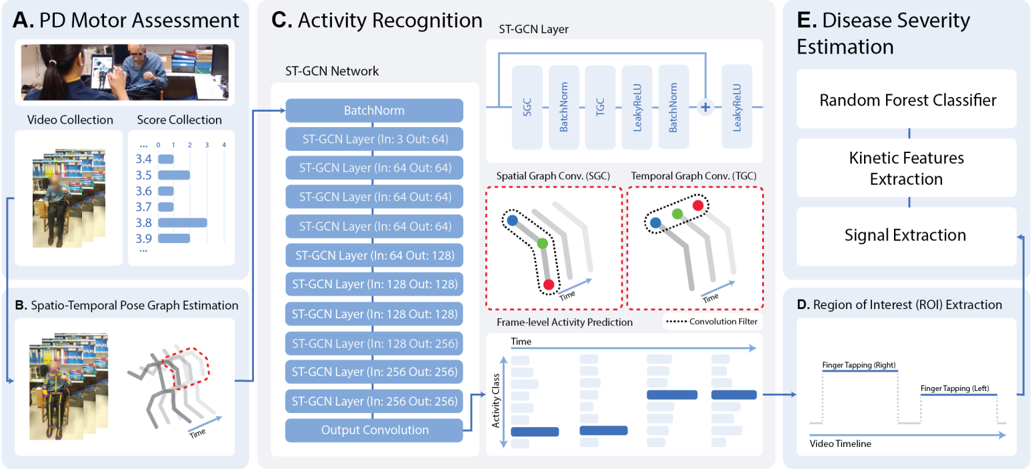
“(B ) A pose estimation library OpenPose is used to estimate the patient’s joint locations in each video frame and a spatio-temporal graph representation of the patient’s movement is created.”
MethodInfluentialSpatial Temporal Graph Convolutional Networks for Skeleton-Based Action Recognition
Yan, S., Xiong, Y., & Lin, D. (2018) · Proceedings of the AAAI Conference on Artificial Intelligence · doi:10.1609/aaai.v32i1.12328 · Cited by 5,410 · cited 2×
“An added benefit of many DL methods is the end-to-end learning and prediction setup, removing the need for feature engineering and validation [14], [15].”
MethodBetter Bootstrap Confidence Intervals
Efron, B. (1987) · Journal of the American Statistical Association · doi:10.1080/01621459.1987.10478410 · Cited by 3,364
Generalised Dice Overlap as a Deep Learning Loss Function for Highly Unbalanced Segmentations
Sudre, C. H., Li, W., Vercauteren, T., Ourselin, S., & Jorge Cardoso, M. (2017) · Lecture Notes in Computer Science · doi:10.1007/978-3-319-67558-9_28 · Cited by 2,829
Cited by
Kumar, P., Chauhan, S., & Awasthi, L. K. (2024) · Archives of Computational Methods in Engineering · doi:10.1007/s11831-023-09986-x · Cited by 206
Perez, K., Wisniewski, D., Ari, A., Lee, K., Lieneck, C., & Ramamonjiarivelo, Z. H. (2025) · Healthcare · doi:10.3390/healthcare13030324 · Cited by 192
Computer Vision Technologies in Movement Disorders: A Systematic Review
Pecoraro, P. M., Marsili, L., Espay, A. J., Bologna, M., & di Biase, L. (2025) · Movement Disorders Clinical Practice · doi:10.1002/mdc3.70123 · Cited by 42
Amprimo, G., Masi, G., Olmo, G., & Ferraris, C. (2024) · Artificial Intelligence in Medicine · doi:10.1016/j.artmed.2024.102914 · Cited by 41
Park, K. W., Mirian, M. S., & McKeown, M. J. (2024) · Singapore Medical Journal · doi:10.4103/singaporemedj.smj-2023-189 · Cited by 39
“Sarapata et al ., 2023 [21] Morinan et al ., 2023 [22] Mobile Human pose estimation refers to a deep learning computer vision process that captures a set of coordinates for key joints from an image that can describe a person’s pose, resulting in a skeleton-like structure when graphically formatted.”
BackgroundA Survey of Video Action Recognition Based on Deep Learning
Gong, P., & Luo, X. (2025) · Knowledge-Based Systems · doi:10.1016/j.knosys.2025.113594 · Cited by 40
Clinically Informed Automated Assessment of Finger Tapping Videos in Parkinson’s Disease
Yu, T., Park, K. W., McKeown, M. J., & Wang, Z. J. (2023) · Sensors · doi:10.3390/s23229149 · Cited by 41
“Morinan et al. [4,30] introduced a Random Forest algorithm for classifying bradykinesia, utilizing 11 kinetic features derived from video recordings of 1156 MDS-UPDRS assessments across five medical centers.”
BackgroundMethodYang, Y.-Y., Ho, M.-Y., Tai, C.-H., Wu, R., Kuo, M., & Tseng, Y. J. (2024) · npj Digital Medicine · doi:10.1038/s41746-024-01022-x · Cited by 31
“KELVIN TM , built by Machine Medicine Technologies 14,17 , and Tencent Medopad 18 are two recently developed systems for monitoring and examining PD patients ’ status.”
Power of Multi-Modality Variables in Predicting Parkinson's Disease Progression
Jiang, Y., Yang, H.-J., Kim, J., Tang, Z., & Ruan, X. (2024) · IEEE Journal of Biomedical and Health Informatics · doi:10.1109/jbhi.2024.3482180 · Cited by 31
Tang, W., van Ooijen, P. M. A., Sival, D. A., & Maurits, N. M. (2024) · Artificial Intelligence in Medicine · doi:10.1016/j.artmed.2024.102952 · Cited by 29
Interpretable video-based tracking and quantification of Parkinsonism clinical motor states
Deng, D., Ostrem, J. L., Nguyen, V., Cummins, D. D., Sun, J., Pathak, A., Little, S., & Abbasi-Asl, R. (2024) · npj Parkinson's Disease · doi:10.1038/s41531-024-00742-x · Cited by 25
“A truly valuable video-based solution for tracking PD motor symptom progression would need to be affordable, accessible, automated, transparent, and able to obtain rich and clinically relevant metrics for holistic evaluation of PD symptoms 28,29 .”
BackgroundVideo‐Based Data‐Driven Models for Diagnosing Movement Disorders: Review and Future Directions
Martínez‐García‐Peña, R., Koens, L. H., Azzopardi, G., & Tijssen, M. A. J. (2025) · Movement Disorders · doi:10.1002/mds.30327 · Cited by 26
di Biase, L., Pecoraro, P. M., & Bugamelli, F. (2025) · Sensors · doi:10.3390/s25206373 · Cited by 24
“Sarapata and colleagues [122] developed a multi-site deep-learning pipeline to automatically recognize MDS-UPDRS III motor activities from video.”
Arnab, S. B., Palash, M. I. A., Islam, R., Ovi, H. H., Yousuf, M. A., & Uddin, M. Z. (2024) · Expert Systems · doi:10.1111/exsy.13790 · Cited by 18
Radar-Based Human Activity Recognition Using Time-Weighted Network Based on Strip Pooling
Ai, W., Xu, H., Li, J., Li, X., Li, X., Li, Y., Li, S., Xu, Z., & Yu, Y. (2024) · IEEE Internet of Things Journal · doi:10.1109/jiot.2024.3492721 · Cited by 10
Review of the Open Data Sets for Contactless Sensing
Liang, K., Chen, J., He, T., Wang, W. W., Singh, A. K., Rawat, D. B., Song, H., & Lv, Z. (2024) · IEEE Internet of Things Journal · doi:10.1109/jiot.2024.3351838 · Cited by 12
“For example, Parkinson’s disease is related to movement characteristics of the human body [13], while speech recognition has been exploited to diagnose Alzheimer’s disease [14].”
BackgroundWang, L., Gai, W., Jiang, N., Chen, G., Bian, Y., Luan, H., Huang, L., & Yang, C. (2024) · IEEE Journal of Biomedical and Health Informatics · doi:10.1109/jbhi.2024.3371470 · Cited by 13
“Recently, there has been a growing trend among researchers to utilize deep learning models [31] for the recognition and analysis of motions in 2D videos.”
BackgroundHuman Activity Recognition Based on Feature Fusion of Millimeter Wave Radar and Inertial Navigation
Shi, J., Zhu, Y., He, J., Xu, Z., Chu, L., Braun, R., & Shi, Q. (2025) · IEEE Journal of Microwaves · doi:10.1109/jmw.2025.3539957 · Cited by 11
“In HAR or biological signal data sets, manual segmentation is usually more accurate than automatic segmentation [44], [45], so the inertial data in this paper adopts manual segmentation.”
Wearable Sensors and Artificial Intelligence for the Diagnosis of Parkinson’s Disease
Benyoucef, Y., Melliti, I., Harmouch, J., Asadi, B., Mastro, A. D., Lapuente‐Hernández, D., & Herrero, P. (2025) · Journal of Clinical Medicine · doi:10.3390/jcm14124207 · Cited by 9
Fu, X., Ni, S., & Al‐qaness, M. A. A. (2025) · Engineering Applications of Artificial Intelligence · doi:10.1016/j.engappai.2025.113506 · Cited by 6
Rom, H., Peleg, O., Rom, Y., Mirelman, A., Blumrosen, G., & Maidan, I. (2025) · BMC Medical Informatics and Decision Making · doi:10.1186/s12911-025-03104-6 · Cited by 7
“Given that the facial sub-score alone has limited quantization, incorporating additional body parts could potentially yield results that surpass those found to date [24, 25].”
DS-MS-TCN: Otago Exercises Recognition With a Dual-Scale Multi-Stage Temporal Convolutional Network
Shang, M., Dedeyne, L., Dupont, J., Vercauteren, L., Amini, N., Lapauw, L., Gielen, E., Verschueren, S., Varon, C., De Raedt, W., et al. (2024) · IEEE Journal of Biomedical and Health Informatics · doi:10.1109/jbhi.2024.3455426 · Cited by 5
“[28].”
Zheng, T., Wang, X., Peng, X., Su, N., Xu, T., Xurong, X. I. E., Huang, J., Xie, L., & Tian, F. (2024) · Virtual Reality & Intelligent Hardware · doi:10.1016/j.vrih.2024.08.001 · Cited by 6
Lee, G. Y., Kwon, H. Y., Park, K. W., Jo, S., Lee, J., Lee, S.-J., Lee, J., Kim, N., & Chung, S. J. (2025) · Scientific Reports · doi:10.1038/s41598-025-02098-5 · Cited by 4
“Our model’s performance is either superior to or on par with the most recent advancements in MDS-UPDRS score prediction 13,47 .”
Pecoraro, P. M., Marsili, L., Cannavacciuolo, A., Duque, K., Abanto, J., Sharma, J., Scheler, J., Deraz, H., Wingler, L., di Lazzaro, V., et al. (2025) · Movement Disorders Clinical Practice · doi:10.1002/mdc3.70488 · Cited by 3
“41 41 – 44 Because the metric set is derived from a single, ≤ 15-s task with the most-affected hand, deployment in outpatient and telemedicine settings is logistically simple and rater-independent, facilitating high-frequency assessments without additional hardware.”
Observation on prefrontal cortex activation in patients with Parkinson’s disease: a fNIRS study
Li, Y., Hu, T., Wang, Y., Wang, J., Qie, S., & Wang, C. (2025) · Frontiers in Aging Neuroscience · doi:10.3389/fnagi.2025.1560315 · Cited by 7
Vision-Based Assessment of Skeletal Muscle Decline: Correlating Gait Variance with SPPB Performance
Tong, Z., Chen, S., Yamaguchi, Y., Nakamura, M., Yen, H., & Lee, S. (2025) · Healthcare · doi:10.3390/healthcare13121405 · Cited by 3
“Similar computer vision approaches have been successfully applied to motor assessment in Parkinson’s disease and gait analysis using single RGB cameras [6,7].”
InfluentialStatic and dynamic human activity recognition with VGG-16 pre-trained CNN model
Harahap, M., Damar, V., Yek, S., Michael, M., & Putra, M. A. P. (2023) · JURNAL INFOTEL · doi:10.20895/infotel.v15i2.916 · Cited by 3
Suppression of Signal Distortion Within CSI Ratio-Based Wireless Sensing by Orthogonal Antennas
Lei, L., Lin, K., & Hao, T. (2024) · IEEE Sensors Journal · doi:10.1109/jsen.2024.3417209 · Cited by 2
“This includes approaches like video-based [20], [21], visible light-based [22], [23], RF-based [24], [25], and acoustic-based [26], [27] methods.”
TrPrNet: Early Parkinson Detection Network Using Marker-Less Gait Analysis
Kumawat, V., Sharma, Y., Bhatia, A., & Tiwari, K. (2025) · Lecture notes on data engineering and communications technologies · doi:10.1007/978-3-031-87769-8_36 · Cited by 2
Rezvani, A., Ravansalar, N., Akhaee, M. A., Greenshaw, A. J., Greiner, R., Mirian, M. S., Yousefnezhad, M., & McKeown, M. J. (2025) · IEEE Transactions on Neural Systems and Rehabilitation Engineering · doi:10.1109/tnsre.2025.3589074 · Cited by 2
“Random forests [4], [5] and support vector machines (SVMs) [6] are among the most commonly used approaches in these classic PD assessment schemes.”
Liou, L., Chien, C., Chiu, Y.-H., Dong, H., & Ouyang, C. (2025) · IEEE Gaming, Entertainment, and Media Conference (GEM) · doi:10.1109/gem66882.2025.11155608 · Cited by 1
“The guidelines differ significantly from the motion features proposed in other studies[11], [12].”
Dharshani, R., Jamunadevi, C., Arun, G. K., Shaheena, K. V., & Easwaramoorthy, S. V. (2025) · International Conference on Next Generation Computing Systems (ICNGCS) · doi:10.1109/icngcs64900.2025.11183550 · Cited by 1
Mudusu, R., & Venkatanareshbabu, K. (2025) · Neurocomputing · doi:10.1016/j.neucom.2025.132061 · Cited by 1
Mixed Integer Linear Programming for Active Contact Selection in Deep Brain Stimulation
Frigge, A. F., & Medvedev, A. (2025) · Annual International Conference of the IEEE Engineering in Medicine and Biology Society (EMBC) · doi:10.1109/embc58623.2025.11252808 · Cited by 1
“Emerging technologies, including smartphones, smartwatches, gait sensors, and video-based assessments, have begun to offer objective data for evaluating patient responses [4]–[7].”
Balamurugan, V., & Krishnakumar, S. (2026) · Journal of Integrative Neuroscience · doi:10.31083/jin47677 · Cited by 1
“[ 22] created a scalable and autonomous video-based human activity identification system for PD motor dysfunction using Spatio-Temporal Graph Convolutional Network (ST-GCN).”
Video-Based Human Gesture-Action Mapping
Tao, X., Guo, H. M., Hu, B., Zhao, Y., & Zhang, T. (2024) · International Conference on Ubiquitous Computing and Communications (IUCC) · doi:10.1109/iucc65928.2024.00111
“Sarapata G et al [11]demonstrated that advances in markerless pose estimation enable an individual’s body position to be tracked accurately and efficiently in video frames.”
Jandhyam, L. A., Rengaswamy, R., & Satyala, N. (2025) · Computer Modeling in Engineering & Sciences · doi:10.32604/cmes.2025.068941
Machine Learning Algorithm for Parkinson’s Disease Diagnosis
Prabhakar, T., Kalpana, R., Rakesh, T., Kumar, R., Gurunadh, V., & Chapa, B. P. (2025) · Lecture notes in electrical engineering · doi:10.1007/978-981-95-3616-0_1
EMGPose: An Efficient Multi-Granularity Representation for Human Pose Estimation
Deng, G., Lan, S., Wang, W., Qiao, Y., Li, Y., Chen, H., & Yang, H. (2025) · IEEE International Conference on Multimedia and Expo (ICME) · doi:10.1109/icme59968.2025.11209868 · Cited by 1
“HPE has been extensively researched and lays the foundation for diverse downstream tasks, such as medical diagnosis [1] and action recognition [2].”
Assessing Elderly Physical Health Using Motor Function Variability and Bayesian Regression
Tong, Z., Chen, S., Yamaguchi, Y., Nakamura, M., Yen, H., & Lee, S. (2025) · ACIS International Conference on Software Engineering, Artificial Intelligence, Networking and Parallel/Distributed Computing (SNPD) · doi:10.1109/snpd65828.2025.11253290
Benyoucef, Y., Harmouch, J., Asadi, B., Melliti, I., Mastro, A. D., Herrero, P., Carcasona-Otal, A., & Lapuente‐Hernández, D. (2026) · Life · doi:10.3390/life16020193
“Full-body motion capture was performed using the Perception Neuron 2.0 (PN 2.0) system, a validated inertial-based tracking technology widely used in biomechanics, rehabilitation, and movement analysis research [21].”
InfluentialTelemedicine in deep brain stimulation
Bogdan, I. D., Kuijf, M. L., Pathak, Y. J., & Kubben, P. (2026) · Elsevier eBooks · doi:10.1016/b978-0-323-99742-3.00008-4
Das, S., & Ghosh, R. (2026) · Engineering Applications of Artificial Intelligence · doi:10.1016/j.engappai.2026.115385
Computer Vision Models for Human Activity Recognition: A Literature Review
Travassos, L., Ravella, E., Bernardino, J., & Pereira, F. B. (2026) · Algorithms · doi:10.3390/a19070514
Parkinson’s Disease Classification using Serial Ensemble Deep Network
Reddy, C. H., Kanchana, M., & Reddy, N. M. (2026) · International Conference on Computer Networks, Big Data and IoT (ICCBI) · doi:10.1109/iccbi68589.2026.11619606
Vanitha, V., Srivani, M., Bellam, S. K., & Mohanavel, S. K. (2026) · Communications in computer and information science · doi:10.1007/978-3-032-31233-4_13
Bamani, E., Buzzatto, J., Ding, F., Bonilla, D. G., Stec, N. E., Hauswirth, A., Jeong, S., Hamilton, T., Plotkin, S. R., & Krebs, H. I. (2026) · IEEE Transactions on Neural Systems and Rehabilitation Engineering · doi:10.1109/tnsre.2026.3732658 · Cited by 1
“Parkinson’s disease was selected as the bridge domain because it combines practical data availability with clinically relevant overlap: postural instability and dynamic gait impairment are measurable from monocular video and map onto constructs assessed by the Mini-BESTest [12], [54], [55], [56].”
Azman, N. I. I. M., Connie, T., Al-Khatib, A., & Farfoura, M. E. (2026) · Signals · doi:10.3390/signals7050095
“…frameworks combining CNN-based detectors with ensemble or graph-based classifiers have been applied to predict UPDRS sub-scores and motor severity with an F1-score near 0.75 to 0.78 [18] and classification accuracies above 96% using spatial-temporal graph convolutional networks (ST-GCN) [19].”
Influential
Metadata
- Authors
- Sarapata, G., Dushin, Y., Morinan, G., Ong, J., Budhdeo, S., Kainz, B., & O'Keeffe, J.
- Affiliations
- Machine Medicine Technologies, London, U.K.
- UCL Queen Square Institute of Neurology (GB)
- Imperial College London (GB)
- ORCID
- Venue
- IEEE Journal of Biomedical and Health Informatics
- Published
- 2023-10
- Volume
- 27
- Issue
- 10
- Pages
- 5032-5041
- ISSN
- 2168-2194 (ISSN-L)
- 2168-2208
- OpenAlex
- W4385246386
- Cited by
- 49
- References
- 34
- Citations by year
- 2026: 9 · 2025: 23 · 2024: 14 · 2023: 3
- FWCI
- 4.45
- Type
- journal article
- Language
- en
- Open access
- hybrid
- doi.org
- Locations
- IEEE Journal of Biomedical and Health Informatics (publishedVersion, cc-by)
- PubMed (publishedVersion)
- UCL Discovery (University College London) (submittedVersion, cc-by)
- Figshare (submittedVersion, cc-by)
- Spiral (Imperial College London) (submittedVersion, cc-by)
- Funders
- Machine Medicine Technologies
- Topics
- Physical Sciences › Computer Science › Computer Vision and Pattern Recognition › Human Pose and Action Recognition
- Physical Sciences › Computer Science › Computer Vision and Pattern Recognition › Context-Aware Activity Recognition Systems
- Physical Sciences › Computer Science › Human-Computer Interaction › Hand Gesture Recognition Systems
- Keywords
- Parkinson's disease, motor function assessment, activity recognition, video-based assessment, markerless pose estimation, spatio-temporal graph, deep learning, motor impairment
- MeSH terms
- Mental Status and Dementia Tests, Biomechanical Phenomena, Humans, Parkinson Disease, Severity of Illness Index
About these checks
Registry, retraction, Cites and statistics results are computed, not judged, with one exception: a printed reference that no index lists is read once by a model before it counts as a citation error. Claims are extracted by a model and kept only when their quote appears verbatim in the text; each cited source is then checked, with a model’s help, for whether it says what the claim relies on. Those verdicts can be wrong — read the claim’s quote and the cited source before relying on one.
Statistics and arithmetic are recomputed, not judged.
Confidence bands are shown only for fields calibrated on our annotated test set. None is calibrated yet, so no band is shown.
What counts as a claim ›How we measure confidence ›How we check this ›
Are you an author, or do you see a problem with this page? Request a review
Data sources
Bibliographic data: Semantic Scholar, OpenAlex, Crossref.
Contains information from the Semantic Scholar Academic Graph Datasets, made available under the ODC Attribution License (ODC-BY 1.0).
Semantic Scholar’s data is described in: Kinney, R., et al. (2023). The Semantic Scholar Open Data Platform. arXiv:2301.10140.
