

Video-Based Activity Recognition for Automated Motor Assessment of Parkinson's Disease
Open accessPublished version of a preprint
The DOI matches its Crossref record; 34 of the 34 references it cites were found in a registry or an index.
Abstract
Over the last decade, video-enabled mobile devices have become ubiquitous, while advances in markerless pose estimation allow an individual's body position to be tracked accurately and efficiently across the frames of a video. Previous work by this and other groups has shown that pose-extracted kinematic features can be used to reliably measure motor impairment in Parkinson's disease (PD). This presents the prospect of developing an asynchronous and scalable, video-based assessment of motor dysfunction. Crucial to this endeavour is the ability to automatically recognise the class of an action being performed, without which manual labelling is required. Representing the evolution of body joint locations as a spatio-temporal graph, we implement a deep-learning model for video and frame-level classification of activities performed according to part 3 of the Movement Disorder Society Unified PD Rating Scale (MDS-UPDRS). We train and validate this system using a dataset of n = 7310 video clips, recorded at 5 independent sites. This approach reaches human-level performance in detecting and classifying periods of activity within monocular video clips. Our framework could support clinical workflows and patient care at scale through applications such as quality monitoring of clinical data collection, automated labelling of video streams, or a module within a remote self-assessment system.
Overview
The claims and statistics of this paper haven’t been checked yet.
Free: it reads the open-access text and checks the first 5 claims that cite a source we can check. Create a free account to check every claim.
Integrity signals
Registry
Cites
Statistics
Figures
Verification
Claims the paper makes
The claims and statistics of this paper haven’t been checked yet.
Free: it reads the open-access text and checks the first 5 claims that cite a source we can check. Create a free account to check every claim.
Claims other papers make about this one
Each is checked against this paper’s own text: does it say what the citing paper says it does?
The cited source doesn’t support the claim as written.
In the citing paper
“The other study [29] explored most Otago sub-exercises using different sensor combinations, as shown in Table VI.”
From DS-MS-TCN: Otago Exercises Recognition With a Dual-Scale Multi-Stage Temporal Convolutional Network (2024) · cites this paper as [29]
Checked by a reasoning model — may be wrong.
Experimental — accuracy not yet measuredThe cited source doesn’t support the claim as written.
In the citing paper
“When comparing the results using one IMU on the waist, the proposed system reported higher f1-scores, proving the advantages of the seq-to-seq DS-MS-TCN model.”
From DS-MS-TCN: Otago Exercises Recognition With a Dual-Scale Multi-Stage Temporal Convolutional Network (2024) · cites this paper as [29]
Checked by a reasoning model — may be wrong.
Experimental — accuracy not yet measuredThe source backs part of the claim, not all of it — or backs it for a different population, condition or comparison.
In the citing paper
“Compared with the previous study [29], the proposed system was validated in a less controlled environment focusing on older adults.”
From DS-MS-TCN: Otago Exercises Recognition With a Dual-Scale Multi-Stage Temporal Convolutional Network (2024) · cites this paper as [29]
Experimental — accuracy not yet measuredThe check wasn’t confident either way, so it gives no verdict — never disputed.
In the citing paper
“The previous study [29] reported lower f1-scores for chair rising because it was confused with knee bends .”
From DS-MS-TCN: Otago Exercises Recognition With a Dual-Scale Multi-Stage Temporal Convolutional Network (2024) · cites this paper as [29]
Experimental — accuracy not yet measured
Self-check
Percentages, sums and reported differences re-computed from the paper’s own numbers.
The self-check needs the paper’s full text.
Citations
Cites
Adam: A Method for Stochastic Optimization
Kingma, D. P., & Ba, J. (2014) · arXiv · doi:10.48550/arxiv.1412.6980 · Cited by 98,946 · cited 1×
“Thetraininggradient descent has been performed using the Adam [30] optimiser with an initial learning rate of 0.01.”
MethodInfluentialRethinking the Inception Architecture for Computer Vision
Szegedy, C., Vanhoucke, V., Ioffe, S., Shlens, J., & Wojna, Z. (2016) · 2016 IEEE Conference on Computer Vision and Pattern Recognition (CVPR) · doi:10.1109/cvpr.2016.308 · Cited by 32,138
On a Test of Whether one of Two Random Variables is Stochastically Larger than the Other
Mann, H. B., & Whitney, D. R. (1947) · The Annals of Mathematical Statistics · doi:10.1214/aoms/1177730491 · Cited by 14,320
Learning Spatiotemporal Features with 3D Convolutional Networks
Tran, D., Bourdev, L., Fergus, R., Torresani, L., & Paluri, M. (2015) · 2015 IEEE International Conference on Computer Vision (ICCV) · doi:10.1109/iccv.2015.510 · Cited by 9,593 · cited 1×
“Within vision-based HAR, two further subdivisions can be delineated: 1) Pixel-based activity recognition from a video stream [17], [18].”
BackgroundGoetz, C. G., Tilley, B. C., Shaftman, S. R., Stebbins, G. T., Fahn, S., Martinez‐Martin, P., Poewe, W., Sampaio, C., Stern, M. B., Dodel, R., et al. (2008) · Movement Disorders · doi:10.1002/mds.22340 · Cited by 7,536 · cited 1×
“Parkinson’s disease (PD) severity is often assessed using the Movement Disorder Society Unified PD Rating Scale (MDSUPDRS) [13].”
Method3D Convolutional Neural Networks for Human Action Recognition
Ji, S., Xu, W., Yang, M., & Yu, K. (2013) · IEEE Transactions on Pattern Analysis and Machine Intelligence · doi:10.1109/tpami.2012.59 · Cited by 6,235
OpenPose: Realtime Multi-Person 2D Pose Estimation Using Part Affinity Fields
Cao, Z., Hidalgo, G., Simon, T., Wei, S.-E., & Sheikh, Y. (2021) · IEEE Transactions on Pattern Analysis and Machine Intelligence · doi:10.1109/tpami.2019.2929257 · Cited by 5,536 · cited 4×
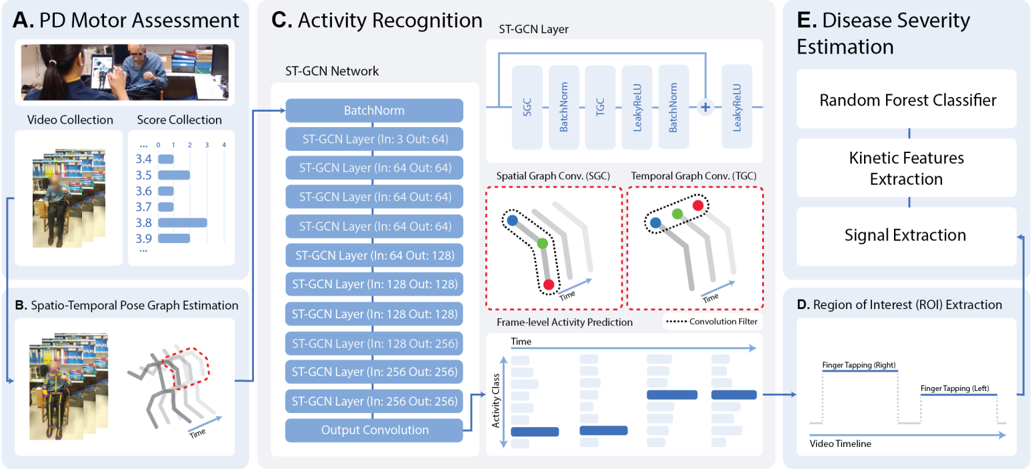
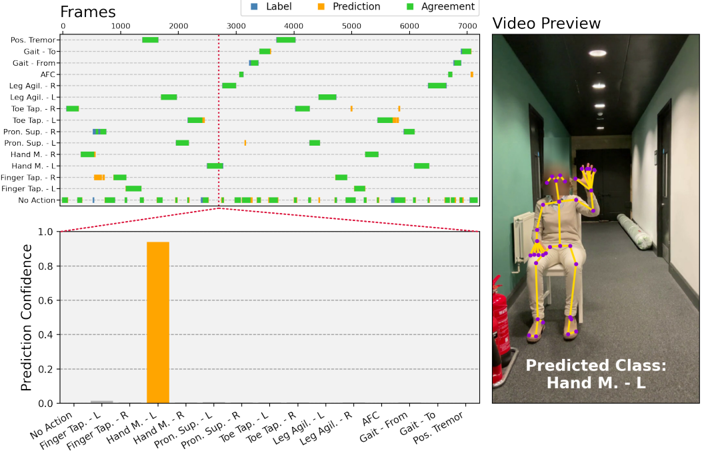
“(B ) A pose estimation library OpenPose is used to estimate the patient’s joint locations in each video frame and a spatio-temporal graph representation of the patient’s movement is created.”
MethodInfluentialSpatial Temporal Graph Convolutional Networks for Skeleton-Based Action Recognition
Yan, S., Xiong, Y., & Lin, D. (2018) · Proceedings of the AAAI Conference on Artificial Intelligence · doi:10.1609/aaai.v32i1.12328 · Cited by 5,410 · cited 2×
“An added benefit of many DL methods is the end-to-end learning and prediction setup, removing the need for feature engineering and validation [14], [15].”
MethodBetter Bootstrap Confidence Intervals
Efron, B. (1987) · Journal of the American Statistical Association · doi:10.1080/01621459.1987.10478410 · Cited by 3,364
Generalised Dice Overlap as a Deep Learning Loss Function for Highly Unbalanced Segmentations
Sudre, C. H., Li, W., Vercauteren, T., Ourselin, S., & Jorge Cardoso, M. (2017) · Lecture Notes in Computer Science · doi:10.1007/978-3-319-67558-9_28 · Cited by 2,829
Two-Stream Adaptive Graph Convolutional Networks for Skeleton-Based Action Recognition
Shi, L., Zhang, Y., Cheng, J., & Lu, H. (2019) · 2019 IEEE/CVF Conference on Computer Vision and Pattern Recognition (CVPR) · doi:10.1109/cvpr.2019.01230 · Cited by 2,071 · cited 1×
“2) A two-step framework whereby human pose estimation (i.e. annotation of body joint locations) is performed first, followed by activity recognition based on the estimated key points [20], [21].”
BackgroundTelehealth Benefits and Barriers
Gajarawala, S. N., & Pelkowski, J. N. (2021) · The Journal for Nurse Practitioners · doi:10.1016/j.nurpra.2020.09.013 · Cited by 987 · cited 1×
“Mobile health technology has been shown to effectively complement traditional public health services, and the rapid growth of its popularity further motivates the development of machine-driven HAR [7], [8].”
BackgroundHuman Activity Recognition and Pattern Discovery
Kim, E., Helal, S., & Cook, D. (2010) · IEEE Pervasive Computing · doi:10.1109/mprv.2010.7 · Cited by 704 · cited 1×
“A. Background H UMAN Activity Recognition (HAR) is the process of detecting and classifying human actions through sensor data [1].”
BackgroundOpenPose: Realtime Multi-Person 2D Pose Estimation using Part Affinity FieldsPreprint
Cao, Z., Hidalgo, G., Simon, T., et al. (2018) · arXiv (Cornell University) · doi:10.48550/arxiv.1812.08008 · Cited by 672 · cited 4×
“(B ) A pose estimation library OpenPose is used to estimate the patient’s joint locations in each video frame and a spatio-temporal graph representation of the patient’s movement is created.”
MethodInfluentialHuman action recognition using a temporal hierarchy of covariance descriptors on 3D joint locations
Hussein, M. E., Torki, M., Gowayyed, M. A., & El-Saban, M. (2013) · Cited by 507
Vision-based human activity recognition: a survey
Beddiar, D. R., Nini, B., Sabokrou, M., & Hadid, A. (2020) · Multimedia Tools and Applications · doi:10.1007/s11042-020-09004-3 · Cited by 505 · cited 1×
“However, HAR remains challenging, due in part to the complexity of scenes and human movements [9].”
BackgroundMulti-input CNN-GRU based human activity recognition using wearable sensors
Dua, N., Singh, S. N., & Semwal, V. B. (2021) · Computing · doi:10.1007/s00607-021-00928-8 · Cited by 432 · cited 1×
“Previous HAR work broadly falls into two categories according to input data, accelerometer data [16] and image data.”
BackgroundDeep learning and alternative learning strategies for retrospective real-world clinical data
Chen, D., Liu, S., Kingsbury, P., Sohn, S., Storlie, C. B., Habermann, E. B., Naessens, J. M., Larson, D. W., & Liu, H. (2019) · npj Digital Medicine · doi:10.1038/s41746-019-0122-0 · Cited by 223 · cited 1×
“Additionally, the performance of deep learning methods in medical settings is often limited by the amount of available training data, preventing in-depth evaluation of typically data-hungry deep learning frameworks [24].”
BackgroundSupporting patient monitoring using activity recognition with a smartphone
Lau, S. L., König, I., David, K., Parandian, B., Carius, C., & Schultz, M. (2010) · International Symposium on Wireless Communication Systems · doi:10.1109/iswcs.2010.5624490 · Cited by 121 · cited 1×
“In the context of healthcare, HAR has found use as an assistive tool for patient monitoring, remote medicine services or eldercare [5], [6].”
BackgroundChen, L. (2009) · Springer eBooks · doi:10.1007/978-0-387-39940-9_133 · Cited by 117
Accuracy of mHealth Devices for Atrial Fibrillation Screening: Systematic Review
Giebel, G. D., & Gissel, C. (2019) · JMIR mHealth and uHealth · doi:10.2196/13641 · Cited by 99 · cited 13×
“Mobile health technology has been shown to effectively complement traditional public health services, and the rapid growth of its popularity further motivates the development of machine-driven HAR [7], [8].”
BackgroundInfluentialA Clinically Interpretable Computer-Vision Based Method for Quantifying Gait in Parkinson’s Disease
Rupprechter, S., Morinan, G., Peng, Y., Foltynie, T., Sibley, K. G., Weil, R. S., Leyland, L., Baig, F., Morgante, F., Gilron, R., et al. (2021) · Sensors · doi:10.3390/s21165437 · Cited by 96 · cited 4×
“We compare the ST-GCN’s performance with two “shallow” machine learning models: KUPDRS [10], [11], [12], originally developed for PD severity estimation, extracts MDS-UPDRS item-specific signals and features and performs the prediction using a random forest classifier.”
BackgroundMethodInfluentialSelf-citationNoori, F. M., Wallace, B., Uddin, M. Z., & Tørresen, J. (2019) · Lecture notes in computer science · doi:10.1007/978-3-030-20205-7_25 · Cited by 79 · cited 1×
“2) A two-step framework whereby human pose estimation (i.e. annotation of body joint locations) is performed first, followed by activity recognition based on the estimated key points [20], [21].”
BackgroundMorinan, G., Dushin, Y., Sarapata, G., Rupprechter, S., Peng, Y., Girges, C., Salazar, M., Milabo, C., Sibley, K. G., Foltynie, T., et al. (2023) · npj Parkinson s Disease · doi:10.1038/s41531-023-00454-8 · Cited by 71
Self-citationReal-Time Action Recognition System for Elderly People Using Stereo Depth Camera
Zin, T. T., Htet, Y., Akagi, Y., Tamura, H., Kondo, K., Araki, S., & Chosa, E. (2021) · Sensors · doi:10.3390/s21175895 · Cited by 56 · cited 1×
“In the context of healthcare, HAR has found use as an assistive tool for patient monitoring, remote medicine services or eldercare [5], [6].”
BackgroundKinect Sensing of Shopping Related Actions
Popa, M. C., Koc, A. K., Rothkrantz, L. J. M., Shan, C., & Wiggers, P. (2012) · Communications in computer and information science · doi:10.1007/978-3-642-31479-7_16 · Cited by 47 · cited 1×
“An automated activity recognition framework would facilitate many practical applications such as behavioural analysis [2], automatic security surveillance [3], and human-computer interactive systems [4].”
MethodComputer-vision based method for quantifying rising from chair in Parkinson's disease patients
Morinan, G., Peng, Y., Rupprechter, S., Weil, R. S., Leyland, L., Foltynie, T., Sibley, K. G., Baig, F., Morgante, F., Gilron, R., et al. (2021) · Intelligence-Based Medicine · doi:10.1016/j.ibmed.2021.100046 · Cited by 45 · cited 4×
“We compare the ST-GCN’s performance with two “shallow” machine learning models: KUPDRS [10], [11], [12], originally developed for PD severity estimation, extracts MDS-UPDRS item-specific signals and features and performs the prediction using a random forest classifier.”
BackgroundMethodInfluentialSelf-citationAbnormal activity detection for bank ATM surveillance
Nar, R., Singal, A., & Kumar, P. (2016) · International Conference on Advances in Computing, Communications and Informatics (ICACCI) · doi:10.1109/icacci.2016.7732351 · Cited by 33 · cited 1×
“An automated activity recognition framework would facilitate many practical applications such as behavioural analysis [2], automatic security surveillance [3], and human-computer interactive systems [4].”
MethodShallow Graph Convolutional Network for Skeleton-Based Action Recognition
Yang, W., Zhang, J., Cai, J., & Xu, Z. (2021) · Sensors · doi:10.3390/s21020452 · Cited by 23 · cited 1×
“An added benefit of many DL methods is the end-to-end learning and prediction setup, removing the need for feature engineering and validation [14], [15].”
MethodChen, Y., Ma, H., Wang, J., Wu, J., Wu, X., & Xie, X. S. (2021) · ACM SIGKDD Conference on Knowledge Discovery and Data Mining (KDD) · doi:10.1145/3447548.3467130 · Cited by 18 · cited 1×
“Previous work has shown that machine-learning models can analyse PD assessment videos within manually annotated ROIs of patient activity through the extraction of kinetic signals and features, and yield estimates of the motor impairment severity [10], [11], [12], [32].”
BackgroundActivity recognition for movement-based interaction in mobile games
Almeida, A., & Alves, A. (2017) · International Conference on Human-Computer Interaction with Mobile Devices and Services (MobileHCI) · doi:10.1145/3098279.3125443 · Cited by 15 · cited 1×
“An automated activity recognition framework would facilitate many practical applications such as behavioural analysis [2], automatic security surveillance [3], and human-computer interactive systems [4].”
MethodTarget-Specific Action Classification for Automated Assessment of Human Motor Behavior from Video
Rezaei, B., Christakis, Y., Ho, B. K., Thomas, K. C., Erb, K., Ostadabbas, S., & Patel, S. (2019) · Sensors · doi:10.3390/s19194266 · Cited by 14 · cited 1×
“been applied to recognise a set of universal activities such as walking or standing [22], [23], but its application to the clinically relevant MDS-UPDRS motor assessment remained,”
MethodAbbreviated MDS‐UPDRS for Remote Monitoring in PD Identified Using Exhaustive Computational Search
Morinan, G., Hauser, R. A., Schrag, A. E., Tang, J., O’Keeffe, J., & MDS-NMS Scale Development Study Group (2022) · Parkinson s Disease · doi:10.1155/2022/2920255 · Cited by 12 · cited 1×
“that can be performed without assistance, taking into consideration overall informativeness about a patient’s holistic disease state [28].”
BackgroundSelf-citationKazemimoghadam, M., & Fey, N. P. (2022) · Applied Sciences · doi:10.3390/app12094682 · Cited by 9
Cited by
Kumar, P., Chauhan, S., & Awasthi, L. K. (2024) · Archives of Computational Methods in Engineering · doi:10.1007/s11831-023-09986-x · Cited by 206
Perez, K., Wisniewski, D., Ari, A., Lee, K., Lieneck, C., & Ramamonjiarivelo, Z. H. (2025) · Healthcare · doi:10.3390/healthcare13030324 · Cited by 192
Computer Vision Technologies in Movement Disorders: A Systematic Review
Pecoraro, P. M., Marsili, L., Espay, A. J., Bologna, M., & di Biase, L. (2025) · Movement Disorders Clinical Practice · doi:10.1002/mdc3.70123 · Cited by 42
Amprimo, G., Masi, G., Olmo, G., & Ferraris, C. (2024) · Artificial Intelligence in Medicine · doi:10.1016/j.artmed.2024.102914 · Cited by 41
Park, K. W., Mirian, M. S., & McKeown, M. J. (2024) · Singapore Medical Journal · doi:10.4103/singaporemedj.smj-2023-189 · Cited by 39
“Sarapata et al ., 2023 [21] Morinan et al ., 2023 [22] Mobile Human pose estimation refers to a deep learning computer vision process that captures a set of coordinates for key joints from an image that can describe a person’s pose, resulting in a skeleton-like structure when graphically formatted.”
Background
Metadata
- Authors
- Sarapata, G., Dushin, Y., Morinan, G., Ong, J., Budhdeo, S., Kainz, B., & O'Keeffe, J.
- Affiliations
- Machine Medicine Technologies, London, U.K.
- UCL Queen Square Institute of Neurology (GB)
- Imperial College London (GB)
- ORCID
- Venue
- IEEE Journal of Biomedical and Health Informatics
- Published
- 2023-10
- Volume
- 27
- Issue
- 10
- Pages
- 5032-5041
- ISSN
- 2168-2194 (ISSN-L)
- 2168-2208
- OpenAlex
- W4385246386
- Cited by
- 49
- References
- 34
- Citations by year
- 2026: 9 · 2025: 23 · 2024: 14 · 2023: 3
- FWCI
- 4.45
- Type
- journal article
- Language
- en
- Open access
- hybrid
- doi.org
- Locations
- IEEE Journal of Biomedical and Health Informatics (publishedVersion, cc-by)
- PubMed (publishedVersion)
- UCL Discovery (University College London) (submittedVersion, cc-by)
- Figshare (submittedVersion, cc-by)
- Spiral (Imperial College London) (submittedVersion, cc-by)
- Funders
- Machine Medicine Technologies
- Topics
- Physical Sciences › Computer Science › Computer Vision and Pattern Recognition › Human Pose and Action Recognition
- Physical Sciences › Computer Science › Computer Vision and Pattern Recognition › Context-Aware Activity Recognition Systems
- Physical Sciences › Computer Science › Human-Computer Interaction › Hand Gesture Recognition Systems
- Keywords
- Parkinson's disease, motor function assessment, activity recognition, video-based assessment, markerless pose estimation, spatio-temporal graph, deep learning, motor impairment
- MeSH terms
- Mental Status and Dementia Tests, Biomechanical Phenomena, Humans, Parkinson Disease, Severity of Illness Index
About these checks
Registry, retraction, Cites and statistics results are computed, not judged, with one exception: a printed reference that no index lists is read once by a model before it counts as a citation error. Claims are extracted by a model and kept only when their quote appears verbatim in the text; each cited source is then checked, with a model’s help, for whether it says what the claim relies on. Those verdicts can be wrong — read the claim’s quote and the cited source before relying on one.
Statistics and arithmetic are recomputed, not judged.
Confidence bands are shown only for fields calibrated on our annotated test set. None is calibrated yet, so no band is shown.
What counts as a claim ›How we measure confidence ›How we check this ›
Are you an author, or do you see a problem with this page? Request a review
Data sources
Bibliographic data: Semantic Scholar, OpenAlex, Crossref.
Contains information from the Semantic Scholar Academic Graph Datasets, made available under the ODC Attribution License (ODC-BY 1.0).
Semantic Scholar’s data is described in: Kinney, R., et al. (2023). The Semantic Scholar Open Data Platform. arXiv:2301.10140.
