

Enhancing Physical-Layer Security for IoT With Nonorthogonal Multiple Access Assisted Semi-Grant-Free Transmission
Open accessThe DOI matches its Crossref record; 45 of the 45 references it cites were found in a registry or an index.
Abstract
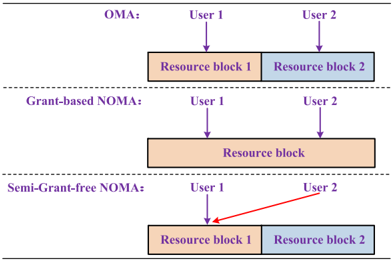
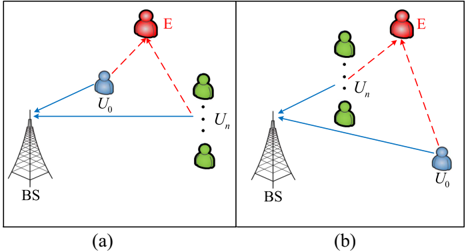
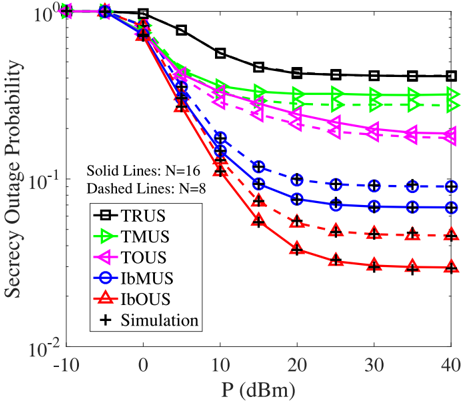
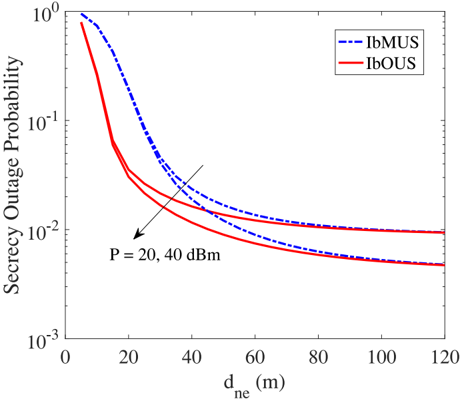
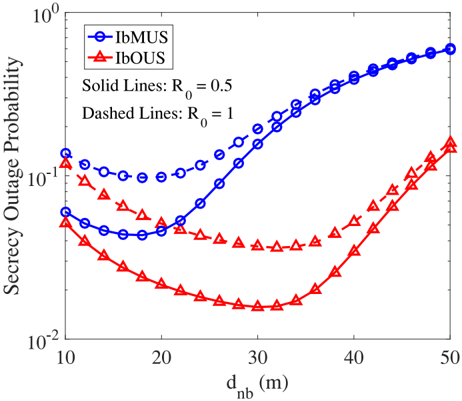
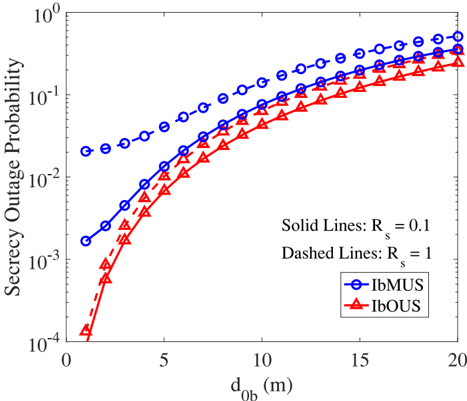
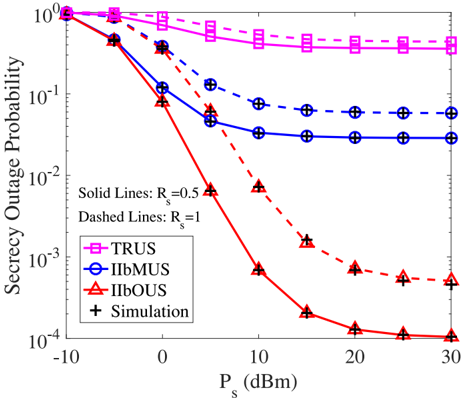
Nonorthogonal multiple access (NOMA) assisted semi-grant-free transmission admits grant-free users to access the channels otherwise solely occupied by grant-based users, and has been recently attracting considerable attention in terms of accommodating massive connectivity and reducing access delay in Internet of Things (IoT). In this work, we investigate the security of semi-grant-free NOMA transmission in the presence of passive and active eavesdropping attacks. In particular, for the scenario-I with strong grant-based user and weak grant-free users, the scenario-I-based maximal user scheduling (IbMUS) and scenario-I-based optimal user scheduling (IbOUS) schemes are proposed to combat the passive and active eavesdropping, respectively. For the scenario-II with weak grant-based user and strong grant-free users, two parallel schemes, namely, the scenario-II-based maximal user scheduling (IIbMUS) and scenario-II-based optimal user scheduling (IIbOUS) schemes, are proposed to combat the passive and active eavesdropping, respectively. These proposed schemes enhance the security by scheduling a grant-free user with maximal main channel capacity/maximal secrecy capacity to access the NOMA channel on the premise of ensuring the grant-based user’s Quality of Service. Based on these proposed schemes, the exact secrecy outage probability (SOP) are analyzed to evaluate the system performance. The simulation results validates the theoretic analysis and the superiority of the proposed schemes. The IbOUS and IIbOUS schemes can achieve better performance than the IbMUS and IIbMUS schemes owing to the use of active eavesdropper’s channel state information (CSI). The SOP achieved by the proposed schemes can be further improved with the increasing number of grant-free users and decreasing target rate (or target secrecy rate).
Overview
The claims and statistics of this paper haven’t been checked yet.
Free: it reads the open-access text and checks the first 5 claims that cite a source we can check. Create a free account to check every claim.
Integrity signals
Registry
Cites
Statistics
Figures








Verification
Claims the paper makes
The claims and statistics of this paper haven’t been checked yet.
Free: it reads the open-access text and checks the first 5 claims that cite a source we can check. Create a free account to check every claim.
Self-check
Percentages, sums and reported differences re-computed from the paper’s own numbers.
The self-check needs the paper’s full text.
Citations
Cites
Table of Integrals, Series, and Products
(2000) · Elsevier eBooks · doi:10.1016/b978-0-12-294757-5.x5000-4 · Cited by 8,408
Wyner, A. D. (1975) · Bell System Technical Journal · doi:10.1002/j.1538-7305.1975.tb02040.x · Cited by 7,075 · cited 2×
“According to the definition of secrecy capacity and theory of Wyner’s wiretap code [19], the secrecy capacity of the grant-free user is enhanced as its main channel capacity is maximized by using the IbMUS scheme.”
BackgroundMethodDai, L., Wang, B., Yuan, Y., Han, S., Chih-lin, I., & Wang, Z. (2015) · IEEE Communications Magazine · doi:10.1109/mcom.2015.7263349 · Cited by 2,943
Self-citationPower-Domain Non-Orthogonal Multiple Access (NOMA) in 5G Systems: Potentials and Challenges
Islam, S. M. R., Avazov, N., Dobre, O. A., & Kwak, K.-S. (2017) · IEEE Communications Surveys & Tutorials · doi:10.1109/comst.2016.2621116 · Cited by 2,458
Non-Orthogonal Multiple Access (NOMA) for Cellular Future Radio Access
Saito, Y., Kishiyama, Y., Benjebbour, A., Nakamura, T., Li, A., & Higuchi, K. (2013) · 2013 IEEE 77th Vehicular Technology Conference (VTC Spring) · doi:10.1109/vtcspring.2013.6692652 · Cited by 2,453
A Survey on Non-Orthogonal Multiple Access for 5G Networks: Research Challenges and Future Trends
Ding, Z., Lei, X., Karagiannidis, G. K., Schober, R., Yuan, J., & Bhargava, V. K. (2017) · IEEE Journal on Selected Areas in Communications · doi:10.1109/jsac.2017.2725519 · Cited by 2,392
Application of Non-Orthogonal Multiple Access in LTE and 5G Networks
Ding, Z., Liu, Y., Choi, J., Sun, Q., Elkashlan, M., Chih-Lin, I., & Poor, H. V. (2017) · IEEE Communications Magazine · doi:10.1109/mcom.2017.1500657cm · Cited by 1,967 · cited 1×
“Recently, non-OMA (NOMA), encouraging spectrum sharing among wireless devices, has emerged as a spectrally efficient solution to implement the massive connectivity for the IoT [2].”
BackgroundWireless Information-Theoretic Security
Bloch, M., Barros, J., Rodrigues, M. R. D., & McLaughlin, S. W. (2008) · IEEE Transactions on Information Theory · doi:10.1109/tit.2008.921908 · Cited by 1,847 · cited 1×
“2) IbOUS Scheme for Active Eavesdropping: Active eavesdropper is a transceiver operating with known protocols in the system but having a low-security clearance, which is also known as internal eavesdropper or untrusted node [20], [33], [42]–[44].”
BackgroundImpact of User Pairing on 5G Nonorthogonal Multiple-Access Downlink Transmissions
Ding, Z., Fan, P., & Poor, H. V. (2016) · IEEE Transactions on Vehicular Technology · doi:10.1109/tvt.2015.2480766 · Cited by 1,554
Principles of Physical Layer Security in Multiuser Wireless Networks: A Survey
Mukherjee, A., Fakoorian, S. A. A., Huang, J., & Swindlehurst, A. L. (2014) · IEEE Communications Surveys & Tutorials · doi:10.1109/surv.2014.012314.00178 · Cited by 1,483
Cited by
Heidari, A., Jafari Navimipour, N., Unal, M., & Zhang, G. (2023) · ACM Computing Surveys · doi:10.1145/3571728 · Cited by 195
Mohsan, S. A. H., Li, Y., Sadiq, M., Liang, J., & Khan, M. A. (2023) · Journal of Marine Science and Engineering · doi:10.3390/jmse11010124 · Cited by 164
A Novel Blockchain-Based Deepfake Detection Method Using Federated and Deep Learning Models
Heidari, A., Navimipour, N. J., Dag, H., Talebi, S., & Unal, M. (2024) · Cognitive Computation · doi:10.1007/s12559-024-10255-7 · Cited by 164
A Survey on Network Slicing Security: Attacks, Challenges, Solutions and Research Directions
de Alwis, C., Porambage, P., Dev, K., Gadekallu, T. R., & Liyanage, M. (2023) · IEEE Communications Surveys & Tutorials · doi:10.1109/comst.2023.3312349 · Cited by 181
“In a side-channel attack, the attackers try to extract the secrets of a system by analyzing or measuring several physical parameters such as electromagnetic emission, execution time, supply current, etc [83], [84].”
BackgroundFederated deep learning for anomaly detection in the internet of things
Wang, X., Wang, Y., Javaheri, Z., Almutairi, L., Moghadamnejad, N., & Younes, O. (2023) · Computers & Electrical Engineering · doi:10.1016/j.compeleceng.2023.108651 · Cited by 130
Metadata
- Authors
- Cao, K., Ding, H., Wang, B., Lv, L., Tian, J., Wei, Q., & Gong, F.
- Affiliations
- Xidian University (CN)
- National University of Defense Technology (CN)
- Air Force Engineering University (CN)
- Venue
- IEEE Internet of Things Journal
- Published
- 2022-12-15
- Volume
- 9
- Issue
- 24
- Pages
- 24669-24681
- ISSN
- 2327-4662 (ISSN-L)
- 2372-2541
- OpenAlex
- W4286579641
- Cited by
- 97
- References
- 45
- Citations by year
- 2026: 5 · 2025: 21 · 2024: 18 · 2023: 43 · 2022: 10
- FWCI
- 6.30
- Type
- journal article
- Language
- en
- Open access
- hybrid
- doi.org
- Locations
- IEEE Internet of Things Journal (publishedVersion, cc-by)
- Funders
- National Natural Science Foundation of China (62101560, 61871387, 61901313)
- Natural Science Basic Research Program of Shaanxi (2022JQ-619)
- National University of Defense Technology Research Fund (ZK21-44)
- Open Research Fund of the State Key Laboratory of ISN, Xidian University (ISN23-04)
- China Postdoctoral Science Foundation (BX20190264, 2019M650258)
- Topics
- Physical Sciences › Engineering › Electrical and Electronic Engineering › Wireless Communication Security Techniques
- Physical Sciences › Engineering › Electrical and Electronic Engineering › Advanced Wireless Communication Technologies
- Physical Sciences › Computer Science › Computer Networks and Communications › Age of Information Optimization
- Keywords
- physical layer security, non-orthogonal multiple access, Internet of Things, passive eavesdropping, active eavesdropping, user scheduling, secrecy outage probability, secrecy capacity, massive connectivity, channel state information
About these checks
Registry, retraction, Cites and statistics results are computed, not judged, with one exception: a printed reference that no index lists is read once by a model before it counts as a citation error. Claims are extracted by a model and kept only when their quote appears verbatim in the text; each cited source is then checked, with a model’s help, for whether it says what the claim relies on. Those verdicts can be wrong — read the claim’s quote and the cited source before relying on one.
Statistics and arithmetic are recomputed, not judged.
Confidence bands are shown only for fields calibrated on our annotated test set. None is calibrated yet, so no band is shown.
What counts as a claim ›How we measure confidence ›How we check this ›
Are you an author, or do you see a problem with this page? Request a review
How to cite
Cite CoChat for the checks on this page, and the paper for its own findings.
- This page
- CoChat. (2026). Citation check: Enhancing Physical-Layer Security for IoT With Nonorthogonal Multiple Access Assisted Semi-Grant-Free Transmission. https://app.cochat.ai/papers/10.1109/jiot.2022.3193189
- The paper
- Cao, K., Ding, H., Wang, B., Lv, L., Tian, J., Wei, Q., & Gong, F. (2022). Enhancing Physical-Layer Security for IoT With Nonorthogonal Multiple Access Assisted Semi-Grant-Free Transmission. IEEE Internet of Things Journal. https://doi.org/10.1109/jiot.2022.3193189
Data sources
Bibliographic data: Semantic Scholar, OpenAlex, Crossref.
Contains information from the Semantic Scholar Academic Graph Datasets, made available under the ODC Attribution License (ODC-BY 1.0).
Semantic Scholar’s data is described in: Kinney, R., et al. (2023). The Semantic Scholar Open Data Platform. arXiv:2301.10140.
