

Photonic Pseudospin Skyrmion in Momentum Space
The DOI matches its Crossref record; 22 of the 22 references it cites were found in a registry or an index.
Abstract
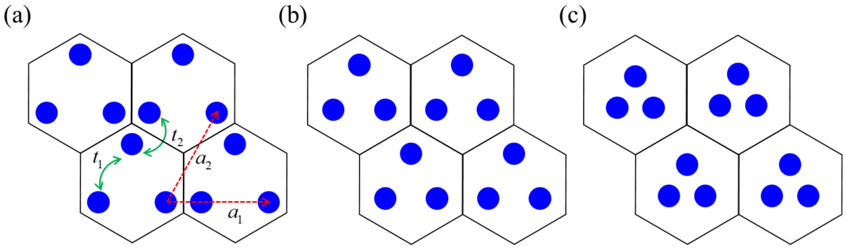
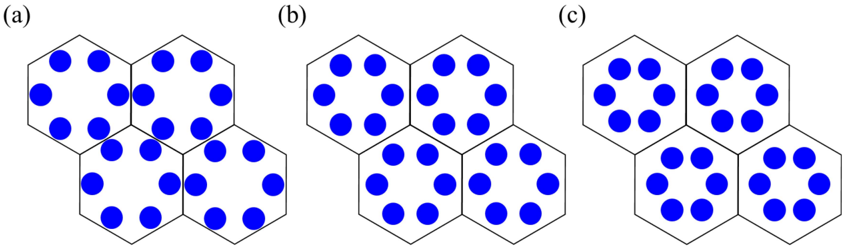
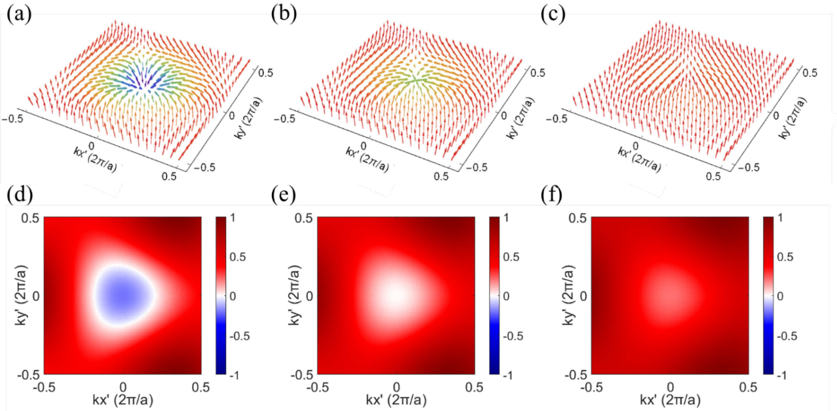
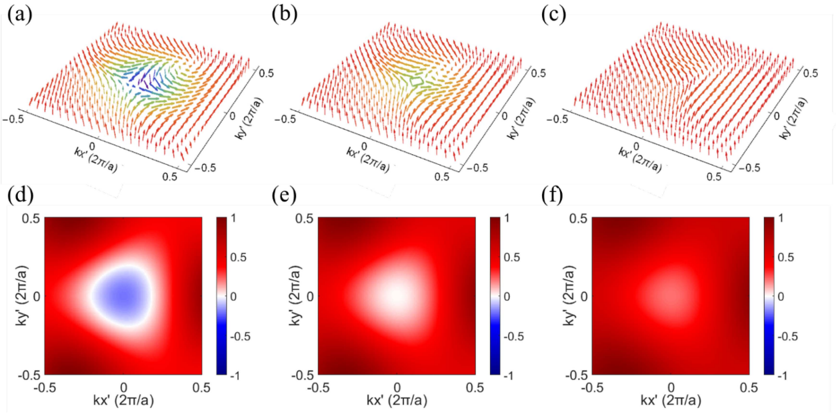
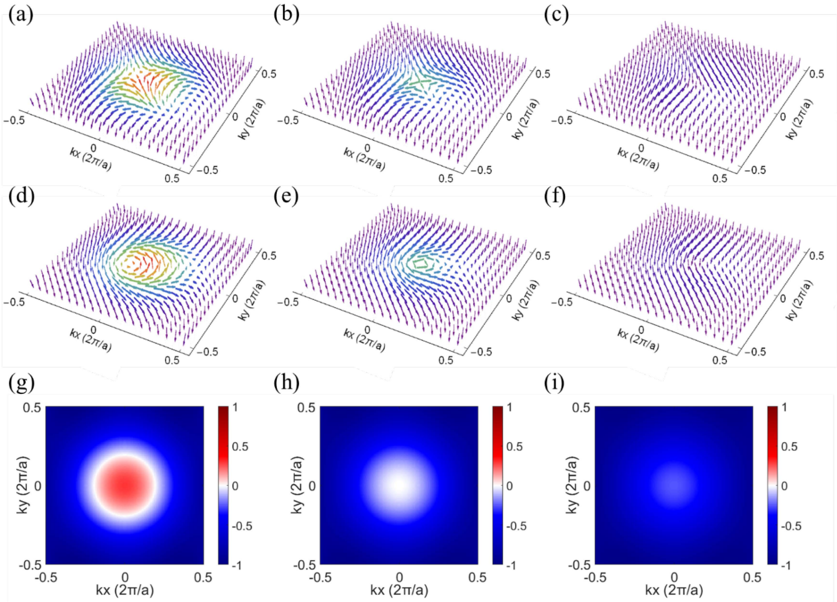
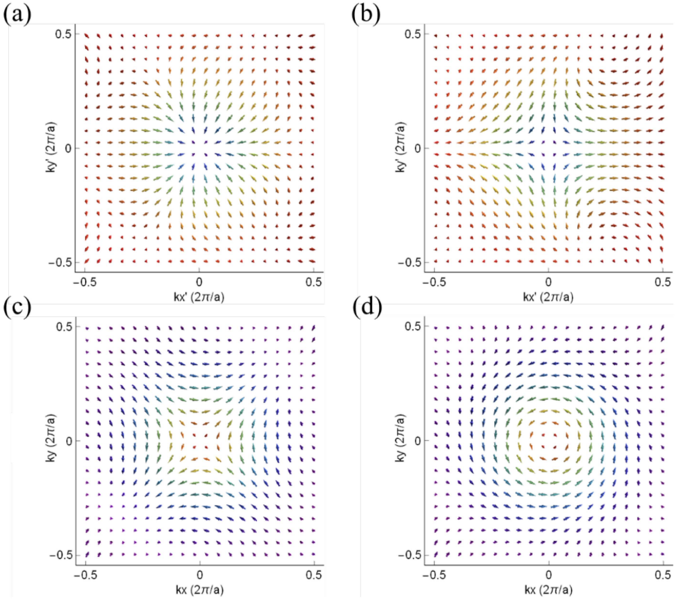
Magnetic Skyrmions are topologically protected spin structures with sophisticated swirls of electron spins. In recent times, photonic counterparts of the magnetic Skyrmions have been discovered with new deep-subwavelength characteristics promising for future applications in optical information storage and transfer. While the photonic Skyrmions in real space have been observed in diverse photonic systems, studies on the photonic Skyrmions in momentum space have rarely been done. Here we show different forms of pseudospin Skyrmion around the Dirac point in momentum space of photonic crystals with the Kagome and honeycomb lattice. The pseudospin Skyrmions in momentum space are directly related to the topologically nontrivial states and manipulated by the inter-cell and intra-cell interactions between cylinders of the photonic crystal. The observation of the pseudospin Skyrmion in momentum space is expected to be valuable for manipulation of the flows and polarizations of light in topologically robust ways.
Overview
The claims and statistics of this paper haven’t been checked yet.
Free: it reads the open-access text and checks the first 5 claims that cite a source we can check. Create a free account to check every claim.
Integrity signals
Registry
Cites
Statistics
Figures
Verification
Claims the paper makes
The claims and statistics of this paper haven’t been checked yet.
Free: it reads the open-access text and checks the first 5 claims that cite a source we can check. Create a free account to check every claim.
Claims other papers make about this one
Each is checked against this paper’s own text: does it say what the citing paper says it does?
In the citing paper
“(iii) diversity of topologies-the vector textures of skyrmions can be characterized by multiple topological numbers and extended to higher dimensional cases [69,70]”
From Optical skyrmions and other topological quasiparticles of light (2024) · cites this paper as [70]
In the citing paper
“The kπ skyrmions were reported in free-space skyrmionic vector beams with reconfigurable topological textures, including higher-order vorticity and kπ radial twist [70].”
From Optical skyrmions and other topological quasiparticles of light (2024) · cites this paper as [70]
In the citing paper
“In particular, the digital hologram method can be used to generate tuneable skyrmions with all the textures of Néel-, Bloch, and anti-types [70] (Fig. 4g).”
From Optical skyrmions and other topological quasiparticles of light (2024) · cites this paper as [70]
Self-check
Percentages, sums and reported differences re-computed from the paper’s own numbers.
The self-check needs the paper’s full text.
Citations
Cites
Skyrmion Lattice in a Chiral Magnet
Mühlbauer, S., Binz, B., Jonietz, F., Pfleiderer, C., Rosch, A., Neubauer, A., Georgii, R., & Böni, P. (2009) · Science · doi:10.1126/science.1166767 · Cited by 4,781
Topological properties and dynamics of magnetic skyrmions
Nagaosa, N., & Tokura, Y. (2013) · Nature Nanotechnology · doi:10.1038/nnano.2013.243 · Cited by 4,076
Real-space observation of a two-dimensional skyrmion crystal
Yu, X. Z., Onose, Y., Kanazawa, N., Park, J. H., Han, J. H., Matsui, Y., Nagaosa, N., & Tokura, Y. (2010) · Nature · doi:10.1038/nature09124 · Cited by 3,448
Magnetic skyrmions: advances in physics and potential applications
Fert, A., Reyren, N., & Cros, V. (2017) · Nature Reviews Materials · doi:10.1038/natrevmats.2017.31 · Cited by 2,426
Scheme for Achieving a Topological Photonic Crystal by Using Dielectric Material
Wu, L.-H., & Hu, X. (2015) · Physical Review Letters · doi:10.1103/physrevlett.114.223901 · Cited by 1,648 · cited 2×
“The Dirac cones at K and K′ points in the first Brillouin zone of honeycomb lattice are folded to doubly degenerate Dirac cones at the Γ point [20].”
BackgroundBeyond skyrmions: Review and perspectives of alternative magnetic quasiparticles
Göbel, B., Mertig, I., & Tretiakov, O. A. (2021) · Physics Reports · doi:10.1016/j.physrep.2020.10.001 · Cited by 673
Optical skyrmion lattice in evanescent electromagnetic fields
Tsesses, S., Ostrovsky, E., Cohen, K., Gjonaj, B., Lindner, N. H., & Bartal, G. (2018) · Science · doi:10.1126/science.aau0227 · Cited by 514 · cited 1×
“Recently, photonic analogies of the magnetic Skyrmions were observed in different forms of optical fields, such as electric field vector Skyrmion lattice [7], [8], photonic spin vector Skyrmion [9], [10], and Stokes vector Skyrmion of Poincaré beams [11], [12], [13].”
BackgroundDu, L., Yang, A., Zayats, A. V., & Yuan, X. (2019) · Nature Physics · doi:10.1038/s41567-019-0487-7 · Cited by 416
Self-citationUltrafast vector imaging of plasmonic skyrmion dynamics with deep subwavelength resolution
Davis, T. J., Janoschka, D., Dreher, P., Frank, B., Meyer zu Heringdorf, F.-J., & Giessen, H. (2020) · Science · doi:10.1126/science.aba6415 · Cited by 296
Generation of Optical Skyrmions with Tunable Topological Textures
Shen, Y., Martínez, E. C., & Rosales-Guzmán, C. (2022) · ACS Photonics · doi:10.1021/acsphotonics.1c01703 · Cited by 278
Two-dimensional skyrmion bags in liquid crystals and ferromagnets
Foster, D., Kind, C., Ackerman, P. J., Tai, J.-S. B., Dennis, M. R., & Smalyukh, I. I. (2019) · Nature Physics · doi:10.1038/s41567-019-0476-x · Cited by 262
Gao, S., Speirits, F. C., Castellucci, F., Franke-Arnold, S., Barnett, S. M., & Götte, J. B. (2020) · Physical Review A · doi:10.1103/physreva.102.053513 · Cited by 253
Pseudo-spin–valley coupled edge states in a photonic topological insulator
Kang, Y., Ni, X., Cheng, X., Khanikaev, A. B., & Genack, A. Z. (2018) · Nature Communications · doi:10.1038/s41467-018-05408-w · Cited by 184
Unveiling pseudospin and angular momentum in photonic graphene
Song, D., Paltoglou, V., Liu, S., Zhu, Y., Gallardo, D., Tang, L., Xu, J., Ablowitz, M., Efremidis, N. K., & Chen, Z. (2015) · Nature Communications · doi:10.1038/ncomms7272 · Cited by 183
Far-field probing of leaky topological states in all-dielectric metasurfaces
Gorlach, M. A., Ni, X., Smirnova, D. A., Korobkin, D., Zhirihin, D., Slobozhanyuk, A. P., Belov, P. A., Alù, A., & Khanikaev, A. B. (2018) · Nature Communications · doi:10.1038/s41467-018-03330-9 · Cited by 181
Microcavity-based generation of full Poincaré beams with arbitrary skyrmion numbers
Lin, W., Ota, Y., Arakawa, Y., & Iwamoto, S. (2021) · Physical Review Research · doi:10.1103/physrevresearch.3.023055 · Cited by 122
Reconfigurable topological photonic crystal
Shalaev, M. I., Desnavi, S., Walasik, W., & Litchinitser, N. M. (2018) · New Journal of Physics · doi:10.1088/1367-2630/aaac04 · Cited by 120
Meron Spin Textures in Momentum Space
Guo, C., Xiao, M., Guo, Y., Yuan, L., & Fan, S. (2020) · Physical Review Letters · doi:10.1103/physrevlett.124.106103 · Cited by 110
Topological edge states in acoustic Kagome lattices
Ni, X., Gorlach, M. A., Alù, A., & Khanikaev, A. B. (2017) · New Journal of Physics · doi:10.1088/1367-2630/aa6996 · Cited by 99
Ultrafast microscopy of a twisted plasmonic spin skyrmion
Dai, Y., Zhou, Z., Ghosh, A., Kapoor, K., Dąbrowski, M., Kubo, A., Huang, C.-B., & Petek, H. (2022) · Applied Physics Reviews · doi:10.1063/5.0084482 · Cited by 76
Pseudospin-induced chirality with staggered optical graphene
Liu, J.-L., Ye, W.-M., & Zhang, S. (2016) · Light: Science & Applications · doi:10.1038/lsa.2016.94 · Cited by 29
Vortex index identification and unidirectional propagation in Kagome photonic crystals
Deng, W., Chen, X., Chen, W.-J., Zhao, F., & Dong, J. (2018) · Nanophotonics · doi:10.1515/nanoph-2019-0009 · Cited by 24
Cited by
Optical skyrmions and other topological quasiparticles of light
Shen, Y., Zhang, Q., Shi, P., Du, L., Yuan, X., & Zayats, A. V. (2024) · Nature Photonics · doi:10.1038/s41566-023-01325-7 · Cited by 469
Self-citation
Metadata
- Authors
- Lin, M., Du, L., & Yuan, X.
- Affiliations
- Nanophotonics Research Centre, Institute of Microscale Optoelectronics, Shenzhen University, Shenzhen, China
- Venue
- IEEE Photonics Journal
- Published
- 2023-02
- Volume
- 15
- Issue
- 1
- Pages
- 1-6
- ISSN
- 1943-0655
- 1943-0647
- Cited by
- 17
- References
- 22
- Funders
- National Natural Science Foundation of China (U1701661, 62075139, 61935013, 12004260)
- Science and Technology Innovation Commission of Shenzhen (RCJC20200714114435063, JCYJ20200109114018750)
About these checks
Registry, retraction, Cites and statistics results are computed, not judged, with one exception: a printed reference that no index lists is read once by a model before it counts as a citation error. Claims are extracted by a model and kept only when their quote appears verbatim in the text; each cited source is then checked, with a model’s help, for whether it says what the claim relies on. Those verdicts can be wrong — read the claim’s quote and the cited source before relying on one.
Statistics and arithmetic are recomputed, not judged.
Confidence bands are shown only for fields calibrated on our annotated test set. None is calibrated yet, so no band is shown.
What counts as a claim ›How we measure confidence ›How we check this ›
Are you an author, or do you see a problem with this page? Request a review
Data sources
Bibliographic data: Semantic Scholar, OpenAlex, Crossref.
Contains information from the Semantic Scholar Academic Graph Datasets, made available under the ODC Attribution License (ODC-BY 1.0).
Semantic Scholar’s data is described in: Kinney, R., et al. (2023). The Semantic Scholar Open Data Platform. arXiv:2301.10140.
