

The DOI matches its Crossref record; 45 of the 45 references it cites were found in a registry or an index; 16 of the 29 sources its claims cite were checked for support.
Learning Hierarchical Interactive Multi-Object Search for Mobile Manipulation
Open accessAbstract
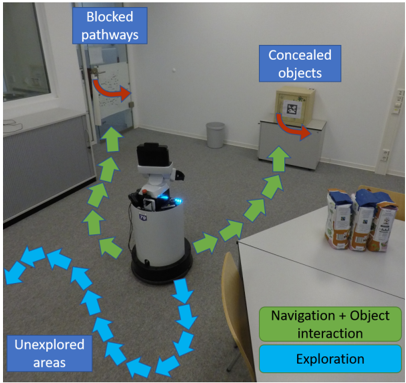
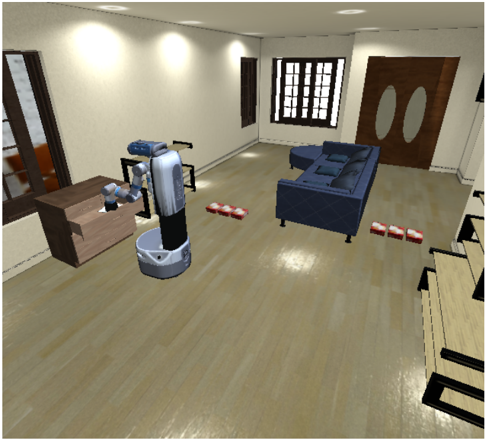
Existing object-search approaches enable robots to search through free pathways, however, robots operating in unstructured human-centered environments frequently also have to manipulate the environment to their needs. In this work, we introduce a novel interactive multi-object search task in which a robot has to open doors to navigate rooms and search inside cabinets and drawers to find target objects. These new challenges require combining manipulation and navigation skills in unexplored environments. We present HIMOS, a hierarchical reinforcement learning approach that learns to compose exploration, navigation, and manipulation skills. To achieve this, we design an abstract high-level action space around a semantic map memory and leverage the explored environment as instance navigation points. We perform extensive experiments in simulation and the real world that demonstrate that, with accurate perception, the decision making of HIMOS effectively transfers to new environments in a zero-shot manner. It shows robustness to unseen subpolicies, failures in their execution, and different robot kinematics. These capabilities open the door to a wide range of downstream tasks across embodied AI and real-world use cases.
Overview
CoChat Summary
TL;DR
HIMOS is a hierarchical reinforcement learning approach for interactive multi-object search in which a mobile manipulator opens doors and searches cabinets/drawers to find target objects. In simulation it achieves 94.6% average success on seen and 95.6% on unseen apartments for 1–6 objects, and transfers zero-shot to a real Toyota HSR robot with 23/30 (76.7%) success.
Key findings
- HIMOS outperforms baselines in simulation: average success 94.6% seen and 95.6% unseen for 1–6 target objects, versus Greedy 91.8%/92.7% and SGoLAM+ 89.8%/93.0%; SPL is 55.7 seen and 60.6 unseen.
- Ablations show frontier exploration is critical: removing it drops average success to 66.5% (unseen; 64.2% seen). Removing local exploration causes a 12.0 ppt average success drop, and removing invalid action masking lowers success/SPL while masking improves convergence speed by up to 2.5×.
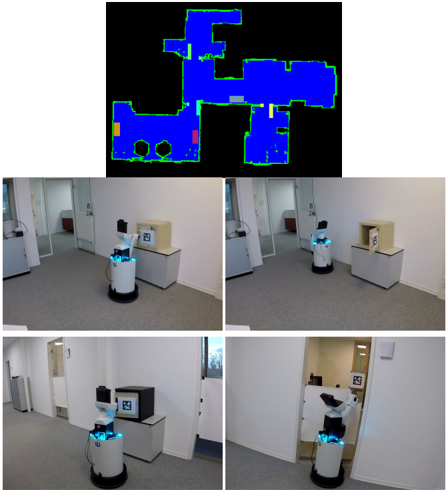
- Real-world HSR experiments complete 23/30 episodes (76.7%) across 1–6 target objects, with 2 collisions, 3 interaction failures, and 2 navigation failures; the high-level policy is robust to subpolicy failures and unseen subpolicies.
- The learned decision making transfers zero-shot to the real world, unseen environments, unseen subpolicies, and different robot kinematics, given accurate perception.
Methods
- Task: goal-conditional POMDP where an agent must find k objects out of c categories; success requires seeing each object and navigating within 1.3 m, with a 1,000-timestep limit; doors and cabinets/drawers must be opened to explore.
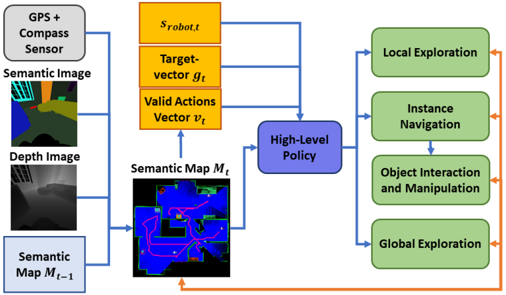
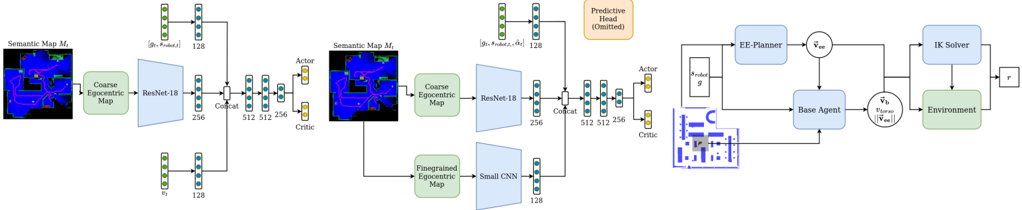
- HIMOS: semantic/panoptic map memory; high-level PPO policy in a semi-Markov decision process over a 12-dimensional discrete action space (local exploration, global frontier exploration, instance navigation with interaction), using pretrained low-level subpolicies, adaptive discounting, and invalid action masking.
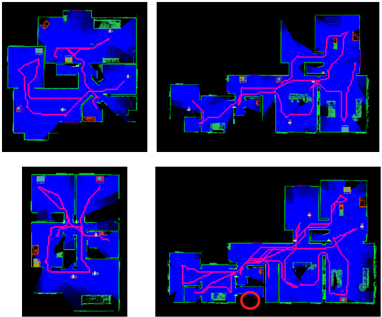
- Evaluation: iGibson simulation with a Fetch robot, 8 training and 7 unseen apartments, 1–6 target objects, 25 episodes per scene/object count and 3 seeds (3,600 seen and 3,150 unseen episodes per approach); real Toyota HSR in a ~180 m² office with 30 episodes; metrics are success rate and SPL.
Limitations
- Stated: the work abstracts from real-world perception and assumes accurate semantic labels, depth/localization, object detection, and a static environment except for the agent’s own interactions; real-world experiments use AR markers and a pre-annotated semantic map, with full perception-pipeline deployment left to future work.
- Stated: instance navigation assumes a pre-specified maximum number of possible instances; joint training of high- and low-level policies is not performed; finer failure feedback and active perception are future work.
- Evident from the text: real-world success (76.7%) is lower than simulation (94.6%/95.6%), with irrecoverable failures including a wrist-joint safety limit, base collisions, and repeated navigation-stack failures; real-world evaluation is limited to 30 episodes in one office environment.
Model-written summary. Check it against the paper before relying on it.
Integrity signals
Registry
Cites
Statistics
Figures
Verification
Claims the paper makes
10 Valid · 7 Not valid · 10 Not checked · 55 Own results and interpretations
The cited sources support only part of this claim — read each source’s verdict below.
In the paper
“We furthermore find it beneficial for learning speed [32] to only allow the agent to navigate to doors or cabinets that have not been successfully opened yet”
What the sources say
- Partly supportedcites [32] sourceExperimental — accuracy not yet measured
The Evaluation Results (p. 5) report that invalid-action masking helped agents find rewards quickly, supporting the general learning-speed rationale. The paper does not study navigation to doors or cabinets, or masking destinations after they have been opened; that specific restriction is the citing authors’ finding, not a result established by this source. (LLM, conf=0.84)
plainstates a cause- Asserted: passes — The authors put it forward as true.
- Checkable: passes — It can be checked against evidence.
- Load-bearing: unclear — It is unclear whether the paper’s conclusions depend on it.
- Based: passes — The paper gives a reason why it holds.
- Partly supported
The cited sources support only part of this claim — read each source’s verdict below.
In the paper
“This, however, is a strength of frontier exploration [4], which samples points at the frontier to (often far away) unexplored areas.”
What the sources say
- Partly supportedcites [4] sourceExperimental — accuracy not yet measured
Section 2.0 (pp. 1–2) says that moving to successive frontiers expands the map into unexplored space, including farther along a path. But §2.3 (p. 3) says the robot selects the nearest accessible, unvisited frontier; the paper does not establish reaching faraway areas as a particular strength or say it often selects distant points. (LLM, conf=0.84)
plainstates a cause- Asserted: passes — The authors put it forward as true.
- Checkable: passes — It can be checked against evidence.
- Load-bearing: passes — The paper’s conclusions depend on it.
- Based: passes — The paper gives a reason why it holds.
- Partly supported
The cited sources support only part of this claim — read each source’s verdict below.
In the paper
“While naive skill-chaining of arbitrary skills often results in”
What the sources say
- Partly supportedcites [9] Szot, 2021, Habitat 2.0: Training home assistants to rearrange their habitat sourceExperimental — accuracy not yet measured
Appendix F.2 (p. 25) says skills must return the arm to a resting position to facilitate transitions, and its Navigate description (p. 27) says navigation brings the robot to the start of other skills. These passages support the concern that a subsequent skill needs a suitable starting state, but they do not establish that naive chaining of arbitrary skills often produces hand-off failures. (LLM, conf=0.79)
plainstates a cause- Asserted: passes — The authors put it forward as true.
- Checkable: passes — It can be checked against evidence.
- Load-bearing: passes — The paper’s conclusions depend on it.
- Based: passes — The paper gives a reason why it holds.
- Partly supported
A result the paper reports from its own data — it cites no other source for it, so there is none to check. The quote shows it is in the paper.
In the paper
“we transfer the trained agent to the real world and demonstrate that it successfully accomplishes these tasks in a real office environment.”
- Also stated in: § II. RELATED WORK · boosted
“in contrast to most previous works, we demonstrate that our approach successfully transfers to the real world.”
boostedstates a cause- Asserted: passes — The authors put it forward as true.
- Checkable: passes — It can be checked against evidence.
- Load-bearing: passes — The paper’s conclusions depend on it.
- Based: passes — The paper gives a reason why it holds.
- Also stated in: § II. RELATED WORK · boosted
A result the paper reports from its own data — it cites no other source for it, so there is none to check. The quote shows it is in the paper.
In the paper
“We perform extensive experiments in simulation and the real world that demonstrate that, with accurate perception, the decision making of HIMOS effectively transfers to new environments in a zero-shot manner.”
- Also stated in: § I. INTRODUCTION · plain
“given accurate perception, its decision making achieves zero-shot transfer to the real world, unseen environments, unseen subpolicies, and is robust to unseen failures.”
boostedstates a cause- Asserted: passes — The authors put it forward as true.
- Checkable: passes — It can be checked against evidence.
- Load-bearing: passes — The paper’s conclusions depend on it.
- Based: passes — The paper gives a reason why it holds.
- Also stated in: § I. INTRODUCTION · plain
22 more claims
Create a free account to see all 82 claims and every source verdict.
- Probably not a substantial claim. 25
- It may state two separate claims as one. 37
Citations
Cites
Deep Residual Learning for Image Recognition
He, K., Zhang, X., Ren, S., & Sun, J. (2016) · 2016 IEEE Conference on Computer Vision and Pattern Recognition (CVPR) · doi:10.1109/cvpr.2016.90 · Cited by 235,474
He, K., Gkioxari, G., Dollar, P., & Girshick, R. (2017) · 2017 IEEE International Conference on Computer Vision (ICCV) · doi:10.1109/iccv.2017.322 · Cited by 29,137
Proximal Policy Optimization Algorithms
Schulman, J., Wolski, F., Dhariwal, P., Radford, A., & Klimov, O. (2017) · arXiv · doi:10.48550/arxiv.1707.06347 · Cited by 10,625
Deep Residual Learning for Image Recognition
He, K., Zhang, X., Ren, S., & Sun, J. (2015) · arXiv · doi:10.48550/arxiv.1512.03385 · Cited by 4,196
Masked-attention Mask Transformer for Universal Image Segmentation
Cheng, B., Misra, I., Schwing, A. G., Kirillov, A., & Girdhar, R. (2022) · 2022 IEEE/CVF Conference on Computer Vision and Pattern Recognition (CVPR) · doi:10.1109/cvpr52688.2022.00135 · Cited by 3,565
Between MDPs and semi-MDPs: A framework for temporal abstraction in reinforcement learning
Sutton, R. S., Precup, D., & Singh, S. (1999) · Artificial Intelligence · doi:10.1016/s0004-3702(99)00052-1 · Cited by 3,119
A frontier-based approach for autonomous exploration
Yamauchi, B. (2002) · Proceedings 1997 IEEE International Symposium on Computational Intelligence in Robotics and Automation CIRA'97. 'Towards New Computational Principles for Robotics and Automation' · doi:10.1109/cira.1997.613851 · Cited by 1,695
Dynamical Movement Primitives: Learning Attractor Models for Motor Behaviors
Ijspeert, A. J., Nakanishi, J., Hoffmann, H., Pastor, P., & Schaal, S. (2013) · Neural Computation · doi:10.1162/neco_a_00393 · Cited by 1,598
A flexible and scalable SLAM system with full 3D motion estimation
Kohlbrecher, S., von Stryk, O., Meyer, J., & Klingauf, U. (2011) · 2011 IEEE International Symposium on Safety, Security, and Rescue Robotics · doi:10.1109/ssrr.2011.6106777 · Cited by 1,086 · cited 1×
“In the real world, we simulate access to semantic labels as follows: we pre-build a map of the environment using Hector SLAM [28] and annotate it with labels for target objects, cabinets, and doors.”
MethodLabbé, M., & Michaud, F. (2019) · Journal of Field Robotics · doi:10.1002/rob.21831 · Cited by 989
Research works printed but not linked: 1
- 10.1109/lra.2023.3336109/mm6 · doi:10.1109/lra.2023.3336109/mm6
Cited by
Language-Grounded Dynamic Scene Graphs for Interactive Object Search With Mobile Manipulation
Honerkamp, D., Büchner, M., Despinoy, F., Welschehold, T., & Valada, A. (2024) · IEEE Robotics and Automation Letters · doi:10.1109/lra.2024.3441495 · Cited by 95
“To evaluate the efficacy of our approach, we formulate an interactive semantic search task, extending previous non-semantic interactive tasks [7] to more complex scenarios.”
BackgroundMethodInfluentialSelf-citationSample-Efficient Deep Reinforcement Learning of Mobile Manipulation for 6-DOF Trajectory Following
Zhou, Y., Feng, Q., Zhou, Y., et al. (2025) · IEEE Transactions on Automation Science and Engineering · doi:10.1109/tase.2025.3530162 · Cited by 9
“As for interactive navigation tasks, hierarchical structure [21], [22], [23] is designed to decompose the overall task into subtasks.”
Lochner, S., Honerkamp, D., Valada, A., & Straw, A. D. (2024) · Frontiers in Computational Neuroscience · doi:10.3389/fncom.2024.1460006 · Cited by 9
Self-citationTask-Driven Co-Design of Mobile Manipulators
Schneider, R., Honerkamp, D., Welschehold, T., & Valada, A. (2025) · IEEE Robotics and Automation Letters · doi:10.1109/lra.2025.3573622 · Cited by 5
“…returns over the distribution of tasks ( We propose to use a recent state-of-the-art multitask reinforcement learning agent, N 2 M 2 [7], [9] that has been demonstrated to outperform optimization-based methods and to perform well across a wide range of tasks in the real world [8], [10], [11].”
Self-citationBayesian Optimization for Sample-Efficient Policy Improvement in Robotic Manipulation
Röfer, A., Nematollahi, I., Welschehold, T., Burgard, W., & Valada, A. (2024) · IEEE/RSJ International Conference on Intelligent Robots and Systems (IROS) · doi:10.1109/iros58592.2024.10802400 · Cited by 5
Self-citation
Metadata
- Authors
- Schmalstieg, F., Honerkamp, D., Welschehold, T., & Valada, A.
- Affiliations
- University of Freiburg (DE)
- Venue
- IEEE Robotics and Automation Letters
- Published
- 2023-12
- Volume
- 8
- Issue
- 12
- Pages
- 8549-8556
- ISSN
- 2377-3766 (ISSN-L)
- 2377-3774
- OpenAlex
- W4388240413
- Cited by
- 21
- References
- 42
- Citations by year
- 2026: 7 · 2025: 9 · 2024: 4 · 2023: 1
- FWCI
- 1.86
- Type
- journal article
- Language
- en
- Open access
- green
- arxiv.org
- Licence
- Locations
- IEEE Robotics and Automation Letters (publishedVersion)
- arXiv (Cornell University) (submittedVersion, cc-by)
- arXiv (Cornell University) (cc-by)
- Funders
- European Commission (HORIZON2020, 871449)
- Toyota Motor Europe
- Topics
- Physical Sciences › Computer Science › Artificial Intelligence › Reinforcement Learning in Robotics
- Physical Sciences › Engineering › Control and Systems Engineering › Robot Manipulation and Learning
- Physical Sciences › Computer Science › Computer Vision and Pattern Recognition › Robotics and Sensor-Based Localization
- Keywords
- mobile manipulation, hierarchical reinforcement learning, door opening, zero-shot transfer, embodied AI, human-centered environments
About these checks
Registry, retraction, Cites and statistics results are computed, not judged, with one exception: a printed reference that no index lists is read once by a model before it counts as a citation error. Claims are extracted by a model and kept only when their quote appears verbatim in the text; each cited source is then checked, with a model’s help, for whether it says what the claim relies on. Those verdicts can be wrong — read the claim’s quote and the cited source before relying on one.
The claim verdicts this report counts are experimental: their accuracy is not yet measured.
A language model drew the claims from the paper on 2026-10-01, under version 3 of the claim definition (model deepseek-v4.1-flash, prompt extract-v3).
A second model labelled each claim on 2026-10-01 (model jev-1.13-20260917, definition revision gold-guideline-v0.2).
Cited sources are checked with a language model’s help (gpt-6-sol).
Statistics and arithmetic are recomputed, not judged.
Confidence bands are shown only for fields calibrated on our annotated test set. None is calibrated yet, so no band is shown.
What counts as a claim ›How we measure confidence ›How we check this ›
Are you an author, or do you see a problem with this page? Request a review
How to cite
Cite CoChat for the checks on this page, and the paper for its own findings.
- This page
- CoChat. (2026). Citation check: Learning Hierarchical Interactive Multi-Object Search for Mobile Manipulation. https://app.cochat.ai/papers/10.1109/lra.2023.3329619
- The paper
- Schmalstieg, F., Honerkamp, D., Welschehold, T., & Valada, A. (2023). Learning Hierarchical Interactive Multi-Object Search for Mobile Manipulation. IEEE Robotics and Automation Letters. https://doi.org/10.1109/lra.2023.3329619
Data sources
Bibliographic data: Semantic Scholar, OpenAlex, Crossref.
Contains information from the Semantic Scholar Academic Graph Datasets, made available under the ODC Attribution License (ODC-BY 1.0).
Semantic Scholar’s data is described in: Kinney, R., et al. (2023). The Semantic Scholar Open Data Platform. arXiv:2301.10140.
