

NavFormer: A Transformer Architecture for Robot Target-Driven Navigation in Unknown and Dynamic Environments
Open accessThe DOI matches its Crossref record; 43 of the 45 references it cites were found in a registry or an index; 7 of the 16 sources its claims cite were checked for support.
Abstract
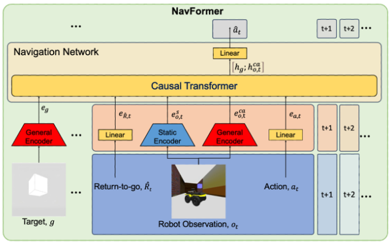
In unknown cluttered and dynamic environments such as disaster scenes, mobile robots need to perform target-driven navigation in order to find people or objects of interest, where the only information provided about these targets are images of the individual targets. In this letter, we introduce NavFormer, a novel end-to-end transformer architecture developed for robot target-driven navigation in unknown and dynamic environments. NavFormer leverages the strengths of both 1) transformers for sequential data processing and 2) self-supervised learning (SSL) for visual representation to reason about spatial layouts and to perform collision-avoidance in dynamic settings. The architecture uniquely combines dual-visual encoders consisting of a static encoder for extracting invariant environment features for spatial reasoning, and a general encoder for dynamic obstacle avoidance. The primary robot navigation task is decomposed into two sub-tasks for training: single robot exploration and multi-robot collision avoidance. We perform cross-task training to enable the transfer of learned skills to the complex primary navigation task. Simulated experiments demonstrate that NavFormer can effectively navigate a mobile robot in diverse unknown environments, outperforming existing state-of-the-art methods. A comprehensive ablation study is performed to evaluate the impact of the main design choices of NavFormer. Furthermore, real-world experiments validate the generalizability of NavFormer.
Overview
CoChat Summary
TL;DR
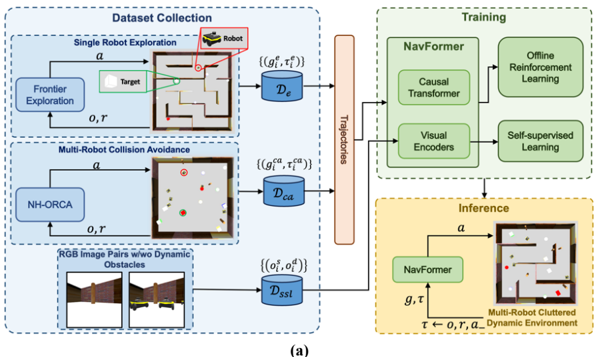
NavFormer is an end-to-end transformer architecture for robot target-driven navigation in unknown and dynamic environments, combining dual visual encoders trained with self-supervised learning and a GPT-2-based causal transformer trained with offline reinforcement learning. It outperformed several state-of-the-art learning methods in simulated unseen mazes, photorealistic environments, and unseen dynamic-obstacle tests, and generalized to real-world office trials.
Key findings
- In unseen 3D maze environments, NavFormer consistently achieved higher success rate (SR) and SPL and lower collision rate (CR) than VRW, DSAC, MA-TDN, and DT across all tested environment sizes and robot counts; for example, with 2 robots in one setup it reached SR 80.83%, SPL 0.562, and CR 0.228.
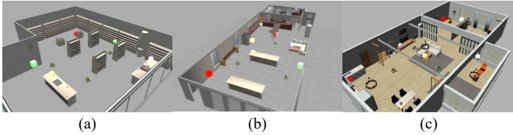
- In unseen photorealistic environments, NavFormer achieved SR 36.67%, SPL 0.269, and CR 0.412, outperforming VRW, DSAC, MA-TDN, and DT, though FCA—an upper-bound method using extra map and ground-truth state information—reached SR 82.22%, SPL 0.612, and CR 0.092.
- With unseen dynamic obstacles, NavFormer’s SR decreased from 48.89% (seen dynamic obstacles) to 41.67% (unseen), with SPL 0.322 and CR 0.301, but it still outperformed the other SOTA learning methods.
- Ablation showed the full NavFormer achieved SR 48.89%, SPL 0.378, and CR 0.223, while removing SSL, target hidden state concatenation, exploration trajectories, or either encoder reduced performance; replacing the dual encoders with ResNet18 gave the lowest result (SR 7.92%, SPL 0.080, CR 0.765).
- Real-world office experiments yielded SR 63.33%, SPL 0.406, and CR 0.229.
Methods
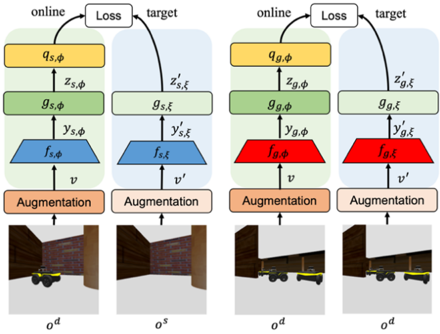
- NavFormer uses a multi-modal input sequence of target image and robot trajectory, dual visual encoders (a static encoder for invariant environment features and a general encoder for static/dynamic obstacle features) trained with BYOL self-supervised learning, and a GPT-2-based causal transformer navigation network trained with the Decision Transformer offline RL method.
- Training uses cross-task learning on two sub-tasks: single-robot exploration and multi-robot collision avoidance. Datasets included 3,496 exploration trajectories (342,954 timesteps), 7,467 collision-avoidance trajectories (469,378 timesteps), and 98,000 image pairs across 1,000 environments for representation learning.
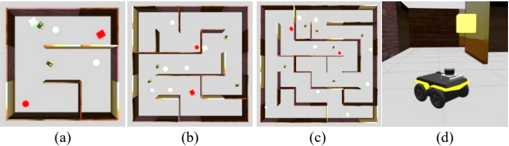
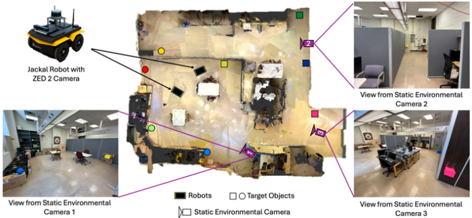
- Simulated experiments used Gazebo with 54 new 3D mazes, 2/4/6 Jackal robots, and 60 trials per setup; photorealistic tests used three environments with 30 trials each; unseen dynamic-obstacle tests used 60 trials per scenario; ablation used 60 trials in six 12.5 m × 12.5 m mazes with 4 Jackal robots; real-world tests used a 9.0 m × 10.0 m office with two Jackal robots and 15 trials.
Limitations
- The paper states that FCA outperformed NavFormer because FCA uses additional information unavailable to NavFormer and other learning methods, including point clouds, maps, other robots’ states, and specific target locations.
- The paper states that NavFormer’s performance decreased in unseen out-of-distribution photorealistic environments and with unseen dynamic obstacles, and future work will expand the architecture with object recognition backbones for common objects and different dynamic obstacles.
- Evident from the text: training used only Jackal robots as dynamic obstacles, real-world validation was limited to one office environment with two robots and 15 trials, and target objects were restricted to geometric shapes and colors.
Model-written summary. Check it against the paper before relying on it.
Integrity signals
Registry
Cites
Statistics
Figures
Verification
Claims the paper makes
6 Valid · 0 Not valid · 5 Not checked · 43 Own results and interpretations
The sources with a verdict support this claim; the rest weren’t checked yet, have no full text we could read, or their verdicts aren’t rated yet.
In the paper
“To-date, existing robot TDN methods for unknown environments have mainly used: 1) deep reinforcement learning (DRL) [5], [8]-[12] or 2) imitation learning (IL) [13].”
What the sources say
- Supportedcites [5] L. Mezghan et al. , 'Memory-Augmented Reinforcement Learning for Image-Goal Navigation,' in Proc. IEEE Int. Conf. Intell Robots Syst , 2022, pp. 3316-3323. source
The citation is among those attached to the deep-reinforcement-learning branch, not the separate imitation-learning citation. The Introduction (p. 1) calls RL a popular framework for navigation, and Related Work (p. 2) describes deep RL methods for navigation and the paper’s work on generalization to unseen environments. (LLM, conf=0.90)
- Not matchedcites [8]-[12]
A range of references, not one source.
- Not checked yetcites [13] Q. Wu, X. Gong, K. Xu, D. Manocha, J. Dong, and J. Wang, 'Towards Target-Driven Visual Navigation in Indoor Scenes via Generative Imitation Learning,' IEEE Robot. Autom. Lett. , vol. 6, no. 1, pp. 175182, Jan. 2021. source
Checked before — its earlier verdict is held back until a new check runs.
plain- Asserted: passes — The authors put it forward as true.
- Checkable: passes — It can be checked against evidence.
- Load-bearing: passes — The paper’s conclusions depend on it.
- Based: passes — The paper gives a reason why it holds.
- Supported
The cited sources support only part of this claim — read each source’s verdict below.
In the paper
“The pretrained visual representations do not generalize to domainspecific robot navigation task, leading to the decrease in performance [43].”
What the sources say
- Partly supportedcites [43] A. Majumdar et al. , 'Where are we in the search for an Artificial Visual Cortex for Embodied Intelligence?' arXiv: 2303.18240, 2024. sourceExperimental — accuracy not yet measured
The Introduction (p. 1) says pretrained visual representations are not universally dominant and tend to work best in the domains for which they were designed. But it also says they generally outperform learning-from-scratch baselines, and the results (Section 4, p. 5) identify pretrained models that perform best on navigation benchmarks. The source therefore supports a limitation in cross-domain generalization, not the claimed decrease in robot-navigation performance. (LLM, conf=0.86)
plainstates a cause- Asserted: passes — The authors put it forward as true.
- Checkable: passes — It can be checked against evidence.
- Load-bearing: passes — The paper’s conclusions depend on it.
- Based: passes — The paper gives a reason why it holds.
- Partly supported
A result the paper reports from its own data — it cites no other source for it, so there is none to check. The quote shows it is in the paper.
In the paper
“Furthermore, real-world experiments validate the generalizability of NavFormer.”
plainstates a cause- Asserted: passes — The authors put it forward as true.
- Checkable: passes — It can be checked against evidence.
- Load-bearing: passes — The paper’s conclusions depend on it.
- Based: passes — The paper gives a reason why it holds.
- Rests on an assumption not shown here.
A result the paper states — it cites no source for it, so there is none to check. The quote shows it is in the paper.
In the paper
“However, NavFormer still outperformed the other SOTA methods, showcasing the robustness of its learned policy against other TDN SOTA methods for unseen dynamic obstacles.”
boosted- Asserted: passes — The authors put it forward as true.
- Checkable: passes — It can be checked against evidence.
- Load-bearing: passes — The paper’s conclusions depend on it.
- Based: passes — The paper gives a reason why it holds.
A result the paper states — it cites no source for it, so there is none to check. The quote shows it is in the paper.
In the paper
“FCA had higher performance than NavFormer across all environments”
plainstates an association- Asserted: passes — The authors put it forward as true.
- Checkable: passes — It can be checked against evidence.
- Load-bearing: unclear — It is unclear whether the paper’s conclusions depend on it.
- Based: passes — The paper gives a reason why it holds.
29 more claims
Create a free account to see all 54 claims and to verify the 3 references still open.
- It may state two separate claims as one. 18
- The quote only partly states this claim. 1
- Probably not a substantial claim. 3
Self-check
Percentages, sums and reported differences re-computed from the paper’s own numbers.
Each contradiction between two passages listed here was confirmed by an independent check.
Rated minor: it would not touch a result — a value no result rests on, a p-value that stays on the same side of the significance level, or a conflict that is clerical, resolved elsewhere in the paper, or outside its own findings.
In the paper
§ D. Ablation Study · p. 7
“We conducted 60 trials in 6 maze environments of 12.5 m × 12.5 m with 4 Jackal robots for each variant.”
§ D. Ablation Study · p. 7
“| NavFormer | 48.89% | 0.378 | 0.223 |”
Rated minor: it would not touch a result — a value no result rests on, a p-value that stays on the same side of the significance level, or a conflict that is clerical, resolved elsewhere in the paper, or outside its own findings.
In the paper
§ A. Comparison Study in Unseen Maze Environments · p. 6
“60 trials were conducted for each experiment setup.”
§ Ⅴ. D ATASET C OLLECTION · p. 5
“| | 6 | 13.61% | 0.101 | 0.716 | 23.89% | 0.18 | 0.550 | 23.06% | 0.488 | 31.94% | 0.231 | 0.530 | 60.28% | 0.454 | 0.071 | 48.75% | 0.359 | 0.355 |”
Citations
Cites
Deep Residual Learning for Image Recognition
He, K., Zhang, X., Ren, S., & Sun, J. (2016) · 2016 IEEE Conference on Computer Vision and Pattern Recognition (CVPR) · doi:10.1109/cvpr.2016.90 · Cited by 235,474 · cited 1×
“These methods used Siamese CNN such as ResNet [15] to generate a joint embedding from robot image observations and the target image, and then they used this joint embedding to generate navigation actions.”
MethodHochreiter, S., & Schmidhuber, J. (1997) · Neural Computation · doi:10.1162/neco.1997.9.8.1735 · Cited by 102,318 · cited 1×
“In [10], the Importance Weighted Actor-Learner Architecture (IMPALA) [18] was used to train a navigation network with LSTM [17] to account for historical observations for robot navigation in 3D mazes.”
MethodAdam: A Method for Stochastic Optimization
Kingma, D. P., & Ba, J. (2014) · arXiv · doi:10.48550/arxiv.1412.6980 · Cited by 98,946
ImageNet: A large-scale hierarchical image database
Deng, J., Dong, W., Socher, R., Li, L.-J., Li, K., & Fei-Fei, L. (2009) · 2009 IEEE Conference on Computer Vision and Pattern Recognition · doi:10.1109/cvpr.2009.5206848 · Cited by 65,333 · cited 1×
“NavFormer with ResNet18 achieved the lowest performance among all variants due to the domain gap between the test environments (i.e., simulated 3D mazes) and ImageNet (i.e., web-scale object-centric images) [42].”
BackgroundProximal Policy Optimization Algorithms
Schulman, J., Wolski, F., Dhariwal, P., Radford, A., & Klimov, O. (2017) · arXiv · doi:10.48550/arxiv.1707.06347 · Cited by 40,403
(2014) · Cited by 33,419
Human-level control through deep reinforcement learning
Mnih, V., Kavukcuoglu, K., Silver, D., Rusu, A. A., Veness, J., Bellemare, M. G., Graves, A., Riedmiller, M., Fidjeland, A. K., Ostrovski, G., et al. (2015) · Nature · doi:10.1038/nature14236 · Cited by 30,357 · cited 1×
“Task-specific feature extraction has been shown to enhance policy learning in robot navigation [33].”
BackgroundReinforcement Learning: An Introduction
Sutton, R. S., & Barto, A. G. (1998) · IEEE Transactions on Neural Networks · doi:10.1109/tnn.1998.712192 · Cited by 27,225
Decoupled Weight Decay Regularization
Loshchilov, I., & Hutter, F. (2017) · arXiv · doi:10.48550/arxiv.1711.05101 · Cited by 12,522
Asynchronous Methods for Deep Reinforcement Learning
Mnih, V., Badia, A. P., Mirza, M., Graves, A., Lillicrap, T. P., Harley, T., Silver, D., & Kavukcuoglu, K. (2016) · arXiv · doi:10.48550/arxiv.1602.01783 · Cited by 7,132 · cited 1×
“In [8], the Asynchronous Advantage Actor Critic (A3C) [16] was used to train scene-specific FCLs to generate navigation actions using joint embedding.”
Method
Research works printed but not linked: 1
- J.-B. Grill et al. , 'Bootstrap Your Own Latent - A New Approach to SelfSupervised Learning,' in Adv. Neural Inf. Process. Syst, pp. 2127121284, 2020. · doi:10.5555/3495724.3497510
Cited by
Cheng, Z., Yang, J., Sun, J., & Zhao, L. (2025) · Drones · doi:10.3390/drones9070468 · Cited by 24
Baglioni, M., & Jamshidnejad, A. (2024) · Journal of Intelligent & Robotic Systems · doi:10.1007/s10846-024-02167-3 · Cited by 17
“The second group includes papers on navigation approaches guided by target information, where many use reinforcement learning [62, 63], foundation models based on deep learning [64, 65], or solve optimization problems [66].”
BackgroundMobile Robot Navigation Using Hand-Drawn Maps: A Vision Language Model Approach
Tan, A. H., Fung, A., Wang, H., & Nejat, G. (2025) · IEEE Robotics and Automation Letters · doi:10.1109/lra.2025.3577456 · Cited by 19
“This letter introduces a novel Hand-drawn Map Navigation (HAM-Nav) architecture that leverages pre-trained vision language models (VLMs) for robot navigation across diverse environments, hand-drawing styles, and robot embodiments, even in the presence of map inaccuracies.”
Self-citationLDTrack: Dynamic People Tracking by Service Robots Using Diffusion Models
Fung, A., Benhabib, B., & Nejat, G. (2025) · International Journal of Computer Vision · doi:10.1007/s11263-024-02336-9 · Cited by 11
Self-citationTowards real-time embodied AI agent: a bionic visual encoding framework for mobile robotics
Hou, X., Guan, Y., Han, T., & Wang, C. (2024) · International Journal of Intelligent Robotics and Applications · doi:10.1007/s41315-024-00363-w · Cited by 18
“…al. 2022; Yen-Chen et al. 2020), recent works are focusing on escalating the training methods from supervised learning to self-supervised learning (Wang et al. 2024; Pari et al. 2021) such as contrastive learning (Khandelwal et al. 2022; Fung et al. 2023) and masked autoencoder (Radosavovic et…”
Hu, D. T., Huang, C., Wu, J., & Yuan, X. (2025) · IEEE Transactions on Intelligent Transportation Systems · doi:10.1109/tits.2025.3591239 · Cited by 17
DRONE-RL: Dynamic reinforcement learning for online navigation of UAVs in evolving environments
Khial, N., Allahham, M. S., Mhaisen, N., Ismail, L. S., Mabrok, M. A., & Mohamed, A. M. S. (2025) · Knowledge-Based Systems · doi:10.1016/j.knosys.2025.115147 · Cited by 11
Enabling robots to autonomously search dynamic cluttered post-disaster environments
Rado, K., Baglioni, M., & Jamshidnejad, A. (2025) · Scientific Reports · doi:10.1038/s41598-025-18573-y · Cited by 10
“Navigating SaR robots is often target-driven 43 , i.e., it involves steering the robot via reference points towards a given target.”
Tang, Y., Bai, Y., & Chen, Q. (2025) · Sensors · doi:10.3390/s25061839 · Cited by 6
“Nejat G. et al. [4] introduced the NavFormer model, an end-to-end deep-learning solution designed for navigation in unknown dynamic motion planning, but it requires large-scale training datasets.”
Co-NavGPT: Multirobot Cooperative Visual Semantic Navigation Using Vision Language Models
Yu, B., Yuan, Q., Li, K., Kasaei, H., & Cao, M. (2025) · IEEE Robotics and Automation Letters · doi:10.1109/lra.2025.3645650 · Cited by 81
“Existing approaches can be broadly categorized into end-to-end frameworks [7], [8] and modular pipelines [9], [10], which aim to improve navigation performance by incorporating spatial and semantic features through supervised or reinforcement learning.”
Multi-modal scene graph inspired policy for visual navigation
He, Y. Q., Zhou, K., & Tian, T. L. (2024) · The Journal of Supercomputing · doi:10.1007/s11227-024-06541-8 · Cited by 7
Robot Arm Technology in Detection and Manipulation in Smart Pharmacies: A Review
Efendi, A., & Huang, C.-Y. (2025) · International Journal of Humanoid Robotics · doi:10.1142/s0219843625300016 · Cited by 4
Causality-Aware Transformer Networks for Robotic Navigation
Wang, R., Liu, Y., Cao, Y., & Yao, L. (2025) · Communications in computer and information science · doi:10.1007/978-981-96-7030-7_28 · Cited by 10
Wang, Q., Lyu, P., Lai, J., Bai, S., Fang, W., Li, J., Zeng, L., & Chen, Y. (2025) · IEEE Transactions on Instrumentation and Measurement · doi:10.1109/tim.2025.3600832 · Cited by 6
“In addition, NavFormer [94], a Transformer-based target-driven navigation framework, introduces a dual-visual encoder to disentangle static structures and dynamic obstacles, enabling separate modeling for mapping and avoidance.”
Chen, L., Wang, Y., Miao, Z., Feng, M., Wang, Y., Mo, Y., Zhou, Z., Wang, H., & Wang, D. (2024) · IEEE/RSJ International Conference on Intelligent Robots and Systems (IROS) · doi:10.1109/iros58592.2024.10802823 · Cited by 3
Self-citationVANP: Learning Where to See for Navigation with Self-Supervised Vision-Action Pre-Training
Nazeri, M., Wang, J., Payandeh, A., & Xiao, X. (2024) · IEEE/RSJ International Conference on Intelligent Robots and Systems (IROS) · doi:10.1109/iros58592.2024.10802451 · Cited by 13
“Conversely, VANP achieves real-world data generalization without relying on the pre-de fi nition of speci fi c rules only possible in simulation or through human annotation.”
4CNet: A Diffusion Approach to Map Prediction for Decentralized Multirobot Exploration
Tan, A. H., Narasimhan, S., & Nejat, G. (2026) · IEEE Transactions on Robotics · doi:10.1109/tro.2026.3666133 · Cited by 14
Self-citationDong, W., Liu, Y., Guo, X., Wang, C., & Ding, Z. (2025) · Chinese Journal of Aeronautics · doi:10.1016/j.cja.2025.104022 · Cited by 3
A Wheeled Robot Inspection System for Long‐Term Operation in Large‐Scale Industrial Environments
Yao, C., Liu, C., Chen, H., & Chen, Q. J. (2026) · Journal of Field Robotics · doi:10.1002/rob.70198 · Cited by 1
Xu, N., Yang, Z., Zhuo, H.-Z., et al. (2026) · Actuators · doi:10.3390/act15020116 · Cited by 1
İnner, A. B., & Chachoua, M. E. (2026) · Applied Sciences · doi:10.3390/app16031242 · Cited by 3
A Walk to Remember: Mllm Memory-Driven Visual Navigation*
Vitharana, S. S., Mallikarachchi, S., Wijayagrahi, H. C., Abizov, N., Bektemessov, A., Ibrayev, A., & Godage, I. S. (2025) · International Conference on Ubiquitous Robots (UR) · doi:10.1109/ur65550.2025.11078086 · Cited by 1
“Transformer-based architectures, like NavFormer [13], further enhance navigation by leveraging sequential data for improved adaptability in dynamic settings.”
Liu, H., Wang, R., Li, Y., Zhang, X., & Wang, Y. (2026) · IEEE Robotics and Automation Letters · doi:10.1109/lra.2026.3730349
Fan, B.-D., Xie, L.-H., Zhu, L.-F., et al. (2026) · The international journal of medical robotics + computer assisted surgery : MRCAS · doi:10.1002/rcs.70198
“Specifically, the visual deviation between the image centre and the intensity centroid of the lumen provides an early warning for potential collisions [19], thereby compensating for the absence of force information prior to contact.”
Li, H., Wang, H., & Zeng, L. (2026) · International Conference on Computational Intelligence and Communication Networks · doi:10.1109/cicn70047.2026.11594199
“Wang et al. [7] introduced a new end-to-end Transformer architecture called NavFormer, which is specifically developed for target-driven navigation of robots in unknown and dynamic environments.”
Self-citationA modal separation deep reinforcement learning method for navigation of autonomous mobile robot
Zhang, X., Wang, L., & Yi, J. (2026) · International Conference on Intelligent Computing and Signal Processing (ICSP) · doi:10.1109/icsp69961.2026.11540607
“Transformer based methods [9]–[11] solve the problem of sequential state observation of robot navigation.”
Vihmar, M., Boiko, R., Pankratov, K.-A., Kaasik, F., Ojavee, K., & Must, I. (2026) · Frontiers in Robotics and AI · doi:10.3389/frobt.2026.1736915
“Robots typically struggle to differentiate between genuine obstacles, such as branches or barbed wire, and harmless motions, such as swaying grass, due to the lack of a consistent frame of reference (Wang et al., 2024; Mohanan and Salgaonkar, 2022).”
Attention in depth for visual navigation of a mobile robot
Regragui, A., Benhlima, S., Bekri, A., Benhouria, Y., & Waga, A. (2026) · Results in Engineering · doi:10.1016/j.rineng.2026.109680
LLM-Based Simultaneous Waypoint Generation for Multi-robot Planning in 2D Corridor Environments
Lfellah, M. E. M., Leow, P. L., & Khamis, N. (2026) · Communications in computer and information science · doi:10.1007/978-981-92-0306-2_3
Wang, F., Chen, B., Zhang, Y., Guo, X., Lyu, Y., Liu, C., Knoll, A., Cui, D., Jiang, H., Ying, Y., et al. (2026) · IEEE Transactions on Robotics · doi:10.1109/tro.2026.3701578
Lai, J., Jiang, Z., & Liu, Y. (2025) · IEEE Robotics and Automation Letters · doi:10.1109/lra.2025.3645654 · Cited by 2
Recent advances in diffusion-based embodied imitation learning: a survey
Mu, L. I., Liu, X., Li, Q., Yu, X., Jingzhi, C. U. I., Zhao, L., Feng, H. A. N., Yang, X., Zhou, B., Niu, J., et al. (2026) · Scientia Sinica Informationis · doi:10.1360/ssi-2025-0307 · Cited by 2
Find Everything: A General Vision Language Model Approach to Multi-Object Search
Choi, D., Fung, A., Wang, H., & Tan, A. H. (2025) · IEEE/RSJ International Conference on Intelligent Robots and Systems (IROS) · doi:10.1109/iros60139.2025.11246991 · Cited by 10
“This is critical in domains such as such as warehouse management [1], construction inspection [2], and domestic [3], and retail assistance [4], [5].”
Self-citationUnleashing Creative Potential: Nurturing Trustworthy Generative AI
Huang, Z. (2025) · Cambridge University Press eBooks · doi:10.1017/9781009492553.005 · Cited by 2
Understanding Generative AI from Multidisciplinary Perspectives
Zou, M., Poncibò, C., Ebers, M., & Calo, R. (2025) · Cambridge University Press eBooks · doi:10.1017/9781009492553.003
Free-Form Instruction Guided Robotic Navigation Path Planning with Large Vision-Language Model
Du, Y., Wu, C., Feng, M., Luo, J., Zhong, H., Miao, Z., & Wang, Y. (2025) · Lecture notes in computer science · doi:10.1007/978-981-96-0789-1_28
Transformers Can Navigate Mazes With Multi-Step PredictionPreprint
Nolte, N. S. (2024) · Qeios · doi:10.32388/3q1xzw · Cited by 11
Metadata
- Authors
- Wang, H., Tan, A. H., & Nejat, G.
- Affiliations
- University of Toronto (CA)
- Venue
- IEEE Robotics and Automation Letters
- Published
- 2024-08
- Volume
- 9
- Issue
- 8
- Pages
- 6808-6815
- ISSN
- 2377-3766 (ISSN-L)
- 2377-3774
- OpenAlex
- W4391800510
- Cited by
- 40
- References
- 40
- Citations by year
- 2026: 13 · 2025: 21 · 2024: 6
- FWCI
- 5.93
- Type
- journal article
- Language
- en
- Open access
- green
- arxiv.org
- Licence
- Locations
- IEEE Robotics and Automation Letters (publishedVersion)
- arXiv (Cornell University) (submittedVersion)
- arXiv (Cornell University)
- Funders
- Natural Sciences and Engineering Research Council of Canada
- Canada Research Chairs
- Topics
- Physical Sciences › Computer Science › Artificial Intelligence › Reinforcement Learning in Robotics
- Physical Sciences › Engineering › Control and Systems Engineering › Robotic Path Planning Algorithms
- Physical Sciences › Computer Science › Computer Vision and Pattern Recognition › Robotics and Sensor-Based Localization
- Keywords
- transformer models, dynamic obstacle avoidance, multi-robot collision avoidance, dynamic environments, disaster search and rescue, mobile robot navigation, spatial reasoning
About these checks
Registry, retraction, Cites and statistics results are computed, not judged, with one exception: a printed reference that no index lists is read once by a model before it counts as a citation error. Claims are extracted by a model and kept only when their quote appears verbatim in the text; each cited source is then checked, with a model’s help, for whether it says what the claim relies on. Those verdicts can be wrong — read the claim’s quote and the cited source before relying on one.
The claim verdicts this report counts are experimental: their accuracy is not yet measured.
A language model drew the claims from the paper on 2026-10-10, under version 3 of the claim definition (model deepseek-v4.1-flash, prompt extract-v3).
A second model labelled each claim on 2026-10-10 (model jev-1.13-20260917, definition revision gold-guideline-v0.2).
Cited sources are checked with a language model’s help (gpt-6-sol).
Statistics and arithmetic are recomputed, not judged.
Confidence bands are shown only for fields calibrated on our annotated test set. None is calibrated yet, so no band is shown.
What counts as a claim ›How we measure confidence ›How we check this ›
Are you an author, or do you see a problem with this page? Request a review
Data sources
Bibliographic data: Semantic Scholar, OpenAlex, Crossref.
Contains information from the Semantic Scholar Academic Graph Datasets, made available under the ODC Attribution License (ODC-BY 1.0).
Semantic Scholar’s data is described in: Kinney, R., et al. (2023). The Semantic Scholar Open Data Platform. arXiv:2301.10140.
