

Improving Generalization of Deepfake Detection With Data Farming and Few-Shot Learning
Open accessThe DOI matches its Crossref record; 51 of the 52 references it cites were found in a registry or an index; 9 of the 24 sources its claims cite were checked for support.
Abstract
Recent advances in automated video and audio editing tools, generative adversarial networks (GANs), and social media allow creation and fast dissemination of high quality tampered videos, which are generally called deepfakes. Typically, in these videos, a face is swapped with someone else’s using GANs. Accessible open source software and apps for the face swapping led to a wide and rapid dissemination of the generated deepfakes, posing a significant technical challenge for their detection and filtering. In response to the threat, which deepfake videos can pose to our trust in video evidence, several large datasets of deepfake videos and several methods to detect them were proposed recently. However, the proposed methods suffer from a problem of overfitting on the training data and the lack of the generalization across different databases and the generative models. Therefore, in this paper, we investigate the techniques for improving the generalization of deepfake detection methods that can be employed in practical settings. We have selected two popular state of the art deepfake detectors: based on Xception and EfficientNet models, and we use five databases: from Google and Jigsaw, FaceForensics++, DeeperForensics, Celeb-DF, and our own publicly available large dataset DF-Mobio. To improve generalization, we apply different augmentation strategies used during training, including a proposed aggressive ‘data farming’ technique based on random patches. We also tested two few-shot tuning methods, when either a first convolutional layer or a last layer of a pre-trained model is tuned on 100 seconds from a training set of the test database. The experimental results clearly expose the generalization problem of deepfake detection methods, since the accuracy drops significantly when a model is trained on one dataset and evaluated on another. However, the silver lining is that an aggressive augmentation during training and a few-shot tuning on the test database can improve the accuracy of the detection methods in a cross-database scenario. As a side observation, we show the importance of database selection for training and evaluation, as FaceForensics++ is found to be better to use for training, while DeeperForensics is found to be significantly more challenging as a test database.
Overview
CoChat Summary
TL;DR
This paper evaluates Xception and EfficientNet deepfake detectors across five databases and shows severe cross-database generalization failure, with deepfakes misclassified as real rising from about 7% on average in same-database tests to well above 80% cross-database. It finds that aggressive “data farming” augmentation plus first-layer few-shot tuning on the target database improves cross-database HTER, while FaceForensics++ is best for training and DeeperForensics is most challenging for testing.
Key findings
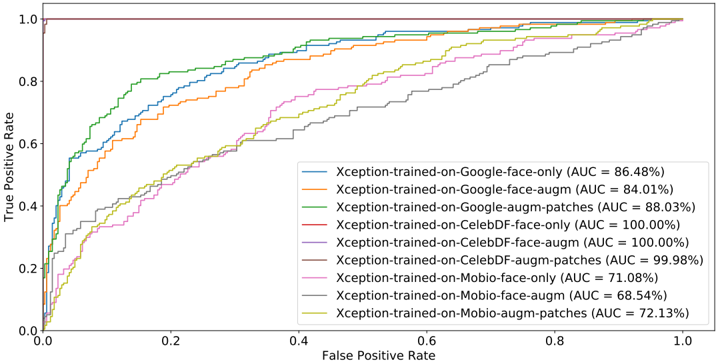
- Same-database performance is high, but cross-database performance collapses: the conclusion reports that the percentage of deepfake videos misclassified as real can go from a desirable 7% on average in a single-database scenario to well above 80% in the cross-database scenario. In Table 3, cross-database HTER values are roughly 38–46, with many FAR values above 80%.
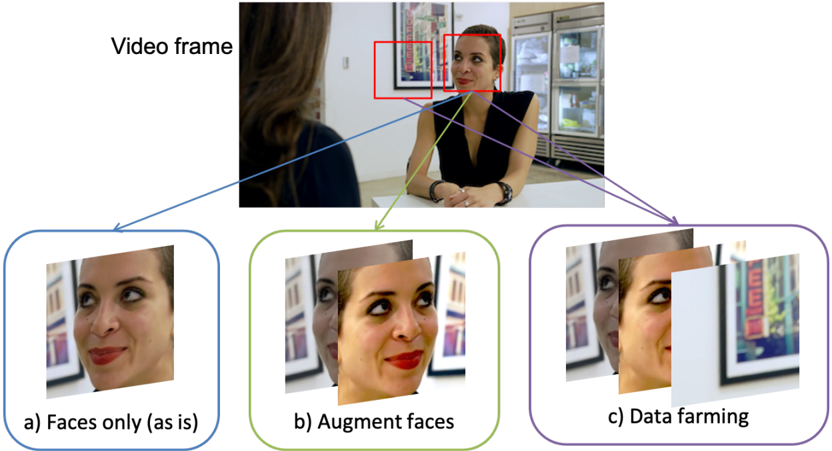
- The best generalization strategy is data farming (`augm-patches`: face augmentation plus background patches) combined with tuning the first layer on the test database. In Table 3, Xception with `augm-patches` and `first layer` tuning reaches HTER 38.14 and FAR 68.34; EfficientNet with the same strategy reaches HTER 39.69 and FAR 73.76. Removing DeeperForensics lowers Xception `augm-patches` + `first layer` to HTER 31% and FAR 50%, from 38% and 68%.
- Last-layer tuning is a mixed bag and is not recommended: it sometimes improves and sometimes worsens FAR/HTER. For same-database evaluation, the best configurations are faces-only with no tuning or at most last-layer tuning and no augmentation, but these overfit and perform poorly cross-database.
- Database choice matters: FaceForensics++ is the best database for training, DF-Mobio is next best, and DeeperForensics is the most challenging test database, with HTER averaging at 50% and FAR at nearly 99% independent of training or tuning strategies.
Methods
- Two detectors were used: XceptionNet and EfficientNet variant B4. Five databases were used: FaceForensics++ (Deepfakes, Face Shifter, Face Swap subsets), Google and Jigsaw, DeeperForensics, Celeb-DF, and DF-Mobio. Table 1 reports, for example, FaceForensics++ with 1000 original videos and 3000 deepfakes, DeeperForensics with 1000 original and 2000 deepfakes, Celeb-DF with 590 original and 5639 deepfakes, and DF-Mobio with 31,950 original and 14,546 deepfakes.
- Training used 299×299 input images, batch size 32, Adam optimizer with learning rate 0.0002, 20 epochs, early stopping on validation loss, and cross-entropy loss. The study trained 30 original non-tuned models, produced 240 tuned models, and evaluated 270 models total, yielding 630 sets of evaluation scores.
- Input variability strategies were `face-only`, `face-augm` (hue, brightness, contrast, saturation, flipping, JPEG quality 50–90), and `augm-patches` data farming (adding a background patch for each genuine face, effectively doubling the genuine class). Few-shot tuning strategies were `none`, `first layer`, and `last layer`, using roughly 100 seconds or 5 clips of 10 seconds from each class from another database’s training set. Evaluation used FAR, FRR, HTER, and AUC, with the threshold θ_far set at 10% FAR on the original training database’s validation set.
Limitations
- The paper states that detailed analysis of all results is not feasible in scope, so it focuses on general trends; DF-Mobio’s public availability is pending journal publication; the Facebook Deepfake Detection Challenge dataset was excluded due to strict licensing; and data/training fusion is left for future work.
- The paper states that generalization remains far from solved: even with aggressive data farming and first-layer tuning, cross-database FAR values are close to 70%, DeeperForensics is smaller and models may overfit more on it, and last-layer tuning is not recommended.
- Evident from the text: the evaluation covers only two architectures and five databases, fixes the threshold from the original training database, limits few-shot tuning to about 100 seconds, and lets DeeperForensics strongly affect aggregate cross-database averages.
Model-written summary. Check it against the paper before relying on it.
Integrity signals
Registry
Cites
Statistics
Figures
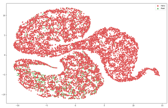
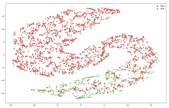
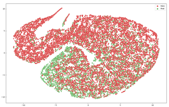
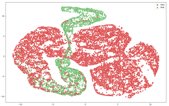
Verification
Claims the paper makes
7 Valid · 2 Not valid · 7 Not checked · 47 Own results and interpretations
The cited sources that could be checked couldn’t confirm or dispute this claim.
In the paper
“This problem was clearly shown during the Facebook's Deepfake Detection Challenge 2 , when the top approaches of the competition have consistently shown a much lower error on the public validation set compared to the error on the secret test set, which contained unseen data and deepfakes generated using undisclosed methods.”
What the sources say
- Could not verifycites [2] [2] D. M. Montserrat, H. Hao, S. K. Yarlagadda, S. Baireddy, R. Shao, J. Horvath, E. Bartusiak, J. Yang, D. G¨ uera, F. Zhu, and E. J. Delp, 'Deepfakes detection with automatic face weighting,' in 2020 IEEE/CVF Conference on Computer Vision and Pattern Recognition Workshops (CVPRW) , 2020, pp. 2851-2859. - sourceExperimental — accuracy not yet measured
Our copy of Montserrat et al. (2020) describes the DFDC setup — Section 3 states the 4000 private test videos "can not be inspected but models can be evaluated on it through the Kaggle system", that the manipulation type is not specified, and that "methods with good performance in metrics like accuracy, could have very high log-likelihood errors" — and the Abstract notes that many detection methods "fail when evaluated with data outside of the datasets used in research environments". But no passage reports the claim's decisive point: a comparison showing the competition's top approaches had much lower error on the public validation set than on the secret test set. The paper's own numbers (Section 4/Table 1 and Table 3, its 0.321 log-likelihood at position 117 of 2275 on the public leader-board; validation 92.61% vs test 91.88% balanced accuracy on its own splits) do not address a public-vs-private gap. Searched: public/private leaderboard gap, top approaches, undisclosed methods, generalization to unseen data. (LLM, conf=0.70)
boostedstates an association- Asserted: passes — The authors put it forward as true.
- Checkable: passes — It can be checked against evidence.
- Load-bearing: passes — The paper’s conclusions depend on it.
- Based: passes — The paper gives a reason why it holds.
- Could not verify
The cited sources that could be checked couldn’t confirm or dispute this claim.
In the paper
“DF-Mobio 6 dataset is generated by us and is one of the largest databases available with almost 15 K deepfake and 31 K real videos (see Table 1 for the comparison with other databases).”
What the sources say
- Could not verifycites [6] [6] Y. Li, P. Sun, H. Qi, and S. Lyu, 'Celeb-DF: A Large-scale Challenging Dataset for DeepFake Forensics,' in IEEE Conference on Computer Vision and Patten Recognition (CVPR) , Seattle, WA, United States, 2020. - sourceExperimental — accuracy not yet measured
Table 1 (p. 4) compares several DeepFake datasets, but does not list DF-Mobio. A search for DF-Mobio and the claimed counts found no passage in our copy addressing whether it has nearly 15,000 deepfake and 31,000 real videos. (LLM, conf=0.74)
plainn = 72- Asserted: passes — The authors put it forward as true.
- Checkable: passes — It can be checked against evidence.
- Load-bearing: unclear — It is unclear whether the paper’s conclusions depend on it.
- Based: passes — The paper gives a reason why it holds.
- Could not verify
A result the paper reports from its own data — it cites no other source for it, so there is none to check. The quote shows it is in the paper.
In the paper
“Adding more genuine data to the training will also help to balance out the genuine data portion (we are effectively doubling it by adding background patches), which is often significantly smaller compared to the amount of the deepfake data (Table 1 shows how significant the imbalance can be).”
plainstates a cause- Asserted: passes — The authors put it forward as true.
- Checkable: passes — It can be checked against evidence.
- Load-bearing: passes — The paper’s conclusions depend on it.
- Based: passes — The paper gives a reason why it holds.
A result the paper reports from its own data — it cites no other source for it, so there is none to check. The quote shows it is in the paper.
In the paper
“However, the silver lining is that an aggressive augmentation during training and a few-shot tuning on the test database can improve the accuracy of the detection methods in a cross-database scenario.”
plainstates a cause- Asserted: passes — The authors put it forward as true.
- Checkable: passes — It can be checked against evidence.
- Load-bearing: passes — The paper’s conclusions depend on it.
- Based: passes — The paper gives a reason why it holds.
A result the paper reports from its own data — it cites no other source for it, so there is none to check. The quote shows it is in the paper.
In the paper
“The experimental results clearly expose the generalization problem of deepfake detection methods, since the accuracy drops significantly when a model is trained on one dataset and evaluated on another.”
boostedstates a cause- Asserted: passes — The authors put it forward as true.
- Checkable: passes — It can be checked against evidence.
- Load-bearing: passes — The paper’s conclusions depend on it.
- Based: passes — The paper gives a reason why it holds.
28 more claims
Create a free account to see all 63 claims and to verify the 6 references still open.
- Probably not a substantial claim. 15
- It may state two separate claims as one. 21
Self-check
Percentages, sums and reported differences re-computed from the paper’s own numbers.
Each contradiction between two passages listed here was confirmed by an independent check.
Rated minor: it would not touch a result — a value no result rests on, a p-value that stays on the same side of the significance level, or a conflict that is clerical, resolved elsewhere in the paper, or outside its own findings.
In the paper
§ Pavel Korshunov and S´ ebastien Marcel
“our own publicly available large dataset DF-Mobio.”
§ 3.5 DF-Mobio
“The availability of this database to public is pending a journal publication.”
Rated minor: it would not touch a result — a value no result rests on, a p-value that stays on the same side of the significance level, or a conflict that is clerical, resolved elsewhere in the paper, or outside its own findings.
In the paper
§ 3.4 Celeb-DF
“The v2 of the database contains more than 5 K deepfakes and nearly 2 K real videos”
§ 2 RELATED WORK
“| Celeb-DF | 59 | 590 | 5639 |”
Citations
Cites
ImageNet Large Scale Visual Recognition Challenge
Russakovsky, O., Deng, J., Su, H., Krause, J., Satheesh, S., Ma, S., Huang, Z., Karpathy, A., Khosla, A., Bernstein, M., et al. (2015) · International Journal of Computer Vision · doi:10.1007/s11263-015-0816-y · Cited by 39,380
Xception: Deep Learning with Depthwise Separable Convolutions
Chollet, F. (2017) · 2017 IEEE Conference on Computer Vision and Pattern Recognition (CVPR) · doi:10.1109/cvpr.2017.195 · Cited by 20,380 · cited 3×
“For that reason, we have selected two state of the art algorithms, based on Xception model [18] and EfficientNet variant B4 [2], both of which showed a great performance on several databases [1] and were also successfully used in many top systems from Deepfake Detection Challenge [7].”
MethodEfficientNet: Rethinking Model Scaling for Convolutional Neural Networks
Tan, M., & Le, Q. V. (2019) · arXiv · doi:10.48550/arxiv.1905.11946 · Cited by 17,072
FaceForensics++: Learning to Detect Manipulated Facial Images
Rossler, A., Cozzolino, D., Verdoliva, L., Riess, C., Thies, J., & Niessner, M. (2019) · 2019 IEEE/CVF International Conference on Computer Vision (ICCV) · doi:10.1109/iccv.2019.00009 · Cited by 3,314 · cited 10×
“Strictly speaking this dataset is part of the FaceForensics++ [1] database, however, it is so different and is done by a different group of authors, hence we consider it as a separate dataset.”
BackgroundMethodInfluentialGeneralizing from a Few Examples: A Survey on Few-shot Learning
Wang, Y., Yao, Q., Kwok, J. T., & Ni, L. M. (2021) · ACM Computing Surveys · doi:10.1145/3386252 · Cited by 3,165
Celeb-DF: A Large-Scale Challenging Dataset for DeepFake Forensics
Li, Y., Yang, X., Sun, P., Qi, H., & Lyu, S. (2020) · 2020 IEEE/CVF Conference on Computer Vision and Pattern Recognition (CVPR) · doi:10.1109/cvpr42600.2020.00327 · Cited by 1,846 · cited 6×
“Another but larger ( 5 (cid:48) 000 videos) database based on Youtube videos (different from FaceForensics) is Celeb-Df [6].”
BackgroundMethodInfluentialDeepFakes and Beyond: A Survey of Face Manipulation and Fake Detection
Tolosana, R., Vera-Rodríguez, R., Fierrez, J., Morales, A., & Ortega-García, J. (2020) · Information Fusion · doi:10.48550/arxiv.2001.00179 · Cited by 1,252
Deepfakes and beyond: A Survey of face manipulation and fake detection
Tolosana, R., Vera-Rodriguez, R., Fierrez, J., Morales, A., & Ortega-Garcia, J. (2020) · Information Fusion · doi:10.1016/j.inffus.2020.06.014 · Cited by 1,237
CNN-Generated Images Are Surprisingly Easy to Spot… for Now
Wang, S.-Y., Wang, O., Zhang, R., Owens, A., & Efros, A. A. (2020) · 2020 IEEE/CVF Conference on Computer Vision and Pattern Recognition (CVPR) · doi:10.1109/cvpr42600.2020.00872 · Cited by 1,210
Exposing Deep Fakes Using Inconsistent Head Poses
Yang, X., Li, Y., & Lyu, S. (2019) · ICASSP 2019 - 2019 IEEE International Conference on Acoustics, Speech and Signal Processing (ICASSP) · doi:10.1109/icassp.2019.8683164 · Cited by 1,196
Research works printed but not linked: 3
- [31] N. Hulzebosch, S. Ibrahimi, and M. Worring, 'Detecting cnn-generated facial images in real-world scenarios,' in Proceedings of the IEEE/CVF Conference on Computer Vision and Pattern Recognition (CVPR) Workshops , June 2020. -
- [40] R. Tolosana, S. Romero-Tapiador, J. Fierrez, and R. Vera-Rodriguez, 'Deepfakes evolution: Analysis of facial regions and fake detection performance,' in ICPR International Workshops and Challenges , Feb. 2021.
- [28] D. Stanton, P. Karlsson, A. Vorobyov, T. Leung, J. Childs, A. Sud, and C. Bregler, 'Contributing data to deepfake detection research,' in Blogpost , 2019. -
Cited by
Privacy and Security Concerns in Generative AI: A Comprehensive Survey
Golda, A., Mekonen, K., Pandey, A., Singh, A., Hassija, V., Chamola, V., & Sikdar, B. (2024) · IEEE Access · doi:10.1109/access.2024.3381611 · Cited by 264
“…4) Technological Perspective 5) Institutional Perspective The rapid advancement of Generative AI has given rise to Deepfake Technology (DT) [81], [82], presenting a significant challenge to individuals and global institutions such as financial organizations and entertainment industry at large.”
BackgroundAbbas, F., & Taeihagh, A. (2024) · Expert Systems with Applications · doi:10.1016/j.eswa.2024.124260 · Cited by 186
Synthetic Data in Human Analysis: A Survey
Joshi, I., Grimmer, M., Rathgeb, C., Busch, C., Brémond, F., & Dantcheva, A. (2024) · IEEE Transactions on Pattern Analysis and Machine Intelligence · doi:10.1109/tpami.2024.3362821 · Cited by 149
DeepFake on Face and Expression Swap: A Review
Waseem, S., Abu Bakar, S. A. R. S., Ahmed, B. A., Omar, Z., Eisa, T. A. E., & Dalam, M. E. E. (2023) · IEEE Access · doi:10.1109/access.2023.3324403 · Cited by 65
“DF-Mobio [96]: This dataset contains over 46,000 videos, including 15,000 deepfakes and 31,000 authentic videos.”
BackgroundKosarkar, U. P., & Sakarkar, G. (2024) · Multimedia Tools and Applications · doi:10.1007/s11042-024-19220-w · Cited by 222
Improving Deepfake Detection Generalization by Invariant Risk Minimization
Yin, Z., Wang, J., Xiao, Y., Zhao, H., Li, T., Zhou, W., Liu, A., & Liu, X. (2024) · IEEE Transactions on Multimedia · doi:10.1109/tmm.2024.3355651 · Cited by 65
“Recently, improving the generalization ability of deepfake detection methods has attracted much attention [25], [26], [27], [28], [29], [30], [31].”
BackgroundDatasets, clues and state-of-the-arts for multimedia forensics: An extensive review
Yadav, A. K., & Vishwakarma, D. K. (2024) · Expert Systems with Applications · doi:10.1016/j.eswa.2024.123756 · Cited by 27
Deepfake attack prevention using steganography GANs
Noreen, I., Muneer, M. S., & Gillani, S. A. (2022) · PeerJ Computer Science · doi:10.7717/peerj-cs.1125 · Cited by 28
Manipulation detection of key populations under information measurement
Xiao, S., Zhang, Z., Yang, J., Wen, J., & Li, Y. (2023) · Information Sciences · doi:10.1016/j.ins.2023.03.006 · Cited by 20
Hydara, E., Kikuchi, M., & Ozono, T. (2024) · IEEE Access · doi:10.1109/access.2024.3480320 · Cited by 29
“These advancements are essential for maintaining the integrity of legal proceedings and ensuring that justice is served accurately and fairly in an era where digital evidence can no longer be taken at face value [26], [27], [28], [29], [30], [31], [32].”
BackgroundAlazwari, S., Alsamri, M. O. J., Alamgeer, M., Alabdan, R., Alzahrani, I. R., Rizwanullah, M., & Osman, A. E. (2024) · Ain Shams Engineering Journal · doi:10.1016/j.asej.2024.103057 · Cited by 13
Undercover Deepfakes: Detecting Fake Segments in Videos
Saha, S., Perera, R. D., Seneviratne, S., Malepathirana, T., Rasnayaka, S., Geethika, D., Sim, T., & Halgamuge, S. K. (2023) · IEEE International Conference on Computer Vision Workshops · doi:10.1109/iccvw60793.2023.00048 · Cited by 25
“Recently, more works [8, 67, 70, 28, 43, 31, 26, 23, 71, 58] have given increased attention towards generalizability of the detectors to detect deepfakes from unseen methods.”
BackgroundOn the detection of morphing attacks generated by GANs
Colbois, L., & Marcel, S. (2022) · International Conference of the Biometrics Special Interest Group (BIOSIG) · doi:10.1109/biosig55365.2022.9897046 · Cited by 17
“[14]), and the EER % (∈ [0, 100], lower is better).”
BackgroundMethodInfluentialSelf-citationHuman Versus Machine: A Comparative Analysis in Detecting Artificial Intelligence-Generated Images
Maiano, L., Benova, A., Papa, L., Stockner, M., Marchetti, M., Convertino, G., Mazzoni, G. A. L., & Amerini, I. (2024) · IEEE Security & Privacy · doi:10.1109/msec.2024.3390555 · Cited by 16
Samesh Enathe, V. P., Chandra Mouli, S., & Dheepthi, R. (2024) · International Conference on Advances in Data Engineering and Intelligent Computing Systems (ADICS) · doi:10.1109/adics58448.2024.10533511 · Cited by 15
“[8] looks on ways to make deepfake detection techniques more universal.”
BackgroundCustom Attribution Loss for Improving Generalization and Interpretability of Deepfake Detection
Korshunov, P., Jain, A., & Marcel, S. (2022) · IEEE International Conference on Acoustics Speech and Signal Processing · doi:10.1109/icassp43922.2022.9747628 · Cited by 13
Self-citationRajesh, T., & Maruthupermal, S. (2025) · Expert Systems with Applications · doi:10.1016/j.eswa.2025.129357 · Cited by 14
Qazi, N., & Ahmed, I. (2024) · International Conference on Pattern Recognition Systems (ICPRS) · doi:10.1109/icprs62101.2024.10677831 · Cited by 15
“Related experiments [1] have proved that the generalization performance of existing deepfake detection algorithms is still insufficient for cross-dataset detection tasks.”
BackgroundMITD-Net: Multi-scale iterative tamper detection network for image manipulation localization
Deng, F., Yu, H., Liu, T., & Yang, R. (2024) · Digital Signal Processing · doi:10.1016/j.dsp.2024.104901 · Cited by 10
Revisiting face forgery detection towards generalization
Peng, C., Chen, T., Liu, D., Guo, H., Wang, N., & Gao, X. (2025) · Neural Networks · doi:10.1016/j.neunet.2025.107310 · Cited by 9
Vulnerability of Automatic Identity Recognition to Audio-Visual Deepfakes
Korshunov, P., Chen, H., Garner, P. N., & Marcel, S. (2023) · IEEE International Joint Conference on Biometrics (IJCB) · doi:10.1109/ijcb57857.2023.10449189 · Cited by 13
“Methods for detecting visual fakes range from those based on simple visual or facial features [62, 60, 2, 37], binary classifiers trained on fake images [55, 17] and videos [50, 41, 40], to the methods that try to generalize to new deepfake methods or various post-processing blending techniques [3, 33, 29].”
BackgroundMethodSelf-citationA Meta-Learning Approach for Few-Shot Face Forgery Segmentation and Classification
Lin, Y., & Yen, T.-Y. (2023) · Sensors · doi:10.3390/s23073647 · Cited by 8
“[21] use few-shot tuning on the test dataset to overcome the problem of the accuracy dropping significantly when the model is tested on an unseen dataset.”
A Contemporary and Comprehensive Bibliometric Exposition on Deepfake Research and Trends
AbdulQudus, A. B., Amodu, O. A., Bukar, U. A., Mahmood, R. A. R., Zakaria, A. F., Queen, S.-O., & Hanapi, Z. M. (2025) · Computers, materials & continua/Computers, materials & continua (Print) · doi:10.32604/cmc.2025.061427 · Cited by 9
IRL-Net: Inpainted Region Localization Network via Spatial Attention
Daryani, A. E., Mirmahdi, M., Hassanpour, A., Shahreza, H. O., Yang, B., & Fiérrez, J. (2023) · IEEE Access · doi:10.1109/access.2023.3324541 · Cited by 11
“Future work includes analyzing and improving the generalization capabilities specially against unseen manipulations [16], [43], and further exploration of more sophisticate fusion architectures [27] combining image contents and noise elements.”
BackgroundTheoretical Bases of Methods of Counteraction to Modern Forms of Information Warfare
Bakirov, A. S., & Suleimenov, I. E. (2025) · Computers · doi:10.3390/computers14100410 · Cited by 25
Deepfake-Based Cyber Threats: Security Challenges and Countermeasures in the Age of Synthetic Media
Malik, A., Al-Aqrabi, H., & Aoudi, S. (2025) · Advances in computational intelligence and robotics book series · doi:10.4018/979-8-3373-0832-6.ch008 · Cited by 5
Auwal, A. M. (2026) · AI and Ethics · doi:10.1007/s43681-026-01154-8 · Cited by 5
“…using both adversarial training and input validation achieve higher effectiveness (60–75% mitigation) than either technique in isolation, but require substantial computational overhead. on current generation techniques show accuracy decline of 15–30% annually as new generation methods emerge [28 ].”
InfluentialDeepfake MRI Detection: A ViViT-Based Landmark Feature Extraction Approach for Brain Tumor Scans
Manju, V. N., & Pramiee, L. (2025) · International Conference on Smart Technologies, Communication and Robotics (STCR) · doi:10.1109/stcr62650.2025.11018958 · Cited by 2
“A New Approach for Effective Medical Deepfake Detection in Medical Images [12] proposes a CNN-based detection framework tailored for medical deepfake images, highlighting the challenges posed by GAN-based synthetic tumor manipulations.”
Lakhchaura, R., Madan, P., & Vishnoi, A. (2025) · International Conference on Computing, Communication and Automation · doi:10.1109/iccca66364.2025.11325599 · Cited by 3
“In [13] the author aim to solve the problems caused by the quick spread of high-quality deepfake films, which frequently result in poor generalization across various databases and generative models as well as overfitting on training data.”
Preserving video authenticity in the age of synthetic media using blockchain
Satone, K. N., & Amdani, S. Y. (2024) · AIP conference proceedings · doi:10.1063/5.0240462 · Cited by 2
FantasyID: A Dataset for Detecting Digital Manipulations in ID-Documents
Korshunov, P., Mohammadi, A., Vidit, Ecabert, C., & Marcel, S. (2025) · IEEE International Joint Conference on Biometrics (IJCB) · doi:10.1109/ijcb65343.2025.11411292 · Cited by 13
“For the base-line algorithms, we have only considered methods that focus on generic synthetic image or local region manipulations detection, as oppose to more known methods of deep-fake detection that typically focus on faces [13, 16].”
Self-citationJabbar, N., Bhatti, S. M., Rashid, M., Jaffar, A., & Akram, S. (2025) · PLoS ONE · doi:10.1371/journal.pone.0326565 · Cited by 7
“The research [27] investigates techniques for improving the generalization of deepfake detection methods, employing aggressive data augmentation and few-shot tuning.”
TBIOM Special Issue on Trustworthy Biometrics–Editorial
Deng, W., Hassner, T., Liu, X., & Pantić, M. (2022) · IEEE Transactions on Biometrics Behavior and Identity Science · doi:10.1109/tbiom.2022.3185447 · Cited by 2
A Survey on Accessible Deepfake Detection on Improved Datasets and Algorithms
Dhawase, D. D. D., Rathore, N., Panmand, P., Yadav, V., & Patil, P. (2025) · Lecture notes in networks and systems · doi:10.1007/978-981-96-3247-3_26 · Cited by 1
DeepID Challenge of Detecting Synthetic Manipulations in ID Documents
Korshunov, P., Vidit, Mohammadi, A., Ecabert, C., Shamoska, N., Marcel, S., Yu, Z., Tian, Y., Ni, J., Lazarević, L., et al. (2025) · IEEE International Conference on Computer Vision Workshops · doi:10.1109/iccvw69036.2025.00059 · Cited by 16
“Recent advances in visual generative models, including generative adversarial networks (GANs) and diffusion-based methods, have made it increasingly easy to create highly realistic and convincing digital forgeries of ID documents.”
Self-citationEnhancing abnormality identification: Robust out-of-distribution strategies for deepfake detection
Maiano, L., Casadei, F., & Amerini, I. (2026) · Forensic Science International Digital Investigation · doi:10.1016/j.fsidi.2026.302062 · Cited by 4
Shivaprakash, S. J., Chauhan, A., Sabireen, H., & Quadir, A. (2026) · Signal Image and Video Processing · doi:10.1007/s11760-026-05279-5 · Cited by 4
Hsu, M.-H., Hsu, Y.-C., & Chiu, C. (2026) · IEEE Transactions on Biometrics Behavior and Identity Science · doi:10.1109/tbiom.2026.3683085 · Cited by 2
“Related e ff orts in biometric PAD and synthetic media detection also suggest that learning from diverse forgery sources is an e ff ective direction for improving generalization to unseen attacks [20], [34], [35], [36].”
Evaluating Cross-Dataset Robustness of Video Deepfake Detection Models
Jyothi, B. N., & Jabbar, M. A. (2026) · IEEE International Conference for Convergence in Computing Technology (I3CTCON) · doi:10.1109/i3ctcon68242.2026.11507503
“Consequently, retraining strategies and few-shot learning approaches have been explored to address evolving deepfake generation methods [14], [15].”
Ahmed, A. E. S. (2024) · International Journal of Advanced Computer Science and Applications · doi:10.14569/ijacsa.2024.0150794 · Cited by 2
“A suggested approach for MM RETINGRAPH image segmentation is integrated with super-pixel-based fuzzy-modified flower pollination and a type 2 fuzzy clustering method in a segmentation-based study [35].”
MethodEnhanced security through face recognition and deepfake prevention
Ramteke, N. S., & Ramteke, S. P. (2025) · Information Security Journal A Global Perspective · doi:10.1080/19393555.2025.2557856 · Cited by 1
“DeepFaceLab (K. Liu et al., 2023), Data Farming Few-Shot Learning (Korshunov & Marcel, 2022), convolutional neural networks, and vision transformers (Soudy et al., 2024) are unable to identify new types of fake images and require improvements in training quality.”
Multi-Collaborative Unsupervised Contrastive Learning for DeepFake Detection Amidst Unseen Artifact
Michael, M. S. M., & Jeyaraj, P. R. (2025) · Cognitive Computation · doi:10.1007/s12559-025-10519-w
“Conventional DeepFake detection methods, such as biometric feature extraction [8], Principal component analysis [ 9 ], image quality enhancement [10], and textural [11 ] rely primarily on handcrafted features.”
DeepFex: Explainable and Secure Deepfake Detection System
Manoj, R. K., & Nandhini, S. A. (2025) · Blockchain technologies · doi:10.1007/978-981-95-1394-9_4
Performance Analysis of Deepfake Detection Techniques Using Different Deep Learning Models
Pandey, A., & Solanki, A. (2025) · Lecture notes in electrical engineering · doi:10.1007/978-981-96-3936-6_20 · Cited by 1
A Semantic Adversarial Network for Detection and Classification of Myopic燤aculopathy
Abbas, Q., Baig, A. R., & Hussain, A. (2023) · Computers, materials & continua/Computers, materials & continua (Print) · doi:10.32604/cmc.2023.036366 · Cited by 1
Sumon, M. S. B., & Najar, F. (2026) · INTERNATIONAL CONFERENCE ON MULTIMODAL INTERACTION · doi:10.1145/3776574.3831219
Attention-Based Refinement and Criss-Cross Mechanisms in GANs for Improved Deepfake Detection
Selvaraj, P., & Belmin, S. A. (2025) · Communications in computer and information science · doi:10.1007/978-3-032-00884-8_26
Unmasking the Audio Illusion: A Survey on Spoofing and Deepfake Detection
Aarthi, S., & Agarwal, A. (2025) · IEEE International Joint Conference on Biometrics (IJCB) · doi:10.1109/ijcb65343.2025.11411112 · Cited by 1
“• Performance on Limited Data and Zero-Shot Sce-narios: Existing challenges persist in achieving robust deepfake audio detection, particularly when confronted with limited training data and encountering entirely new voices (zero-shot scenarios) [24].”
Metadata
- Authors
- Korshunov, P., & Marcel, S.
- Affiliations
- Idiap Research Institute (CH)
- Biometrics Security and Privacy Group, Idiap Research Institute, Martigny, Switzerland
- Venue
- IEEE Transactions on Biometrics, Behavior, and Identity Science
- Published
- 2022-07
- Volume
- 4
- Issue
- 3
- Pages
- 386-397
- ISSN
- 2637-6407 (ISSN-L)
- OpenAlex
- W4205421468
- Cited by
- 50
- References
- 52
- Citations by year
- 2026: 8 · 2025: 17 · 2024: 14 · 2023: 7 · 2022: 4
- FWCI
- 3.44
- Type
- journal article
- Language
- en
- Open access
- green
- iris.unil.ch
- Licence
- Locations
- IEEE Transactions on Biometrics Behavior and Identity Science (publishedVersion)
- IRIS (submittedVersion)
- Funders
- Hasler Foundation’s VERIFAKE Project
- Swiss Center for Biometrics Research and Testing
- Topics
- Physical Sciences › Computer Science › Computer Vision and Pattern Recognition › Digital Media Forensic Detection
- Physical Sciences › Computer Science › Computer Vision and Pattern Recognition › Generative Adversarial Networks and Image Synthesis
- Social Sciences › Sociology and Political Science › Misinformation and Its Impacts
- Keywords
- deepfake detection, cross-dataset generalization, data farming, few-shot learning, cross-database evaluation, face swapping, generative adversarial networks, Xception, EfficientNet, FaceForensics++, Celeb-DF, database selection, overfitting
About these checks
Registry, retraction, Cites and statistics results are computed, not judged, with one exception: a printed reference that no index lists is read once by a model before it counts as a citation error. Claims are extracted by a model and kept only when their quote appears verbatim in the text; each cited source is then checked, with a model’s help, for whether it says what the claim relies on. Those verdicts can be wrong — read the claim’s quote and the cited source before relying on one.
The claim verdicts this report counts are experimental: their accuracy is not yet measured.
A language model drew the claims from the paper on 2026-09-30, under version 3 of the claim definition (model deepseek-v4.1-flash, prompt extract-v3).
A second model labelled each claim on 2026-09-30 (model jev-1.13-20260917, definition revision gold-guideline-v0.2).
Cited sources are checked with a language model’s help (qwen3.8-omni-flash and gpt-6-sol).
Statistics and arithmetic are recomputed, not judged.
Confidence bands are shown only for fields calibrated on our annotated test set. None is calibrated yet, so no band is shown.
What counts as a claim ›How we measure confidence ›How we check this ›
Are you an author, or do you see a problem with this page? Request a review
Data sources
Bibliographic data: Semantic Scholar, OpenAlex, Crossref.
Contains information from the Semantic Scholar Academic Graph Datasets, made available under the ODC Attribution License (ODC-BY 1.0).
Semantic Scholar’s data is described in: Kinney, R., et al. (2023). The Semantic Scholar Open Data Platform. arXiv:2301.10140.
