

Explainable AI-Aided Feature Selection and Model Reduction for DRL-Based V2X Resource Allocation
The DOI matches its Crossref record; 59 of the 59 references it cites were found in a registry or an index; 12 of the 30 sources its claims cite were checked for support.
Abstract
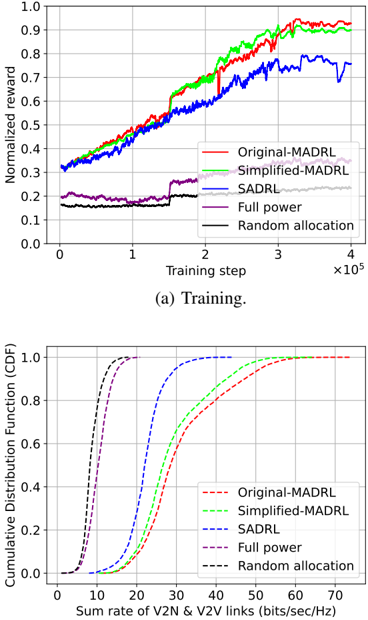
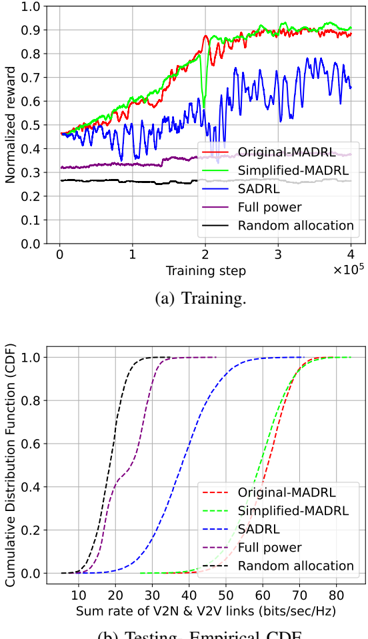
Artificial intelligence (AI) is expected to significantly enhance radio resource management (RRM) in sixth-generation (6G) networks. However, the lack of explainability in complex deep learning (DL) models poses a challenge for practical implementation. This paper proposes a novel explainable AI (XAI)-based framework for feature selection and model complexity reduction in a model-agnostic manner. Applied to a multi-agent deep reinforcement learning (MADRL) setting, our approach addresses the joint sub-band assignment and power allocation problem in cellular vehicle-to-everything (V2X) communications. We propose a novel two-stage systematic explainability framework leveraging feature relevance-oriented XAI to simplify the DRL agents. While the former stage generates a state feature importance ranking of the trained models using Shapley additive explanations (SHAP)-based importance scores, the latter stage exploits these importance-based rankings to simplify the state space of the agents by removing the least important features from the model’s input. Simulation results demonstrate that the XAI-assisted methodology achieves ~97% of the original MADRL sum-rate performance while reducing optimal state features by ~28%, average training time by ~11%, and trainable weight parameters by ~46% in a network with eight vehicular pairs.
Overview
CoChat Summary
TL;DR
The paper proposes a post-hoc, model-agnostic SHAP-based XAI pipeline to rank and select input state features for a MADRL V2X resource-allocation system, then retrains reduced-size DRL agents. It reports near-original sum-rate with fewer state features, lower training time, and fewer broadcast parameters.
Key findings
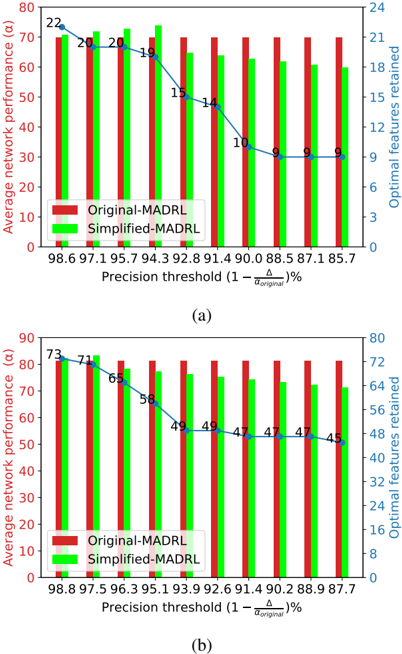
- The XAI-assisted Simplified-MADRL achieves ∼97% of Original-MADRL sum-rate while reducing optimal state features by ∼28%, average training time by ∼11%, and trainable weight parameters by ∼46% in a network with eight vehicular pairs.
- For K=4 and K=8 V2V agents, the method reduces optimal state features by ∼21% and ∼28%, average training time by ∼26% and ∼11%, and broadcast parameters per agent by ∼35% and ∼46%, respectively; Table IV reports 24→19 and 80→58 state features, 6.23→4.56 ms and 13.4→11.9 ms training time, and 34,544→22,424 and 347,920→185,912 broadcast parameters.
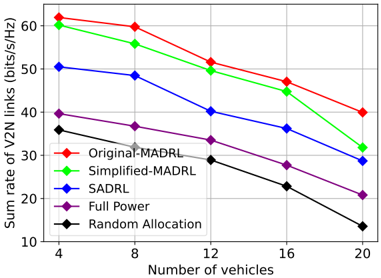
- Simplified-MADRL outperforms centralized SADRL by on average 41% higher sum-rate for K=N=4 and 66% higher for K=N=8; the average sum-rate difference from Original-MADRL is less than ∼7% for K=N=4, and for K=N=8 it achieves higher sum-rates for most links with ∼28% fewer state features.
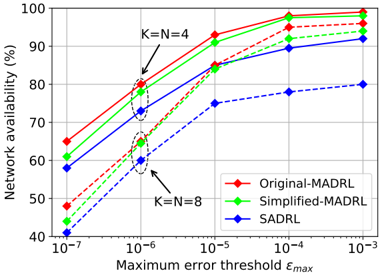
- Reliability results show Original-MADRL reaching ∼92% network availability at εmax=10⁻⁵ for K=N=4 and nearly 98.3% at εmax=10⁻⁴; Simplified-MADRL reaches around 98% at εmax=10⁻⁴ for K=N=4, while SADRL achieves only ∼80% for K=N=8 at εmax=10⁻³.
Methods
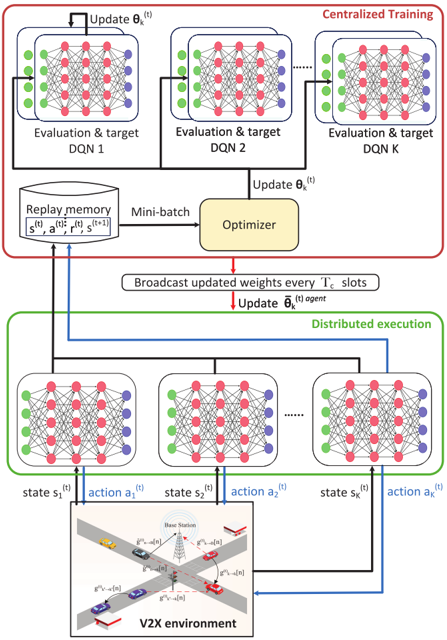
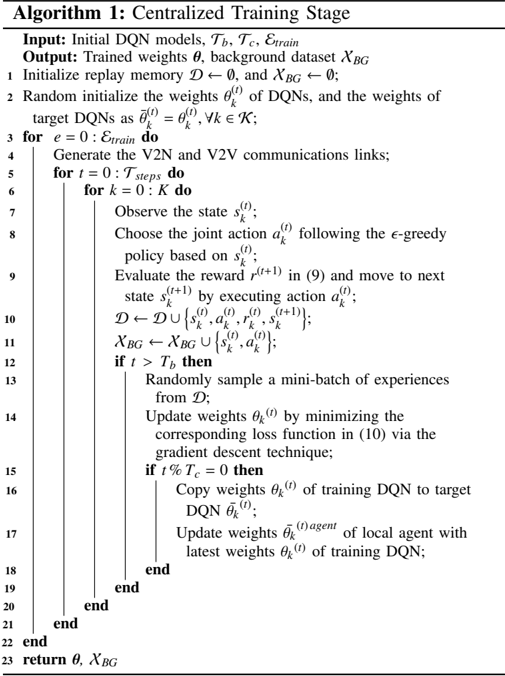
- The paper formulates joint spectrum sub-band assignment and transmit-power allocation for V2N and V2V links in a URLLC-enabled C-V2X network, maximizing sum-rate under reliability, latency, and power constraints. It solves this with MADRL using centralized training at the BS and decentralized execution at V2V transmitters, with DQNs and a common reward.
- The XAI pipeline uses Deep-SHAP on trained DQN agents with background and hold-out datasets to produce global state-feature importance rankings. An iterative feature-selection algorithm masks the least important features, evaluates average network performance against a precision threshold Δ, and retrains the model on the retained subset.
- Simulations follow 3GPP TR 36.885 urban V2X setup: 750×1299 m area, 9 buildings, 2 GHz carrier, 23 dBm max transmit power, 1 ms packet latency, 180 kHz V2N bandwidth, and K=N=4 and K=N=8 configurations. Performance is compared against Original-MADRL, Simplified-MADRL, centralized SADRL, Full power, and Random allocation.
Limitations
- The paper states that theoretical convergence guarantees for the proposed MADRL solution and other advanced multi-agent adaptations are challenging in dynamic vehicular networks despite good empirical performance; the common global reward mitigates instability but prevents each agent from achieving a higher individual reward.
- The paper states that the method is designed for a specific vehicular environment: when the environment changes, DNNs need retraining and feature selection must be reevaluated. It also notes that high mobility can make well-trained models outdated, retraining may be triggered by performance thresholds, and if vehicles exceed the maximum trained agents, extra vehicle information is not included in the state.
- The paper states that Deep-SHAP computational complexity increases exponentially with the number of state features and linearly with background samples, so it uses K-means summaries (1% background, 10% hold-out). Evident from the text: evaluation is simulation-only, with no real-world deployment results, and the approach depends on offline training, CSI/feedback assumptions, and periodic weight broadcasting.
Model-written summary. Check it against the paper before relying on it.
Integrity signals
Registry
Cites
Statistics
Figures



Verification
Claims the paper makes
5 Valid · 13 Not valid · 17 Not checked · 89 Own results and interpretations
The cited sources support only part of this claim — read each source’s verdict below.
In the paper
“Nevertheless, DRL-based resource allocation relies on complex deep neural networks (DNNs) with multiple layers, making them difficult to understand due to their black-box nature and lack of explainability [5].”
What the sources say
- Partly supportedcites [5] sourceExperimental — accuracy not yet measured
The Introduction says AI-based resource management commonly uses complex deep-learning models that are difficult to interpret because of their black-box nature. The section on DRL-based resource management describes a DRL agent for power allocation, but the passages found do not establish the claim's specific description of its DNN as having multiple layers. (LLM, conf=0.82)
plainstates a cause- Asserted: passes — The authors put it forward as true.
- Checkable: passes — It can be checked against evidence.
- Load-bearing: passes — The paper’s conclusions depend on it.
- Based: passes — The paper gives a reason why it holds.
- Partly supported
The cited sources that could be checked couldn’t confirm or dispute this claim.
In the paper
“One major obstacle associated with the Deep-SHAP based SHAP values estimation is the considerable computational complexity, which increases exponentially with the number of state features and linearly with the number of background data samples [40].”
What the sources say
- Could not verifycites [40] sourceExperimental — accuracy not yet measured
The Discussion section discusses the computational complexity of the paper’s deep reinforcement-learning method, not Deep-SHAP. Searches for Deep-SHAP, SHAP values, background samples, and feature-attribution complexity found no passage addressing the claimed exponential or linear scaling. Page numbers were unavailable in our copy. (LLM, conf=0.78)
plainstates a cause- Asserted: passes — The authors put it forward as true.
- Checkable: passes — It can be checked against evidence.
- Load-bearing: passes — The paper’s conclusions depend on it.
- Based: passes — The paper gives a reason why it holds.
- Could not verify
The cited sources support only part of this claim — read each source’s verdict below.
In the paper
“The Shapley additive explanations (SHAP) method is particularly effective for feature selection, as it assigns importance values to each feature based on their contribution to the model's predictions, allowing for the exclusion of less significant features without sacrificing performance [20].”
What the sources say
- Partly supportedcites [20] sourceExperimental — accuracy not yet measured
Split into 2 atoms — 0 confirmed, 2 partially supported, 0 disputed, 0 misattributed, 0 unverifiable. Expand the claim to see per-atom verdicts.
plainstates a cause- Asserted: passes — The authors put it forward as true.
- Checkable: passes — It can be checked against evidence.
- Load-bearing: passes — The paper’s conclusions depend on it.
- Based: passes — The paper gives a reason why it holds.
- Partly supported
Every source the paper cites for this claim was checked and supports it.
In the paper
“Due to the dynamic nature of the C-V2X networks and the associated short coherence time interval, centralized solutions are inadequate due to difficulties in acquiring the instantaneous CSI of all links [36].”
What the sources say
- Supportedcites [36] source
Section II (System Model) of our copy states directly that 'High mobility in a vehicular environment precludes collection of accurate full CSI at a central controller, hence making distributed V2V resource allocation more preferable,' which is the claim's substance. The same section models decisions over channel coherence time ΔT with small-scale fading varying each slot, and Section III has each V2V agent act 'on a time scale on par with the small-scale channel fading,' supporting the dynamism/short-coherence-time rationale. Section IV reinforces inadequacy of the centralized alternative: the centralized maxV2V baseline 'needs to be performed in a centralized way with accurate global CSI available' and is called 'way too idealistic and cannot be implemented in practice.' The Related Work section likewise frames prior schemes as coping with 'fleeting channel conditions' by relieving full-CSI requirements. (LLM, conf=0.85)
plainstates a cause- Asserted: passes — The authors put it forward as true.
- Checkable: passes — It can be checked against evidence.
- Load-bearing: passes — The paper’s conclusions depend on it.
- Based: passes — The paper gives a reason why it holds.
- Supported
A result the paper reports from its own data — it cites no other source for it, so there is none to check. The quote shows it is in the paper.
In the paper
“Simulation results demonstrate that the XAI-assisted methodology achieves ∼ 97% of the original MADRL sum-rate performance while reducing optimal state features by ∼ 28%, average training time by ∼ 11%, and trainable weight parameters by ∼ 46% in a network with eight vehicular pairs.”
boostedstates a cause- Asserted: passes — The authors put it forward as true.
- Checkable: passes — It can be checked against evidence.
- Load-bearing: passes — The paper’s conclusions depend on it.
- Based: passes — The paper gives a reason why it holds.
55 more claims
Create a free account to see all 124 claims and to verify the 4 references still open.
- Probably not a substantial claim. 45
- It may state two separate claims as one. 33
- The quote only partly states this claim. 1
Self-check
Percentages, sums and reported differences re-computed from the paper’s own numbers.
Each contradiction between two passages listed here was confirmed by an independent check.
Rated minor: it would not touch a result — a value no result rests on, a p-value that stays on the same side of the significance level, or a conflict that is clerical, resolved elsewhere in the paper, or outside its own findings.
In the paper
§ A. Problem Transformation into DRL Framework
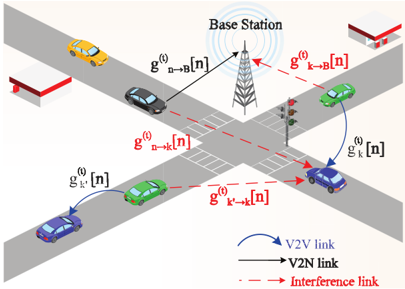
“the interference channel gain from its transmitter to the BS g ( t ) k → B [ n ], ∀ n ∈ N”
§ A. Problem Transformation into DRL Framework
“The scale of the state space is ( K + 2) × N per V2V agent, which includes N elements for the direct link between the k -th V2V transmitter and its receiver, ( K × N -N ) elements for the interfering channels from other V2V transmitters, N elements for the V2N links, and N elements for the sum interference.”
Citations
Cites
Human-level control through deep reinforcement learning
Mnih, V., Kavukcuoglu, K., Silver, D., Rusu, A. A., Veness, J., Bellemare, M. G., Graves, A., Riedmiller, M., Fidjeland, A. K., Ostrovski, G., et al. (2015) · Nature · doi:10.1038/nature14236 · Cited by 30,357
A Unified Approach to Interpreting Model Predictions
Lundberg, S., & Lee, S.-I. (2017) · arXiv · doi:10.48550/arxiv.1705.07874 · Cited by 23,707
"Why Should I Trust You?": Explaining the Predictions of Any Classifier
Ribeiro, M. T., Singh, S., & Guestrin, C. (2016) · Proceedings of the 22nd ACM SIGKDD International Conference on Knowledge Discovery and Data Mining · doi:10.1145/2939672.2939778 · Cited by 17,555
From local explanations to global understanding with explainable AI for trees
Lundberg, S. M., Erion, G., Chen, H., DeGrave, A., Prutkin, J. M., Nair, B., Katz, R., Himmelfarb, J., Bansal, N., & Lee, S.-I. (2020) · Nature Machine Intelligence · doi:10.1038/s42256-019-0138-9 · Cited by 10,551 · cited 4×
“In the first stage of generating state feature importance ranking using the trained agents, we instantiate a DeepExplainer from the SHAP library [17] and pass the trained agent’s DQNs along with the background dataset to it.”
InfluentialModel-Agnostic Meta-Learning for Fast Adaptation of Deep Networks
Finn, C., Abbeel, P., & Levine, S. (2017) · arXiv · doi:10.48550/arxiv.1703.03400 · Cited by 8,512
“Why Should I Trust You?”: Explaining the Predictions of Any Classifier
Ribeiro, M., Singh, S., & Guestrin, C. (2016) · Proceedings of the 2016 Conference of the North American Chapter of the Association for Computational Linguistics: Demonstrations · doi:10.18653/v1/n16-3020 · Cited by 6,682
Channel Coding Rate in the Finite Blocklength Regime
Polyanskiy, Y., Poor, H. V., & Verdu, S. (2010) · IEEE Transactions on Information Theory · doi:10.1109/tit.2010.2043769 · Cited by 3,885
Learning Important Features Through Propagating Activation Differences
Shrikumar, A., Greenside, P., & Kundaje, A. (2017) · arXiv · doi:10.48550/arxiv.1704.02685 · Cited by 2,761
Explaining Deep Neural Networks and Beyond: A Review of Methods and Applications
Samek, W., Montavon, G., Lapuschkin, S., Anders, C. J., & Muller, K.-R. (2021) · Proceedings of the IEEE · doi:10.1109/jproc.2021.3060483 · Cited by 1,477 · cited 1×
“For instance, Saliency Maps and Layer-wise Relevance Propagation methods are well-suited for convolutional neural networks, highlighting important input regions in computer vision tasks [25].”
A tutorial on 5G NR V2X communications
Garcia, M. H. C., Molina-Galan, A., Boban, M., Gozalvez, J., Coll-Perales, B., Şahin, T., & Kousaridas, A. (2021) · IEEE Communications Surveys & Tutorials · doi:10.1109/comst.2021.3057017 · Cited by 975
Research works printed but not linked: 2
- 2016, Technical Specification Group Radio Access Network; Study on LTE-Based V2X Services; (release 14)
- Kyösti, 2007, Ist-4-027756 Winner II D1.1.2 V1.2 Winner II Channel Models
Cited by
Utilization of machine learning in future wireless networks for resource optimization: A survey
Liaq, M., Sharif, S., Zeadally, S., & Ejaz, W. (2025) · Ad Hoc Networks · doi:10.1016/j.adhoc.2025.103983 · Cited by 19
Explainable AI for Enhancing Efficiency of DL-Based Channel Estimation
Gizzini, A. K., Medjahdi, Y., Ghandour, A. J., & Clavier, L. (2025) · IEEE Transactions on Machine Learning in Communications and Networking · doi:10.1109/tmlcn.2025.3596548 · Cited by 18
Explainable and Robust Millimeter Wave Beam Alignment for AI-Native 6G Networks
Khan, N., Abdallah, A., Celik, A., Eltawil, A. M., & Çöleri, S. (2025) · International Conference on Communications · doi:10.1109/icc52391.2025.11161537 · Cited by 11
Self-citationA Broader Survey on 6G Radio Resource Management
de Faria, A. J., Brito, J. M. C., Spadoti, D. H., & Borges, R. M. (2026) · Sensors · doi:10.3390/s26082497 · Cited by 6
Metadata
- Authors
- Khan, N., Abdallah, A., Celik, A., Eltawil, A. M., & Coleri, S.
- Affiliations
- Koç University (TR)
- King Abdullah University of Science and Technology (SA)
- Computer, Electrical, and Mathematical Sciences and Engineering Division, King Abdullah University of Science and Technology, Thuwal, Saudi Arabia
- Department of Electrical and Electronics Engineering, Koc University, İstanbul, Türkiye
- Venue
- IEEE Transactions on Communications
- Published
- 2025-09
- Volume
- 73
- Issue
- 9
- Pages
- 7633-7649
- ISSN
- 0090-6778 (ISSN-L)
- 1558-0857
- OpenAlex
- W4408860665
- Cited by
- 20
- References
- 39
- Citations by year
- 2026: 12 · 2025: 8
- FWCI
- 8.09
- Type
- journal article
- Language
- en
- Open access
- closed
- Licence
- Locations
- IEEE Transactions on Communications (publishedVersion)
- Funders
- Türkiye Bilimsel ve Teknolojik Araştırma Kurumu (119C058)
- Topics
- Physical Sciences › Computer Science › Artificial Intelligence › Explainable Artificial Intelligence (XAI)
- Physical Sciences › Engineering › Electrical and Electronic Engineering › Vehicular Ad Hoc Networks (VANETs)
- Physical Sciences › Engineering › Electrical and Electronic Engineering › Advanced Wireless Communication Technologies
- Keywords
- explainable AI, feature selection, model reduction, deep reinforcement learning, multi-agent deep reinforcement learning, vehicle-to-everything communication, radio resource management, 6G, power allocation, SHAP, feature importance ranking, state space reduction, vehicular communication
About these checks
Registry, retraction, Cites and statistics results are computed, not judged, with one exception: a printed reference that no index lists is read once by a model before it counts as a citation error. Claims are extracted by a model and kept only when their quote appears verbatim in the text; each cited source is then checked, with a model’s help, for whether it says what the claim relies on. Those verdicts can be wrong — read the claim’s quote and the cited source before relying on one.
The claim verdicts this report counts are experimental: their accuracy is not yet measured.
A language model drew the claims from the paper on 2026-10-10, under version 3 of the claim definition (model deepseek-v4.1-flash, prompt extract-v3).
A second model labelled each claim on 2026-10-10 (model jev-1.13-20260917, definition revision gold-guideline-v0.2).
Cited sources are checked with a language model’s help (gpt-6-sol and qwen3.8-omni-flash).
Statistics and arithmetic are recomputed, not judged.
Confidence bands are shown only for fields calibrated on our annotated test set. None is calibrated yet, so no band is shown.
What counts as a claim ›How we measure confidence ›How we check this ›
Are you an author, or do you see a problem with this page? Request a review
Data sources
Bibliographic data: Semantic Scholar, OpenAlex, Crossref.
Contains information from the Semantic Scholar Academic Graph Datasets, made available under the ODC Attribution License (ODC-BY 1.0).
Semantic Scholar’s data is described in: Kinney, R., et al. (2023). The Semantic Scholar Open Data Platform. arXiv:2301.10140.
