

RRSIS: Referring Remote Sensing Image Segmentation
Open accessThe DOI matches its Crossref record; 63 of the 63 references it cites were found in a registry or an index.
Abstract
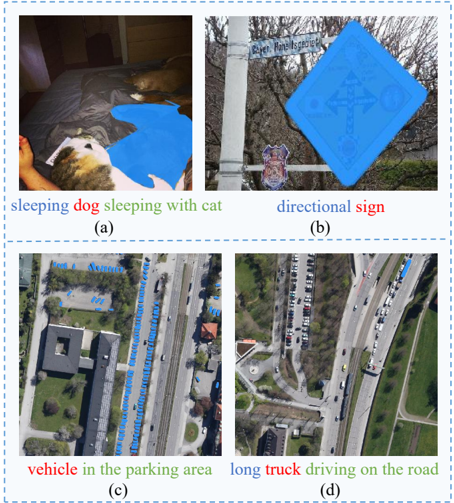
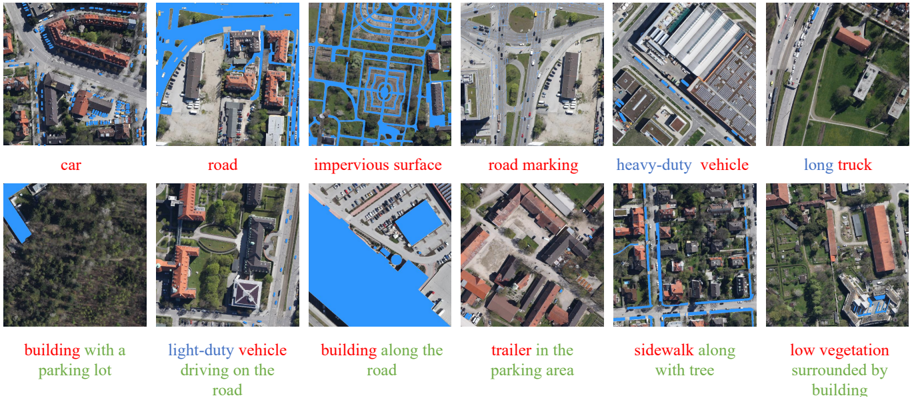
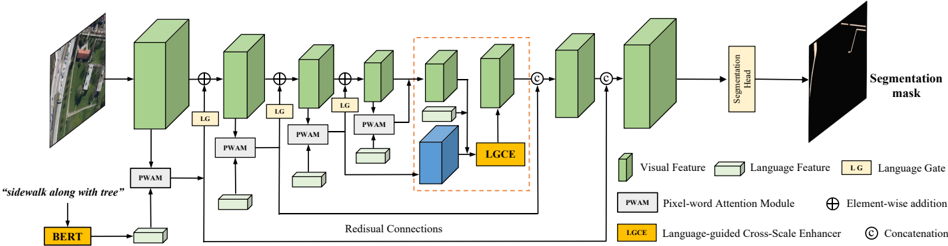
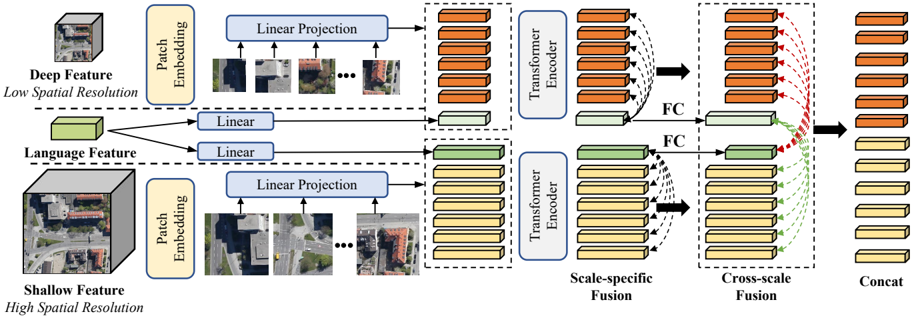
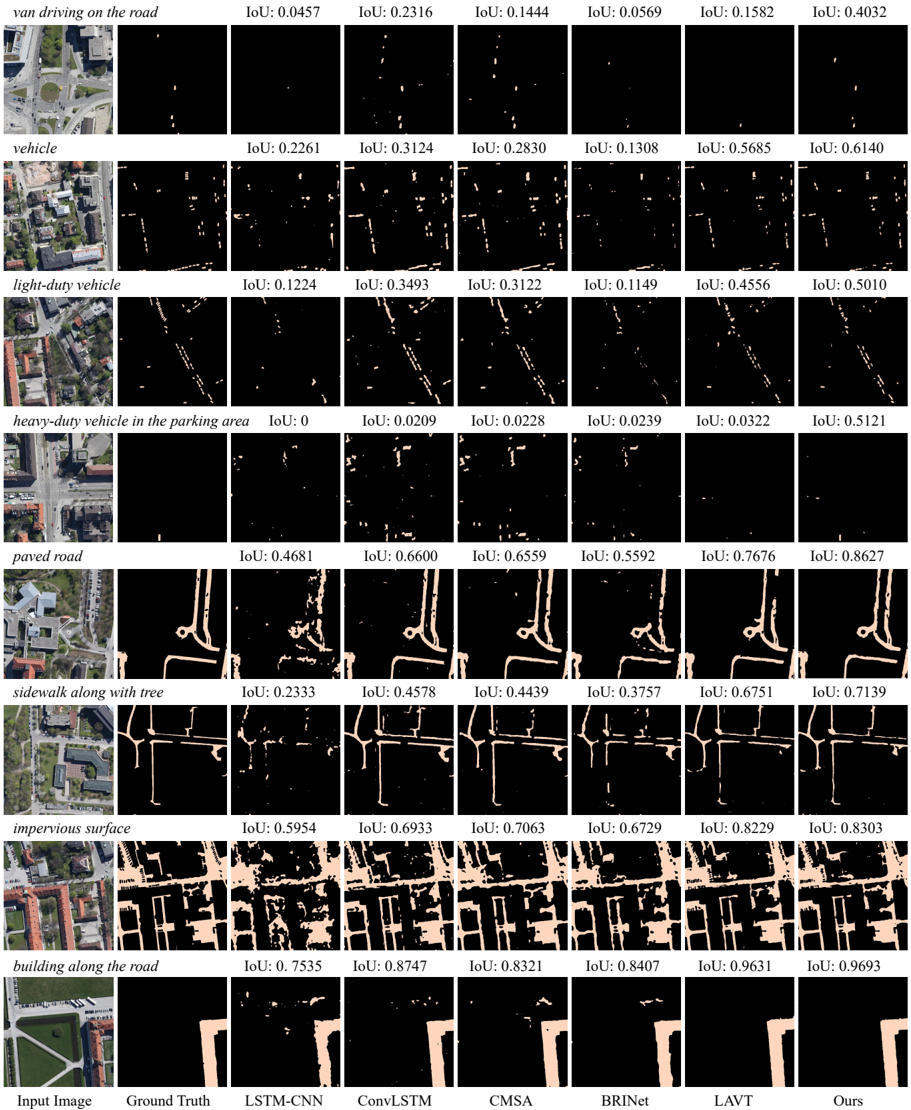
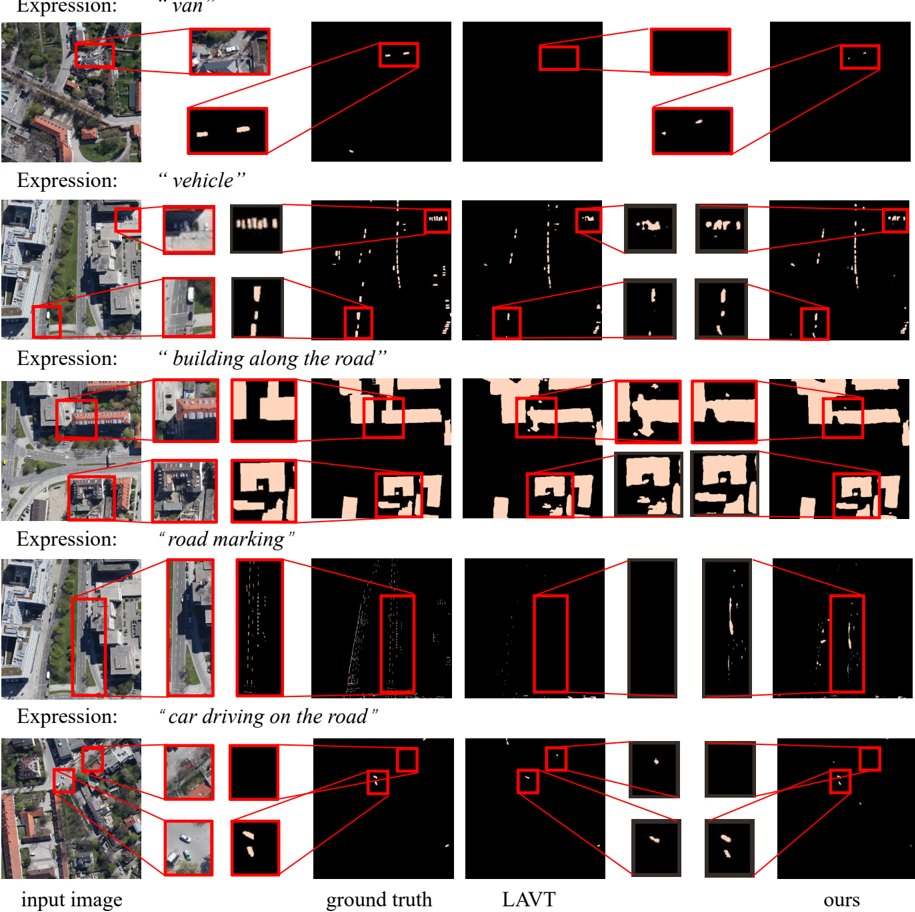
Localizing desired objects from remote sensing images is of great use in practical applications. Referring image segmentation, which aims at segmenting out the objects to which a given expression refers, has been extensively studied in natural images. However, almost no research attention is given to this task of remote sensing imagery. Considering its potential for real-world applications, in this paper, we introduce referring remote sensing image segmentation (RRSIS) to fill in this gap and make some insightful explorations. Specifically, we create a new dataset, called RefSegRS, for this task, enabling us to evaluate different methods. Afterward, we benchmark referring image segmentation methods of natural images on the RefSegRS dataset and find that these models show limited efficacy in detecting small and scattered objects. To alleviate this issue, we propose a language-guided cross-scale enhancement (LGCE) module that utilizes linguistic features to adaptively enhance multi-scale visual features by integrating both deep and shallow features. The proposed dataset, benchmarking results, and the designed LGCE module provide insights into the design of a better RRSIS model. The dataset and code will be available at https://gitlab.lrz.de/ai4eo/reasoning/rrsis.
Overview
The claims and statistics of this paper haven’t been checked yet.
Free: it reads the open-access text and checks the first 5 claims that cite a source we can check. Create a free account to check every claim.
Integrity signals
Registry
Cites
Statistics
Figures




Verification
Claims the paper makes
The claims and statistics of this paper haven’t been checked yet.
Free: it reads the open-access text and checks the first 5 claims that cite a source we can check. Create a free account to check every claim.
Claims other papers make about this one
Each is checked against this paper’s own text: does it say what the citing paper says it does?
The cited source doesn’t support the claim as written.
In the citing paper
“This higher instance density in DOTA-v2 offers a more challenging and diverse training environment compared to existing remote sensing visual grounding datasets, such as DIOR-RSVG [19] and RRSIS-D [35], that are typically sourced from the DIOR dataset.”
From VRSBench: A Versatile Vision-Language Benchmark Dataset for Remote Sensing Image Understanding (2024) · cites this paper as [35]
Checked by a reasoning model — may be wrong.
Experimental — accuracy not yet measured
Self-check
Percentages, sums and reported differences re-computed from the paper’s own numbers.
The self-check needs the paper’s full text.
Citations
Cites
Deep Residual Learning for Image Recognition
He, K., Zhang, X., Ren, S., & Sun, J. (2016) · 2016 IEEE Conference on Computer Vision and Pattern Recognition (CVPR) · doi:10.1109/cvpr.2016.90 · Cited by 235,474 · cited 2×
“Convolutional neural networks (CNNs) such as VGG [10], ResNet [11], and ConvNext [12] achieve human-competitive accuracy in image classification on large-scale Z. Yuan and L. Mou are with the Chair of Data Science in Earth Observation, Technical University of Munich, 80333 Munich, Germany.”
MethodVaswani, A., Shazeer, N., Parmar, N., Uszkoreit, J., Jones, L., Gomez, A. N., Kaiser, L., & Polosukhin, I. (2017) · arXiv · doi:10.48550/arxiv.1706.03762 · Cited by 120,404 · cited 5×
“More recently, Transformers have also been explored in this task.”
BackgroundInfluentialVery Deep Convolutional Networks for Large-Scale Image Recognition
Simonyan, K., & Zisserman, A. (2014) · arXiv · doi:10.48550/arxiv.1409.1556 · Cited by 114,148 · cited 2×
“Convolutional neural networks (CNNs) such as VGG [10], ResNet [11], and ConvNext [12] achieve human-competitive accuracy in image classification on large-scale Z. Yuan and L. Mou are with the Chair of Data Science in Earth Observation, Technical University of Munich, 80333 Munich, Germany.”
MethodHochreiter, S., & Schmidhuber, J. (1997) · Neural Computation · doi:10.1162/neco.1997.9.8.1735 · Cited by 102,318 · cited 2×
“The pioneer work can be found in [22], where a long short-term memory (LSTM) [31] network is employed to encode referring expressions into vectors, and a CNN is used to learn visual features.”
BackgroundMethodU-Net: Convolutional Networks for Biomedical Image Segmentation
Ronneberger, O., Fischer, P., & Brox, T. (2015) · Lecture notes in computer science · doi:10.1007/978-3-319-24574-4_28 · Cited by 99,404
Exploiting Generative AI to Scale up Intelligent Tutoring Systems
Jakubův, J., Chvalovský, K., Goertzel, Z., Kaliszyk, C., Olšák, M., Piotrowski, B., Schulz, S., Suda, M., & Urban, J. (2023) · DROPS (Schloss Dagstuhl – Leibniz Center for Informatics) · doi:10.4230/lipics.itp.2023.19 · Cited by 76,658
BERT: Pre-training of Deep Bidirectional Transformers for Language Understanding
Devlin, J., Chang, M.-W., Lee, K., & Toutanova, K. (2018) · arXiv · doi:10.48550/arxiv.1810.04805 · Cited by 73,173 · cited 5×
“LAVT [26] employs bidirectional encoder representations from Transformers (BERT) [38] and a novel Transformer network for referring image segmentation.”
BackgroundMethodInfluentialBERT: Pre-training of Deep Bidirectional Transformers for Language Understanding
Devlin, J., Chang, M.-W., Lee, K., & Toutanova, K. (2019) · Proceedings of the 2019 Conference of the North American Chapter of the Association for Computational Linguistics: Human Language Technologies, Volume 1 (Long and Short Papers) · doi:10.18653/v1/n19-1423 · Cited by 54,325 · cited 5×
“LAVT [26] employs bidirectional encoder representations from Transformers (BERT) [38] and a novel Transformer network for referring image segmentation.”
BackgroundMethodInfluentialYou Only Look Once: Unified, Real-Time Object Detection
Redmon, J., Divvala, S., Girshick, R., & Farhadi, A. (2016) · 2016 IEEE Conference on Computer Vision and Pattern Recognition (CVPR) · doi:10.1109/cvpr.2016.91 · Cited by 53,803 · cited 1×
“Moreover, object detection in remote sensing images has witnessed a dramatic improvement in accuracy with the emergence of models like Faster R-CNN [15], YOLO [16], and DETR [17].”
MethodFully convolutional networks for semantic segmentation
Long, J., Shelhamer, E., & Darrell, T. (2015) · 2015 IEEE Conference on Computer Vision and Pattern Recognition (CVPR) · doi:10.1109/cvpr.2015.7298965 · Cited by 38,834
Research works printed but not linked: 4
- Alexey Dosovitskiy, Lucas Beyer, Alexander Kolesnikov, Dirk Weis- senborn, Xiaohua Zhai, Thomas Unterthiner, Mostafa Dehghani, Matthias Minderer, Georg Heigold, Sylvain Gelly, et al., "An image is worth 16x16 words: Transformers for image recognition at scale," arXiv preprint arXiv:2010.11929, 2020. · arXiv
- Sergey Ioffe and Christian Szegedy, "Batch normalization: Accelerating deep network training by reducing internal covariate shift," in Interna- tional conference on machine learning. pmlr, 2015, pp. 448-456. · doi:10.5555/3045118.3045167
- Ilya Loshchilov and Frank Hutter, "Decoupled weight decay regulariza- tion," in International Conference on Learning Representations, 2018.
- Zhenghang Yuan (Student Member, IEEE) received the B.E. degree and M.E. degree from the North- western Polytechnical University, Xi'an, China, in 2017 and 2020, respectively. She is currently pursu- ing the Ph.D. degree with the Technical University of Munich, Munich, Germany. Her research interests include remote sensing, computer vision, and deep learning.
Cited by
Rotated Multi-Scale Interaction Network for Referring Remote Sensing Image Segmentation
Liu, S., Ma, Y., Zhang, X., Wang, H., Ji, J., Sun, X., & Ji, R. (2024) · IEEE Computer Society Conference on Computer Vision and Pattern Recognition/Proceedings - IEEE Computer Society Conference on Computer Vision and Pattern Recognition/Proceedings · doi:10.1109/cvpr52733.2024.02517 · Cited by 216
Deep learning for wildfire risk prediction: Integrating remote sensing and environmental data
Xu, Z., Li, J., Cheng, S. L., Xue, R., Zhao, Y., He, H., Guan, H., Sharma, A., Erxleben, M., Chang, R., et al. (2025) · ISPRS Journal of Photogrammetry and Remote Sensing · doi:10.1016/j.isprsjprs.2025.06.002 · Cited by 130
Liu, R., Wu, J., Lu, W., Miao, Q., Zhang, H., Liu, X., Lu, Z., & Li, L. (2024) · Remote Sensing · doi:10.3390/rs16122056 · Cited by 111
“Yuan et al. [106] proposed RRSIS, a model that generates segmentation masks from natural language descriptions using a Transformer-based LAVT model with an LGCE module for better detection of small targets.”
MethodEarthNets: Empowering artificial intelligence for Earth observation
Xiong, Z., Zhang, F., Wang, Y., Shi, Y., & Zhu, X. X. (2024) · IEEE Geoscience and Remote Sensing Magazine · doi:10.1109/mgrs.2024.3466998 · Cited by 129
“Datasets for RS VG [330] are constructed to enable specific object detection guided by natural language [344].”
Self-citationExploring Fine-Grained Image-Text Alignment for Referring Remote Sensing Image Segmentation
Lei, S., Xiao, X., Zhang, T., Li, H.-C., Shi, Z., & Zhu, Q. (2024) · IEEE Transactions on Geoscience and Remote Sensing · doi:10.1109/tgrs.2024.3522293 · Cited by 115
“For this point, in the past year, many researchers have focused on the RRSIS task and established two datasets for remote sensing including RefSegRS [1] and RRSIS-D [26], which promotes the development of the field of RRSIS.”
BackgroundMethodInfluential
Metadata
- Authors
- Yuan, Z., Mou, L., Hua, Y., & Zhu, X. X.
- Affiliations
- Technical University of Munich (DE)
- Shenzhen University (CN)
- Munich Center for Machine Learning (DE)
- Venue
- IEEE Transactions on Geoscience and Remote Sensing
- Published
- 2024
- Volume
- 62
- Pages
- 1-12
- ISSN
- 0196-2892 (ISSN-L)
- 1558-0644
- OpenAlex
- W4392397297
- Cited by
- 81
- References
- 61
- Citations by year
- 2026: 34 · 2025: 37 · 2024: 9
- FWCI
- 13.20
- Type
- journal article
- Language
- en
- Open access
- hybrid
- doi.org
- Licence
- Locations
- IEEE Transactions on Geoscience and Remote Sensing (publishedVersion, cc-by-nc-nd)
- arXiv (Cornell University) (submittedVersion)
- arXiv (Cornell University)
- Funders
- Bundesministerium f?r Bildung und Forschung (01DD20001)
- Bundesministerium f?r Wirtschaft und Technologie (50EE2201C)
- Topics
- Physical Sciences › Computer Science › Computer Vision and Pattern Recognition › Remote-Sensing Image Classification
- Physical Sciences › Computer Science › Computer Vision and Pattern Recognition › Advanced Neural Network Applications
- Physical Sciences › Computer Science › Computer Vision and Pattern Recognition › Multimodal Machine Learning Applications
- Keywords
- referring image segmentation, remote sensing images, multi-scale feature enhancement, small object detection
About these checks
Registry, retraction, Cites and statistics results are computed, not judged, with one exception: a printed reference that no index lists is read once by a model before it counts as a citation error. Claims are extracted by a model and kept only when their quote appears verbatim in the text; each cited source is then checked, with a model’s help, for whether it says what the claim relies on. Those verdicts can be wrong — read the claim’s quote and the cited source before relying on one.
Statistics and arithmetic are recomputed, not judged.
Confidence bands are shown only for fields calibrated on our annotated test set. None is calibrated yet, so no band is shown.
What counts as a claim ›How we measure confidence ›How we check this ›
Are you an author, or do you see a problem with this page? Request a review
How to cite
Cite CoChat for the checks on this page, and the paper for its own findings.
- This page
- CoChat. (2026). Citation check: RRSIS: Referring Remote Sensing Image Segmentation. https://app.cochat.ai/papers/10.1109/tgrs.2024.3369720
- The paper
- Yuan, Z., Mou, L., Hua, Y., & Zhu, X. X. (2024). RRSIS: Referring Remote Sensing Image Segmentation. IEEE Transactions on Geoscience and Remote Sensing. https://doi.org/10.1109/tgrs.2024.3369720
Data sources
Bibliographic data: Semantic Scholar, OpenAlex, Crossref.
Contains information from the Semantic Scholar Academic Graph Datasets, made available under the ODC Attribution License (ODC-BY 1.0).
Semantic Scholar’s data is described in: Kinney, R., et al. (2023). The Semantic Scholar Open Data Platform. arXiv:2301.10140.
