

The DOI matches its Crossref record; 84 of the 84 references it cites were found in a registry or an index.
Student Perceptions of ChatGPT Use in a College Essay Assignment: Implications for Learning, Grading, and Trust in Artificial Intelligence
Open accessAbstract
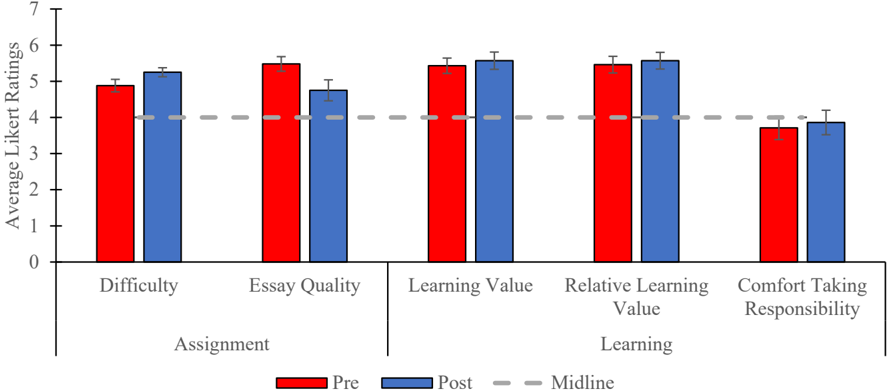
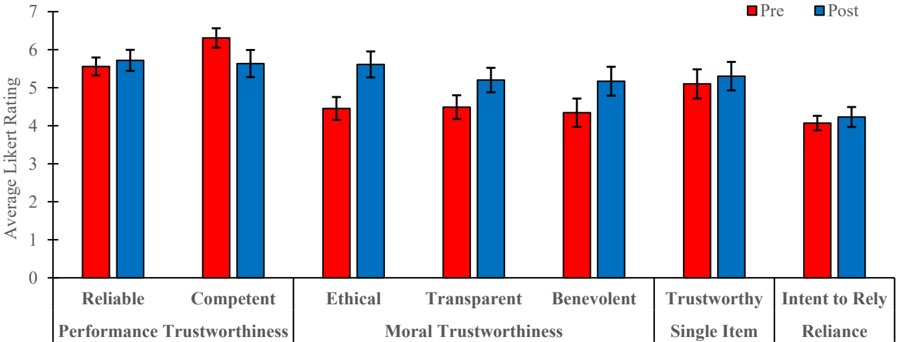
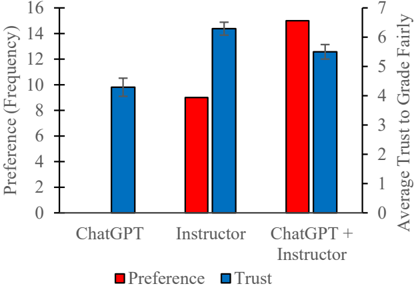
This study examined student experiences before and after an essay writing assignment that required the use of ChatGPT within an undergraduate engineering course. Utilizing a pre-post study design, we gathered data from 24 participants to evaluate ChatGPT's support for both completing and grading an essay assignment, exploring its educational value and impact on the learning process. Our quantitative and thematic analyses uncovered that ChatGPT did not simplify the writing process. Instead, the tool transformed the student learning experience yielding mixed responses. Participants reported finding ChatGPT valuable for learning, and their comfort with its ethical and benevolent aspects increased post-use. Concerns with ChatGPT included poor accuracy and limited feedback on the confidence of its output. Students preferred instructors to use ChatGPT to help grade their assignments, with appropriate oversight. They did not trust ChatGPT to grade by itself. Student views of ChatGPT evolved from a perceived “cheating tool” to a collaborative resource that requires human oversight and calibrated trust. Implications for writing, education, and trust in AI are discussed.
Overview
The claims and statistics of this paper haven’t been checked yet.
Run the check — free, no account needed. It reads the open-access text and checks the sources it cites.
Integrity signals
Registry
Cites
Statistics
Figures
Verification
Claims the paper makes
The claims and statistics of this paper haven’t been checked yet.
Run the check — free, no account needed. It reads the open-access text and checks the sources it cites.
Claims other papers make about this one
Each is checked against this paper’s own text: does it say what the citing paper says it does?
The source backs part of the claim, not all of it — or backs it for a different population, condition or comparison.
In the citing paper
“Student-centred AI feedback mechanisms involve tasks like reflection prompts, AI-use reports, or annotated submissions, encouraging students to critically evaluate how and why they used generative AI tools (Rawas, 2024; Tossell et al., 2024).”
From Six Institutional Intervention Areas to Support Ethical and Effective Student Use of Generative AI in Higher Education: A Narrative Review (2026) · cites this paper as Tossell et al., 2024
Experimental — accuracy not yet measuredThe cited source says what the claim attributes to it.
In the citing paper
“For example, Tossell et al. (2024) found perceived trustworthiness of ChatGPT predicted students' intent to rely upon it for future educational purposes.”
From College students’ literacy, ChatGPT activities, educational outcomes, and trust from a digital divide perspective (2026) · cites this paper as Tossell et al., 2024
The cited source says what the claim attributes to it.
In the citing paper
“students are using ChatGPT to complete their homework assignments [3]”
From Survey on Plagiarism Detection in Large Language Models: The Impact of ChatGPT and Gemini on Academic Integrity (2024) · cites this paper as [3]
In the citing paper
“This finding suggests that university students, in particular, value ChatGPT for its utility in completing academic tasks, such as writing assistance, research, and learning new concepts [1,7,20,65].”
From ChatGPT in Learning: Assessing Students’ Use Intentions through the Lens of Perceived Value and the Influence of AI Literacy (2024) · cites this paper as [20]
Self-check
Percentages, sums and reported differences re-computed from the paper’s own numbers.
The self-check needs the paper’s full text.
Citations
Cites
An integrative model of organizational trust
Mayer, R. C., Davis, J. H., & Schoorman, F. D. (1995) · The Academy of Management Review · doi:10.2307/258792 · Cited by 10,736
Cohen, J. (1992) · Psychological Bulletin · doi:10.1037//0033-2909.112.1.155 · Cited by 8,771
Trust in Automation: Designing for Appropriate Reliance
Lee, J. D., & See, K. A. (2004) · Human Factors: The Journal of the Human Factors and Ergonomics Society · doi:10.1518/hfes.46.1.50_30392 · Cited by 6,605 · cited 2×
“…responsibility for the essay produced with its help, this report provides the first comprehensive trust assessment for ChatGPT, which has strong validity due to the real vulnerability and consequences associated with this assignment; a requirement for accurate trust assessment [43], [48], [80].”
BackgroundMethodDwivedi, Y. K., Kshetri, N., Hughes, L., Slade, E. L., Jeyaraj, A., Kar, A. K., Baabdullah, A. M., Koohang, A., Raghavan, V., Ahuja, M., et al. (2023) · International Journal of Information Management · doi:10.1016/j.ijinfomgt.2023.102642 · Cited by 4,584
Humans and automation: Use, misuse, disuse, abuse
Parasuraman, R., & Riley, V. (1997) · Human Factors: The Journal of the Human Factors and Ergonomics Society · doi:10.1518/001872097778543886 · Cited by 4,554
A model for types and levels of human interaction with automation
Parasuraman, R., Sheridan, T. B., & Wickens, C. D. (2000) · IEEE Transactions on Systems, Man, and Cybernetics - Part A: Systems and Humans · doi:10.1109/3468.844354 · Cited by 4,195 · cited 2×
“…resultsuggeststhatstudentsunderstoodChatGPTs’capabilities butalsorealizedthattheycouldnotfullydependonitalone tocompletetheassignment;aconclusionconsistentwiththe decadesofhumanfactorsautomationresearchthatdemonstrates automationdoesnotreplacethehumanbutchangesthewaywe workwithtechnology[15],[77].”
MethodBAİDOO-ANU, D., & OWUSU ANSAH, L. (2023) · Journal of AI · doi:10.61969/jai.1337500 · Cited by 3,939
Baidoo-Anu, D., & Owusu Ansah, L. (2023) · doi:10.2139/ssrn.4337484 · Cited by 3,004
Human trust in artificial intelligence: Review of empirical research
Glikson, E., & Woolley, A. W. (2020) · Academy of Management Annals · doi:10.5465/annals.2018.0057 · Cited by 2,921
Trust in Automation: Integrating Empirical Evidence on Factors That Influence Trust
Hoff, K. A., & Bashir, M. (2015) · Human Factors: The Journal of the Human Factors and Ergonomics Society · doi:10.1177/0018720814547570 · Cited by 2,817
Research works printed but not linked: 4
- Heaven, 2023, ChatGPT is going to change education, not destroy it
- Teddlie, 2003, Major issues and controversies in the use of mixed methods in the social and behavioural sciences, 3
- 10.21428/cb6ab371.755e9cb7 · DOI
- McGovern, 2002, Processpedagogy, 81
Cited by
Sorted by citations
Kong, S.-C., & Yang, Y. (2024) · IEEE Transactions on Learning Technologies · doi:10.1109/tlt.2024.3392830 · Cited by 298
Almogren, A. S., Al-Rahmi, W. M., & Dahri, N. A. (2024) · Heliyon · doi:10.1016/j.heliyon.2024.e31887 · Cited by 250
Al-Abdullatif, A. M. (2024) · Education Sciences · doi:10.3390/educsci14111209 · Cited by 169
An LLM-Driven Chatbot in Higher Education for Databases and Information Systems
Neumann, A. T., Yin, Y., Sowe, S. K., Decker, S., & Jarke, M. (2024) · IEEE Transactions on Education · doi:10.1109/te.2024.3467912 · Cited by 209
Almulla, M. A. (2024) · Heliyon · doi:10.1016/j.heliyon.2024.e32220 · Cited by 174
Metadata
- Authors
- Tossell, C. C., Tenhundfeld, N. L., Momen, A., Cooley, K., & de Visser, E. J.
- Affiliations
- United States Air Force Academy (US)
- University of Alabama in Huntsville (US)
- Department of Behavioral Sciences and Leadership, United States Air Force Academy, Colorado Springs, CO, USA
- Venue
- IEEE Transactions on Learning Technologies
- Published
- 2024
- Volume
- 17
- Pages
- 1069-1081
- ISSN
- 1939-1382 (ISSN-L)
- 2372-0050
- OpenAlex
- W4390921168
- Cited by
- 218
- References
- 79
- Citations by year
- 2026: 80 · 2025: 90 · 2024: 48
- FWCI
- 81.97
- Type
- journal article
- Language
- en
- Open access
- hybrid
- doi.org
- Locations
- IEEE Transactions on Learning Technologies (publishedVersion, cc-by)
- Funders
- Air Force Office of Scientific Research (21USCOR004)
- Defense Advanced Research Projects Agency (FA8650-23-C-7318)
- Topics
- Social Sciences › Education › Artificial Intelligence in Education
- Health Sciences › Medicine › Health Informatics › Artificial Intelligence in Healthcare and Education
- Social Sciences › Education › Academic integrity and plagiarism
- Keywords
- ChatGPT, student perceptions, AI-assisted grading, trust in AI, academic integrity, human oversight of AI, engineering education, student learning experience
About these checks
Registry, retraction, Cites and statistics results are computed, not judged, with one exception: a printed reference that no index lists is read once by a model before it counts as a citation error. Claims are extracted by a model and kept only when their quote appears verbatim in the text; each cited source is then checked, with a model’s help, for whether it says what the claim relies on. Those verdicts can be wrong — read the claim’s quote and the cited source before relying on one.
Statistics and arithmetic are recomputed, not judged.
Confidence bands are shown only for fields calibrated on our annotated test set. None is calibrated yet, so no band is shown.
What counts as a claim ›How we measure confidence ›How we check this ›
Are you an author, or do you see a problem with this page? Request a review
