

The DOI matches its Crossref record; 84 of the 84 references it cites were found in a registry or an index.
Student Perceptions of ChatGPT Use in a College Essay Assignment: Implications for Learning, Grading, and Trust in Artificial Intelligence
Open accessAbstract
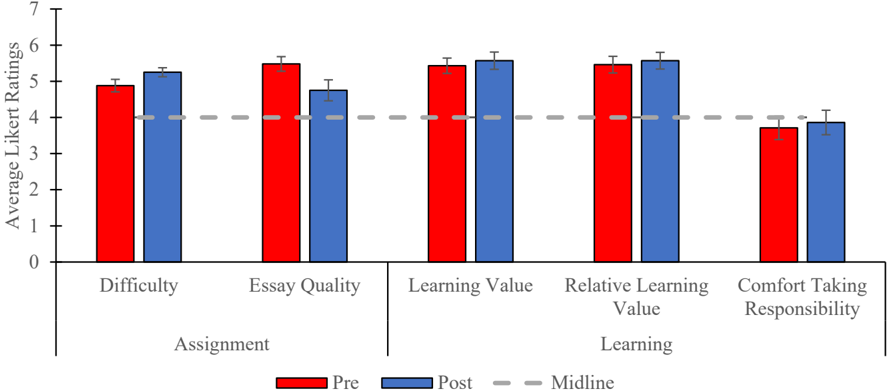
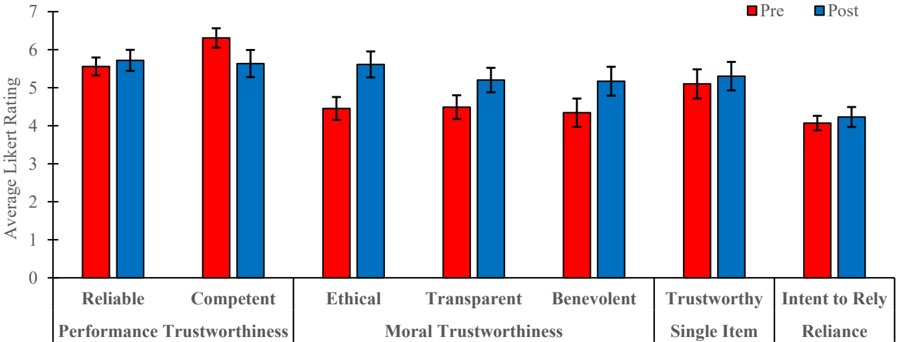
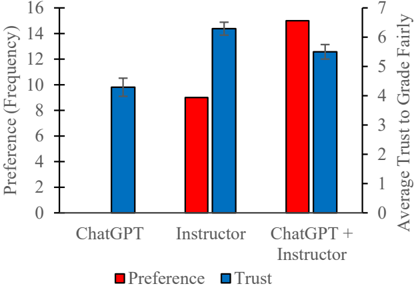
This study examined student experiences before and after an essay writing assignment that required the use of ChatGPT within an undergraduate engineering course. Utilizing a pre-post study design, we gathered data from 24 participants to evaluate ChatGPT's support for both completing and grading an essay assignment, exploring its educational value and impact on the learning process. Our quantitative and thematic analyses uncovered that ChatGPT did not simplify the writing process. Instead, the tool transformed the student learning experience yielding mixed responses. Participants reported finding ChatGPT valuable for learning, and their comfort with its ethical and benevolent aspects increased post-use. Concerns with ChatGPT included poor accuracy and limited feedback on the confidence of its output. Students preferred instructors to use ChatGPT to help grade their assignments, with appropriate oversight. They did not trust ChatGPT to grade by itself. Student views of ChatGPT evolved from a perceived “cheating tool” to a collaborative resource that requires human oversight and calibrated trust. Implications for writing, education, and trust in AI are discussed.
Overview
The claims and statistics of this paper haven’t been checked yet.
Run the check — free, no account needed. It reads the open-access text and checks the sources it cites.
Integrity signals
Registry
Cites
Statistics
Figures
Verification
Claims the paper makes
The claims and statistics of this paper haven’t been checked yet.
Run the check — free, no account needed. It reads the open-access text and checks the sources it cites.
Claims other papers make about this one
Each is checked against this paper’s own text: does it say what the citing paper says it does?
The source backs part of the claim, not all of it — or backs it for a different population, condition or comparison.
In the citing paper
“Student-centred AI feedback mechanisms involve tasks like reflection prompts, AI-use reports, or annotated submissions, encouraging students to critically evaluate how and why they used generative AI tools (Rawas, 2024; Tossell et al., 2024).”
From Six Institutional Intervention Areas to Support Ethical and Effective Student Use of Generative AI in Higher Education: A Narrative Review (2026) · cites this paper as Tossell et al., 2024
Experimental — accuracy not yet measuredThe cited source says what the claim attributes to it.
In the citing paper
“For example, Tossell et al. (2024) found perceived trustworthiness of ChatGPT predicted students' intent to rely upon it for future educational purposes.”
From College students’ literacy, ChatGPT activities, educational outcomes, and trust from a digital divide perspective (2026) · cites this paper as Tossell et al., 2024
The cited source says what the claim attributes to it.
In the citing paper
“students are using ChatGPT to complete their homework assignments [3]”
From Survey on Plagiarism Detection in Large Language Models: The Impact of ChatGPT and Gemini on Academic Integrity (2024) · cites this paper as [3]
In the citing paper
“This finding suggests that university students, in particular, value ChatGPT for its utility in completing academic tasks, such as writing assistance, research, and learning new concepts [1,7,20,65].”
From ChatGPT in Learning: Assessing Students’ Use Intentions through the Lens of Perceived Value and the Influence of AI Literacy (2024) · cites this paper as [20]
Self-check
Percentages, sums and reported differences re-computed from the paper’s own numbers.
The self-check needs the paper’s full text.
Citations
Cites
An integrative model of organizational trust
Mayer, R. C., Davis, J. H., & Schoorman, F. D. (1995) · The Academy of Management Review · doi:10.2307/258792 · Cited by 10,736
Cohen, J. (1992) · Psychological Bulletin · doi:10.1037//0033-2909.112.1.155 · Cited by 8,771
Trust in Automation: Designing for Appropriate Reliance
Lee, J. D., & See, K. A. (2004) · Human Factors: The Journal of the Human Factors and Ergonomics Society · doi:10.1518/hfes.46.1.50_30392 · Cited by 6,605 · cited 2×
“…responsibility for the essay produced with its help, this report provides the first comprehensive trust assessment for ChatGPT, which has strong validity due to the real vulnerability and consequences associated with this assignment; a requirement for accurate trust assessment [43], [48], [80].”
BackgroundMethodDwivedi, Y. K., Kshetri, N., Hughes, L., Slade, E. L., Jeyaraj, A., Kar, A. K., Baabdullah, A. M., Koohang, A., Raghavan, V., Ahuja, M., et al. (2023) · International Journal of Information Management · doi:10.1016/j.ijinfomgt.2023.102642 · Cited by 4,584
Humans and automation: Use, misuse, disuse, abuse
Parasuraman, R., & Riley, V. (1997) · Human Factors: The Journal of the Human Factors and Ergonomics Society · doi:10.1518/001872097778543886 · Cited by 4,554
A model for types and levels of human interaction with automation
Parasuraman, R., Sheridan, T. B., & Wickens, C. D. (2000) · IEEE Transactions on Systems, Man, and Cybernetics - Part A: Systems and Humans · doi:10.1109/3468.844354 · Cited by 4,195 · cited 2×
“…resultsuggeststhatstudentsunderstoodChatGPTs’capabilities butalsorealizedthattheycouldnotfullydependonitalone tocompletetheassignment;aconclusionconsistentwiththe decadesofhumanfactorsautomationresearchthatdemonstrates automationdoesnotreplacethehumanbutchangesthewaywe workwithtechnology[15],[77].”
MethodBAİDOO-ANU, D., & OWUSU ANSAH, L. (2023) · Journal of AI · doi:10.61969/jai.1337500 · Cited by 3,939
Baidoo-Anu, D., & Owusu Ansah, L. (2023) · doi:10.2139/ssrn.4337484 · Cited by 3,004
Human trust in artificial intelligence: Review of empirical research
Glikson, E., & Woolley, A. W. (2020) · Academy of Management Annals · doi:10.5465/annals.2018.0057 · Cited by 2,921
Trust in Automation: Integrating Empirical Evidence on Factors That Influence Trust
Hoff, K. A., & Bashir, M. (2015) · Human Factors: The Journal of the Human Factors and Ergonomics Society · doi:10.1177/0018720814547570 · Cited by 2,817
Research works printed but not linked: 4
- Heaven, 2023, ChatGPT is going to change education, not destroy it
- Teddlie, 2003, Major issues and controversies in the use of mixed methods in the social and behavioural sciences, 3
- 10.21428/cb6ab371.755e9cb7 · DOI
- McGovern, 2002, Processpedagogy, 81
Cited by
Sorted by citations
Kong, S.-C., & Yang, Y. (2024) · IEEE Transactions on Learning Technologies · doi:10.1109/tlt.2024.3392830 · Cited by 298
Almogren, A. S., Al-Rahmi, W. M., & Dahri, N. A. (2024) · Heliyon · doi:10.1016/j.heliyon.2024.e31887 · Cited by 250
Al-Abdullatif, A. M. (2024) · Education Sciences · doi:10.3390/educsci14111209 · Cited by 169
An LLM-Driven Chatbot in Higher Education for Databases and Information Systems
Neumann, A. T., Yin, Y., Sowe, S. K., Decker, S., & Jarke, M. (2024) · IEEE Transactions on Education · doi:10.1109/te.2024.3467912 · Cited by 209
Almulla, M. A. (2024) · Heliyon · doi:10.1016/j.heliyon.2024.e32220 · Cited by 174
Al-Abdullatif, A. M., & Alsubaie, M. A. (2024) · Behavioral Sciences · doi:10.3390/bs14090845 · Cited by 126
“Students who have more experience engaging with AI tools are better at navigating risks and understanding the limitations of these technologies.”
Chen, A., Xiang, M., Zhou, J., Jia, J., Shang, J., Li, X., Gašević, D., & Fan, Y. (2025) · Computers & Education · doi:10.1016/j.compedu.2024.105198 · Cited by 115
Qadhi, S. M., Alduais, A., Chaaban, Y., & Khraisheh, M. (2024) · Information · doi:10.3390/info15060325 · Cited by 106
Policy guidelines and recommendations on AI use in teaching and learning: A meta-synthesis study
Funa, A. A., & Gabay, R. A. E. (2024) · Social Sciences & Humanities Open · doi:10.1016/j.ssaho.2024.101221 · Cited by 168
Nazaretsky, T., Mejia‐Domenzain, P., Swamy, V., Frej, J., & Käser, T. (2025) · Computers and Education Artificial Intelligence · doi:10.1016/j.caeai.2025.100368 · Cited by 164
Li, B., Bonk, C. J., Wang, C., & Kou, X. (2024) · IEEE Transactions on Learning Technologies · doi:10.1109/tlt.2024.3386098 · Cited by 109
Zhang, X., Zhang, P., Shen, Y., Liu, M., Wang, Q., Gašević, D., & Fan, Y. (2024) · Frontiers of Digital Education · doi:10.1007/s44366-024-0028-5 · Cited by 83
Zhang, C., Hu, M., Wu, W., Kamran, F., & Wang, X. (2024) · Education and Information Technologies · doi:10.1007/s10639-024-12905-7 · Cited by 102
Automated Essay Scoring and Revising Based on Open-Source Large Language Models
Song, Y., Zhu, Q., Wang, H., & Zheng, Q. (2024) · IEEE Transactions on Learning Technologies · doi:10.1109/tlt.2024.3396873 · Cited by 89
Pudasaini, S., Miralles-Pechuán, L., Lillis, D., & Llorens Salvador, M. (2025) · Journal of Academic Ethics · doi:10.1007/s10805-024-09576-x · Cited by 70
Filippi, S., & Motyl, B. (2024) · Information · doi:10.3390/info15060345 · Cited by 80
Beyond Traditional Assessment: Exploring the Impact of Large Language Models on Grading Practices
Fagbohun, O., Iduwe, N. P., Abdullahi, M., Ifaturoti, A., & Nwanna, M. (2024) · Journal of Artificial Intelligence Machine Learning and Data Science · doi:10.51219/jaimld/oluwole-fagbohun/19 · Cited by 80
Ma, W., Wen-jing, M., Hu, Y., & Xinyu, B. I. (2024) · Education and Information Technologies · doi:10.1007/s10639-024-13128-6 · Cited by 71
Analyzing student prompts and their effect on ChatGPT’s performance
Sawalha, G., Taj, I., & Shoufan, A. (2024) · Cogent Education · doi:10.1080/2331186x.2024.2397200 · Cited by 93
Chen, A., Jia, J., Li, Y., & Fu, L. (2024) · Journal of Educational Computing Research · doi:10.1177/07356331241299058 · Cited by 72
ChatPRCS: A Personalized Support System for English Reading Comprehension Based on ChatGPT
Wang, X., Zhong, Y., Huang, C., & Huang, X. (2024) · IEEE Transactions on Learning Technologies · doi:10.1109/tlt.2024.3405747 · Cited by 63
Exploring the influence of ChatGPT on student academic success and career readiness
Dahri, N. A., Yahaya, N., & Al-Rahmi, W. M. (2024) · Education and Information Technologies · doi:10.1007/s10639-024-13148-2 · Cited by 69
EduPlanner: LLM-Based Multiagent Systems for Customized and Intelligent Instructional Design
Zhang, X., Zhang, C., Sun, J., Xiao, J., Yang, Y., & Luo, Y. (2025) · IEEE Transactions on Learning Technologies · doi:10.1109/tlt.2025.3561332 · Cited by 56
Arar, K., Tlili, A., Schunka, L., Salha, S., & Saiti, A. (2025) · Leadership and Policy in Schools · doi:10.1080/15700763.2025.2451982 · Cited by 43
Grading the Graders: Comparing Generative AI and Human Assessment in Essay Evaluation
Wetzler, E. L., Cassidy, K. S., Jones, M. J., Frazier, C. R., Korbut, N., Sims, C. M., Bowen, S. S., & Wood, M. (2024) · Teaching of Psychology · doi:10.1177/00986283241282696 · Cited by 47
Zhang, C. (., Rice, R. E., & Wang, L. H. (2026) · New Media & Society · doi:10.1177/14614448241301741 · Cited by 47
“Overall, our findings extend past research on trust and technology adoption to the novel context of ChatGPT use and build on previous ChatGPT research (Choudhury and Shamszare, 2023; Tossell et al., 2024) by testing the moderating role of trust.”
Generative AI and College Students: Use and Perceptions
Golding, J. M., Lippert, A., Neuschatz, J. S., Salomon, I., & Burke, K. C. (2024) · Teaching of Psychology · doi:10.1177/00986283241280350 · Cited by 40
Uppal, K., & Hajian, S. (2024) · European Journal of Educational Research · doi:10.12973/eu-jer.14.1.199 · Cited by 36
Almogren, A. S., Al-Rahmi, W. M., & Dahri, N. A. (2024) · IEEE Access · doi:10.1109/access.2024.3498047 · Cited by 47
Impact of GPT-Driven Teaching Assistants in VR Learning Environments
Tracy, K., & Spantidi, O. (2025) · IEEE Transactions on Learning Technologies · doi:10.1109/tlt.2025.3539179 · Cited by 38
Li, Z., & Xiao, Y. (2025) · BMC Medical Education · doi:10.1186/s12909-025-07669-8 · Cited by 38
Wu, H., & Dong, Z. (2025) · IEEE Access · doi:10.1109/access.2025.3544489 · Cited by 34
Cui, Y. (2025) · Computers and Education: Artificial Intelligence · doi:10.1016/j.caeai.2025.100391 · Cited by 26
Friction: Deciphering Writing Feedback into Writing Revisions through LLM-Assisted Reflection
Zhang, C., Ju, K., Bidoshi, P., Yen, Y.-C. G., & Rzeszotarski, J. M. (2025) · CHI Conference on Human Factors in Computing Systems · doi:10.1145/3706598.3714316 · Cited by 38
Durgungöz, A., & Kharrufa, A. (2025) · Interactive Learning Environments · doi:10.1080/10494820.2025.2509276 · Cited by 33
Who Gives Feedback Matters: Student Biases Towards Human and AI ‐Generated Formative Feedback
Nazaretsky, T., Mejia‐Domenzain, P., Swamy, V., Frej, J., & Käser, T. (2026) · Journal of Computer Assisted Learning · doi:10.1111/jcal.70153 · Cited by 26
Empowering Student Learning Through Artificial Intelligence: A Bibliometric Analysis
Yun, G., Lee, K. M., & Choi, H. H. (2024) · Journal of Educational Computing Research · doi:10.1177/07356331241278636 · Cited by 26
Jayasinghe, S., Gamage, K. A. A., Yang, D., Cheng, C., Disanayake, C., & Apeji, U. D. (2026) · Education Sciences · doi:10.3390/educsci16010137 · Cited by 23
Xiao-hua, L., Xiao, Y., & Li, D. (2025) · International Journal of Educational Technology in Higher Education · doi:10.1186/s41239-025-00567-5 · Cited by 35
Alghazo, R., Fatima, G., Malik, M., Abdelhamid, S. E., Jahanzaib, M., Nayab, D. E., & Raza, A. (2025) · Education Sciences · doi:10.3390/educsci15020158 · Cited by 22
Zhu, Y., Jiang, H., & Zhong, L. (2026) · European Journal of Education · doi:10.1111/ejed.70462 · Cited by 24
Ali, M., Rehman, S., & Cheema, E. U. (2025) · International Journal of Clinical Pharmacy · doi:10.1007/s11096-025-01876-5 · Cited by 20
Generative artificial intelligence in fifth-generation education systems: A systematic review
Chakraborty, S. (2026) · Engineering Applications of Artificial Intelligence · doi:10.1016/j.engappai.2026.114463 · Cited by 65
Yang, C. T.-Y., & Chen, H. H.-J. (2025) · Computer Assisted Language Learning · doi:10.1080/09588221.2025.2453205 · Cited by 23
Suchánek, P., & Kŕaĺová, M. (2025) · Journal of Innovation & Knowledge · doi:10.1016/j.jik.2025.100781 · Cited by 23
Examining Student and Teacher Perspectives on Undisclosed Use of Generative AI in Academic Work
Adnin, R., Pandkar, A., Yao, B., Wang, D., & Das, M. (2025) · Proceedings of the 2025 CHI Conference on Human Factors in Computing Systems · doi:10.1145/3706598.3713393 · Cited by 16
Guo, Y., Shen, S., Liu, Q., Huang, Z., Zhu, L., Su, Y., & Chen, E. (2024) · ACM International Conference on Information and Knowledge Management (CIKM) · doi:10.1145/3627673.3679664 · Cited by 20
Bai, L., & Wei, Y. (2024) · IEEE Transactions on Learning Technologies · doi:10.1109/tlt.2024.3491864 · Cited by 21
Mirea, C.-M., Bologa, R., Toma, A., Clim, A., Plăcintă, D.-D., & Bobocea, A. (2025) · Applied Sciences · doi:10.3390/app15105785 · Cited by 31
Rücker, C. R., & Becker, S. (2025) · Computers and Education Open · doi:10.1016/j.caeo.2025.100315 · Cited by 15
Santhi, T. M., & Srinivasan, K. (2024) · IEEE Transactions on Learning Technologies · doi:10.1109/tlt.2024.3417252 · Cited by 18
Gawlik-Kobylińska, M. (2024) · Education Sciences · doi:10.3390/educsci14101132 · Cited by 14
Choi, K. Y., Wu, C., & Moorhouse, B. L. (2025) · Technology in Language Teaching & Learning · doi:10.29140/tltl.v7n3.102516 · Cited by 13
Divisional perspectives on trust in generative AI: an empirical study of senior decision-makers
Khac, L. T. D., Leyer, M., Wichmann, J., & Richter, A. (2025) · Enterprise Information Systems · doi:10.1080/17517575.2025.2481557 · Cited by 14
Yu, Y., Wei, W., & Chen, Z. (2025) · The Interpreter and Translator Trainer · doi:10.1080/1750399x.2025.2533069 · Cited by 15
Understanding user trust in AI-generated content: an elaboration likelihood model perspective
Zhou, T., & Fang, X. (2025) · Online Information Review · doi:10.1108/oir-01-2025-0041 · Cited by 16
Evaluating the Potential of Generative Artificial Intelligence to Innovate Feedback Processes
Huesca, G., Elizondo-García, M. E., Aguayo-González, R., Aguayo-Hernández, C. H., González-Buenrostro, T., & Verdugo-Jasso, Y. A. (2025) · Education Sciences · doi:10.3390/educsci15040505 · Cited by 13
Diyab, A., Frost, R. M., Fedoruk, B. D., & Diyab, A. (2025) · Education Sciences · doi:10.3390/educsci15020156 · Cited by 13
Zhang, Y., Guo, J., Wang, Y., Li, S., Yang, Q., Zhang, J., & Lu, Z. (2025) · Systems · doi:10.3390/systems13100855 · Cited by 16
Pirzado, F. A., Ahmed, A., Alipour, M. A., & Terashima‐Marín, H. (2025) · Journal of Computers in Education · doi:10.1007/s40692-025-00375-w · Cited by 19
Hanelt, A., Wiesche, M., Benlian, A., & Hinz, O. F. (2025) · MIS Quarterly · doi:10.25300/misq/2025/18041 · Cited by 18
The Importance of Collaboration Between Human Intelligence and GenAI in Digitalization of Education
Yakin, A. M. A., Rasyid, A. R., Massyat, M., Muthmainnah, M., Aquino, A. B., Noche, T. H., & Cardoso, L. (2024) · Advances in computer and electrical engineering book series · doi:10.4018/979-8-3693-5762-0.ch006 · Cited by 11
Zou, D., Gu, M. M., & Yu, G. (2025) · System · doi:10.1016/j.system.2025.103783 · Cited by 13
What Shapes Learners’ Trust in AI? A Meta-Analytic Review of Its Antecedents and Consequences
Cui, Y., Zeng, M. L., Du, X. K., & He, W. M. (2025) · IEEE Access · doi:10.1109/access.2025.3611367 · Cited by 18
Chatbot in education: trends, personalisation, and techniques
Jusoh, S., & Kadir, R. A. (2025) · Multimedia Tools and Applications · doi:10.1007/s11042-025-20659-8 · Cited by 11
Kohn, T. (2025) · Journal of Computer Assisted Learning · doi:10.1111/jcal.70043 · Cited by 14
Gong, L., Chen, J., & Wu, F. Q. (2025) · IEEE Transactions on Learning Technologies · doi:10.1109/tlt.2025.3564177 · Cited by 11
Martha, A. S. D., Widowati, S., & Rahayu, D. P. (2025) · Journal of Information Technology Education Research · doi:10.28945/5599 · Cited by 24
Pudasaini, S., Miralles-Pechuán, L., Lillis, D., & Salvador, M. L. (2024) · arXiv · doi:10.48550/arxiv.2407.13105 · Cited by 8
“For example, students are using ChatGPT to complete their homework assignments [3] and to pass challenging exams like the Graduate Record Examination (GRE) and Scholastic Assessment Test (SAT) [4].”
MethodThey Prefer Humans! Experimental Measurement of Student Trust in ChatGPT
Walker, F., Favetta, M., Hasker, L., & Walker, R. D. (2024) · CHI Conference Extended Abstracts on Human Factors in Computing Systems (CHI EA) · doi:10.1145/3613905.3650955 · Cited by 11
A Diffusion-Based Cognitive Diagnosis Framework for Robust Learner Assessment
Zhao, G., Huang, Z., Zhuang, Y., Bi, H., Wang, Y., Wang, F., Ma, Z., & Zhao, Y. (2024) · IEEE Transactions on Learning Technologies · doi:10.1109/tlt.2024.3492214 · Cited by 9
Liu, S., Liang, C., & Yu, S. (2025) · System · doi:10.1016/j.system.2025.103831 · Cited by 10
Ding, J., & Song, Y. (2025) · Educational Psychology · doi:10.1080/01443410.2025.2568189 · Cited by 13
Bashraheel, M., & Ghinea, G. (2026) · Computer Science Review · doi:10.1016/j.cosrev.2026.100929 · Cited by 14
Sozon, M., Pok, W. F., Sia, B. C., & Alkharabsheh, O. H. M. (2024) · Journal of Applied Research in Higher Education · doi:10.1108/jarhe-12-2023-0558 · Cited by 8
The Algorithm of Fear: Unpacking Prejudice Against AI and the Mistrust of Technology
Hutson, J., & Plate, D. (2024) · Journal of Innovation and Technology · doi:10.61453/joit.v2024no38 · Cited by 8
Almogren, A. S. (2025) · IEEE Access · doi:10.1109/access.2025.3553631 · Cited by 9
Trust(worthiness) Issues with Trust in Human–Robot Interaction
Onnasch, L., Roesler, E., Robert, L., & de Visser, E. J. (2025) · ACM Transactions on Human-Robot Interaction · doi:10.1145/3778865 · Cited by 9
Guardia-Paniura, C. H., Cueva-Luza, T., Cruz-Carpio, F. M., Ito-Díaz, R. R., Apaza-Paco, D. V., Rosas-Rojas, N., Mamani-Mamani, B., Terrero-Pérez, Á., Yaedú, R. Y. F., & Peralta-Mamani, M. (2026) · Contemporary Educational Technology · doi:10.30935/cedtech/17863 · Cited by 8
Li, X., Li, T., Wang, M., Tao, S., Zhou, X., Wei, X., & Guan, N. (2025) · IEEE Transactions on Learning Technologies · doi:10.1109/tlt.2025.3539104 · Cited by 8
Huang, M., Cheong, N., Zhang, Z., & Liu, J. (2025) · IEEE Transactions on Learning Technologies · doi:10.1109/tlt.2025.3610636 · Cited by 8
ChatGPT and academic work: new psychological phenomena
de Winter, J., Hancock, P. A., & Eisma, Y. B. (2025) · AI & Society · doi:10.1007/s00146-025-02241-w · Cited by 7
Dindorf, C., Weisenburger, F., Bartaguiz, E., Dully, J., Klappenberger, L., Lang, V., Zimmermann, L., Fröhlich, M., & Seibert, J. (2024) · Education Sciences · doi:10.3390/educsci14050531 · Cited by 11
Brocato, E. D., & Davis, C. D. (2025) · Journal of Marketing Education · doi:10.1177/02734753241312350 · Cited by 8
Detecting AI-Generated Writing Using GPTZero
Paullet, K., Pinchot, J., Kinney, E., & Stewart, T. (2025) · Information Systems Education Journal · doi:10.62273/pzww7741 · Cited by 5
The Effect of Feedback on Informative Text Writing: AI or Teacher?
Baz, M. A., & Hasırcı, S. (2025) · Open Praxis · doi:10.55982/openpraxis.17.3.871 · Cited by 12
Demir, M., Miratsky, J. A., Mishra, P., Nguyen, J. T., Chan, C. K., & Singharoy, A. (2025) · Cognitive Computation · doi:10.1007/s12559-025-10498-y · Cited by 5
Alkabaa, A. S., & Alamri, N. M. H. (2025) · Computer Applications in Engineering Education · doi:10.1002/cae.70110 · Cited by 6
Perceived trustworthiness and moral competence of a GenAI-enabled ethical robot advisor
Momen, A., Tossell, C. C., Niemeyer, R. E., Walliser, J. C., Tolston, M. T., Funke, G. J., & de Visser, E. J. (2025) · Interaction Studies Social Behaviour and Communication in Biological and Artificial Systems · doi:10.1075/is.25072.mom · Cited by 5
Self-citationJapanese University EFL Student Insights on the Emerging ChatGPT Phenomenon
Price, G. (2024) · International Journal of Education Learning and Development · doi:10.37745/ijeld.2013/vol12n583100 · Cited by 5
Abdelwahed, N. A. A. (2024) · OBM Neurobiology · doi:10.21926/obm.neurobiol.2403241 · Cited by 5
Al-Shamaileh, O., Mubin, O., & Nizamuddin, N. (2025) · International Journal of Human-Computer Interaction · doi:10.1080/10447318.2025.2532712 · Cited by 8
Zhang, C., Zhu, S., Yang, X., Tseng, Y.-C., Jiang, S., & Rzeszotarski, J. M. (2025) · Proceedings of the 7th ACM Conference on Conversational User Interfaces · doi:10.1145/3719160.3736618 · Cited by 4
AI chatbots in higher education: Comparing expectations to evidence
Thoeni, A., & Fryer, L. K. (2026) · Computers in Human Behavior Reports · doi:10.1016/j.chbr.2026.101061 · Cited by 4
Kumar, V. (2025) · International Journal of Mechanical Engineering Education · doi:10.1177/03064190251374463 · Cited by 6
Pedraja-Rejas, L., Vega, P. L., & Huanca, P. R. (2025) · Behavioral Sciences · doi:10.3390/bs16010011 · Cited by 7
Qadhi, S. M., Alduais, A. M. S., Chaaban, Y., & Khraisheh, M. A. M. (2026) · The International Information & Library Review · doi:10.1080/10572317.2026.2626122 · Cited by 7
Elia, J. (2024) · Studies in big data · doi:10.1007/978-3-031-71213-5_11 · Cited by 4
Helm, G., & Hesse, F. (2025) · Journal of Writing Research · doi:10.17239/jowr-2025.17.01.01 · Cited by 8
Korchak, A., Patarakin, E., & Costley, J. (2025) · RUDN Journal of Informatization in Education · doi:10.22363/2312-8631-2025-22-1-37-57 · Cited by 5
Metadata
- Authors
- Tossell, C. C., Tenhundfeld, N. L., Momen, A., Cooley, K., & de Visser, E. J.
- Affiliations
- United States Air Force Academy (US)
- University of Alabama in Huntsville (US)
- Department of Behavioral Sciences and Leadership, United States Air Force Academy, Colorado Springs, CO, USA
- Venue
- IEEE Transactions on Learning Technologies
- Published
- 2024
- Volume
- 17
- Pages
- 1069-1081
- ISSN
- 1939-1382 (ISSN-L)
- 2372-0050
- OpenAlex
- W4390921168
- Cited by
- 218
- References
- 79
- Citations by year
- 2026: 80 · 2025: 90 · 2024: 48
- FWCI
- 81.97
- Type
- journal article
- Language
- en
- Open access
- hybrid
- doi.org
- Locations
- IEEE Transactions on Learning Technologies (publishedVersion, cc-by)
- Funders
- Air Force Office of Scientific Research (21USCOR004)
- Defense Advanced Research Projects Agency (FA8650-23-C-7318)
- Topics
- Social Sciences › Education › Artificial Intelligence in Education
- Health Sciences › Medicine › Health Informatics › Artificial Intelligence in Healthcare and Education
- Social Sciences › Education › Academic integrity and plagiarism
- Keywords
- ChatGPT, student perceptions, AI-assisted grading, trust in AI, academic integrity, human oversight of AI, engineering education, student learning experience
About these checks
Registry, retraction, Cites and statistics results are computed, not judged, with one exception: a printed reference that no index lists is read once by a model before it counts as a citation error. Claims are extracted by a model and kept only when their quote appears verbatim in the text; each cited source is then checked, with a model’s help, for whether it says what the claim relies on. Those verdicts can be wrong — read the claim’s quote and the cited source before relying on one.
Statistics and arithmetic are recomputed, not judged.
Confidence bands are shown only for fields calibrated on our annotated test set. None is calibrated yet, so no band is shown.
What counts as a claim ›How we measure confidence ›How we check this ›
Are you an author, or do you see a problem with this page? Request a review
