

Dynamic Crosswalk Scene Understanding for the Visually Impaired
Open accessThe DOI matches its Crossref record; 40 of the 41 references it cites were found in a registry or an index.
Abstract
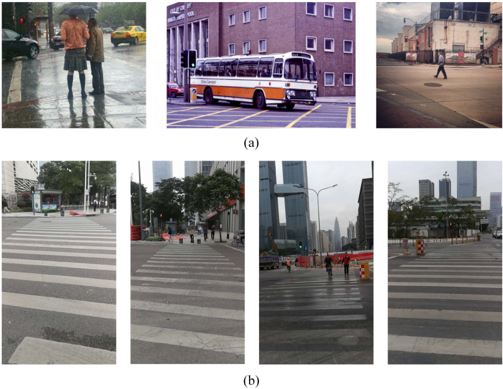
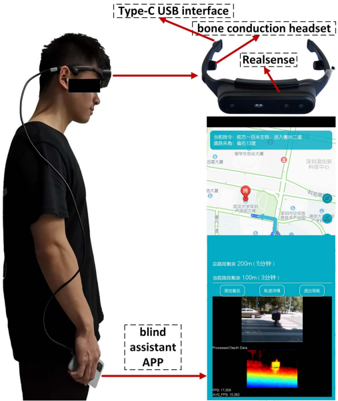
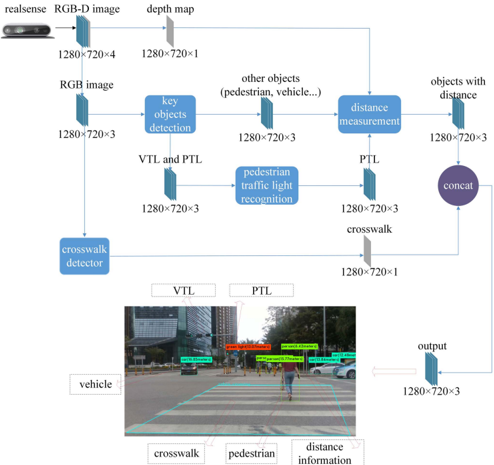
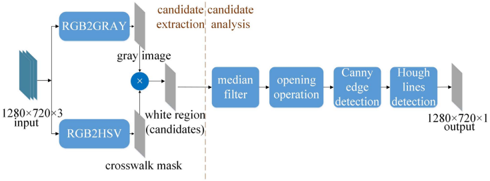
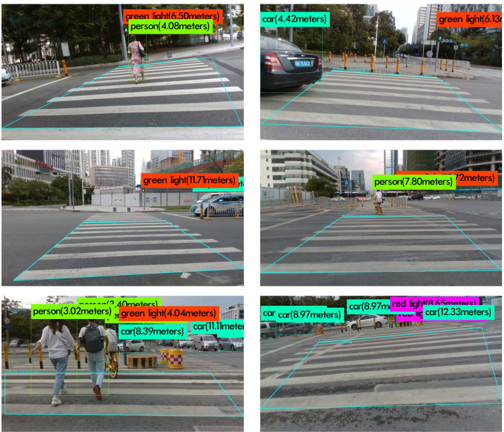
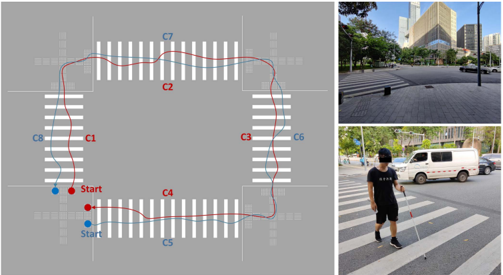
Independent mobility poses a great challenge to the visually impaired individuals. This paper proposes a novel system to understand dynamic crosswalk scenes, which detects the key objects, such as crosswalk, vehicle, and pedestrian, and identifies pedestrian traffic light status. The indication of where and when to cross the road is provided to the visually impaired based on the crosswalk scene understanding. Our proposed system is implemented on a head-mounted mobile device (SensingAI G1) equipped with an Intel RealSense camera and a cellphone, and provides surrounding scene information to visually impaired individuals through audio signal. To validate the performance of the proposed system, we propose a crosswalk scene understanding dataset which contains three sub-datasets: a pedestrian traffic light dataset with 7447 images, a dataset of key objects on the crossroad with 1006 images and a crosswalk dataset with 3336 images. Extensive experiments demonstrated that the proposed system was robust and outperformed the state-of-the-art approaches. The experiment conducted with the visually impaired subjects shows that the system is practical useful.
Overview
The claims and statistics of this paper haven’t been checked yet.
Free: it reads the open-access text and checks the first 5 claims that cite a source we can check. Create a free account to check every claim.
Integrity signals
Registry
Cites
Statistics
Figures
Verification
Claims the paper makes
The claims and statistics of this paper haven’t been checked yet.
Free: it reads the open-access text and checks the first 5 claims that cite a source we can check. Create a free account to check every claim.
Self-check
Percentages, sums and reported differences re-computed from the paper’s own numbers.
The self-check needs the paper’s full text.
Citations
Cites
YOLOv4: Optimal Speed and Accuracy of Object Detection
Bochkovskiy, A., Wang, C.-Y., & Liao, H.-Y. M. (2020) · arXiv · doi:10.48550/arxiv.2004.10934 · Cited by 10,307
Smart guiding glasses for visually impaired people in indoor environment
Bai, J., Lian, S., Liu, Z., Wang, K., & Liu, D. (2017) · IEEE Transactions on Consumer Electronics · doi:10.1109/tce.2017.014980 · Cited by 236
Navigation Assistance for the Visually Impaired Using RGB-D Sensor With Range Expansion
Aladren, A., Lopez-Nicolas, G., Puig, L., & Guerrero, J. J. (2016) · IEEE Systems Journal · doi:10.1109/jsyst.2014.2320639 · Cited by 231
Safe Local Navigation for Visually Impaired Users With a Time-of-Flight and Haptic Feedback Device
Katzschmann, R. K., Araki, B., & Rus, D. (2018) · IEEE Transactions on Neural Systems and Rehabilitation Engineering · doi:10.1109/tnsre.2018.2800665 · Cited by 214
Design and Construction of Electronic Aid for Visually Impaired People
Patil, K. R., Jawadwala, Q., & Shu, F. C. (2018) · IEEE Transactions on Human-Machine Systems · doi:10.1109/thms.2018.2799588 · Cited by 156
Unifying Terrain Awareness for the Visually Impaired through Real-Time Semantic Segmentation
Yang, K., Wang, K., Bergasa, L. M., Romera, E., Hu, W., Sun, D., Sun, J., Cheng, R., Chen, T., & López-Guillén, E. (2018) · Sensors · doi:10.3390/s18051506 · Cited by 130
Zebra-crossing detection for the partially sighted
Se, S. (2002) · Proceedings IEEE Conference on Computer Vision and Pattern Recognition. CVPR 2000 (Cat. No.PR00662) · doi:10.1109/cvpr.2000.854787 · Cited by 105
Recovering the sight to blind people in indoor environments with smart technologies
Mekhalfi, M. L., Melgani, F., Zeggada, A., De Natale, F. G. B., Salem, M. A.-M., & Khamis, A. (2016) · Expert Systems with Applications · doi:10.1016/j.eswa.2015.09.054 · Cited by 91
Expanding the Detection of Traversable Area with RealSense for the Visually Impaired
Yang, K., Wang, K., Hu, W., & Bai, J. Y. (2016) · Sensors · doi:10.3390/s16111954 · Cited by 86
Cardillo, E., Mattia, V. D., Manfredi, G., Russo, P., Leo, A. D., Caddemi, A., & Cerri, G. (2018) · IEEE Sensors Journal · doi:10.1109/jsen.2018.2795046 · Cited by 77
3-D Object Recognition of a Robotic Navigation Aid for the Visually Impaired
Ye, C., & Qian, X. (2017) · IEEE Transactions on Neural Systems and Rehabilitation Engineering · doi:10.1109/tnsre.2017.2748419 · Cited by 75
A Mobile-Cloud Collaborative Traffic Lights Detector for Blind Navigation
Angin, P., Bhargava, B., & Helal, S. (2010) · 2010 Eleventh International Conference on Mobile Data Management · doi:10.1109/mdm.2010.71 · Cited by 72
Detecting stairs and pedestrian crosswalks for the blind by RGBD camera
Wang, S., & Tian, Y. (2012) · IEEE International Conference on Bioinformatics and Biomedicine Workshops (BIBMW) · doi:10.1109/bibmw.2012.6470227 · Cited by 71
Robust traffic lights detection on mobile devices for pedestrians with visual impairment
Mascetti, S., Ahmetovic, D., Gerino, A., Bernareggi, C., Busso, M., & Rizzi, A. (2015) · Computer Vision and Image Understanding · doi:10.1016/j.cviu.2015.11.017 · Cited by 67
Mechatronic System to Help Visually Impaired Users During Walking and Running
Mancini, A., Frontoni, E., & Zingaretti, P. (2018) · IEEE Transactions on Intelligent Transportation Systems · doi:10.1109/tits.2017.2780621 · Cited by 67
A Smart Multisensor Approach to Assist Blind People in Specific Urban Navigation Tasks
Ando, B. (2008) · IEEE Transactions on Neural Systems and Rehabilitation Engineering · doi:10.1109/tnsre.2008.2003374 · Cited by 58
The Semantic Paintbrush: Interactive 3D Mapping and Recognition in Large Outdoor Spaces
Miksik, O., Vineet, V., Lidegaard, M., Prasaath, R., Nießner, M., Golodetz, S., Hicks, S. L., Pérez, P., Izadi, S., & Torr, P. H. S. (2015) · Proceedings of the 33rd Annual ACM Conference on Human Factors in Computing Systems · doi:10.1145/2702123.2702222 · Cited by 57
Multiple distance sensors based smart stick for visually impaired people
Sharang, S., Manind, G., Kumar, A., Tripathi, M., & Gaur, M. S. (2017) · IEEE Annual Computing and Communication Workshop and Conference (CCWC) · doi:10.1109/ccwc.2017.7868407 · Cited by 56
Bipolarity and Projective Invariant-Based Zebra-Crossing Detection for the Visually Impaired
Uddin, M. S., & Shioyama, T. (2006) · 2009 IEEE Computer Society Conference on Computer Vision and Pattern Recognition Workshops · doi:10.1109/cvpr.2005.423 · Cited by 54
LIDAR Assist Spatial Sensing for the Visually Impaired and Performance Analysis
Ton, C., Omar, A., Szedenko, V., Tran, V. H., Aftab, A., Perla, F., Bernstein, M. J., & Yang, Y. (2018) · IEEE Transactions on Neural Systems and Rehabilitation Engineering · doi:10.1109/tnsre.2018.2859800 · Cited by 52
Real-time pedestrian crossing lights detection algorithm for the visually impaired
Cheng, R., Wang, K., Yang, K., Long, N., Bai, J. Y., & Liu, D. (2017) · Multimedia Tools and Applications · doi:10.1007/s11042-017-5472-5 · Cited by 44
Recognition of Traffic Lights in Live Video Streams on Mobile Devices
Roters, J., Jiang, X., & Rothaus, K. (2011) · IEEE Transactions on Circuits and Systems for Video Technology · doi:10.1109/tcsvt.2011.2163452 · Cited by 43
Real-Time Walk Light Detection with a Mobile Phone
Ivanchenko, V., Coughlan, J. M., & Shen, H. (2010) · Lecture notes in computer science · doi:10.1007/978-3-642-14100-3_34 · Cited by 39
Crosswalk navigation for people with visual impairments on a wearable device
Cheng, R., Wang, K., Yang, K., Long, N., Hu, W., Chen, H., Bai, J., & Liu, D. (2017) · Journal of Electronic Imaging · doi:10.1117/1.jei.26.5.053025 · Cited by 39
An enhanced obstacle avoidance method for the visually impaired using deformable grid
Kang, M.-C., Chae, S.-H., Sun, J.-Y., Lee, S.-H., & Ko, S.-J. (2017) · IEEE Transactions on Consumer Electronics · doi:10.1109/tce.2017.014832 · Cited by 36
A new hybrid infrared-ultrasonic electronic travel aids for blind people
Prattico, F., Cera, C., & Petroni, F. (2013) · Sensors and Actuators A Physical · doi:10.1016/j.sna.2013.06.028 · Cited by 33
CrossNavi: enabling real-time crossroad navigation for the blind with commodity phones
Shangguan, L., Yang, Z., Zhou, Z., Zheng, X., Wu, C., & Liu, Y. (2014) · Proceedings of the 2014 ACM International Joint Conference on Pervasive and Ubiquitous Computing · doi:10.1145/2632048.2632083 · Cited by 33
Visual impairment aid using haptic and sound feedback
Rizvi, S. T. H., Asif, M. J., & Ashfaq, M. H. (2017) · International Conference on Communication, Computing and Digital Systems (C-CODE) · doi:10.1109/c-code.2017.7918924 · Cited by 28
Smart Assistive Navigation System for Blind and Visually Impaired Individuals
Owayjan, M. J., Hayek, A., Nassrallah, H., & Eldor, M. (2015) · International Conference on Advances in Biomedical Engineering (ICABME) · doi:10.1109/icabme.2015.7323277 · Cited by 27
Kwiatkowski, P., Jaeschke, T., Starke, D., Piotrowsky, L., Deis, H., & Pohl, N. (2017) · IEEE MTT-S International Microwave Biomedical Conference (IMBioC) · doi:10.1109/imbioc.2017.7965796 · Cited by 23
Camera auto-calibration using pedestrians and zebra-crossings
Hödlmoser, M., Mičušík, B., & Kampel, M. (2011) · IEEE International Conference on Computer Vision Workshops · doi:10.1109/iccvw.2011.6130454 · Cited by 22
A new vision and navigation research for a guide-dog robot system in urban system
Wei, Y., Kou, X., & Lee, M. C. (2014) · IEEE/ASME International Conference on Advanced Intelligent Mechatronics · doi:10.1109/aim.2014.6878260 · Cited by 21
Crosswalk Localization from Low Resolution Satellite Images to Assist Visually Impaired People
Ghilardi, M. C., Jacques, J. C. S., & Manssour, I. H. (2016) · IEEE Computer Graphics and Applications · doi:10.1109/mcg.2016.50 · Cited by 21
Real-time Pedestrian Traffic Light Detection
Ash, R., Ofri-Amar, D., Brokman, J., Friedman, I., & Moshe, Y. (2018) · IEEE Convention of Electrical and Electronics Engineers in Israel · doi:10.1109/icsee.2018.8646287 · Cited by 21
Ultrasonic navigation based blind aid for the visually impaired
Jawale, R. V., Kadam, M. V., Gaikawad, R. S., & Kondaka, L. S. (2017) · IEEE International Conference on Power, Control, Signals and Instrumentation Engineering (ICPCSI) · doi:10.1109/icpcsi.2017.8391846 · Cited by 20
Low Energy Precise Navigation System for the Blind with Infrared Sensors
Marzec, P., & Kos, A. (2019) · International Conference Mixed Design of Integrated Circuits and Systems · doi:10.23919/mixdes.2019.8787093 · Cited by 19
Implementation of an Obstacle Recognition System for the Blind
Ou, S., Park, H., & Lee, J. (2019) · Applied Sciences · doi:10.3390/app10010282 · Cited by 13
Asami, T., & Ohnishi, K. (2014) · France-Japan / Europe-Asia Congress on Mecatronics (MECATRONICS) · doi:10.1109/mecatronics.2014.7018597 · Cited by 10
Fast Vision-Based Pedestrian Traffic Light Detection
Wu, X.-H., Hu, R., & Bao, Y. (2018) · IEEE International Conference on Multimedia Information Processing and Retrieval (MIPR) · doi:10.1109/mipr.2018.00050 · Cited by 8
Development of a Microprocessor Based Smart and Safety Blind Glass System
Islam, M. T., Ahmad, M., & Bappy, A. S. (2019) · International Conference on Computer, Communication, Chemical, Materials and Electronic Engineering (IC4ME2) · doi:10.1109/ic4me247184.2019.9036504 · Cited by 5
Research works printed but not linked: 4
- 10. X. Huang and Q. Lin, "An improved method of zebra crossing detection based on bipolarity," Comput. Appl. Softw., vol. 12, no. 34, pp. 202-205, Dec. 2017.
- 12. N. Chen, F. Hong, and B. Bai, "Zebra crossing recognition method based on edge frature and Hough transform," J. Zhejiang Univ. Sci. Technol., vol. 6, no. 31, pp. 476-483, Aug. 2019.
- 2021, World Health Organization
- 43. J. Roters. (2011). Pedestrian Lights Database. Accessed: Mar. 28, 2017. [Online]. Available: http://www.uni-muenster.de/PRIA/ en/forschung/index.shtml
Cited by
Zhang, J., Yang, K., Constantinescu, A., Peng, K., Müller, K., & Stiefelhagen, R. (2022) · IEEE Transactions on Intelligent Transportation Systems · doi:10.1109/tits.2022.3161141 · Cited by 110
“Whereas traditional assistance systems rely on multiple monocular detectors and depth sensors [4], [15], [16], [29] for different perception tasks, semantic segmentation allows to solve many navigational detection problems in a unified way and has been employed in visual assistance.”
BackgroundAutomatic Detection of Pedestrian Crosswalk with Faster R-CNN and YOLOv7
Kaya, Ö., Çodur, M. Y., & Mustafaraj, E. (2023) · Buildings · doi:10.3390/buildings13041070 · Cited by 65
Hu, X., Song, A., Wei, Z., & Zeng, H. (2022) · IEEE Transactions on Neural Systems and Rehabilitation Engineering · doi:10.1109/tnsre.2022.3182661 · Cited by 50
Liu, R., Zhang, J., Peng, K., Zheng, J., Cao, K., Chen, Y., Yang, K., & Stiefelhagen, R. (2023) · IEEE International Conference on Computer Vision Workshops · doi:10.1109/iccvw60793.2023.00200 · Cited by 35
“…research fields, e.g ., autonomous driving [11, 19, 47, 54, 66, 67, 75], medical image analysis [31, 50, 65], and assistance for visually impaired people [18, 30, 36, 56, 71, 74, 77], rely heavily on semantic segmentation to provide a deep understanding of the scenario to achieve better assistance.”
BackgroundInfluentialWalkVLM: Aid Visually Impaired People Walking by Vision Language Model
Yuan, Z., Zhang, T., Zhu, Y., Zhang, J., Deng, Y., Jia, Z., Luo, P., Duan, X., Zhou, J. N., & Zhang, J. (2025) · IEEE/CVF International Conference on Computer Vision (ICCV) · doi:10.1109/iccv51701.2025.00918 · Cited by 35
“Tian et al. [33] introduced a method to understand dynamic crosswalk scenes, including crosswalks, vehicles, and pedestrians, to provide VIPs with guidance of when and where to cross the road.”
Metadata
- Authors
- Tian, S., Zheng, M., Zou, W., Li, X., & Zhang, L.
- Affiliations
- Shenzhen University (CN)
- Institut National des Sciences Appliquées de Rennes (FR)
- Venue
- IEEE Transactions on Neural Systems and Rehabilitation Engineering
- Published
- 2021
- Volume
- 29
- Pages
- 1478-1486
- ISSN
- 1534-4320 (ISSN-L)
- 1558-0210
- OpenAlex
- W3180901291
- Cited by
- 48
- References
- 41
- Citations by year
- 2026: 4 · 2025: 12 · 2024: 11 · 2023: 13 · 2022: 8
- FWCI
- 2.88
- Type
- journal article
- Language
- en
- Open access
- gold
- doi.org
- Licence
- Locations
- IEEE Transactions on Neural Systems and Rehabilitation Engineering (publishedVersion, cc-by-nc-nd)
- PubMed (publishedVersion)
- HAL (submittedVersion, other-oa)
- Funders
- National Natural Science Foundation of China (61771321, 61871273, 61872429)
- Key Project of DEGP (2018KCXTD027)
- Natural Science Foundation of Guangdong Province, China (2020A1515010959)
- Natural Science Foundation of Shenzhen (JCYJ20200109105832261)
- Interdisciplinary Innovation Team of Shenzhen University
- Topics
- Physical Sciences › Computer Science › Computer Vision and Pattern Recognition › Advanced Neural Network Applications
- Health Sciences › Health Professions › Occupational Therapy › Assistive Technology in Communication and Mobility
- Physical Sciences › Engineering › Automotive Engineering › Autonomous Vehicle Technology and Safety
- Keywords
- visually impaired people, independent mobility, head-mounted devices, audio feedback, object detection, assistive technology
- MeSH terms
- Accidents, Traffic, Pedestrians, Humans, Visually Impaired Persons, Persons with Visual Disabilities
About these checks
Registry, retraction, Cites and statistics results are computed, not judged, with one exception: a printed reference that no index lists is read once by a model before it counts as a citation error. Claims are extracted by a model and kept only when their quote appears verbatim in the text; each cited source is then checked, with a model’s help, for whether it says what the claim relies on. Those verdicts can be wrong — read the claim’s quote and the cited source before relying on one.
Statistics and arithmetic are recomputed, not judged.
Confidence bands are shown only for fields calibrated on our annotated test set. None is calibrated yet, so no band is shown.
What counts as a claim ›How we measure confidence ›How we check this ›
Are you an author, or do you see a problem with this page? Request a review
Data sources
Bibliographic data: Semantic Scholar, OpenAlex, Crossref.
Contains information from the Semantic Scholar Academic Graph Datasets, made available under the ODC Attribution License (ODC-BY 1.0).
Semantic Scholar’s data is described in: Kinney, R., et al. (2023). The Semantic Scholar Open Data Platform. arXiv:2301.10140.
