

Dynamic Crosswalk Scene Understanding for the Visually Impaired
Open accessThe DOI matches its Crossref record; 40 of the 41 references it cites were found in a registry or an index.
Abstract
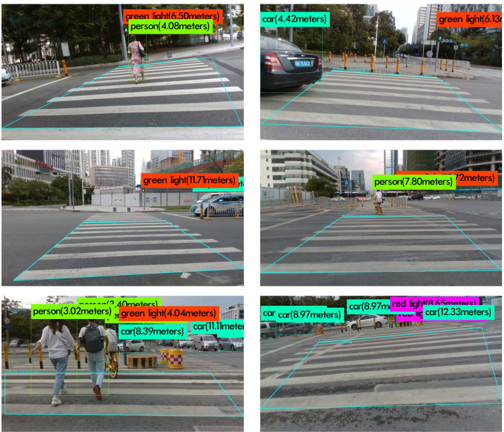
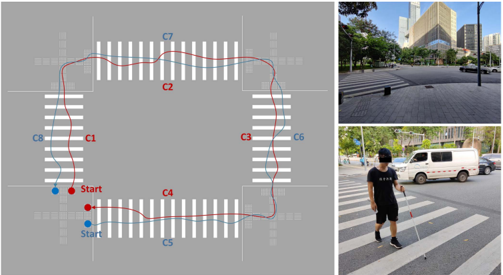
Independent mobility poses a great challenge to the visually impaired individuals. This paper proposes a novel system to understand dynamic crosswalk scenes, which detects the key objects, such as crosswalk, vehicle, and pedestrian, and identifies pedestrian traffic light status. The indication of where and when to cross the road is provided to the visually impaired based on the crosswalk scene understanding. Our proposed system is implemented on a head-mounted mobile device (SensingAI G1) equipped with an Intel RealSense camera and a cellphone, and provides surrounding scene information to visually impaired individuals through audio signal. To validate the performance of the proposed system, we propose a crosswalk scene understanding dataset which contains three sub-datasets: a pedestrian traffic light dataset with 7447 images, a dataset of key objects on the crossroad with 1006 images and a crosswalk dataset with 3336 images. Extensive experiments demonstrated that the proposed system was robust and outperformed the state-of-the-art approaches. The experiment conducted with the visually impaired subjects shows that the system is practical useful.
Overview
The claims and statistics of this paper haven’t been checked yet.
Free: it reads the open-access text and checks the first 5 claims that cite a source we can check. Create a free account to check every claim.
Integrity signals
Registry
Cites
Statistics
Figures
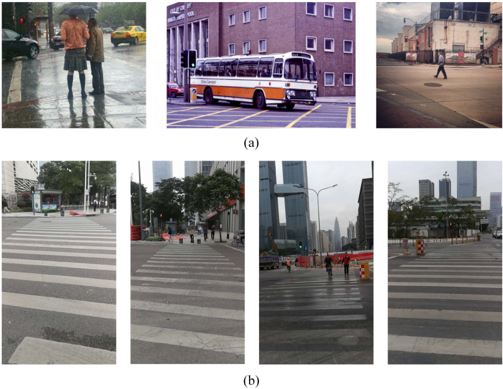
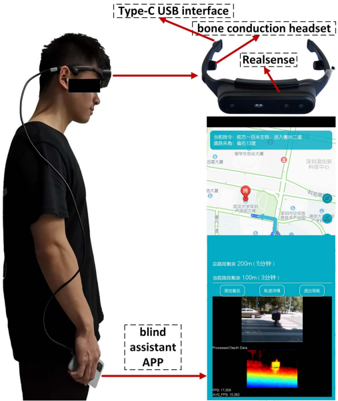
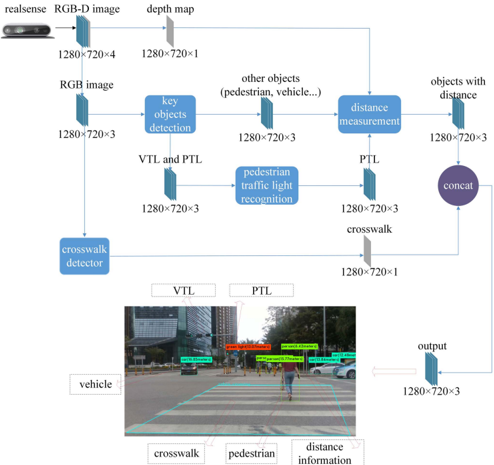
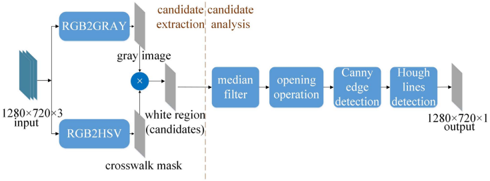
Verification
Claims the paper makes
The claims and statistics of this paper haven’t been checked yet.
Free: it reads the open-access text and checks the first 5 claims that cite a source we can check. Create a free account to check every claim.
Self-check
Percentages, sums and reported differences re-computed from the paper’s own numbers.
The self-check needs the paper’s full text.
Citations
Cites
YOLOv4: Optimal Speed and Accuracy of Object Detection
Bochkovskiy, A., Wang, C.-Y., & Liao, H.-Y. M. (2020) · arXiv · doi:10.48550/arxiv.2004.10934 · Cited by 10,307
Smart guiding glasses for visually impaired people in indoor environment
Bai, J., Lian, S., Liu, Z., Wang, K., & Liu, D. (2017) · IEEE Transactions on Consumer Electronics · doi:10.1109/tce.2017.014980 · Cited by 236
Navigation Assistance for the Visually Impaired Using RGB-D Sensor With Range Expansion
Aladren, A., Lopez-Nicolas, G., Puig, L., & Guerrero, J. J. (2016) · IEEE Systems Journal · doi:10.1109/jsyst.2014.2320639 · Cited by 231
Safe Local Navigation for Visually Impaired Users With a Time-of-Flight and Haptic Feedback Device
Katzschmann, R. K., Araki, B., & Rus, D. (2018) · IEEE Transactions on Neural Systems and Rehabilitation Engineering · doi:10.1109/tnsre.2018.2800665 · Cited by 214
Design and Construction of Electronic Aid for Visually Impaired People
Patil, K. R., Jawadwala, Q., & Shu, F. C. (2018) · IEEE Transactions on Human-Machine Systems · doi:10.1109/thms.2018.2799588 · Cited by 156
Unifying Terrain Awareness for the Visually Impaired through Real-Time Semantic Segmentation
Yang, K., Wang, K., Bergasa, L. M., Romera, E., Hu, W., Sun, D., Sun, J., Cheng, R., Chen, T., & López-Guillén, E. (2018) · Sensors · doi:10.3390/s18051506 · Cited by 130
Zebra-crossing detection for the partially sighted
Se, S. (2002) · Proceedings IEEE Conference on Computer Vision and Pattern Recognition. CVPR 2000 (Cat. No.PR00662) · doi:10.1109/cvpr.2000.854787 · Cited by 105
Recovering the sight to blind people in indoor environments with smart technologies
Mekhalfi, M. L., Melgani, F., Zeggada, A., De Natale, F. G. B., Salem, M. A.-M., & Khamis, A. (2016) · Expert Systems with Applications · doi:10.1016/j.eswa.2015.09.054 · Cited by 91
Expanding the Detection of Traversable Area with RealSense for the Visually Impaired
Yang, K., Wang, K., Hu, W., & Bai, J. Y. (2016) · Sensors · doi:10.3390/s16111954 · Cited by 86
Cardillo, E., Mattia, V. D., Manfredi, G., Russo, P., Leo, A. D., Caddemi, A., & Cerri, G. (2018) · IEEE Sensors Journal · doi:10.1109/jsen.2018.2795046 · Cited by 77
Research works printed but not linked: 4
- 10. X. Huang and Q. Lin, "An improved method of zebra crossing detection based on bipolarity," Comput. Appl. Softw., vol. 12, no. 34, pp. 202-205, Dec. 2017.
- 12. N. Chen, F. Hong, and B. Bai, "Zebra crossing recognition method based on edge frature and Hough transform," J. Zhejiang Univ. Sci. Technol., vol. 6, no. 31, pp. 476-483, Aug. 2019.
- 2021, World Health Organization
- 43. J. Roters. (2011). Pedestrian Lights Database. Accessed: Mar. 28, 2017. [Online]. Available: http://www.uni-muenster.de/PRIA/ en/forschung/index.shtml
Cited by
Zhang, J., Yang, K., Constantinescu, A., Peng, K., Müller, K., & Stiefelhagen, R. (2022) · IEEE Transactions on Intelligent Transportation Systems · doi:10.1109/tits.2022.3161141 · Cited by 110
“Whereas traditional assistance systems rely on multiple monocular detectors and depth sensors [4], [15], [16], [29] for different perception tasks, semantic segmentation allows to solve many navigational detection problems in a unified way and has been employed in visual assistance.”
BackgroundAutomatic Detection of Pedestrian Crosswalk with Faster R-CNN and YOLOv7
Kaya, Ö., Çodur, M. Y., & Mustafaraj, E. (2023) · Buildings · doi:10.3390/buildings13041070 · Cited by 65
Hu, X., Song, A., Wei, Z., & Zeng, H. (2022) · IEEE Transactions on Neural Systems and Rehabilitation Engineering · doi:10.1109/tnsre.2022.3182661 · Cited by 50
Liu, R., Zhang, J., Peng, K., Zheng, J., Cao, K., Chen, Y., Yang, K., & Stiefelhagen, R. (2023) · IEEE International Conference on Computer Vision Workshops · doi:10.1109/iccvw60793.2023.00200 · Cited by 35
“…research fields, e.g ., autonomous driving [11, 19, 47, 54, 66, 67, 75], medical image analysis [31, 50, 65], and assistance for visually impaired people [18, 30, 36, 56, 71, 74, 77], rely heavily on semantic segmentation to provide a deep understanding of the scenario to achieve better assistance.”
BackgroundInfluentialWalkVLM: Aid Visually Impaired People Walking by Vision Language Model
Yuan, Z., Zhang, T., Zhu, Y., Zhang, J., Deng, Y., Jia, Z., Luo, P., Duan, X., Zhou, J. N., & Zhang, J. (2025) · IEEE/CVF International Conference on Computer Vision (ICCV) · doi:10.1109/iccv51701.2025.00918 · Cited by 35
“Tian et al. [33] introduced a method to understand dynamic crosswalk scenes, including crosswalks, vehicles, and pedestrians, to provide VIPs with guidance of when and where to cross the road.”
Obs-tackle: an obstacle detection system to assist navigation of visually impaired using smartphones
Vijetha, U., & Geetha, V. (2024) · Machine Vision and Applications · doi:10.1007/s00138-023-01499-8 · Cited by 23
Real-Time Passable Area Segmentation With Consumer RGB-D Cameras for the Visually Impaired
Zou, W., Hua, G., Zhuang, Y., & Tian, S. (2023) · IEEE Transactions on Instrumentation and Measurement · doi:10.1109/tim.2023.3272369 · Cited by 19
Self-citationMixture reality-based assistive system for visually impaired people
Song, J., Wang, J., Zhu, S., Hu, H., Zhai, M., Xie, J.-C., & Gao, H. (2023) · Displays · doi:10.1016/j.displa.2023.102449 · Cited by 16
Montanha, A., Oprescu, A. M., & Ternero, M. D. C. R. (2022) · Applied Artificial Intelligence · doi:10.1080/08839514.2022.2062818 · Cited by 14
“( Tian et al. 2021) described an assistive solution to understand crosswalk scenes and provide users with key information and directions to cross the street.”
BackgroundA dataset for the visually impaired walk on the road
Xia, H., Yao, C., Tan, Y., & Song, S. (2023) · Displays · doi:10.1016/j.displa.2023.102486 · Cited by 20
Deep Learning-Based Optimization of Visual–Auditory Sensory Substitution
Kim, M., Park, Y., Moon, K., & Jeong, C. Y. (2023) · IEEE Access · doi:10.1109/access.2023.3243641 · Cited by 12
“However, in visual–auditory substitution, various methods that can code visual information [15], [16], [17], [18], [23], [24], [25] are available.”
BackgroundMethodHong, K., He, W., Tang, H., Zhang, X., Li, Q., & Zhou, B. (2024) · IEEE Internet of Things Journal · doi:10.1109/jiot.2024.3371978 · Cited by 13
“However, the precision of GNSS heavily depends on satellite geometry, signal blockage and other factors, which is not accurate and stable enough for ensuring the navigation safety of visually impaired individuals [5], [7].”
BackgroundMethodInfluentialChen, L.-B., Pai, W.-Y., Chen, W.-H., & Huang, X.-R. (2024) · IEEE Sensors Journal · doi:10.1109/jsen.2024.3484576 · Cited by 11
“Tian et al. [23] proposed a detection system for visually impaired people in dynamic crosswalk scenes.”
Enhancing Street-Crossing Safety for Visually Impaired Pedestrians with Haptic and Visual Feedback
Ren, G., Huang, Z., Lin, W., Huang, T., Wang, G., & Lee, J. H. (2025) · Applied Sciences · doi:10.3390/app15073942 · Cited by 8
Efficient Real-Time Pathfinding for Visually Impaired Individuals
Ghahremanians, T., & Mohammadi, H. M. (2025) · IEEE Access · doi:10.1109/access.2025.3562247 · Cited by 6
“Computer vision techniques such as object recognition [8], [9], [10], face recognition [11], crosswalk identification [12], traffic sign and light recognition [12], and OCR methods [13] can be employed in assistive systems for visually impaired individuals.”
Bu, L., Cui, B., Pan, W., Chen, H., Xia, S., & Li, H. (2025) · Universal Access in the Information Society · doi:10.1007/s10209-025-01240-4 · Cited by 6
Lightweight boundary-assisted network for freespace segmentation in unstructured road scenes
Peng, J., Hua, G., Tian, S., Wu, Y., & Zou, W. (2024) · Displays · doi:10.1016/j.displa.2024.102688 · Cited by 6
Self-citationZhang, Q. (2022) · Multimedia Tools and Applications · doi:10.1007/s11042-022-13805-z · Cited by 6
“Some measures [14, 69] have been implemented for protecting pedestrians from vehicle collisions [34, 37].”
BackgroundLei, Y., Thompson, J. L., Phung, S. L., Bouzerdoum, A., & Le, H. T. (2025) · Neurocomputing · doi:10.1016/j.neucom.2025.129468 · Cited by 7
AI Based Talking and Virtual Eye for Visionless People
Kumar, P., Karthick, V., Lithishkumar, S., & Madhavan, V. (2024) · International Conference on Emerging Trends in Information Technology and Engineering (ICETITE) · doi:10.1109/ic-etite58242.2024.10493777 · Cited by 5
Koike, Y., & Tanjo, Y. (2024) · Conference proceedings/Conference proceedings - IEEE International Conference on Systems, Man, and Cybernetics · doi:10.1109/smc54092.2024.10831696 · Cited by 5
A Study on Smart Assistive Stick for Visually Impaired Individuals
Megajai., K. Y., Kumar, P., & Prabha., K. L. (2025) · International Conference on Visual Analytics and Data Visualization (ICVADV) · doi:10.1109/icvadv63329.2025.10961202 · Cited by 5
Khan, A., Ramli, D. A., Rehman, M. Z., Bangash, J. I., & Atta, M. N. (2025) · IEEE Access · doi:10.1109/access.2025.3612482 · Cited by 5
“Therefore, some researchers are investigating the use of computer vision algorithms [7], [8], [9], [10], [11], [12] to assist VII in navigating by identifying items in different contexts, such as traffic signals and common impediments.”
Bathool, S., M, J. R., & Biradar, V. (2025) · Computers & Electrical Engineering · doi:10.1016/j.compeleceng.2025.110813 · Cited by 5
Pedestrian Crossing Detection by VGG16 for Visually-impaired Walking Assistance System
Yoshikawa, T., & Premachandra, C. (2022) · International Conference on Robotics, Automation and Artificial Intelligence (RAAI) · doi:10.1109/raai56146.2022.10092992 · Cited by 4
“Such as in-vehicle cameras [6] [7], field-fixed cameras [8] [9] [10], and pedestrian-mounted cameras [11] [12].”
Travel behavior of visually impaired people before and during COVID-19
Zhang, T., Jia, Q., Cheng, L., Cheng, G., & Yang, Y. (2023) · Travel Behaviour and Society · doi:10.1016/j.tbs.2023.100717 · Cited by 7
From Pedestrian Detection to Crosswalk Estimation: An EM Algorithm and Analysis on Diverse DatasetsPreprint
Greer, R., & Trivedi, M. M. (2022) · arXiv (Cornell University) · doi:10.48550/arxiv.2205.12579 · Cited by 4
“…(Coughlan & Shen, 2006), edge direction and cross-ratio analysis (Suzuki et al., 2010), Canny edge detection and Hough line parameter estimation (Tian et al., 2021), MSER and ERANSAC (Zhai et al., 2015), laser scanning (Hernndez et al., 2015), monocular image deep learning to classify presence…”
MethodRomić, K., Leventić, H., Habijan, M., & Galić, I. (2025) · IEEE Access · doi:10.1109/access.2025.3629349 · Cited by 2
Computer Vision based Tools and Technologies for Navigational Assistance for the Visually Impaired
Dasu, S., Ranade, M. M., Sarkar, S., & Anala, M. R. (2022) · International Conference on Augmented Intelligence and Sustainable Systems (ICAISS) · doi:10.1109/icaiss55157.2022.10010946 · Cited by 2
“[12] provides a solution for the specific problem of evaluating a crosswalk scene using computer vision.”
BackgroundDevelopment of Fuzzy Algorithm as Mobility Aid for Blind Person Using Two Sensor Points
Supriyadi, T., Solihin, R., Habinuddin, E., & Sudrajat, S. (2025) · International Journal of Engineering Continuity · doi:10.58291/ijec.v3i2.336 · Cited by 2
A Deep Learning-Based Scene Description and Object Recognition App for the Visually Impaired
Saraswathi, P., Abdul Khaliq, H., Hariprasath, N., & Prabha, M. (2024) · International Conference on Sustainable Communication Networks and Application (ICSCNA) · doi:10.1109/icscna63714.2024.10863919 · Cited by 2
Object Detection Using Deep Learning for Blind People with Voice Feedback
Pongiannan, R. K., Franklin, J. A., Richard Pravin, A., Maria, M., & Mishra, S. K. (2024) · International Conference on System, Computation, Automation and Networking (ICSCAN) · doi:10.1109/icscan62807.2024.10894354 · Cited by 3
“As we delve deeper into this transformative technology, this report sheds light on the significance and impact of the BlindSpace application in the lives of the visually challenged, marking an exciting journey toward inclusivity, autonomy, and a brighter, more accessible future[9, 10,11].”
Song, W., Sun, Y., Huang, Q., & Cheok, J. (2024) · Artificial Intelligence and Applications · doi:10.47852/bonviewaia42022098 · Cited by 3
Astute Assistance System for Blind and Visually Impaired People
Rani, P. U., Angel, S., Janani, L., Berista, S., & Tejasri Deeptha, A. (2024) · International Conference on Intelligent Communication Technologies and Virtual Mobile Networks (ICICV) · doi:10.1109/icicv62344.2024.00018 · Cited by 2
“Tian [7] proposed a unique system to comprehend dynamic crosswalk sceneries.”
BackgroundMobility aid for identification of bus and auto-rikshaw for visually challenged people
Bhatlawande, S. S., Hegde, A., Jain, A., Jain, N., Shilaskar, S., & Madake, J. (2023) · AIP conference proceedings · doi:10.1063/5.0148314 · Cited by 1
Detection of Outdoor Traffic and Kids Playing Scene for Visually Impaired People
Shilaskar, S., Kadam, A., Kadam, R., Jadhav, T., Bhatlawande, S. S., & Madake, J. (2022) · Lecture notes in electrical engineering · doi:10.1007/978-981-19-6581-4_18 · Cited by 1
Jeong, S., Lee, Y.-H., & Jung, E. (2024) · The Journal of Korean Institute of Information Technology · doi:10.14801/jkiit.2024.22.12.39 · Cited by 1
Bansal, V., Joshi, A., Aarsha, V. S., Shivali, & Talwandi, N. S. (2025) · Lecture notes in networks and systems · doi:10.1007/978-981-96-6297-5_15 · Cited by 1
Bhuyan, Z., Xie, Y., Rith, A., Yan, X., Apostolov, A., Oke, J. B., & Ai, C. (2025) · arXiv (Cornell University) · doi:10.48550/arxiv.2506.07885 · Cited by 1
“Existing crosswalk detection studies primarily rely on images captured by ground-level cameras (e.g., Haselhoff and Kummert, 2010; Kaya et al., 2023; Malbog, 2019; Murali and Coughlan, 2013; Tian et al., 2021; Tümen and Ergen, 2020; Zhai et al., 2015; Zhang et al., 2022).”
Electronic Mobility Aid for Detection of Roadside Tree Trunks and Street-Light Poles
Bhatlawande, S. S., Joshi, A., Joshi, R. R., Joshi, K., Shilaskar, S., & Madake, J. (2022) · Smart innovation, systems and technologies · doi:10.1007/978-981-19-2541-2_29
E-C ommerce website for visually challenged
Durgaveni, G., Priyanka, B. K., Subama, K. K., Gomathi, S., Deepa, C., & Maharasi, S. L. (2023) · AIP conference proceedings · doi:10.1063/5.0140072
Staircase detection for safe mobility of visually impaired people
Madake, J., Bhatlawande, S. S., Shilaskar, S., Deshpande, P., & Deshpande, V. (2023) · AIP conference proceedings · doi:10.1063/5.0161151
An expert system for detection of household furniture for safe mobility of blind people
Bhatlawande, S. S., Katkalambekar, V., Singh, K., Kulkarni, C., Madake, J., & Shilaskar, S. (2023) · AIP conference proceedings · doi:10.1063/5.0161156
Electronic Travel Aid for Bus Detection and Bus-Route Number Recognition for Blind People
Bhatlawande, S. S., Agrawal, H., Jagdale, A., Agrawal, A., & Shilaskar, S. (2023) · Lecture notes in electrical engineering · doi:10.1007/978-981-99-3656-4_8
Integration of Voice Assistance System for Visually Challenged Person
Gilda, A. J., Dayana, A. M., Sheela, A. J., & Gowthami, M. (2023) · International Conference on Research Methodologies in Knowledge Management, Artificial Intelligence and Telecommunication Engineering (RMKMATE) · doi:10.1109/rmkmate59243.2023.10368698
“For those with these limitations, using the web, online services and even daily outdoor walking can be difficult [2].”
BackgroundMethodExtended Kalman filter design for compass navigation tool on visual impaired person
Solihin, R., Sudrajat, S., Utomo, T., Putra, F. A. S., & Supriyadi, T. (2024) · JITEL (Jurnal Ilmiah Telekomunikasi Elektronika dan Listrik Tenaga) · doi:10.35313/jitel.v4.i2.2024.115-124
“The use of RGB camera sensors [8] and Visible Light Communication (VLC) technology mounted on sticks [9] is used to identify zebra crossing patterns.”
MethodAnalysis of Smart Walking Sticks for Visually Impaired People
Marappan, R., & Mhapankar, S. (2025) · National Academy Science Letters · doi:10.1007/s40009-025-01712-4
Supriyadi, T., Solihin, R., Habinuddin, E., Sudrajat, S., Utomo, T., Setiadi, B., & Nugraha, R. (2025) · International Journal of Engineering Continuity · doi:10.58291/ijec.v4i1.395
Independent pathfinding with collision avoidance for visually impaired individuals
Ghahremanians, T., & Mohammadi, H. M. (2025) · Scientific Reports · doi:10.1038/s41598-025-19387-8
Solihin, R., Sudrajat, S., Utomo, T., Putra, F. A. S., & Supriyadi, T. (2025) · AIP conference proceedings · doi:10.1063/5.0295141
Solihin, R., Hasanah, R., Setiadi, B., Supriyadi, T., Sudrajat, S., & Hartono, R. W. T. (2025) · International Journal of Engineering Continuity · doi:10.58291/ijec.v4i2.416
“…studies have shown that single-sensor systems, such as LiDAR, cameras, or ultrasonic sensors, are still limited in detecting moving objects, recognising the direction of arrival, and adapting to varying environmental conditions (Barontini et al., 2021; Qiu et al., 2020; Tian et al., 2021).”
Montanha, A. (2023) · Deposito de Investigacion Universidad de Sevilla (University of Seville)
Padmapriya, R., & Jeyasekar, A. (2026) · Journal of Circuits Systems and Computers · doi:10.1142/s0218126626501823
Hsu, S., Yao, K., Nguyen, P. T.-T., & Kuo, C.-H. (2026) · International Conference on Consumer Electronics · doi:10.1109/icce67443.2026.11449621
“Complex intersection designs, multi-directional traffic, and surrounding noise further increase the challenge, as important acoustic signals may be missed [2].”
SIGHSAGE: Smart Scene Narrator for Visually Impaired Using YOLOv11
Baskar, S. N., Divi, S., Kriti, P., Akshara, S., V, Manavsagar, & Karthikeyan, N. (2025) · International Conference on Emerging Research in Computational Science (ICERCS) · doi:10.1109/icercs65898.2025.11580435
“• Connectivity: As these kinds of systems are designed to work over the Internet, they become useless in offline situations, e.g., in remote areas, subways, or as a result of a network failure [12].”
Yan, X., Bhuyan, Z., Oke, J. B., Wu, G., & Xie, Y. (2026) · Engineering Applications of Artificial Intelligence · doi:10.1016/j.engappai.2026.115851
Shagor, M. S. I. (2026) · Research Square · doi:10.21203/rs.3.rs-11073218/v1
Metadata
- Authors
- Tian, S., Zheng, M., Zou, W., Li, X., & Zhang, L.
- Affiliations
- Shenzhen University (CN)
- Institut National des Sciences Appliquées de Rennes (FR)
- Venue
- IEEE Transactions on Neural Systems and Rehabilitation Engineering
- Published
- 2021
- Volume
- 29
- Pages
- 1478-1486
- ISSN
- 1534-4320 (ISSN-L)
- 1558-0210
- OpenAlex
- W3180901291
- Cited by
- 48
- References
- 41
- Citations by year
- 2026: 4 · 2025: 12 · 2024: 11 · 2023: 13 · 2022: 8
- FWCI
- 2.88
- Type
- journal article
- Language
- en
- Open access
- gold
- doi.org
- Licence
- Locations
- IEEE Transactions on Neural Systems and Rehabilitation Engineering (publishedVersion, cc-by-nc-nd)
- PubMed (publishedVersion)
- HAL (submittedVersion, other-oa)
- Funders
- National Natural Science Foundation of China (61771321, 61871273, 61872429)
- Key Project of DEGP (2018KCXTD027)
- Natural Science Foundation of Guangdong Province, China (2020A1515010959)
- Natural Science Foundation of Shenzhen (JCYJ20200109105832261)
- Interdisciplinary Innovation Team of Shenzhen University
- Topics
- Physical Sciences › Computer Science › Computer Vision and Pattern Recognition › Advanced Neural Network Applications
- Health Sciences › Health Professions › Occupational Therapy › Assistive Technology in Communication and Mobility
- Physical Sciences › Engineering › Automotive Engineering › Autonomous Vehicle Technology and Safety
- Keywords
- visually impaired people, independent mobility, head-mounted devices, audio feedback, object detection, assistive technology
- MeSH terms
- Accidents, Traffic, Pedestrians, Humans, Visually Impaired Persons, Persons with Visual Disabilities
About these checks
Registry, retraction, Cites and statistics results are computed, not judged, with one exception: a printed reference that no index lists is read once by a model before it counts as a citation error. Claims are extracted by a model and kept only when their quote appears verbatim in the text; each cited source is then checked, with a model’s help, for whether it says what the claim relies on. Those verdicts can be wrong — read the claim’s quote and the cited source before relying on one.
Statistics and arithmetic are recomputed, not judged.
Confidence bands are shown only for fields calibrated on our annotated test set. None is calibrated yet, so no band is shown.
What counts as a claim ›How we measure confidence ›How we check this ›
Are you an author, or do you see a problem with this page? Request a review
Data sources
Bibliographic data: Semantic Scholar, OpenAlex, Crossref.
Contains information from the Semantic Scholar Academic Graph Datasets, made available under the ODC Attribution License (ODC-BY 1.0).
Semantic Scholar’s data is described in: Kinney, R., et al. (2023). The Semantic Scholar Open Data Platform. arXiv:2301.10140.
