

StereoPilot: A Wearable Target Location System for Blind and Visually Impaired Using Spatial Audio Rendering
Open accessThe DOI matches its Crossref record; 39 of the 44 references it cites were found in a registry or an index; 2 of the 14 sources its claims cite were checked for support.
Abstract
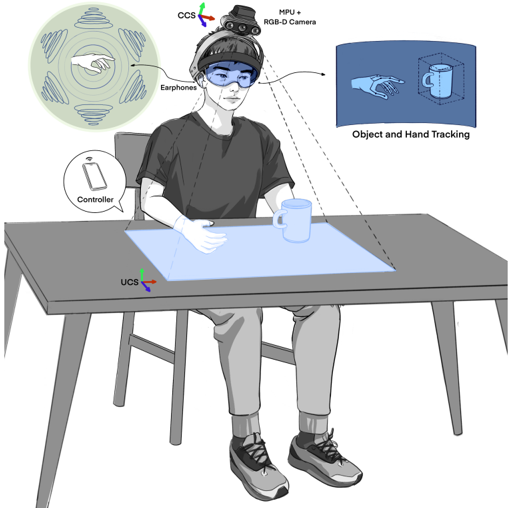
Vision loss severely impacts object recognition and spatial cognition for limited vision individuals. It is a challenge to compensate for this using other sensory modalities, such as touch or hearing. This paper introduces StereoPilot, a wearable target location system to facilitate the spatial cognition of BVI. Through wearing a head-mounted RGB-D camera, the 3D spatial information of the environment is measured and processed into navigation cues. Leveraging spatial audio rendering (SAR) technology, it allows the navigation cues to be transmitted in a type of 3D sound from which the sound orientation can be distinguished by the sound localization instincts in humans. Three haptic and auditory display strategies were compared with SAR through experiments with three BVI and four sighted subjects. Compared with mainstream speech instructional feedback, the experimental results of the Fitts' law test showed that SAR increases the information transfer rate (ITR) by a factor of three for spatial navigation, while the positioning error is reduced by 40%. Furthermore, SAR has a lower learning effect than other sonification approaches such as vOICe. In desktop manipulation experiments, StereoPilot was able to obtain precise localization of desktop objects while reducing the completion time of target grasping tasks in half as compared to the voice instruction method. In summary, StereoPilot provides an innovative wearable target location solution that swiftly and intuitively transmits environmental information to BVI individuals in the real world.
Overview
CoChat Summary
TL;DR
StereoPilot is a wearable target-location system that uses a head-mounted RGB-D camera and spatial audio rendering (SAR) to convey object locations to blind and visually impaired users. In experiments with 3 BVI and 4 sighted participants, SAR improved information transfer rate and reduced positioning error and grasping time relative to voice, vibrotactile, and vOICe-style sonification feedback.
Key findings
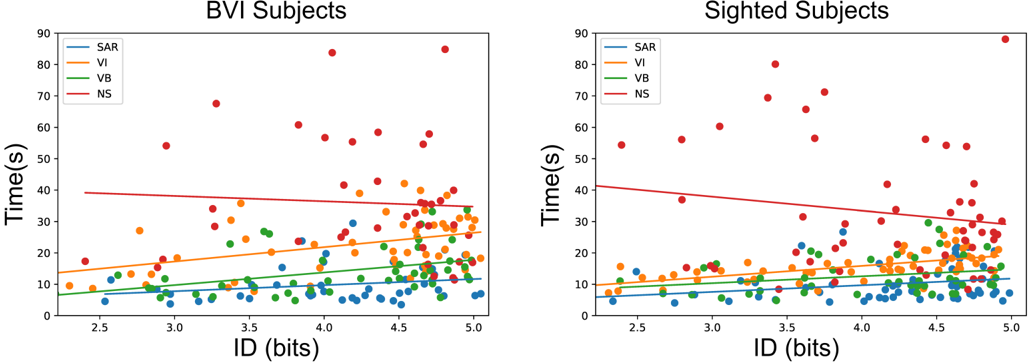
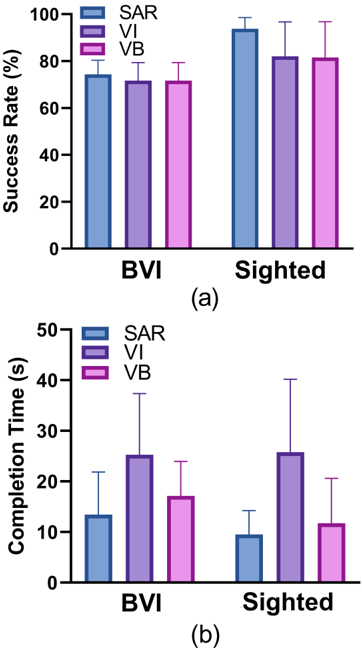
- In the Fitts’ law test, BVI participants had SAR ITR of 0.764 bits/s versus VI 0.243, VB 0.256, and NS −0.596; completion time was 9.97 ± 5.71 s for SAR versus 22.46 ± 9.12 s for VI, 14.01 ± 7.42 s for VB, and 33.04 ± 19.57 s for NS.
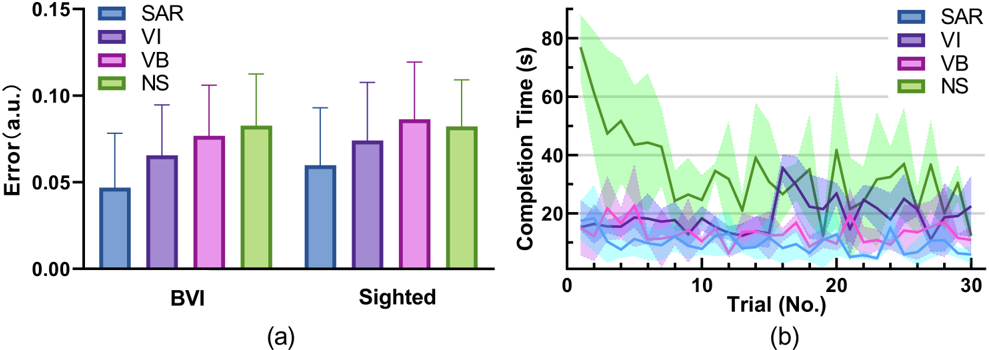
- For BVI participants, SAR reduced positioning error by 28% compared with VI, 39% compared with VB, and 46% compared with NS; SAR positioning accuracy for BVI was 22% higher than for sighted subjects. The abstract reports SAR increased ITR by a factor of three and reduced positioning error by 40% compared with speech instruction.
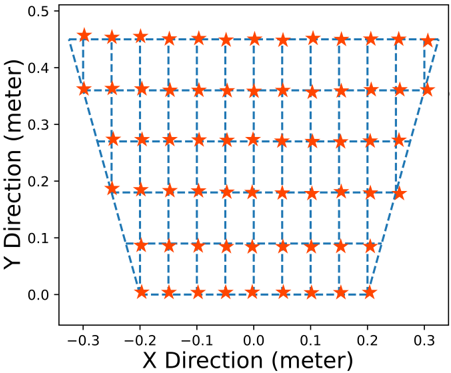
- In desktop manipulation, the RGB-D camera’s average localization error was 0.43 ± 0.14 cm; the system ran at 15 fps with 43% CPU and 400 MB memory usage. SAR shortened target-grasping completion time, reported in the abstract as half that of the voice instruction method.
- Success rates were similar across SAR, VI, and VB but lower for NS: BVI SAR 96.61 ± 1.43%, VI 95.90 ± 1.06%, VB 96.24 ± 1.51%, NS 84.56 ± 3.54%; sighted SAR 97.11 ± 1.82%, VI 95.59 ± 1.93%, VB 95.60 ± 1.07%, NS 87.61 ± 4.60%.
Methods
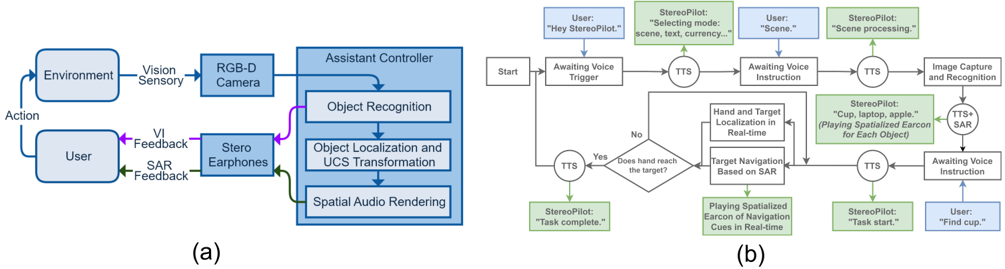
- The wearable system used an Intel RealSense D435 RGB-D camera and MPU9250 on a head-mounted helmet, MediaPipe for object and hand recognition, and coordinate transformation from the camera coordinate system to the user coordinate system; stereo earphones provided audio feedback.
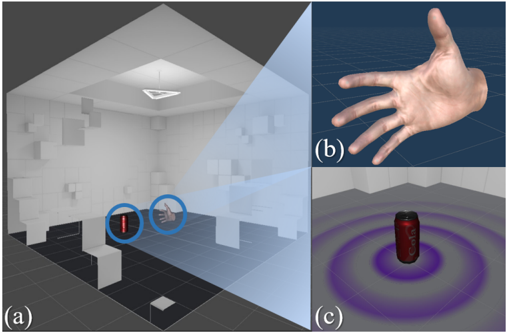
- SAR encoded target location using a sound cue with high- and low-frequency components, a CIPIC-based HRTF model, and Google Resonance Audio in a Unity virtual scene, with the virtual hand as listener and target object as sound source.
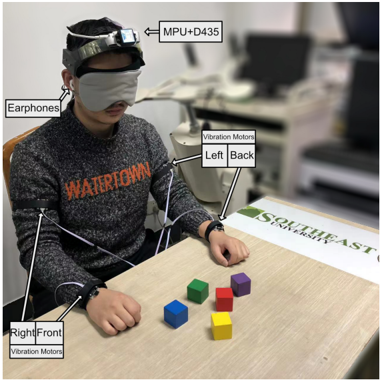
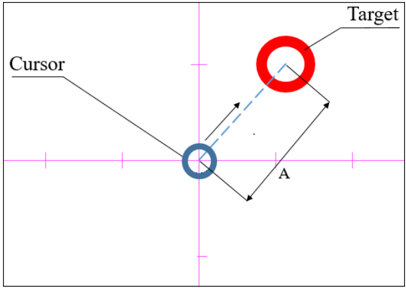
- Experiments included 4 sighted participants (25.5 ± 4.2 years) and 3 participants with congenital blindness (22.6 ± 1.5 years), all with normal hearing. The Fitts’ law test compared SAR, VI, VB, and NS with 30 repetitions per group; the desktop manipulation experiment used five same-material, same-mass, same-shape blocks differing in color, randomly positioned less than 5 cm apart, with 30 trials per feedback method.
Limitations
- Stated: some subjects reported that rendered spatial audio deviated from actual orientation, possibly due to the generalized HRTF model; the authors propose subject-specific HRTF and more realistic rendering.
- Stated: machine vision recognition errors during human-environment interaction, especially hand/object occlusion, can cause positioning errors and incorrect spatial information; robustness needs improvement.
- Stated: vOICe/NS had a 1 fps snapshot update rate, high learning cost, and target/cursor confusion; BVI success was lower than sighted partly because RGB-D recognition accuracy decreased when the hand blocked the object. Evident: the sample was small (3 BVI, 4 sighted), limiting generalizability.
Model-written summary. Check it against the paper before relying on it.
Integrity signals
Registry
Cites
Statistics
Figures
Verification
Claims the paper makes
1 Valid · 5 Not valid · 8 Not checked · 53 Own results and interpretations
Every source the paper cites for this claim was checked and supports it.
In the paper
“May et al. [21] investigated the effectiveness of area cues and proximity feedback in facilitating object targeting based on virtual environment, but to our best knowledge there is rarely research on BVI's hand prehension task in real environment.”
§ StereoPilot: A Wearable Target Location System for Blind and Visually Impaired Using Spatial Audio Rendering > I. INTRODUCTION
What the sources say
- Supportedcites [21] 21. K. R. May, B. Sobel, J. Wilson, and B. N. Walker, "Auditory displays to facilitate object targeting in 3D space," in Proceedings of the 25th International Conference on Auditory Display (ICAD 2019). Newcastle upon Tyne, United Kingdom: Department of Computer and Information Sciences, Northumbria University, 6 2019, pp. 155-162. [Online]. Available: http://hdl.handle.net/1853/61542 source
Section 1.2 'Current Study' states verbatim the goal attributed to May et al.: investigating the effectiveness of area cues and proximity feedback in facilitating object targeting, with participants walking a virtual kitchen and physically reaching for targets; Section 2.2.1 confirms the setting was a Unity/SteamVR virtual environment. The trailing clause about the scarcity of real-environment hand-prehension research for BVI users is the citing authors' own 'to our best knowledge' assertion and is not attributed to this source (our copy does not make that claim, and its participants were sighted undergraduates, not BVI), so it falls outside what is judged here. (LLM, conf=0.88)
hedged- Asserted: passes — The authors put it forward as true.
- Checkable: passes — It can be checked against evidence.
- Load-bearing: passes — The paper’s conclusions depend on it.
- Based: passes — The paper gives a reason why it holds.
- Supported
The cited sources that could be checked couldn’t confirm or dispute this claim.
In the paper
“The slope of the linear regression curve represents the ITR and shows that SAR was nearly three times that of the VI and VB in the BVI group.”
- Also stated in: § A. Analysis of experimental results · boosted
“The experimental results show that SAR improves the ITR for BVI, which is consistent with the results demonstrated by Dunai et al. [37] and Frauenberger et al. [19].”
- Also stated in: § VI. CONCLUSION · plain
“The results of Fitts' law test show that SAR can effectively improve the ITR of location information for users.”
§ StereoPilot: A Wearable Target Location System for Blind and Visually Impaired Using Spatial Audio Rendering > A. Fitts' law test
What the sources say
- Could not verifycites Dunai et al. [37] 37. L. Dunai, I. Lengua, G. Peris-Fajarnés, and F. Brusola, "Virtual sound localization by blind people," Archives of Acoustics, vol. 40, no. 4, pp. 561-567, 12 2015. [Online]. Available: http://journals.pan.pl/dlibra/publication/116685/edition/101416/content sourceExperimental — accuracy not yet measured
Our copy of Dunai et al. (2015) reports localization times, distance/azimuth errors (±40 cm, ±10 cm), walking times and number of hits (Results and discussion, pp. of Sec. 4), but nowhere defines or reports an information transfer rate (ITR), a 'SAR' condition, or 'VI'/'VB'/'BVI' groups, and no linear-regression slope is used as a performance metric. Searches for 'ITR / information transfer rate', 'slope of linear regression', 'SAR VI VB', and 'three times' returned only HRTF/filter equations (Sec. 2.2), the sensory system (Sec. 2.1), and the four-participant description (Sec. 3). Since the copy is complete but does not address the claimed quantity, the attribution can be neither confirmed nor contradicted. (LLM, conf=0.72)
- Not matchedcites Frauenberger et al. [19] 19. C. Frauenberger and M. Noistering, "3D audio interfaces for the blind," in Proceedings of the 9th International Conference on Auditory Display. Boston, MA, USA: International Community for Auditory Display, 7 2003.
We searched by its title and found no matching paper.
boostedstates a cause- Asserted: passes — The authors put it forward as true.
- Checkable: passes — It can be checked against evidence.
- Load-bearing: passes — The paper’s conclusions depend on it.
- Based: passes — The paper gives a reason why it holds.
- Also stated in: § A. Analysis of experimental results · boosted
A result the paper reports from its own data — it cites no other source for it, so there is none to check. The quote shows it is in the paper.
In the paper
“In desktop manipulation experiments, StereoPilot was able to obtain precise localization of desktop objects while reducing the completion time of target grasping tasks in half as compared to the voice instruction method.”
§ StereoPilot: A Wearable Target Location System for Blind and Visually Impaired Using Spatial Audio Rendering > Abstract
plainstates a cause- Asserted: passes — The authors put it forward as true.
- Checkable: passes — It can be checked against evidence.
- Load-bearing: passes — The paper’s conclusions depend on it.
- Based: passes — The paper gives a reason why it holds.
The paper states this without a source or data behind it here, so there is nothing to check it against. The quote shows it is in the paper.
In the paper
“Furthermore, SAR has a lower learning effect than other sonification approaches such as vOICe.”
§ StereoPilot: A Wearable Target Location System for Blind and Visually Impaired Using Spatial Audio Rendering > Abstract
plainstates a cause- Asserted: passes — The authors put it forward as true.
- Checkable: passes — It can be checked against evidence.
- Load-bearing: unclear — It is unclear whether the paper’s conclusions depend on it.
- Based: unclear — It is unclear why the paper says it holds.
A result the paper reports from its own data — it cites no other source for it, so there is none to check. The quote shows it is in the paper.
In the paper
“In desktop manipulation experiments, StereoPilot was able to obtain precise localization of desktop objects while reducing the completion time of target grasping tasks in half as compared to the voice instruction method.”
§ StereoPilot: A Wearable Target Location System for Blind and Visually Impaired Using Spatial Audio Rendering > Abstract
plainstates a cause- Asserted: passes — The authors put it forward as true.
- Checkable: passes — It can be checked against evidence.
- Load-bearing: passes — The paper’s conclusions depend on it.
- Based: passes — The paper gives a reason why it holds.
35 more claims
Create a free account to see all 67 claims and to verify the 3 references still open.
- Probably not a substantial claim. 16
- It may state two separate claims as one. 17
- The quote only partly states this claim. 1
Self-check
Percentages, sums and reported differences re-computed from the paper’s own numbers.
Each contradiction between two passages listed here was confirmed by an independent check.
Rated minor: it would not touch a result — a value no result rests on, a p-value that stays on the same side of the significance level, or a conflict that is clerical, resolved elsewhere in the paper, or outside its own findings.
In the paper
§ StereoPilot: A Wearable Target Location System for Blind and Visually Impaired Using Spatial Audio Rendering > A. Fitts' law test
“while sighted subjects have a relatively stable perception in VI group (RMSE = 4.855).”
§ StereoPilot: A Wearable Target Location System for Blind and Visually Impaired Using Spatial Audio Rendering > D. Desktop Manipulation Experiment
“RMSE (a.u.) 5.970 6.828 6.484 19.240 4.995 3.238 4.855 19.470”
Citations
Cites
Delving Deep into Rectifiers: Surpassing Human-Level Performance on ImageNet Classification
He, K., Zhang, X., Ren, S., & Sun, J. (2015) · 2015 IEEE International Conference on Computer Vision (ICCV) · doi:10.1109/iccv.2015.123 · Cited by 19,741
Spatial hearing: the psychophysics of human sound localization
(1997) · Choice Reviews Online · doi:10.5860/choice.35-0346 · Cited by 2,304
Bourne, R., Steinmetz, J. D., Flaxman, S., Briant, P. S., Taylor, H. R., Resnikoff, S., Casson, R. J., Abdoli, A., Abu-Gharbieh, E., Afshin, A., et al. (2021) · The Lancet Global Health · doi:10.1016/s2214-109x(20)30425-3 · Cited by 1,431
MediaPipe: A framework for building perception pipelines
Lugaresi, C., Tang, J., Nash, H., McClanahan, C., Uboweja, E., Hays, M., Zhang, F., Chang, C.-L., Yong, M. G., Lee, J., et al. (2019) · arXiv · doi:10.48550/arxiv.1906.08172 · Cited by 1,043
Algazi, V. R., Duda, R. O., Thompson, D. M., & Avendano, C. (2002) · Proceedings of the 2001 IEEE Workshop on the Applications of Signal Processing to Audio and Acoustics (Cat. No.01TH8575) · doi:10.1109/aspaa.2001.969552 · Cited by 926
An experimental system for auditory image representations
Meijer, P. B. L. (1992) · IEEE Transactions on Biomedical Engineering · doi:10.1109/10.121642 · Cited by 900
AlignedReID: Surpassing Human-Level Performance in Person Re-Identification
Zhang, X., Luo, H., Fan, X., Xiang, W., Sun, Y., Xiao, Q., Jiang, W., Zhang, C., & Sun, J. (2017) · arXiv · doi:10.48550/arxiv.1711.08184 · Cited by 419
The GuideCane-applying mobile robot technologies to assist the visually impaired
Ulrich, I., & Borenstein, J. (2001) · IEEE Transactions on Systems, Man, and Cybernetics - Part A: Systems and Humans · doi:10.1109/3468.911370 · Cited by 414
Sensory conflict in judgments of spatial direction
Pick, H. L., Warren, D. H., & Hay, J. C. (1969) · Perception & Psychophysics · doi:10.3758/bf03207017 · Cited by 386
The Argus® II Retinal Prosthesis System
Luo, Y. H.-L., & da Cruz, L. (2016) · Progress in Retinal and Eye Research · doi:10.1016/j.preteyeres.2015.09.003 · Cited by 351
Cited by
Lai, J., Song, A., Wang, J., Lu, Y., Wu, T., Li, H., Xu, B., & Wei, X. (2023) · IEEE Transactions on Neural Systems and Rehabilitation Engineering · doi:10.1109/tnsre.2023.3302612 · Cited by 50
“in their rehabilitation process [4], [5].”
Self-citationJoshi, R. C., Singh, N. K., Sharma, A. K., Bürget, R., & Dutta, M. K. (2024) · IEEE Transactions on Human-Machine Systems · doi:10.1109/thms.2024.3375655 · Cited by 51
“Most of the applications are made for only limited tasks, such as drug pill recognition [22], target localization [23], object recognition [24], accident prevention [25], and obstacle detection [26].”
BackgroundChen, D., Zhang, Y., Hu, X., Chen, G., Fang, Y., Chen, X., Liu, J., & Song, A. (2024) · IEEE Transactions on Neural Systems and Rehabilitation Engineering · doi:10.1109/tnsre.2024.3363495 · Cited by 42
“Due to severe vision impairment, BVI mainly rely on touch [2], [3], [4] and hearing [5] to gather information from their surroundings.”
BackgroundSelf-citationTechnological Advancements in Human Navigation for the Visually Impaired: A Systematic Review
Casanova, E., Guffanti, D., & Hidalgo, L. (2025) · Sensors · doi:10.3390/s25072213 · Cited by 35
A Systematic Review of Fitts' Law in 3D Extended Reality
Amini, M. M., Stuerzlinger, W., Teather, R. J., & Batmaz, A. U. (2025) · CHI Conference on Human Factors in Computing Systems · doi:10.1145/3706598.3713623 · Cited by 40
“For example, Hu et al. [63] used Fitts’ law to evaluate their wearable target location system, designed for visually impaired or blind users.”
Wearable technologies for assisted mobility in the real world
Gao, S., Chen, J., Xia, Y., Li, X., Ma, W., Yang, H., Li, J., Zhou, X., Jia, T., Xu, Y., et al. (2025) · Nature Communications · doi:10.1038/s41467-025-67126-4 · Cited by 43
“…have been validated in real-world applications with studies con fi rming their ability to reduce navigation errors and boost user con fi dence 133,135 – 137, 139, Despite technological advancements, current wearable navigation systems still face limitations such as high cost, restricted…”
Campanelli, A., Tiboni, M., Vérité, F., Saudrais, C., Mick, S., & Jarrassé, N. (2024) · Mechatronics · doi:10.1016/j.mechatronics.2024.103161 · Cited by 17
Exploring Audio Interfaces for Vertical Guidance in Augmented Reality via Hand-Based Feedback
Guarese, R., Pretty, E. J., Renata, A., Polson, D., & Zambetta, F. (2024) · IEEE Transactions on Visualization and Computer Graphics · doi:10.1109/tvcg.2024.3372040 · Cited by 13
“Vertical guidance methods are rarely explored in auditory interface literature beyond the simplistic notion of using static levels of high pitch as an indication of high elevations [28,37,56].”
BackgroundMethodInfluentialPeng, C., Yang, D., Zhao, D., Cheng, M., Dai, J., & Jiang, L. (2024) · IEEE Robotics and Automation Letters · doi:10.1109/lra.2024.3448218 · Cited by 13
“In the latest research, Hu et al. [20], [21] utilized the ability of humans to perceive the position of sound sources and used spatial audio rendering to improve the efficiency and accuracy of object positioning.”
BackgroundMadake, J., Bhatlawande, S. S., Solanke, A., & Shilaskar, S. (2023) · IEEE Access · doi:10.1109/access.2023.3314702 · Cited by 12
“A 3D sound rendering system [10] provides spatial information but lacks scene descriptions.”
BackgroundPRTFNet: HRTF Individualization for Accurate Spectral Cues Using a Compact PRTF
Ko, B.-Y., Lee, G.-T., Nam, H., & Park, Y. (2023) · IEEE Access · doi:10.1109/access.2023.3308143 · Cited by 22
“entertainment audio industry [3], and blind assistance [4], emphasizing its significance beyond virtual environments.”
BackgroundWearROBOT: An Energy Conservative Wearable Obstacle Detection Robot With LP Multi-Commodity Graph
Okafor, K. C., & Longe, O. M. (2022) · IEEE Access · doi:10.1109/access.2022.3211319 · Cited by 8
AudioMove: Applying the Spatial Audio to Multi-Directional Limb Exercise Guidance
Xia, C., Min, T., & Sugiura, Y. (2024) · Proceedings of the ACM on Human-Computer Interaction · doi:10.1145/3676489 · Cited by 11
“They also actively designed a wearable locating system with a web camera [30].”
Wu, H., Yang, H., Chang, F., Zhu, D., & Liu, Z. (2025) · International Journal of Human-Computer Studies · doi:10.1016/j.ijhcs.2025.103525 · Cited by 18
Immersive tele-guidance towards evoking empathy with people who are vision impaired
Guarese, R., Polson, D., & Zambetta, F. (2023) · IEEE International Symposium on Mixed and Augmented Reality Adjunct (ISMAR-Adjunct) · doi:10.1109/ismar-adjunct60411.2023.00179 · Cited by 5
“In this manner, users may take advantage of spatialized audio without having to move and turn their heads as much, allowing them to rely on their hand movement instead, similar to Hu et al. [23].”
BackgroundAI-based Voice E-Mail System for Visually Impaired
Narayanee, N. P. S., Nathiya, M., Vihashini, V. P., et al. (2024) · Journal of Ubiquitous Computing and Communication Technologies · doi:10.36548/jucct.2024.1.002 · Cited by 3
HANDSON Hand: Strategies and Approaches for Competitive Success at CYBATHLON 2024
Hu, X., Guo, F., Wei, Z., Chen, D., Dai, J., Li, A., Zhang, S., Orban, M., Tong, Y., Hu, C., et al. (2025) · Bioengineering · doi:10.3390/bioengineering12030228 · Cited by 3
Self-citationSharma, M., Kishor, I., Dwivedi, A., & Bhattacherjee, A. (2025) · Advances in computational intelligence and robotics book series · doi:10.4018/979-8-3373-2307-7.ch020 · Cited by 4
Mobile Robot Control Based on Virtual Impedance Force Feedback
Sasaki, M., Shibanoki, T., & Tonooka, H. (2023) · International Conference on Emerging Smart Computing and Informatics (ESCI) · doi:10.1109/esci56872.2023.10099666 · Cited by 2
“In [10], the user wore a head-mounted RGB-D camera and headphones, and the position of objects around the user's hand was fed back from the image measured by the RGB-D camera through the headphones.”
MethodLi, R., Zhang, Y., Zhang, J., Hu, W., & Chen, Y. (2023) · International Journal of Human-Computer Interaction · doi:10.1080/10447318.2023.2254627 · Cited by 1
“Hu et al. (2022) designed a wearable device that uses spatial audio to transmit environmental information to blind people, which helps them identify nearby objects quickly and intuitively.”
A Blind Driving System Leveraging Multimodal Feedback
Zhang, R., Zhao, S., Yang, W., Li, S., & Pan, G. (2024) · IEEE Smart World Congress (SWC) · doi:10.1109/swc62898.2024.00186 · Cited by 1
“These include audio feedback systems like Headlock [4] and Stereopilot [5], tactile feedback systems like Tactile compass [6], and audio-haptic feedback systems such as VirtuNav [7], Virtual Paving [8], and Audio-tactile map [9].”
Dissociate Dimensions to Improve Sound Metaphors Guiding the Hand Towards 3D Non-visible Targets
Fons, C., Huet, S., Pellerin, D., & Graff, C. (2025) · SN Computer Science · doi:10.1007/s42979-025-03877-7 · Cited by 3
“This metaphor resembles verbal instructions, which are used in many guidance systems [5, 19, 21, 30, 48, 49, 56] and are more natural and intuitive, while still being faster to interpret than full words.”
Exploring Auditory Hand Guidance for Eyes-free 3D Path Tracing
Abe, Y., Hara, K., Sakamoto, D., & Ono, T. (2025) · CHI Conference Extended Abstracts on Human Factors in Computing Systems (CHI EA) · doi:10.1145/3706599.3719761 · Cited by 2
Merzhäuser, E., Zimmermann, G., & Gerlicher, A. R. S. (2025) · Springer eBooks · doi:10.1007/978-3-032-01628-7_6 · Cited by 1
Multi-path sensory substitution device navigates the blind and visually impaired individuals
Han, Z., Li, S., Wang, X., Hu, X., Higashita, R., & Liu, J. (2025) · Displays · doi:10.1016/j.displa.2025.103200 · Cited by 3
Self-citationSridhar, A. N., Qiao, F., Aldas, N. D. T., Shi, Y., Mahdavi, M., Itti, L., & Narayanan, V. (2025) · International ACM SIGACCESS Conference on Computers and Accessibility (ASSETS) · doi:10.1145/3663547.3759726 · Cited by 8
“Auditory systems deliver spatial cues through verbal instructions [18, 55, 60] and/or non-verbal audio signals [1, 2, 17, 26], while may falter in noisy settings.”
Nagata, C., Ota, T., Sumida, Y., ISOMURA, Y., Shimizu, Y., Yamamoto, T., & Chen, C. (2025) · Scientific Reports · doi:10.1038/s41598-025-30590-5 · Cited by 2
Liu, R., Zhang, J., Schön, A., Müller, K., Zheng, J., Yang, K., Guo, A., Gerling, K., & Stiefelhagen, R. (2026) · International Journal of Human-Computer Interaction · doi:10.1080/10447318.2026.2695932 · Cited by 8
“…obstacle avoidance (Bala et al., 2023; Liu et al., 2021; Ou et al., 2022), risk assessment (Wang et al., 2024), object finding (Duh et al., 2020; Hu et al., 2022; Li et al., 2023), shopping (Boldu et al., 2020) and passable path planning (Hong et al., 2024; Jain et al., 2023a; Surougi & McCann,…”
Using Fitts' Law to Compare Sonification Guidance Methods for Target Reaching Without Vision
Fons, C., Huet, S., Pellerin, D., & Graff, C. (2024) · International Joint Conference on Computer Vision, Imaging and Computer Graphics Theory and Applications (VISIGRAPP) · doi:10.5220/0012346400003660 · Cited by 5
“Hu et al. (2022) tested the non-spatialized sonification algorithm ”vOICe”: video streams were sounded from left to right at a rate of one image snapshot per second.”
BackgroundMethodInfluentialUnderstanding the Feasibility of Auditory Hand-Steering Guidance for Blind and Low-Vision People
Abe, Y., Lin, R. X., Hara, K., & Sakamoto, D. (2026) · CHI Conference on Human Factors in Computing Systems · doi:10.1145/3772318.3790782 · Cited by 2
“Previous hand guidance research has largely focused on supporting hand reaching , i.e., hand movement without the tunnel constraint [24, 33, 68].”
InfluentialA Dataset and Post-Processing Method for Pointing Device Human-Machine Interface Evaluation
Madou, R., Guerrero, F. N., & Spinelli, E. M. (2023) · Journal of Computer Science and Technology · doi:10.24215/16666038.23.e11
“The TP has been used as a metric related to the Information Transfer Rate (ITR) in brain-computer interfaces [7] and as a valuable tool to compare different pointing-device technologies and the abilities of different users when using these devices [8, 9, 10].”
MethodAugmenting the dark: Exploring assistive micro-guidance in sonified mixed reality
Guarese, R., van Schyndel, R., Polson, D., & Zambetta, F. (2024) · Simpósio de Realidade Virtual e Aumentada (SVR) · doi:10.5753/svr_estendido.2024.243612
Prema, G., Sarveshwaran, S., & Aakash, S. J. S. (2024) · Lecture notes in electrical engineering · doi:10.1007/978-981-97-5866-1_39
PAWS: A Physical Acoustic Wave Simulation Dataset for Sound Modeling and Rendering
Yin, T., Zhou, Y., Ye, X., & Kong, Q. (2025) · IEEE International Conference on Acoustics, Speech, and Signal Processing Workshops (ICASSPW) · doi:10.1109/icasspw65056.2025.11011275
“Sound rendering have applications in many scenarios, including virtual reality [4], [5], spatial audio rendering [6] and reproduction [7], audio navigation [8], [9], and audio data augmentation [10].”
Wardhani, S. I. K. M. K. (2025) · Profilm Jurnal Ilmiah Ilmu Perfilman dan Pertelevisian · doi:10.56849/jpf.v4i1.80
Vision-cart: IoT - Enabled Smart Glasses for an Enhanced Shopping Experience
Poovizhi, P., Vijaya Kumar, T., Rajasekaran, P., et al. (2025) · doi:10.1109/icima64861.2025.11074045
“It performs poorly with small objects and under low-light environments, impacting performance [20].”
From Vision to Sound: Enhanced Object Localization for Visually Impaired and Blind
Kuzdeuov, A., Nurgaliyev, S., Akhmetov, T., Ezhov, V., Moger, G. D., & Varol, H. A. (2025) · International Conference on Control, Automation and Robotics (ICCAR) · doi:10.1109/iccar64901.2025.11073053
“In [20], the use of spatial audio rendering (SAR) for instructional feedback led to significant improvements over traditional speech-based feedback.”
Ruiz, R. M., Garcés, J. A. C., Soo, L., & Fernández, E. (2025) · Translational Vision Science & Technology · doi:10.1167/tvst.14.7.14 · Cited by 2
“Although some studies have proposed the use of auditory assistive technologies, 30,58,59 others have realized the potential interference that these strategies might have and use haptic assistive technology, 31,60–62 especially given the enhanced dependence on auditory cues in visual impairment.”
Advanced visual assistance robot for the empowerment and guidance of visually impaired individuals
John, N. M., Pradeep, A., Thomas, G., et al. (2025) · AIP conference proceedings · doi:10.1063/5.0259359
Obu, H., Pusparani, F. A., Yeoh, W. L., et al. (2025) · doi:10.23919/sicefes67750.2025.11236700
“They found that spatial audio reduced positioning error by 40% [7].”
DNN-Based HRIRs Identification With a Continuously Rotating Speaker Array
Ko, B.-Y., Min, D., Nam, H., et al. (2025) · IEEE Transactions on Instrumentation and Measurement · doi:10.1109/tim.2025.3644532
“The proposed deep neural network (DNN) model incorporates fully connected (FC) networks to e ff ectively capture HRIR transitions and includes reset and update gates to identify HRIRs over a whole sequence.”
Maliya, R., Maliya, R., & Kumar, A. (2026) · Disability and Rehabilitation Assistive Technology · doi:10.1080/17483107.2026.2620445
Qin, C., Iwasaki, Y., Li, C., & Iwata, H. (2026) · IEEE/SICE International Symposium on System Integration · doi:10.1109/sii64115.2026.11404455
“…interaction, the wearable StereoPilot headset fuses an RGB-D camera with head-tracked spatial audio and halves grasp time while cutting localization error by 40 percent; however, it presumes that users naturally orient their head toward the workspace and does not integrate semantic voice input [7].”
Padmapriya, R., & Jeyasekar, A. (2026) · Journal of Circuits Systems and Computers · doi:10.1142/s0218126626501823
Yaazhini, M. A., Premalatha, R., Swapna, M., et al. (2026) · International Conference on Intelligent Computing and Control Systems (ICICCS) · doi:10.1109/iciccs67901.2026.11502766
“In [8], a wearable target localization system was proposed called StereoPilot (Spatial Audio–Based Wearable Navigation System) in which spatial audio rendering was used to orient users to their targets, but the system is dependent on stereo vision equipment, making the system more complex and…”
Bougheloum, L., Bousbia-Salah, M., & Bettayeb, M. (2026) · International Journal of Human-Computer Interaction · doi:10.1080/10447318.2026.2688494 · Cited by 1
Feature-Filtered Deep Learning Architecture for Blind Assistance Using Improved Relief-F Algorithm
Masal, K. M., Bhatlawande, S. S., & Shingade, S. D. (2026) · Algorithms for intelligent systems · doi:10.1007/978-3-032-32423-8_15
Shagor, M. S. I. (2026) · Research Square · doi:10.21203/rs.3.rs-11073218/v1
Metadata
- Authors
- Hu, X., Song, A., Wei, Z., & Zeng, H.
- Affiliations
- State Key Laboratory of Digital Medical Engineering (CN)
- Venue
- IEEE Transactions on Neural Systems and Rehabilitation Engineering
- Published
- 2022
- Volume
- 30
- Pages
- 1621-1630
- ISSN
- 1534-4320 (ISSN-L)
- 1558-0210
- OpenAlex
- W4282935978
- Cited by
- 50
- References
- 44
- Citations by year
- 2026: 11 · 2025: 20 · 2024: 11 · 2023: 7 · 2022: 1
- FWCI
- 5.03
- Type
- journal article
- Language
- en
- Open access
- gold
- doi.org
- Locations
- IEEE Transactions on Neural Systems and Rehabilitation Engineering (publishedVersion, cc-by)
- PubMed (publishedVersion)
- DOAJ (DOAJ: Directory of Open Access Journals) (submittedVersion)
- Funders
- National Natural Science Foundation of China (92148205, 62173089)
- Basic Research Program of Jiangsu Province (BK201900240)
- Basic Research Funds for Universities (2242022K30056)
- Topics
- Life Sciences › Neuroscience › Cognitive Neuroscience › Tactile and Sensory Interactions
- Health Sciences › Health Professions › Occupational Therapy › Assistive Technology in Communication and Mobility
- Social Sciences › Human Factors and Ergonomics › Digital Accessibility for Disabilities
- Keywords
- blind and visually impaired, spatial audio rendering, sonification, haptic feedback, spatial cognition, Fitts' law, information transfer rate, object localization, assistive technology, sound localization
- MeSH terms
- Wearable Electronic Devices, Blindness, Humans, Vision, Ocular, Visual Perception, Persons with Visual Disabilities
About these checks
Registry, retraction, Cites and statistics results are computed, not judged, with one exception: a printed reference that no index lists is read once by a model before it counts as a citation error. Claims are extracted by a model and kept only when their quote appears verbatim in the text; each cited source is then checked, with a model’s help, for whether it says what the claim relies on. Those verdicts can be wrong — read the claim’s quote and the cited source before relying on one.
The claim verdicts this report counts are experimental: their accuracy is not yet measured.
A language model drew the claims from the paper on 2026-10-10, under version 3 of the claim definition (model deepseek-v4.1-flash, prompt extract-v3).
A second model labelled each claim on 2026-10-10 (model jev-1.13-20260917, definition revision gold-guideline-v0.2).
Cited sources are checked with a language model’s help (qwen3.8-omni-flash).
Statistics and arithmetic are recomputed, not judged.
Confidence bands are shown only for fields calibrated on our annotated test set. None is calibrated yet, so no band is shown.
What counts as a claim ›How we measure confidence ›How we check this ›
Are you an author, or do you see a problem with this page? Request a review
Data sources
Bibliographic data: Semantic Scholar, OpenAlex, Crossref.
Contains information from the Semantic Scholar Academic Graph Datasets, made available under the ODC Attribution License (ODC-BY 1.0).
Semantic Scholar’s data is described in: Kinney, R., et al. (2023). The Semantic Scholar Open Data Platform. arXiv:2301.10140.
